Automatic Construction of Predicate-argument Structure Patterns
for Biomedical Information Extraction
Akane Yakushiji∗ † Yusuke Miyao∗ Tomoko Ohta∗
∗Department of Computer Science, University of Tokyo
Hongo 7-3-1, Bunkyo-ku, Tokyo 113-0033 JAPAN
§School of Informatics, University of Manchester
POBox 88, Sackville St, MANCHESTER M60 1QD, UK
{akane, yusuke, okap, yucca, tsujii}@is.s.u-tokyo.ac.jp
Yuka Tateisi∗ ‡ Jun’ichi Tsujii∗ §
Abstract
This paper presents a method of automat-ically constructing informationextraction patterns on predicate-argument structures (PASs) obtained by full parsing from a smaller training corpus. Because PASs represent generalized structures for syn-tactical variants, patterns on PASs are ex-pected to be more generalized than those on surface words. In addition, patterns are divided into components to improve recall and we introduce a Support Vector Machine to learn a prediction model using pattern matching results. In this paper, we present experimental results and analyze them on how well protein-protein interac-tions were extracted from MEDLINE ab-stracts. The results demonstrated that our method improved accuracy compared to a machine learning approach using surface word/part-of-speech patterns.
1 Introduction
One primitive approach to Information Extrac-tion (IE) is to manually craft numerous extrac-tion patterns for particular applicaextrac-tions and this is presently one of the main streams of biomedi-cal IE (Blaschke and Valencia, 2002; Koike et al., 2003). Although such IE attempts have demon-strated near-practical performance, the same sets of patterns cannot be applied to different kinds of information. A real-world task requires several kinds of IE, thus manually engineering extraction
Current Affiliation:
† FUJITSU LABORATORIES LTD.
‡ Faculty of Informatics, Kogakuin University
patterns, which is tedious and time-consuming process, is not really practical.
Techniques based on machine learning (Zhou et al., 2005; Hao et al., 2005; Bunescu and Mooney, 2006) are expected to alleviate this problem in manually crafted IE. However, in most cases, the cost of manually crafting patterns is simply trans-ferred to that for constructing a large amount of training data, which requires tedious amount of manual labor to annotate text.
To systematically reduce the necessary amount of training data, we divided the task of construct-ing extraction patterns into a subtask that general natural language processing techniques can solve and a subtask that has specific properties accord-ing to the information to be extracted. The former subtask is of full parsing (i.e. recognizing syntactic structures of sentences), and the latter subtask is of constructing specific extraction patterns (i.e. find-ing clue words to extract information) based on the obtained syntactic structures.
We adopted full parsing from various levels of parsing, because we believe that it offers the best utility to generalize sentences into normal-ized syntactic relations. We also divided patterns into components to improve recall and we intro-duced machine learning with a Support Vector Machine (SVM) to learn a prediction model us-ing the matchus-ing results of extraction patterns. As an actual IE task, we extracted pairs of interacting protein names from biomedical text.
2 Full Parsing
2.1 Necessity for Full Parsing
A technique that many previous approaches have used is shallow parsing (Koike et al., 2003; Yao et al., 2004; Zhou et al., 2005). Their assertion is
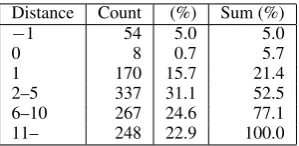
Distance Count (%) Sum (%)
−1 54 5.0 5.0
0 8 0.7 5.7
1 170 15.7 21.4
2–5 337 31.1 52.5 6–10 267 24.6 77.1 11– 248 22.9 100.0
[image:2.595.107.257.61.134.2]Distance−1 means protein word has been annotated as in-teracting with itself (e.g. “actin polymerization”). Distance 0 means words of the interacting proteins are directly next to one another. Multi-word protein names are concatenated as long as they do not cross tags to annotate proteins.
Table 1: Distance between Interacting Proteins
that shallow parsers are more robust and would be sufficient for IE. However, their claims that shal-low parsers are sufficient, or that full parsers do not contribute to application tasks, have not been fully proved by experimental results.
Zhou et al. (2005) argued that most informa-tion useful for IE derived from full parsing was shallow. However, they only used dependency trees and paths on full parse trees in their experi-ment. Such structures did not include information of semantic subjects/objects, which full parsing can recognize. Additionally, most relations they extracted from the ACE corpus (Linguistic Data Consortium, 2005) on broadcasts and newswires were within very short word-distance (70% where two entities are embedded in each other or sep-arated by at most one word), and therefore shal-low information was beneficial. However, Table 1 shows that the word distance is long between in-teracting protein names annotated on the AImed corpus (Bunescu and Mooney, 2004), and we have to treat long-distance relations for information like protein-protein interactions.
Full parsing is more effective for acquiring gen-eralized data from long-length words than shallow parsing. The sentences at left in Figure 1 exem-plify the advantages of full parsing. The gerund “activating” in the last sentence takes a non-local semantic subject “ENTITY1”, and shallow parsing cannot recognize this relation because “ENTITY1” and “activating” are in different phrases. Full pars-ing, on the other hand, can identify both the sub-ject of the whole sentence and the semantic subsub-ject of “activating” have been shared.
2.2 Predicate-argument Structures
We applied Enju (Tsujii Laboratory, 2005a) as a full parser which outputs predicate-argument structures (PASs). PASs are well normalized
forms that represent syntactic relations. Enju is based on Head-driven Phrase Structure Gram-mar (Sag and Wasow, 1999), and it has been trained on the Penn Treebank (PTB) (Marcus et al., 1994) and a biomedical corpus, the GENIA Treebank (GTB) (Tsujii Laboratory, 2005b). We used a part-of-speech (POS) tagger trained on the GENIA corpus (Tsujii Laboratory, 2005b) as a preprocessor for Enju. On predicate-argument re-lations, Enju achieved 88.0% precision and 87.2% recall on PTB, and 87.1% precision and 85.4% re-call on GTB.
The illustration at right in Figure 1 is a PAS example, which represents the relation between “activate”, “ENTITY1” and “ENTITY2” of all sen-tences to the left. The predicate and its argu-ments are words converted to their base forms, augmented by their POSs. The arrows denote the connections from predicates to their arguments and the types of arguments are indicated as arrow labels, i.e.,ARGn(n= 1,2, . . .), MOD. For ex-ample, the semantic subject of a transitive verb is ARG1and the semantic object isARG2.
What is important here is, thanks to the strong normalization of syntactic variations, that we can expect that the construction algorithm for extract-ing patterns that works on PASs will need a much smaller training corpus than those working on surface-word sequences. Furthermore, because of the reduced diversity of surface-word sequences at the PAS level, any IE system at this level should demonstrate improved recall.
3 Related Work
Sudo et al. (2003), Culotta and Sorensen (2004) and Bunescu and Mooney (2005) acquired sub-structures derived from dependency trees as ex-traction patterns for IE in general domains. Their approaches were similar to our approach using PASs derived from full parsing. However, one problem with their systems is that they could not treat non-local dependencies such as seman-tic subjects of gerund constructions (discussed in Section 2), and thus rules acquired from the con-structions were partial.
Al-ENTITY1recognizes andactivatesENTITY2.
ENTITY2activatedbyENTITY1are not well characterized.
The herpesvirus encodes a functionalENTITY1thatactivateshumanENTITY2.
ENTITY1can functionally cooperate to synergisticallyactivateENTITY2. TheENTITY1plays key roles byactivatingENTITY2.
ENTITY1/NN activate/VB ENTITY2/NN ARG1 ARG2
Figure 1: Syntactical Variations of “activate”
though they achieved about 60% precision and about 40% recall, these heuristic restrictions could not be guaranteed to be applied to other IE tasks.
Hao et al. (2005) learned extraction patterns for protein-protein interactions as sequences of words, POSs, entity tags and gaps by dynamic programming, and reduced/merged them using a minimum description length-based algorithm. Al-though they achieved 79.8% precision and 59.5% recall, sentences in their test corpus have too many positive instances and some of the pat-terns they claimed to have been successfully con-structed went against linguistic or biomedical in-tuition. (e.g. “ENTITY1 and interacts with EN-TITY2” should be replaced by a more general pat-tern because they aimed to reduce the number of patterns.)
4 Method
We automatically construct patterns to extract protein-protein interactions from an annotated training corpus. The corpus needs to be tagged to denote which protein words are interacting pairs.
We follow five steps in constructing extraction patterns from the training corpus. (1) Sentences in the training corpus are parsed into PASs and we extract raw patterns from the PASs. (2) We divide the raw patterns to generate both combi-nation and fragmental patterns. Because obtained patterns include inappropriate ones (wrongly gen-erated or too general), (3) we apply both kinds of patterns to PASs of sentences in the training cor-pus, (4) calculate the scores for matching results of combination patterns, and (5) make a prediction model with SVM using these matching results and scores.
We extract pairs of interacting proteins from a target text in the actual IE phase, in three steps. (1) Sentences in the target corpus are parsed into PASs. (2) We apply both kinds of extraction pat-terns to these PASs and (3) calculate scores for combination pattern matching. (4) We use the pre-diction model to predict interacting pairs.
ENTITY1 ENTITY2
CD4/NNprotein/NNinteract/VBwith/INpolymorphic/JJregion/NNof/INMHCII/NN
MOD ARG1 ARG1 ARG2 ARG1 ARG2
ARG1 Parsing Result
Raw Pattern
CD4protein interacts with polymorphic regions of MHCII.
ENTITY1 ENTITY2
Sentence in Training Corpus
protein/NNinteract/VBwith/IN region/NNof/IN
MOD ARG1 ARG1 ARG2 ARG1 ARG2
(1) (2) (3) (4) (5) (6)
p0
p0 pp11 pp22 pp33 pp44 pp55 pp66
ENTITY2/NN ENTITY1/NN
Figure 2: Extraction of Raw Pattern
4.1 Full Parsing and Extraction of Raw
Patterns
As the first step in both the construction phase and application phase of extraction patterns, we parse sentences into PASs using Enju.1 We label all PASs of the protein names as protein PASs.
After parsing, we extract the smallest set of PASs, whichconnect words that denote interact-ing proteins, and make it a raw pattern. We take the same method to extract and refine raw patterns as Yakushiji et al. (2005). Connecting means we can trace predicate-argument relations from one protein word to the other in an interacting pair. The procedure to obtain a raw pattern(p0, . . . , pn) is as follows:
predicate(p): PASs that havepas their argument
argument(p): PASs thatphas as its arguments
1. pi = p0 is the PAS of a word correspondent
to one of interacting proteins, and we obtain candidates of the raw pattern as follows:
1-1. Ifpiis of the word of the other interact-ing protein, (p0, . . . , pi) is a candidate of the raw pattern.
1-2. If not, make pattern candidates for each pi+1 ∈ predicate(pi) ∪
argument(pi) − {p0, . . . , pi} by
returning to 1-1.
2. Select the pattern candidate of the smallest set as the raw pattern.
3. Substitute variables (ENTITY1,ENTITY2) for the predicates of PASs correspondent to the interacting proteins.
The lower part of Figure 2 shows an example of the extraction of a raw pattern. “CD4” and “MHCII” are words representing interacting pro-teins. First, we set the PAS of “CD4” as p0.
argument(p0)includes the PAS of “protein”, and
we set it asp1 (in other words, tracing the arrow
(1)). Next,predicate(p1)includes the PAS of “in-teract” (tracing the arrow (2) back), so we set it as p2. We continue similarly until we reach the
PAS of “MHCII” (p6). The result of the extracted
raw pattern is the set ofp0, . . . , p6 with
substitut-ing variables ENTITY1 andENTITY2 for “CD4” and “MHCII”.
There are some cases where an extracted raw pattern is not appropriate and we need to re-fine it. One case is when unnecessary coordi-nations/parentheses are included in the pattern, e.g. two interactions are described in a combined representation (“ENTITY1 binds this protein and
ENTITY2”). Another is when two interacting pro-teins are connected directly by a conjunction or only one protein participates in an interaction. In such cases, we refine patterns by unfolding of co-ordinations/parentheses and extension of patterns, respectively. We have omitted detailed explana-tions because of space limitaexplana-tions. The details are described in the work of Yakushiji et al. (2005).
4.2 Division of Patterns
Division for generating combination patterns is based on observation of Yakushiji et al. (2005) that there are many cases where combinations of verbs and certain nouns form IE patterns. In the work of Yakushiji et al. (2005), we divided only patterns that include only one verb. We have extended the division process to also treat nominal patterns or patterns that include more than one verb.
Combination patterns are not appropriate for utilizing individual word information because they are always used in rather strictly combined ways. Therefore we have newly introduced fragmental patterns which consist of independent PASs from raw patterns, in order to use individual word infor-mation for higher recall.
4.2.1 Division for Generating Combination
Patterns
Raw patterns are divided into some compo-nents and the compocompo-nents are combined to
con-ENTITY1/NN protein/NN interact/VBwith/INregion/NNof/INENTITY2/NN
MOD ARG1 ARG1 ARG2 ARG1 ARG2
*/VBwith/IN
ARG1ARG2
*/NN
ENTITY/NN protein/NN
MOD
region/NNof/INENTITY/NN
ARG1 ARG2
interact/VB
ARG1 =
*/NN
*/VB
ARG1
*/NN
= $X
$X
Main
Prep
Entity
Entity
Entity Main Entity Main
Main
Entity
Raw Pattern
Combination Pattern
Figure 3: Division of Raw Pattern into Combina-tion Pattern Components (Entity-Main-Entity)
struct combination patterns according to types of the division. There are three types of division of raw patterns for generating combination patterns. These are:
(a) Two-entity Division
(a-1) Entity-Main-Entity Division (a-2) Main-Entity-Entity Division (b) Single-entity Division, and (c) No Division (Naive Patterns).
Most raw patterns, where entities are at both ends of the patterns, are divided into Entity-Main-Entity. Main-Entity-Entity are for the cases where there are PASs other than entities at the ends of the patterns (e.g. “interaction between ENTITY1
andENTITY2”). Single-entity is a special Main-Entity-Entity for interactions with only one partic-ipant (e.g. “ENTITY1dimerization”).
corresponding to the entities of the original pair are labeled as only unifiable with the entities of other pairs.
Main-Entity-Entity division is similar, except we distinguish only one prep component as a double-prep component and the PAS of the coor-dinate conjunction between entities becomes the coord component. Single-entity division is simi-lar to Main-Entity-Entity division and the differ-ence is that single-entity division produces no co-ord and one entity component. Naive patterns are patterns without division, where no division can be applied (e.g. “ENTITY1/NN in/IN complexes/NN with/INENTITY2/NN”).
All PASs on boundaries of components are la-beled to determine which PAS on a boundary of another component can be unified. Labels are rep-resented by subscriptions in Figure 3. These re-strictions on component connection are used in the step of constructing combination patterns.
Constructing combination patterns by combin-ing components is equal to reconstructcombin-ing orig-inal raw patterns with the origorig-inal combination of components, or constructing new raw patterns with new combinations of components. For exam-ple, an Entity-Main-Entity pattern is constructed by combination of any main, any two prep and any two entity components. Actually, this construction process by combination is executed in the pattern matching step. That is, we do not off-line con-struct all possible combination patterns from the components and only construct the combination patterns that are able to match the target.
4.2.2 Division for Generating Fragmental
Patterns
A raw pattern is splitted into individual PASs and each PAS becomes a fragmental pattern. We also prepare underspecified patterns where one or more of the arguments of the original are under-specified, i.e., are able to match any words of the same POSs and the same label of protein/not-protein. We underspecify the PASs of entities in fragmental patterns to enable them to unify with any PASs with the same POSs and a protein la-bel, although in combination patterns we retain the PASs of entities as only unifiable with entities of pairs. This is because fragmental patterns are de-signed to be less strict than combination patterns.
4.3 Pattern Matching
Matching of combination patterns is executed as a process to match and combine combination pat-tern components according to their division types (Entity-Main-Entity, Main-Entity-Entity, Single-entity and No Division). Fragmental matching is matching all fragmental patterns to PASs derived from sentences.
4.4 Scoring for Combination Matching
We next calculate the score of each combination matching to estimate the adequacy of the tion of components. This is because new combina-tion of components may form inadequate patterns. (e.g. “ENTITY1 be ENTITY2” can be formed of components from “ENTITY1 be ENTITY2 recep-tor”.) Scores are derived from the results of com-bination matching to the source training corpus.
We apply the combination patterns to the train-ing corpus, and count pairs of True Positives (TP) and False Positives (FP). The scores are calculated basically by the following formula:
Score=T P/(T P+F P) +α×T P
This formula is based on the precision of the pat-tern on the training corpus, i.e., an estimated pre-cision on a test corpus. α works for smoothing, that is, to accept only patterns of largeT P when
F P = 0.αis set as 0.01 empirically. The formula is similar to the Apriori algorithm (Agrawal and Srikant, 1995) that learns association rules from a database. The first term corresponds to the confi-dence of the algorithm, and the second term corre-sponds to the support.
For patterns where T P = F P = 0, which are not matched to PASs in the training corpus (i.e., newly produced by combinations of com-ponents), we estimates T P′ and F P′ by using the confidence of the main and entity compo-nents. This is because main and entity components tend to contain pattern meanings, whereas prep, double-prep and coord components are rather functional. The formulas to calculate the scores for all cases are:
Score=
8 > > > > > < > > > > > :
T P/(T P+F P) +α×T P
(T P+F P ̸= 0)
T P′/(T P′+F P′)
(T P=F P= 0, T P′+F P′̸= 0)
Combination Pattern
(1) Combination of components in combination matching
(2) Main component in combination matching (3) Entity components in combination matching (4) Score for combination matching (SCORE) Fragmental Pattern
(5) Matched fragmental patterns
(6) Number of PASs of example that are not matched in fragmental matching
Raw Pattern
[image:6.595.75.290.59.186.2](7) Length of raw pattern derived from example
Table 2: Features for SVM Learning of Prediction Model
T P′=
8 > < > :
T Pmain′ +T Pentity1′ (+T Pentity2′ ) (for Two-entity, Single-entity) 0 (for Naive)
F P′= (similar toT P′butT Px′ is replaced byF Px′)
T Pmain′ =
8 > > > > > > > > > > < > > > > > > > > > > :
T Pmain:two/(T Pmain:two+F Pmain:two) T Pmain:two+F Pmain:two̸= 0,
for Two-entity
!
T Pmain:single/(T Pmain:single+F Pmain:single) T Pmain:single+F Pmain:single̸= 0,
for Single-entity
!
0 (other cases)
T Pentityi′ = 8 > <
> :
T P“entityi/(T Pentityi+F Pentityi) T Pentityi+F Pentityi̸= 0
”
0 (other cases)
F Px′ =
„
similar toT Px′ butT Py′in the
numerators is replaced byF Py′ «
• T P: number of TPs by the combination of components
• T Pmain:two: sum of TPs by two-entity combinations
that include the same main component
• T Pmain:single: sum of TPs by single-entity
combina-tions that include the same main component
• T Pentityi: sum of TPs by combinations that include
the same entity component which is not the straight en-tity component
• F Px: similar toT Pxbut TP is replaced by FP
The entity component “ENTITY/NN”, which only consists of the PAS of an entity, adds no infor-mation to combinations of components. We call this component a straight entity component and exclude its effect from the scores.
4.5 Construction of Prediction Model
We use an SVM to learn a prediction model to de-termine whether a new protein pair is interacting. We usedSV Mlight (Joachims, 1999) with an rbf kernel, which is known as the best kernel for most tasks. The prediction model is based on the fea-tures of Table 2.
0.1 0.2 0.3 0.4 0.5 0.6 0.7 0.8 0.9 1
0 0.1 0.2 0.3 0.4 0.5 0.6 0.7 0.8 0.9 1
Precision
Recall
[image:6.595.311.533.67.291.2]ALL SCORE ERK
Figure 4: Results of IE Experiment
ENTITY1
FGF-2/NN bind well to FGFR1 but interact/VBpoorly/RBwith/IN
ENTITY2
KGFR/NN
ARG1 ARG1 ARG2
Figure 5: Example Demonstrating Advantages of Full Parsing
5 Results and Discussion
5.1 Experimental Results on the AImed
Corpus
To evaluate extraction patterns automatically con-structed with our method, we used the AImed cor-pus, which consists of 225 MEDLINE (U.S. Na-tional Library of Medicine, 2006) abstracts (1969 sentences) annotated with protein names and protein-protein interactions, for the training/test corpora. We used tags for the protein names given. We measured the accuracy of the IE task using the same criterion as Bunescu and Mooney (2006), who used an SVM to construct extraction patterns on word/POS/type sequences from the AImed cor-pus. That is, an extracted interaction from an ab-stract is correct if the proteins are tagged as inter-acting with each othersomewherein that abstract (document-level measure).
Figure 4 plots our 10-fold cross validation and the results of Bunescu and Mooney (2006). The line ALL represents results when we used all fea-tures for SVM learning. The line SCORE repre-sents results when we extracted pairs with higher combination matching scores than various thresh-old values. And the line ERK represents results by Bunescu and Mooney (2006).
be-tween 50% and 80%. It also needs to be noted that SCORE, which did not use SVM learning and only used the combination patterns, achieved performance comparable to that by Bunescu and Mooney (2006) for the precision range from 50% to 80%. And for this range, introducing the frag-mental patterns with SVM learning raised the re-call. This range of precision is practical for the IE task, because precision is more important than recall for significant interactions that tend to be described in many abstracts (as shown by the next experiment), and too-low recall accompa-nying too-high precision requires an excessively large source text.
Figure 5 shows the advantage of introducing full parsing. “FGF-2” and “KGFR” is an interact-ing protein pair. The pattern “ENTITY1 interact with ENTITY2” based on PASs successfully ex-tracts this pair. However, it is difficult to extract this pair with patterns based on surface words, be-cause there are 5 words between “FGF-2” and “in-teract”.
5.2 Experimental Results on Abstracts of
MEDLINE
We also conducted an experiment to extract in-teracting protein pairs from a large amount of biomedical text, i.e. about 14 million titles and 8 million abstracts in MEDLINE. We constructed combination patterns from all 225 abstracts of the AImed corpus, and calculated a threshold value of combination scores that produced about 70% precision and 30% recall on the training corpus. We extracted protein pairs with higher combi-nation scores than the threshold value. We ex-cluded single-protein interactions to reduce time consumption and we used a protein name recog-nizer in this experiment2.
We compared the extracted pairs with a man-ually curated database, Reactome (Joshi-Tope et al., 2005), which published 16,564 human pro-tein interaction pairs as pairs of Entrez Gene IDs (U.S. National Library of Medicine, 2006). We converted our extracted protein pairs into pairs of Entrez Gene IDs by the protein name recog-nizer.3 Because there may be pairs missed by
Re-2
Because protein names were recognized after the pars-ing, multi-word protein names were not concatenated.
3Although the same protein names are used for humans and other species, these are considered to be human proteins without checking the context. This is a fair assumption be-cause Reactome itself infers human interaction events from experiments on model organisms such as mice.
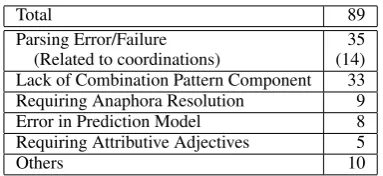
Total 89
Parsing Error/Failure 35 (Related to coordinations) (14) Lack of Combination Pattern Component 33 Requiring Anaphora Resolution 9 Error in Prediction Model 8 Requiring Attributive Adjectives 5
Others 10
[image:7.595.321.513.60.148.2]More than one cause can occur in one error, thus the sum of all causes is larger than the total number of False Negatives.
Table 3: Causes of Error for FNs
actome or pairs that our processed text did not in-clude, we excluded extracted pairs of IDs that are not included in Reactome and excluded Reactome pairs of IDs that do not co-occur in the sentences of our processed text.
After this postprocessing, we found that we had extracted 7775 human protein pairs. Of them, 155 pairs were also included in Reactome ([a] pseudo TPs) and 7620 pairs were not included in Reac-tome ([b] pseudo FPs). 947 pairs of ReacReac-tome were not extracted by our system ([c] pseudo False Negatives (FNs)). However, these results included pairs that Reactome missed or those that only co-occurred and were not interacting pairs in the text. There may also have been errors with ID assign-ment.
To determine such cases, a biologist investi-gated 100 pairs randomly selected from pairs of pseudo TPs, FPs and FNs retaining their ratio of numbers. She also checked correctness of the as-signed IDs. 2 pairs were selected from pseudo TPs, 88 pairs were from pseudo FPs and 10 pairs were from pseudo FNs. The biologist found that 57 pairs were actual TPs (2 pairs of pseudo TPs and 55 pairs of pseudo FPs) and 32 pairs were ac-tual FPs of the pseudo FPs. Thus, the precision was 64.0% in this sample set. Furthermore, even if we assume that all pseudo FNs are actual FNs, the recall can be estimated by actual TPs/(actual TPs+pseudo FNs)×100=83.8%.
These results mean that the recall of an IE sys-tem for interacting proteins is improved for a large amount of text even if it is low for a small corpus. Thus, this justifies our assertion that a high degree of precision in the low-recall range is important.
5.3 Error Analysis
Total 35 Requiring Attributive Adjectives 13
Corpus Error 11
Error in Prediction Model 5 Requiring Negation Words 2
Parsing Error 1
[image:8.595.106.260.58.148.2]Others 3
Table 4: Causes of Error for FPs
features. Different to Subsection 5.1, we individ-ually checked each occurring pair of interacting proteins. The biggest problems were parsing er-ror/failure, lack of necessary patterns and learning of inappropriate patterns.
5.3.1 Parsing Error
As listed in Table 3, 14 (40%) of the 35 pars-ing errors/failures were related to coordinations. Many of these were caused by differences in the characteristics of the PTB/GTB, the training cor-pora for Enju, and the AImed Corpus. For ex-ample, Enju failed to obtain the correct structure for “the ENTITY1 / ENTITY1 complex” because words in the PTB/GTB are not segmented with “/” and Enju could not be trained on such a case. One method to solve this problem is to avoid seg-menting words with “/” and introducing extraction patterns based on surface characters, such as “ EN-TITY1/ENTITY2complex”.
Parsing errors are intrinsic problems to IE meth-ods using parsing. However, from Table 3, we can conclude that the key to gaining better accuracy is refining of the method with which the PAS pat-terns are constructed (there were 46 related FNs) rather than improving parsing (there were 35 FNs).
5.3.2 Lack of Necessary Patterns and
Learning of Inappropriate Patterns
There are two different reasons causing the problems with the lack of necessary patterns and the learning of inappropriate patterns: (1) the training corpus was not sufficiently large to sat-urate IE accuracy and (2) our method of pattern construction was too limited.
Effect of Training Corpus Size To investigate
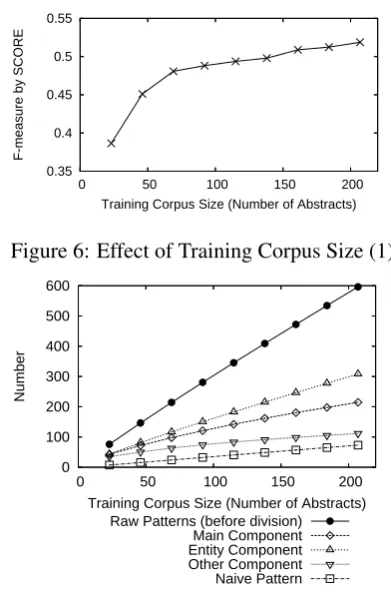
whether the training corpus was large enough to maximize IE accuracy, we conducted experiments on training corpora of various sizes. Figure 6 plots graphs of F-measures by SCORE and Figure 7 plots the number of combination patterns on train-ing corpora of various sizes. From Figures 6 and 7, the training corpus (207 abstracts at a maximum)
0.35 0.4 0.45 0.5 0.55
0 50 100 150 200
F-measure by SCORE
[image:8.595.315.511.61.358.2]Training Corpus Size (Number of Abstracts)
Figure 6: Effect of Training Corpus Size (1)
0 100 200 300 400 500 600
0 50 100 150 200
Number
Training Corpus Size (Number of Abstracts) Raw Patterns (before division)
Main Component Entity Component Other Component Naive Pattern
Figure 7: Effect of Training Corpus Size (2)
is not large enough. Thus increasing corpus size will further improve IE accuracy.
Limitation of the Present Pattern Construc-tion The limitations with our pattern construc-tion method are revealed by the fact that we could not achieve a high precision like Bunescu and Mooney (2006) within the high-recall range. Compared to theirs, one of our problems is that our method could not handle attributives. One exam-ple is “binding property ofENTITY1toENTITY2”. We could not obtain “binding” because the small-est set of PASs connecting “ENTITY1” and “ EN-TITY2” includes only the PASs of “property”, “of” and “to”. To handle these attributives, we need dis-tinguish necessary attributives from those that are general4by semantic analysis or bootstrapping.
Another approach to improve our method is to include local information in sentences, such as surface words between protein names. Zhao and Grishman (2005) reported that adding local infor-mation to deep syntactic inforinfor-mation improved IE results. This approach is also applicable to IE in other domains, where related entities are in a short
[image:8.595.320.507.65.165.2]distance like the work of Zhou et al. (2005).
6 Conclusion
We proposed the use of PASs to construct pat-terns as extraction rules, utilizing their ability to abstract syntactical variants with the same rela-tion. In addition, we divided the patterns for gen-eralization, and used matching results for SVM learning. In experiments on extracting of protein-protein interactions, we obtained 71.8% precision and 48.4% recall on a small corpus and 64.0% pre-cision and 83.8% recall estimated on a large text, which demonstrated the obvious advantages of our method.
Acknowledgement
This work was partially supported by Grant-in-Aid for Scientific Research on Priority Areas “Sys-tems Genomics” (MEXT, Japan) and Solution-Oriented Research for Science and Technology (JST, Japan).
References
R. Agrawal and R Srikant. 1995. Mining Sequential Patterns. InProc. the 11th International Conference on Data Engineering, pages 3–14.
Christian Blaschke and Alfonso Valencia. 2002. The Frame-Based Module of the SUISEKI Informa-tion ExtracInforma-tion System. IEEE Intelligent Systems, 17(2):14–20.
Razvan Bunescu and Raymond J. Mooney. 2004. Collective information extraction with relational markov networks. InProc. ACL’04, pages 439–446.
Razvan C. Bunescu and Raymond J. Mooney. 2005. A Shortest Path Dependency Kernel for Relation Ex-traction. InProc. HLT/EMNLP 2005, pages 724– 731.
Razvan Bunescu and Raymond Mooney. 2006. Subse-quence kernels for relation extraction. InAdvances in Neural Information Processing Systems 18, pages 171–178. MIT Press.
Aron Culotta and Jeffrey Sorensen. 2004. Dependency tree kernels for relation extraction. InProc. ACL’04, pages 423–429.
Yu Hao, Xiaoyan Zhu, Minlie Huang, and Ming Li. 2005. Discovering patterns to extract protein-protein interactions from the literature: Part II.
Bioinformatics, 21(15):3294–3300.
Thorsten Joachims. 1999. Making Large-Scale SVM Learning Practical. InAdvances in Kernel Methods – Support Vector Learning. MIT-Press.
G Joshi-Tope, M Gillespie, I Vastrik, P D’Eustachio, E Schmidt, B de Bono, B Jassal, GR Gopinath, GR Wu, L Matthews, S Lewis, E Birney, and Stein L. 2005. Reactome: a knowledgebase of biologi-cal pathways. Nucleic Acids Research, 33(Database Issue):D428–D432.
Asako Koike, Yoshiyuki Kobayashi, and Toshihisa Takagi. 2003. Kinase Pathway Database: An Integrated Kinase and NLP-Based Protein-Interaction Resource. Genome Research, 13:1231– 1243.
Linguistic Data Consortium. 2005. ACE Program. http://projects.ldc.upenn.edu/ace/.
Mitchell Marcus, Grace Kim, Mary Ann Marcinkiewicz, Robert MacIntyre, Ann Bies, Mark Ferguson, Karen Katz, and Britta Schas-berger. 1994. The Penn Treebank: Annotating predicate argument structure. InProc. AAI ’94.
Ivan A. Sag and Thomas Wasow. 1999. Syntactic The-ory. CSLI publications.
Kiyoshi Sudo, Satoshi Sekine, and Ralph Grishman. 2003. An improved extraction pattern representa-tion model for automatic IE pattern acquisirepresenta-tion. In
Proc. ACL 2003, pages 224–231.
Tsujii Laboratory. 2005a. Enju - A practical HPSG parser. http://www-tsujii.is.s.u-tokyo.ac.jp/enju/.
Tsujii Laboratory. 2005b. GENIA Project. http://www-tsujii.is.s.u-tokyo.ac.jp/GENIA/.
U.S. National Library of Medicine. 2006. PubMed. http://www.pubmed.gov.
Akane Yakushiji, Yusuke Miyao, Yuka Tateisi, and Jun’ichi Tsujii. 2005. Biomedical information ex-traction with predicate-argument structure patterns. InProc. SMBM 2005, pages 60–69.
Daming Yao, Jingbo Wang, Yanmei Lu, Nathan No-ble, Huandong Sun, Xiaoyan Zhu, Nan Lin, Don-ald G. Payan, Ming Li, and Kunbin Qu. 2004. Path-wayFinder: Paving The Way Towards Automatic Pathway Extraction. InBioinformatics 2004: Proc. the 2nd APBC, volume 29 ofCRPIT, pages 53–62.
Shubin Zhao and Ralph Grishman. 2005. Extracting relations with integrated information using kernel methods. InProc. ACL’05, pages 419–426.