Two-Level 0-1 Programming Using Genetic
Algorithms and a Sharing Scheme Based on
Cluster Analysis
Keiichi Niwa
∗Ichiro Nishizaki
†,
Masatoshi Sakawa
‡Abstract— This paper deals with the two level 0-1 programming problems in which there are two deci-sion makers (DMs); the decideci-sion maker at the upper level and the decision maker at the lower level. The authors modify the problematic aspects of a computa-tion method for the Stackelberg solucomputa-tion which they previously presented, and thus propose an improved computation method. Specifically, a genetic algo-rithm (GA) is proposed with the objective of boost-ing the accuracy of solutions while maintainboost-ing the diversity of the population, which adopts a clustering method instead of calculating distances during shar-ing. Also, in order to eliminate unnecessary compu-tation, an additional algorithm is included for avoid-ing obtainavoid-ing the rational reaction of the lower level DM in response to upper level DM’s decisions when necessary. In order to verify the effectiveness of the proposed method, it is intended to make a compar-ison with existing methods by performing numerical experiments into both the accuracy of solutions and the computation time.
Keywords: Two-level 0-1 programming problem, Stack-elberg solution, Genetic algorithm, Clustering algo-rithm
1
Introduction
Under actual decision making situations, there are mul-tiple decision makers (DMs) in hierarchically structured organizations, and decisions may be taken serially or si-multaneously in order to optimize each of the objectives. This kind of problem has been formulated as a two-level programming problem [11]. In two-level programming problems, upper level DMs take their decisions first, and then, with a knowledge of the decisions of the upper level DMs, the lower level DMs make their decisions in order to optimize their own objective functions. This
combi-∗Faculty of Economics, Hiroshima University of Economics,
5-37-1 Gion, Asaminami-ku, Hiroshima 731-0192, Japan Tel/Fax: +81-82-871-1048/1005; Email: [email protected]
†Graduate School of Engineering, Hiroshima University 1-4-1,
Kagamiyama, Higashi-Hiroshima, 739-8527, Japan, Tel/Fax: +81-82-424-7604/422-7195 Email: [email protected]
‡Graduate School of Engineering, Hiroshima University 1-4-1,
Kagamiyama, Higashi-Hiroshima, 739-8527, Japan, Tel/Fax: +81-82-424-7694/422-7195 Email: [email protected]
nation of decisions is known as a Stackelberg solution. In this paper, both the upper level and the lower level have one DM, and the problem is treated as a two-level 0-1 programming problem in which both DMs treat all of their decision variables as 0-1 parameters.
As an overview of research dealing with two-level pro-gramming problems that include discrete variables, Bard
et al. presented an algorithm based on the branch-and-bound approach in order to derive the Stackelberg solu-tion for level 0-1 programming problems [4] and two-level mixed integer programming problems [3]. Wen et al.[12] have presented a computation method for obtain-ing the Stackelberg solution to two-level programmobtain-ing problems which have 0-1 parameters for the decision vari-ables in the upper level and continuous parameters for the decision variables in the lower level.
Meanwhile, the adaptive process of systems in the natural world has been explained, and genetic algorithms (GAs) which imitate the evolution occurring in living organisms have been receiving attention at international conferences related to GAs, publications by Goldberg [6], as have methodologies for optimization, adaptation and learning. GAs have also been adopted for a variety of combinatorial optimization problems, and their effectiveness has been reported [10].
Regarding research utilizing GAs for two-level program-ming problems, Anandalingam et al. [1] have proposed a method for obtaining the Stackelberg solution for two-level linear programming problems. We have previously proposed a computation method for deriving the Stackel-berg solution to 0-1 programming problems for two-level decentralized systems [9], which adopts the double string proposed by Sakawaet al. for individual representation. We have also proposed a computation method using shar-ing [5] in order to boost the computational precision of the Stackelberg solution [8]. However, while it was pos-sible to increase the precision of the derived Stackelberg solution using this method, it prompted an increase in computation time as a result.
reforming the problematic aspects of the computation method for the Stackelberg solution we previously pre-sented, propose an improved version of the computation method. Specifically, we propose a GA which introduces a clustering method to replace the computation of dis-tances between individuals occurring during sharing, in order to reduce computation time while maintaining the accuracy of the approximate Stackelberg solution. Also, for duplications within populations of the GA which han-dles decision making in the upper level, the method does not generatexand for each value iterates the computa-tion of the racomputa-tional reaccomputa-tion of the lower level DM,y(x), using a GA. Rather, an algorithm is proposed which re-duces the number of applications of the GA used to com-pute the rational reaction of the lower level, by placing the combinations of past decisions of the DM for the up-per level, x, and their corresponding rational reactions
y(x) in constant memory, and extracting the storedy(x) whenever a x which is identical to a value occurring in a previous generation of the GA appears. In order to verify the effectiveness of the proposed method, it is in-tended to perform numerical experiments investigating and comparing the method with existing methods from the perspectives of both solution accuracy and computa-tion time.
2
The two-level 0-1 programming
prob-lem
For the sake of brevity, we denote the upper and lower level DMs by DM1 and DM2, respectively. The objec-tive functions of DM1 and DM2 are writtenz1(x,y), and
z2(x,y). The vectors of decision variables for DM1 and DM2 are x = (x1, . . . , xn1)
T, and y = (y
1, . . . , yn2) T. The superscriptTindicates transposition. The coefficient vectors of the objective functions are denoted by c1 = (c11, . . . , c1n1),d1 = (d11, . . . , d1n2),c2= (c21, . . . , c2n1),
and d2 = (d21, . . . , d2n2). The coefficient matrices in
the constraint equation are the m×n1 matrix A, and the m×n2 matrix B. The vector of constants on the right hand side of the constraint equation is written as
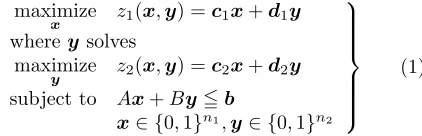
b= (b1, . . . , bm)T. The two-level 0-1 programming prob-lem may now be formulated in general with an equation such as the following.
maximize
x z1(x,y) =c1x+d1y wherey solves
maximize
y z2(x,y) =c2x+d2y subject to Ax+By5b
x∈ {0,1}n1,y∈ {0,1}n2
(1)
For the sake of simplicity, in this paper, it is assumed that each component of A, B, b, c1, c2, d1, and d2 is positive.
It is possible to express the process for choosing the Stack-elberg solution for a two-level 0-1 programming problem
in the following manner. Each decision maker completely knows objective functions and constraints of the oppo-nent and self, and DM1 first makes a decision and then DM2 makes a decision so as to minimize the objective function with full knowledge of the decision of DM1. That is to say, when the decision by DM1 is denoted ˆ
x, DM2 solves the 0-1 programming problem (2) with parameters ˆx, choosing the optimal solutiony(ˆx) as the rational reaction to ˆx.
maximize
y z2(ˆx,y) =d2y+c2xˆ subject to By5b−Axˆ
y∈ {0,1}n2
(2)
Under this premise, DM1 also determines xby choosing the value which minimizes its own objective function. For problems which adopt the Stackelberg solution to con-ceptualize their solution, it is assumed that there is no consensus among DMs that might mutually constrain de-cisions. Putting it another way, their relationship may be described as non-cooperative.
3
GA based computational method
In this section, we present the derivation of the Stackel-berg solution to the two-level 0-1 programming problem. A computation method based on a genetic algorithm is explained.3.1
Coding and decoding
When solving 0-1 programming problems using GAs, bi-nary strings are usually adopted to express individu-als [7, 6]. However, under this representation it is possi-ble that infeasipossi-ble solutions that do not satisfy the con-straints may be generated, so there is a danger that the performance of the GA may degrade. Thus, in this pa-per, in order to derive only feasible solutions, a double string [10] is used which is composed of the substring corresponding to the decision of DM1, x, and the sub-string corresponding to the decision of DM2,y, as shown in Fig.1. The decisions of DM1 and DM2 are handled by applying genetic operators on each sub-individual. In this paper, the GA handling the decision of DM1 is called the upper level GA, and the GA handling the decision of DM2 is called the lower level GA.
←Individual forx→ ←Individual fory→
ix(1) · · · ix(n1) iy(1) · · · iy(n2)
[image:2.595.80.291.608.676.2]Six(1) · · · Six(n1) Siy(1) · · · Siy(n2)
Figure 1: Double string
six(m) ∈ {0,1}, ix(m) ∈ {1, . . . , n1}, and for m ̸= m
′
it is assumed that ix(m) ̸= ix(m
′
). Similarly, siy(m) ∈
{0,1}, iy(m)∈ {1, . . . , n2}, and form̸=m
′
it is assumed that iy(m)̸=iy(m
′
iy(m) and six(m), siy(m) express the indexes of the
ele-ments of each solution vector respectively, and their val-ues.
In this paper a decoding algorithm proposed by the au-thors [9] is also applied to the upper level and lower level GAs, generating only feasible solutions.
3.2
Reproduction
We first describe the reproduction operator of the lower level GA. In the lower level GA the value ofyobtained by decoding individuals in the lower level GA, and the given values of the decision variables in the upper level GA,
x, are substituted into the objective function of DM2,
z2(x,y), and the value of the evaluation function for each individual is thus obtained. Next, the fitness value for each individual is derived using linear scaling, and the individuals reproducing in the next generation are deter-mined by applying elitist expected value selection.
We now describe the reproduction operator of the upper level GA. In the upper level GA, the value ofxobtained by decoding individuals in the upper level GA and the value of the rational reaction obtained by applying the lower level GA, y(x), are substituted into the objective function of DM1,z1(x,y(x)), and the value of the evalu-ation function for each individual is thus obtained. Next, the fitness value for each individual is calculated by ap-plying linear scaling and adopting a clustering method such as that described in the next section. The individu-als reproducing in the next generation are determined by applying elitist expected value selection based on these fitness values.
3.3
Applying the cluster analysis method
In the existing computation method proposed by the au-thors [8], sharing was introduced in order to calculate the fitness value in accordance with the degree of convergence among individuals within populations. However, because introducing sharing made it necessary to compute the distances between all the individuals within a population for each generation, this encouraged an increase in com-putation time.
On the other hand, when Yin et al. applied sharing to multimodal function optimization problems, instead of computing the distances between strings, a GA utilizing a clustering method [2] was proposed. Numerical exper-iments revealed that it was possible to reduce compu-tation time while maintaining roughly the same search performance with a GA using unmodified sharing. In this paper we therefore incorporate the method of Yin
et al. into the reproduction operator for the upper level GA, thus reducing the computation time of the proposed method.
The method proposed by Yinet al. adopts the centroid
method known as the Adaptive MacQueen’s KMEAN Al-gorithm for clustering. The procedure for the centroid algorithm is stated below.
Procedure for the Centroid method
Step 1 Process of representation: ClusterCcis given by its centroidG(Cc).
G(Cc) = (¯xc1,x¯c2, . . . ,x¯cj, . . . ,x¯cp), c= 1, . . . , k
with x¯cj = 1
nc nc ∑
i=1
xij
pexpresses the number of variables in the data units, and k is the number of clusters. nc expresses the number of data units in the cth cluster, and ¯x
cj is the mean value of thejthvariable in thecthcluster.
xij expresses the value of thejth variable in theith data unit, andxi is the vector of theithdata unit. Step 2 Process of assignment: Each data unit is
as-signed to the cluster with the nearest centroid.
xi∈Cc, if d(xi, G(Cc)) = min
l=1,...,kd(xi, G(Cl))
Under the centroid method, these two steps are repeated until the data units converge on a stable state.
Next, the process for the Adaptive MacQueen’s KMEAN Algorithm is described.
Procedure for the Adaptive MacQueen’s KMEAN Algorithm
Step 1 The initial value of k is chosen, and the first k
data units are allocated as members of each of thek
initial clusters. The value of each data unit is taken as the value for each centroid. Next, the distance be-tween each of thekcluster’s centroids is calculated. If this distance is less thandmin, then a new cluster is generated by combining them. In such a case, the new cluster’s centroid is computed, and the distance between the new cluster and the remaining clusters is recomputed. These operations are repeated un-til the distance between the centroids of the nearest clusters is at least as large asdmin.
clusters is recomputed. These operations are re-peated until the distance between the centroids of the nearest clusters is at least as large as dmin. If the distance to the cluster with the nearest centroid is larger thandmax, then a new cluster is generated with the data unit as a member.
Step 3 After allocating data unitsk+ 1 to N, the cen-troid of each of the existing clusters is taken as a fixed seed point, and each data unit is reallocated to the nearest seed point.
dmin and dmax are complementary parameters express-ing the minimum and maximum distances used when the Adaptive MacQueen’s KMEAN Algorithm is applied.
This paper adopts the method proposed by Yin et al.
for distributing k data units among the initial clusters. Specifically, when selecting the k data units, they are chosen in order of decreasing fitness value.
By using such a cluster analysis method, each individ-ual’s degree of convergence is measured. The following calculation is subsequently performed in order to update the fitness values. Here, the fitness value of individual i
is writtenfi, and the updated fitness value is writtenfi′. The population size isN. Also,αis a constant, anddik is the distance between individual i and the centroid of the cluster within which it is contained,G(Cc).
fi′:= fi
mi
, i= 1, . . . , N
with mi=nc−nc∗
( dic 2dmax
)α
,xi ∈Cc
3.4
Crossover and mutation
For double strings, if standard one-point or multi-point crossovers are performed then there is a possibility that infeasible solutions may be generated because the indexes occurring in the offspring, ix(m), ix(m
′
), m ̸= m′ or
iy(m),iy(m
′
),m̸=m′, may have the same number. This kind of difficulty has been identified as occurring when ge-netic algorithms are applied to problems such as that of the traveling salesman, or the scheduling problem. Par-tially matched crossovers (PMX) have been devised to overcome this difficulty. In this paper, a modified ver-sion of PMX is used in order to handle the double strings proposed by Sakawa et al.[10]. Also, when determining whether or not to apply the cross over operator, a prob-abilitypc is used. Its value is set in advance.
The PMX procedure
Step 1 For two individuals expressed using double strings, s1 and s2, two crossover points are set at random.
Step 2 According to PMX, the upper strings ofs1 and
s2, along with the corresponding lower strings are reordered, generatings′1and s′2.
Step 3 For double strings, the offsprings,s′′1 ands′′2, re-sulting from the application of the revised PMX are obtained by exchanging the lower strings between the two crossover pointss′1ands′2.
The mutation operator is thought to fulfill the role of a local random search in genetic algorithms. For dou-ble strings, the index string expresses the priority of the parameters. For 0-1 strings, since the value of the 0-1 pa-rameters themselves are expressed, strings with differing properties coexist in a single string, and it is necessary to apply mutations to each string. In this paper, the mu-tation operator is applied to each string, and inversion is used for index strings. For 0-1 strings, bit-reverse is introduced. When applying the mutation operator to in-dividuals, it is first determined whether or not mutation will be applied to an individual according to the mutation probabilitypm. In the case that mutation is applied, it is then determined whether to apply inversion or bit-reverse according to the mutation selection constantMP um.
Mutation procedure
Step 1 For an individual s, expressed using a double string, a random number rm is generated. If rm 5
MP um, a point on the 0-1 string is chosen at random and bit-reverse is performed, yieldings′1. Otherwise, step 2 is adopted.
Step 2 Two points on the index string are chosen at random, and inversion is applied to the substring between the two points, yieldings′2.
3.5
Procedure for avoiding the lower level
GA
It is possible to derive a good approximate Stackelberg solution in a comparatively short time using the compu-tation method we have presented. However, there is a problem with the algorithm of the existing method, and by solving it, the accuracy of the approximate Stackel-berg solution is improved, and unnecessary calculations may be eliminated.
Regarding the problem, it occurs when an individualx, handled by the upper level GA, exists multiply in the population of a single generation, or when the same indi-vidual reappears in the population of another generation, and results in the same problem (2) being solved using the lower level GA, yielding the same rational reaction,
y(x).
rational reaction of the lower level GA, y(x), may be placed in memory, and then whenever a past individual
x reappears, the application of the lower level GA may be avoided by extracting the recorded rational reaction. However, when the scale of the problem is increased, stor-ing the rational reaction data for everyxbecomes prob-lematic due to limitations on memory space and the time needed to search for x.
A storage region with a data structure of the form shown in Fig.2 is therefore established, and a proportion of the individual and corresponding rational reaction data, x
[image:5.595.55.283.235.424.2]andy(x), is stored.
Figure 2: Storage region forxandy(x)
xi, i = 1, . . . , x max express the values of x already handled as individuals by the upper level GA. yi
j, i = 1, . . . , x max, j= 1, . . . , y maxexpress the rational reac-tion values obtained from the lower level GA for eachxi.
x maxis the number of stored decisionsx. y maxis the number of stored rational reactions y(x). z1(xi,yij(xi)) and z2(xi,yij(x
i)) are the values of the DM1 and DM2
objective functions for xi and yi
j(xi). yibest(x
i) is the
yi
j(xi) which yields the largest value ofz1(xi,yij(xi)). Using an algorithm such as the following reduces the number of times the lower GA is applied, and eliminates unnecessary computation.
Procedure for storing the rational reaction y(x)
and avoiding the lower level GA
Step 1 If an individual ¯xof the upper level GA exists in a stored xi, then step 2 is adopted. If such an individual does not exist, it is checked whether the number of individuals xi has reached x max. If it has, then step 3 is adopted, if not, then step 4 is adopted.
Step 2 Ifyijhas reachedy max, then the savedyibest(xi) is returned to the upper level GA as the rational reaction and the algorithm terminates. Ify maxhas not been reached then step 4 is adopted.
Step 3 The element among the storedxi for which the value ofz1(xi,yibest(x
i)) is smallest is selected, and that value, x, is denoted xk. After obtaining the rational reaction y(¯x) for ¯x by applying the lower level GA, the values are saved in the storage area of
xk, and the algorithm terminates.
Step 4 After obtaining the rational reactiony(¯x) for ¯x
by applying the lower level GA, the values are saved and the algorithm terminates.
The algorithm of the previous method is thus refined by adopting the above methods.
3.6
Algorithm of the refined computation
method
The algorithm of the refined computation method is sum-marized and presented below.
Step 1 The generation number of the upper level algo-rithm is set tot:= 0, andNu initial individuals are generated randomly.
Step 2 For each individualx in the upper level GA, it is judged whether or not to effect the procedure for avoiding the lower level GA. If it is effected, then a storedy(x) of the lower level is taken as the rational response, and step 3 is adopted. If it is not effected, the operations of the lower level GA from step 2-1 to step 2-3 are applied, and the rational response of the lower level,y(x), is obtained.
Step 2-1 Nl lower level GA individuals are ran-domly generated, and taken as the initial pop-ulation of the lower level GA.
Step 2-2 Using a x given as an individual of the upper level GA, and aygenerated by the lower level GA, the value of the objective function for DM2 is calculated, and an individual is repro-duced using this value.
Step 2-3 If the current number of iterations exceeds a maximum number of generations set in ad-vance, Ml, then step 3 is adopted. Otherwise, crossover operator and mutation operator are applied to each individual of the lower level GA and step 2-2 is repeated.
Next, the convergence of the individual is measured using the clustering method, and the resulting degree is used as a basis for obtaining the fitness of each individual.
Step 4 If the current number of iterations in the up-per level GA exceeds a maximum number of genera-tions set in advance, Mu, then the algorithm is ter-minated. In such a case, the individual (x,y) with the largest fitness value among all those obtained un-til that point is regarded as the optimal individual. Otherwise, step 5 is adopted.
Step 5 Reproduction is performed using the fitness value of each individual in the upper level GA ob-tained using step 3, and crossover operator and mu-tation operator are applied. Next step 2 is repeated witht:=t+ 1.
4
Conclusion
In this paper, we considered the two level 0-1 program-ming problems in which there are two decision makers; the decision maker at the upper level and the decision maker at the lower level. By reforming a problem with the computation method for the Stackelberg solution pre-viously presented by the authors, an improved computa-tion method was presented. Specifically, the diversity of the population is maintained, and instead of comput-ing the distances among all the individuals which occur during sharing, a GA adopting a clustering method is introduced in order to increase the precision of the de-rived solution. Also, for each decisionx, prompted by a duplicate among the population of the upper level GA, the rational responsey(x) is not obtained by repeatedly applying the lower level GA. Instead, a proportion ofx
values already handled by the upper level GA and their rational responsesy(x) are stored in memory, and when an identical x appears in a subsequent generation, the information regarding the stored y(x) is retrieved. An algorithm which reduces the number of times the lower level GA is applied was thus presented. In order to verify the effectiveness of the proposed method, it is intended to conduct numerical experiments into both the solution precision and computation time, and thus compare the method with previous methods.
References
[1] G. Anandalingam, R. Mathieu, C.L. Pittard, and N. Sinha: “Artificial intelligence based approaches for solving hierarchical optimization problems,” in: Sharda, Golden, Wasil, Balci and Stewart (eds.), Im-pacts of Recent Computer Advances on Operations Research,North-Holland, pp. 289–301 (1989).
[2] M.R. Anderberg: Cluster Analysis for Applications,
Academic press, (1975).
[3] J. Bard and J.Moore: “The mixed integer lin-ear bilevel programming problem,” Operations Re-search, Vol.38, pp.911-921 (1990).
[4] J. Bard and J.Moore: “An algorithm for the discrete bilevel programming problem,” Naval Research Lo-gistics, Vol.39, pp.419-435 (1992).
[5] D.E. Goldberg and J. Richardson: “Genetic algo-rithms with sharing for multimodal function opti-mization,” Proceedings of the Second International Conference on Genetic Algorithms, Lawrence Erl-baum Associates, Hilsdale, New Jersey, pp. 41-49 (1987).
[6] D.E. Goldberg: Genetic Algorithms in Search, Op-timization, and Machine Learning, Addison Wesley, Massachusetts (1989).
[7] D.E. Goldberg and R. Lingle: “Alleles, loci, and the traveling salesman problem,”Proceedings of the First International Conference on Genetic Algo-rithms and Their Applications, Lawrence Erlbaum Associates, Hillsdale, NJ, pp. 154–159 (1985).
[8] K. Niwa: “Revised computational methods for us-ing genetic algorithms for obtainus-ing Stackelberg so-lutions to two-level 0-1 programming problems,” Es-says and Studies in Commemoration of the 40th An-niversary of the Founding of Hiroshima University of Economics,Hiroshima University Economics, pp. 771–794, in Japanese (2007)
[9] K. Niwa, I. Nishizaki and M. Sakawa: “Decentrized two-level 0-1 programming through genetic al-gorithms with double strings,” Proceedings of Sec-ond International Conference on Knowledge-Based Intelligent Electronic Systems, Vol. 2, pp. 278–284 (1998).
[10] M. Sakawa, M. Tanaka: Genetic Algorithms, Asakura Publishing, in Japanese (1995).
[11] K. Shimizu, Y. Ishizuka and J.F. Bard: Nondif-ferentiable and two-level mathematical programming, Kluwer Academic Publishers (1997).
[12] W.P. Wen, and Y.H. Yang: “Algorithms for solv-ing the mixed integer two-level linear programmsolv-ing problem,”Computers and Operations Research, Vol. 17, pp. 133–142 (1990).