Proceedings of the 2018 EMNLP Workshop SCAI: The 2nd Int’l Workshop on Search-Oriented Conversational AI, pages 33–39
33
A Reinforcement Learning-driven Translation Model for Search-Oriented
Conversational Systems
Wafa Aissa Sorbonne Universit´e
CNRS, LIP6 F-75005 Paris, France
Laure Soulier Sorbonne Universit´e
CNRS, LIP6 F-75005 Paris, France
Ludovic Denoyer Sorbonne Universit´e
CNRS, LIP6 F-75005 Paris, France
Abstract
Search-oriented conversational systems rely on information needs expressed in natural lan-guage (NL). We focus here on the understand-ing of NL expressions for buildunderstand-ing keyword-based queries. We propose a reinforcement-learning-driven translation model framework able to 1) learn the translation from NL ex-pressions to queries in a supervised way, and, 2) to overcome the lack of large-scale dataset by framing the translation model as a word se-lection approach and injecting relevance feed-back as a reward in the learning process. Experiments are carried out on two TREC datasets. We outline the effectiveness of our approach.
1 Introduction
Artificial Intelligence, and more particularly deep learning, have recently opened tremendous per-spectives for reasoning over semantics in text-based applications such as machine translation (Lample et al., 2017), chat-bot (Bordes and We-ston, 2016), knowledge base completion (Lin et al.,2015) or extraction (Hoffmann et al.,2011). Very recently, conversational information retrieval (IR) has emerged as a new paradigm in IR ( Burt-sev et al.,2017;Joho et al.,2018), in which natu-ral conversations between humans and computers are used to satisfy an information need. As for now, conversational systems are limited to sim-ple conversational interactions (namely, chit-chat conversations) (Li et al.,2016;Ritter et al.,2011), closed worlds driven by domain-adapted or slot-filling patterns (Bordes and Weston, 2016;Wang and Lemon,2013) (e.g., a travel planning task re-quiring to book a flight, then a hotel, etc...), or knowledge-base extraction (e.g., information ex-traction tasks) (Dhingra et al.,2017).
In contrast, search-oriented conversational sys-tems (SOCS) aim at finding information in
an open world (both unstructured information sources and knowledge-bases) in response to users’ information needs expressed in natural lan-guage (NL); the latter often being ambiguous. Therefore, one key challenge of SOCS is to under-stand users’ information needs expressed in NL to identify relevant documents.
Formulating an information need through queries has been outlined as a difficult task (Vakulenko et al., 2017; Agichtein et al., 2006;
Joachims, 2002) which is generally tackled by refining/reformulating queries using pseudo-relevance feedback or users’ clicks. In SOCS, there is an upstream challenge dealing with the building of the query from a NL expression that initiates the search session to avoid useless users’ interactions with the system. This problem could be tackled for instance through deep neural trans-lation models (e.g., encoder-decoder approaches) as initiated by (Song et al.,2017;Yin et al.,2017). However, these methods learn the query formu-lation model independently of the search task at hand. To overpass this limitation, (Nogueira and Cho,2017) have proposed a reinforcement learn-ing model for query reformulation in which the re-ward is based on terms of documents retrieved by the IR system.
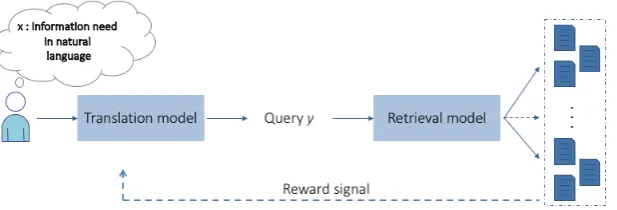
Figure 1: Overview of our reinforcement learning-driven translation model for SOCS
the search engine. It is worth mentioning that there does not exist SOCS-oriented dataset that both aligns users’ information needs in NL with keyword-based queries and includes a document collection to perform a retrieval task. To the best of our knowledge, TREC datasets are the only ones expressing such constraint, but the number of NL-query pairs is however limited. To fit with the issue of dealing with large vocabulary and the dataset constraint, we frame the translation model as a word selection one which aims at identifying which words in the NL expression can be used to build the query. Our model is evaluated on two TREC datasets. The obtained results outline the effectiveness of combining reinforcement learning with machine translation models.
The remaining of the paper is organized as fol-lows. Section 2 details our translation model. Sec-tion 3 presents the evaluaSec-tion protocol and results are highlighted in Section 4. The conclusion and perspectives are discussed in Section 5.
2 Reinforcement learning-driven translation model
2.1 Notation and problem formulation
Our reinforcement learning-driven translation model allows to formulate a user’s information need x expressed in NL into a keyword-based query y. The user’s information need x is a se-quence of n words (x = x1, ..., xi, ..., xn). To
fit with our word selection objective, the query
y is modeled as a binary vector y ∈ {0,1}n
of size n (namely, the size of the natural lan-guage expressionx). Each elementyj ∈y equals to 1 if word xi ∈ x exists in query y and 0
otherwise. For example, if we consider the NL as ”Identify documents that discuss sick build-ing syndrome or buildbuild-ing related illnesses.” and
the key-words query as ”sick building syndrome.”, the expected query will be formulated as follows:
y= (0,0,0,0,1,1,1,0,0,0,0).
The objective of our modelfθ(withθbeing the
parameters of our model) is to estimate the prob-ability p(y|x) of generating the binary vector y
given the NL expression x. Since terms are not independent within the formulation of NL expres-sions and queries, it makes sense to consider that the selection of a word is conditioned by the se-quence of decisions taken on previous wordsy<i.
Thus,P(y|x)could be written as follows:
p(y|x) = Y yi∈y
p(yi|y<i, x) (1)
This probability is first learned using a maxi-mum likelihood estimation (MLE) on the basis of NL-query pairs (Section 2.2). Then, this proba-bility is refined using reinforcement learning tech-niques (Section 2.3). We end up with the network architecture used in the translation model.
2.2 Supervised translation model: from NL to queries
The translation model works as a supervised word selection model aiming at building queries y by using the vocabulary available in NL expressions
x. To do so, we use a setDofN NL-query pairs
D={(x1, y1), ...,(xk, yk), ...,(xN, yN)}.
The objective of the translation model is to pre-dict whether each word xki in the NL expres-sion xk is included in the expected query yk. In other words, it consists in predicting the probabil-ityp(ˆyki = yik|ˆy<ik , xk) that theith elementyˆik of vectoryˆk is equal to the same element yik in the original query yk (namely, that yˆk
i = yki) given
the state of previous elementsyˆ<ik and the NL ex-pressionxk. This probabilityp(ˆyik = yki|ˆyk<i, xk)
Figure 2: Network architecture of our translation model
Let’s define for a NL-query instance (xk, yk),
f(θ,xk) = Pyk
i∈yklog(p(ˆy
k
i = yik|ˆy<ik , xk)). The
translation model is trained by maximizing the fol-lowing MLE over the set D of NL-query pairs
(xk, yk):
LSM T =
X
(xk,yk)∈D
log(f(θ, xk)) (2)
2.3 Reinforcement learning
To inject the task objective in the translation model, we consider that the process of query building could be enhanced through reinforcement learning techniques. Therefore, the word selection could be seen as a sequence of choices of select-ing wordxt at each time step t. The choices are
rewarded at the end of the selection process by a metric measuring the effectiveness of the query building process within a retrieval task. Particu-larly, the predicted queryyˆobtained from the bi-nary vector yˆ is fed to a retrieval model to rank documents. For each NL expression x (and ac-cordingly the associated predicted query yˆ), we dispose of a set Dx of relevant documents (also called ground truth). We noteGT the set ofnpairs
(x;Dx). With this in mind, the effectiveness of the obtained ranking could be estimated using an effectiveness-driven metric (e.g., the MAP). Thus, the reward R for a generated query yˆ given the relevance feedback pair(x,Dx)is obtained as fol-lows:
R(ˆy) =M AP(ˆy,Dx) (3)
At the end of the selection process, the objective function aims at maximizing the expectation of the search effectiveness over the predicted queries:
LRL(θ) =argmax
θ E(xyˆ;∼Dxf)∈GT
θ(x)
[R(ˆy)] (4)
where yˆis given by the translation modelfθ(x).
This objective function is maximized using gradi-ent descgradi-ent techniques (Baxter et al.,1999).
2.4 Model architecture
The model is based on an encoder-decoder build-ing a queryqˆfrom the inputx. Particularly, each elementxi ofxis modeled through word
embed-dingswxi; resulting in a sequencewxof word
em-beddings for inputx. As shown in Figure2, the encoder is a bi-directional LSTM (Hochreiter and Schmidhuber, 1997) aiming to transform the in-put sequencewx to its continuous representation
hn. The decoder is composed of a LSTM in which
each wordxi is injected to estimate the word
se-lection probability p(yi|y<i, x) using the hidden vectorhnlearned in the encoder network and the
current word xi; leading to estimate probability p(yi|y<i, xi, hn).
3 Protocol design
3.1 Datasets
Since there does not exist yet SOCS-driven datasets including NL-query pairs, we use TREC tracks (namely, Robust 2004 and Web 2000-2001). In these tracks, query topics include a title, a topic description and a narrative text; the two latter being formulated in natural lan-guage. To build query-NL pairs, we use the ti-tle to form the set of keyword queries and the description for the set of information needs ex-pressed in NL. An example of a query-NL pair is:
Title Lewis and Clark expedition
Description What are some useful sites containing information about the historic Lewis and Clark expedition?
This NL-query building process results in 350 pairs in total as presented in Table1.
ex-TREC track collection pairs NL length avg of duplic. word in NL
[image:4.595.125.467.62.95.2]TREC Robust (2004) disk4-5 250 15.333 1.108 TREC Web (2000 2001) WT10G 100 11.47 0.65
Table 1:Dataset statistics separated per document collections
ploratory work. Further experiments with gener-ated datasets, as done in (Song et al.,2017), will be carried out in the future.
We also analyze the issue of duplicate words into TREC descriptions since it can directly im-pact the query formulation process based on word selection in the word sequence of TREC descrip-tions. In practice, this might lead to select several times the same word to build the query, and, there-fore, directly impact the retrieval performance. As shown in Table1, the ratio of duplicate words in TREC descriptions over the whole set of queries is very low (1.1 duplicate words in average in each query for TREC Robust and 0.65 for TREC Web). This suggests that this issue is minor in the used datasets. We, therefore, decided to skip this issue for the moment.
3.2 Metrics and baselines
To evaluate our approach, we measure the retrieval effectiveness of the predicted queries. To do so, for each predicted query, we run the BM25 model through an IR system (namely, PyLucene1) to obtain a document ranking. The latter is evaluated through the MAP metric.
To show the soundness of our approach (namely, translating information needs expressed in NL into queries), we compare our generated queries to scenario NL feeding the natural lan-guage information needs (TREC descriptions in our protocol) to the IR retrieval system.
Since the objective of our model is to formulate queries, we also evaluate the effectiveness of orig-inal TREC titles (scenarioQ). This setting rather refers to the oracle that our model must reach.
We mentioned that before training the selection model we transformed eachxto its binary repre-sentationybased on the presence of the words in the ground truth query. The dataset being slightly biased by this binary modeling, we observed that not all the words existing in the query do exist in
x. To analyze this bias, we also compare our ap-proach with these binary queries (scenarioQ bin)
1http://lucene.apache.org/pylucene/
referring to the projection of queriesQon the vo-cabulary available in theNLdescription.
We also compare our model to a random approach which randomly selects 3 words fromx
to build queries (scenarioRandom).
Different variants of our model are also tested:
• SMT which only considers the first com-ponent of our model based on a supervised machine translation approach (Section 2.2). This variant could be assimilated to the ap-proach proposed in (Song et al., 2017) in the sense that the machine translation is per-formed independently of the task objective.
• RL which only considers the reinforce-ment learning objective function (Section 2.3) without pre-training of the supervised translation model.
• SMT+RLwhich is our full model in which we start by pre-training the model using the supervised translation model (Section 2.3), and, then, we inject the reward signal in the translation probabilities (Section 2.4).
3.3 Implementation details
To transform each wordxi to its vector
represen-tation wxi, we use Fasttext
2 (Bojanowski et al.,
2017) pre-trained word embeddings. The encoder and decoders have one hidden layer with 100 hid-den units each.
To train our model, we perform 10-fold cross-validation. For the SMT+RL model, we start by a pre-training using the supervised translation model for 100 iterations. The training is then pur-sued by 1000 iterations while including the rein-forcement learning approach. In the latter, the re-ward, namely the MAP metric, is estimated over document rankings obtained by the BM25 model in PyLucene. We use a minibatch Adam (Kingma and Ba,2014) algorithm to pre-train the model and SGD for the reinforcement learning part. Each up-date is computed after a minibatch of 12 sentences.
2https://github.com/facebookresearch/
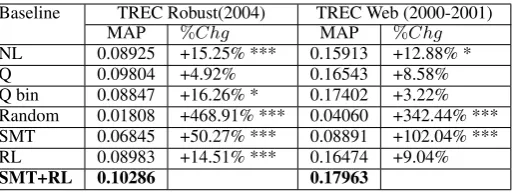
Baseline TREC Robust(2004) TREC Web (2000-2001) MAP %Chg MAP %Chg NL 0.08925 +15.25% *** 0.15913 +12.88% * Q 0.09804 +4.92% 0.16543 +8.58% Q bin 0.08847 +16.26% * 0.17402 +3.22% Random 0.01808 +468.91% *** 0.04060 +342.44% *** SMT 0.06845 +50.27% *** 0.08891 +102.04% *** RL 0.08983 +14.51% *** 0.16474 +9.04%
SMT+RL 0.10286 0.17963
Table 2: Comparative effectiveness analysis of our approach. %Chg: improvement ofSMT+RLover corresponding baselines. Paired t-test significance *: 0.01 < t ≤ 0.05; **: 0.001< t ≤ 0.01; ***:
t≤0.001.
NL Q Q bin SMT+RL
what are new methods of producing steel
steel producing producing steel new methods of pro-ducing steel
what are the advantages and or disad-vantages of tooth implant
implant dentistry implant advantages disadvan-tages tooth implant find documents that discuss the toronto
film festival awards
toronto film awards toronto film awards the toronto film festival awards
find documents that give growth rates of pine trees
where can i find growth rates for the pine trees
[image:5.595.172.429.61.157.2]growth rates pine trees growth rates of pine trees
Table 3: Examples of query formulation forNLqueries, the original queryQ, the binary versionQ bin
of the original query, and our modelSMT+RL.
4 Results
We present here the effectiveness of our approach aiming at generating queries from users’ informa-tion needs expressed in NL. In Table2, we present the retrieval effectiveness (regarding the MAP) of our model and the different baselines (NL,
Q, Q bin, Random, SMT, and RL) described in section 3.2. From a general point of view, results highlight that in both datasets, our pro-posed modelSMT+RLoutperforms the different baselines with improvements that are generally significant, ranging from+3.22%to+468.91%.
More particularly, the effectiveness analysis al-lows to draw the following statements:
•The overall performance of the compared ap-proaches generally outperforms the retrieval ef-fectiveness of the NLbaseline. For instance, on TREC Robust, queries generated by our model al-lows to significantly improve the retrieval perfor-mance of +15.25% regarding information needs expressed in NL (MAP: 0.10286 vs. 0.08925). This result validates the motivation of this work to formulate queries from NL expressions. This is relatively intuitive since NL expressions are verbose by nature and might include non-specific words willing to inject noise in the retrieval pro-cess.
• Our approachSMT+RLprovides similar
re-sults as theQandQ bin. Since the objective func-tion of our model is guided by the initial query
Q transformed in a binary vector (Q bin), these baselines could be considered as oracles. We note however that our model obtains higher results (im-provements from +3.22% to +16.26%) with a significant difference for the Q bin baseline for TREC Robust. To get a better understanding to what extent our generated queries are different from those used in baselinesQandQ bin, we il-lustrate in Table3some examples. While queries inQidentify the most important words leading to an exploratory query (e.g. “steel productions”), our model SMT+RL provides additional words that precise which facet of the query is concerned (e.g., “new methods of...”), and accordingly im-proves the ranking of documents.
• The RL baseline achieves relatively good retrieval performances. As we can see from TREC Web, the RL model obtains a MAP of 0.16474 against 0.15913 for the NL baseline. The RL
baseline allows approaching the retrieval perfor-mances of baselines Q and Q bin, although it obtains lower results. This reinforces our intuition that 1) applying machine translation approaches should be driven by the task (retrieval task in our context) and 2) reinforcement learning techniques provide good strategies to build effective queries. The latter statement has also been outlined in previous work (Nogueira and Cho,2017).
• The comparison of our model SMT+RL re-gardingSMTandRLbaselines outlines that rein-forcement learning techniques might be more ben-eficial when a pre-training is performed. In our context, the pre-training is performed using the
SMTmodel (Section 2.3) which helps the model to be more general and effective before using the reward signal to guide the selection process.
It is worth mentioning that we also trained in preliminary experiments a state of the art transla-tion models such as a generative encoder-decoder RNN with attention mechanism, as done in (Yin et al.,2017;Song et al.,2017). We did not report the results since the model was not able to general-ize in the testing phase over new samples from the NL-query dataset used in the training phase. This is probably due to the trade-off between the num-ber of training pairs and the large size of the vo-cabulary which is not enough represented in differ-ent contexts. However, we believe that combining reinforcement learning with attention-mechanism for query-generation is promising. We let this per-spective for future work.
5 Conclusion and future work
We propose a selection model to transform user’s need in NL into a keyword query to increase the retrieval effectiveness in a SOCS context. Our model bridges two lines of work dealing with su-pervised machine translation and reinforcement learning. Our model has been evaluated using two different TREC datasets and outlines promising results in terms of effectiveness. Our approach has some limitations we plan to overcome in the future. First, our model is framed as a word se-lection process that could be turned into a gener-ative model. Second, experiments are carried out
on small datasets (250 and 100 NL-query pairs) that could be augmented using the evaluation pro-tocol proposed in (Song et al.,2017). In long term, we plan to adapt our model by totally skipping the query formulation step and designing retrieval models dealing with NL expressions.
References
Eugene Agichtein, Eric Brill, and Susan Dumais. 2006. Improving web search ranking by incorporating user behavior information. InSIGIR ’06, pages 19–26.
Jonathan Baxter, Lex Weaver, and Peter Bartlett. 1999. Direct gradient-based reinforcement learning: Ii. gradient ascent algorithms and experiments. Tech-nical report, National University.
Piotr Bojanowski, Edouard Grave, Armand Joulin, and Tomas Mikolov. 2017. Enriching word vectors with subword information. Transactions of the Associa-tion for ComputaAssocia-tional Linguistics, 5:135–146.
Antoine Bordes and Jason Weston. 2016. Learn-ing end-to-end goal-oriented dialog. CoRR, abs/1605.07683.
Mikhail Burtsev, Aleksandr Chuklin, Julia Kiseleva, and Alexey Borisov. 2017. Search-oriented conver-sational ai (scai). In ICTIR ’17, pages 333–334. ACM.
Bhuwan Dhingra, Lihong Li, Xiujun Li, Jianfeng Gao, Yun-Nung Chen, Faisal Ahmed, and Li Deng. 2017. Towards end-to-end reinforcement learning of dia-logue agents for information access. In ACL’ 17, pages 484–495.
Sepp Hochreiter and J¨urgen Schmidhuber. 1997. Long short-term memory. Neural Comput., 9(8):1735– 1780.
Raphael Hoffmann, Congle Zhang, Xiao Ling, Luke Zettlemoyer, and Daniel S. Weld. 2011. Knowledge-based weak supervision for information extraction of overlapping relations. In HLT ’11, pages 541–550.
Thorsten Joachims. 2002. Optimizing Search Engines Using Clickthrough Data. In SIGKDD ’02, pages 133–142. ACM.
Hideo Joho, Lawrence Cavedon, Jaime Arguello, Mi-lad Shokouhi, and Filip Radlinski. 2018. Cair’17: First international workshop on conversational ap-proaches to information retrieval at sigir 2017. SI-GIR Forum, 51(3):114–121.
Guillaume Lample, Ludovic Denoyer, and Marc’Aurelio Ranzato. 2017. Unsupervised machine translation using monolingual corpora only. CoRR, abs/1711.00043.
Jiwei Li, Michel Galley, Chris Brockett, Jianfeng Gao, and Bill Dolan. 2016. A diversity-promoting objec-tive function for neural conversation models. InHLT ’16, pages 110–119. ACL.
Yankai Lin, Zhiyuan Liu, Maosong Sun, Yang Liu, and Xuan Zhu. 2015. Learning entity and relation em-beddings for knowledge graph completion. InAAAI, pages 2181–2187. AAAI Press.
Rodrigo Nogueira and Kyunghyun Cho. 2017. Task-oriented query reformulation with reinforcement learning. InSCAI Workshop - ICTIR.
Alan Ritter, Colin Cherry, and William B. Dolan. 2011. Data-driven response generation in social media. In
EMNLP ’11.
Hyun-Je Song, A-Yeong Kim, and Seong-Bae Park. 2017. Translation of natural language query into keyword query using a rnn encoder-decoder. In SI-GIR ’17, pages 965–968.
Svitlana Vakulenko, Ilya Markov, and Maarten de Ri-jke. 2017. Conversational exploratory search via in-teractive storytelling. InNEUIR SIGIR’17.
Zhuoran Wang and Oliver Lemon. 2013. A simple and generic belief tracking mechanism for the dialog state tracking challenge: On the believability of ob-served information. InSIGDIAL’ 13, page 423–432.