75
Coordinate Structures in Universal Dependencies
for Head-final Languages
Hiroshi Kanayama IBM Research
Tokyo, Japan [email protected]
Na-Rae Han University of Pittsburgh
Pittsburgh, PA [email protected]
Masayuki Asahara NINJAL, Japan
Tokyo, Japan [email protected]
Jena D. Hwang IHMC Ocala, FL [email protected]
Yusuke Miyao University of Tokyo
Tokyo, Japan
Jinho Choi Emory University
Atlanta, GA [email protected]
Yuji Matsumoto
Nara Institute of Science and Technology Nara, Japan
Abstract
This paper discusses the representation of co-ordinate structures in the Universal Dependen-cies framework for two head-final languages, Japanese and Korean. UD applies a strict prin-ciple that makes the head of coordination the left-most conjunct. However, the guideline may produce syntactic trees which are diffi-cult to accept in head-final languages. This pa-per describes the status in the current Japanese and Korean corpora and proposes alternative designs suitable for these languages.
1 Introduction
The Universal Dependencies (UD) (Nivre et al., 2016,2017) is a worldwide project to provide mul-tilingual syntactic resources of dependency struc-tures with a uniformed tag set for all languages. The dependency structure in UD was originally de-signed based on the Universal Stanford Dependen-cies (De Marneffe et al.,2014), in which the left-most conjunct was selected as the head node in co-ordinate structures. After some modifications, the current UD (version 2) uses the definition as shown in Figure1.
The UD principles include a simple mandate: the left word is always the head in parallel and sequential structures, including coordination, ap-position and multi-word expressions. The ratio-nale behind this uniformity is that these structures do not involve true dependency, and having a sin-gle direction forconjrelations on the assumption that coordinate structures are completely
paratac-tic, both within and across languages, is advan-tageous. However, as discussed in several pro-posal for extended representation of coordination structures (Gerdes and Kahane,2015;Schuster and Manning,2016), they cannot be straightforwardly represented as dependencies. Especially in head-final languages such as Japanese and Korean, the left-headed structure poses some fundamental is-sues due to hypotactic attributes in terms of syntax in coordinate structures.
This paper points out the issues in the treatment of coordinate structures with evidence of linguistic plausibility and the trainability of parsers, reports on the current status of the corpora in those lan-guages, and proposes alternative representations.
Section 2 describes the linguistic features of head-final languages, and Section3points out the problems in the left-headed coordinate structures in head-final languages. Section4summarizes the current status of UD Japanese (Tanaka et al.,2016; Asahara et al.,2018) and UD Korean (Chun et al., 2018) corpora released as version 2.2. Section5 shows the experimental results on multiple cor-pora in Japanese and Korean to attest the difficulty in training with left-headed coordination. Section 6 proposes a revision to the UD guidelines more suited to head-final languages.
2 Head-final languages
John bought and ate an apple and a banana PROPN VERB CCONJ VERB DET NOUN CCONJ DET NOUN
nsubj cc
conj
det obj
conj
cc
[image:2.595.148.455.64.152.2]det root
Figure 1: English coordinate structures (“bought and ate” and “an apple and a banana”) in UD v2.
妻 が 買っ た かばん を 友達 に ⾒せ たい 。
tsuma -ga kat -ta kaban -wo tomodachi -ni mise -tai .
NOUN ADP VERB AUX NOUN ADP NOUN ADP VERB AUX PUNCT ‘wife’ -NOM ‘buy’ -PAST ‘bag’ -ACC ‘friend’ -DAT ‘show’ ‘want’ .
case nsubj
aux acl
case
obj
obl
case aux
[image:2.595.107.493.202.308.2]punct root
Figure 2: A head-final dependency structure of a Japanese sentence “妻が買ったかばんを友達に⾒せたい” (‘(I) want to show the bag which (my) wife bought to (my) friend’).
아내가 산 가방을 친구에게 보이고 싶다 .
anay+ka sa+n kapang+ul chinku+eykey poi+ko siph+ta .
NOUN VERB NOUN NOUN VERB VERB PUNCT
‘wife-NOM’ ‘buy-PAST’ ‘bag-ACC’ ‘friend-DAT’ ‘show’ ‘want’ . nsubj acl
obj
obl flat punct root
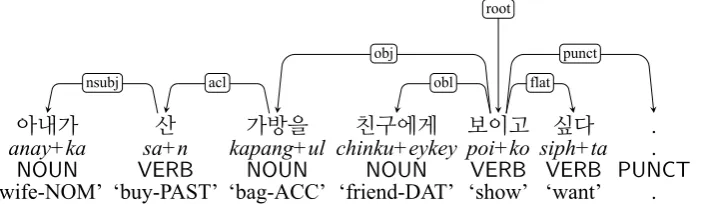
Figure 3: A head-final dependency structure of a Korean sentence “아내가 산 가방을 친구에게 보이고 싶다.”, which is parallel to that in Figure2.
right. Figures2and3depict the dependency struc-tures in Universal Dependencies for Japanese and Korean sentences, respectively. Both have right-headed dependencies except for functional words and punctuations.
Japanese has a well-known phrasal unit, called
bunsetsu—each unit is marked with a rounded rectangle in Figure 2. A bunsetsu consists of a content word (or multiple words in the case of a compound) and zero or more functional words such as postpositional case markers (ADP), parti-cles (PART) and auxiliary verbs (AUX).
Korean has a similar unit called eojeol. It typ-ically consists of a content word optionally fol-lowed by highly productive verbal or nominal suffixation, and, unlike Japanese bunsetsu, it is marked by white space in orthography. Figure3
shows a Korean counterpart to Figure2, where the syntax and the main dependency relations mirror those of the Japanese example. The main departure here is that the Korean UD’s treatment of postpo-sition suffixes and verbal endings are dependent morphemes in theeojeol-based Korean orthogra-phy, and thus, are neither tokenized nor assigned separate dependency relations.
UD corpora from both languages are converted from dependency or constituency corpora based on
bunsetsu oreojeol units. In Japanese, functional words in eachbunsetsu(ADP,AUXandPUNCT in Figure2) must depend on the head word in the
[image:2.595.128.479.365.467.2]flatlabel. As for the dependencies between con-tent words, the right-hand unit is always the head. The exceptions are limited to special cases such as annotations using parentheses, but when the UD’s left-headedness principle is adopted, multi-word expressions and coordination are added to excep-tional cases.
In addition to these two languages, Tamil is cat-egorized as a rigid head-final language (Polinsky, 2012). According to the typological classification using statistics of UD corpora (Chen and Gerdes, 2017), Japanese and Korean fall into a similar class in terms of distance of dependencies. The same goes for Urdu and Hindi, but they have more flex-ibility in word order including predicates.
かわいい ⽝ と 猫 が ⾛る
kawaii inu -to neko -ga hashiru
ADJ NOUN CCONJ NOUN ADP VERB ‘cute’ ‘dog’ ‘and’ ‘cat’ -NOM ‘run’
acl
conj
cc case
nsubj
[image:3.595.75.296.292.408.2]root
Figure 4: Left-headed representation of a nominal co-ordination in Japanese “⽝と猫” (‘dog and cat’), in a
sentence “かわいい⽝と猫が⾛る” (‘A cute dog and
cat run’).
예쁜 개와 고양이가 달린다
yeyppun kay+wa koyangi+ka tali+nta
ADJ NOUN NOUN VERB
‘cute’ ‘dog+and’ ‘cat-NOM’ ‘run’ acl conj
nsubj
[image:3.595.87.271.465.571.2]root
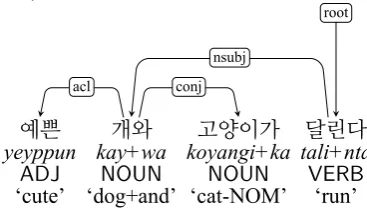
Figure 5: Left-headed representation of a nominal co-ordination in Korean “개와 고양이‘’(’dog and cat’), in
a sentence “예쁜 개와 고양이가 달린다” (‘A cute dog
and cat run’).
3 Issues with left-headed coordination
This section points out several issues regarding Japanese and Korean coordinate structures in Uni-versal Dependencies when the left-headed rules are strictly applied.
3.1 Nominal coordination
If a Japanese noun phrase “⽝と猫” (‘dog and cat’) is regarded as a coordination and represented in a left-headed manner under UD, the structure is as Figure4 in a sentence “⽝と猫が⾛る” (‘A cute dog and cat run’). When the particle “と” (to) is regarded as a conjunctionCCONJto connect two conjuncts, instead of a case marker attached to the preceding noun “⽝” (‘dog’), it is made a depen-dent of the right conjunct, breaking thebunsetsu
unit in the dependency structure.
Also the nominative case marker “が” (ga) fol-lowing “猫” (‘cat’) should specify the nominative case of the noun phrase (‘dog and cat’), then the case marker is a child of “⽝” (‘dog’) as the left conjunct, which produces a long distance depen-dency for a case marker which is usually attached to the preceding word.
The Korean counterpart in Figure5mirrors the Japanese example, except that again due to the dif-ferent tokenization scheme the conjunctive particle “와” (wa) is kept suffixized in the left nominal con-juncteojeol, thus the conjunction relationccis not overtly marked.
A common problem with adjectival modifica-tion in UD shown in Figures4and5is that there is no way to distinguish between modification of the full coordination vs. of the first conjunct (Przepiórkowski and Patejuk,2018) . For exam-ple, there is no way to specify the scope of the ad-jective ‘cute’: the two readings (1) only a dog is cute and (2) both animals are cute.
3.2 Verbal coordination
⾷べ て ⾛る ⼈
tabe -te hashiru hito
VERB SCONJ VERB NOUN ‘eat’ -ADV ‘run-ADN’ ‘person’
mark conj
acl
[image:4.595.100.260.64.165.2]root
Figure 6: Left-headed representation of a verbal co-ordination in a Japanese phrase “⾷べて⾛る⼈” (‘A person who eats and runs’).
먹고 달리는 사람
mek+ko tali+nun salam
VERB VERB NOUN
‘eat-and’ ‘run-ADN’ ‘person’ conj
acl
[image:4.595.116.247.221.323.2]root
Figure 7: Left-headed representation of a verbal coor-dination in a Korean phrase “먹고 달리는 사람” (‘A person who eats and runs’).
3.3 Ellipsis
It is widely acknowledged that the phenomenon of ellipsis in non-constituent coordination is difficult to represent in UD, which does not allow introduc-tion of covert gap words. Such structures can be even trickier to capture in head-final languages.
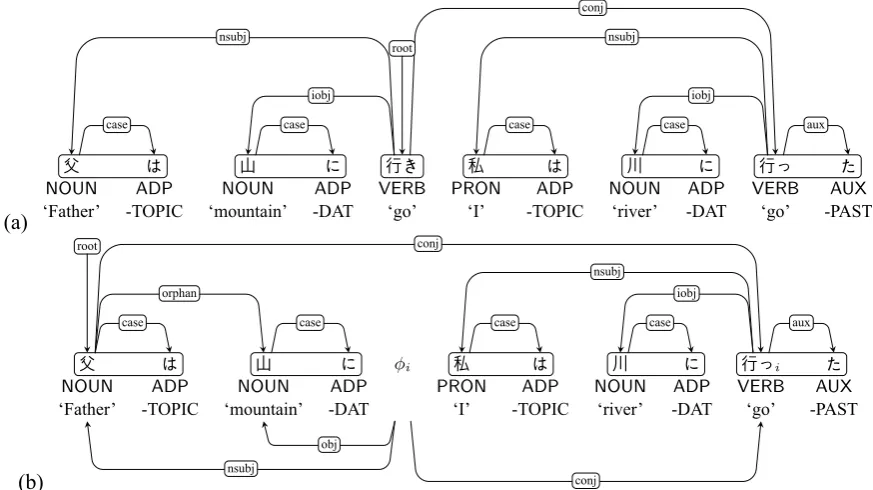
Figure 8 shows Japanese examples of non-constituent coordination. (a) is the coordination of “⽗は⼭に⾏き” (‘he goes to a mountain’) and “私 は川に⾏った” (‘I went to a river’). The root node is the rightmost word in the left conjunct chunk. The second example (b) (‘My father went to the mountain, and I, to the river.’) shows the ellipsis of the first verb “⾏き” (‘go’), which is the root node in (a). The dependency relations of the omit-ted node that include the root are reduced and at-tached to the daughter node “⽗” (‘father’). The labelorphanshould be assigned between “私” (‘I’) and “⼭” (‘mountain’), and then, the first word, “⽗” (‘father’), becomes the root of the sentence. These peculiar tree constructions are caused by the left-headed principle of coordinate structures for a strictly head-final language, where the left con-junct tends to be omitted in this type of ellipsis. Korean likewise exhibits an exact parallel with its predicate ellipsis construction; examples are not
shown in the interest of conserving space.
3.4 Coordination in Japanese and Korean: grammar vs. meaning
Conjunction is typically schematized as ‘X and Y’, where ‘X’ and ‘Y’ are interchangeable: com-mutativity is a defining characteristic of coordi-nation which forms a basis for its headlessness. The Japanese and Korean examples presented so far, however, depart from this in a fundamental way: coordination in the two languages is asym-metric on the levels of syntax and morphology. Their ‘and’-counterpart is a dependent morpheme attached to the left conjunct,1and it is the right con-junct that bears all inflections and syntactic mark-ings. In ellipsis, it’s the left conjunct that is re-duced, while the right conjunct, along with requi-site inflectional markings, is left standing.
This, then, points strongly towards the right con-junct being the head. Hoeksema(1992) cites four criteria of the ‘head’, which are: semantic, dis-tributional, morphosyntactic, and technical (i.e., phrasal projection); his morphosyntactic criterion states that the head is the locus of inflection, which applies to the right conjunct in the two languages. On the other hand, there is one source of com-mutativity for Japanese and Korean coordination, which ismeaning: namely, the fact that the lexical portions of left and right conjuncts can be swapped with no impact on truth conditions. In nominal co-ordination (4,5) this semantic commutativity is ro-bust; in verbal coordination (6,7,8), it is more re-stricted as temporal-sequential or causal interpre-tation often slips in (e.g.,6,7could be understood as ‘eatsand thenruns’), but where it is available it tends to be just as robust (e.g.,8). This would mean that the semantic commutativity is the pri-mary basis for identifying and acknowledging co-ordination as a phenomenon in these languages, as this property does not extend to grammar.
Back to the grammatical aspect, a natural corol-lary is that Japanese and Korean coordinate struc-tures are very close to those of nominal modifi-cation and subordination. In Korean, “존-의 고 양이-가” (John-uy koyangi-ka, ‘John’s cat-NOM’) with the genitive marker “-의” (-uy) therefore ap-pears to share the same configuration as ‘cat-and dog-NOM’; “먹-고서 달리-는 사람” (mek-kose tali-nun salam, ‘person who eats and thenruns’)
(a)
⽗ は ⼭ に ⾏き 私 は 川 に ⾏っ た
NOUN ADP NOUN ADP VERB PRON ADP NOUN ADP VERB AUX
‘Father’ -TOPIC ‘mountain’ -DAT ‘go’ ‘I’ -TOPIC ‘river’ -DAT ‘go’ -PAST
case case
nsubj
iobj
case case
nsubj
iobj
aux conj
root
(b)
⽗ は ⼭ に ϕi 私 は 川 に ⾏っi た
NOUN ADP NOUN ADP PRON ADP NOUN ADP VERB AUX
‘Father’ -TOPIC ‘mountain’ -DAT ‘I’ -TOPIC ‘river’ -DAT ‘go’ -PAST
case case
nsubj
obj orphan
case case
nsubj
iobj
aux
conj conj
[image:5.595.77.514.63.308.2]root
Figure 8: Predicate ellipsis in the non-constituent conjunct coordination.
with the sequential verbal ending “-고서” (-kose) likewise is indistinguishable on the surface from the coordination counterpart which uses “-고” ( -ko, ‘and’) instead. In both cases, the righthand-side elements are unquestionably the head, syn-tactically and semantically, and they are treated as such in Japanese and Korean UD. Then, the only criteria for distinguishing the coordinate structures from their headed cousins are (1) choice of the suffix, and (2) semantic commutativity. One un-fortunate consequence of the current UD princi-ples is that these seemingly parallel pairs of struc-tures in Korean and Japanese must receive vastly different syntactic treatments – one right-headed and the other left-headed – based on these two, non-syntactic, attributes. This creates a point of incongruence in terms of language-internal gram-mar; additionally, it becomes an engineering-side liability, as we will see shortly in Section5.
4 Current status
Despite the complexities outlined in the previous section, the UD Japanese and UD Korean teams had to work within the bounds of the principles laid out by the Universal Dependencies version 2. Therefore, in the official version 2.2 release used for the CoNLL 2018 shared task (Zeman et al., 2018), UD Japanese and UD Korean adopted two separate strategies in order to ensure compliance,
as we will see below.
4.1 UD Japanese
かわいい ⽝ と 猫 が ⾛る
kawaii inu -to neko -ga hashiru
ADJ NOUN ADP NOUN ADP VERB ‘cute’ ‘dog’ ‘and’ ‘cat’ -NOM ‘run’
acl nmod
case case nsubj
root
Figure 9: The representation in UD Japanese v2.2 for
a sentence “かわいい⽝と猫が⾛る” (‘A cute dog and
cat run’).
[image:5.595.306.526.392.518.2]the verb ‘run’ with the (nsubj) label.
⾷べ て ⾛る ⼈
tabe -te hashiru hito
VERB SCONJ VERB NOUN ‘eat’ -ADV ‘run-ADN’ ‘person’
mark advcl
[image:6.595.98.261.87.192.2]acl root
Figure 10: The representation in UD Japanese v2.2 for a phrase “⾷べて⾛る⼈” (‘A person who eats and runs’).
Additionally, the relationship between verbs are not handled as coordination, as shown in Fig-ure10. A verb connected with “て” (te) is regarded as subordination rather than coordination, because the phrase can be read as ‘a person who runs after eating’. It is consistent with the strategy of PoS tagging in UD Japanese to assignSCONJfor con-junctive particles.
Besides the coordination, UD Japanese does not use flatlabel for sequential nouns, including proper nouns, to avoid the left-headed structures. Instead,compoundis used as shown in Figure11. UD Japanese_GSD usesfixedfor a limited num-bers of multi-word functional words, while UD Japanese_BCCWJ does not use it at all. Table1 shows the distribution of some labels.
オバマ ⼤統領 が ⾔う
Obama daitouryou -ga iu
PROPN NOUN ADP VERB
‘Obama’ ‘president’ -NOM ‘say’ compound case
nsubj
[image:6.595.101.261.496.598.2]root
Figure 11: The use ofcompoundin UD Japanese v2.2 for “オバマ⼤統領が⾔う” (‘President Obama says’).
Corpus root conj flat fixed
GSD 8,232 0 0 338
BCCWJ 57,256 0 0 0
Table 1: Distribution of labels in UD Japanese corpora. rootshows the number of sentences.
4.2 UD Korean
Unlike the Japanese UD, the Korean UD effort has made a conscious decision to use right-headedness for conjunction following the coordination guide-lines proposed byChoi and Palmer(2011). Thus, the coordinate structures in all three of the Ko-rean UD corpora (Chun et al.,2018) were devel-oped with the rightmost conjunct as the head of the phrase, with each conjunct pointing to its right sib-ling as its head.
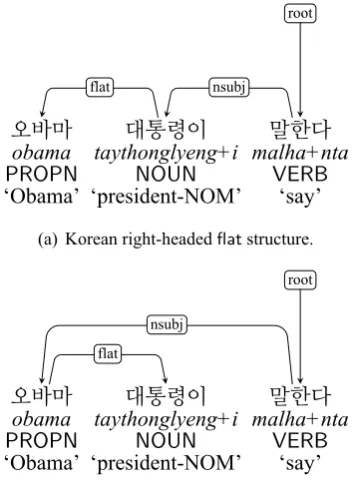
For the latest available UD_Korean-GSD, how-ever, the dependencies were converted to left-headed structures post-development in an effort to fully comply with the UD guidelines despite the problems left-headed structures pose for the lan-guage as described in Section 3. The other two Korean UD corpora, namely the Kaist and the Korean Penn Treebank, reflect right-headed co-ordinate structures (Chun et al., 2018). In addi-tion to coordinaaddi-tion, UD Korean extends the right-headed dependency structures to noun-noun struc-tures. Unlike the Japanese that has opted to repre-sent sequential nouns as cases ofcompound (Fig-ure 11), Korean uses right-headed flatand fixed dependencies (Figure 12(a)), assigning the right-most nominal with the morphological case mark-ing as the phrasal head. Just as with the coordinate structure, theseflatdependencies were converted into left-headed structures for the UD_Korean-GSD (Figure12(b)). Table2shows the distribu-tions ofconj,flatandfixedlabels.
Corpus root conj flat fixed
GSD 6,339 3,864 12,247 13 Kaist 27,363 20,774 803 3,186 Penn 5,010 9,960 528 18
Table 2: Distribution of dependency labels in UD Ko-rean corpora.
The differing strategies employed in the Japanese and Korean UD produce very different dependencies over structures that should other-wise receive similar analyses. Effectively, despite the syntactic similarities apparent in the two languages, the differences in the UD structures pose a challenge to the cross-lingual transfer learning (Kanayama et al.,2014).
5 Parsing Experiments
[image:6.595.312.522.496.553.2] [image:6.595.88.273.671.713.2]lan-오바마 대통령이 말한다
obama taythonglyeng+i malha+nta
PROPN NOUN VERB
‘Obama’ ‘president-NOM’ ‘say’ flat nsubj
root
(a) Korean right-headedflatstructure.
오바마 대통령이 말한다
obama taythonglyeng+i malha+nta
PROPN NOUN VERB
‘Obama’ ‘president-NOM’ ‘say’ flat
nsubj
root
[image:7.595.93.270.61.310.2](b) (a) converted to left-headed structure as reflected in the UD_Korean-GSD.
Figure 12: The use offlatin Korean UD v2.2.
guages? To answer this question, we trained and tested UDPipe (Straka et al.,2016) on multiple ver-sions of UD Japanese and Korean corpora.
5.1 Japanese
As described in Section 4.1, the current UD Japanese-GSD corpus does not use conj tags. The corpus was converted into another version with coordinations without changing the depen-dency structures (right-headed coordination), that is, some ofnmodandadvcl labels are converted into conj label when the original manual annota-tion usedconjregarding them as nominal or ver-bal coordinations. AlsoCCONJtag and cclabel are assigned to the coordinative case markers. The corpus was further converted into left-headed co-ordination, by changing the dependency structures following the UD guidelines.
For each corpora, two models were trained using
trainanddevportions; with (1) default UDPipe
settings without changing any parameters, and (2) Japanese specific parameters for each phase2 and
2 --tokenizer=dimension=64
;epochs=100;
initialization_range=0.1;batch_size=
50;learning_rate=0.005;dropout=0.3;early_ stopping=1
--tagger=models=2;templates_1=tagger;guesser_
suffix_rules_1=12;guesser_enrich_dictionary_1=
4;guesser_prefixes_max_1=0;use_lemma_1=0;use_
xpostag_1=1;use_feats_1=1;provide_lemma_1=
precomputed word embeddings.
Given the model trained with each corpus and the raw input text of the test portion of corre-sponding corpus, UDPipe processed tokenization, PoS tagging and parsing. Table3shows the F1 val-ues of tokenization (word), PoS tagging (UPOS) and UAS and LAS, for three models and two con-figurations. Tokenization is not straightforward because there is no whitespace between words, and it lowers scores of downstream processes; PoS tagging and parsing. Japanese specific configura-tion consistently showed better parsing scores by around 2 points.
Compared to the current UD Japanese (‘no coor-dination’), ‘right-head coordination’ showed sim-ilar UAS values because the dependency relations were almost the same. In both configurations, LAS values dropped by 1.4 points because coor-dination (conj) cannot be deterministically distin-guished from other dependencies (nmod or ad-vcl). ‘left-head coordination’ further confused the model. UAS scores decreased by more than 3 points due to the difficulty to distinguish coordi-nate structures which completely change the de-pendency orientation, and the inconsistent syntac-tic relationship between the left conjunct and the head word. Also, it is known that shorter length of dependencies are preferred (Futrell et al.,2015) and the right-headed coordination strictly reduces the dependency distance in head-final languages. These results support the advantages of the right-headed strategy in Japanese coordinate structures.
5.2 Korean
All three UD corpora in Section4.2, GSD, Kaist, and Penn Treebanks, are used to conduct similar experiments in Korean. First, raw text from those corpora are combined and fed into the original im-plementation of Word2Vec (Mikolov et al.,2013)
0;provide_xpostag_1=1;provide_feats_1=1;prune_
features_1=0;templates_2=lemmatizer;guesser_
suffix_rules_2=6;guesser_enrich_dictionary_2=
6;guesser_prefixes_max_2=4;use_lemma_2=1;use_
xpostag_2=1;use_feats_2=1;provide_lemma_2=
1;provide_xpostag_2=0;provide_feats_2=0;prune_ features_2=0
--parser=iterations=30;embedding_upostag=
20;embedding_feats=20;embedding_xpostag=
0;embedding_form=50;embedding_form_file=ud-2. 0-embeddings/ja.skip.forms.50.vectors;embedding_
lemma=0;embedding_deprel=20;learning_rate=
0.02;learning_rate_final=0.001;l2=0.3;hidden_
layer=200;batch_size=10;transition_system=
projective;transition_oracle=static;structured_
default parameter Japanese configuration word UPOS UAS LAS word UPOS UAS LAS no coordination [UD v2.2] 91.0 88.4 75.5 74.0 91.8 89.1 77.0 75.4 Left-head coordination 91.0 88.2 71.7 69.9 91.6 88.6 73.6 71.8 Right-head coordination 91.0 88.2 75.4 72.6 91.6 88.6 76.7 74.0
Table 3: Parsing performance on Japanese UD corpora. F1 values of tokenization, the Universal POS tagging Score (UPOS), the Unlabeled Attachment Score (UAS), and the Labeled Attachment Score (LAS) are shown here.
UPOS UAS LAS
GSD Kaist Penn GSD Kaist Penn GSD Kaist Penn Left-head coordination 89.37 90.12 92.17 69.49 77.54 73.54 61.98 70.37 65.94 Right-head coordination 89.39 90.10 92.41 77.22 83.00 78.34 65.03 75.02 69.18
Table 4: Parsing performance on the three Korean UD corpora, GSD, Kaist, and Penn. The gold-tokenization is used, and F1 values of UPOS tagging, UAS and LAS are reported.
to train word embeddings, where skip-gram with negative sample is used for language modeling and the vector size of 50 and the minimum count of 3 are used for configuration (the default values are used for all the other parameters).
The GSD and Kaist Treebanks are experimented with the configuration recommended by the UD-Pipe team, which was optimized on the CoNLL’17 shared task dataset.3 The Penn Treebank is
experi-mented with mostly the same configuration except that the transition-based parsing algorithm using the SWAP transition with the static lazy oracle is applied because this corpus allows multiple roots as well as non-projective dependencies, which is not assumed for the recommended configuration.
Following the annotation guidelines, the conj, flat, and fixed relations in the version 2.2 of the GSD and Kaist Treebanks are all left-headed.
3--tokenizer='dimension=24;epochs=
100;initialization_range=0.1;batch_size= 50;learning_rate=0.01;dropout=0.2;early_
stopping=1'--tagger='models=2;templates_
1=tagger;guesser_suffix_rules_1=8;guesser_
enrich_dictionary_1=6;guesser_prefixes_
max_1=0;use_lemma_1=1;use_xpostag_1=1;use_
feats_1=1;provide_lemma_1=0;provide_xpostag_
1=1;provide_feats_1=1;prune_features_1=
0;templates_2=lemmatizer;guesser_suffix_rules_
2=6;guesser_enrich_dictionary_2=5;guesser_
prefixes_max_2=4;use_lemma_2=1;use_xpostag_
2=0;use_feats_2=0;provide_lemma_2=1;provide_
xpostag_2=0;provide_feats_2=0;prune_features_
2=1'--parser='iterations=30;embedding_upostag=
20;embedding_feats=20;embedding_xpostag=
0;embedding_form=50;
embedding_form_file=ko-all.vec;embedding_lemma=0;embedding_deprel= 20;learning_rate=0.01;learning_rate_final= 0.001;l2=0.5;hidden_layer=200;batch_size=
10;transition_system=projective;transition_
oracle=dynamic;structured_interval=10'
However, the authors of these Korean UD corpora also provide the right-headed version of those cor-pora from their open-source project. This project provides both left- and right-headed versions of the Penn Treebank as well, which makes it easy for us to make head-to-head comparisons.4
Table4shows parsing performance of UDPipe on the Korean UD corpora. Significant improve-ments are found in all three corpora for both the unlabeled and labeled attachment scores when the right-headed version is used. Moreover, our quali-tative analysis indicates that the improvements are not just from those three relations,conj, flat, and fixed, but other relations associated with them be-cause the right-headed version makes them more coherent with the other relations.
6 Proposal
The strict left-headed constraint for the coordi-nate structures in the current Universal Dependen-cies has tied the hands of the two individual lan-guage UD projects, driving them to adopt sub-optimal solutions: dropping the conjunction cat-egory entirely in the case of Japanese, and main-taining two forks of the same data sets in the case of Korean (Section 4). The former approach in-curs the loss of a real and essential cross-linguistic parallelism involvingconj which undermines the UD framework’s premise of universality; the lat-ter risks splinlat-tering of the UD as a linguistically diverse yet unified project.
Even if one was inclined to regard these draw-backs as merely abstract, hopefully we have suf-ficiently demonstrated that the adherence to the left-headed principle leads to numerous language-internal inconsistencies (Section3) and, moreover, has an engineering-side consequence, as parser trainability is negatively impacted (Section5).
Given these considerations, we propose that the UD guidelines be modified so as to allow flexi-bility in head orientation for coordinate structures. This move will leave our two UD teams free to ap-ply right-headedness in coordinate structures and hence represent them in a way that is linguistically sound and with engineering-side advantages, all without making a compromise.
Additionally, general UD issues like the scope problem triggered by adjectival modification of coordinate structures (Section3.1) can be resolved through right-headed attachment (i.e., making the right conjunct (‘cat’) the head of the coordination). While admittedly right-headed attachment is not a complete solution for UD’s general issue of ad-jectival modification of coordination, for the right-headed languages, at least, would allow the syntax to supply appropriate syntactic structures for the ambiguities present in the text5.
Furthermore, it is our belief that the change will ultimately prove beneficial to all head-final lan-guages. Rather than viewing this modification as a concession, we invite the UD leadership to con-sider the fact that coordination manifests differ-ently across languages, and sometimes in a man-ner that strongly indicates headedness, as it does in Japanese and Korean; extending the head pa-rameter to coordination will therefore strengthen the UD’s position of universality. This flexibility may arise another issue in drawing a line between left- or right-headed, but any languages can keep the current strategy without any drawbacks, and apparently, it is beneficial for the rigid head-final languages.
7 Conclusion
In this paper, we presented issues that Japanese and Korean face in the representation of coordi-nate structures within the current design of Univer-sal Dependencies, followed by a propoUniver-sal for the
5Note that in “⽝とかわいい猫” (‘dog and cute cat’), where ‘cute’ modifies ‘cat’ (the head of coordination), am-biguity is resolved through word order (i.e., cannot be read as both of them are cute).
UD principles to allow right-headedness in coor-dination. We hope this proposal will lead to more flexibility in the annotation scheme for the two lan-guages, which will be essential in creating corpora that are useful not only for academic research but also for real-world use cases.
References
Masayuki Asahara, Hiroshi Kanayama, Takaaki
Tanaka, Yusuke Miyao, Sumire Uematsu, Shinsuke Mori, Yuji Matsumoto, Mai Omura, and Yugo Murawaki. 2018. Universal Dependencies Version 2 for Japanese. In Proceedings of the Eleventh International Conference on Language Resources and Evaluation (LREC 2018), Miyazaki, Japan.
Xinying Chen and Kim Gerdes. 2017. Classifying lan-guages by dependency structure. typologies of delex-icalized Universal Dependency treebanks. In Pro-ceedings of the Fourth International Conference on Dependency Linguistics (Depling 2017), September 18-20, 2017, Università di Pisa, Italy, 139, pages 54–63. Linköping University Electronic Press.
Jinho D. Choi and Martha Palmer. 2011. Statistical De-pendency Parsing in Korean: From Corpus Genera-tion To Automatic Parsing. InProceedings of the IWPT Workshop on Statistical Parsing of Morpho-logically Rich Languages, SPMRL’11, pages 1–11, Dublin, Ireland.
Jayeol Chun, Na-Rae Han, Jena D. Hwang, and Jinho D. Choi. 2018. Building Universal Depen-dency Treebanks in Korean. InProceedings of the Eleventh International Conference on Language Re-sources and Evaluation (LREC 2018), Miyazaki, Japan.
Marie-Catherine De Marneffe, Timothy Dozat, Na-talia Silveira, Katri Haverinen, Filip Ginter, Joakim Nivre, and Christopher D Manning. 2014. Univer-sal Stanford dependencies: A cross-linguistic typol-ogy. InProceedings of the 9th International Confer-ence on Language Resources and Evaluation (LREC 2014), volume 14, pages 4585–4592.
Richard Futrell, Kyle Mahowald, and Edward Gibson. 2015. Large-scale evidence of dependency length minimization in 37 languages. InProceedings of the National Academy of Sciences of the United States of America.
Kim Gerdes and Sylvain Kahane. 2015.
Non-constituent coordination and other coordinative con-structions as dependency graphs. InProceedings of the Third International Conference on Dependency Linguistics (Depling 2015), pages 101–110.
Hiroshi Kanayama, Youngja Park, Yuta Tsuboi, and Dongmook Yi. 2014. Learning from a neigh-bor: Adapting a Japanese parser for Korean through feature transfer learning. In Proceedings of the EMNLP’2014 Workshop on Language Technology for Closely Related Languages and Language Vari-ants, pages 2–12.
Tomas Mikolov, Ilya Sutskever, Kai Chen, Greg S Cor-rado, and Jeff Dean. 2013. Distributed Representa-tions of Words and Phrases and their Compositional-ity. InProceedings of Advances in Neural Informa-tion Processing Systems 26, NIPS’13, pages 3111– 3119.
Joakim Nivre, Željko Agić, Lars Ahrenberg, et al. 2017. Universal Dependencies 2.0. LINDAT/CLARIN digital library at the Institute of Formal and Applied Linguistics, Charles University, Prague.
Joakim Nivre, Marie-Catherine de Marneffe, Filip Gin-ter, Yoav Goldberg, Jan Hajič, Christopher Man-ning, Ryan McDonald, Slav Petrov, Sampo Pyysalo, Natalia Silveira, Reut Tsarfaty, and Daniel Zeman. 2016. Universal Dependencies v1: A multilingual treebank collection. InProceedings of the 10th In-ternational Conference on Language Resources and Evaluation (LREC 2016), Portorož, Slovenia.
Maria Polinsky. 2012. Headness, again. UCLA Work-ing Papers in LWork-inguistics, Theories of EverythWork-ing, 17:348–359.
Adam Przepiórkowski and Agnieszka Patejuk. 2018. Arguments and adjuncts in universal dependencies. InProceedings of the 27th International Conference on Computational Linguistics, pages 3837–3852.
Sebastian Schuster and Christopher D Manning. 2016. Enhanced english universal dependencies: An im-proved representation for natural language under-standing tasks. InProceedings of the Tenth Interna-tional Conference on Language Resources and Eval-uation (LREC 2016), pages 23–28. Portorož, Slove-nia.
Milan Straka, Jan Hajič, and Jana Straková. 2016. UD-Pipe: trainable pipeline for processing CoNLL-U files performing tokenization, morphological anal-ysis, POS tagging and parsing. In Proceedings of the 10th International Conference on Language Resources and Evaluation (LREC 2016), Portorož, Slovenia. European Language Resources Associa-tion.
Takaaki Tanaka, Yusuke Miyao, Masayuki Asahara, Sumire Uematsu, Hiroshi Kanayama, Shinsuke Mori, and Yuji Matsumoto. 2016. Universal Depen-dencies for Japanese. InProceedings of the Tenth In-ternational Conference on Language Resources and Evaluation (LREC 2016).
Daniel Zeman, Filip Ginter, Jan Hajič, Joakim Nivre, Martin Popel, and Milan Straka. 2018. CoNLL 2018 Shared Task: Multilingual Parsing from Raw