Smooth Bilingual N-gram Translation
Holger Schwenk Marta R. Costa-juss `a and Jos´e A.R. Fonollosa LIMSI-CNRS, BP 133
91403 Orsay cedex, FRANCE [email protected]
UPC - TALP Barcelona 08034, Spain {mruiz,adrian}@gps.tsc.upc.edu
Abstract
We address the problem of smoothing trans-lation probabilities in a bilingual N-gram-based statistical machine translation system. It is proposed to project the bilingual tuples onto a continuous space and to estimate the translation probabilities in this representa-tion. A neural network is used to perform the projection and the probability estimation.
Smoothing probabilities is most important for tasks with a limited amount of training
material. We consider here the BTEC task
of the 2006 IWSLT evaluation.
Improve-ments in all official automatic measures are reported when translating from Italian to En-glish. Using a continuous space model for the translation model and the target language model, an improvement of 1.5 BLEU on the test data is observed.
1 Introduction
The goal of statistical machine translation (SMT) is
to produce a target sentence e from a source
sen-tence f. Among all possible target language
sen-tences the one with the highest probability is chosen:
e∗ = arg max e Pr(
e|f) = arg max
e Pr(
f|e) Pr(e)
wherePr(f|e)is the translation model andPr(e)
is the target language model. This approach is
usually referred to as the noisy source-channel ap-proach in statistical machine translation (Brown et al., 1993).
During the last few years, the use of context in SMT systems has provided great improvements
in translation. SMT has evolved from the
origi-nal word-based approach to phrase-based translation systems (Och et al., 1999; Koehn et al., 2003). A
phrase is defined as a group of source words ˜f that
should be translated together into a group of target
wordse˜. The translation model in phrase-based
sys-tems includes the phrase translation probabilities in both directions, i.e.P(˜e|˜f)andP(˜f|˜e).
The use of a maximum entropy approach simpli-fies the introduction of several additional models ex-plaining the translation process :
e∗ = arg maxp(e|f)
= arg max
e {exp(
X
i
λihi(e,f))} (1)
The feature functions hi are the system models and
theλi weights are typically optimized to maximize
a scoring function on a development set (Och and Ney, 2002).
The phrase translation probabilities P(˜e|˜f) and
P(˜f|˜e)are usually obtained using relative frequency estimates. Statistical learning theory, however, tells us that relative frequency estimates have several drawbacks, in particular high variance and low bias. Phrase tables may contain several millions of en-tries, most of which appear only once or twice, which means that we are confronted with a data sparseness problem. Surprisingly, there seems to be little work addressing the issue of smoothing of the phrase table probabilities.
On the other hand, smoothing of relative fre-quency estimates was extensively investigated in the
area of language modeling. A systematic compari-son can be for instance found in (Chen and Good-man, 1999). Language models and phrase tables have in common that the probabilities of rare events may be overestimated. However, in language mod-eling probability mass must be redistributed in order
to account for the unseen n-grams. Generalization
to unseen events is less important in phrase-based SMT systems since the system searches only for the best segmentation and the best matching phrase pair among the existing ones.
We are only aware of one work that performs a systematic comparison of smoothing techniques in phrase-based machine translation systems (Foster et
al., 2006). Two types of phrase-table smoothing
were compared: black-box and glass-box methods. Black-methods do not look inside phrases but in-stead treat them as atomic objects. By these means, all the methods developed for language modeling can be used. Glass-box methods decomposeP(˜e|˜f) into a set of lexical distributions P(e|˜f). For in-stance, it was suggested to use IBM-1 probabili-ties (Och et al., 2004), or other lexical translation probabilities (Koehn et al., 2003; Zens and Ney, 2004). Some form of glass-box smoothing is now used in all state-of-the-art statistical machine trans-lation systems.
Another approach related to phrase table smooth-ing is the so-called N-gram translation model (Mari˜no et al., 2006). In this model, bilingual
tu-ples are used instead of the phrase pairs andn-gram
probabilities are considered rather than relative
fre-quencies. Therefore, smoothing is obtained
us-ing the standard techniques developed for language modeling. In addition, a context dependence of the
phrases is introduced. On the other hand, some
restrictions on the segmentation of the source sen-tence must be used. N-gram-based translation mod-els were extensively compared to phrase-based sys-tems on several tasks and typically achieve compa-rable performance.
In this paper we propose to investigate improved smoothing techniques in the framework of the N-gram translation model. Despite the undeniable
suc-cess of n-graam back-off models, these techniques
have several drawbacks from a theoretical point of view: the words are represented in a discrete space, the vocabulary. This prevents “true interpolation” of
the probabilities of unseen n-grams since a change
in this word space can result in an arbitrary change
of then-gram probability. An alternative approach
is based on a continuous representation of the words (Bengio et al., 2003). The basic idea is to convert the word indices to a continuous representation and to use a probability estimator operating in this space. Since the resulting distributions are smooth func-tions of the word representation, better
generaliza-tion to unknown n-grams can be expected.
Prob-ability estimation and interpolation in a continuous space is mathematically well understood and numer-ous powerful algorithms are available that can per-form meaningful interpolations even when only a limited amount of training material is available. This approach was successfully applied to language mod-eling in large vocabulary continuous speech recogni-tion (Schwenk, 2007) and to language modeling in phrase-based SMT systems (Schwenk et al., 2006).
In this paper, we investigate whether this ap-proach is useful to smooth the probabilities involved in the bilingual tuple translation model. Reliable
es-timation of unseenn-grams is very important in this
translation model. Most of the trigram tuples en-countered in the development or test data were never seen in the training data. N-gram hit rates are re-ported in the results section of this paper. We report
experimental results for the BTEC corpus as used
in the 2006 evaluations of the international
work-shop on spoken language translation IWSLT (Paul,
2006). This task provides a very limited amount of resources in comparison to other tasks like the
translation of journal texts (NIST evaluations) or of
parliament speeches (TC-STARevaluations).
There-fore, new techniques must be deployed to take the best advantage of the limited resources. Among the language pairs tested in this years evaluation, Ital-ian to English gave the best BLEU results in this year evaluation. The better the translation quality is, the more it is challenging to outperform it without adding more data. We show that a new smoothing technique for the translation model achieves a sig-nificant improvement in the BLEU score for a state-of-the-art statistical translation system.
space translation model and section 4 summarizes the experimental evaluation. The paper concludes with a discussion of future research directions.
2 N-gram-based Translation Model
The N-gram-based translation model has been
de-rived from the finite-state perspective; more specif-ically, from the work of Casacuberta (2001). How-ever, different from it, where the translation model is implemented by using a finite-state transducer,
the N-gram-based system implements a bilingual
N-gram model. It actually constitutes a language
model of bilingual units, referred to as tuples, which approximates the joint probability between source
and target languages by usingN-grams, such as
de-scribed by the following equation:
p(e,f)≈
K
Y
k=1
p((e, f)k|(e, f)k−1, . . . ,(e, f)k−4)
(2) wheree refers to target, f to source and (e, f)k to
thekthtuple of a given bilingual sentence pair.
Bilingual units (tuples) are extracted from any word-to-word alignment according to the following constraints:
• a monotonic segmentation of each bilingual
sentence pairs is produced,
• no word inside the tuple is aligned to words
outside the tuple, and
• no smaller tuples can be extracted without
vio-lating the previous constraints.
As a consequence of these constraints, only one segmentation is possible for a given sentence pair.
Two important issues regarding this translation model must be considered. First, it often occurs that a large number of single-word translation probabil-ities are left out of the model. This happens for all words that are always embedded in tuples contain-ing two or more words, then no translation probabil-ity for an independent occurrence of these embed-ded words will exist. To overcome this problem, the tuple trigram model is enhanced by incorporating 1-gram translation probabilities for all the embed-ded words detected during the tuple extraction step.
These 1-gram translation probabilities are computed from the intersection of both the source-to-target and the target-to-source alignments.
The second issue has to do with the fact that some words linked to NULL end up producing tuples with NULL source sides. Since no NULL is actually ex-pected to occur in translation inputs, this type of tu-ple is not allowed. Any target word that is linked to NULL is attached either to the word that precedes or the word that follows it. To determine this, an ap-proach based on the IBM1 probabilities was used, as described in (Mari˜no et al., 2006).
2.1 Additional features
The following feature functions were used in the N-gram-based translation system:
• A target language model. In the baseline
sys-tem, this feature consists of a4-gram back-off
model of words, which is trained from the tar-get side of the bilingual corpus.
• A source-to-target lexicon model and a
target-to-source lexicon model. These fea-ture, which are based on the lexical parameters
of the IBM Model1, provide a complementary
probability for each tuple in the translation ta-ble.
• A word bonus function. This feature
intro-duces a bonus based on the number of target words contained in the partial-translation hy-pothesis. It is used to compensate for the sys-tem’s preference for short output sentences.
All these models are combined in the
de-coder. Additionally, the decoder allows for a
non-monotonic search with the following distorsion model.
• A word distance-based distorsion model.
P(tK1 ) =exp(−
K
X
k=1
dk)
wheredkis the distance between the first word
of thekth tuple (unit), and the last word+1 of
Figure 1: Comparing regular and unfolded tuples.
Distance are measured in words referring to the units source side.
To reduce the computational cost we place lim-its on the search using two parameters: the distor-tion limit (the maximum distance measured in words
that a tuple is allowed to be reordered, m) and the
reordering limit (the maximum number of
reorder-ing jumps in a sentence, j). Tuples need to be
ex-tracted by an unfolding technique (Mari˜no et al., 2006). This means that the tuples are broken into smaller tuples, and these are sequenced in the order of the target words. In order not to lose the infor-mation on the correct order, the decoder performs a non-monotonic search. Figure 1 shows an example of tuple unfolding compared to the monotonic ex-traction. The unfolding technique produces a
differ-ent bilingualn-gram language model with reordered
source words.
In order to combine the models in the decoder suitably, an optimization tool based on the Simplex algorithm is used to compute log-linear weights for each model.
3 Continuous Space N-gram Models
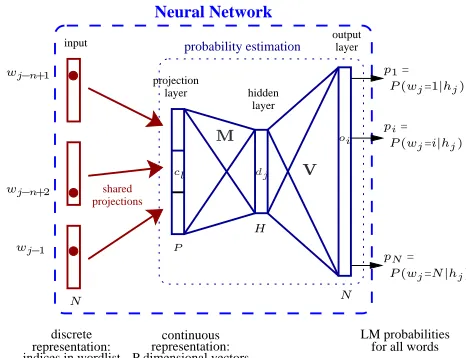
The architecture of the neural network n-gram
model is shown in Figure 2. A standard
fully-connected multi-layer perceptron is
used. The inputs to the neural network are
the indices of the n−1 previous units (words
or tuples) in the vocabulary hj=wj−n+1,
. . . , wj−2, wj−1 and the outputs are the
poste-rior probabilities of all units of the vocabulary:
projection
layer hidden layer
output layer input
projections shared
LM probabilities for all words probability estimation
Neural Network
discrete representation: indices in wordlist
continuous representation: P dimensional vectors
N
wj−1 P
H
N
P(wj=1|hj) wj−n+1
wj−n+2
P(wj=i|hj)
P(wj=N|hj) cl
oi
M
V
dj
p1=
[image:4.612.73.297.55.190.2]pN= pi=
Figure 2: Architecture of the continuous space LM.
hj denotes the contextwj−n+1, . . . , wj−1. P is the
size of one projection and H,N is the size of the
hidden and output layer respectively. When short-lists are used the size of the output layer is much smaller than the size of the vocabulary.
P(wj =i|hj) ∀i∈[1, N] (3)
whereN is the size of the vocabulary. The input
uses the so-called 1-of-n coding, i.e., theith unit of
the vocabulary is coded by setting theith element of
the vector to 1 and all the other elements to 0. The
ith line of theN×P dimensional projection matrix
corresponds to the continuous representation of the
ith unit. Let us denote cl these projections, dj the
hidden layer activities,oi the outputs,pi their
soft-max normalization, andmjl,bj,vij andki the
hid-den and output layer weights and the corresponding biases. Using these notations, the neural network performs the following operations:
dj = tanh
X
l
mjlcl+bj
!
(4)
oi =
X
j
vijdj+ki (5)
pi = eoi / N
X
r=1
eor (6)
The value of the output neuronpicorresponds
Training is performed with the standard back-propagation algorithm minimizing the following er-ror function:
E=
N
X
i=1
tilog pi+β
X
jl
m2jl+X
ij
vij2
(7)
whereti denotes the desired output, i.e., the
proba-bility should be 1.0 for the next unit in the training sentence and 0.0 for all the other ones. The first part of this equation is the cross-entropy between the out-put and the target probability distributions, and the second part is a regularization term that aims to pre-vent the neural network from over-fitting the
train-ing data (weight decay). The parameterβ has to be
determined experimentally. Training is done using a re-sampling algorithm as described in (Schwenk, 2007).
It can be shown that the outputs of a neural net-work trained in this manner converge to the posterior probabilities. Therefore, the neural network directly minimizes the perplexity on the training data. Note also that the gradient is back-propagated through the projection-layer, which means that the neural net-work learns the projection of the units onto the con-tinuous space that is best for the probability estima-tion task.
In general, the complexity to calculate one prob-ability with this basic version of the neural network
n-gram model is dominated by the dimension of the
output layer since the size of the vocabulary (10k to 64k) is usually much larger than the dimension of the hidden layer (200 to 500). Therefore, in previous
applications of the continuous spacen-gram model,
the output was limited to thesmost frequent units,s
ranging between 2k and 12k (Schwenk, 2007). This is called a short-list.
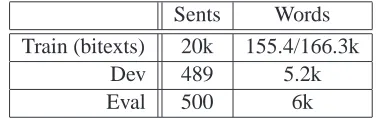
Sents Words
Train (bitexts) 20k 155.4/166.3k
Dev 489 5.2k
[image:5.612.90.278.613.672.2]Eval 500 6k
Table 1: Available data in the supplied resources of
the 2006 IWSLT evaluation.
4 Experimental Evaluation
In this work we report results on the Basic
Travel-ing Expression Corpus (BTEC) as used in the 2006 evaluations of the international workshop on spoken
language translation (IWSLT). This corpus consists
of typical sentences from phrase books for tourists in several languages (Takezawa et al., 2002). We report results on the supplied development corpus of 489
sentences and the official test set of the IWSLT’06
evaluation. The main measure is the BLEU score, using seven reference translations. The scoring is case insensitive and punctuations are ignored. De-tails on the available data are summarized in Table 1. We concentrated first on the translation from
Ital-ian to English. All participants in the IWSLT
evalua-tion achieved much better performances for this lan-guage pair than for the other considered translation directions. This makes it more difficult to achieve additional improvements.
A non-monotonic search was performed follow-ing a local reorderfollow-ing named in Section 2, settfollow-ing
m = 5and j = 3. Also we used histogram
prun-ing in the decoder, i.e. the maximum number of hy-potheses in a stack is limited to 50.
4.1 Language-dependent preprocessing
Italian contracted prepositions have been separated
into preposition + article, such as ’alla’→’a la’,
’degli’→’di gli’ or ’dallo’→’da lo’, among others.
4.2 Model training
The training and development data for the bilingual back-off and neural network translation model were created as follows. Given the alignment of the train-ing parallel corpus, we perform a unique segmenta-tion of each parallel sentence following the criterion of unfolded segmentation seen in Section 2. This segmentation is used in a sequence as training text for building the language model. As an example, given the alignment and the unfold extraction of Fig-ure 1, we obtain the following training sentence:
<s> how long#cu´anto does#NULL last#dura the#el flight#vuelo</s>
us-ing the SRI LM toolkit (Stolcke, 2002). Different smoothing techniques were tried, and best results were obtained using Good-Turing discounting.
The neural network approach was trained on ex-actly the same data. A context of two tuples was used (trigram model). The training corpus contains about 21,500 different bilingual tuples. We decided to limit the output of the neural network to the 8k most frequent tuples (short-list). This covers about
90% of the requested tuplen-grams in the training
data.
Similar to previous applications, the neural net-work is not used alone but interpolation is performed
to combine severaln-gram models. First of all, the
neural network and the reference back-off model are interpolated together - this always improved perfor-mance since both seem to be complementary. Sec-ond, four neural networks with different sizes of the continuous representation were trained and interpo-lated together. This usually achieves better general-ization behavior than training one larger neural net-work. The interpolation coefficients were calculated by optimizing perplexity on the development data, using an EM procedure. The obtained values are 0.33 for the back-off translation model and about 0.16 for each neural network model respectively. This interpolation is used in all our experiments. For the sake of simplicity we will still call this the con-tinuous space translation model.
Each network was trained independently using early stopping on the development data. Conver-gence was achieved after about 10 iterations through the training data (less than 20 minutes of processing on a standard Linux machine). The other parameters are as follows:
• Context of two tuples (trigram)
• The dimension of the continuous representation
of the tuples werec=120,140,150 and 200,
• The dimension of the hidden layer was set to
P = 200,
• The initial learning rate was 0.005 with an
ex-ponential decay,
• The weight decay coefficient was set to β =
0.00005.
N-gram models are usually evaluated using per-plexity on some development data. In our case, i.e. using bilingual tuples as basic units (“words”), it is less obvious if perplexity is a useful measure. Nev-ertheless, we provide these numbers for complete-ness. The perplexity on the development data of the trigram back-off translation model is 227.0. This could be reduced to 170.4 using the neural network.
It is also very informative to analyze the n-gram
hit-rates of the back-off model on the development data: 10% of the probability requests are actually a true trigram, 40% a bigram and about 49% are fi-nally estimated using unigram probabilities. This means that only a limited amount of phrase con-text is used in the standard N-gram-based translation model. This makes this an ideal candidate to ap-ply the continuous space model since probabilities are interpolated for all possible contexts and never backed-up to shorter contexts.
4.3 Results and analysis
The incorporation of the neural translation model
is done using n-best list. Each hypothesis is
com-posed of a sequence of bilingual tuples and the cor-responding scores of all the feature functions. Fig-ure 3 shows an example of such an n-best list. The neural trigram translation model is used to replace the scores of the trigram back-off translation model. This is followed by a re-optimization of the coef-ficients of all feature functions, i.e. maximization of the BLEU score on the development data using the numerical optimization tool CONDOR (Berghen and Bersini, 2005). An alternative would be to add a feature function and to combine both translation models under the log-linear model framework, us-ing maximum BLEU trainus-ing.
Another open question is whether it might by better to already use the continuous space transla-tion model during decoding. The continuous space model has a much higher complexity than a
back-offn-gram. However, this can be heavily optimized
when rescoring n-best lists, i.e. by grouping
spiacente#sorry tutto occupato#it ’s full spiacente#i ’m sorry tutto occupato#it ’s full spiacente#i ’m afraid tutto occupato#it ’s full spiacente#sorry tutto#all occupato#busy spiacente#sorry tutto#all occupato#taken
Figure 3: Example of sentences in the n-best list of bilingual tuples. The special character ’#’ is used to separate the source and target sentence words. Sev-eral words in one tuple a grouped together using ’ .’
In all our experiments 1000-best lists were used. In order to evaluate the quality of these n-best lists, an oracle trigram back-off translation model was build on the development data. Rescoring the n-best lists with this translation model resulted in an increase of the BLEU score of about 10 points (see Table 2). While there is an decrease of about 6% for the position dependent word error rate (mWER), a smaller change in the position independent word error rate was observed (mPER). This suggests that most of the alternative translation hypothesis re-sult in word reorderings and not in many alternative word choices. This is one of the major drawbacks of phrase- and N-gram-based translation systems: only translations observed in the training data can be used. There is no generalization to new phrase pairs.
Back-off Oracle Neural
BLEU 42.34 52.45 43.87
mWER 41.6% 35.6% 40.3%
mPER 31.5% 28.2% 30.7%
Table 2: Comparison of different
N-gram-translation models on the development data.
When the 1000-best lists are rescored with the neural network translation model the BLEU score increases by 1.5 points (42.34 to 43.87). Similar im-provements were observed in the word error rates (see Table 2). For comparison, a 4-gram back-off translation model was also built, but no change of the BLEU score was observed. This suggests that careful smoothing is more important than increasing the context when estimating the translation probabil-ities in an N-gram-based statistical machine transla-tion system.
In previous work, we have investigated the use of the neural network approach to modeling the target
language for the IWSLT task (Schwenk et al., 2006).
We also applied this technique to this improved N-gram-based translation system. In our implemen-tation, the neural network target 4-gram language model gives an improvement of 1.3 points BLEU on the development data (42.34 to 43.66), in com-parison to 1.5 points for the neural translation model (see Table 3).
Back-off neural neural neural
TM+LM TM LM TM+LM
BLEU 42.34 43.87 43.66 44.83
Table 3: Combination of a neural translation model (TM) and a neural language model (LM). BLEU scores on the development data.
The neural translation and target language model were also applied to the test data, using of course the same feature function coefficients as for the devel-opment data. The results are given in Table 4 for all
the official measures of the IWSLT evaluation. The
new smoothing method of the translation probabili-ties achieves improvement in all measures. It gives also an additional gain (again in all measures) when used together with a neural target language model. Surprisingly, neural TM and neural LM improve-ments almost add up: when both techniques are used together, the BLEU scores increases by 1.5 points
(36.97→ 38.50). Remember that the reference
N-gram-based translation system already uses a local reordering approach.
Back-off neural neural neural
TM+LM TM LM TM+LM
BLEU 36.97 37.21 38.04 38.50
mWER 48.10 47.42 47.83 47.61
mPER 38.21 38.07 37.26 37.12
NIST 8.3 8.3 8.6 8.7
[image:7.612.92.279.453.509.2]Meteor 63.16 63.40 64.70 65.20
5 Discussion
Phrase-based approaches are the de-facto standard in statistical machine translation. The phrases are extracted automatically from the word alignments of parallel texts, and the different possible transla-tions of a phrase are weighted using relative fre-quency. This can be problematic when the data is sparse. However, there seems to be little work on possible improvements of the relative frequency es-timates by some smoothing techniques. It is today common practice to use additional feature functions like IBM-1 scores to obtain some kind of smoothing (Och et al., 2004; Koehn et al., 2003; Zens and Ney, 2004), but better estimation of the phrase probabili-ties is usually not addressed.
An alternative way to represent phrases is to fine bilingual tuples. Smoothing, and context
de-pendency, is obtained by using ann-gram model on
these tuples. In this work, we have extended this approach by using a new smoothing technique that operates on a continuous representation of the tu-ples. Our method is distinguished by two charac-teristics: better estimation of the numerous unseen
n-grams, and a discriminative estimation of the
tu-ple probabilities. Results are provided on the BTEC
task of the 2006 IWSLTevaluation for the translation
direction Italian to English. This task provides very limited amount of resources in comparison to other tasks. Therefore, new techniques must be deployed to take the best advantage of the limited resources. We have chosen the Italian to English task because it is challenging to enhance a good quality translation task (over 40 BLEU percentage). Using the continu-ous space model for the translation and target lan-guage model, an improvement of 2.5 BLEU on the development data and 1.5 BLEU on the test data was observed.
Despite these encouraging results, we believe that additional research on improved estimation of prob-abilities in N-gram- or phrase-based statistical
ma-chine translation systems is needed. In
particu-lar, the problem of generalization to new trans-lations seems to be promising to us. This could be addressed by the so-called factored phrase-based model as implemented in the Moses decoder (Koehn et al., 2007). In this approach words are decom-posed into several factors. These factors are
trans-lated and a target phrase is generated. This model could be complemented by a factored continuous
tuple N-gram. Factored word language models
were already successfully used in speech recogni-tion (Bilmes and Kirchhoff, 2003; Alexandrescu and Kirchhoff, 2006) and an extension to machine trans-lation seems to be promising.
The described smoothing method was explicitly developed to tackle the data sparseness problem in
tasks like the BTEC corpus. It is well known from
language modeling that careful smoothing is less im-portant when large amounts of data are available. We plan to investigate whether this also holds for smoothing of the probabilities in phrase- or tuple-based statistical machine translation systems.
6 Acknowledgments
This work has been partially funded by the European
Union under the integrated project TC-STAR
(IST-2002-FP6-506738), by the French Government
un-der the project INSTAR(ANR JCJC06 143038) and
the the Spanish government under a FPU grant and
the project AVIVAVOZ(TEC2006-13964-C03).
References
A. Alexandrescu and K. Kirchhoff. 2006. Factored neu-ral language models. In HLT-NAACL.
Y. Bengio, R. Ducharme, P. Vincent, and C. Jauvin. 2003. A neural probabilistic language model. Journal of
Ma-chine Learning Research, 3(2):1137–1155.
F. Vanden Berghen and H. Bersini. 2005. CON-DOR, a new parallel, constrained extension of pow-ell’s UOBYQA algorithm: Experimental results and comparison with the DFO algorithm. Journal of
Com-putational and Applied Mathematics, 181:157–175.
J. A. Bilmes and K. Kirchhoff. 2003. Factored language models and generalized backoff. In HLT-NAACL.
P. Brown, S. Della Pietra, V. J. Della Pietra, and R: Mer-cer. 1993. The mathematics of statistical machine translation. Computational Linguistics, 19(2):263–
311.
F. Casacuberta, D. Llorens, C. Mart´ınez, S. Molau, F. Nevado, H. Ney, M. Pastor, D. Pic´o, A. Sanchis, E. Vidal, and J.M. Vilar. 2001. Speech-to-speech translation based on finite-state transducers.
S. F. Chen and J. T. Goodman. 1999. An empirical study of smoothing techniques for language modeling. CSL, 13(4):359–394.
G. Foster, R. Kuhn, and H. Johnson. 2006. Phrasetable smoothing for statistical machine translation. In
EMNLP06, pages 53–61.
P. Koehn, F. J. Och, and D. Marcu. 2003. Statistical phrased-based machine translation. In Human
Lan-guage Technology Conference (HLT-NAACL), pages
127–133.
Philipp Koehn, Hieu Hoang, Alexandra Birch, Chris Callison-Burch, Marcello Federico, Nicola Bertoldi, Brooke Cowan, Wade Shen, Christine Moran, Richard Zens, Chris Dyer, Ondrej Bojar, Alexandra Con-stantin, and Evan Herbst. 2007. Moses: Open source toolkit for statistical machine translation. In
Proceed-ings of ACL, demonstration session.
J.B. Mari˜no, R.E. Banchs, J.M. Crego, A. de Gispert, P. Lambert, J.A.R. Fonollosa, and M. R. Costa-juss`a. 2006. Bilingual n-gram statistical machine transla-tion. Computational Linguistics, 32(4):527–549, De-cember.
F. J. Och and H. Ney. 2002. Discriminative training and maximum entropy models for statistical machine translation. In ACL, pages 295–302.
F. J. Och, C. Tillmann, and H. Ney. 1999. Improved alignment models for statistical machine translation. In Joint SIGDAT Conference on Empirical Methods in
Natural Language Processing and Very Large Copora,
pages 20–28.
F.-J. Och, D. Gildea, S. Khudanpur, A. Sarkar, K. Ya-mada, A. Fraser, S. Kumar, L. Shen, D. Smith, K. Eng, V. Jain, Z. Jin, and D. Radev. 2004. A smorgasbord of features for statistical machine translation. In
HLT-NAACL, pages 161–168.
M. Paul. 2006. Overview of the IWSLT 2006 campaign. In IWSLT, pages 1–15.
H. Schwenk, M. R. Costa-juss`a, and J. A. R. Fonollosa. 2006. Continuous space language models for the iwslt 2006 task. IWSLT, pages 166–173.
H. Schwenk. 2007. Continuous space language models.
Computer Speech and Language, 21:492–518.
A. Stolcke. 2002. SRILM - an extensible language mod-eling toolkit. In ICSLP, pages II: 901–904.
T. Takezawa, E. Sumita, F. Sugaya, H. Yamamoto, and S. Yamamoto. 2002. Toward a borad-coverage bilin-gual corpus for speech translation of travel conversa-tions in the real world. In LREC, pages 147–152.