Improving Word Sense Disambiguation Using Topic Features
Jun Fu Cai, Wee Sun Lee Department of Computer Science National University of Singapore 3 Science Drive 2, Singapore 117543
{caijunfu, leews}@comp.nus.edu.sg
Yee Whye Teh
Gatsby Computational Neuroscience Unit University College London
17 Queen Square, London WC1N 3AR, UK [email protected]
Abstract
This paper presents a novel approach for ex-ploiting the global context for the task of word sense disambiguation (WSD). This is done by using topic features constructed us-ing the latent dirichlet allocation (LDA) al-gorithm on unlabeled data. The features are incorporated into a modified na¨ıve Bayes network alongside other features such as part-of-speech of neighboring words, single words in the surrounding context, local col-locations, and syntactic patterns. In both the English all-words task and the English lex-ical sample task, the method achieved sig-nificant improvement over the simple na¨ıve Bayes classifier and higher accuracy than the best official scores on Senseval-3 for both task.
1 Introduction
Natural language tends to be ambiguous. A word often has more than one meanings depending on the context. Word sense disambiguation (WSD) is a nat-ural language processing (NLP) task in which the correct meaning (sense) of a word in a given context is to be determined.
Supervised corpus-based approach has been the most successful in WSD to date. In such an ap-proach, a corpus in which ambiguous words have been annotated with correct senses is first collected. Knowledge sources, or features, from the context of the annotated word are extracted to form the training data. A learning algorithm, like the support vector
machine (SVM) or na¨ıve Bayes, is then applied on the training data to learn the model. Finally, in test-ing, the learnt model is applied on the test data to assign the correct sense to any ambiguous word.
The features used in these systems usually in-clude local features, such as part-of-speech (POS) of neighboring words, local collocations , syntac-tic patterns and global features such as single words in the surrounding context (bag-of-words) (Lee and Ng, 2002). However, due to the data scarcity prob-lem, these features are usually very sparse in the training data. There are, on average, 11 and 28 training cases per sense in Senseval 2 and 3 lexi-cal sample task respectively, and 6.5 training cases per sense in the SemCor corpus. This problem is especially prominent for the bag-of-words feature; more than hundreds of bag-of-words are usually ex-tracted for each training instance and each feature could be drawn from any English word. A direct consequence is that the global context information, which the bag-of-words feature is supposed to cap-ture, may be poorly represented.
Our approach tries to address this problem by clustering features to relieve the scarcity problem, specifically on the bag-of-words feature. In the pro-cess, we construct topic features, trained using the latent dirichlet allocation (LDA) algorithm. We train the topic model (Blei et al., 2003) on unlabeled data, clustering the words occurring in the corpus to a pre-defined number of topics. We then use the resulting topic model to tag the bag-of-words in the labeled corpus with topic distributions. We incorporate the distributions, called the topic features, using a sim-ple Bayesian network, modified from na¨ıve Bayes
model, alongside other features and train the model on the labeled corpus. The approach gives good per-formance on both the lexical sample and all-words tasks on Senseval data.
The paper makes mainly two contributions. First, we are able to show that a feature that efficiently captures the global context information using LDA algorithm can significantly improve the WSD ac-curacy. Second, we are able to obtain this feature from unlabeled data, which spares us from any man-ual labeling work. We also showcase the potential strength of Bayesian network in the WSD task, ob-taining performance that rivals state-of-arts meth-ods.
2 Related Work
Many WSD systems try to tackle the data scarcity problem. Unsupervised learning is introduced pri-marily to deal with the problem, but with limited success (Snyder and Palmer, 2004). In another ap-proach, the learning algorithm borrows training in-stances from other senses and effectively increases the training data size. In (Kohomban and Lee, 2005), the classifier is trained using grouped senses for verbs and nouns according to WordNet top-level synsets and thus effectively pooling training cases across senses within the same synset. Similarly, (Ando, 2006) exploits data from related tasks, using all labeled examples irrespective of target words for learning each sense using the Alternating Structure Optimization (ASO) algorithm (Ando and Zhang, 2005a; Ando and Zhang, 2005b). Parallel texts is proposed in (Resnik and Yarowsky, 1997) as po-tential training data and (Chan and Ng, 2005) has shown that using automatically gathered parallel texts for nouns could significantly increase WSD ac-curacy, when tested on Senseval-2 English all-words task.
Our approach is somewhat similar to that of us-ing generic language features such as POS tags; the words are tagged with its semantic topic that may be trained from other corpuses.
3 Feature Construction
We first present the latent dirichlet allocation algo-rithm and its inference procedures, adapted from the original paper (Blei et al., 2003).
3.1 Latent Dirichlet Allocation
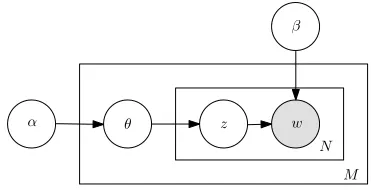
LDA is a probabilistic model for collections of dis-crete data and has been used in document model-ing and text classification. It can be represented as a three level hierarchical Bayesian model, shown graphically in Figure 1. Given a corpus consisting of
M documents, LDA models each document using a mixture overK topics, which are in turn character-ized as distributions over words.
β
w z
θ α
N
[image:2.612.333.519.192.287.2]M
Figure 1: Graphical Model for LDA
In the generative process of LDA, for each doc-ument d we first draw the mixing proportion over topicsθdfrom a Dirichlet prior with parametersα. Next, for each of theNdwordswdnin documentd, a topiczdn is first drawn from a multinomial distribu-tion with parametersθd. Finallywdn is drawn from the topic specific distribution over words. The prob-ability of a word token w taking on valuei given that topicz =jwas chosen is parameterized using a matrixβ withβij =p(w= i|z =j). Integrating outθd’s andzdn’s, the probabilityp(D|α, β)of the corpus is thus:
M
Y
d=1
Z
p(θd|α) Nd Y
n=1
X
zdn
p(zdn|θd)p(wdn|zdn, β)
!
dθd
3.1.1 Inference
Unfortunately, it is intractable to directly solve the posterior distribution of the hidden variables given a document, namelyp(θ,z|w, α, β). However, (Blei et al., 2003) has shown that by introducing a set of variational parameters,γ andφ, a tight lower bound on the log likelihood of the probability can be found using the following optimization procedure:
(γ∗, φ∗) = arg min
γ,φ
where
q(θ,z|γ, φ) =q(θ|γ)
N
Y
n=1
q(zn|φn),
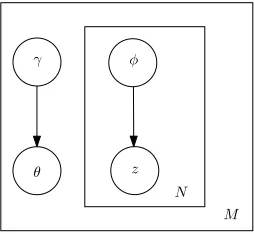
γ is the Dirichlet parameter forφand the multino-mial parameters(φ1· · ·φN)are the free variational parameters. Note here γ is document specific in-stead of corpus specific likeα. Graphically, it is rep-resented as Figure 2. The optimizing values ofγand
φcan be found by minimizing the Kullback-Leibler (KL) divergence between the variational distribution and the true posterior.
γ
θ
φ
z
N
[image:3.612.320.532.191.358.2]M
Figure 2: Graphical Model for Variational Inference
3.2 Baseline Features
For both the lexical sample and all-words tasks, we use the following standard baseline features for comparison.
POS Tags For each training or testing word, w, we include POS tags forP words prior to as well as afterwwithin the same sentence boundary. We also include the POS tag of w. If there are fewer than
P words prior or after win the same sentence, we denote the corresponding feature as NIL.
Local Collocations Collocation Ci,j refers to the ordered sequence of tokens (words or punctuations) surroundingw. The starting and ending position of the sequence are denotediandjrespectively, where a negative value refers to the token position prior to
w. We adopt the same 11 collocation features as (Lee and Ng, 2002), namelyC−1,−1,C1,1,C−2,−2,
C2,2, C−2,−1, C−1,1, C1,2, C−3,−1, C−2,1, C−1,2, andC1,3.
Bag-of-Words For each training or testing word,
w, we getGwords prior to as well as afterw, within the same document. These features are position in-sensitive. The words we extract are converted back to their morphological root forms.
Syntactic Relations We adopt the same syntactic relations as (Lee and Ng, 2002). For easy reference, we summarize the features into Table 1.
POS ofw Features
Noun Parent headwordh
POS ofh
Relative position ofhtow
Verb Left nearest child word ofw,l
Right nearest child word ofw,r
POS ofl
POS ofr
POS ofw
Voice ofw
Adjective Parent headwordh
POS ofh
Table 1: Syntactic Relations Features
The exact values ofP andGfor each task are set according to cross validation result.
3.3 Topic Features
We first select an unlabeled corpus, such as 20 Newsgroups, and extract individual words from it (excluding stopwords). We choose the number of topics,K, for the unlabeled corpus and we apply the LDA algorithm to obtain the β parameters, where
β represents the probability of a word wi given a topic zj, p(wi|zj) = βij. The model essentially clusters words that occurred in the unlabeled cor-pus according to K topics. The conditional prob-abilityp(wi|zj) = βij is later used to tag the words in the unseen test example with the probability of each topic.
[image:3.612.122.249.251.368.2]selecting topiciin the document:
p(zi|γ) =
γi
P
Kγk
. (1)
4 Classifier Construction
4.1 Bayesian Network
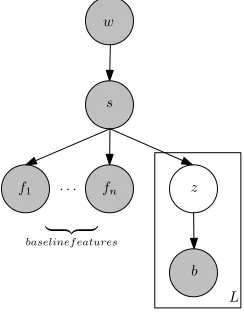
We construct a variant of the na¨ıve Bayes network as shown in Figure 3. Here, w refers to the word.
srefers to the sense of the word. In training, sis observed while in testing, it is not. The featuresf1 tofnare baseline features mentioned in Section 3.2 (including bag-of-words) while z refers to the la-tent topic that we set for clustering unlabeled corpus. The bag-of-words b are extracted from the neigh-bours ofwand there areLof them. Note thatLcan be different fromG, which is the number of bag-of-words in baseline features. Both will be determined by the validation result.
· · ·
| {z }
baselinef eatures w
s
fn f1
b z
[image:4.612.125.247.332.489.2]L
Figure 3: Graphical Model with LDA feature
The log-likelihood of an instance, `(w, s, F, b)
whereF denotes the set of baseline features, can be written as
= logp(w) +logp(s|w) +X
F
log(p(f|s))
+X
L
log X K
p(zk|s)p(bl|zk)
!
.
Thelogp(w)term is constant and thus can be ig-nored. The first portion is normal na¨ıve Bayes. And second portion represents the additional LDA plate.
We decouple the training process into three separate stages. We first extract baseline features from the task training data, and estimate, using normal na¨ıve Bayes, p(s|w) andp(f|s) for all w, sand f. The parameters associated withp(b|z)are estimated us-ing LDA from unlabeled data. Finally we estimate the parameters associated with p(z|s). We experi-mented with three different ways of both doing the estimation as well as using the resulting model and chose one which performed best empirically.
4.1.1 Expectation Maximization Approach
For p(z|s), a reasonable estimation method is to use maximum likelihood estimation. This can be done using the expectation maximization (EM) algo-rithm. In classification, we just chooses∗that maxi-mizes the log-likelihood of the test instance, where:
s∗ = arg max
s
`(w, s, F, b)
In this approach,γis never used which means the LDA inference procedure is not used on any labeled data at all.
4.1.2 Soft Tagging Approach
Classification in this approach is done using the full Bayesian network just as in the EM approach. However we do the estimation ofp(z|s)differently. Essentially, we perform LDA inference on the train-ing corpus in order to obtainγ for each document. We then use the γ andβ to obtain p(z|b) for each word using
p(zi|bl, γ) =
p(bl|zi)p(zi|γ)
P
Kp(bl|zk)p(zk|γ)
,
where equation [1] is used for estimation ofp(zi|γ). This effectively transforms b to a topical distri-bution which we call a soft tag where each soft tag is probability distribution t1, . . . , tK on topics. We then use this topical distribution for estimating
p(z|s). Let si be the observed sense of instance i
and tij1, . . . , tijK be the soft tag of the j-th bag-of-word feature of instancei. We estimatep(z|s)as
p(zjk|s) =
P
si=st
ij k
P
si=s P
k0tijk0
(2)
not the testing data. This is because we needγ to get transformed topical distribution in order to learn
p(z|s)in the training. In the testing, we only apply the learnt parameters to the model.
4.1.3 Hard Tagging Approach
Hard tagging approach no longer assumes thatzis latent. Afterp(z|b) is obtained using the same pro-cedure in Section 4.1.2, the topic zi with the high-estp(zi|b)among allKtopics is picked to represent
z. In this way, b is transformed into a single most “prominent” topic. This topic label is used in the same way as baseline features for both training and testing in a simple na¨ıve Bayes model.
This approach requires us to perform the transfor-mation both on the training as well as testing data, sincez becomes an observed variable. LDA infer-ence is done on two corpora, one formed by the training data and the other by testing data, in order to get the respective values ofγ.
4.2 Support Vector Machine Approach
In the SVM (Vapnik, 1995) approach, we first form a training and a testing file using all standard features for each sense following (Lee and Ng, 2002) (one classifier per sense). To incorporate LDA feature, we use the same approach as Section 4.1.2 to trans-form b into soft tags, p(z|b). As SVM deals with only observed features, we need to transformbboth in the training data and in the testing data. Compared to (Lee and Ng, 2002), the only difference is that for each training and testing case, we have additional
L∗KLDA features, since there areLbag-of-words and each has a topic distribution represented byK
values.
5 Experimental Setup
We describe here the experimental setup on the En-glish lexical sample task and all-words task.
We use MXPOST tagger (Adwait, 1996) for POS tagging, Charniak parser (Charniak, 2000) for ex-tracting syntactic relations, SVMlight1 for SVM classifier and David Blei’s version of LDA2for LDA training and inference. All default parameters are used unless mentioned otherwise. For all standard
1http://svmlight.joachims.org
2
http://www.cs.princeton.edu/˜blei/lda-c/
baseline features, we use Laplace smoothing but for the soft tag (equation [2]), we use a smoothing pa-rameter value of 2.
5.1 Development Process
5.1.1 Lexical Sample Task
We use the Senseval-2 lexical sample task for preliminary investigation of different algorithms, datasets and other parameters. As the dataset is used extensively for this purpose, only the Senseval-3 lex-ical sample task is used for evaluation.
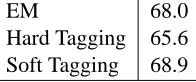
Selecting Bayesian Network The best achievable result, using the three different Bayesian network approaches, when validating on Senseval-2 test data is shown in Table 2. The parameters that are used areP = 3 andG= 3.
EM 68.0
[image:5.612.378.476.295.336.2]Hard Tagging 65.6 Soft Tagging 68.9
Table 2: Results on Senseval-2 English lexical sam-ple using different Bayesian network approaches.
From the results, it appears that both the EM and the Hard Tagging approaches did not yield as good results as the Soft Tagging approach did. The EM approach ignores the LDA inference result,γ, which we use to get our topic prior. This information is document specific and can be regarded as global context information. The Hard Tagging approach also uses less information, as the original topic dis-tribution is now represented only by the topic with the highest probability of occurring. Therefore, both methods have information loss and are disadvan-taged against the Soft Tagging approach. We use the Soft Tagging approach for the Senseval-3 lexical sample and the all-words tasks.
The relative effect using different corpus and com-binations of them is shown in Table 3, when validat-ing on Senseval-2 test data usvalidat-ing the Soft Taggvalidat-ing approach.
Corpus |w| K L Senseval-2 20 Newsgroups 1.7M 40 60 67.9 Reuters 1.3M 30 60 65.5
SemCor 0.3M 30 60 66.9
Senseval-2 0.6M 30 40 66.9 Senseval-3 0.6M 50 60 67.6
[image:6.612.324.534.56.182.2]All 4.5M 60 40 68.9
Table 3: Effect of using different corpus for LDA training, |w|represents the corpus size in terms of the number of words in the corpus
The 20 Newsgroups corpus yields the best result if used individually. It has a relatively larger corpus size at 1.7 million words in total and also a well bal-anced topic distribution among its documents, rang-ing across politics, finance, science, computrang-ing, etc. The Reuters corpus, on the other hand, focuses heav-ily on finance related articles and has a rather skewed topic distribution. This probably contributed to its inferior result. However, we found that the best re-sult comes from combining all the corpora together withK = 60andL= 40.
Results for Optimized Configuration As base-line for the Bayesian network approaches, we use na¨ıve Bayes with all baseline features. For the base-line SVM approach, we chooseP = 3 and include all the words occurring in the training and testing passage as bag-of-words feature.
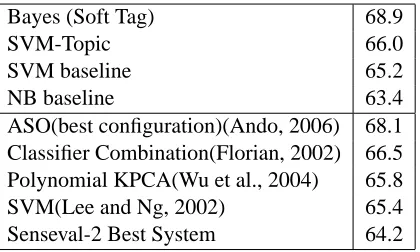
The F-measure result we achieve on Senseval-2 test data is shown in Table 4. Our four systems are listed as the top four entries in the table. Soft Tag refers to the soft tagging Bayesian network ap-proach. Note that we used the Senseval-2 test data for optimizing the configuration (as is done in the ASO result). Hence, the result should not be taken as reliable. Nevertheless, it is worth noting that the improvement of Bayesian network approach over its baseline is very significant (+5.5%). On the other hand, SVM with topic features shows limited im-provement over its baseline (+0.8%).
Bayes (Soft Tag) 68.9
SVM-Topic 66.0
SVM baseline 65.2
NB baseline 63.4
ASO(best configuration)(Ando, 2006) 68.1 Classifier Combination(Florian, 2002) 66.5 Polynomial KPCA(Wu et al., 2004) 65.8 SVM(Lee and Ng, 2002) 65.4 Senseval-2 Best System 64.2
Table 4: Results (best configuration) compared to previous best systems on Senseval-2 English lexical sample task.
5.1.2 All-words Task
In the all-words task, no official training data is provided with Senseval. We follow the common practice of using the SemCor corpus as our training data. However, we did not use SVM approach in this task as there are too few training instances per sense for SVM to achieve a reasonably good accuracy.
As there are more training instances in SemCor,
230,000in total, we obtain the optimal configura-tion using 10 fold cross validaconfigura-tion on the SemCor training data. With the optimal configuration, we test our system on both Senseval-2 and Senseval-3 official test data.
For baseline features, we setP= 3 andB= 1. We choose a LDA training corpus comprising 20 News-groups and SemCor data, with number of topicsK
= 40 and number of LDA bag-of-wordsL= 14.
6 Results
We now present the results on both English lexical sample task and all-words task.
6.1 Lexical Sample Task
With the optimal configurations from Senseval-2, we tested the systems on Senseval-3 data. Table 5 shows our F-measure result compared to some of the best reported systems. Although SVM with topic features shows limited success with only a 0.6%
improvement, the Bayesian network approach has again demonstrated a good improvement of 3.8%
[image:6.612.75.296.128.227.2]Bayes (Soft Tag) 73.6
SVM-topic 73.0
SVM baseline 72.4
NB baseline 69.8
ASO(Ando, 2006) 74.1
[image:7.612.82.294.55.153.2]SVM-LSA (Strapparava et al., 2004) 73.3 Senseval-3 Best System(Grozea, 2004) 72.9
Table 5: Results compared to previous best systems on Senseval-3 English lexical sample task.
6.2 All-words Task
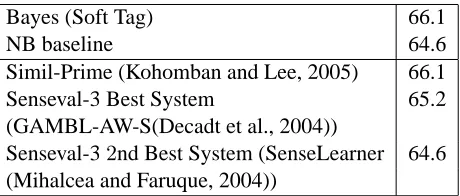
The F-measure micro-averaged result for our sys-tems as well as previous best syssys-tems for Senseval-2 and Senseval-3 all-words task are shown in Table 6 and Table 7 respectively. Bayesian network with soft tagging achieved 2.6%improvement over its base-line in Senseval-2 and1.7%in Senseval-3. The re-sults also rival some previous best systems, except for SMUaw (Mihalcea, 2002) which used additional labeled data.
Bayes (Soft Tag) 66.3
NB baseline 63.7
[image:7.612.77.297.360.444.2]SMUaw (Mihalcea, 2002) 69.0 Simil-Prime (Kohomban and Lee, 2005) 66.4 Senseval-2 Best System 63.6 (CNTS-Antwerp (Hoste et al., 2001))
Table 6: Results compared to previous best systems on Senseval-2 English all-words task.
Bayes (Soft Tag) 66.1
NB baseline 64.6
Simil-Prime (Kohomban and Lee, 2005) 66.1 Senseval-3 Best System 65.2 (GAMBL-AW-S(Decadt et al., 2004))
Senseval-32nd Best System (SenseLearner 64.6 (Mihalcea and Faruque, 2004))
Table 7: Results compared to previous best systems on Senseval-3 English all-words task.
6.3 Significance of Results
We perform theχ2-test, using the Bayesian network and its na¨ıve Bayes baseline (NB baseline) as pairs,
to verify the significance of these results. The result is reported in Table 8. The results are significant at 90% confidence level, except for the Senseval-3 all-words task.
[image:7.612.344.514.465.508.2]Senseval-2 Senseval-3 All-word 0.0527 0.2925 Lexical Sample <0.0001 0.0002
Table 8: P value for χ2-test significance levels of results.
6.4 SVM with Topic Features
The results on lexical sample task show that SVM benefits less from the topic feature than the Bayesian approach. One possible reason is that SVM base-line is able to use all bag-of-words from surround-ing context while na¨ıve Bayes baseline can only use very few without decreasing its accuracy, due to the sparse representation. In this sense, SVM baseline already captures some of the topical information, leaving a smaller room for improvement. In fact, if we exclude the bag-of-words feature from the SVM baseline and add in the topic features, we are able to achieve almost the same accuracy as we did with both features included, as shown in Table 9. This further shows that the topic feature is a better rep-resentation of global context than the bag-of-words feature.
SVM baseline 72.4
SVM baseline - BAG + topic 73.5
SVM-topic 73.6
Table 9: Results on Senseval-3 English lexical sam-ple task
6.5 Results on Different Parts-of-Speech
[image:7.612.75.305.504.602.2]0.64 0.645 0.65 0.655 0.66 0.665 0.67 0.675 0.68
0 2 4 6 8 10 12 14 16 18 L
K=10
3 3
3 3 3 3 3
3 3
K=20
+ +
+ +
+ + +
+ +
K=40
2 2 2
2
2 2
2 2 2
K=60
× ×
× × ×
× ×
× × K=80
4 4
4 4
4 4
4 4
[image:8.612.87.301.61.277.2]4
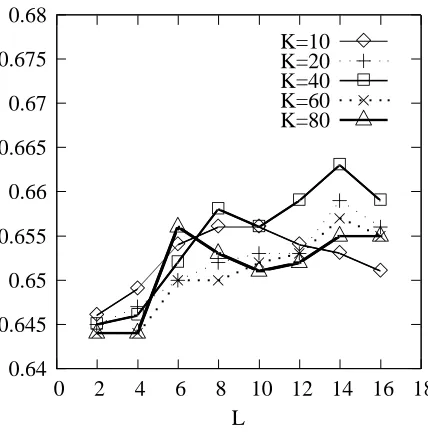
Figure 4: Accuracy with varing L and K on Senseval-2 all-words task
accuracy achieved by na¨ıve Bayes baseline and the Bayesian network. Adjectives show no improve-ment while verbs show a moderate+2.2% improve-ment. Nouns clearly benefit from topical informa-tion much more than the other two parts-of-speech, obtaining a+5.7%increase over its baseline.
POS Total NB baseline Bayes (Soft Tag)
Noun 1807 69.5 75.2
Verb 1978 71.1 73.5
Adj 159 57.2 57.2
Total 3944 69.8 73.6
Table 10: Improvement with different POS on Senseval-3 lexical sample task
6.6 Sensitivity to L and K
We tested on Senseval-2 all-words task using differ-ent L and K. Figure 4 is the result.
6.7 Results on SemEval-1
We participated in SemEval-1 English coarse-grained all-words task (task 7), English fine-coarse-grained all-words task (task 17, subtask 3) and English coarse-grained lexical sample task (task 17, subtask 1), using the method described in this paper. For all-words task, we use Senseval-2 and Senseval-3
all-words task data as our validation set to fine tune the parameters. For lexical sample task, we use the training data provided as the validation set.
We achieved 88.7%, 81.6% and 57.6% for coarse-grained lexical sample task, coarse-coarse-grained all-words task and fine-grained all-all-words task respec-tively. The results ranked first, second and fourth in the three tasks respectively.
7 Conclusion and Future Work
In this paper, we showed that by using LDA algo-rithm on bag-of-words feature, one can utilise more topical information and boost the classifiers accu-racy on both English lexical sample and all-words task. Only unlabeled data is needed for this improve-ment. It would be interesting to see how the feature can help on WSD of other languages and other nat-ural language processing tasks such as named-entity recognition.
References
Y. K. Lee and H. T. Ng. 2002. An Empirical Evaluation of Knowledge Sources and Learning Algorithms for Word Sense Disambiguation. In Proc. of EMNLP.
B. Snyder and M. Palmer. 2004. The English All-Words Task. In Proc. of Senseval-3.
U. S. Kohomban and W. S. Lee 2005. Learning Semantic Classes for Word Sense Disambiguation. In Proc. of
ACL.
R. K. Ando. 2006. Applying Alternating Structure Op-timization to Word Sense Disambiguation. In Proc. of
CoNLL.
Y. S. Chan and H. T. Ng 2005. Scaling Up Word Sense Disambiguation via Parallel Texts. In Proc. of AAAI.
R. K. Ando and T. Zhang. 2005a. A Framework for Learning Predictive Structures from Multiple Tasks and Unlabeled Data. Journal of Machine Learning
Re-search.
R. K. Ando and T. Zhang. 2005b. A High-Performance Semi-Supervised Learning Method for Text Chunking. In Proc. of ACL.
P. Resnik and D. Yarowsky. 1997. A Perspective on Word Sense Disambiguation Methods and Their Eval-uation. In Proc. of ACL.
D. M. Blei and A. Y. Ng and M. I. Jordan. 2003. La-tent Dirichlet Allocation. Journal of Machine
[image:8.612.74.298.427.499.2]A. Ratnaparkhi 1996. A Maximum Entropy Model for Part-of-Speech Tagging. In Proc. of EMNLP.
E. Charniak 2000. A Maximum-Entropy-Inspired
Parser. In Proc. of the 1st Meeting of the North
Ameri-can Chapter of the Association for Computational Lin-guistics.
V. N. Vapnik 1995. The Nature of Statistical Learning Theory. Springer-Verlag, New York.
R. Florian and D. Yarowsky 2002. Modeling consensus: Classifier Combination for Word Sense Disambigua-tion. In Proc. of EMNLP.
D. Wu and W. Su and M. Carpuat. 2004. A Kernel PCA Method for Superior Word Sense Disambiguation. In
Proc. of ACL.
C. Strapparava and A. Gliozzo and C. Giuliano 2004. Pattern Abstraction and Term Similarity for Word Sense Disambiguation: IRST at Senseval-3. In Proc.
of Senseval-3.
C. Grozea 2004. Finding Optimal Parameter Settings for High Performance Word Sense Disambiguation. In
Proc. of Senseval-3.
R. Mihalcea 2002. Bootstrapping Large Sense Tagged Corpora. In Proc. of the 3rd International Conference
on Languages Resources and Evaluations.
V. Hoste and A. Kool and W. Daelmans 2001. Classifier Optimization and Combination in English All Words Task. In Proc. of Senseval-2.
B. Decadt and V. Hoste and W. Daelmans 2004.
GAMBL, Genetic Algorithm Optimization of
Memory-Based WSD. In Proc. of Senseval-3.