Authorship Attribution with Latent Dirichlet Allocation
Yanir Seroussi Ingrid Zukerman
Faculty of Information Technology, Monash University Clayton, Victoria 3800, Australia
Fabian Bohnert
Abstract
The problem of authorship attribution – at-tributing texts to their original authors – has been an active research area since the end of the 19th century, attracting increased interest in the last decade. Most of the work on au-thorship attribution focuses on scenarios with only a few candidate authors, but recently con-sidered cases with tens to thousands of can-didate authors were found to be much more challenging. In this paper, we propose ways of employing Latent Dirichlet Allocation in authorship attribution. We show that our ap-proach yields state-of-the-art performance for both a few and many candidate authors, in cases where these authors wrote enough texts to be modelled effectively.
1 Introduction
The problem of authorship attribution – attributing texts to their original authors – has received con-siderable attention in the last decade (Juola, 2006; Stamatatos, 2009). Most of the work in this field fo-cuses on cases where texts must be attributed to one of a few candidate authors, e.g., (Mosteller and Wal-lace, 1964; Gamon, 2004). Recently, researchers have turned their attention to scenarios with tens to thousands of candidate authors (Koppel et al., 2011). In this paper, we study authorship attribution with few to many candidate authors, and introduce a new method that achieves state-of-the-art performance in the latter case.
Our approach to authorship attribution consists of building models of authors and their texts using La-tent Dirichlet Allocation (LDA) (Blei et al., 2003). We compare these models to models built from texts
with unknown authors to find the most likely authors of these texts (Section 3.2). Our evaluation shows that our approach yields a higher accuracy than the method recently introduced by Koppel et al. (2011) in several cases where prolific authors are consid-ered, while requiring less runtime (Section 4).
This paper is structured as follows. Related work is surveyed in Section 2. Our LDA-based approach to authorship attribution is described in Section 3, together with the baselines we considered in our evaluation. Section 4 presents and discusses the re-sults of our evaluation, and Section 5 discusses our conclusions and plans for future work.
2 Related Work
The field of authorship attribution predates modern computing. For example, in the late 19th century, Mendenhall (1887) suggested that word length can be used to distinguish works by different authors. In recent years, increased interest in authorship attribu-tion was fuelled by advances in machine learning, information retrieval, and natural language process-ing (Juola, 2006; Stamatatos, 2009).
Commonly used features in authorship attribu-tion range from “shallow” features, such as token and character n-gram frequencies, to features that require deeper analysis, such as part-of-speech and rewrite rule frequencies (Stamatatos, 2009). As in other text classification tasks, Support Vector Ma-chines (SVMs) have delivered high accuracy, as they are designed to handle feature vectors of high dimensionality (Juola, 2006). For example, one-vs.-all (OVA) is an effective approach to using bi-nary SVMs for multi-class (i.e., multi-author) prob-lems (Rifkin and Klautau, 2004). GivenAauthors,
OVA trainsA binary classifiers, where each classi-fier is trained on texts by one author as positive ex-amples and all the other texts as negative exex-amples. However, ifAis large, each classifier has many more negative than positive examples, often yielding poor results due to class imbalance (Raskutti and Kowal-czyk, 2004). Other setups, such as one-vs.-one or
directed acyclic graph, require trainingO(A2) clas-sifiers, making them impractical where thousands of authors exist.Multi-class SVMshave also been sug-gested, but they generally perform comparably to OVA while taking longer to train (Rifkin and Klau-tau, 2004). Hence, using SVMs for scenarios with many candidate authors is problematic (Koppel et al., 2011). Recent approaches to employing binary SVMs consider class similarity to improve perfor-mance (Bickerstaffe and Zukerman, 2010; Cheng et al., 2007). We leave experiments with such ap-proaches for future work (Section 5).
In this paper, we focus on authorship attribution with many candidate authors. This problem was pre-viously addressed by Madigan et al. (2005) and Luy-ckx and Daelemans (2008), who worked on datasets with texts by 114 and 145 authors respectively. In both cases, the reported results were much poorer than those reported in the binary case. More re-cently, Koppel et al. (2011) considered author sim-ilarity to handle cases with thousands of candidate authors. Their method, which we use as our base-line, is described in Section 3.1.
Our approach to authorship attribution utilises La-tent Dirichlet Allocation (LDA) (Blei et al., 2003) to build models of authors from their texts. LDA is a generative probabilistic model that is tradition-ally used to find topics in textual data. The main idea behind LDA is that each document in a cor-pus is generated from a distribution of topics, and each word in the document is generated according to the per-topic word distribution. Blei et al. (2003) showed that using LDA for dimensionality reduction can improve performance for supervised text clas-sification. We know of only one case where LDA was used in authorship attribution: Rajkumar et al. (2009) reported preliminary results on using LDA topic distributions as feature vectors for SVMs, but they did not compare the results obtained with LDA-based SVMs to those obtained with SVMs trained on tokens directly. Our comparison shows that both
methods perform comparably (Section 4.3).
Nonetheless, the main focus of our work is on authorship attribution with many candidate au-thors, where it is problematic to use SVMs. Our
LDA+Hellinger approach employs LDA without
SVM training (Section 3.2), yielding state-of-the-art performance in several scenarios (Section 4).
3 Authorship Attribution Methods
This section describes the authorship attribution methods considered in this paper. While all these methods can employ various representations of doc-uments, e.g., token frequencies or part-of-speech n-gram frequencies, we only experimented with token frequencies.1 This is because they are simple to ex-tract, and can achieve good performance (Section 4). Further, the focus of this paper is on comparing the performance of our methods to that of the baseline methods. Thus, we leave experiments on other fea-ture types for fufea-ture work (Section 5).
3.1 Baselines
We consider two baseline methods, depending on whether there are two or many candidate authors. If there are only two, we use Support Vector Ma-chines (SVMs), which have been shown to de-liver state-of-the-art performance on this task (Juola, 2006). If there are many, we follow Koppel et al.’s (2011) approach, which we denoteKOP.
The main idea behind KOP is that different pairs of authors may be distinguished by different sub-sets of the feature space. Hence, KOP randomly choosesk1 subsets of sizek2F (k2 <1) from a set
ofF features; for each of thek1 subsets, it
calcu-lates the cosine similarity between a test document and all the documents by one author (each author is represented by one feature vector); it then outputs the author who had most of the top matches. KOP also includes a thresholdσ∗ to handle cases where a higher level of precision is required, at the cost of lower recall. If the top-matching author was the top match less thanσ∗times, then KOP outputs “un-known author”. In our experiments we setσ∗ = 0to obtain full coverage, as this makes it easier to inter-pret the results using a single measure of accuracy.
1Token frequency is the token count divided by the total
3.2 Authorship Attribution with LDA
In this work, we follow the extended LDA model de-fined by Griffiths and Steyvers (2004). Under the as-sumptions of the extended model, given a corpus of
Mdocuments, a documentiwithNtokens is gener-ated by choosing a document topic distributionθi∼
Dir(α), where Dir(α) is aT-dimensional symmet-ric Disymmet-richlet distribution, and αandT are parame-ters of the model. Then, each token in the document
wij is generated by choosing a topic from the
docu-ment topic distributionzij ∼ Multinomial(θi), and
choosing a token from the token topic distribution
wij ∼Multinomial(φzij), whereφzij ∼Dir(β), and
β is a parameter of the model. The model can be inferred from the data using Gibbs sampling, as out-lined in (Griffiths and Steyvers, 2004) – an approach we follow in our experiments.
Note that the topics obtained by LDA do not have to correspond to actual, human-interpretable topics. A more appropriate name may be “latent factors”, but we adopt the convention of calling these fac-tors “topics” throughout this paper. The meaning of the factors depends on the type of tokens that are used as input to the LDA inference process. For example, if stopwords are removed from the cor-pus, the resulting factors often, but not necessarily, correspond to topics. However, if only stopwords are retained, as is commonly done in authorship at-tribution studies, the resulting factors lose their in-terpretability as topics; rather, they can be seen as stylistic markers. Note that even if stopwords are discarded, nothing forces the factors to stand for ac-tual topics. Indeed, in a preliminary experiment on a corpus of movie reviews and message board posts, we found that some factors correspond to topics, with words such as “noir” and “detective” consid-ered to be highly probable for one topic. However, other factors seemed to correspond to authorship style as reflected by authors’ vocabulary, with net-speak words such as “wanna”, “alot” and “haha” as-signed to one topic, and words such as “compelling” and “beautifully” assigned to a different topic.
We consider two ways of using LDA in authorship attribution: (1)Topic SVM, and (2)LDA+Hellinger. The LDA part of both approaches consists of apply-ing a frequency filter to the features in the trainapply-ing
documents,2 and then using LDA to reduce the di-mensionality of each document to a topic distribu-tion of dimensionalityT.
Topic SVM. The topic distributions are used as features for a binary SVM classifier that discrimi-nates between authors. This approach has been em-ployed in the past for document classification, e.g., in (Blei et al., 2003), but it has been applied to au-thorship attribution only in a limited study that con-sidered just stopwords (Rajkumar et al., 2009). In Section 4.3, we present the results of more thorough experiments in applying this approach to binary au-thorship attribution. Our results show that the per-formance of this approach is comparable to that ob-tained without using LDA. This indicates that we do not lose authorship-related information when em-ploying LDA, even though the dimensionality of the document representations is greatly reduced.
LDA+Hellinger. This method is our main contri-bution, as it achieves state-of-the-art performance in authorship attribution with many candidate authors, where it is problematic to use SVMs (Section 2).
The main idea of our approach is to use the
Hellinger distancebetween document topic distribu-tions to find the most likely author of a document:3
D(θ1, θ2) =
q
1 2
PT t=1
p θ1,t−
p θ2,t
2
whereθi
is a T-dimensional multinomial topic distribution, andθi,tis the probability of thet-th topic.
We propose two representations of an author’s documents:multi-documentandsingle-document.
• Multi-document (LDAH-M). The LDA model is built based on all the training documents. Given a test document, we measure the Hellinger distance between its topic distribu-tion and the topic distribudistribu-tions of the training documents. The author with the lowest mean distance for all of his/her documents is returned as the most likely author of the test document.
2
We employed frequency filtering because it has been shown to be a scalable and effective feature selection method for au-thorship attribution tasks (Stamatatos, 2009). We leave experi-ments with other feature selection methods for future work.
3
• Single-document (LDAH-S). Each author’s documents are concatenated into a single doc-ument (the profile document), and the LDA model is learned from the profile documents.4 Given a test document, the Hellinger distance between the topic distributions of the test docu-ment and all the profile docudocu-ments is measured, and the author of the profile document with the shortest distance is returned.
The time it takes to learn the LDA model de-pends on the number of Gibbs samplesS, the num-ber of tokens in the training corpusW, and the num-ber of topics T. For each Gibbs sample, the al-gorithm iterates through all the tokens in the cor-pus, and for each token it iterates through all the topics. Thus, the time complexity of learning the model isO(SW T). Once the model is learned, in-ferring the topic distribution of a test document of length N takes O(SN T). Therefore, the time it takes to classify a document when using LDAH-S isO(SN T+AT), whereAis the number of authors, andO(T)is the time complexity of calculating the Hellinger distance between twoT-dimensional dis-tributions. The time it takes to classify a docu-ment when using LDAH-M is O(SN T + M T), whereM is the total number of training documents, and M ≥ A, because every candidate author has written at least one document.
An advantage of LDAH-S over LDAH-M is that LDAH-S requires much less time to classify a test document when many documents per author are available. However, this improvement in runtime may come at the price of accuracy, as authorship markers that are present only in a few short doc-uments by one author may lose their prominence if these documents are concatenated to longer doc-uments. In our evaluation we found that LDAH-M outperforms LDAH-S when applied to one of the datasets (Section 4.3), while LDAH-S yields a higher accuracy when applied to the other two datasets (Sections 4.4 and 4.5). Hence, we present the results obtained with both variants.
4Concatenating all the author documents into one document
has been named theprofile-basedapproach in previous studies, in contrast to theinstance-basedapproach, where each docu-ment is considered separately (Stamatatos, 2009).
4 Evaluation
In this section, we describe the experimental setup and datasets used in our experiments, followed by the evaluation of our methods. We evaluate Topic SVM for binary authorship attribution, and LDA+Hellinger on a binary dataset, a dataset with tens of authors, and a dataset with thousands of au-thors. Our results show that LDA+Hellinger yields a higher accuracy than Koppel et al.’s (2011) base-line method in several cases where prolific authors are considered, while requiring less runtime.
4.1 Experimental Setup
In all the experiments, we perform ten-fold cross validation, employing stratified sampling where pos-sible. The results are evaluated using classification accuracy, i.e., the percentage of test documents that were correctly assigned to their author. Note that we use different accuracy ranges in the figures that present our results for clarity of presentation. Sta-tistically significant differences are reported when
p <0.05according to a paired two-tailed t-test. We used the LDA implementation from Ling-Pipe (alias-i.com/lingpipe) and the SVM im-plementation from Weka (www.cs.waikato.ac.
nz/ml/weka). Since our focus is on testing the
impact of LDA, we used a linear SVM kernel and the default SVM settings. For the LDA param-eters, we followed Griffiths and Steyvers (2004) and the recommendations in LingPipe’s documenta-tion, and set the Dirichlet hyperparameters to α = min(0.1,50/T) and β = 0.01, varying only the number of topics T. We ran the Gibbs sampling process forS = 1000iterations, and based the doc-ument representations on the last sample. While taking more than one sample is generally consid-ered good practice (Steyvers and Griffiths, 2007), we found that the impact of taking several samples on accuracy is minimal, but it substantially increases the runtime. Hence, we decided to use only one sam-ple in our experiments.
4.2 Datasets
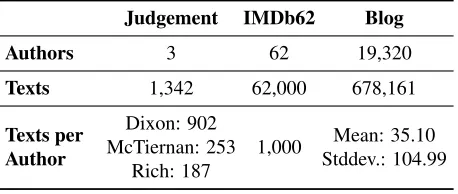
We considered three datasets that cover different writing styles and settings:Judgement,IMDb62and
Judgement IMDb62 Blog
Authors 3 62 19,320
Texts 1,342 62,000 678,161
Texts per Author
Dixon: 902 McTiernan: 253
Rich: 187
1,000 Mean: 35.10
[image:5.612.72.301.58.155.2]Stddev.: 104.99
Table 1: Dataset Statistics
Court from 1913 to 1975: Dixon, McTiernan and Rich (available for download from www.csse.
monash.edu.au/research/umnl/data). In
this paper, we considered the Dixon/McTiernan and the Dixon/Rich binary classification cases, using judgements from non-overlapping periods (Dixon’s 1929–1964 judgements, McTiernan’s 1965–1975, and Rich’s 1913–1928). We removed numbers from the texts to ensure that dates could not be used to dis-criminate between judges. We also removed quotes to ensure that the classifiers take into account only the actual author’s language use.5 Employing this dataset in our experiments allows us to test our meth-ods on formal texts with a minimal amount of noise. The IMDb62 datasetcontains 62,000 movie re-views by 62 prolific users of the Internet Movie database (IMDb, www.imdb.com, available upon request from the authors of (Seroussi et al., 2010)). Each user wrote 1,000 reviews. This dataset is nois-ier than the Judgement dataset, since it may con-tain spelling and grammatical errors, and the reviews are not as professionally edited as judgements. This dataset allows us to test our approach in a setting where all the texts have similar themes, and the num-ber of authors is relatively small, but is already much larger than the number of authors considered in tra-ditional authorship attribution settings.
TheBlog datasetis the largest dataset we consid-ered, containing 678,161 blog posts by 19,320 au-thors (Schler et al., 2006) (available for download
fromu.cs.biu.ac.il/˜koppel). In contrast to
IMDb reviews, blog posts can be about any topic, but the large number of authors ensures that every topic is likely to interest at least some authors. Kop-pel et al. (2011) used a different blog dataset con-sisting of 10,240 authors in their work on authorship
5We removed numbers and quotes by matching regular
ex-pressions for numbers and text in quotation marks, respectively.
attribution with many candidate authors. Unfortu-nately, their dataset is not publicly available. How-ever, authorship attribution is more challenging on the dataset we used, because they imposed some re-strictions on their dataset, such as setting a minimal number of words per author, and truncating the train-ing and testtrain-ing texts so that they all have the same length. The dataset we use has no such restrictions.
4.3 LDA in Binary Authorship Attribution
In this section, we present the results of our experi-ments with the Judgement dataset (Section 4.2), test-ing the use of LDA in productest-ing feature vectors for SVMs and the performance of our LDA+Hellinger methods (Section 3.2).
In all the experiments, we employed a classifier ensemble to address the class imbalance problem present in the Judgement dataset, which contains 5 times more texts by Dixon than by Rich, and over 3 times more texts by Dixon than by McTiernan (Ta-ble 1). Dixon’s texts are randomly split into 5 or 3 subsets, depending on the other author (Rich or McTiernan respectively), and the base classifiers are trained on each subset of Dixon’s texts together with all the texts by the other judge. Given a text by an unknown author, the classifier outputs are combined using majority voting. We found that the accuracies obtained with an ensemble are higher than those ob-tained with a single classifier. We did not require the vote to be unanimous, even though this increases precision, because we wanted to ensure full cover-age of the test dataset. This enables us to compare different methods using only an accuracy measure.6 Experiment 1. Figure 1 shows the results of an experiment that compares the accuracy obtained us-ing SVMs with token frequencies as features (Token SVMs) with that obtained using LDA topic distribu-tions as features (Topic SVMs). We experimented with several filters on token frequency, and differ-ent numbers of LDA topics (5, 10, 25, 50,. . ., 250). The x-axis labels describe the frequency filters: the minimum and maximum token frequencies, and the approximate number of unique tokens left after fil-tering (in thousands). We present only the results obtained with 10, 25, 100 and 200 topics, as the
re-6
45 50 55 60 65 70 75 80 85 90 95 100 0 1E-5 9.2 0 5E-5 12.2 0 1E-4 13 0 5E-4 13.8 0 1 14 1E-5 5E-5 3 1E-5 1E-4 3.8 1E-5 5E-4 4.6 1E-5 1 4.8 5E-5 1E-4 0.7 5E-5 5E-4 1.5 5E-5 1 1.7 1E-4 5E-4 0.8 1E-4 1 1 5E-4 1 0.2 Accuracy
Token Frequency Filter Min
Max Tokens (K)
Token SVM Majority Baseline 10 Topic SVM
[image:6.612.329.531.61.207.2]25 Topic SVM 100 Topic SVM 200 Topic SVM
Figure 1: LDA Features for SVMs in Binary Authorship Attribution (Judgement dataset, Dixon/Rich)
sults obtained with other topic numbers are consis-tent with the presented results, and the results ob-tained with 225 and 250 topics are comparable to the results obtained with 200 topics.
Our results show that setting a maximum bound on token frequency filters out important authorship markers, regardless of whether LDA is used or not (performance drops). This shows that it is un-likely that discriminative LDA topics correspond to actual topics, as the most frequent tokens are mostly non-topical (e.g., punctuation and function words).
An additional conclusion is that using LDA for feature reduction yields results that are comparable to those obtained using tokens directly. While Topic SVMs seem to perform slightly better than Token SVMs, the differences between the best results ob-tained with the two approaches are not statistically significant. However, the number of features that the SVMs consider when topics are used is usually much smaller than when tokens are used directly, es-pecially when no token filters are used (i.e., when the minimum frequency is 0 and the maximum fre-quency is 1). This makes it easy to apply LDA to dif-ferent datasets, since the token filtering parameters may be domain-dependent, and LDA yields good re-sults without filtering tokens.
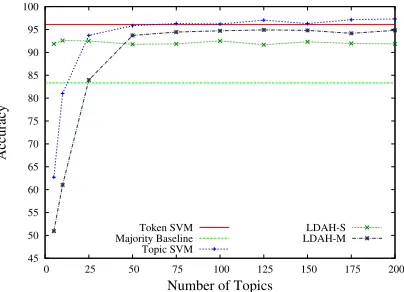
Experiment 2. Figure 2 shows the results of an experiment that compares the performance of the single profile document (LDAH-S) and multi-ple author documents (LDAH-M) variants of our LDA+Hellinger approach to the results obtained with Token SVMs and Topic SVMs. As in Exper-iment 1, we employ classifier ensembles, where the
45 50 55 60 65 70 75 80 85 90 95 100
0 25 50 75 100 125 150 175 200
Accuracy
Number of Topics Token SVM
Majority Baseline Topic SVM
[image:6.612.84.291.61.208.2]LDAH-S LDAH-M
Figure 2: LDA+Hellinger in Binary Authorship Attribu-tion (Judgement dataset, Dixon/Rich)
base classifiers are either SVMs or LDA+Hellinger classifiers. We did not filter tokens, since Experi-ment 1 indicates that filtering has no advantage over not filtering tokens. Instead, Figure 2 presents the accuracy as a function of the number of topics.
Note that we did not expect LDA+Hellinger to outperform SVMs, since LDA+Hellinger does not consider inter-class relationships. Indeed, Figure 2 shows that this is the case (the differences between the best Topic SVM results and the best LDAH-M results are statistically significant). However, LDA+Hellinger still delivers results that are much better than the majority baseline (the differences be-tween LDA+Hellinger and the majority baseline are statistically significant). This leads us to hypothe-sise that LDA+Hellinger will perform well in cases where it is problematic to use SVMs due to the large number of candidate authors. We verify this hypoth-esis in the following sections.
0 10 20 30 40 50 60 70 80 90 100
0 50 100 150 200 250 300 350 400
Accuracy
Number of Topics
KOP: k1 = 400, k2 = 0.2
[image:7.612.80.290.60.207.2]LDAH-S LDAH-M
Figure 3: LDA+Hellinger with Tens of Authors (IMDb62 dataset)
4.4 LDA+Hellinger with Tens of Authors
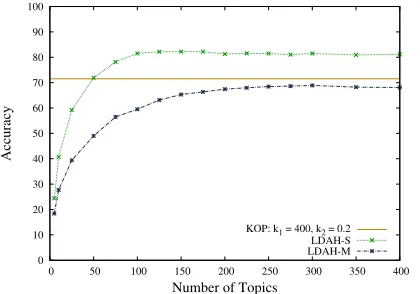
In this section, we apply our LDA+Hellinger ap-proaches to the IMDb62 dataset (Section 4.2), and compare the obtained results to those obtained with Koppel et al.’s (2011) method (KOP). To this effect, we first established a KOP best-performance base-line by performing parameter tuning experiments for KOP. Figure 3 shows the results of the comparison of the accuracies obtained with our LDA+Hellinger methods to the best accuracy yielded by KOP (ob-tained in the parameter tuning experiment).
For this experiment, we ran our LDA+Hellinger variants with 5, 10, 25, 50, . . ., 300, 350 and 400 topics. The highest LDAH-M accuracy was ob-tained with 300 topics (Figure 3). However, LDAH-S yielded a much higher accuracy than LDAH-M. This may be because the large number of training texts per author (900) may be too noisy for LDAH-M. That is, the differences between individual texts by each author may be too large to yield a meaning-ful representation of the author if they are considered separately. Finally, LDAH-S requires only 50 topics to outperform KOP, and outperforms KOP by about 15% for 150 topics. All the differences between the methods are statistically significant.
This experiment shows that LDAH-S models the authors in IMDb62 more accurately than KOP. The large improvement in accuracy shows that the com-pact author representation employed by LDAH-S, which requires only 150 topics to obtain the highest accuracy, has more power to discriminate between authors than KOP’s much heavier representation, of
400 subsets with more than 30,000 features each. In addition, theper-fold runtime of the KOP baseline was 93 hours, while LDAH-S required only 15 hours per fold to obtain the highest accuracy.
4.5 LDA+Hellinger with Thousands of Authors
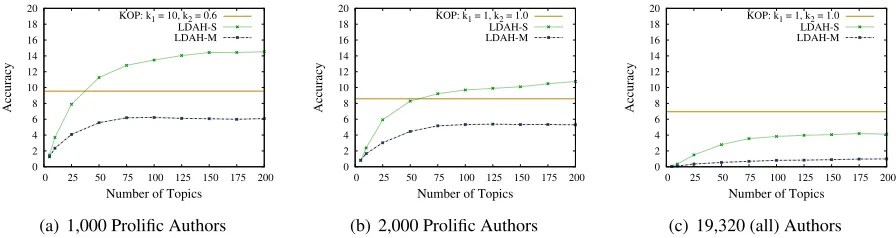
In this section, we compare the performance of our LDA+Hellinger variants to the performance of KOP on several subsets of the Blog dataset (Section 4.2). For this purpose, we split the dataset according to the prolificness of the authors, i.e., we ordered the authors by the number of blog posts, and considered subsets that contain all the posts by the 1000, 2000, 5000 and 19320 most prolific authors.7 Due to the large number of posts, we could not run KOP for more thank1 = 10iterations on the smallest subset
of the dataset and 5 iterations on the other subsets, as the runtime was prohibitive for more iterations. For example, 10 iterations on the smallest subset re-quired about 90 hours per fold (the LDA+Hellinger runtimes were substantially shorter, with maximum runtimes of 56 hours for LDAH-S and 77 hours for LDAH-M, when 200 topics were considered). Inter-estingly, running KOP for 5 iterations on the larger subsets decreased performance compared to running it for 1 iteration. Thus, on the larger subsets, the most accurate KOP results took less time to obtain than those of our LDA+Hellinger variants.
Figure 4 shows the results of this experiment. For each author subset, it compares the results ob-tained by LDAH-S and LDAH-M to the best re-sult obtained by KOP. All the differences between the methods are statistically significant. For up to 2000 prolific authors (Figures 4(a), 4(b)), LDAH-S outperforms KOP by up to 50%. For 5000 prolific users (figure omitted due to space limitations), the methods perform comparably, and KOP outperforms LDAH-S by a small margin. However, with all the authors (Figure 4(c)), KOP yields a higher accuracy than both LDA+Hellinger variants. This may be because considering non-prolific authors introduces noise that results in an LDA model that does not cap-ture the differences between authors. However, it is encouraging that LDAH-S outperforms KOP when less than 5000 prolific authors are considered.
7
0 2 4 6 8 10 12 14 16 18 20
0 25 50 75 100 125 150 175 200
Accuracy
Number of Topics
KOP: k1 = 10, k2 = 0.6 LDAH-S LDAH-M
(a) 1,000 Prolific Authors
0 2 4 6 8 10 12 14 16 18 20
0 25 50 75 100 125 150 175 200
Accuracy
Number of Topics
KOP: k1 = 1, k2 = 1.0 LDAH-S LDAH-M
(b) 2,000 Prolific Authors
0 2 4 6 8 10 12 14 16 18 20
0 25 50 75 100 125 150 175 200
Accuracy
Number of Topics
KOP: k1 = 1, k2 = 1.0 LDAH-S LDAH-M
[image:8.612.84.532.59.178.2](c) 19,320 (all) Authors
Figure 4: LDA+Hellinger with Thousands of Authors (Blog dataset)
The accuracies obtained in this section are rather low compared to those obtained in the previous sections. This is not surprising, since the author-ship attribution problem is much more challenging with thousands of candidate authors. This chal-lenge motivated the introduction of the σ∗ thresh-old in KOP (Section 3.1). Our LDA+Hellinger vari-ants can also be extended to include a threshold: if the Hellinger distance of the best-matching author is greater than the threshold, the LDA+Hellinger algo-rithm would return “unknown author”. We leave ex-periments with this extension to future work, as our focus in this paper is on comparing LDA+Hellinger to KOP, and we believe that this comparison is clearer when no thresholds are used.
5 Conclusions and Future Work
In this paper, we introduced an approach to author-ship attribution that models texts and authors using Latent Dirichlet Allocation (LDA), and considers the distance between the LDA-based representations of the training and test texts when classifying test texts. We showed that our approach yields state-of-the-art performance in terms of classification accu-racy when tens or a few thousand authors are consid-ered, and prolific authors exist in the training data. This accuracy improvement was achieved together with a substantial reduction in runtime compared to Koppel et al.’s (2011) baseline method.
While we found that our approach performs well on texts by prolific authors, there is still room for improvement on authors who have not written many texts – an issue that we will address in the future. One approach that may improve performance on such authors involves considering other types of fea-tures than tokens, such as parts of speech and
char-acter n-grams. Since our approach is based on LDA, it can easily employ different feature types, which makes this a straightforward extension to the work presented in this paper.
In the future, we also plan to explore ways of ex-tending LDA to model authors directly, rather than using it as a black box. Authors were considered by Rosen-Zvi et al. (2004; 2010), who extended LDA to form an author-topic model. However, this model was not used for authorship attribution, and was mostly aimed at topic modelling of multi-authored texts, such as research papers.
Another possible research direction is to improve the scalability of our methods. Our approach, like Koppel et al.’s (2011) baseline, requires linear time in the number of possible authors to classify a single document. One possible way of reducing the time needed for prediction is by employing a hierarchi-cal approach that builds a tree of classifiers based on class similarity, as done by Bickerstaffe and Zuker-man (2010) for the sentiment analysis task. Under this framework, class similarity (in our case, author similarity) can be measured using LDA, while small groups of classes can be discriminated using SVMs. In addition to authorship attribution, we plan to employ text-based author models in user modelling tasks such as rating prediction – a direction that we already started working on by successfully applying our LDA-based approach to model users for the rat-ing prediction task (Seroussi et al., 2011).
Acknowledgements
References
Adrian Bickerstaffe and Ingrid Zukerman. 2010. A hier-archical classifier applied to multi-way sentiment
de-tection. InCOLING 2010: Proceedings of the 23rd
International Conference on Computational Linguis-tics, pages 62–70, Beijing, China.
David M. Blei, Andrew Y. Ng, and Michael I. Jordan.
2003. Latent Dirichlet allocation. Journal of Machine
Learning Research, 3(Jan):993–1022.
Haibin Cheng, Pang-Ning Tan, and Rong Jin. 2007. Lo-calized support vector machine and its efficient
algo-rithm. In SDM 2007: Proceedings of the 7th SIAM
International Conference on Data Mining, pages 461– 466, Minneapolis, MN, USA.
Michael Gamon. 2004. Linguistic correlates of style: Authorship classification with deep linguistic analysis
features. In COLING 2004: Proceedings of the 20th
International Conference on Computational
Linguis-tics, pages 611–617, Geneva, Switzerland.
Thomas L. Griffiths and Mark Steyvers. 2004.
Find-ing scientific topics. Proceedings of the National
Academy of Sciences, 101(Suppl. 1):5228–5235.
Patrick Juola. 2006. Authorship attribution.
Founda-tions and Trends in Information Retrieval, 1(3):233– 334.
Moshe Koppel, Jonathan Schler, and Shlomo Argamon.
2011. Authorship attribution in the wild. Language
Resources and Evaluation, 45(1):83–94.
Kim Luyckx and Walter Daelemans. 2008. Authorship attribution and verification with many authors and
lim-ited data. InCOLING 2008: Proceedings of the 22nd
International Conference on Computational
Linguis-tics, pages 513–520, Manchester, UK.
David Madigan, Alexander Genkin, David D. Lewis, Shlomo Argamon, Dmitriy Fradkin, and Li Ye. 2005.
Author identification on the large scale. In
Proceed-ings of the Joint Annual Meeting of the Interface and the Classification Society of North America, St. Louis, MO, USA.
Thomas C. Mendenhall. 1887. The characteristic curves
of composition. Science, 9(214S):237–246.
Frederick Mosteller and David L. Wallace. 1964.
In-ference and Disputed Authorship: The Federalist. Addison-Wesley.
Arun Rajkumar, Saradha Ravi, Venkatasubramanian Suresh, M. Narasimha Murthy, and C. E. Veni Mad-havan. 2009. Stopwords and stylometry: A latent
Dirichlet allocation approach. In Proceedings of the
NIPS 2009 Workshop on Applications for Topic Mod-els: Text and Beyond (Poster Session), Whistler, BC, Canada.
Bhavani Raskutti and Adam Kowalczyk. 2004. Extreme
re-balancing for SVMs: A case study. ACM SIGKDD
Explorations Newsletter, 6(1):60–69.
Ryan Rifkin and Aldebaro Klautau. 2004. In defense of
one-vs-all classification.Journal of Machine Learning
Research, 5(Jan):101–141.
Michal Rosen-Zvi, Thomas Griffiths, Mark Steyvers, and Padhraic Smyth. 2004. The author-topic model for
authors and documents. InUAI 2004: Proceedings of
the 20th Conference on Uncertainty in Artificial Intel-ligence, pages 487–494, Banff, AB, Canada.
Michal Rosen-Zvi, Chaitanya Chemudugunta, Thomas Griffiths, Padhraic Smyth, and Mark Steyvers. 2010.
Learning author-topic models from text corpora. ACM
Transactions on Information Systems, 28(1):1–38. Jonathan Schler, Moshe Koppel, Shlomo Argamon, and
James W. Pennebaker. 2006. Effects of age and
gen-der on blogging. InProceedings of AAAI Spring
Sym-posium on Computational Approaches for Analyzing Weblogs, pages 199–205, Stanford, CA, USA. Yanir Seroussi, Ingrid Zukerman, and Fabian Bohnert.
2010. Collaborative inference of sentiments from
texts. In UMAP 2010: Proceedings of the 18th
In-ternational Conference on User Modeling, Adaptation and Personalization, pages 195–206, Waikoloa, HI, USA.
Yanir Seroussi, Fabian Bohnert, and Ingrid Zukerman. 2011. Personalised rating prediction for new users
us-ing latent factor models. InHypertext 2011:
Proceed-ings of the 22nd ACM Conference on Hypertext and Hypermedia, Eindhoven, The Netherlands.
Efstathios Stamatatos. 2009. A survey of modern
au-thorship attribution methods. Journal of the
Ameri-can Society for Information Science and Technology, 60(3):538–556.
Mark Steyvers and Tom Griffiths. 2007. Probabilistic topic models. In Thomas K. Landauer, Danielle S. McNamara, Simon Dennis, and Walter Kintsch,
ed-itors, Handbook of Latent Semantic Analysis, pages