Proceedings of the 15th Conference on Computational Natural Language Learning: Shared Task, pages 71–75,
Supervised Coreference Resolution with SUCRE
Hamidreza Kobdani and Hinrich Sch ¨utze Institute for Natural Language Processing
University of Stuttgart, Germany [email protected]
Abstract
In this paper we present SUCRE (Kobdani and Sch¨utze, 2010) that is a modular coref-erence resolution system participating in the CoNLL-2011 Shared Task: Modeling Unre-stricted Coreference in OntoNote (Pradhan et al., 2011). The SUCRE’s modular architecture provides a clean separation between data stor-age, feature engineering and machine learning algorithms.
1 Introduction
Noun phrase coreference resolution is the process of finding markables (noun phrase) referring to the same real world entity or concept. In other words, this process groups the markables of a document into entities (equivalence classes) so that all mark-ables in an entity are coreferent. Examples of ap-plications of coreference resolution are Informa-tion ExtracInforma-tion, QuesInforma-tion Answering and Automatic Summarization.
Coreference is an equivalence relation between two markables, i.e., it is reflexive, symmetric and transitive. The first solution that intuitively comes to mind is binary classification of markable pairs (links). Therefore at the heart of most existing ap-proaches there is a binary classifier that classifies links to coreferent/disreferent. One can also use the transitive property of coreference relation to build the entities; this is done using a clustering method.
Our approach in this paper consist of the above mentioned steps, namely:
1. Classification of links to coreferent/disreferent.
2. Clustering of links which are classified as coreferent.
This paper is organized as follows. In Section 2, we present our feature engineering approach. Sec-tion 3 presents the system architecture. Data set is described in Section 4. Sections 5 and 6 present re-sults and conclusions.
2 Feature Engineering
In recent years there has been substantial work on the problem of coreference resolution. Most meth-ods present and report on the benchmark data sets forEnglish. The feature sets they use are based on (Soon et al., 2001). These features consist of string-based features, distance features, span features, part-of-speech features, grammatical features, and agree-ment features.
ing or complex definitions. Consider the two mark-ablesthe members of parliamentandthe members of the European Union. The semantic class ofmembers ispersonin the first case andcountryin the second. To cover all such cases, we introduced a feature defi-nition language (Kobdani et al., 2010). With the fea-ture definition language we will be able to access all information that is connected to a markable, includ-ing the first, last and head words of the two mark-ables; all other words of the two markmark-ables; and the two markables as atomic elements.
After defining new features (new definition from scratch or definition by combination of existing fea-tures), we have to evaluate them. In principle, we could use any figure of merit to evaluate the useful-ness of a feature or to compare two similar features, including Gini coefficient, mutual information, and correlation coefficient. In our current system, ex-pected information gain (IG) and information gain ratio (IGR) are used.
As an example, consider the following two fea-tures, which can be considered different attempts to formalize the same linguistic property:
1. The noun phrase has a subject role and is def-inite(e.g. markable begins with adefinite arti-cle)
2. The noun phrase has a subject role and isnot indefinite(e.g. markable begins with an indefi-nitearticle)
The information gain ratios of the above men-tioned features are equal to 0.0026 for the first and 0.0051 for the second one – this shows that the sec-ond one is a better choice. We now define IG and IGR.
The change in entropy from a prior state to a state that takes some information is the expected informa-tion gain (Mitchell, 1997):
IG(f) =H(C)−Hf(C) (1)
Where f is the feature value, C its corresponding class, and entropy is defined as follows:
H(C) =−X
i
P(Ci)log2P(Ci) (2)
Hf(C) = X
f
|Cf|
|C|H(Cf) (3)
If a feature takes a large number of distinct values, the information gain would not be a good measure for deciding its relevance. In such cases the infor-mation gain ratio is used instead. The inforinfor-mation gain ratio for a feature is calculated as follows:
IGR(f) = IG(f)
SInf(C) (4)
SInf(C) =−X
i
|Ci|
|C|log2 |Ci|
|C| (5)
Equation (4) can be used as an indicator for which features are likely to improve classification accu-racy.
3 System Architecture
The architecture of the system has two main parts: preprocessing and coreference resolution.
In preprocessing the text corpus is converted to a relational data model. The main purpose of the relational model in our system is the use of a fea-ture definition language (Kobdani et al., 2010). Af-ter modeling the text corpus, coreference resolution can be performed.
The main steps of the system are presented as fol-lows.
3.1 Preliminary text conversion
In this step, tokens are extracted from the corpus. In the CoNLL-2011 Shared Task this step is as simple as reading each line of the input data set and extract-ing its correspondextract-ing token.
3.2 Atomic attributes of tokens
Atomic features of the tokens are extracted in this step. The extracted atomic features are: part of speech, number, pronoun person (first, second and third), pronoun type (subjec-tive,,predeterminer,reflexive,objective and posses-sive), WordNet semantic class and gender.
3.3 Markable Detection
In this step all noun phrases from the parse tree are extracted. After clustering step all markables which are not included in a chain are deleted from the list of markables. In other word we will not have any cluster with less than 2 members.
Figure 1 presents the simple markable detection method which we used in the SUCRE.
3.4 Atomic attributes of markables
In this step, the atomic attributes of the markables are extracted. In the data set of the CoNLL-2011 shared task the named entity property of a markable can be used as its atomic attribute.
3.5 Link Generator
For training, the system generates a positive train-ing instance for an adjacent coreferent markable pair
(m, n)and negative training instances for the mark-ablemand all markables disreferent withmthat oc-cur before n (Soon et al., 2001). For decoding it generates all the possible links inside a window of 100 markables.
3.6 Link feature definition and extraction
The output of the link generator, which is the list of the generated links, is the input to the link feature extractor for creating train and test data sets. To do this, the feature definitions are used to extract the feature values of the links (Kobdani et al., 2011).
3.7 Learning
For learning we implemented a decision tree classi-fier (Quinlan, 1993). To achieve state-of-the-art per-formance, in addition to decision tree we also tried support vector machine and maximum entropy that did not perform better than decision tree.
3.8 Classification and Clustering
In this part, the links inside one document are clas-sified then the coreference chains are created. We usebest-first clusteringfor this purpose. It searches for the best predicted antecedent from right to left starting from the end of the document. For the docu-ments with more than a predefined number of mark-ables we apply a limit for searching. In this way, in addition to better efficiency, the results also improve.
Markable Detection PSG A (W1, W2, . . . , Wn)
1. A markable M is presented by a set of three words:
Begin (Mb), End (Me) and Head (Mh).
2. LetDM be the set of detected markables. 3. LetTi be the nodeiin the parse tree with
labelLi
(if node is a word thenLiis equal toWi).
4. Start from parse tree root Tr:
Find Markables(Tr,Lr,DM)
Find Markables(T,L,DM)
1. IfL is equal to noun phrase, then extract the markableM:
(a) Set the begin word of the markable:
Mb= Noun Phrase Begin(T,L)
(b) Set the end word of the markable:
Me= Noun Phrase End(T,L)
(c) Set the head word of the markable:
Mh= Noun Phrase Head(T,L)
(d) Add the markableM to the set of de-tected markablesDM.
2. Repeat for all Ti the daughters of T:
Find Markables(Ti,Li,DM)
Noun Phrase Begin(T,L)
IfThas no daughter then returnL;
else setTbto the first daughter ofT and return
Noun Phrase Begin(Tb,Lb).
Noun Phrase End(T,L)
IfThas no daughter then returnL;
else setTb to the last daughter ofT and return
Noun Phrase End(Tb,Lb).
Noun Phrase Head(T,L)
IfThas no daughter then returnL;
else setThto the biggest noun phrase daughter
ofT and return Noun Phrase Head(Th,Lh).
Automatic Gold Rec. Prec. F1 Rec. Prec. F1
MD 60.17 60.92 60.55 62.50 61.62 62.06 MUC 54.30 51.84 53.06 57.44 53.15 55.21 B3
71.39 64.68 67.87 74.07 64.39 68.89 CEAFM 46.36 46.36 46.36 47.07 47.07 47.07
CEAFE 35.38 37.26 35.30 35.19 38.44 36.74
[image:4.612.74.297.69.151.2]BLANC 65.01 64.93 64.97 66.23 65.16 65.67
Table 1: Results of SUCRE on the development data set for the automatically detected markables. MD: Markable Detection.
4 Data Sets
OntoNotes has been used for the CoNLL-2011 shared task. The OntoNotes project1 is to provide a large-scale, accurate corpus for general anaphoric coreference. It aims to cover entities and events (i.e. it is not limited to noun phrases or a limited set of entity types) (Pradhan et al., 2007).
For training we used 4674 documents containing a total of 1909175 tokens, 190700 markables and 50612 chains.
SUCRE participated in the closed track of the shared task. Experiments have been performed for the two kind of documents, namely, the automati-cally preprocessed documents and the gold prepro-cessed documents. In this paper, we report only the scores on the development data set using the offi-cial scorer of the shared task. The automatically preprocessed part consists of 303 documents con-taining a total of 136257 tokens, 52189 automati-cally detected markables, 14291 true markables and 3752 chains. The gold preprocessed part consists of 303 documents containing a total of 136257 tokens, 52262 automatically detected markables, 13789 true markables and 3752 chains.
5 Results
We report recall, precision, and F1 for MUC (Vi-lain et al., 1995), B3
(Bagga and Baldwin, 1998), CEAFM/CEAFE (Luo, 2005) and BLANC
(Re-casens et al., 2010).
Table 1 presents results of our system for the automatically detected markables. It is apparent from this table that the application of the gold pre-processed documents slightly improves the perfor-mance (MD-F1: +1.51; MUC-F1: +2.15; B3-F1:
1
http://www.bbn.com/ontonotes/
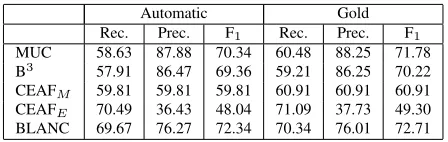
Automatic Gold Rec. Prec. F1 Rec. Prec. F1
MUC 58.63 87.88 70.34 60.48 88.25 71.78 B3
57.91 86.47 69.36 59.21 86.25 70.22 CEAFM 59.81 59.81 59.81 60.91 60.91 60.91
CEAFE 70.49 36.43 48.04 71.09 37.73 49.30
[image:4.612.315.539.70.141.2]BLANC 69.67 76.27 72.34 70.34 76.01 72.71
Table 2: Results of SUCRE on the development data set for the true markables (i.e. no singletone is included).
+1.02; CEAFM-F1: +0.71; CEAFE-F1: +1.44;
BLANC-F1: +0.70 ).
Table 2 presents results of our system for the true markables that were all and only part of coreference chains. Again the results show that the application of gold preprocessed documents slightly improves the performance (MUC-F1: +1.44; B3-F1: +0.86; CEAFM-F1: +1.1; CEAFE-F1: +1.26; BLANC-F1:
+0.37 ).
Comparing the results of tables 1 and 2, there is a significant difference between the scores on the au-tomatically detected markables and the scores on the true markables (e.g. for the automatically prepro-cessed documents: MUC-F1: +17.28; CEAFM-F1:
+13.45; CEAFE-F1: +12.74; BLANC-F1: +7.37).
No significant improvement in B3
is seen (auto-matic: +1.49; gold: +1.33). We suspect that this is partly due to the very sensitive nature of B3 against the singleton chains. Because in the implementation of scorer for the CoNLL-2011 shared task the non-detected key markables are automatically included into the response as singletons.
6 Conclusion
In this paper, we have presented our system SUCRE participated in the CoNLL-2011 shared task. We took a deeper look at the feature engineering of SU-CRE. We presented the markable detection method we applied.
We showed that the application of the gold pre-processed documents improves the performance. It has been demonstrated that the availability of the true markables significantly improves the results. Also it has been shown that the singletons have a large impact on the B3
References
Amit Bagga and Breck Baldwin. 1998. Algorithms for scoring coreference chains. In LREC Workshop on Linguistics Coreference ’98, pages 563–566.
Eric Bengtson and Dan Roth. 2008. Understanding the value of features for coreference resolution. In
EMNLP ’08, pages 294–303.
Hamidreza Kobdani and Hinrich Sch¨utze. 2010. Sucre: A modular system for coreference resolution. In Se-mEval ’10, pages 92–95.
Hamidreza Kobdani, Hinrich Sch¨utze, Andre Burkovski, Wiltrud Kessler, and Gunther Heidemann. 2010. Re-lational feature engineering of natural language pro-cessing. InCIKM ’10. ACM.
Hamidreza Kobdani, Hinrich Sch¨utze, Michael Schiehlen, and Hans Kamp. 2011. Bootstrap-ping coreference resolution using word associations. In Proceedings of the 49th Annual Meeting of the Association for Computational Linguistics, ACL ’11. Association for Computational Linguistics.
Xiaoqiang Luo. 2005. On coreference resolution perfor-mance metrics. InHLT ’05, pages 25–32.
Tom M. Mitchell. 1997. Machine Learning. McGraw-Hill, New York.
Sameer Pradhan, Lance Ramshaw, Ralph Weischedel, Jessica MacBride, and Linnea Micciulla. 2007. Unre-stricted Coreference: Identifying Entities and Events in OntoNotes. In in Proceedings of the IEEE Inter-national Conference on Semantic Computing (ICSC), September 17-19.
Sameer Pradhan, Lance Ramshaw, Mitchell Marcus, Martha Palmer, Ralph Weischedel, and Nianwen Xue. 2011. Conll-2011 shared task: Modeling unrestricted coreference in ontonotes. In Proceedings of the Fif-teenth Conference on Computational Natural Lan-guage Learning (CoNLL 2011), Portland, Oregon, June.
J. Ross Quinlan. 1993. C4.5: Programs for machine learning. Morgan Kaufmann Publishers Inc., San Francisco, CA, USA.
Marta Recasens, Llu´ıs M`arquez, Emili Sapena, M.Ant`onia Mart´ı, Mariona Taul´e, V´eronique Hoste, Massimo Poesio, and Yannick Versley. 2010. SemEval-2010 Task 1: Coreference resolution in multiple languages. InSemEval ’10, pages 70–75. Wee Meng Soon, Hwee Tou Ng, and Daniel Chung Yong
Lim. 2001. A machine learning approach to coref-erence resolution of noun phrases. In CL ’01, pages 521–544.