Unsupervised Neural Dependency Parsing
∗Yong Jiang, Wenjuan Han and Kewei Tu
{jiangyong,hanwj,tukw}@shanghaitech.edu.cn School of Information Science and Technology
ShanghaiTech University, Shanghai, China
Abstract
Unsupervised dependency parsing aims to learn a dependency grammar from text anno-tated with only POS tags. Various features and inductive biases are often used to incorpo-rate prior knowledge into learning. One use-ful type of prior information is that there exist correlations between the parameters of gram-mar rules involving different POS tags. Pre-vious work employed manually designed fea-tures or special prior distributions to encode such information. In this paper, we propose a novel approach to unsupervised dependen-cy parsing that uses a neural model to predict grammar rule probabilities based on distribut-ed representation of POS tags. The distributdistribut-ed representation is automatically learned from data and captures the correlations between POS tags. Our experiments show that our approach outperforms previous approaches u-tilizing POS correlations and is competitive with recent state-of-the-art approaches on nine different languages.
1 Introduction
Unsupervised structured prediction from data is an important problem in natural language processing, with applications in grammar induction, POS tag in-duction, word alignment and so on. Because the training data is unannotated in unsupervised struc-tured prediction, learning is very hard. In this pa-per, we focus on unsupervised dependency parsing, which aims to identify the dependency trees of sen-tences in an unsupervised manner.
∗This work was supported by the National Natural Science
Foundation of China (61503248).
Previous work on unsupervised dependency pars-ing is mainly based on the dependency model with valence (DMV) (Klein and Manning, 2004) and it-s extenit-sion (Headden III et al., 2009; Gillenwater et al., 2010). To effectively learn the DMV mod-el for better parsing accuracy, a variety of induc-tive biases and handcrafted features have been pro-posed to incorporate prior information into learning. One useful type of prior information is that there exist correlations between the parameters of gram-mar rules involving different POS tags. Cohen and Smith (2009; 2010) employed special prior distribu-tions to encourage learning of correladistribu-tions between POS tags. Berg-Kirkpatrick et al. (2010) encoded the relations between POS tags using manually de-signed features.
In this work, we propose a neural based ap-proach to unsupervised dependency parsing. We incorporate a neural model into the DMV model to predict grammar rule probabilities based on dis-tributed representation of POS tags. We learn the neural network parameters as well as the distribut-ed representations from data using the expectation-maximization algorithm. The correlations between POS tags are automatically captured in the learned POS embeddings and contribute to the improvemen-t of parsing accuracy. In parimprovemen-ticular, probabiliimprovemen-ties of grammar rules involving correlated POS tags are au-tomatically smoothed in our approach without the need for manual features or additional smoothing procedures.
Our experiments show that on the Wall Street Journal corpus our approach outperforms the pre-vious approaches that also utilize POS tag
tions, and achieves a comparable result with recent state-of-the-art grammar induction systems. On the datasets of eight additional languages, our approach is able to achieve better performance than the base-line methods without any parameter tuning.
2 Related work
2.1 Dependency Model with Valence
The dependency model with valence (DMV) (Klein and Manning, 2004) is the first model to outperform the left-branching baseline in unsupervised depen-dency parsing of English. The DMV model is a generative model of a sentence and its parse tree. It generates a dependency parse from the root in a re-cursive top-down manner. At each step, a decision is first made as to whether a new child POS tag shall be generated from the current head tag; if the decision is yes, then a new child POS tag is sampled; other-wise, the existing child tags are recursively visited. There are three types of grammar rules in the mod-el:CHILD, DECISIONandROOT, each with a set of multinomial parameters PCHILD(c|h, dir, val),
PDECISION(dec|h, dir, val) and PROOT(c|root),
wherediris a binary variable indicating the
genera-tion direcgenera-tion (left or right),valis a boolean variable indicating whether the current head POS tag already has a child in the current direction or not,cindicates
the child POS tag,hindicates the head POS tag, and decindicates the decision of either STOP or
CON-TINUE. A CHILDrule indicates the probability of generating childcgiven headhon directiondirand
valenceval. ADECISIONrule indicates the proba-bility of STOP or CONTINUE given the head, direc-tion and valence. AROOTrule is the probability of a childcgenerated by the root. The probability of a
dependency tree is the product of probabilities of all the grammar rules used in generating the dependen-cy tree. The probability of a sentence is the sum of probabilities of all the dependency trees consistent with the sentence.
The basic DMV model has the limitation of being oversimplified and unable to capture certain linguis-tic structures. Headden et al. (2009) incorporated more types of valence and lexicalized information in the DMV model to increase its representation power and achieved better parsing accuracy than the basic DMV model.
2.2 DMV-based Learning Algorithms for Unsupervised Dependency Parsing
To learn a DMV model from text, the Expectation Maximization (EM) algorithm (Klein and Manning, 2004) can be used. In the E step, the model calcu-lates the expected number of times each grammar rule is used in parsing the training text by using the inside-outside algorithm. In the M-step, these ex-pected counts are normalized to become the proba-bilities of the grammar rules.
There have been many more advanced learning al-gorithms of the DMV model beyond the basic EM algorithm. In the work of Cohen and Smith (2008), a logistic normal prior was used in the DMV model to capture the similarity between POS tags. In the work of Berg-Kirkpatrick et al. (2010), features that group various morphological variants of nouns and verbs are used to predict theDECISIONandCHILD
parameters. These two approaches both utilize the correlations between POS tags to obtain better prob-ability estimation of grammar rules involving such correlated POS tags. In the work of Tu and Honavar (2012), unambiguity of parse trees is incorporated into the training objective function of DMV to ob-tain a better performance.
2.3 Other Approaches to Unsupervised Dependency Parsing
There are many other approaches to unsupervised dependency parsing that are not based on DMV. Daumé III (2009) proposed a stochastic search based method to do unsupervised Shift-Reduce transition parsing. Rasooli and Faili (2012) proposed a transi-tion based unsupervised dependency parser together with "baby-step" training (Spitkovsky et al., 2010) to improve parsing accuracy. Le and Zuidema (2015) proposed a complicated reranking based unsuper-vised dependency parsing system and achieved the state-of-the-art performance on the Penn Treebank dataset.
2.4 Neural based Supervised Dependency Parser
Head POS Tag Valency
Inputs: Continous Representation:
Hidden Layer:
… Softmax Layer:
Outputs (CHILD or DECISION)
Wdir p=Sof tmax(W f)
W
f=ReLU(Wdir[vh;vval])
[image:3.612.94.268.72.185.2][vh;vval]
Figure 1: Structure of the neural network. BothCHILDand
DECISIONuse the same architecture for the calculation of dis-tributions.
based dependency parsing. Stenetorp (2013) applied recursive neural networks to transitional based de-pendency parsing. Chen and Manning (2014) built a neural network based parser with dense features in-stead of sparse indicator features. Dyer et al. (2015) proposed a stack long short-term memory approach to supervised dependency parsing. To our knowl-edge, our work is the first attempt to incorporate neural networks into a generative grammar for un-supervised dependency parsing.
3 Neural DMV
In this section, we introduce our neural based gram-mar induction approach. We describe the model in section 3.1 and the learning method in section 3.2.
3.1 Model
Our model is based on the DMV model (section 2.1), except that theCHILDandDECISIONprobabilities are calculated through two neural networks. We do not compute the ROOTprobabilities using a neural network because doing that complicates the mod-el while leads to no significant improvement in the parsing accuracy. Parsing a sentence using our mod-el can be done in the same way as using DMV.
Below we show how theCHILDrule probabilities are computed in our neural based DMV model. De-note the set of all possible POS tags byT. We build a neural network to compute the probabilities of pro-ducing child tagc∈T conditioned on the head,
di-rection and valence(h, dir, val).
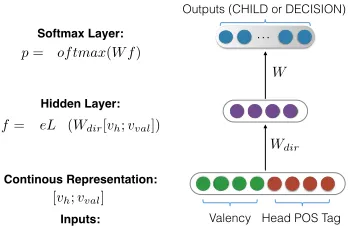
The full architecture of the neural network is shown in Figure 1. First, we represent each head taghas addimensional vectorvh ∈ Rd, represent
each value of valencevalas ad0dimensional vector vval ∈ Rd0. We concatenatevh andvval as the
in-put embedding vector. Then we map the inin-put layer to a hidden layer with weight matrixWdirthrough a
ReLUactivation function. We have two versions of
weight matrixWdir for the directiondir being left
and right respectively.
f(h, dir, val) = ReLU(Wdir[vh;vval])
We then take the inner product offand all the child
POS tag vectors and apply a softmax function to ob-tain the rule probabilities:
[pc1, pc2, ..., pckTk] = Softmax(W Tf)
whereW = [vc1, vc2, ..., vckTk]is an embedding ma-trix composed of all the child POS tag vectors.
We use the same neural architecture to predict the probabilities ofDECISIONrules. The difference is that the neural network for DECISIONhas only t-wo outputs (STOP and CONTINUE). Note that the two networks share parameters such as head POS tag embeddings and direction weight matricesWlef t
andWright. Valence embeddings are either shared
or distinct between the two networks depending on the variant of DMV we use (i.e., whether the max-imal valences for CHILD and DECISION are the same).
The parameters of our neural based model in-clude the weights of the neural network and all the POS and valence embeddings, denoted by a set Θ = {vh, vc, vval, vdec, Wdir;h, c ∈ T, val ∈ {0,1, ...}, dir ∈ {lef t, right}, dec ∈
{STOP,CONTINUE}}.
3.2 Learning
In this section, we describe an approach based on the EM algorithm to learn our neural DMV model. To learn the parameters, given a set of unannotated sen-tences x1, x2, ..., xN, our objective function is the
log-likelihood function.
L(Θ) =
N
X
α=1
P
E
W
Dynamic Programming
Neural Network Training Forward
Evaluating
[image:4.612.119.268.61.187.2]Count Normalizing
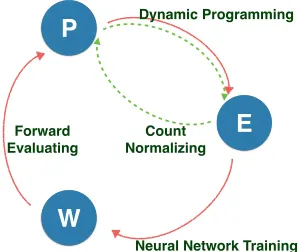
Figure 2:Learning procedure of our neural based DMV model. Green dashed lines represent the EM algorithm for learning tra-ditional DMV. Red solid lines represent the learning procedure of our model. P represents the rule probabilities of DMV,E represents the expected counts of rules, andW represents the parameters of the neural networks. In the traditional EM algo-rithm, the expected counts are directly used to re-estimate the rule probabilities. In our approach, parameter re-estimation is divided into two steps: training the neural networks from the expected counts and forward evaluation of the neural networks to produce the rule probabilities.
The approach is visualized in the Figure 2. The E-step computes the expected number of times each grammar rule used in parsing each training sentence
xi, denoted byec(xi)for CHILDrulec, ed(xi)for
DECISIONruled, ander(xi) forROOTrule r. In
the M-step of traditional DMV learning, these ex-pected counts are normalized to re-estimate the pa-rameters of DMV. This maximizes the expected log likelihood (ELL) with respect to the DMV model
parameters.
ELL(Θ) =
N
X
α=1
X
c
ec(xi) logpc
+X
d
ed(xi) logpd+
X
r
er(xi) logpr
!
In our model, however, we do not directly as-sign the optimal rule probabilities of CHILD and
DECISION; instead, we train the neural networks to output rule probabilities that optimize ELL, which is equivalent to a weighted cross-entropy loss function for each neural network. Note that while the tradi-tional M-step produces the global optimum of ELL, our neural-based M-step does not. This is because a
neural network tends to produce similar outputs for correlated inputs. In our case, the neural network is able to capture the correlations between different POS tags as well as different valence values and s-mooth the probabilities involving correlated tags and valences. In other words, our M-step can be seen as optimizing the ELL with a regularization term tak-ing into account the input correlations. We use mo-mentum based batch stochastic gradient descent al-gorithm to train the neural network and learn all the embeddings and weight matrices.
In addition to standard EM, we can also learn our neural based DMV model based on the Viterbi EM algorithm. The difference from standard EM is that in the E-step, we compute the number of times each grammar rule is used in the best parse of a training sentence instead of considering all possible parses.
4 Experiments 4.1 Setup
We used the Wall Street Journal corpus (with section 2-21 for training, section 22 for validation and sec-tion 23 for testing) in secsec-tion 4.2 and 4.3. Then we reported the results on eight additional languages in section 4.4. In each experiment, we trained our mod-el on gold POS tags with sentences of length less than 10 after punctuation has been stripped off. As the EM algorithm is very sensitive to initializations, we used the informed initialization method proposed in (Klein and Manning, 2004).
The length of embeddings is set to 10 for both POS tags and valence. We trained the neural net-works with batch size 10 and used the change of the validation set loss function as the stop criteria. We ran our model for five times and reported the av-eraged directed dependency accuracy (DDA) of the learned grammars on the test sentences with length less than 10 and all sentences.
4.2 Comparisons of Approaches based on POS Correlations
Methods WSJ10 WSJ Standard EM 46.2 34.9
Viterbi EM 58.3 39.4
LN(Cohen et al., 2008) 59.4 40.5
Shared LN(Cohen and Smith, 2009) 61.3 41.4
Feature DMV(Berg-Kirkpatrick et al., 2010) 63.0
[image:5.612.319.536.55.221.2]-Neural DMV (Standard EM) 51.3 37.1 Neural DMV (Viterbi EM) 65.9 47.0 Table 1: Comparisons of Approaches based on POS Correla-tions
shows the results. It can be seen that our approach with Viterbi EM significantly outperforms the EM and viterbi EM baselines and also outperforms the two previous approaches.
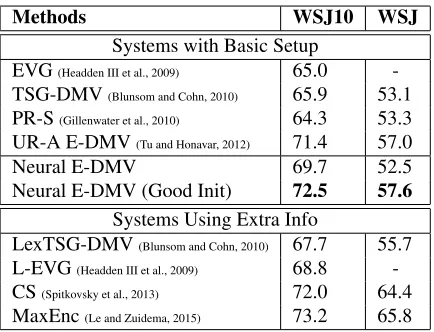
4.3 Results on the extended DMV model We directly apply our neural approach to learning the extended DMV model (Headden III et al., 2009; Gillenwater et al., 2010) (with the maximum va-lence value set to 2 for both CHILD and DECISION rules). As shown in Table 2, we achieve comparable accuracy with recent state-of-the-art systems. If we initialize our model with the grammar learned by Tu and Honavar (2012), the accuracy of our approach can be further improved.
Most of the recent state-of-the-art systems em-ploy more complicated models and learning algo-rithms. For example, Spitkovsky et al. (2013) take several grammar induction techniques as modules and connect them in various ways; Le and Zuide-ma (2015) use a neural-based supervised parser and reranker that make use of high-order features and lexical information. We expect that the performance of our approach can be further improved when these more advanced techniques are incorporated.
4.4 Results on other languages
We also applied our approach on datasets of eight additional languages from the PASCAL Challenge on Grammar Induction (Gelling et al., 2012). We ran our approach using the hyper-parameters from experiment 4.2 on the new datasets without any fur-ther tuning. We tested three versions of our ap-proach based on standard EM, softmax EM (Tu and Honavar, 2012) and Viterbi EM respectively. The results are shown in Table 3 for test sentence length no longer than ten and Table 4 for all test sentences.
Methods WSJ10 WSJ Systems with Basic Setup
EVG(Headden III et al., 2009) 65.0
-TSG-DMV(Blunsom and Cohn, 2010) 65.9 53.1
PR-S(Gillenwater et al., 2010) 64.3 53.3
UR-A E-DMV(Tu and Honavar, 2012) 71.4 57.0
Neural E-DMV 69.7 52.5 Neural E-DMV (Good Init) 72.5 57.6
Systems Using Extra Info
LexTSG-DMV(Blunsom and Cohn, 2010) 67.7 55.7
L-EVG(Headden III et al., 2009) 68.8
-CS(Spitkovsky et al., 2013) 72.0 64.4
[image:5.612.73.294.55.155.2]MaxEnc(Le and Zuidema, 2015) 73.2 65.8
Table 2:Comparison of recent unsupervised dependency pars-ing systems. Basic setup means learnpars-ing from POS tags with sentences of length≤10and punctuation stripped off. Extra
information may contain punctuations, longer sentences, lexi-cal information, etc. For Neural E-DMV, “Good Init” means using the learned DMV model from Tu and Honavar (2012) as our initialization.
Our neural based methods achieve better results than their corresponding baselines in75.0%of the cases
for test sentences no longer than 10 and77.5%for
all test sentences. The good performance of our ap-proach without data-specific hyper-parameter tuning demonstrates the robustness of our approach. Care-fully tuned hyper-parameters on validation datasets, in our experience, can further improve the perfor-mance of our approach, in some cases by a large margin.
4.5 Effects of Hyper-parameters
We examine the influence of hyper-parameters on the performance of our approach with the same ex-perimental setup as in section 4.3.
Activation function We compare different linear and non-linear functions: ReLU, Leaky ReLU, Tan-h, Sigmoid. The results are shown in Table 5. Non-linear activation functions can be seen to significant-ly outperform linear activation functions.
Length of the embedding vectors The dimen-sion of the embedding space is an important hyper-parameter in our system. As Figure 3 illustrates, when the dimension is too low (such asdim= 5),
Arabic Basque Czech Danish Dutch Portuguese Slovene Swedish Standard EM
DMV 45.8 41.1 31.3 50.8 47.1 36.7 36.7 43.5 Neural DMV 43.4 46.5 33.1 55.6 49.0 30.4 42.2 44.3
Softmax EMσ= 0.25
DMV 49.3 45.6 30.4 43.6 46.1 33.5 29.8 50.3 Neural DMV 54.2 46.3 36.8 44.0 39.9 35.8 31.2 49.7
Softmax EMσ= 0.5
DMV 54.2 47.6 43.2 38.8 38.0 33.7 23.0 37.2 Neural DMV 44.6 48.9 33.4 50.3 37.5 35.3 32.2 43.3
Softmax EMσ= 0.75
DMV 42.2 48.6 22.7 41.0 33.8 33.5 23.2 41.6 Neural DMV 56.7 45.3 31.6 41.3 33.7 34.7 22.9 42.0
Viterbi EM
[image:6.612.104.510.57.259.2]DMV 32.5 47.1 27.1 39.1 37.1 32.3 23.7 42.6 Neural DMV 48.2 48.1 28.6 39.8 37.2 36.5 39.9 47.9
Table 3:DDA results (on sentences no longer than 10) on eight additional languages. Our neural based approaches are compared with traditional approaches using standard EM, softmax EM (parameterized byσ) and Viterbi EM.
Activation function WSJ10
ReLU 69.7
Leaky ReLU 67.0
Tanh 66.2
Sigmoid 62.5
[image:6.612.114.256.300.374.2]Linear 55.1
Table 5:Comparison between activation functions.
Length ofPOS embedding
6 8 10 12 16 24
62 64 66 68 70
P
ar
si
ng
a
cc
ur
ac
y
Figure 3:Parsing accuracy vs. length of POS embedding
different POS tags. On the other hand, when the di-mension is too high (such as dim = 30), since we
have only 35 POS tags, the neural network is prone to overfitting.
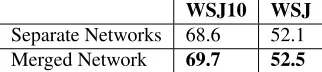
Shared parameters An alternative to our neural network architecture is to have two separate neural networks to compute CHILD andDECISION rule probabilities respectively. The embeddings of the head POS tag and the valence are not shared be-tween the two networks. As can be seen in Table
[image:6.612.346.507.302.338.2]WSJ10 WSJ Separate Networks 68.6 52.1 Merged Network 69.7 52.5
Table 6:Comparison between using two separate networks and using a merged network.
6, sharing POS tags embeddings attribute to better performance.
5 Model Analysis
In this section, we investigate what information our neural based DMV model captures and analyze how it contributes to better parsing performance.
5.1 Correlation of POS Tags Encoded in Embeddings
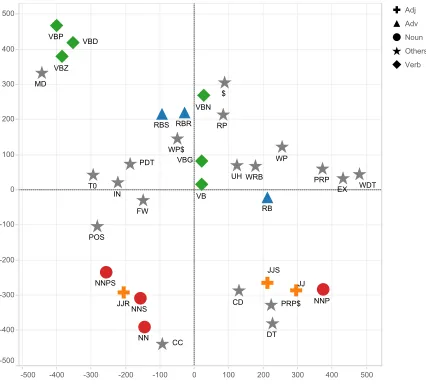
A main motivation of our approach is to encode cor-relation between POS tags in their embeddings so as to smooth the probabilities of grammar rules in-volving correlated POS tags. Here we want to ex-amine whether the POS embeddings learned by our approach successfully capture such correlation.
[image:6.612.84.287.405.518.2]Arabic Basque Czech Danish Dutch Portuguese Slovene Swedish Standard EM
DMV 28.0 31.2 28.1 40.3 44.2 23.5 25.2 32.0 Neural DMV 30.6 38.5 29.3 46.1 46.2 16.2 36.6 32.8
Softmax EMσ= 0.25
DMV 30.0 38.1 27.1 35.1 42.5 27.4 23.1 41.6 Neural DMV 31.5 40.5 32.6 38.0 35.7 26.7 24.2 41.3
Softmax EMσ= 0.5
DMV 32.3 41.0 33.0 32.2 33.9 27.6 15.0 29.6 Neural DMV 22.5 42.6 30.6 40.8 37.5 28.6 25.0 33.7
Softmax EMσ= 0.75
DMV 30.1 43.0 15.6 33.9 29.9 25.8 15.2 32.7 Neural DMV 34.9 37.4 24.7 34.2 29.5 28.9 15.1 33.3
Viterbi EM
[image:7.612.102.512.56.255.2]DMV 23.9 40.9 20.4 32.6 33.0 26.9 16.5 36.2 Neural DMV 31.0 41.8 23.8 34.2 33.6 29.4 30.8 40.2
Table 4: DDA results (on all the sentences) on eight additional languages. Our neural based approaches are compared with traditional approaches using standard EM, softmax EM (parameterized byσ) and viterbi EM.
the data points in the high dimensional space. The "perplexity" hyper-parameter of the algorithm was set to 20.0 and the distance metric we used is the Euclidean distance.
Figure 4 shows the visualization result. It can be seen that in most cases, nearby POS tags in the figure are indeed similar. For example, VBP (Verb, non-3rd person singular present),VBD(Verb, past tense) and VBZ(Verb, 3rd person singular present) can be seen to be close to each other, and they indeed have very similar syntactic behavior. Similar observation can be made toNN(Noun, singular or mass ),NNPS
(Proper noun, plural) andNNS(Noun, plural).
5.2 Smoothing of Grammar Rule Probabilities By using similar embeddings to represent correlat-ed POS tags, we hope to smooth the probabilities of rules involving correlated POS tags. Here we an-alyze whether our neural networks indeed predict more similar probabilities for rules with correlated POS tags.
We conducted a case study on all types of verb-s: VBP (Verb, non-3rd person singular present),
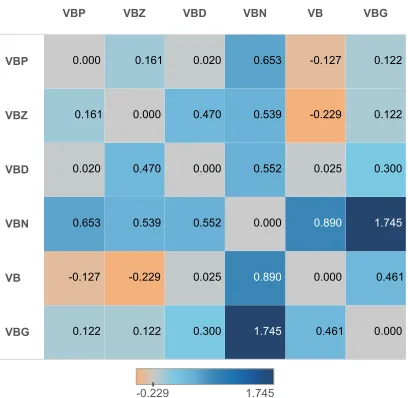
VBZ(Verb, 3rd person singular present),VBD (Ver-b, past tense),VBN(Verb, past participle),VB(Verb, base form),VBG(Verb, gerund or present participle). We used the neural networks in our N-DMV model learned in the experiment described in section 4.2 to predict the probabilities of all theCHILDrules head-ed by a verb. For each pair of verb tags, we
com--500 -400 -300 -200 -100 0 100 200 300 400 500 -500
-400 -300 -200 -100 0 100 200 300 400 500
JJ MD
WDT UH
T0
RP
PRP$ PRP
POS PDT
$
CC CD
DT
EX FW
IN
WP WP$
WRB VBZ
VB VBD
VBG VBN VBP
NNS NNPS
NNP
NN
JJS
JJR RBS RBR
RB
Adj Adv Noun Others Verb
Figure 4:A visualization of the distances between embeddings of different POS tags.
puted the total variation distance between the multi-nomial distributions ofCHILDrules headed by the two verb tags. We also computed the total variation distances betweenCHILD rules of verb tags in the baseline DMV model learned by EM.
[image:7.612.314.527.300.493.2]VBP VBZ VBD VBN VB VBG VBP VBZ VBD VBN VB
VBG 0.000
0.461 1.745 0.300 0.122 0.122 0.461 0.000 0.890 0.025 -0.229 -0.127
1.745 0.890 0.000 0.552 0.539 0.653 0.300 0.025 0.552 0.000 0.470 0.020 0.122 -0.229 0.539 0.470 0.000 0.161
0.122 -0.127 0.653 0.020 0.161 0.000
-0.229 1.745
VBP VBZ VBD VBN VB VBG
VBP
VBZ
VBD
VBN
VB
VBG 0.000
0.461 1.745 0.300 0.122 0.122 0.461 0.000 0.890 0.025 -0.229 -0.127
1.745 0.890 0.000 0.552 0.539 0.653 0.300 0.025 0.552 0.000 0.470 0.020 0.122 -0.229 0.539 0.470 0.000 0.161
0.122 -0.127 0.653 0.020 0.161 0.000
[image:8.612.83.287.57.256.2]-0.229 1.745
Figure 5: The change of the total variation distances between probabilities ofCHILDrules headed by different verb tags in our model vs. the baseline. A positive value means the distance is reduced in our model compared with that in the baseline.
become smaller in our model. This verifies that our approach smooths the probabilities of rules involv-ing correlated POS tags. From the figure one can see that the distance that reduces the most is be-tween VBG and VBN. These two verb tags indeed have very similar syntactic behaviors and thus have similar embeddings as shown in figure 4. One the other hand, the distances betweenVBandVBZ/VBP
become larger. This is reasonable sinceVBis syn-tactically different from VBZ/VBP in that it is very likely to generate a child tag TO to the left while
VBZ/VBPalways generate a subject (e.g., a noun or a pronoun) to the left.
6 Conclusion
We propose a neural based DMV model to do unsu-pervised dependency parsing. Our approach learn-s neural networklearn-s with continuoulearn-s reprelearn-sentationlearn-s of POS tags to predict the probabilities of grammar rules, thus automatically taking into account the cor-relations between POS tags. Our experiments show that our approach outperforms previous approaches utilizing POS correlations and is competitive with recent state-of-the-art approaches on nine different languages.
For future work, we plan to extend our approach in learning lexicalized DMV models. In addition,
we plan to apply our approach to other unsupervised tasks such as word alignment and sentence cluster-ing.
References
Taylor Berg-Kirkpatrick, Alexandre Bouchard-Côté, John DeNero, and Dan Klein. 2010. Painless unsu-pervised learning with features. InHuman Language Technologies: The 2010 Annual Conference of the North American Chapter of the Association for Com-putational Linguistics, pages 582–590. Association for Computational Linguistics.
Phil Blunsom and Trevor Cohn. 2010. Unsupervised in-duction of tree substitution grammars for dependency parsing. In Proceedings of the 2010 Conference on Empirical Methods in Natural Language Processing, pages 1204–1213. Association for Computational Lin-guistics.
Danqi Chen and Christopher D Manning. 2014. A fast and accurate dependency parser using neural network-s. InEMNLP, pages 740–750.
Shay B Cohen and Noah A Smith. 2009. Shared logistic normal distributions for soft parameter tying in unsu-pervised grammar induction. InProceedings of Hu-man Language Technologies: The 2009 Annual Con-ference of the North American Chapter of the Associa-tion for ComputaAssocia-tional Linguistics, pages 74–82. As-sociation for Computational Linguistics.
Shay B Cohen and Noah A Smith. 2010. Covariance in unsupervised learning of probabilistic grammars.
The Journal of Machine Learning Research, 11:3017– 3051.
Shay B Cohen, Kevin Gimpel, and Noah A Smith. 2008. Logistic normal priors for unsupervised probabilistic grammar induction. InAdvances in Neural Informa-tion Processing Systems, pages 321–328.
Hal Daumé III. 2009. Unsupervised search-based struc-tured prediction. In Proceedings of the 26th Annual International Conference on Machine Learning, pages 209–216. ACM.
Chris Dyer, Miguel Ballesteros, Wang Ling, Austin Matthews, and Noah A Smith. 2015. Transition-based dependency parsing with stack long short-term memo-ry. arXiv preprint arXiv:1505.08075.
Douwe Gelling, Trevor Cohn, Phil Blunsom, and Joao Graça. 2012. The pascal challenge on grammar in-duction. InProceedings of the NAACL-HLT Workshop on the Induction of Linguistic Structure, pages 64–80. Association for Computational Linguistics.
Jennifer Gillenwater, Kuzman Ganchev, Joao Graça, Fer-nando Pereira, and Ben Taskar. 2010. Sparsity in de-pendency grammar induction. In Proceedings of the ACL 2010 Conference Short Papers, pages 194–199. Association for Computational Linguistics.
William P Headden III, Mark Johnson, and David Mc-Closky. 2009. Improving unsupervised dependency parsing with richer contexts and smoothing. In Pro-ceedings of Human Language Technologies: The 2009 Annual Conference of the North American Chapter of the Association for Computational Linguistics, pages 101–109. Association for Computational Linguistics. Dan Klein and Christopher D Manning. 2004.
Corpus-based induction of syntactic structure: Models of de-pendency and constituency. In Proceedings of the 42nd Annual Meeting on Association for Computa-tional Linguistics, page 478. Association for Compu-tational Linguistics.
Phong Le and Willem Zuidema. 2015. Unsupervised dependency parsing: Let’s use supervised parsers. In Proceedings of the 2015 Conference of the North American Chapter of the Association for Computa-tional Linguistics: Human Language Technologies, pages 651–661, Denver, Colorado, May–June. Asso-ciation for Computational Linguistics.
Mohammad Sadegh Rasooli and Heshaam Faili. 2012. Fast unsupervised dependency parsing with arc-standard transitions. InProceedings of the Joint Work-shop on Unsupervised and Semi-Supervised Learn-ing in NLP, pages 1–9. Association for Computational Linguistics.
Valentin I Spitkovsky, Hiyan Alshawi, and Daniel Juraf-sky. 2010. From baby steps to leapfrog: How less is more in unsupervised dependency parsing. InHuman Language Technologies: The 2010 Annual Conference of the North American Chapter of the Association for Computational Linguistics, pages 751–759. Associa-tion for ComputaAssocia-tional Linguistics.
Valentin I Spitkovsky, Hiyan Alshawi, and Daniel Juraf-sky. 2013. Breaking out of local optima with coun-t coun-transforms and model recombinacoun-tion: A scoun-tudy in grammar induction. InEMNLP, pages 1983–1995. Pontus Stenetorp. 2013. Transition-based
dependen-cy parsing using recursive neural networks. In NIPS Workshop on Deep Learning.
Kewei Tu and Vasant Honavar. 2012. Unambiguity reg-ularization for unsupervised learning of probabilistic grammars. InProceedings of the 2012 Joint Confer-ence on Empirical Methods in Natural Language
Pro-cessing and Computational Natural Language Learn-ing, pages 1324–1334. Association for Computational Linguistics.