Generalized Expectation Criteria for
Bootstrapping Extractors using Record-Text Alignment
Kedar BellareDept. of Computer Science University of Massachusetts
Amherst, MA 01003
Andrew McCallum Dept. of Computer Science University of Massachusetts
Amherst, MA 01003
Abstract
Traditionally, machine learning ap-proaches for information extraction require human annotated data that can be costly and time-consuming to produce. However, in many cases, there already exists a database (DB) with schema related to the desired output, and records related to the expected input text. We present a conditional random field (CRF) that aligns tokens of a given DB record and its realization in text. The CRF model is trained using only the available DB and unlabeled text with generalized expecta-tion criteria. An annotaexpecta-tion of the text induced from inferred alignments is used to train an information extractor. We eval-uate our method on a citation extraction task in which alignments between DBLP database records and citation texts are used to train an extractor. Experimental results demonstrate an error reduction of 35% over a previous state-of-the-art method that uses heuristic alignments. 1 Introduction
A substantial portion of information on the Web consists of unstructured and semi-structured text. Information extraction (IE) systems segment and label such text to populate a structured database that can then be queried and mined efficiently.
In this paper, we mainly deal with information extraction from text fragments that closely resem-ble structured records. Examples of such texts include citation strings in research papers, con-tact addresses on person homepages and apart-ment listings in classified ads. Pattern match-ing and rule-based approaches for IE (Brin, 1998; Agichtein and Gravano, 2000; Etzioni et al., 2005) that only use specific patterns, and delimiter and
font-based cues for segmentation are prone to fail-ure on such data because these cues are gen-erally not broadly reliable. Statistical machine learning methods such as hidden Markov models (HMMs) (Rabiner, 1989; Seymore et al., 1999; Freitag and McCallum, 1999) and conditional ran-dom fields (CRFs) (Lafferty et al., 2001; Peng and McCallum, 2004; Sarawagi and Cohen, 2005) have become popular approaches to address the text extraction problem. However, these methods require labeled training data, such as annotated text, which is often scarce and expensive to pro-duce.
In many cases, however, there already exists a database with schema related to the desired out-put, and records that are imperfectly rendered in the available unlabeled text. This database can serve as a source of significant supervised guid-ance to machine learning methods. Previous work on using databases to train information extrac-tors has taken one of three simpler approaches. In the first, a separate language model is trained on each column of the database and these mod-els are then used to segment and label a given text sequence (Agichtein and Ganti, 2004; Can-isius and Sporleder, 2007). However, this ap-proach does not model context, errors or differ-ent formats of fields in text, and requires large number of database entries to learn an accurate language model. The second approach (Sarawagi and Cohen, 2004; Michelson and Knoblock, 2005; Mansuri and Sarawagi, 2006) uses database or dictionary lookups in combination with similarity measures to add features to the text sequence. Al-though these features are very informative, learn-ing algorithms still require annotated data to make use of them. The final approach heuristically labels texts using matching records and learns extractors from these annotations (Ramakrishnan and Mukherjee, 2004; Bellare and McCallum, 2007; Michelson and Knoblock, 2008).
tic labeling decisions, however, are made indepen-dently without regard for the Markov dependen-cies among labels in text and are sensitive to subtle changes in text.
Here we propose a method that automatically induces a labeling of an input text sequence us-ing a word alignment with a matching database record. This induced labeling is then used to train a text extractor. Our approach has several advan-tages over previous methods. First, we are able to model field ordering and context around fields by learning an extractor from annotations of the text itself. Second, a probabilistic model for word alignment can exploit dependencies among align-ments, and is also robust to errors, formatting dif-ferences, and missing fields in text and the record. Our word alignment model is a conditional ran-dom field (CRF) (Lafferty et al., 2001) that gen-erates alignments between tokens of a text se-quence and a matching database record. The structure of the graphical model resembles IBM Model 1 (Brown et al., 1993) in which each tar-get (record) word is assigned one or more source (text) words. The alignment is generated con-ditioned on both the record and text sequence, and therefore supports large sets of rich and non-independent features of the sequence pairs. Our model is trained without the need for labeled word alignments by using generalized expectation (GE) criteria (Mann and McCallum, 2008) that penal-ize the divergence of specific model expectations from target expectations. Model parameters are estimated by minimizing this divergence. To limit over-fitting we include aL2-regularization term in
the objective. The model expectations in GE cri-teria are taken with respect to a set of alignment latent variables that are either specific to each se-quence pair (local) or summarizing the entire data set (global). This set is constructed by including all alignment variablesathat satisfy a certain bi-nary feature (e.g., f(a,x1,y1,x2) = 1, for
la-beled record(x1,y1), and text sequencex2). One
example global criterion is that “an alignment ex-ists between two orthographically similar1 words
95% of the time.” Here the criterion has atarget expectationof 95% and is defined over alignments {a=hi, ji |x1[i]∼x2[j],∀x1,x2}. Another
cri-terion for extraction can be “the word ‘EMNLP’ is always aligned with the record labelbooktitle”. 1Two words are orthographically similar if they have low edit distance.
This criterion has a target of 100% and defined for {a = hi, ji | y1[i] = booktitle ∧ x2[j] =
‘EMNLP’,∀y1,x2}. One-to-one correspondence
between words in the sequence pair can be speci-fied as collection of local expectation constraints. Since we directly encode prior knowledge of how alignments behave in our criteria, we obtain suffi-ciently accurate alignments with little supervision. We apply our method to the task of citation extraction. The input to our training algorithm is a set of matching DBLP2-record/citation-text
pairs and global GE criteria3of the following two
types: (1) alignment criteria that consider fea-tures of mapping between record and text words, and, (2) extraction criteria that consider features of the schema label assigned to a text word. In our experiments, the parallel record-text pairs are collected manually but this process can be auto-mated using systems that match text sequences to records in the DB (Michelson and Knoblock, 2005; Michelson and Knoblock, 2008). Such sys-tems achieve very high accuracy close to 90% F1 on semi-structured domains similar to ours.4 Our
trained alignment model can be used to directly align new record-text pairs to create a labeling of the texts. Empirical results demonstrate a 20.6% error reduction in token labeling accuracy com-pared to a strong baseline method that employs a set of high-precision alignments. Furthermore, we provide a 63.8% error reduction compared to IBM Model 4 (Brown et al., 1993). Alignments learned by our model are used to train a linear-chain CRF extractor. We obtain an error reduction of 35.1% over a previous state-of-the-art extraction method that uses heuristically generated alignments. 2 Record-Text Alignment
Here we provide a brief description of the record-text alignment task. For the sake of clarity and space, we describe our approach on a fictional restaurant address data set. The input to our sys-tem is a database (DB) consisting of records (pos-sibly containing errors) and corresponding texts that are realizations of these DB records. An ex-ample of a matching record-text pair is shown in
2http://www.informatik.uni-trier.de/∼ley/db/
3Expectation criteria used in our experiments are listed at http://www.cs.umass.edu/∼kedarb/dbie expts.txt.
Record
name address city state phone
restaurant katsu n. hillhurst avenue los angeles 665-1891 Text
[image:3.595.160.439.66.116.2]katzu, 1972 hillhurst ave., los feliz, california
Table 1: An example of a matching record-text pair for restaurant addresses.
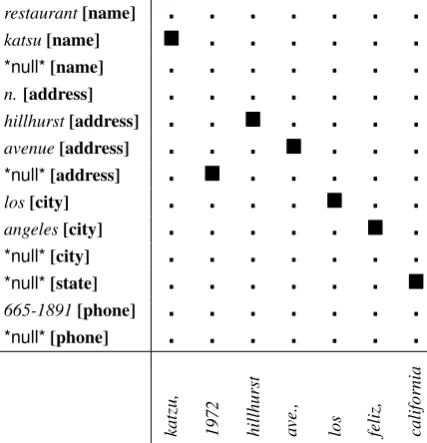
Table 1. This example displays the differences between the record and text: (1) spelling errors: katsu → katzu, (2) word insertions (restaurant), deletions (1972), substitutions (angeles→ feliz), (3) abbreviations (avenue → ave.), (4) missing fields in text (phone=665-1891), and (5) extra fields in text (state=california). These discrep-ancies plus the unknown ordering of fields within text can be addressed through word alignment.
restaurant[name]
katsu[name]
*null*[name]
n.[address]
hillhurst[address]
avenue[address]
*null*[address]
los[city]
angeles[city]
*null*[city]
*null*[state]
665-1891[phone]
*null*[phone]
katzu, 1972 hillhur
st
ave
.,
los feliz, california Table 2: Example of a word alignment. repre-sents aligned tokens. Vertical text at the bottom are the text tokens. Horizontal text on the left are tokens from the DB record with labels shown in braces.
An example word alignment between the record and text is shown in Table 2. Tokenization of record/text string is based on whitespace charac-ters. We add a special *null* token at the field boundaries for each label in the schema to model word insertions. The record sequence is obtained by concatenating individual fields according to the DB schema order. As in statistical word align-ment, we assume the DB record to be our source and the text to be our target. The induced labeling of the text is given by (name, address, address,
address, city, city, state) which can be used to train an information extractor. In the next section, we present our approach to address this task. 3 Approach
We first define notation that will be used throughout this section. Let (x1,y1) be a
database record with token sequence x1 =
hx1[1], x1[2], . . . , x1[m]iand label sequencey1 =
hy1[1], y1[2], . . . , y1[m]i with y1[∗] ∈ Y where
Y is the database schema. Let x2 =
hx2[1], x2[2], . . . , x2[n]ibe the text sequence. Let
a = ha1, a2, . . . , ani be an alignment sequence
of same length as the target text sequence. The alignmentai = jassigns the DB token-label pair
(x1[j], y1[j])to the text tokenx2[i].
3.1 Conditional Random Field for Alignment
Our conditional random field (CRF) for alignment has a graphical model structure that resembles that of IBM Model 1 (Brown et al., 1993). The CRF is an undirected graphical model that defines a probability distribution over alignment sequences
aconditioned on the inputs(x1,y1,x2)as:
pΘ(a|x1,y1,x2) = exp(Pnt=1Θ>f~(at,x1,y1,x2,t))
ZΘ(x1,y1,x2) , (1) where ~f(at,x1,y1,x2, t) are feature functions
defined over the alignments and inputs, Θ are the model parameters and ZΘ(x1,y1,x2) =
P
a0exp(Pnt=1Θ>~f(at0,x1,y1,x2, t))is the
par-tition function.
The feature vector ~f(at,x1,y1,x2, t) is the
concatenation of two types of feature functions: (1)alignmentfeaturesfalign(at,x1,x2, t)defined
on source-target tokens, and, (2) extraction fea-tures fextr(at,y1,x2, t) defined on source labels
and target text. To obtain the probability of an alignment in a particular positiontwe marginal-ize out the alignments over the rest of the positions {1, . . . , n}\{t},
pΘ(at|x1,y1,x2) =
X
{a[1...n]}\{at}
[image:3.595.76.290.304.526.2]= exp(Θ>~f(at,x1,y1,x2, t)) exp(Pa0Θ>~f(a0,x1,y1,x2, t))
(2) Furthermore, the marginal over labelyt assigned
to the text tokenx2[t]at time steptduring
align-ment is given by
pΘ(yt|x2) =
X
{at|y1[at]=yt}
pΘ(at|x1,y1,x2),
(3) where{at |y1[at] =yt}is the set of alignments
that result in a labelingytfor tokenx2[t].
Hence-forth, we abbreviatepΘ(at|x1,y1,x2) topΘ(at).
The gradient ofpΘ(at)with respect to parameters
Θis given by
∂pΘ(at)
∂Θ = pΘ(at)
h
~f(at,x1,y1,x2, t)
−EpΘ(a)~f(a,x1,y1,x2, t)
i ,(4) where the expectation term in the above equation sums over all alignmentsaat positiont. We use the Baum-Welch and Viterbi algorithms to com-pute marginal probabilities and best alignment se-quences respectively.
3.2 Expectation Criteria and Parameter Estimation
LetD=h(x(1)1 ,y(1)1 ,x(1)2 ), . . . ,(x(1K),y1(K),x(2K))i be a data set ofKrecord-text pairs gathered man-ually or automatically through matching (Michel-son and Knoblock, 2005; Michel(Michel-son and Knoblock, 2008). A global expectation criterion is defined on the set of alignment latent variables
Af ={a|f(a,x(1i),y1(i),x(2i)) = 1,∀i= 1. . . K}
on the entire data set that satisfy a given bi-nary feature f(a,x1,y1,x2). Similarly a local
expectation criterion is defined only for a specific instance (x(1i),y1(i),x(2i)) with the set
Af ={a|f(a,x(1i),y(1i),x(2i)) = 1}. For a feature functionf, a target expectation p, and, a weight
w, our criterion minimizes the squared divergence
∆(f, p, w,Θ) =w
EpΘ(Af) |Af| −p
2
, (5)
where EpΘ(Af) =
P
a∈Af pΘ(a) is the sum of
marginal probabilities given by Equation (2) and |Af| is the size of the variable set. The weight
winfluences the importance of satisfying a given expectation criterion. Equation (5) is an instance of generalized expectation criteria (Mann and Mc-Callum, 2008) that penalizes the divergence of
a specific model expectation from a given target value. The gradient of the divergence with respect toΘis given by,
∂∆(f, p, w,Θ)
∂Θ = 2w
EpΘ(Af) |Af| −p
×
1
|Af|
X
a∈Af
∂pΘ(a)
∂Θ −p
, (6)
where the gradient ∂pΘ(a)
∂Θ is given by Eq. (4).
Given expectation criteria C = hF,P,Wi with a set of binary feature functionsF=hf1, . . . , fli,
target expectationsP = hp1, . . . , pliand weights W=hw1, . . . , wli, we maximize the objective
O(θ;D,C) = max
Θ −
l X
i=1
∆(fi, pi, wi,Θ)−||Θ2||2,
(7) where||Θ||2/2is the regularization term added to
limit over-fitting. Hence the gradient of the objec-tive is
∂O(θ;D,C)
∂Θ =−
l X
i=1
∂∆(fi, pi, wi,Θ)
∂Θ −Θ.
We maximize our objective (Equation 7) using the L-BFGS algorithm. It is sometimes necessary to restart maximization after resetting the Hessian calculation in L-BFGS due to non-convexity of our objective.5 Also, non-convexity may lead to
a local instead of a global maximum. Our experi-ments show that local maxima do not adversely af-fect performance since our accuracy is within 4% of a model trained with gold-standard labels.
3.3 Linear-chain CRF for Extraction
The alignment CRF (AlignCRF) model described in Section 3.1 is able to predict labels for a text sequence given a matching DB record. However, without corresponding records for texts the model does not perform well as an extractor because it has learned to rely on the DB record and alignment features (Sutton et al., 2006). Hence, we train a separate linear-chain CRF on the alignment-induced labels for evaluation as an extractor.
per labely∈ Y in the database schema. The CRF induces a conditional probability distribution over label sequences y = hy1, . . . , yni and input text
sequencesx=hx1, . . . , xnias
pΛ(y|x) = exp
Pn
t=1Λ>~g(yt−1, yt,x, t) ZΛ(x) .
(8) In comparison to our earlier zero-orderAlignCRF
model, our ExtrCRF is a first-order model. All the feature functions in this modelg(yt−1, yt,x, t)
are a conjunction of the label pair (yt−1, yt) and
input observational features. ZΛ(x) in the
equa-tion above is the partiequa-tion funcequa-tion. Inference in the model is performed using the Viterbi algo-rithm.
Given expectation criteria C and data set D = h(x(1)1 ,y(1)1 ,x(1)2 ), . . . ,(x(1K),y1(K),x(2K))i, we first estimate the parametersΘof AlignCRF
model as described in Section 3.2. Next, for all text sequences x(2i), i = 1. . . K we compute the marginal probabilities of the labelspΘ(yt|x(2i)),∀t
using Equation (3). To estimate parametersΛwe minimize the KL-divergence betweenpΘ(y|x) =
Qn
t=1pΘ(yt|x)andpΛ(y|x)for all sequencesx,
KL(pΘkpΛ) =
X
y
pΘ(y|x) log(ppΘ(y|x) Λ(y|x))
=H(pΘ(y|x))
− X
t,yt−1,yt
EpΘ(yt−1,yt)[Λ>~g(y
t−1, yt,x, t)]
+ log(ZΛ(x)). (9)
The gradient of the above equation is given by
∂KL ∂Λ =
X
t,yt−1,yt
EpΛ(yt−1,yt|x)[~g(yt−1, yt,x, t)]
−EpΘ(yt−1,yt|x)[~g(yt−1, yt,x, t)].(10)
Both the expectations can be computed using the Baum-Welch algorithm. The parametersΛare es-timated for a given data setDand learned param-etersΘby optimizing the objective
O(Λ;D,Θ) = min
Λ
K X
i=1
KL(pΘ(y|x(2i))kpΛ(y|x(2i))
+kΛk2/2.
The objective is minimized using L-BFGS. Since the objective is convex we are guaranteed to obtain a global minima.
4 Experiments
In this section, we present details about the appli-cation of our method to citation extraction task.
Data set. We collected a set of 260 random records from the DBLP bibliographic database. The schema of DBLP has the following labels {author, editor, address, title, booktitle, pages, year, journal, volume, number, month, url, ee, cdrom, school, publisher, note, isbn, chapter, se-ries}. The complexity of our alignment model de-pends on the number of schema labels and number of tokens in the DB record. We reduced the num-ber of schema labels by: (1) mapping the labels address, booktitle, journalandschooltovenue, (2) mappingmonthandyeartodate, and (3) dropping the fields url, ee, cdrom, note, isbn andchapter, since they never appeared in citation texts. We also added the other labelOfor fields in text that are not represented in the database. Therefore, our final DB schema is{author, title, date, venue, vol-ume, number, pages, editor, publisher, series, O}.
For each DBLP record we searched on the web for matching citation texts using the first author’s last name and words in the title. Each citation text found is manually labeled for evaluation purposes. An example of a matching DBLP record-citation text pair is shown in Table 3. Our data set6
con-tains522record-text pairs for260DBLP entries.
Features and Constraints. We use a variety of rich, non-independent features in our models to optimize system performance. The input features in our models are of the following two types:
(a) Extraction features in the AlignCRF
model (f(at,y1,x2, t)) and ExtrCRF model
(g(yt−1, yt,x, t)) are conjunctions of assigned
la-bels and observational tests on text sequence at time step t. The following observational tests are used: (1) regular expressions to detect to-kens containing all characters (ALLCHAR), all dig-its (ALLDIGITS) or both digits and characters ( AL-PHADIGITS), (2) number of characters or digits in the token (NUMCHAR=3, NUMDIGITS=1), (3) domain-specific patterns for date and pages, (4) token identity, suffixes, prefixes and charactern -grams, (5) presence of a token in lexicons such as “last names,” “publisher names,” “cities,” (6) lex-icon features within a window of 10, (7) regular
6The data set can be found at
DBLP record Citation text
[Chengzhi Li]author [Edward W. Knightly]author [Coordinated Net-work Scheduling: A FrameNet-work for End-to-End Services.]title[69-]pages
[2000]date[ICNP]venue
[image:6.595.306.528.164.296.2][C. Li]author[and]O[E. Knightly.]author[Coordinated network schedul-ing: A framework for end-to-end services.]title[In Proceedings of IEEE ICNP]venue[’00,]date[Osaka, Japan,]venue[November 2000.]date
Table 3: Example of matching record-text pair found on the web.
expression features within a window of10, and (8) token identity features within a window of3.
(b)Alignment features in theAlignCRFmodel (f(at,x1,x2, t)) that operate on the aligned
source tokenx1[at]and target tokenx2[t]. Again
the observational tests used for alignment are: (1) exact token match tests whether the source-target tokens are string identical, (2) approximate token match produces a binary feature after binning the Jaro-Winkler edit distance (Cohen et al., 2003) be-tween the tokens, (3) substring token match tests whether one token is a substring of the other, (4) prefix token match returns true if the pre-fixes match for lengths{1,2,3,4}, (5) suffix to-ken match returns true if the prefixes match for lengths{1,2,3,4}, and (6) exact and approximate token matches at offsets{−1,−1}and{+1,+1} around the alignment.
Thus, a conditional model lets us use these ar-bitrary helpful features that cannot be exploited tractably in a generative model.
As is common practice (Haghighi and Klein, 2006; Mann and McCallum, 2008), we simulate user-specified expectation criteria through statis-tics on manually labeled citation texts. For ex-traction criteria, we select for each label, the top
N extraction features ordered by mutual informa-tion (MI) with that label. Also, we aggregate the alignment features of record tokens whose align-ment with a target text token results in a correct label assignment. The top N alignment features that have maximum MI with this correct label-ing are selected as alignment criteria. We bin tar-get expectations of these criteria into 11 bins as [0.05,0.1,0.2,0.3, . . . ,0.9,0.95].7 In our
exper-iments, we set N = 10 and use a fixed weight
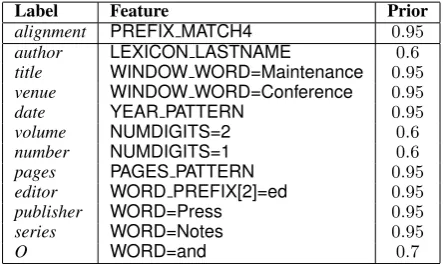
w = 10.0 for all expectation criteria (no tuning of parameters was performed). Table 4 shows a sample of GE criteria used in our experiments.8
7Mann and McCallum (2008) note that GE criteria are ro-bust to deviation of specified targets from actual expectations. 8A complete list of expectation criteria is available at http://www.cs.umass.edu/∼kedarb/dbie expts.txt.
Label Feature Prior
alignment PREFIX MATCH4 0.95
author LEXICON LASTNAME 0.6
title WINDOW WORD=Maintenance 0.95
venue WINDOW WORD=Conference 0.95
date YEAR PATTERN 0.95
volume NUMDIGITS=2 0.6
number NUMDIGITS=1 0.6
pages PAGES PATTERN 0.95
editor WORD PREFIX[2]=ed 0.95
publisher WORD=Press 0.95
series WORD=Notes 0.95
O WORD=and 0.7
Table 4: Sample of expectation criteria used by our model.
Experimental Setup. Our experiments use a 3:1 split of the data for training and testing. We re-peat the experiment 20 times with different ran-dom splits of the data. We train the AlignCRF
model using the training data and the automati-cally created expectation criteria (Section 3.2). We evaluate our alignment model indirectly in terms of token labeling accuracy (i.e., percentage of cor-rectly labeled tokens in test citation data) since we do not have annotated alignments. The alignment model is then used to train aExtrCRF model as described in Section 3.3. Again, we use token la-beling accuracy for evaluation. We also measure F1 performance as the harmonic mean of precision and recall for each label.
4.1 Alternate approaches
We compare our method against alternate ap-proaches that either learn alignment or extraction models from training data.
Extraction approaches. The first alternative (DB-CRF) trains a linear-chain CRF for extrac-tion on fields of the database entries only. Each field of the record is treated as a separate labeled text sequence. Given an unlabeled text sequence, it is segmented and labeled using the Viterbi algo-rithm. This method is an enhanced representative for (Agichtein and Ganti, 2004) in which a lan-guage model is trained for each column of the DB. Another alternative technique constructs par-tially annotated text data using the matching records and a labeling function. The labeling func-tion employs high-precision alignment rules to as-sign labels to text tokens using labeled record to-kens. We use exact and approximate token match-ing rules to create a partially labeled sequence, skipping tokens that cannot be unambiguously la-beled. In our experiments, we achieve a pre-cision of 97% and a recall of 70% using these rules. Given a partially annotated citation text, we train a linear-chain CRF by maximizing the marginal likelihood of the observed labels. This marginal CRF training method (Bellare and Mc-Callum, 2007) (M-CRF) was the previous state-of-the-art on this data set. Additionally, if a match-ing record is available for a test citation text, we can partially label tokens and use constrained Viterbi decoding with labeled positions fixed at their observed values (M+R-CRFapproach).
Our third approach is similar to (Mann and Mc-Callum, 2008). We create extraction expectation criteria from labeled text sequences in the training data and uses these criteria to learn a linear-chain CRF for extraction (MM08). The performance achieved by this approach is an upper bound on methods that: (1) use labeled training records to create extraction criteria, and, (2) only use extrac-tion criteria without any alignment criteria.
Finally, we train a supervised linear-chain CRF (GS-CRF) using the labeled text sequences from the training set. This represents an upper bound on the performance that can be achieved on our task. All the extraction methods have access to the same features as theExtrCRFmodel.
4.2 Results
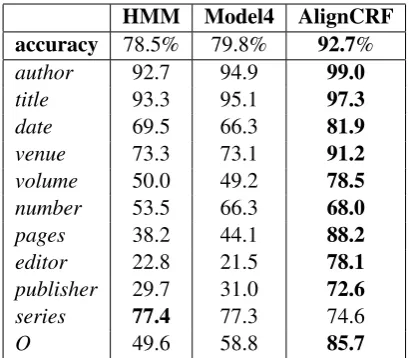
Table 5 shows the results of various alignment algorithms applied to the record-text data set. Alignment methods use the matching record to perform labeling of a test citation text. The Align-CRFmodel outperforms the best generative
align-HMM Model4 AlignCRF
accuracy 78.5% 79.8% 92.7%
author 92.7 94.9 99.0
title 93.3 95.1 97.3
date 69.5 66.3 81.9
venue 73.3 73.1 91.2
volume 50.0 49.2 78.5
number 53.5 66.3 68.0
pages 38.2 44.1 88.2
editor 22.8 21.5 78.1
publisher 29.7 31.0 72.6
series 77.4 77.3 74.6
[image:7.595.314.519.61.240.2]O 49.6 58.8 85.7
Table 5: Token-labeling accuracy and per-label F1 for different alignment methods. These methods all use matching DB records at test time. Bold-faced numbers indicate the best performing model.
HMM, Model4: generative alignment models from GIZA++,AlignCRF: alignment model from this paper.
ment model Model4 (IBM Model 4) with an er-ror reduction of 63.8%. Our conjecture is that
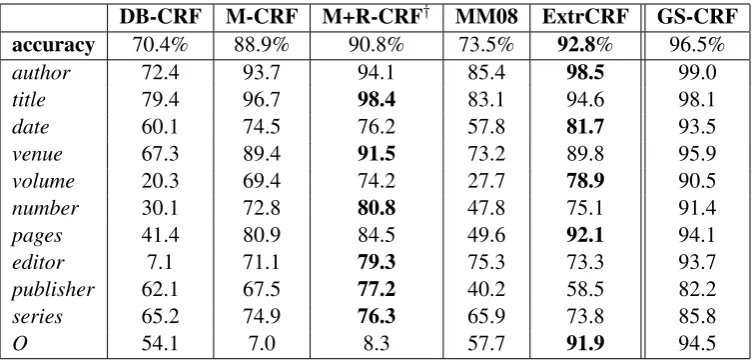
Model4is getting stuck in sub-optimal local max-ima during EM training since our training set only contains hundreds of parallel record-text pairs. This problem may be alleviated by training on a large parallel corpus. Additionally, our alignment model is superior toModel4since it leverages rich non-independent features of input sequence pairs. Table 6 shows the performance of various ex-traction methods. ExceptM+R-CRF, all extrac-tion approaches, do not use any record informaextrac-tion at test time. In comparison to the previous state-of-the-artM-CRF, theExtrCRFmethod provides an error reduction of 35.1%. ExtrCRF also pro-duces an error reduction of 21.7% compared to
M+R-CRFwithout the use of matching records. These reductions are significant at levelp= 0.005 using the two-tailed t-test. Training only on DB records is not helpful for extraction as we do not learn the transition structure9 and additional
con-text information10 in text. This explains the low
accuracy of the DB-CRFmethod. Furthermore, theMM08approach (Mann and McCallum, 2008) achieves low accuracy since it does not use any 9In general, theeditorfield follows thetitlefield while the authorfield precedes it.
DB-CRF M-CRF M+R-CRF† MM08 ExtrCRF GS-CRF
accuracy 70.4% 88.9% 90.8% 73.5% 92.8% 96.5%
author 72.4 93.7 94.1 85.4 98.5 99.0
title 79.4 96.7 98.4 83.1 94.6 98.1
date 60.1 74.5 76.2 57.8 81.7 93.5
venue 67.3 89.4 91.5 73.2 89.8 95.9
volume 20.3 69.4 74.2 27.7 78.9 90.5
number 30.1 72.8 80.8 47.8 75.1 91.4
pages 41.4 80.9 84.5 49.6 92.1 94.1
editor 7.1 71.1 79.3 75.3 73.3 93.7
publisher 62.1 67.5 77.2 40.2 58.5 82.2
series 65.2 74.9 76.3 65.9 73.8 85.8
[image:8.595.111.489.61.241.2]O 54.1 7.0 8.3 57.7 91.9 94.5
Table 6: Token-labeling accuracy and per-label F1 for different extraction methods. ExceptM+R-CRF†,
all other approaches do not use any records at test time. Bold-faced numbers indicate the best performing model. DB-CRF: CRF trained on DB fields. M+R-CRF,M-CRF: CRFs trained from heuristic align-ments.ExtrCRF: Extraction model presented in this paper.GS-CRF: CRF trained on human annotated citation texts.
alignment criteria during training. Hence, align-ment information is crucial for obtaining high ac-curacy.
Note that we do not observe a decrease in per-formance of ExtrCRF over AlignCRFalthough we are not using the test records during decoding. This is because: (1) a first-order model in Extr-CRFimproves performance compared to a zero-order model inAlignCRFand (2) the use of noisy DB records in the test set for alignment often in-creases extraction error.
Both our models have a high F1 value for the other label O because we provide our algorithm with constraints for the labelO. In contrast, since there is no realization of the O field in the DB records, both M-CRF and M+R-CRF methods fail to label such tokens correctly. Our alignment model trained using expectation criteria achieves a performance of 92.7% close to gold-standard training (GS-CRF) (96.5%). Furthermore, Ex-trCRF obtains an accuracy of 92.8% similar to
AlignCRF without access to DB records due to better modeling of transition structure and context. 5 Related Work
Recent research in information extraction (IE) has focused on reducing the labeling effort needed to train supervised IE systems. For instance, Grenager et al. (2005) perform unsupervised HMM learning for field segmentation, and bias the model to prefer self-transitions and
Another area of research, related to the task described in our paper, is learning extractors from database records. These records are also known as field books and reference sets in liter-ature (Canisius and Sporleder, 2007; Michelson and Knoblock, 2008). Both Agichtein and Ganti (2004) and Canisius and Sporleder (2007) train a language model for each database column. The language modeling approach is sensitive to word re-orderings in text and other variability present in real-world text (e.g., abbreviation). We allow for word and field re-orderings through alignments and model complex transformations through fea-ture functions. Michelson and Knoblock (2008) extract information from unstructured texts using a rule-based approach to align segments of text with fields in a DB record. Our probabilistic alignment approach is more robust and uses rich features of the alignment to obtain high performance.
Recently, Snyder and Barzilay (2007) and Liang et al. (2009) have explored record-text matching in domains with unstructured texts. Unlike a semi-structured text sequence obtained by noisily con-catenating fields from a single record, an unstruc-tured sequence may contain fields from multiple records embedded in large amounts of extraneous text. Hence, the problems of record-text matching and word alignment are significantly harder in un-structured domains. Snyder and Barzilay (2007) achieve a state-of-the-art performance of 80% F1 on matching multiple NFL database records to sentences in the news summary of a football game. Their algorithm is trained using supervised ma-chine learning and learns alignments at the level of sentences and DB records. In contrast, this paper presents a semi-supervised learning algorithm for learning token-level alignments between records and texts. Liang et al. (2009) describe a model that simultaneously performs record-text matching and word alignment in unstructured domains. Their model is trained in an unsupervised fashion using EM. It may be possible to further improve their model performance by incorporating prior knowl-edge in the form of expectation criteria.
Traditionally, generative word alignment mod-els have been trained on massive parallel cor-pora (Brown et al., 1993). Recently, discrim-inative alignment methods trained using anno-tated alignments on small parallel corpora have achieved superior performance. Taskar et al. (2005) train a discriminative alignment model
from annotated alignments using a large-margin method. Labeled alignments are also used by Blunsom and Cohn (2006) to train a CRF word alignment model. Our method is trained using a small number of easily specified expectation cri-teria thus avoiding tedious and expensive human labeling of alignments. An alternate method of learning alignment models is proposed by McCal-lum et al. (2005) in which the training set consists of sequence pairs classified as match or mismatch. Alignments are learned to identify the class of a given sequence pair. However, this method relies on carefully selected negative examples to duce high-accuracy alignments. Our method pro-duces good alignments as we directly encode prior knowledge about alignments.
6 Conclusion and Future Work
Information extraction is an important first step in data mining applications. Earlier approaches for learning reliable extractors have relied on manu-ally annotated text corpora. This paper presents a novel approach for training extractors using align-ments between texts and existing database records. Our approach achieves performance close to su-pervised training with very little supervision.
In the future, we plan to surpass supervised ac-curacy by applying our method to millions of par-allel record-text pairs collected automatically us-ing matchus-ing. We also want to explore the addi-tion of Markov dependencies into our alignment model and other constraints such as monotonicity and one-to-one correspondence.
Acknowledgments
This work was supported in part by the Center for Intelligent Information Retrieval and in part by The Central Intelligence Agency, the National Se-curity Agency and National Science Foundation under NSF grant #IIS-0326249. Any opinions, findings and conclusions or recommendations ex-pressed in this material are the authors’ and do not necessarily reflect those of the sponsor.
References
Eugene Agichtein and Venkatesh Ganti. 2004. Mining reference tables for automatic text segmentation. In
KDD.
Kedar Bellare and Andrew McCallum. 2007. Learn-ing extractors from unlabeled text usLearn-ing relevant databases. InIIWeb workshop at AAAI 2007. Phil Blunsom and Trevor Cohn. 2006. Discriminative
word alignment with conditional random fields. In
ACL.
Sergey Brin. 1998. Extracting patterns and relations from the world wide web. In EDBT Workshop, pages 172–183.
Peter Brown, Vincent J. Della Pietra, Stephen A. Della Pietra, and Robert Mercer. 1993. The mathematics of statistical machine translation: parameter estima-tion. Computational Linguistics, 19:263–311. Sander Canisius and Caroline Sporleder. 2007.
Boot-strapping information extraction from field books. InEMNLP-CoNLL.
M. Chang, L. Ratinov, and D. Roth. 2007. Guiding semi-supervision with constraint-driven learning. In
ACL, pages 280–287.
William Cohen, Pradeep Ravikumar, and Stephen Fien-berg. 2003. A comparison of string distance metrics for name-matching tasks. InIJCAI.
O. Etzioni, M. Cafarella, D. Downey, A.-M. Popescu, T. Shaked, S. Soderland, D. S. Weld, and A. Yates. 2005. Unsupervised named-entity extraction from the Web: An experimental study. Artificial Intelli-gence, 165.
D. Freitag and A. McCallum. 1999. Information ex-traction with HMM and shrinkage. InAAAI. T. Grenager, D. Klein, and C. D. Manning. 2005.
Un-supervised learning of field segmentation models for information extraction. InACL.
Aria Haghighi and Dan Klein. 2006. Prototype-driven learning for sequence models. InHLT-NAACL. John Lafferty, Andrew McCallum, and Fernando C N
Pereira. 2001. Conditional random fields: Prob-abilistic models for segmenting and labeling se-quence data. InICML, page 282.
P. Liang, M. I. Jordan, and D. Klein. 2009. Learning semantic correspondences with less supervision. In
Association for Computational Linguistics (ACL). Gideon S. Mann and Andrew McCallum. 2008.
Generalized expectation criteria for semi-supervised learning of conditional random fields. In Proceed-ings of ACL’08, pages 870–878.
I. R. Mansuri and S. Sarawagi. 2006. Integrating un-structured data into relational databases. InICDE. Andrew McCallum, Kedar Bellare, and Fernando
Pereira. 2005. A conditional random field for discriminatively-trained finite-state string edit dis-tance. InUAI.
Matthew Michelson and Craig A. Knoblock. 2005. Se-mantic annotation of unstructured and ungrammati-cal text. InIJCAI, pages 1091–1098.
Matthew Michelson and Craig A. Knoblock. 2008. Creating relational data from unstructured and un-grammatical data sources.JAIR, 31:543–590. Franz Josef Och and Hermann Ney. 2003. A
sys-tematic comparison of various statistical alignment models. Computational Linguistics, 29.
Fuchun Peng and A. McCallum. 2004. Accurate infor-mation extraction from research papers using condi-tional random fields. InHLT-NAACL.
Lawrence R. Rabiner. 1989. A tutorial on hidden markov models and selected applications in speech processing.IEEE, 17:257–286.
Sridhar Ramakrishnan and Sarit Mukherjee. 2004. Taming the unstructured: Creating structured con-tent from partially labeled schematic text sequences. InCoopIS/DOA/ODBASE, volume 2, page 909. Sunita Sarawagi and William W. Cohen. 2004.
Ex-ploiting dictionaries in named entity extraction: combining semi-markov extraction processes and data integration methods. InKDD, page 89. Sunita Sarawagi and William W. Cohen. 2005.
Semi-Markov conditional random fields for information extraction. InNIPS.
Burr Settles and Mark Craven. 2008. An analysis of active learning strategies for sequence labeling tasks. InEMNLP, pages 1070–1079.
K. Seymore, A. McCallum, and R. Rosenfeld. 1999. Learning hidden markov model structure for infor-mation extraction. In Proceedings of the AAAI Workshop on ML for IE.
Benjamin Snyder and Regina Barzilay. 2007. Database-text alignment via structured multi-label classification. InIJCAI.
Charles Sutton, Michael Sindelar, and Andrew McCal-lum. 2006. Reducing weight undertraining in struc-tured discriminative learning. InHLT-NAACL. Ben Taskar, Simon Lacoste-Julien, and Dan Klein.