Reducing Grounded Learning Tasks to Grammatical Inference
Benjamin Börschinger
Department of Computing
Macquarie University
Sydney, Australia
Bevan K. Jones
School of Informatics
University of Edinburgh
Edinburgh, UK
Mark Johnson
Department of Computing
Macquarie University
Sydney, Australia
[email protected]Abstract
It is often assumed that ‘grounded’ learning tasks are beyond the scope of grammatical in-ference techniques. In this paper, we show that the grounded task of learning a seman-tic parser from ambiguous training data as dis-cussed in Kim and Mooney (2010) can be re-duced to a Probabilistic Context-Free Gram-mar learning task in a way that gives state of the art results. We further show that ad-ditionally letting our model learn the lan-guage’s canonical word order improves its performance and leads to the highest seman-tic parsing f-scores previously reported in the literature.1
1 Introduction
One of the most fundamental ideas about language is that we use it to express our thoughts. Learning a natural language, then, amounts to (at least) learning a mapping between the things we utter and the things we think, and can therefore be seen as the task of learning a semantic parser, i.e. something that maps natural language expressions such as sentences into meaning representations such as logical forms. Ob-viously, this learning can neither take place in a fully supervised nor in a fully unsupervised fashion: the learner does not ‘hear’ the meanings of the sentences she observes, but she is also not treating them as merely meaningless strings. Rather, it seems plau-sible to assume that she uses extra-linguistic context
1The source code used for our experiments and the
evalua-tion is available as supplementary material for this article.
to assign certain meanings to the linguistic input she is confronted with.
In this sense, learning a semantic parser seems to go beyond the well-studied task of unsupervised grammar induction. It involves not only learning a grammar for the form-side of language, i.e. lan-guage expressions such as sentences, but also the ‘grounding’ of this structure in meaning represen-tations. It requires going beyond the mere linguistic input to incorporate, for example, perceptual infor-mation that provides a clue to the meaning of the ob-served forms. Essentially, it seems as if ‘grounded’ learning tasks like this require dealing with two different kinds of information, the purely formal (phonemic) and meaningful (semantic) aspects of language. Grammatical inference seems to be lim-ited to dealing with one level of formal information (Chang and Maia, 2001). For this reason, probably, approaches to the task of learning a semantic parser employ a variety of sophisticated and task-specific techniques that go beyond (but often elaborate on) the techniques used for grammatical inference (Lu et al., 2008; Chen and Mooney, 2008; Liang et al., 2009; Kim and Mooney, 2010; Chen et al., 2010).
In this paper, we show that one can reduce the task of learning a semantic parser to a Probabilistic Context Free Grammar (PCFG) learning task, and more generally, that grounded learning tasks are not in principle beyond the scope of grammatical infer-ence techniques. In particular, we show how to for-mulate the task of learning a semantic parser as dis-cussed by Chen, Kim and Mooney (2008, 2010) as the task of learning a PCFG from strings. Our model does not only constitute a proof of concept that this
reduction is possible for certain cases, it also yields highly competitive results.2
By reducing the problem to the well understood PCFG formalism, it also becomes easy to consider extensions, leading to our second contribution. We demonstrate that a slight modification to our model so that it also learns the language’s canonical word order improves its performance even beyond the best results previously reported in the literature. This language-independent and linguistically well moti-vated elaboration allows the model to learn a global fact about the language’s syntax, its canonical word order.
Our contribution is two-fold. We provide an illus-tration of how to reduce grounded learning tasks to grammatical inference. Secondly, we show that ex-tending the model so that it can learn linguistically well motivated generalizations such as the canonical word order can lead to better results.
The structure of the paper is as follows. First we give a short overview of the previous work by Chen, Kim and Mooney and describe their dataset. Then, we show how to reduce the parsing task addressed by them to a PCFG-learning task. Finally, we ex-plain how to let our model additionally learn the lan-guage’s canonical word order.
2 Previous Work by Chen, Kim and
Mooney
In a series of recent papers, Chen, Kim and Mooney approach the task of learning a semantic parser from
ambiguoustraining data (Chen and Mooney, 2008; Kim and Mooney, 2010; Chen et al., 2010). This goes beyond previous work on semantic parsing such as Lu et al. (2008) or Zettlemoyer and Collins (2005) which rely on unambiguous training data where every sentence is paired only with its mean-ing. In contrast, Chen, Kim and Mooney allow their training examples to exhibit the kind of uncer-tainty about sentence meanings human learners are likely to have to deal with by allowing for sentences to be associated with aset of candidate-meanings, 2It has been pointed out to us by one reviewer that the task
we address falls short of what is often called ‘grounded learn-ing’. We acknowledge that semantic parsing constitutes a very limited kind of grounded learning but want to point out that the task has been introduced as an instance of grounded learning in the previous literature such as Chen and Mooney (2008).
and the correct meaning might not even be in this set. They create the training data by first collect-ing humanly generated written language comments on four different RoboCup games. The comments are recorded with a time-stamp and then associated with all game events automatically extracted from the games which occured up to five seconds before the comment was made. This leads to an ambigu-ous pairing of comments with candidate meanings that can be considered similar to the "linguistic in-put in the context of a rich, relevant, perceptual en-vironment" to which real language learners prob-ably have access (Chen and Mooney, 2008). For evaluation purposes, they manually create a gold-standard which contains unambiguous natural lan-guage comment / event pairs. Due to the fact that some comments refer to events not detected by their extraction-algorithm, not every natural lan-guage sentence has a gold matching meaning repre-sentation. In addition to the inherent ambiguity of the training examples, the learner therefore has to somehow deal with those examples which only have ‘wrong’ meanings associated with them.
Datasets exist for both Korean and English, each comprising training and gold data for four games.3
Some details about this data are given in Table 1, such as the number of examples, their average am-biguity and the number of misleading examples.
For the following short discussion of previous ap-proaches, we mainly focus on Kim and Mooney (2010). This is the most recent publication and re-ports the highest scores.
2.1 The parsing task
Learning a semantic parser from the ambiguous data is, in fact, just one of three tasks discussed by Kim and Mooney (2010), henceforth KM. In addition to parsing, they discuss matching and natural language generation. We are ignoring the generation task as we are currently only interested in the parsing prob-lem, and we treat the matching task, picking the cor-rect meaning from the set of candidates, merely as a byproduct of parsing, rather than as a completely separate task: parsing implicitly requires the model to disambiguate the data it is learning from.
3The datasets are freely available at http://www.cs.
Number of comments Ambiguity # Training # Training with
Gold Match # Training withcorrect MR # Gold Noise Avg. # of MRs English dataset
total 1872 1492 1360 1539 0.2735 2.20
Korean dataset
[image:3.612.105.508.73.168.2]total 1914 1763 1733 1763 0.0946 2.39
Table 1: Statistics for the Korean and the English datasets. The numbers are basically identical to those reported in Chen et al. (2010) except for minimal differences in the number of training examples (we give one more for every English training set, and one more for the 2004 Korean training set). In addition, our calculation of the average sentential ambiguity (Avg. # of MRs) differs because we assume that mutiple occurences of the same event in a context do not add to the overall ambiguity, and our calculation of the noise (fraction of training examples without the correct meaning in their context) takes into account that there are training examples which do not have their gold meaning associated with them in the training data and is therefore slightly higher than the one reported in Chen et al. (2010).
KM’s model builds on previous work by Lu et al. (2008) and is a generative model which defines a joint probability distribution over natural language sentences (NLs), meaning representations (MRs) and hybrid trees. The NLs are the natural language comments to the games, the MRs are simple log-ical formulae describing game events and playing the role of sentence meanings, and a hybrid tree is a tree structure that represents the correspondence between a sentence and its meaning. More specif-ically, if some NL W has as its meaning an MR
m, and mhas been generated by a meaning gram-mar (MG)G, the hybrid tree corresponding to the
pairhW,mihas as its internal nodes those rules of
Gused in the derivation ofm, and as its leaves the words making upW.4 An example hybrid tree for
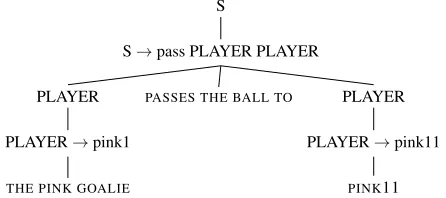
the pairhTHE PINK GOALIE PASSES THE BALL TO PINK11,pass(pink1,pink11)i is given in Figure 1. Their model is trained by a variant of the Inside-Outside algorithm which deals with the hybrid tree structure and takes into account the ambiguity of the training examples.
In addition to learning directly from the ambigu-ous training data, they also train a semantic parser in a supervised fashion on data that has been pre-viously disambiguated by their matching model. This slightly improves their system’s performance. Consequently, there are two scores for each of the
4We useSMALL CAPSfor words,sans seriffor MRs and
MR constituents (concepts), anditalicsfor non-terminals and Grammars.
S
S→pass PLAYER PLAYER
PLAYER
PLAYER→pink11
PINK11 PASSES THE BALL TO
PLAYER
PLAYER→pink1
THE PINK GOALIE
Figure 1: A hybrid tree for the sentence-meaning pair hTHE PINK GOALIE PASSES THE BALL TO PINK11,pass(pink1,pink11)i. The internal nodes
cor-respond to the rules used to derivepass(pink1,pink11)
from a given Meaning Grammar, and the leaves corre-spond to the words or substrings that make up the sen-tence.
two languages (English and Korean) with which we compare our own model: those of the parsers trained directly from the ambiguous data, and those of the ‘supervised’ parsers which constitute the cur-rent state of the art. The details of their evaluation method are disccused in Section 3.3, and their scores are given in Table 2, together with our own scores.
3 Learning a Semantic Parser as a
PCFG-learning problem
[image:3.612.313.536.291.390.2]tech-niques from strings which incorporate the contextual information. In this section, we show how to reduce hybrid trees to such ‘standard’ trees. In effect, we show via construction that ‘grounded’ learning tasks such as learning a semantic parser from semantically enriched and ambiguous data can be reduced to ‘un-grounded’ tasks such as grammatical inference.
Instead of taking the internal nodes of the trees generated by our model as corresponding to MG
production rules, we take them to correspond to MR
constituents. The MRpass(pink1,pink11), for exam-ple, has 4 constituents: the whole MR, the predicate
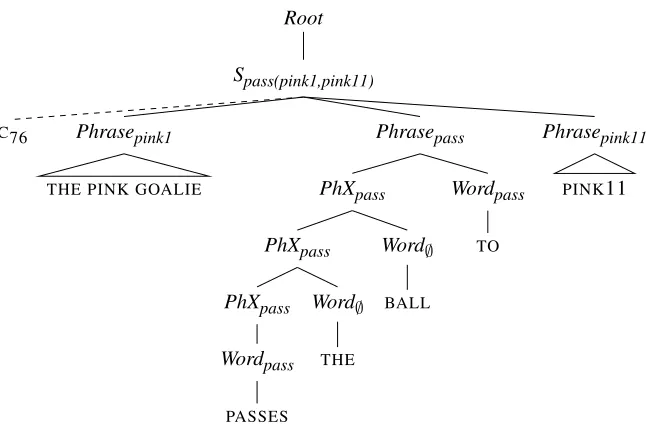
pass, and the two argumentspink1andpink11. Fig-ure 2 gives the tree we assume instead of FigFig-ure 1 for the sentence-meaning pairhTHE PINK GOALIE PASSES THE BALL TO PINK11,pass(pink1,pink11)i. Its root is assumed to correspond to the whole MR and is labeled Spass(pink1,pink11). The remain-ing three MR constituents correspond to the root’s daughters which we label Phrasepink1, Phrasepass
andPhrasepink11. Generally speaking, we assume a special non-terminalSmfor every MRmgenerated by the MG, and a special non-terminalPhraseconfor each of the terminals of the MG (which loosely cor-respond to concepts). This is only possible for MGs which create a finite set of MRs, but the MG used by Kim and Mooney (2010) obeys this restriction.5
The tree’s terminals are the words that make up the sentence, and we assume them to be dominated by concept-specific pre-terminals Wordcon which correspond to concept-specific probability distribu-tions over the language’s vocabulary. Since each
Phrasecon may span multiple words, we give trees rooted in Phrasecon a left-recursive structure that corresponds to a unigram Markov-process. This process generates an arbitrary sequence of words semantically related tocon, dominated by the cor-responding pre-terminalWordconin our model, and words not directly semantically related tocon, dom-inated by a special word pre-terminal Word∅. The sole further restriction is that everyPhrasecon must contain at least oneWordcon.
Trees like the one in Figure 2 can be generated by a Context-Free Grammar (CFG) which, in turn, can be trained on strings to yield a PCFG which
embod-5This grammar is given in the Appendix to Chen et al.
(2010) and generates a total of 2048 MRs.
ies a semantic parser as will be discussed in Section 3.3. We now describe how to set up such a CFG in a systematic way and how to train it on the data used by KM.
3.1 Setting up the PCFG
The training data expresses information of two dif-ferent kinds – form and meaning. Every training ex-ample consists of a natural language string (the for-mal information) and a set of candidate meanings for the string (the semantic information, its context), allowing for the possibility that none of the mean-ings in the context is the correct one. In order to learn from data like this within a grammatical in-ference framework, we have to encode the semantic information as part of the string. Assigning a spe-cific MR mto a string corresponds, in our frame-work, to analyzing it as a tree withSmas its root.
A sentence’s context constrains which of the many possible meanings might be expressed by the string. Thus the role played by the context is adequately modelled if we ensure that if a stringWis associated
with a context {m1,...,mn}, the model only considers
the possibilities that this string might be analyzed as
Sm1,...,Smn.
There are 959 different contexts, i.e. 959 dif-ferent sets of MRs, in the English data set (984 for the Korean data), and we therefore introduce 959 new terminal symbols which play the role of context-identifiers, for example C1 to C959.6
For-mally speaking, a context-identifier is a terminal like any other word of the language and we can therefore prefix every comment in the training data with the context-identifier standing for the set of MRs associated with this comment, an idea taken from previous work such as Johnson et al. (2010). Thus having incorporated the contextual informa-tion into the string, we go on to show how our model makes use of this information, considering the MR
pass(pink1,pink11) as an example. A formal de-scription of the model is given Figure 3.
Assume that pass(pink1,pink11) is associated with only one training example and therefore occurs only in one specific context. If the context-identifier introduced for this context is C1, we require the 6If we were to consider every possible context, we would
Root
Spass(pink1,pink11)
Phrasepink11
PINK11 Phrasepass
Wordpass
TO PhXpass
Word∅
BALL PhXpass
Word∅
THE PhXpass
Wordpass
PASSES Phrasepink1
[image:5.612.145.468.72.287.2]THE PINK GOALIE C76
Figure 2: The tree-structure we propose instead of the Hybrid Tree structure used by (Kim and Mooney, 2010). The non-terminal nodes do not correspond to MG productions, but to MR constituents. The internal structure of the
Phraseconconstituents, shown in full detail forPhrasepass, corresponds to a Markov process that generates the words that make up the sentence. The terminalC76is a context-identifier that restricts the range ofSmnon-terminals that might dominate the sentence and is only used during training, as described in Section 3.1. The grammar that generates this trees is described in Figure 3.
right-hand side of all rules withSpass(pink1,pink11)on their left-hand side to begin with C1. More gener-ally, if an MRm occurs in the contexts associated with the context-identifiersCK,...,CL, we require the
right-hand side of all rules withSmon their left-hand side to begin with exactly one ofCK,...,CL.
In this sense, the context-identifiers can be seen as providing the model with atop-down constraint
– if it encounters a context-identifier, it can only try analyses leading to MRs which are licensed by this context-identifier. On the other hand, the words have to be generated by concept-specific word-distributions, and the concepts that are present re-strict the range of possibleSmnon-terminals which might dominate the whole string. In this sense, the
wordsthe model observes provide it with a bottom-up constraint– if it sees words which are semanti-cally related to certain conceptscon1,...,conn, it has to arrive at an MR which licenses the presence of the correspondingPhraseconxnon-terminals. Of course, the model has to also learn which words are seman-tically related to which concepts. To enable it to do this, our grammar allows everyWordxnon-terminal
to be rewritten as every word of the language. Since there are sentences in the training data with-out the correct meaning in their context, we want to give our model the possibility of not assigning to a sentence any of the MRs licensed by its context-identifier. To do this, we employ another trick of previous work by Johnson et. al and assume a spe-cial null meaning∅ to be present in every context. S∅ may only span words generated by Word∅, the language-specific distribution for words not directly related to any concept; this also has to be learned by the model.
As a last complication, we deal with the fact that syntactic constituents are linearized with respect to each other. For example, if an MR has 3 proper con-stituents (i.e. excluding the MR itself), our grammar allows the corresponding 3 syntactic constituents – which we might label Phrasepredicate, Phrasearg1
and Phrasearg2– to occur in any of the 6 possible orders. Therefore, we have anSmrule for every con-text in whichmoccurs and for every possible order of the proper constituents ofm.
schemata used to generate the CFG is given in Fig-ure 3.7 Instantiating all those schemata leads to a
grammar with 33,101 rules for the English data and 30,731 rules for the Korean data. The difference in size is due to differences in the size of the vocabu-lary and the different number of contexts in the data sets.
These CFGs can now be trained on the training data using the Inside-Outside algorithm (Lari and Young, 1990). After training, the resulting PCFG embodies a semantic parser in the sense that, with a slight modification we describe in section 3.3, it can be used to parse a string into its meaning rep-resentation by determining the most likely syntactic analysis and reading off the meaning assigned by our model at theSm-node.
3.2 Possible objections to our reduction
Before we go on to discuss the details of training and evaluation of our model, we want to address an objection that might seem tempting. Isn’t our reduc-tion impractical and unrealistic as even a highly ab-stract model of language learning – after all, setting up the huge CFG requires knowledge about the vo-cabulary, the MG and all the complicated rules dis-cussed which, presumably, is more knowledge than we want to provide a language learner with, lest we trivialize the task. To this we reply firstly, that it is true that our reduction only works forofflineorbatch grounded learning taskswhere all the data is avail-able to the model before the actual learning begins so that it ‘knows’ the words, the meanings and the contexts present in the data. This offline constraint is, however, true of all models which are trained by iterating multiple times over training data such as KM’s model. Secondly, the intimidating CFG can in principle be reduced to a hand-full of intuitive prin-ciples and is easy to generate automatically.
First of all, the many specificSm-rewrite rules re-duce to the heuristic that every semantic constituent should correspond to a syntactic constituent, and the fact that natural language expressions are linearly or-dered. Note that our model does not contain knowl-edge about the specific word order of the language.
7In our description, we use context-identifiers such as
C1
with a systematic ambiguity, letting them stand for the terminal symbol representing a context and, in contexts such asm∈C1, for the represented context itself.
It simply allows for the constituents of an MR to oc-cur in every possible order which is a very unbiased and empiricist assumption. Of course, this leads to some limited kind of ‘implicit learning’ of word or-der in the sense that for every meaning and for every context, our model might (and in most cases will) as-sign different probabilities to the different rules for every word order; so it can learn that certain specific MRs such aspass(pink1,pink11)are more often lin-earized in one way than in any other. It cannot, how-ever, generalize this to other (or even unseen) MRs, i.e. it does not learn a global fact about the language. In a way, it lacks the knowledge that there is such a thing as word order, a point which we will elaborate on in Section 4.
The many re-write rules for the pre-terminal
W ordxs are nothing but an explicit version of the
assumption that every word the model encounters might, in principle, be semantically related to every concept it knows. Again, this seems to us to be a reasonable assumption.
Finally, the complicated looking set of rules for the internal structure of P hrasexs corresponds to
a simple unigram Markov-process for generating strings. All in all, we do not see that we make any more assumptions than other approaches; our for-mulation may make explicit how rich those assump-tions are but we have not qualitatively changed them.
3.3 Training and Evaluation
The CFG described in the previous section is trained on the same training data used by KM, except that we reduce it to strings (without changing the infor-mation present in the original data) by prefixing ev-ery sentence with a context-identifier. For training we run the Inside-Outside algorithm8with uniform
initialization weights until convergence. For En-glish, this results in an average number of 76 itera-tions for each fold, for Korean the average number of iterations is 50. To deal with the fact that the model might not observe certain meanings during training, we apply a simple smoothing technique by using a Dirichlet prior ofα=0.1 on the rule probabilities. In effect, this provides our system with a small number of pseudo-observations for each rule which prevents 8We use Mark Johnson’s freely available
Root→Sm m∈M∪ {∅}
Sm→c P hrasep(m) c∈C, m∈c, m∈P red0(M) Sm→c{P hrasep(m), P hrasea1(m)} c∈C, m∈c, m∈P red1(M) Sm→c{P hrasep(m), P hrasea1(m), P hrasea2(m)} c∈C, m∈c, m∈P red2(M)
S∅→c P hrase∅ c∈C
P hrase∅→W ord∅
P hrase∅→P hrase∅W ord∅
P hrasex→W ordx x∈T
P hrasex→P hXxW ordx x∈T
P hrasex→P hxW ord∅ x∈T
P hXx→W ordr x∈T, r∈ {x,∅}
P hXx→P hXxW ordr x∈T, r∈ {x,∅}
P hx →P hXxW ordx x∈T
P hx →P hxW ord∅ x∈T
P hx →W ordx x∈T
[image:7.612.140.467.73.258.2]W ordx→v x∈T∪ {∅}, v∈V
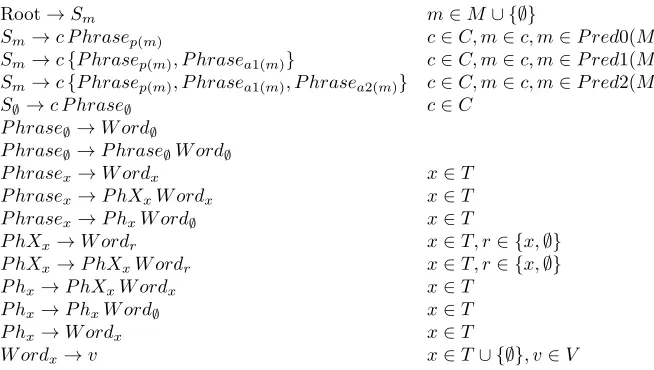
Figure 3: The rule-schemata used to generate the NoWo-PCFG.Rootis the unique start-symbol,Mis the set of all MRs present in the corpus,Cis set the of all context-identifiers present in the corpus,T is the set of terminals of the MG,V is the vocabulary of the corpus.P red0(M)is the subset of all MRs in M of the formpredicate,P red1(M)
is the subset of all MRs in M of the formpredicate(arg1)andP red2(M)is the subset of all MRs in M of the form
predicate(arg1,arg2). p(m)is the predicate of the MRm,a1(m)is the first argument of the MRm,a2(m)is the second argument of the MRm. The rules expandingPhrasexensure that it contains at least oneWordx. A set on the right-hand side of a rule is shorthand for all possible orderings of the elements of the set.
the automatic assignment of zero probability to rules not used during training.9
For parsing, the resulting PCFG is slightly mod-ified by removing the context-identifiers. This is done because the task of a semantic parser is to es-tablish a mapping between NLs and MRs, irrespec-tive of contexts which were only used for learning the parser and should not play a role in its final per-formance. To do this, we add up the probability of all rules which differ only in the context-identifier which can be thought of as marginalizing out the dif-ferent contexts, giving our first model which we call NoWo-PCFG.10
Note that the context-deletion (and the simple smoothing) enables NoWo-PCFG to parse sentences into meanings not present in the data it was trained on which, in fact, happens. For example, there are 81 meanings in the training data for the first English 9We experimented withα=0.1,α=0.5 andα=1.0 and found
that overall, 0.1 yields the best results. We also tried jittering the initial rule weights during training and found that our re-sults are very robust and seem to be independent of a specific initialization.
10NoWo because this model, unlike the one described in
Sec-tion 4, doesnot make explicit use ofwordorder generalisa-tions.
match that are not present in any of the other games’ training data. The PCFG trained on games 2, 3 and 4 is still able to correctly assign 12 of those 81 mean-ings which it has not seen during the training phase which shows the effectiveness of the bottom-up con-straint.
For evaluation, we employ 4-fold cross validation as described in detail in Chen and Mooney (2008) and used by KM: the model is trained on all possible combinations of 3 of the 4 games and is then used to produce an MR for all sentences of the held-out game for which there is a matching gold-standard meaning. For an NLW, our model produces an MR
mby finding themost probableparse ofWwith the
CKY algorithm and reading offmat theSm-node.11 An MR is considered correct if and only if it matches the gold-standard MR exactly; the final evaluation result is averaged over all 4 folds. Our evaluation results for NoWo-PCFG are given in Table 2. All scores are reported in F-measure which is the har-monic mean of Precision and Recall. In this specific case, precision is the fraction of correct parses out 11For parsing, we use Mark Johnson’s freely available CKY
English Korean
KM 0.742 0.764
[image:8.612.104.280.73.154.2]KM ‘supervised’ 0.810 0.808 Chen et al. (2010) 0.801 0.812 NoWo-PCFG 0.742 0.718 WO-PCFG 0.860 0.829
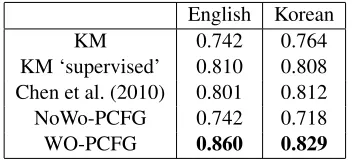
Table 2: A summary of results for the parsing task, in F-measure. We also show the results of Chen et al. (2010), as given in Kim and Mooney (2010), which to our knowl-edge are the highest previously reported scores for Ko-rean. WO-PCFG, described in Section 4 performs better than all previously reported models, but only slightly so for Korean.
of the total number of parses the model returns. Re-call is the fraction of correct parses out of the total number of test sentences.12
NoWo-PCFG performs a little worse than KM’s model. Its scores are virtually identical for English (0.742) and worse for Korean (0.718 vs 0.764). We are not sure as to why our model performs worse on the Korean data, but it might have to do with the fact that the Korean average ambiguity is higher than for the English data.
This shows that it is not only possible to re-duce the task of learning a semantic parser to stan-dard grammatical inference, but that this way of ap-proaching the problem yields comparable results.
The remainder of the paper focuses on our second main point: that letting the model learn additional kinds of information, such as the language’s canoni-cal word order, can further improve its performance. In order to do this we propose a model that learns the word order as well as the mapping from NLs to MRs, and compare its performance to that of the other models.
4 Extending NoWo-PCFG to WO-PCFG
We already pointed out that our model considers ev-ery possible linear order of syntactic constituents. Our NoWo-PCFG model considers each of the pos-sible word orders for every meaning and context in isolation: it is unable to infer from the fact that most meanings it has observed are most likely to be ex-pressed with a certain word order that new meanings 12Because our model parses every sentence, for it Recall and
Precision are identical and F-measure is identical to Accuracy.
it will encounter are also more likely to be expressed with this word order. It seems, however, to be at least a soft fact about languages that theydo have a canonical word order that is more likely to be re-alized in its sentences than any other possible word order. In order to test whether trying to learn this order helps our model, we modify the CFG used for NoWo-PCFG so it can learn word order generaliza-tions, and train it in the same way to yield another semantic parser, WO-PCFG.
4.1 Setting up WO-PCFG
For every possible ordering of the constituents cor-responding to an MR, our grammar contains a rule. In NoWo-PCFG, these different rules all share the same parent which prevents the model from learn-ing the probability of the different word orders cor-responding to the many rules. A straight-forward way to overcome this is to annotate everySmnode with the word order of its daughter. We split every
Sm non-terminal in multiple Swo_m non-terminals, wherewo ∈{v,sv,vs,svo,sov,osv,ovs,vso,vos} indi-cates the linear order of the constituents the non-terminal rewrites as.13
This in itself does not yet allow our model touse
word order as a means of generalization. To model that whenever itencounters a specific examplethat is indicative of a certain word order, this word or-der becomes slightly more probablefor every other example as well, we have to make a further slight change to the CFG which we now describe. A for-mally explicit description of the necessary changes which we go on to describe is given in Figure 4.
We introduce six new non-terminals, correspond-ing to the six possible word orders SVO, SOV, VSO, VOS, OSV and OVS and require everySwo_m non-terminal to be dominated by the non-non-terminal com-patible with its daughters linear order. As an exam-ple, consider the two syntactic non-terminals cor-responding to the MR kick(pink1), Svs_kick(pink11)
and Ssv_kick(pink11). Whenever an example is suc-cessfully analyzed as Svs_kick(pink11), this should strengthen our model’s expectation of encountering
13We assume, somewhat simplifying, that an MR’s predicate
Root→wo wo∈W O
wo→Sx_m wo∈W O, x∈W OS, x⊂wo, m∈M
Sv_m→c P hrasep(m) c∈C, m∈c, m∈P red0(M)
Sx_m→c{P hrasep(m), P hrasea1(m)} c∈C, m∈c, m∈P red1(M), x∈ {sv, vs} Sx_m→c{P hrasep(m), P hrasea1(m), P hrasea2(m)} c∈C, m∈c, m∈P red2(M), x∈W OS
Sv_∅→c P hrase∅ c∈C
Figure 4: In order to turn NoWo-PCFG described in Figure 3 into the WO-PCFG described in the text, substitute the first five rule-schemata with the schemata given here. W O is the set of word
order non-terminals {SV O, SOV, OSV, OV S, V SO, V OS}, W OS is the set of word order annotations
{v, sv, vs, svo, svo, ovs, osv, vso, vos}. We takex ⊂ woto mean thatxis compatible withwo, wherevis
com-patible with all word orders,svis compatible with SVO,SOV and OSV, and so on. For rule-schemata 4 and 5, the
choice of x determines the order of the elements of the set on the right-hand side. All other symbols have the same meaning as explained in Figure 3.
more examples where the verb precedes the sub-ject, i.e. of the language being pre-dominantly VSO, VOS or OVS. Therefore, we allowVSO, VOSand
OVSto be rewritten asSvs_kick(pink11). More gener-ally, every word order non-terminal can rewrite as any of theSwo_mnon-terminals that are compatible with it. Adding this additional layer of word order abstraction leads to a grammar with 36,019 rules for English and a grammar with 33,715 rules for Ko-rean.
4.2 Evaluation of WO-PCFG
Training and evaluating WO-PCFG in exactly the same way as the previous grammar gives an F-measure of 0.860 for English and an F-F-measure of 0.829 for Korean. Those scores are, to our knowl-edge, the highest scores previously reported for this parsing task and establish our second main point: letting the model learn the language’s word order in addition to learning the mapping from sentences to MR increases semantic parsing accuracy.14
An intuitive explanation for the increase in perfor-mance is that by allowing the model to learn word order, we are providing it with a new dimension along which it can generalize.
In this sense, we can look at our refinement as providing the model with abstract linguistic knowl-edge, namely that languages tend to have a
canon-14Liang et al. (2009)’s model can be seen as capturing
some-thing similar to our word order generalization with the help of a Field Choice Model which primarily captures discourse co-herence and salience properties. It differs, however, in that it can only learn one generalization for each predicate type and no language wide generalization.
ical word order. The usefulness of this kind of in-formation is impressive – for English, it improves the accuracy of semantic parsing by almost 12% in F-measure and for Korean by 11.1%. In addition, our model correctly learns that English’s nant word order is SVO and that Korean is predomi-nantly SOV, assigning by far the highest probability to the correspondingRootrewrite rule (0.91 for En-glish and 0.98 for Korean). This kind of information is useful in its own right and could, for example, be exploited by coupling word order with other linguis-tic properties, perhaps following Greenberg (1966)’s implicational universals.
In this sense, the reduction of grounded learning problems to grammatical inference does not only make possible the application of a wide variety of tools and insights developed over years of research, it might also make it easier to bring abstract (and not so abstract) linguistic knowledge to bear on those tasks.
The overall slightly worse performance of our system on Korean data might stem from the fact that Korean, unlike English, has a rich morphology, and that our model does not learn anything about mor-phology at all. We plan on further investigating ef-fects like this in the future, as well as applying more advanced grammatical inference algorithms.
5 Conclusion and Future Work
for the application of techniques and insights devel-oped for grammatical inference to grounded learn-ing tasks. In addition, we have shown that lettlearn-ing the model learn the language’s canonical word or-der improves parsing performance, beyond the top scores previously reported, thus illustrating the use-fullnes of linguistic knowledge for tasks like this.
In future research, we plan to address the limi-tation of our model to a finite set of meaning rep-resentations, in particular through the use of non-parametric Bayesian models such as the Infinite PCFG model of Liang et al. (2007) and the Infi-nite Tree model of Finkel et al. (2007); both allow for a potentially infinite set of non-terminals, hence directly addressing this problem. In addition, we are thinking about using an extension of the PCFG formalism that allows for some kind of ‘feature-passing’ which could lead to much smaller and more general grammars.
References
N. C. Chang and T. V. Maia. 2001. Grounded learning of grammatical constructions. In2001 AAAI Spring Symposium on Learning Grounded Representations. David L. Chen and Raymond J. Mooney. 2008. Learning
to sportscast: A test of grounded language acquisition. InProceedings of the 25th International Conference on Machine Learning (ICML).
David L. Chen, Joohyun Kim, and Raymond J. Mooney. 2010. Training a multilingual sportscaster: Using per-ceptual context to learn language. Journal of Artificial Intelligence Research, 37:397–435.
Jenny R. Finkel, Trond Grenager, and Christopher D. Manning. 2007. The infinite tree. InProceedings of the 45th Annual Meeting of the Association of Com-putational Linguistics, pages 272–279.
Joseph H. Greenberg. 1966. Some universals of gram-mar with particular reference to the order of meaning-ful elements. In Joseph H. Greenberg, editor, Univer-sals of Language, chapter 5, pages 73–113. The MIT Press, Cambridge, Massachusetts.
Mark Johnson, Katherine Demuth, Michael Frank, and Bevan Jones. 2010. Synergies in learning words and their referents. In J. Lafferty, C. K. I. Williams, J. Shawe-Taylor, R.S. Zemel, and A. Culotta, editors,
Advances in Neural Information Processing Systems 23, pages 1018–1026.
Joohyun Kim and Raymond J. Mooney. 2010. Genera-tive alignment and semantic parsing for learning from
ambiguous supervision. InProceedings of the 23rd In-ternational Conference on Computational Linguistics (COLING 2010).
K. Lari and S.J. Young. 1990. The estimation of Stochas-tic Context-Free Grammars using the Inside-Outside algorithm.Computer Speech and Language, 4(35-56). Percy Liang, Slav Petrov, Michael Jordan, and Dan Klein. 2007. The infinite PCFG using hierarchical Dirichlet processes. InProceedings of the 2007 Joint Confer-ence on Empirical Methods in Natural Language Pro-cessing and Computational Natural Language Learn-ing (EMNLP-CoNLL), pages 688–697.
Percy Liang, Michael I. Jordan, and Dan Klein. 2009. Learning semantic correspondences with less supervi-sion. InProceedings of the 47th Annual Meeting of the ACL and the 4th IJCNLP of the AFNLP.
Wei Lu, Hwee Tou Ng, Wee Sun Lee, and Luke S. Zettle-moyer. 2008. A generative model for parsing natu-ral language to meaning representations. InEmpirical Methods in Natural Language Processing (EMNLP), pages 783–792.
Luke S. Zettlemoyer and Michael Collins. 2005. Learn-ing to map sentences to logical form: Structured clas-sification with probabilistic categorial grammars. In