In: Proceedings Of CoNLL-2000 and LLL-2000, pages 43-48, Lisbon, Portugal, 2000.
Memory-Based Learning for Article Generation
G u i d o M i n n e n * F r a n c i s B o n d t Cognitive and Computing Sciences MT Research Group
University of Sussex NTT Communication Science Labs Palmer BN1 9QH, Brighton, UK 2-4 Hikari-dai, Kyoto 619-0237, JAPAN Guido. M i n n e n © c o g s . susx. ac. u k b o n d © c s l a b , kecl. ntt. co. jp
A n n C o p e s t a k e CSLI Stanford University Stanford CA 94305-2150, USA
aac©csli, stanford, edu
A b s t r a c t
Article choice can pose difficult problems in ap- plications such as machine translation and auto- mated summarization. In this paper, we investi- gate the use of corpus data to collect statistical generalizations about article use in English in order to be able to generate articles automati- cally to supplement a symbolic generator. We use data from the Penn Treebank as input to a memory-based learner (TiMBL 3.0; Daelemans et al., 2000) which predicts whether to gener- ate an article with respect to an English base noun phrase. We discuss competitive results ob- tained using a variety of lexical, syntactic and semantic features that play an important role in automated article generation.
1 I n t r o d u c t i o n
Article choice can pose difficult problems in nat- ural language applications. Machine transla- tion (MT) is an example of such an applica- tion. When translating from a source language that lacks articles, such as Japanese or Rus- sian, to one that requires them, such as English or German, the system must somehow generate the source language articles (Bond and Ogura, 1998). Similarly in automated summarization: when sentences or fragments are combined or reduced, it is possible that the form of a noun phrase (NP) is changed such that a change of the article associated with the NP's head be- comes necessary. For example, consider the sen- tences A talk will be given on Friday about NLP; The talk will last .for one hour which might get summarized as Friday's N L P talk will last one * Visiting CSLI, Stanford University (2000).
t Visiting CSLI, Stanford University (1999-2000).
hour. However, given the input sentences, it is not clear how to decide not to generate an arti- cle for the subject NP in the output sentence.
Another important application is in the field known as augmentative and alternative com- munication (AAC). In particular, people who have lost the ability to speak sometimes use a text-to-speech generator as a prosthetic de- vice. But most disabilities which affect speech, such as stroke or amyotrophic lateral sclerosis (ALS or Lou Gehrig's disease), also cause some more general motor impairment, which means that prosthesis users cannot achieve a text in- put rate comparable to normal typing speeds even if they are able to use a keyboard. Many have to rely on a slower physical interface (head- stick, head-pointer, eye-tracker etc). We are at- tempting to use a range of NLP technology to improve text input speed for such users. Article choice is particularly important for this applica- tion: many AAC users drop articles and resort to a sort of telegraphese, but this causes degra- dation in comprehension of synthetic speech and contributes to its perception as unnatural and robot-like. Our particular goal is to be able to use an article generator in conjunction with a symbolic generator for AAC (Copestake, 1997; Carroll et al., 1999).
In this paper we investigate the use of corpus data to collect statistical generalizations about article use in English so as to be able to gen- erate them automatically. We use data from the Penn Treebank as input to a memory-based learner (TiMBL 3.0; Daelemans et al., 2000) that is used to predict whether to generate the or alan or no article. 1 We discuss a variety of lexical, syntactic and semantic features that
play an important role in automated article gen- eration, and compare our results with other re- searchers'.
The paper is structured as follows. Section 2 relates our work to that of others. Section 3 introduces the features we use. Section 4 intro- duces the learning method we use. We discuss our results in Section 5 and suggest some di- rections for future research, then conclude with some final remarks in Section 6.
2 R e l a t e d W o r k
There has been considerable research on gen- erating articles in machine translation sys- tems (Gawrofiska, 1990; Murata and Nagao, 1993; Bond and Ogura, 1998; Heine, 1998). These systems use hand-written rules and lex- ical information to generate articles. The best cited results, 88% accuracy, are quoted by Heine (1998) which were obtained with respect to a very small corpus of 1,000 sentences in a re- stricted domain.
Knight and Chander (1994) present an ap- proach that uses decision trees to determine whether to generate
the
oralan.
They do not consider the possibility that no article should be generated. On the basis of a corpus of 400K NP instances derived from the Wall Street Jour- nal, they construct decision trees for the 1,600 most frequent nouns by considering over 30,000 lexical, syntactic and semantic features. They achieve an accuracy of 81% with respect to these nouns. By guessingthe
for the remainder of the nouns, they achieve an overall accuracy of 78%. 3 F e a t u r e s D e t e r m i n i n g A u t o m a t e dA r t i c l e G e n e r a t i o n
We have extracted 300K base noun phrases (NPs) from the Penn Treebank Wall Street Journal data (Bies et al., 1995) using the tgrep tool. The distribution of these NP instances with respect to articles is as follows:
the
20.6%,a/an
9.4% and 70.0% with no article.We experimented with a range of features: 1. Head of the NP: We consider as the head of the NP the rightmost noun in the NP. If an NP does not contain a noun, we take the last word in the NP as its head.
2. Part-of-speech (PoS) tag of the head of the NP: PoS labels were taken from the Penn Treebank. We list the tags that occurred with
(PP-DIR t o / T 0
(NP the/DT problem/NN)) Figure 1: An example o f a prepositional phrase annotated with a f u n c t i o n a l t a g
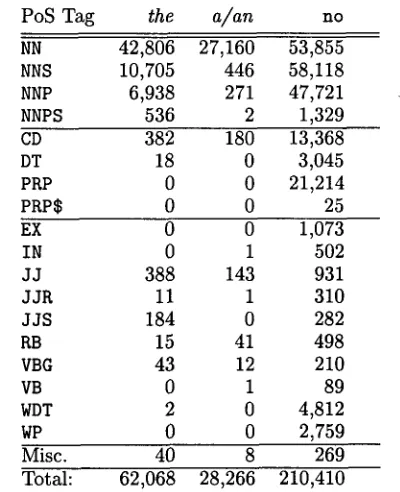
the heads of t h e N P s in Table 1.
PoS Tag
the
alan
noNN 42,806 27,160 53,855
NNS 10,705 446 58,118
NNP 6,938 271 47,721
NNPS 536 2 1,329
CD 382 180 13,368
DT 18 0 3,045
PRP 0 0 21,214
PRP$ 0 0 25
EX 0 0 1,073
IN 0 1 502
JJ 388 143 931
JJR 11 1 310
JJS 184 0 282
RB 15 41 498
VBG 43 12 210
VB 0 1 89
WDT 2 0 4,812
WP 0 0 2,759
Misc. 40 8 269
Total: 6 2 , 0 6 8 28,266 210,410
Table 1: Distribution of NP instances in Wall Street Journal data (300,744 NPs in all)
3. Functional tag of the head of the NP: In the Penn Treebank each syntactic category can be associated with up to four functional tags as listed in Table 2. We consider the sequence of functional tags associated with the category of the NP as a feature; if a constituent has no func- tional tag, we give the feature the value NONE.
4. Category of the constituent embedding the NP: We looked at the category of the embedding constituent. See Figure 1: The category of the constituent embedding the NP
the problem
is PP.5. Functional tag of the constituent embedding the NP: If the category of the con- stituent embedding the NP is associated with one or more functional tags, they are used as features. The functional tag of the constituent embedding
the problem
in Figure 1 is DIR. [image:2.596.321.521.175.421.2]Functional Marks:
Tag (ft) T e x t c a t e g o r i e s HLN headlines and datelines LST list markers
TTL titles
G r a m m a t i c a l f u n c t i o n s CLF
N0M ADV LGS PRD SUBJ TPC CLR BNF DTV
true clefts
non NPs that function as NPs clausal and NP adverbials logical subjects in passives nonVP predicates
surface subject
topicalized/fronted constituents closely related
beneficiary of action dative object S e m a n t i c roles V0C vocatives
DIR direction and trajectory
L0C location
MNR manner
PRP purpose and reason
TMP temporal phrases
PUT locative complement of put EXT spatial extent of activity
Table 2: Functional tags and their mean- ing (Santorini, 1990)
have one determiner (Bies et al., 1995), so we expect it to be a good predictor of situations where we should not generate an article.
7. Head countability preferences of the head of the NP: In case the head of an N P is a noun we also use its countability as a feature. We an- ticipate t h a t this is a useful feature because sin- gular indefinite countable nouns normally take the article a/n, whereas singular indefinite un- countable nouns normally take no article: a dog vs water. We looked up the countability from the transfer lexicon used in the Japanese-to- English machine translation system A L T - J / E (Ikehara et al., 1991). We used six values for the countability feature: FC (fully countable) for nouns that have b o t h singular and plural forms and can be directly modified by numerals and modifiers such as many; UC (uncountable) for nouns that have no plural form and can be mod- ified by much; SC (strongly countable) for nouns that are more often countable t h a n uncount- able; WC (weakly countable) for nouns t h a t are more often u n c o u n t a b l e t h a n countable; and PT (pluralia t a n t u m ) for nouns that only have plu-
ral forms, such as for example, scissors (Bond et al., 1994). Finally, we used the value UNKNOWN if the lexicon did not provide countability infor- mation for a noun or if the head of the N P was not a noun. 41.4% of the N P instances received the value UNKNOWN for this feature.
8. Semantic classes of the head of the NP: If the head of the N P is a noun we also take into account its semantic classification in a large se- mantic hierarchy. T h e underlying idea is that the semantic class of the n o u n can be used as a way to back off in case of u n k n o w n head nouns. The 2,710 node semantic hierarchy we used was also developed in the context of the A L T - J / E system (Ikehara et al., 1991). Edges in this hi- erarchy represent IS-A or HAS-A relationships. In case the semantic classes associated with two nodes s t a n d in the IS-A relation, the semantic class associated with the node highest in the hi- erarchy s u b s u m e s the semantic class associated with the other node.
Each of the nodes in this part of the hierarchy is represented b y a boolean feature which is set to 1 if that node lies on the p a t h from the root of the hierarchy to a particular semantic class. Thus, for example, the semantic features of a noun in the semantic class organization con- sists of a vector of 30 features where the features corresponding to the nodes noun, c o n c r e t e , agent and organization are set to I and all other features are set to 0. 2
4 M e m o r y - b a s e d l e a r n i n g
We used the Tilburg m e m o r y based learner T i M B L 3.0.1 (Daelemans et al., 2000) to learn from examples for generating articles using the features discussed above. M e m o r y - b a s e d learn- ing reads all training instances into m e m o r y and classifies test instances by extrapolating a class from the most similar instance(s) in memory.
[image:3.596.64.269.73.376.2]numbers of features from heterogeneous sources: W h e n data is sparse, feature weighing embod- ies a smoothing-by-similarity effect (Zavrel and Daelemans, 1997).
5 E v a l u a t i o n a n d D i s c u s s i o n
We tested the features discussed in section 3 with respect to a number of different memory- based learning m e t h o d s as implemented in the TiMBL system (Daelemans et al., 2000).
We considered two different learning algo- rithms. The first, IB1 is a k-nearest neighbour algorithm. 3. This can be used with two differ- ent metrics to judge the distance between the examples: overlap and modified value difference metric (MVDM). TiMBL automatically learns weights for the features, using one of five dif- ferent weighting methods: no weighting, gain ratio, information gain, chi-squared and shared variance. The second algorithm, IGTREE, stores examples in a tree which is p r u n e d according to the weightings. This makes it much faster and of comparable accuracy. The results for these different methods, for k = 1, 4, 16 are dis- played in Table 3. IB1 is tested with leave-one- out cross-validation, IGTREE with ten-fold cross validation.
The best results were (82.6%) for IB1 with the MVDM metric, and either no weighting or weighting by gain ratio. I G T R E E did not per- form as well. We investigated more values of k, from 1 to 200, and found they had little influ- ence on the accuracy results with k = 4 or 5 performing slightly better.
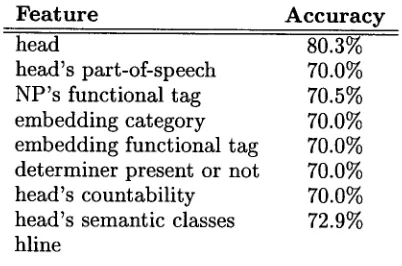
We also tested each of the features described in Section 3 in isolation and then all together. We used the best performing algorithm from our earlier experiment: IB1 with MVDM, gain ratio and k = 4. T h e results of this are given in Table 4.
When interpreting these results it is impor- tant to recall the figures provided in Table 1. The most c o m m o n article, for any PoS, was no
and for many PoS, including pronouns, gener- ating no article is always correct. There is more variation in NPs headed by c o m m o n nouns and adjectives, and a little in NPs headed by proper nouns. Our baseline therefore consists of never
3Strictly speaking, it is a k nearest distance algo- rithm, which looks at all examples in the nearest k dis- tances, the number of which may be greater t h a n k.
Feature A c c u r a c y
head 80.3%
head's part-of-speech 70.0% NP's functional tag 70.5%
embedding category 70.0%
embedding functional tag 70.0% determiner present or not 70.0% head's countability 70.0% head's semantic classes 72.9% hline
Table 4: Accuracy results by feature generating an article: this will be right in 70.0% of all cases.
Looking at the figures in Table 4, we see that many of the features investigated did not im- prove results above the baseline. Using the head of the NP itself to predict the article gave the best results of any single feature, raising the ac- curacy to 79.4%. T h e functional tag of the head of the NP itself improved results slightly. The use of the semantic classes (72.1%) clearly im- proves the results over the baseline thereby indi- cating that they capture useful generalizations. T h e results from testing the features in com- bination are shown in Table 5. Interestingly, features which were not useful on their own, proved useful in combination with the head noun. T h e most useful features appear to be the category of the e m b e d d i n g constituent (81.1%) and the presence or absence of a determiner (80.9%). Combining all the features gave an accuracy of 82.9%.
Feature Accuracy
h e a d + i t s part-of-speech 80.8% head+functional tag of NP 81.1% h e a d + e m b e d d i n g category 80.8% h e a d + e m b e d d i n g functional tag 81.4% h e a d + d e t e r m i n e r present or not 81.7%
head+countability 80.8%
h e a d + s e m a n t i c classes 80.8%
hline all features 83.6%
[image:4.596.328.529.78.211.2] [image:4.596.322.542.521.649.2]A l g o r i t h m k
F e a t u r e W e i g h t i n g
None Gain ratio Information gain X 2 Shared variance
IB1 1 83.5% 83.5% 83.3% 83.2% 83.3%
(MVDM) 4 83.5% 83.6% 83.3% 83.3% 83.3%
16 83.6% 83.5% 83.2% 83.2% 83.2%
IB1 1 83.1% 83.5% 83.3% 83.2% 83.3%
(overlap) 4 82.9% 83.1% 83.1% 83.1% 83.1%
16 82.9% 83.0% 82.9% 82.9% 82.9%
IGTREE - - - - 82.9% 82.5% 82.4% 82.6%
Table 3: Accuracy results broken down with respect to memory-based learning methods used also improve significantly upon earlier results of
78% as reported by Knight and Chander (1994), which in any case is a simpler task since it only involved choice between
the
andalan.
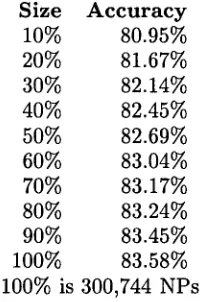
Further, our results are competitive with state of the art rule-based systems. Because different corpora are used to obtain the various results reported in the literature and the problem is often de- fined differently, detailed comparison is difficult. However, the accuracy achieved appears to ap- proach the accuracy results achieved with hand- written rules.In order to test the effect of the size of the training data, we tested used the best perform- ing algorithm from our earlier experiment
(IB1
with MVDM, gain ratio and k = 4) on various subsets of the corpus: the first 10%, the first 20%, the first 30% and so on to the whole cor- pus. The results are given in Table 6.S i z e A c c u r a c y
10% 80.95%
20% 81.67%
30% 82.14%
4O% 82.45%
50% 82.69%
60% 83.04%
70% 83.17%
80% 83.24%
90% 83.45%
100% 83.58%
(100% is 300,744 NPs)
Table 6: Accuracy versus Size of Training Data The accuracy is still improving even with 300,744 NPs, an even larger corpus should give even better results. It is important to keep in mind that we, like most other researchers, have been training and testing on a relatively homo-
geneous corpus. Furthermore, we took as given information about the number of the NP. In many applications we will have neither a large amount of homogeneous training data nor infor- mation about number.
5.1 F u t u r e W o r k
In the near future we intend to further ex- tend our approach in various directions. First, we plan to investigate other lexical and syn- tactic features that might further improve our results, such as the existence of pre-modifiers like superlative and comparative adjectives, and post-modifiers like prepositional phrases, rela- tive clauses, and so on. We would also like to in- vestigate the effect of additional discourse-based features such as one that incorporates informa- tion about whether the referent of a noun phrase has been mentioned before.
Second, we intend to make sure that the fea- tures we are using in training and testing will be available in the applications we consider. For example, in machine translation, the input noun phrase may be
all dogs,
whereas the output could be eitherall dogs
orall the dogs.
At present, words such asall, both, half
in our in- put are tagged as pre-determiners if there is a following determiner (it can only bethe
or a possessive), and determiners if there is no arti- cle. To train for a realistic application we need to collapse the determiner and pre-determiner inputs together in our training data. [image:5.596.94.490.70.198.2] [image:5.596.122.222.485.636.2]to train on, then it will b e easier to a d a p t our tool quickly to new domains, for which there are unlikely to be fully marked up corpora.
6 C o n c l u d i n g r e m a r k s
We described a m e m o r y - b a s e d approach to au- t o m a t e d article generation that uses a variety of lexical, syntactic and semantic features as pro- vided by the P e n n Treebank Wall Street Jour- nal d a t a and a large h a n d - e n c o d e d M T dictio- nary. W i t h this approach we achieve an accu- racy of 82.6%. We believe that this approach is an encouraging first step towards a statistical device for a u t o m a t e d article generation t h a t can be used in a range of applications such as speech prosthesis, machine translation and a u t o m a t e d summarization.
A c k n o w l e d g m e n t s
The authors would like to thank the Stanford NLP reading group, the LinGO project at CSLI, Timo- thy Baldwin, Kevin Knight, Chris Manning, Wal- ter Daelemans and two anonymous reviewers for their helpful comments. This project is in part sup- ported by the National Science Foundation under grant number IRI-9612682.
R e f e r e n c e s
Ann Bies, Mark Fergusona, Karen Katz, and Robert MacIntyre, 1995. Bracketing Guidelines for Tree- bank H Style. Penn Treebank Project, University of Pennsylvania.
Francis Bond and Kentaro Ogura. 1998. Reference in Japanese-to-English machine translation. Ma- chine Translation, 13(2-3):107-134.
Francis Bond, Kentaro Ogura, and Satoru Ikehara. 1994. Countability and number in Japanese-to- English machine translation. In 15th Interna- tional Conference on Computational Linguistics: COLING-94, pages 32-38, Kyoto. ( h t t p : / / x x x .
lanl. gov/abs/cmp- ig/951 i001).
Lou Burnard. 1995. User reference guide for the
British National Corpus. Technical report, Ox- ford University Computing Services.
John Carroll, Ann Copestake, Dan Flickinger, and Victor Poznanski. 1999. An efficient chart gen- erator for (semi-)lexicalist grammars. In Proceed- ings o/ the 7th European Workshop on Natural Language Generation (EWNLG'99), pages 86-95, Toulouse, France.
Ann Copestake. 1997. Augmented and alternative NLP techniques for augmentative and alternative communication. In Proceedings of the ACL work- shop on Natural Language Processing for Commu- nication Aids, pages 37-42, Madrid.
Walter Daelemans, Antal van den Bosch, and Jakub Zavrel. 1999. Forgetting exceptions is harmful in language learning. Machine Learning, 34. Walter Daelemans, Jakub Zavrel, Ko van der Sloot,
and Antal van den Bosch. 2000. TiMBL: Tilburg memory based learner, version 3.0, reference guide. ILK Technical Report 00-01, ILK, Tilburg, The Netherlands. (ILK-0001; h t t p : / / i l k . k u b .
nl).
Barbara Gawrofiska. 1990. "Translation Great Problem" on the problem of inserting articles when translating from Russian into Swedish. In
13th International Conference on Computational Linguistics: COLING-90, Helsinki.
Julia E. Heine. 1998. Definiteness predictions for Japanese noun phrases. In 36th Annual Meeting o] the Association ]or Computational Linguistics and 17th International Conference on Computa- tional Linguistics: COLING/A CL-98, pages 519- 525, Montreal, Canada.
Satoru Ikehara, Satoshi Shirai, Akio Yokoo, and Hi- romi Nakaiwa. 1991. Toward an MT system with- out pre-editing - effects of new methods in ALT- J / E - . In Third Machine Translation Summit: M T Summit III, pages 101-106, Washington DC.
(http ://xxx. lanl. gov/abs/cmp- ig/9510008). Kevin Knight and Ishwar Chander. 1994. Au-
tomated postediting of documents. In Proceed- ings of the 12th National Conference on Artificial Intelligence: AAAI-9~, pages 779-784, Seattle.
(http ://xxx. lanl.
gov/abs/cmp-ig/9407028).
Guido Minnen, John Carroll, and Darren Pearce.2000. Robust, applied morphological generation.
In Proceedings of the first International Natural Language Genration Conference, Mitzpe Ramon, Israel.
Masaki Murata and Makoto Nagao. 1993. Deter- mination of referential property and number of nouns in Japanese sentences for machine transla- tion into English. In Fifth International Confer- ence on Theoretical and Methodological Issues in Machine Translation: TMI-93, pages 218-25, Ky- oto, July. ( h t t p : / / x x x . l a a l . g o v / a b s / c m p - l g / 9405019).
Beatrice Santorini. 1990. Part-of-speech tagging guidelines for the Penn Treebank Project. Tech- nical Report MS-CIS-90-47, Department of Com- puter and Information Science, University of Pennsylvania.