Proceedings of the 2019 Conference on Empirical Methods in Natural Language Processing 261
Low-Resource Name Tagging Learned with Weakly Labeled Data
Yixin Cao1 Zikun Hu1 Tat-Seng Chua1 Zhiyuan Liu2 Heng Ji3
1School of Computing, National University of Singapore, Singapore
2Department of CST, Tsinghua University, Beijing, China
3Department of CS, University of Illinois Urbana-Champaign, U.S.A.
[email protected],[email protected],[email protected] [email protected],[email protected]
Abstract
Name tagging in low-resource languages or domains suffers from inadequate training data. Existing work heavily relies on additional in-formation, while leaving those noisy annota-tions unexplored that extensively exist on the web. In this paper, we propose a novel neu-ral model for name tagging solely based on weakly labeled (WL) data, so that it can be applied in any low-resource settings. To take the best advantage of all WL sentences, we split them into high-quality and noisy portions for two modules, respectively: (1) a classifi-cation module focusing on the large portion of noisy data can efficiently and robustly pre-train the tag classifier by capturing textual con-text semantics; and (2) a costly sequence la-beling module focusing on high-quality data utilizes Partial-CRFs with non-entity sampling to achieve global optimum. Two modules are combined via shared parameters. Extensive experiments involving five low-resource lan-guages and fine-grained food domain demon-strate our superior performance (6% and 7.8%
F1 gains on average) as well as efficiency1.
1 Introduction
Name tagging2 is the task of identifying the
boundaries of entity mentions in texts and classi-fying them into the pre-defined entity types (e.g., person). It serves as a fundamental role as pro-viding the essential inputs for many IE tasks, such
as Entity Linking (Cao et al.,2018a) and Relation
Extraction (Lin et al.,2017).
Many recent methods utilize a neural net-work (NN) with Conditional Random Fields
(CRFs) (Lafferty et al., 2001) by treating name
tagging as a sequence labeling problem (Lample
1
Our project can be found in https://github.com/ zig-kwin-hu/Low-Resource-Name-Tagging.
2Someone may call it Named Entity Recognition (NER).
… Barangay Ginebra and FormulaShell forming a rivalry … Barangay GinebraShaquille and FormulaO’NealShell forming a rivalry … Barangay Ginebra and FormulaShell forming a rivalry
B-ORG I-ORG O O O O B-LOC Formula shell won game one in Philippines …
Weakly Labelled, extensively exists on the web
Fully Labelled, expensive to obtain
s<latexit sha1_base64="zD0+iHg15Vq/defZn4JzGP6vt+A=">AAACxnicjVHLSsNAFD2Nr1pfVZdugkVwVRIRdFl002VF+4BaSjKd1tC8yEyUUgR/wK1+mvgH+hfeGaegFtEJSc6ce8+Zuff6aRgI6TivBWthcWl5pbhaWlvf2Nwqb++0RJJnjDdZEiZZx/cED4OYN2UgQ95JM+5Ffsjb/vhcxdu3PBNBEl/JScp7kTeKg2HAPEnUpei7/XLFqTp62fPANaACsxpJ+QXXGCABQ44IHDEk4RAeBD1duHCQEtfDlLiMUKDjHPcokTanLE4ZHrFj+o5o1zVsTHvlKbSa0SkhvRkpbRyQJqG8jLA6zdbxXDsr9jfvqfZUd5vQ3zdeEbESN8T+pZtl/lenapEY4lTXEFBNqWZUdcy45Lor6ub2l6okOaTEKTygeEaYaeWsz7bWCF276q2n4286U7Fqz0xujnd1Sxqw+3Oc86B1VHWdqntxXKmdmVEXsYd9HNI8T1BDHQ00yXuERzzh2apbsZVbd5+pVsFodvFtWQ8fAiGQHA==</latexit><latexit sha1_base64="zD0+iHg15Vq/defZn4JzGP6vt+A=">AAACxnicjVHLSsNAFD2Nr1pfVZdugkVwVRIRdFl002VF+4BaSjKd1tC8yEyUUgR/wK1+mvgH+hfeGaegFtEJSc6ce8+Zuff6aRgI6TivBWthcWl5pbhaWlvf2Nwqb++0RJJnjDdZEiZZx/cED4OYN2UgQ95JM+5Ffsjb/vhcxdu3PBNBEl/JScp7kTeKg2HAPEnUpei7/XLFqTp62fPANaACsxpJ+QXXGCABQ44IHDEk4RAeBD1duHCQEtfDlLiMUKDjHPcokTanLE4ZHrFj+o5o1zVsTHvlKbSa0SkhvRkpbRyQJqG8jLA6zdbxXDsr9jfvqfZUd5vQ3zdeEbESN8T+pZtl/lenapEY4lTXEFBNqWZUdcy45Lor6ub2l6okOaTEKTygeEaYaeWsz7bWCF276q2n4286U7Fqz0xujnd1Sxqw+3Oc86B1VHWdqntxXKmdmVEXsYd9HNI8T1BDHQ00yXuERzzh2apbsZVbd5+pVsFodvFtWQ8fAiGQHA==</latexit><latexit sha1_base64="zD0+iHg15Vq/defZn4JzGP6vt+A=">AAACxnicjVHLSsNAFD2Nr1pfVZdugkVwVRIRdFl002VF+4BaSjKd1tC8yEyUUgR/wK1+mvgH+hfeGaegFtEJSc6ce8+Zuff6aRgI6TivBWthcWl5pbhaWlvf2Nwqb++0RJJnjDdZEiZZx/cED4OYN2UgQ95JM+5Ffsjb/vhcxdu3PBNBEl/JScp7kTeKg2HAPEnUpei7/XLFqTp62fPANaACsxpJ+QXXGCABQ44IHDEk4RAeBD1duHCQEtfDlLiMUKDjHPcokTanLE4ZHrFj+o5o1zVsTHvlKbSa0SkhvRkpbRyQJqG8jLA6zdbxXDsr9jfvqfZUd5vQ3zdeEbESN8T+pZtl/lenapEY4lTXEFBNqWZUdcy45Lor6ub2l6okOaTEKTygeEaYaeWsz7bWCF276q2n4286U7Fqz0xujnd1Sxqw+3Oc86B1VHWdqntxXKmdmVEXsYd9HNI8T1BDHQ00yXuERzzh2apbsZVbd5+pVsFodvFtWQ8fAiGQHA==</latexit><latexit sha1_base64="zD0+iHg15Vq/defZn4JzGP6vt+A=">AAACxnicjVHLSsNAFD2Nr1pfVZdugkVwVRIRdFl002VF+4BaSjKd1tC8yEyUUgR/wK1+mvgH+hfeGaegFtEJSc6ce8+Zuff6aRgI6TivBWthcWl5pbhaWlvf2Nwqb++0RJJnjDdZEiZZx/cED4OYN2UgQ95JM+5Ffsjb/vhcxdu3PBNBEl/JScp7kTeKg2HAPEnUpei7/XLFqTp62fPANaACsxpJ+QXXGCABQ44IHDEk4RAeBD1duHCQEtfDlLiMUKDjHPcokTanLE4ZHrFj+o5o1zVsTHvlKbSa0SkhvRkpbRyQJqG8jLA6zdbxXDsr9jfvqfZUd5vQ3zdeEbESN8T+pZtl/lenapEY4lTXEFBNqWZUdcy45Lor6ub2l6okOaTEKTygeEaYaeWsz7bWCF276q2n4286U7Fqz0xujnd1Sxqw+3Oc86B1VHWdqntxXKmdmVEXsYd9HNI8T1BDHQ00yXuERzzh2apbsZVbd5+pVsFodvFtWQ8fAiGQHA==</latexit> 1
s2
<latexit sha1_base64="9HpV6YLUpskfSajXTx2xU6cogv8=">AAACxnicjVHLSsNAFD2Nr1pfVZdugkVwVZIi6LLopsuKthVqKUk6rUPzYmailCL4A27108Q/0L/wzpiCWkQnJDlz7j1n5t7rpyGXynFeC9bC4tLySnG1tLa+sblV3t5pyyQTAWsFSZiIK9+TLOQxaymuQnaVCuZFfsg6/vhMxzu3TEiexJdqkrJe5I1iPuSBp4i6kP1av1xxqo5Z9jxwc1BBvppJ+QXXGCBBgAwRGGIowiE8SHq6cOEgJa6HKXGCEDdxhnuUSJtRFqMMj9gxfUe06+ZsTHvtKY06oFNCegUpbRyQJqE8QVifZpt4Zpw1+5v31Hjqu03o7+deEbEKN8T+pZtl/lena1EY4sTUwKmm1DC6uiB3yUxX9M3tL1UpckiJ03hAcUE4MMpZn22jkaZ23VvPxN9Mpmb1PshzM7zrW9KA3Z/jnAftWtV1qu75UaV+mo+6iD3s45DmeYw6GmiiRd4jPOIJz1bDiq3MuvtMtQq5ZhfflvXwAQSBkB0=</latexit>
<latexit sha1_base64="9HpV6YLUpskfSajXTx2xU6cogv8=">AAACxnicjVHLSsNAFD2Nr1pfVZdugkVwVZIi6LLopsuKthVqKUk6rUPzYmailCL4A27108Q/0L/wzpiCWkQnJDlz7j1n5t7rpyGXynFeC9bC4tLySnG1tLa+sblV3t5pyyQTAWsFSZiIK9+TLOQxaymuQnaVCuZFfsg6/vhMxzu3TEiexJdqkrJe5I1iPuSBp4i6kP1av1xxqo5Z9jxwc1BBvppJ+QXXGCBBgAwRGGIowiE8SHq6cOEgJa6HKXGCEDdxhnuUSJtRFqMMj9gxfUe06+ZsTHvtKY06oFNCegUpbRyQJqE8QVifZpt4Zpw1+5v31Hjqu03o7+deEbEKN8T+pZtl/lena1EY4sTUwKmm1DC6uiB3yUxX9M3tL1UpckiJ03hAcUE4MMpZn22jkaZ23VvPxN9Mpmb1PshzM7zrW9KA3Z/jnAftWtV1qu75UaV+mo+6iD3s45DmeYw6GmiiRd4jPOIJz1bDiq3MuvtMtQq5ZhfflvXwAQSBkB0=</latexit>
<latexit sha1_base64="9HpV6YLUpskfSajXTx2xU6cogv8=">AAACxnicjVHLSsNAFD2Nr1pfVZdugkVwVZIi6LLopsuKthVqKUk6rUPzYmailCL4A27108Q/0L/wzpiCWkQnJDlz7j1n5t7rpyGXynFeC9bC4tLySnG1tLa+sblV3t5pyyQTAWsFSZiIK9+TLOQxaymuQnaVCuZFfsg6/vhMxzu3TEiexJdqkrJe5I1iPuSBp4i6kP1av1xxqo5Z9jxwc1BBvppJ+QXXGCBBgAwRGGIowiE8SHq6cOEgJa6HKXGCEDdxhnuUSJtRFqMMj9gxfUe06+ZsTHvtKY06oFNCegUpbRyQJqE8QVifZpt4Zpw1+5v31Hjqu03o7+deEbEKN8T+pZtl/lena1EY4sTUwKmm1DC6uiB3yUxX9M3tL1UpckiJ03hAcUE4MMpZn22jkaZ23VvPxN9Mpmb1PshzM7zrW9KA3Z/jnAftWtV1qu75UaV+mo+6iD3s45DmeYw6GmiiRd4jPOIJz1bDiq3MuvtMtQq5ZhfflvXwAQSBkB0=</latexit>
<latexit sha1_base64="9HpV6YLUpskfSajXTx2xU6cogv8=">AAACxnicjVHLSsNAFD2Nr1pfVZdugkVwVZIi6LLopsuKthVqKUk6rUPzYmailCL4A27108Q/0L/wzpiCWkQnJDlz7j1n5t7rpyGXynFeC9bC4tLySnG1tLa+sblV3t5pyyQTAWsFSZiIK9+TLOQxaymuQnaVCuZFfsg6/vhMxzu3TEiexJdqkrJe5I1iPuSBp4i6kP1av1xxqo5Z9jxwc1BBvppJ+QXXGCBBgAwRGGIowiE8SHq6cOEgJa6HKXGCEDdxhnuUSJtRFqMMj9gxfUe06+ZsTHvtKY06oFNCegUpbRyQJqE8QVifZpt4Zpw1+5v31Hjqu03o7+deEbEKN8T+pZtl/lena1EY4sTUwKmm1DC6uiB3yUxX9M3tL1UpckiJ03hAcUE4MMpZn22jkaZ23VvPxN9Mpmb1PshzM7zrW9KA3Z/jnAftWtV1qu75UaV+mo+6iD3s45DmeYw6GmiiRd4jPOIJz1bDiq3MuvtMtQq5ZhfflvXwAQSBkB0=</latexit>
[image:1.595.313.524.224.311.2]B-ORG I-ORG B-NT I-NT
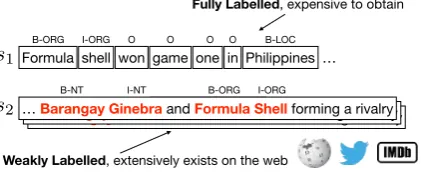
Figure 1: Example of weakly labeled data. B-NT and I-NT denote incomplete labels without types.
et al.,2016), which has became a basic
architec-ture due to its superior performance. Nevertheless, NN-CRFs require exhaustive human efforts for training annotations, and may not perform well in
low-resource settings (Ni et al.,2017). Many
ap-proaches thus focus on transferring cross-domain, cross-task and cross-lingual knowledge into name
tagging (Yang et al.,2017;Peng and Dredze,2016;
Mayhew et al., 2017;Pan et al.,2017;Lin et al.,
2018;Xie et al.,2018). However, they are usually
limited by the extra knowledge resources that are effective only in specific languages or domains.
Actually, in many low-resource settings, there are extensive noisy annotations that naturally
ex-ist on the web yet to be explored (Ni et al.,2017).
In this paper, we propose a novel model for name tagging that maximizes the potential of weakly
labeled (WL) data. As shown in Figure 1, s2
is weakly labeled, since only Formula shell and
Barangay Ginebra are annotated, leaving the re-maining words unannotated.
WL data is more practical to obtain, since it is difficult for people to accurately annotate those en-tities that they do not know or are not interested in. We can construct them from online resources, such as the anchors in Wikipedia. However, the following natures of WL data make learning name tagging from them more challenging:
derived WL data does not contain complete anno-tations, thus can not be directly used for training.
Ni et al.(2017) select the sentences with highest
confidence, and assume missing labels as O (i.e., non-entity), but it will introduce a bias to recog-nize mentions as non-entity. Another line of work is to replace CRFs with Partial-CRFs (T¨ackstr¨om
et al., 2013), which assign unlabeled words with
all possible labels and maximize the total
proba-bility (Yang et al.,2018;Shang et al.,2018).
How-ever, they still rely on seed annotations or domain dictionaries for high-quality training.
Massive Noisy Data WL corpora are usually
generated with massive noisy data including miss-ing labels, incorrect boundaries and types. Previ-ous work filtered out WL sentences by statistical
methods (Ni et al.,2017) or the output of a
train-able classifier (Yang et al.,2018). However,
aban-doning training data may exacerbate the issue of inadequate annotation. Therefore, maximizing the potential of massive noisy data as well as high-quality part, yet being efficient, is challenging.
To address these issues, we first differentiate noisy data from high-quality WL sentences via a lightweight scoring strategy, which accounts for the annotation confidence as well as the coverage of all mentions in one sentence. To take best ad-vantages of all WL data, we then propose a unified neural framework that solves name tagging from two perspectives: sequence labeling and classifi-cation for two types of data, respectively.
Specifically, the classification module focuses on noisy data to efficiently pretrain the tag clas-sifier by capturing textual context semantics. It is trained only using annotated words without noisy unannotated words, and thus it is robust and effi-cient during training. The costly sequence labeling module is to achieve sequential optimum among word tags. It further alleviates the burden of seed annotations in Partial-CRFs and increases ran-domness via Non-entity Sampling strategy, which samples O words according to some linguistic na-tures. These two modules are combined via shared parameters. Our main contributions are as follows:
• We propose a novel neural name tagging
model that merely relies on WL data
with-out feature engineering. It can thus be
adapted for both low-resource languages and domains, while no previous work deals with them at the same time.
• We consider name tagging from two
perspec-tives of sequence labeling and classification, to efficiently take the best advantage of both high-quality and noisy WL data.
• We conduct extensive experiments in five
low-resource languages and a fine-grained domain. Since few work has been done in two types of low-resource settings simulta-neously, we arrive at two types of baselines
from state-of-the-art methods. Our model
achieves significant improvements (6% and 7.8% F1 on average), yet being efficient demonstrated in further ablation studies.
2 Related Work
Name tagging is an fundamental task of extracting entity information, which shall benefit many ap-plications, such as information extraction (Zhang
et al.,2017;Kuang et al.,2019;Cao et al.,2019a)
and recommendation (Wang et al., 2019; Cao
et al.,2019b). It can be treated as either a
multi-class multi-classification problem (Hammerton, 2003;
Xu et al., 2017) or a sequence labeling
prob-lem (Collobert et al., 2011), but very little work
combined them together. The difference between them mainly lies in whether the method mod-els sequential label constraints, which have been demonstrated effective in many NN-CRFs
mod-els (Lample et al.,2016;Ma and Hovy,2016;Chiu
and Nichols,2016). However, they require a large
amount of human annotated corpora, which are usually expensive to obtain.
The above issue motivates a lot of work on name tagging in low-resource languages or domains. A typical line of effort focuses on introducing exter-nal knowledge via transfer learning (Fritzler et al.,
2018;Hofer et al.,2018), such as the use of
cross-domain (Yang et al.,2017), cross-task (Peng and
Dredze, 2016;Lin et al.,2018) and cross-lingual
resources (Ni et al.,2017;Xie et al.,2018;
Zafar-ian et al.,2015;Zhang et al.,2016;Mayhew et al.,
2017;Tsai et al.,2016;Feng et al.,2018;Pan et al.,
2017). Although they achieve promising results, there are a large amount of weak annotations on the Web, which have not been well studied
(Noth-man et al., 2008; Ehrmann et al., 2011). Yang
et al.(2018); Shang et al.(2018) utilized
Partial-CRFs (T¨ackstr¨om et al., 2013) to model
Noisy Weakly Labeled Data
Label Scores
Neural Network
Partial-CRFs with Non-Entity Sampling
B-ORG
O I-ORG
Neural Network ParameterShared
B-ORG I-ORG … O
… Barangay Ginebra and FormulaShell forming an … The team is owned by Ginebra
Weakly Labeled Data Generation O
Neural Name Tagging Model
Classification
Module
Sequence Labeling
Module
Label Induction Data Selection Scheme
B-ORG I-ORG
…
B-ORG I-ORG
…
O B-ORG
I-ORG
…
High-quality Weakly Labeled Data O B-ORG
I-ORG
…
O B-ORG
I-ORG
[image:3.595.87.510.63.217.2]…
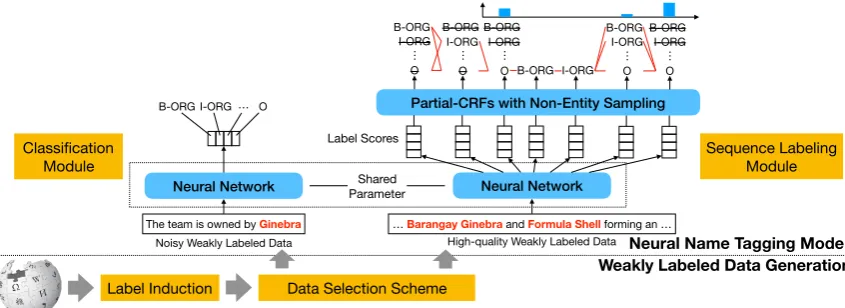
Figure 2: Framework. Rectangles denote the main components for two steps, and rounded rectangles consist of two modules of the neural model. In input sentences, bold fonts denote labeled words, and at the top is corresponding outputs. We use Partial-CRFs to model all possible label sequences (red paths from left to right by picking up one label per column) controlled by non-entity sampling (strikethrough labels according to the distribution). We replace “UN” and “x-NT” label with corresponding possible labels to clarify the principle of PCRF.
data, and adapt it to arbitrary low-resource lan-guages or domains, which can be further improved by the above transfer-based methods.
3 Preliminaries and Framework
3.1 Preliminaries
We formally define the name tagging task as
follows: given a sequence of words X =
hx1,· · · , xi,· · ·, x|X|i, it aims to infer a sequence
of labelsY = hy1,· · ·, yi,· · · , y|X|i, where|X|
is the length of the sequence,yi ∈ Y is the label
of the wordxi, each label consists of the boundary
and type information, such as B-ORG indicating
that the word is Begin of an ORGanization
en-tity. To make notations consistent, we use Y˜ =
YS
{UN,B-NT,I-NT} to denote the label set of
WL data, where UN indicates that the word is un-labeled, and NT denote only the type is unlabeled. In other words, the word with UN may be any one
of the label inY, and the word with NT may be
any type. We defineY˜for notation clarity.
To deal with the issue of limited annotations,
we construct WL data D = {(X,Y˜)} based on
Wikipedia anchors and taxonomy, where Y˜ =
h˜y1,· · ·,y˜i,· · ·,y˜|X|i and y˜i ∈ Y˜. An anchor
hm, ei ∈ A links a mention m to an entity
e ∈ E, wheremcontains one or several
consec-utive words of length|m|. Particularly, we define
A(X) as the set of anchors inX. Most entities
are mapped to hierarchically organized categories,
namelytaxonomyT, which provides category
in-formationC ={c}. We defineC(e)as the
cate-gory set ofe, andT↓(c)as the children ofc.
3.2 Framework
The goal of our method is to extract WL data from Wikipedia and use them as training corpora for
name tagging. As shown in Figure 2, there are
two steps in our framework:
Weakly Labeled Data Generation generates
as many WL data as possible for higher tagging recall. It contains two components of label in-duction and data selection scheme. First, the la-bel induction assigns each word a lala-bel based on Wikipedia anchors and taxonomy. Then, the data selection scheme computes the quality scores for the WL sentences by considering the coverage of mentions as well as the label confidence. Accord-ing to the scores, we split the entire set into two parts: a small set of high-quality data for the se-quence labeling module, and a large amount of noisy data for the classification module.
Neural Name Tagging Model aims at
effi-ciently and robustly utilizing both high-quality and noisy WL data, ensuring satisfying tagging precision. It is to make best use of labeled words via the sequence labeling module and the classifi-cation module. More specifically, we pre-train the classification module to capture the textual con-text semantics from massive noisy data, and then the sequence labeling module further fine-tunes the shared neural networks using a Partial-CRFs layer with Non-Entity Sampling.
4 Weakly Labeled Data Generation
Existing methods use Wikipedia (Ni et al.,2017;
classifier to predict entity categories for name tag-ging training. Instead, we aim at lowering the re-quirements of additional resources in order to sup-port more low-resource settings. We thus utilize a lightweight strategy to generate WL data includ-ing label induction and data selection scheme.
4.1 Label Induction
Given a sentenceXincluding anchorsA(X)and
taxonomyT, we aim at inducing a labely˜∈Y˜for
each wordx ∈ X. Obviously, the words outside
of anchors should be labeled with UN, indicating that it is unlabeled and could be O or unannotated
mentions. For the words in an anchorhm, ei, we
label it according to the entity categories. For
ex-ample, words FormulaandShell(Figure 1) in s2
are labeled as B-ORG and I-ORG, respectively,
because mention Formula Shell is linked to
en-tity Shell Turbo Chargers, which belongs to
cat-egoryBasketball teams. We trace it along the
tax-onomyT: Basketball teams→...→Organizations,
and find that it is a child of Organizations.
Ac-cording to a manually defined mapping Γ(Y) →
C(e.g.,Γ(ORG) =Organizations), we denote all
the classes and their children with the same type (e.g., ORG).
However, there are two minor issues. First, for
the entities without category informationC(e) =
∅, we label them as B-NT or I-NT, indicating that
they have no type information. Second, for the entities referring to multiple categories, we induce labels that maximizes the conditional probability:
argmax
y∗ p
(y∗|C(e)) = P
c∈C(e)1(c∈ T↓(Γ(y∗)))
|C(e)|
(1)
where1(·)indicates1if holds true, otherwise 0.
By doing so, we obtain a set of WL sentences
D = {(X,Y˜)}. However, the induction process
may introduce incorrect boundaries and types of labels due to the crowdsourcing nature of source data. We thus design a data selection scheme to deal with the issues.
4.2 Data Selection Scheme
Following Ni et al. (2017), we compute quality
scores for sentences to distinguish high-quality and noisy data from two aspects: the annotation confidence and the annotation coverage.
The annotation confidence measures the likeli-hood of the text spans being mentions (i.e.,
cor-rectness of boundaries), and being assigned with the types. We define it as follows:
q(X,Y˜) = P
(xi,y˜i)
1(˜yi∈ Y)p(˜yi|C(e))p(C(e)|xi)
|X|
(2)
wherep(C(e)|xi)is the conditional probability of
xi linking to an entity belong to category C(e),
we compute it based on its statistical frequency among Wikipedia anchors.
The annotation coverage measures to which ra-tio the words are being labeled in the sentence:
n(X,Y˜) = P
(xi,y˜i)
1(˜yi ∈ Y)
|X| (3)
We select high-quality sentencesDhqsatisfying:
q(X,Y˜)≥θq;n(X,Y˜)≥θn (4)
whereθq andθn are the hyperparameters. Thus,
the remaining sentences are noisyDnoise.
For example (Figure 2), the sentence ...
Barangay Ginebra and Formula Shell ... is
high-quality, and The team is owned by Ginebra is
noisy. This is because there are more anchors that link Formula Shell to an organization entity and the anchors within the sentence account for a large proportion, leading to a higher quality score. Note thatBarangayandGinebraare labeled with B-NT and I-NT, indicating the type information is miss-ing. Our model may learn the textual semantics for
classifying Ginebra to ORG from the noisy
sen-tence, whereGinebrais labeled with B-ORG.
5 Neural Name Tagging Model
Our neural model contains two modules that share the same NN architecture except the Partial-CRFs
layer. Given Dhq and Dnoise, we first pre-train
the classification module using massive noisy data
Dnoise to efficiently capture the textual
seman-tics. Then, we use the sequence labeling mod-ule to fine-tune the classification modmod-ule on
high-quality data Dhq by considering the transitional
constraints among sequential labels.
5.1 Sequence Labeling Module
models, we utilize the Partial CRFs layer to max-imize the probability of all possible sequential la-bels for the sentence with transitional constraints, where the probability of missing word labels is controlled by non-entity sampling.
Partial-CRFs
Partial-CRFs (PCRFs) was first proposed in the field of Part-of-Speech Tagging (T¨ackstr¨om et al., 2013). It can be trained when the coupled word and label constraints provide only a partial signal by assuming that the uncoupled words may refer to
multiple labels. Given(X,Y˜), we traverse all
pos-sible labelsYfor each unannotated word{xi|˜yi∈
UN,B-NT,I-NT} (e.g., the red paths in Figure2),
and compute the total probability of possible fully
labeled sentencesY(X,Y˜) ={(X, Y)}:
p( ˜Y|X) = Y(X,Y˜)
X
(X,Y)
p(Y|X) (5)
wherep(Y|X) =softmax(s(X, Y)), the same as
in CRFs, and the score functions(X, Y)is:
s(X, Y) = |X| X
i=0
Ayi,yi+1+
|X| X
i=1
Pxi,yi (6)
wherePxi,yi is the score indicating how possible
xi is labeled withyi, which is defined as the
out-put of NN and will be detailed in the next section.
Ayi,yi+1is the transition score from labelyitoyi+1
that is learned in this layer.
Instead of the single correct label sequence in CRFs, the loss function of partial-CRFs is to min-imize the negative log-probability of ground truth over all possible labeled sequences:
L=−
Dnq X
(X,Y˜)
logp( ˜Y|X) (7)
Non-entity Sampling
A crucial drawback of using partial CRFs for WL sentences is that there are no words labeled with O
(i.e., non-entity words) for training (Section6.5).
To further alleviate the reliance on seed annota-tions, we introduce non-entity sampling that sam-ples O from unlabeled words as follows:
p(yi =O|xi,y˜i =N) = α
3(λ1f1+λ2(1−f2) +λ3f3)
(8)
whereα is non-entity ratio to balance how many
unlabeled words are sampled as O, we set α =
0.9in experiments according toAugenstein et al.
(2017). Weighting parameters satisfy 0 ≤
λ1, λ2, λ3 ≤ 1, and f1, f2, f3 are feature scores.
We definef1 =1(xiadjoins an entity), which
im-plies that the words around a mention are
possi-ble to be O; f2 is the ratio of the number of xi
labeled with entities to its total occurrences, re-flecting how frequent a word is in a mention; and
f3 =tf∗df, wheretfis term frequency anddfis
document frequency in Wikipedia articles.
As shown in Figure2, three wordsand,forming
andanare labeled with N since they are outside of
anchors. During training, they should be regarded
as all labels ofYin Partial CRFs, while we sample
some of them as O words according to Equation8.
Thus,andandanare instead treated as O words,
because they do not appear in any anchor, and are
too general due to a highf3value.
5.2 Classification Module
To efficiently utilize the noisy WL sentences, this module regards name tagging as a multi-label clas-sification problem. On one hand, it predicts each word’s label separately, naturally addressing the issue of inconsecutive labels. On the other hand, we only focus on the labeled words, so that the module is robust to the noise since most noise arises from the unlabeled words, and enjoy an ef-ficient training procedure.
Formally, given a noisy sentence (X,Y˜) ∈
Dnoise, we classify words {x
i|˜yi ∈ Y} by
cap-turing textual semantics within the context. Inde-pendently of languages and domains, we combine the character and word embeddings for each word, then feed them into an encoder layer to capture contextual information for the classification layer.
Character and Word Embeddings
As inputs, we introduce character information to enhance word representations to improve the ro-bustness to morphological and misspelling noise
following (Ma and Hovy,2016). Concretely, we
represent a word x by concatenating word
em-bedding w and Convolutional Neural Networks
(CNN) (LeCun et al., 1989) based character
em-beddingc, which is obtained through convolution
Encoder Layer
Given an arbitrary length of sentence X, this
component encodes the semantics of words as well as their compositionality into a
low-dimensional vector space. The most common
encoders are CNN, Long-Short Term Memory
(LSTM) (Hochreiter and Schmidhuber,1997) and
Transformer (Vaswani et al., 2017). We use the
bi-directional LSTM (Bi-LSTM) due to its
supe-rior performance. We discuss it in Section6.2.
Bi-LSTM (Graves et al.,2013) has been widely
used in modeling sequential words, so as to cap-ture both past and fucap-ture input feacap-tures for a given
word. It stacks a forward LSTM and a
back-ward LSTM, so that the output of a word xi is
hi = [
←−
hi;
− →
hi], where
− →
hi = LSTM(X1:i) and
←−
hi =LSTM(Xi:|X|).
Classification Layer
The classification layer makes independent label-ing decisions for each word, so that we can only focus on labeled words, while robustly and effi-ciently skip the noisy unlabeled words.
In this layer, we estimate the scorePxi,yi
(Equa-tion 6) for word xi being the label yi. We use a
fully connected layer followed by softmax to out-put a probability-like score:
Pxi,yi =Sof tmax(Whi+b) (9)
whereW ∈ R|Y|. Note that we have no training
instance for O words. Thus, we also use the
non-entity sampling (Section 5.1). Given (X,Y˜) ∈
Dnoise, this module is trained to minimize
cross-entropy of the predicted and ground truth:
Lc=−
Dnoise X
(X,Y˜)
1(˜yi ∈ Y)˜yilogPxi,yi (10)
5.3 Training and Inference
To distill the knowledge derived from noisy data, we first pre-train the classification module, then share the overall NN with the sequence labeling
module. If we choose a loose thresholdθp andθn,
there is no noisy data and our model shall degrade to the sequential model without the pre-trained classifier. When the threshold is strict, there is no high-quality data and our model will degrade to
the classification module only (Section6.4).
For inference, we use the sequence labeling module to predict the output label sequence with
the largest score as in Equation6.
6 Experiment
We verify our model using five low-resource lan-guages and a specific domain. Furthermore, we investigate the impacts of the main components as well as hyperparameters in the ablation study.
6.1 Experiment Settings
Datasets Since most datasets on low-resource
languages are not publicly available, we use Wikipedia data as the “ground truth”
follow-ing Pan et al. (2017). Thus, we can test name
tagging in low-resource languages as well as do-mains. We choose five languages: Welsh, Bengali, Yoruba, Mongolian and Egyptian Arabic (or CY, BN, YO, MN and ARZ for short), at different low-resource levels, and select 3 types: Person, Loca-tion and OrganizaLoca-tion. For food domain, we reor-ganized the entities in Wikipedia category “Food and drink” into 5 types: Drinks, Meat, Vegetables, Condiments and Breads, for name tagging, and ex-tract sentences containing those entities from all English Wikipedia articles for as many data as possible.
Train Test
#Sent #Ment #Sent # Ment
CY 106,541 146,524 1,193 3,256 BN 66,915 127,932 870 2838
YO 36,548 10,405 77 232
MN 19,250 27,820 173 439 ARZ 18,700 28,928 195 377 Food Domain 27,798 32,155 207 253
Drinks 8,615 9,218 62 67
Meat 7,685 8,841 53 68
Vegetables 6,155 7,235 45 58 Condiments 3,737 4,084 27 30
[image:6.595.308.525.454.590.2]Breads 2,515 2,777 24 30
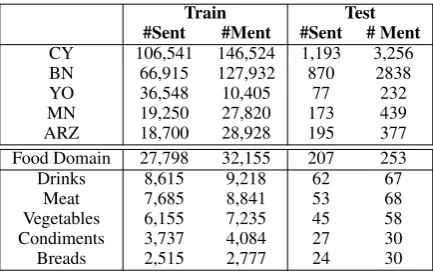
Table 1: The statistics of weakly labeled dataset.
We use 20190120 Wikipedia dump for WL data construction, where the ratio of words in anchors to the whole sentence is nearly 0.12, 0.07, 0.14, 0.07 and 0.06 for languages CY, BN, YO, MN and ARZ, and 0.13 for food domain, demon-strating that unlabeled words are dominant. By
heuristically setting θq = 0.1, θn = 0.9, we
CY BN YO MN ARZ
P R F1 P R F1 P R F1 P R F1 P R F1
[image:7.595.71.529.60.135.2]CNN-CRFs 84.4 76.2 80.1 92.0 89.1 90.5 80.9 68.9 74.4 87.3 85.5 86.3 88.6 86.7 87.6 BiLSTM-CRFs 86.0 77.8 81.6 93.3 91.5 92.3 74.1 68.9 71.3 89.0 85.5 87.1 89.5 88.5 89.0 Trans-CRFs 83.7 73.2 78.1 93.0 85.9 89.3 80.2 60.5 69.0 88.0 80.0 83.8 88.9 83.2 85.9 BiLSTM-PCRFs 85.2 79.6 82.3 91.2 92.7 91.9 68.1 70.2 69.1 82.5 91.2 86.6 84.0 90.7 87.1 Ours 82.8 82.5 82.6 93.4 93.5 93.4 73.5 76.8 75.1 86.9 93.6 90.1 87.7 91.5 89.5
Table 2: Performance (%) on low-resource languages.
CY, BN, YO, MN and ARZ, and food domain, re-spectively. For correctness, we then pick up test data of 25% sentences that has highest annotation confidence and exceed 0.3 coverage. We randomly choose 25% of high-quality data as validation for
early stop, and the rest for training. The statistics3
is in Table1.
Training Details
For tuning of hyper-parameters, we set
non-entity feature weights toλ1 = 0, λ2 = 0.9, λ3 =
0.1 heuristically. We pre-train word embeddings
using Glove (Pennington et al., 2014), and
fine-tune embeddings during training. We set the di-mension of words and characters as 100 and 30, respectively. We use 30 filter kernels, where each kernel has the size of 3 in character CNN, and dropout rate is set to 0.5. For bi-LSTM, the hidden state has 150 dimensions. The batch size is set to 32 and 64 for sequence labeling module and clas-sification module. We adopt Adam with L2 reg-ularization for optimization, and set the learning
rate and weight decay to0.001and1e−9.
Baselines Since most low-resource name
tag-ging methods introduce external knowledge
(Sec-tion2), which has limited availability and is out of
the scope for this paper, we arrive at two types of baselines from weakly supervised models:
Typical NN-CRFs models(Ni et al.,2017) by
selecting high-quality WL data and regarding un-labeled words as O, which usually achieve very
competitive results. NN denotes CNN,
Trans-former (Trans for short) or Bi-LSTM.
NN-PCRFs model (Yang et al., 2018; Shang
et al., 2018). Although they achieves
state-of-the-art performance, methods of this type are only evaluated in specific domains and require a small set of seed annotations or a domain dictionary. We thus carefully adapt them to low-resource languages and domains by selecting the
highest-quality WL data (θn>0.3) as seeds4.
3
The statistics includes noisy data, which greatly in-creases the size but cannot be used for evaluation.
4We adopt the common part of their models related to
6.2 Results on Low-Resource Languages
Table2shows the overall performance of our
pro-posed model as well as the baseline methods (P and R denote Precision and Recall). We can see:
Our method consistently outperforms all base-lines in five languages w.r.t F1, mainly because we greatly improve recall (2.7% to 9.34% on average) by taking best advantage of WL data and being ro-bust to noise via two modules. As for the preci-sion, partial-CRFs perform poorly compared with CRFs due to the uncertainty of unlabeled words, while our method alleviates this issue by introduc-ing lintroduc-inguistic features in non-entity samplintroduc-ing. An exception occurs in CY, because it has the most training data, which may bring more accurate in-formation than sampling. Actually, we can tune
hyper-parameter non-entity ratioαto improve
pre-cision5, more studies can be found in Section6.5.
Besides, the sampling technique can utilize more prior features if available, we leave it in future.
Among all encoders, Bi-LSTM has greater abil-ity for feature abstraction and achieves the highest precision in most languages. An unexpected ex-ception is Yoruba, where CNN achieves the higher
performance. This indicates that the three
en-coders capture textual semantics from different perspectives, thus it is better to choose the encoder by considering the linguistic natures.
As for the impacts of resources, all the mod-els perform the worst in Yoruba. Interestingly, we conclude that the performance for name tagging in low-resource languages doesn’t depend entirely on the absolute number of mentions in the train-ing data, but largely on the average number of an-notations per sentence. For example, Bengali has
1.9mentions per sentence and all methods achieve
their best results, while the opposite is Welsh with
handling weakly labeled data, removing the other parts that are specifically designed for domains, such as instance selec-tor (Yang et al.,2018) which makes it worse since we have already selected the high-quality data.
(a) Efficiency analysis. (b) Impact of non-entity sampling ratio. (c) Impact of non-entity features.
Figure 3: Ablation study of our model in Mongolian.
1.4mentions per sentence. This verifies our data
selection scheme (e.g., annotation coveragen(·)),
and we will give more discussion in Section6.4.
6.3 Results on Low-Resource Domains
Food
D M V C B All
[image:8.595.73.292.325.399.2]CNN-CRFs 67.8 69.8 57.9 42.8 46.5 60.9 BiLSTM-CRFs 64.9 69.0 62.8 50.0 62.2 63.5 Trans-CRFs 62.1 68.9 59.6 43.4 54.5 60.6 BiLSTM-PCRFs 66.1 70.7 67.2 44.4 58.3 64.4 Ours 72.0 76.4 70.0 53.5 66.6 70.1
Table 3: F1-score (%) on food domain.
Table3 shows the overall performance in food
domain, where D, M, V, C and B denote: Drink, Meat, Vegetables, Condiments and Breads. We can observe that there is a performance drop com-pared to that in low-resource languages, mainly because of more types and sparse training data. Our model outperforms all of the baselines in all food types by 7.8% on average. The performance in condiments is relatively low, because most of them are composed of meat or vegetables, such as steak sauce, which is overlapped with other types and make the recognition more difficult.
Figure 4: Our predictions on a noisy WL sentence.
Here is a representative case demonstrating that our model is robust to noise induced by unlabeled
words. In Figure4, the sentence is from the noisy
WL training data of food domain, and onlyMaize
is labeled as B-V. Although our model is trained on
this sentence, it successfully predictsyamsas B-V.
This example shows that our two-modules design
can utilize the noisy data while avoiding side ef-fects caused by incomplete annotation.
6.4 Efficiency Analysis
We utilizeθn, the main factor to annotation
qual-ity (Section6.2), to trade off between high-quality
and noisy WL data. As shown in Figure 3(a),
the red curve denotes the training time and the blue curve denotes F1. We can see that the per-formance of our model is relatively stable when
θn ∈ [0,0.15), while the time cost drops
dramat-ically (from 90 to 20 minutes), demonstrating the robustness and efficiency of two-modules design.
Whenθn∈[0.15,0.3], the performance decreases
greatly due to less available high-quality data for sequence labeling module; meanwhile, little time is saved through classification module. Thus, we
pick up θn = 0.1 in experiments. A special
case happens when θn = 0, our model degrades
to sequence labeling without pre-trained classifier. We can see the performance is worse than that of
θn= 0.1due to massive noisy data.
6.5 Impact of Non-Entity Sampling Ratio
We use non-entity ratio α to control sampling,
and a higherαdenotes that more unlabeled words
are labeled with O. As shown in Figure3(b), the
precision increases as more words are assigned with labels, while the recall achieves two peaks
(α = 0.4,0.9), leading to the highest F1 when
α = 0.9, which conforms to the statistics in
Au-genstein et al.(2017). There are two special cases.
Whenα= 0, our model degrades to a NN-PCRFs
model without non-entity sampling and there is no seed annotations for training. We can see the model performs poorly due to the dominant
unla-beled words (Section5.1). Whenα= 1indicating
degrades to NN-CRFs model, which has higher precision at the cost of recall. Clearly, the model suffers from the bias to O labeling.
6.6 Impact of Non-Entity Features
We propose three features for non-entity samples:
nearby entities (f1), ever within entities (f2) and
term/document frequency (f3). We now
investi-gate how effective each feature is. Figure 3(c)
shows the performance of our model that sam-ples non-entity words using each feature as well as their combinations. The first bar denotes the per-formance of sampling without any features. It is not satisfying but competitive, indicating the im-portance of non-entity sampling to partial-CRFs.
The single f2 contributes the most, and gets
en-hanced withf3because they provide
complemen-tary information. Surprisingly, f1 seems better
than f3, but makes the model worse if we use it
combined withf2, f3, thus we setλ1= 0.
7 Conclusions
In this paper, we propose a novel name tagging model that consists of two modules of sequence labeling and classification, which are combined
via shared parameters. We automatically
con-struct WL data from Wikipedia anchors and split them into high-quality and noisy portions for train-ing each module. The sequence labeltrain-ing mod-ule focuses on high-quality data and is costly due to the partial-CRFs layer with non-entity sam-pling, which models all possible label combina-tions. The classification module focuses on the annotated words in noisy data to pretrain the tag classifier efficiently. The experimental results in five low-resource languages and a specific domain demonstrate the effectiveness and efficiency.
In the future, we are interested in incorporating entity structural knowledge to enhance text
rep-resentation (Cao et al., 2017, 2018b), or transfer
learning (Sun et al., 2019) to deal with massive
rare words and entities for low-resource name tag-ging, or introduce external knowledge for further improvement.
Acknowledgments
NExT++ research is supported by the National Re-search Foundation, Prime Minister’s Office, Sin-gapore under its IRC@SG Funding Initiative.
References
Isabelle Augenstein, Leon Derczynski, and Kalina Bontcheva. 2017. Generalisation in named entity
recognition: A quantitative analysis. Computer
Speech & Language.
Yixin Cao, Lei Hou, Juanzi Li, and Zhiyuan Liu.
2018a. Neural collective entity linking. In
COL-ING.
Yixin Cao, Lei Hou, Juanzi Li, Zhiyuan Liu,
Chengjiang Li, Xu Chen, and Tiansi Dong. 2018b. Joint representation learning of cross-lingual words
and entities via attentive distant supervision. In
EMNLP.
Yixin Cao, Lifu Huang, Heng Ji, Xu Chen, and Juanzi Li. 2017. Bridge text and knowledge by learning
multi-prototype entity mention embedding. InACL.
Yixin Cao, Zhiyuan Liu, Chengjiang Li, Juanzi Li, and Tat-Seng Chua. 2019a. Multi-channel graph neural
network for entity alignment. InACL.
Yixin Cao, Xiang Wang, Xiangnan He, Zikun Hu, and Tat-Seng Chua. 2019b. Unifying knowledge graph learning and recommendation: Towards a better
un-derstanding of user preferences. InWWW.
Jason Chiu and Eric Nichols. 2016. Named entity
recognition with bidirectional lstm-cnns. TACL.
Ronan Collobert, Jason Weston, L´eon Bottou, Michael Karlen, Koray Kavukcuoglu, and Pavel Kuksa. 2011. Natural language processing (almost) from
scratch. JMLR.
Maud Ehrmann, Marco Turchi, and Ralf Steinberger.
2011. Building a multilingual named
entity-annotated corpus using annotation projection. In
Proceedings of the International Conference Recent Advances in Natural Language Processing.
Xiaocheng Feng, Xiachong Feng, Bing Qin, Zhangyin Feng, and Ting Liu. 2018. Improving low resource named entity recognition using cross-lingual
knowl-edge transfer. InIJCAI.
Alexander Fritzler, Varvara Logacheva, and
Mak-sim Kretov. 2018. Few-shot classification in
named entity recognition task. arXiv preprint
arXiv:1812.06158.
Johanna Geiß, Andreas Spitz, and Michael Gertz. 2017. Neckar: a named entity classifier for wikidata. In
International Conference of the German Society for Computational Linguistics and Language
Technol-ogy. Springer.
Alex Graves, Abdel-rahman Mohamed, and Geoffrey Hinton. 2013. Speech recognition with deep
recur-rent neural networks. In 2013 IEEE international
James Hammerton. 2003. Named entity recognition
with long short-term memory. InNAACL.
Sepp Hochreiter and J¨urgen Schmidhuber. 1997. Long
short-term memory.Neural computation.
Maximilian Hofer, Andrey Kormilitzin, Paul Goldberg, and Alejo Nevado-Holgado. 2018. Few-shot learn-ing for named entity recognition in medical text.
arXiv preprint arXiv:1811.05468.
Jun Kuang, Yixin Cao, Jianbing Zheng, Xiangnan He, Ming Gao, and Aoying Zhou. 2019. Improving neu-ral relation extraction with implicit mutual relations.
arXiv preprint arXiv:1907.05333.
John Lafferty, Andrew McCallum, and Fernando CN
Pereira. 2001. Conditional random fields:
Prob-abilistic models for segmenting and labeling
se-quence data. InICML.
Guillaume Lample, Miguel Ballesteros, Sandeep Sub-ramanian, Kazuya Kawakami, and Chris Dyer. 2016. Neural architectures for named entity recognition. InNAACL.
Yann LeCun, Bernhard Boser, John S Denker, Don-nie Henderson, Richard E Howard, Wayne Hubbard, and Lawrence D Jackel. 1989. Backpropagation
ap-plied to handwritten zip code recognition. Neural
computation.
Yankai Lin, Zhiyuan Liu, and Maosong Sun. 2017. Neural relation extraction with multi-lingual
atten-tion. InACL.
Ying Lin, Shengqi Yang, Veselin Stoyanov, and Heng Ji. 2018. A multi-lingual multi-task architecture for
low-resource sequence labeling. InACL.
Xuezhe Ma and Eduard Hovy. 2016. End-to-end se-quence labeling via bi-directional lstm-cnns-crf. In
ACL.
Stephen Mayhew, Chen-Tse Tsai, and Dan Roth. 2017. Cheap translation for cross-lingual named entity
recognition. InEMNLP.
Jian Ni, Georgiana Dinu, and Radu Florian. 2017. Weakly supervised cross-lingual named entity recognition via effective annotation and
representa-tion projecrepresenta-tion. InACL.
Joel Nothman, James R Curran, and Tara Murphy.
2008. Transforming wikipedia into named entity
training data. In Proceedings of the Australasian
Language Technology Association Workshop 2008.
Xiaoman Pan, Boliang Zhang, Jonathan May, Joel Nothman, Kevin Knight, and Heng Ji. 2017. Cross-lingual name tagging and linking for 282 languages.
InACL.
Nanyun Peng and Mark Dredze. 2016. Improving
named entity recognition for chinese social media with word segmentation representation learning. In
ACL.
Jeffrey Pennington, Richard Socher, and Christopher Manning. 2014. Glove: Global vectors for word
representation. InEMNLP.
Jingbo Shang, Liyuan Liu, Xiaotao Gu, Xiang Ren, Teng Ren, and Jiawei Han. 2018. Learning named entity tagger using domain-specific dictionary. In
EMNLP.
Qianru Sun, Yaoyao Liu, Tat-Seng Chua, and Bernt Schiele. 2019. Meta-transfer learning for few-shot
learning. InCVPR.
Oscar T¨ackstr¨om, Dipanjan Das, Slav Petrov, Ryan McDonald, and Joakim Nivre. 2013. Token and type constraints for cross-lingual part-of-speech tagging.
TACL.
Chen-Tse Tsai, Stephen Mayhew, and Dan Roth. 2016. Cross-lingual named entity recognition via
wikifica-tion. InCoNLL.
Ashish Vaswani, Noam Shazeer, Niki Parmar, Jakob Uszkoreit, Llion Jones, Aidan N Gomez, Łukasz Kaiser, and Illia Polosukhin. 2017. Attention is all
you need. InNeurIPS.
Xiang Wang, Dingxian Wang, Canran Xu, Xiangnan He, Yixin Cao, and Tat-Seng Chua. 2019. Explain-able reasoning over knowledge graphs for
recom-mendation. InProceedings of the AAAI Conference
on Artificial Intelligence, volume 33, pages 5329– 5336.
Jiateng Xie, Zhilin Yang, Graham Neubig, Noah A Smith, and Jaime Carbonell. 2018. Neural cross-lingual named entity recognition with minimal
re-sources. InEMNLP.
Mingbin Xu, Hui Jiang, and Sedtawut Watcharawit-tayakul. 2017. A local detection approach for named
entity recognition and mention detection. InACL.
Yaosheng Yang, Wenliang Chen, Zhenghua Li,
Zhengqiu He, and Min Zhang. 2018. Distantly su-pervised ner with partial annotation learning and
re-inforcement learning. InCOLING.
Zhilin Yang, Ruslan Salakhutdinov, and William W Cohen. 2017. Transfer learning for sequence
tag-ging with hierarchical recurrent networks. InICLR.
Atefeh Zafarian, Ali Rokni, Shahram Khadivi, and So-nia Ghiasifard. 2015. Semi-supervised learning for named entity recognition using weakly labeled
train-ing data. InAISP.
Boliang Zhang, Xiaoman Pan, Tianlu Wang, Ashish Vaswani, Heng Ji, Kevin Knight, and Daniel Marcu. 2016. Name tagging for low-resource incident
lan-guages based on expectation-driven learning. In
NAACL.
Jing Zhang, Yixin Cao, Lei Hou, Juanzi Li, and Hai-Tao Zheng. 2017. Xlink: An unsupervised bilingual