Proceedings of the 2019 Conference on Empirical Methods in Natural Language Processing and the 9th International Joint Conference on Natural Language Processing, pages 77–87,
77
Correlations between Word Vector Sets
Vitalii Zhelezniak, April Shen, Daniel Busbridge, Aleksandar Savkov, Nils Hammerla
{firstname.lastname}@babylonhealth.com
Abstract
Similarity measures based purely on word embeddings are comfortably competing with much more sophisticated deep learning and expert-engineered systems on unsupervised semantic textual similarity (STS) tasks. In contrast to commonly used geometric ap-proaches, we treat a single word embedding as e.g. 300 observations from a scalar ran-dom variable. Using this paradigm, we first il-lustrate that similarities derived from elemen-tary pooling operations and classic correla-tion coefficients yield excellent results on stan-dard STS benchmarks, outperforming many recently proposed methods while being much faster and trivial to implement. Next, we demonstrate how to avoid pooling operations altogether and compare sets of word embed-dings directly via correlation operators be-tween reproducing kernel Hilbert spaces. Just like cosine similarity is used to compare in-dividual word vectors, we introduce a novel application of the centered kernel alignment (CKA) as a natural generalisation of squared cosine similarity for sets of word vectors. Likewise, CKA is very easy to implement and enjoys very strong empirical results.
1 Introduction
Distributed representations of text have had a mas-sive impact on the natural language processing (NLP), information retrieval (IR), and machine learning (ML) communities, thanks in part to their ability to capture rich notions of semantic sim-ilarity. While this work originally began with word embeddings (Bengio et al., 2003;Mikolov et al.,2013a;Pennington et al.,2014;Bojanowski et al., 2017; Joulin et al., 2017), there is now an ever-increasing number of representations for longer units of text based on simple aggrega-tions of word vectors (Mitchell and Lapata,2008;
De Boom et al.,2016;Arora et al.,2017;Wieting
et al., 2016;Wieting and Gimpel, 2018; Zhelez-niak et al., 2019b) as well as complex neural ar-chitectures (Le and Mikolov, 2014; Kiros et al.,
2015;Hill et al.,2016;Conneau et al.,2017;Gan et al., 2017; Tang et al., 2017;Pagliardini et al.,
2018;Zhelezniak et al.,2018;Subramanian et al.,
2018;Cer et al.,2018;Devlin et al.,2018). By contrast, relatively little effort has been di-rected towards understanding the similarity mea-sures used to compare these textual embeddings, for which cosine similarity remains a convenient and widespread, yet somewhat arbitrary default, despite some emerging research into the alterna-tives (Camacho-Collados et al., 2015; De Boom et al.,2015;Santus et al.,2018;Zhelezniak et al.,
2019b,a). Part of the appeal of cosine similarity perhaps lies in the simple geometric interpreta-tion behind it. However, as embeddings are ul-timately just arrays of numbers, we are free to take alternative viewpoints other than the geomet-ric ones, if they lead to illuminating insights or strong-performing methods.
coeffi-cients. We show how to overcome these compli-cations, by selecting an outlier-removing pooling operation such as max-pooling, applying a more robust correlation coefficient such as Spearman’s
ρ, or simply clipping (winsorizing) the word vec-tors.
Next, we demonstrate how to avoid pooling operations completely and compare sets of word embeddings directly via correlation operators be-tween reproducing kernel Hilbert spaces (RKHS). We introduce a novel application of the kernel alignment (KA) and the centered kernel alignment (CKA) as a natural generalisation of the squared cosine similarity and Pearson correlation for the sets of word embeddings. These multivariate cor-relation coefficients are very easy to implement and also enjoy very strong empirical results.
2 Related Work
Several lines of research seek to combine the strength of pretrained word embeddings and the elegance of set- or bag-of-words (BoW) repre-sentations. Any method that determines seman-tic similarity between sentences by comparing the corresponding sets of word embeddings is directly related to our work.
Perhaps the most obvious such approaches are based on elementary pooling operations such as average-, max- and min-pooling (Mitchell and La-pata, 2008;De Boom et al., 2015, 2016). While seemingly over-simplistic, numerous studies have confirmed their impressive performance on the downstream tasks (Arora et al., 2017; Wieting et al., 2016;Wieting and Gimpel, 2018; Zhelez-niak et al.,2019b)
One step further,Zhao and Mao(2017); Zhelez-niak et al.(2019b) introduce fuzzy bags-of-words (FBoW) where degrees of membership in a fuzzy set are given by the similarities between word em-beddings. Zhelezniak et al.(2019b) show a close connection between FBoW and max-pooled word vectors.
Some approaches do not seek to build an ex-plicit representation and instead focus directly on designing a similarity function between sets. Word Mover’s Distance (WMD) (Kusner et al.,
2015) is an instance of the Earth Mover’s Dis-tance (EMD) computed between normalised BoW, with the cost matrix given by Euclidean distances between word embeddings. In the soft cardinal-ity framework of (Jimenez et al.,2010,2015), the
contribution of a word to the cardinality of a set depends on its similarities to other words in the same set. Such sets are then compared using an ap-propriately defined Jaccard index or related mea-sures. DynaMax (Zhelezniak et al., 2019b) uses universe-constrained fuzzy sets designed explic-itly for similarity computations.
Approaches that see word embeddings as statis-tical objects are very closely related to our work. Virtually all of them treat word embeddings as ob-servations from some D-variate parametric fam-ily, whereDis the embedding dimension. Arora et al. (2016, 2017) introduce a latent discourse model and show the maximum likelihood esti-mate (MLE) for the discourse vector to be the weighted average of word embeddings in a sen-tence, where the weights are given by smooth in-verse frequencies (SIF).Nikolentzos et al.(2017);
Torki(2018) treat sets of word embeddings as ob-servations from D-variate Gaussians, and com-pare such sets with cosine similarity between the parameters (means and covariances) estimated by maximum likelihood. Vargas et al. (2019) mea-sure semantic similarity through penalised likeli-hood ratio between the joint and factorised models and explore Gaussian and von Mises–Fisher like-lihoods.
Cosine similarity between covariances is an in-stance of the RV coefficient and its uncentered version was applied in the context of word em-beddings before (Botev et al., 2017). We arrive at a similar coefficient (but with different center-ing) as a special case of CKA, which in the gen-eral case makes no parametric assumptions about disbtributions whatsoever. In particular our ver-sion is suitable for comparing sets containing just one word vector, whereas the method of Nikolent-zos et al.(2017);Torki(2018) requires at least two vectors in each set. Very recently,Kornblith et al.
(2019) used CKA to compare representations be-tween layers of the same or different neural net-works. This is again an instance of treating such representations as observations from a D-variate distribution, whereDis the dimension of the hid-den layer in question. Our use of CKA is com-pletely different from theirs.
Unlike all of the above approaches, (Zhelezniak et al.,2019a) see each word embedding itself asD
their properties using simple tools from univari-ate statistics. While they consider correlations be-tween individual word vectors and averaged word vectors, they do not formally explore correlations between word vector sets. We review their frame-work in Section3 and then proceed to formalise and generalise it to the case of sets of word em-beddings.
3 Background: Correlation Coefficients and Semantic Similarity
Suppose we have a word embeddings matrixW∈
RN×D, whereNis the number of words in the
vo-cabulary andDis the embedding dimension (usu-ally 300). In other words, each roww(i) ofWis aD-dimensional word vector. When applying sta-tistical analysis to these vectors, one might choose to treat eachw(i)as an observation from someD -variate distributionPD(E1, . . . ED) and model it
with a Gaussian or a Gaussian Mixture. While such analysis helps in studying the overall geome-try of the embedding space (how dimensions cor-relate and how embeddings cluster),PD is not
di-rectly useful for semantic similarity between indi-vidual words.
For the latter, Zhelezniak et al. (2019a) pro-posed to look at the transposeWT and the corre-sponding distributionP(W1, W2, . . . , WN).
Un-der this perspective, each word vectorw(i)is now a sample of D (e.g. 300) observations from a scalar random variable Wi. Luckily, in
applica-tions we are usually not interested in the full joint distribution but only in the similarity between two words, i.e. the bivariate marginalP(Wi, Wj). In
practice, we make inferences about this marginal from the paired sample (w(i),w(j)) through vi-sualisations (histograms, Q-Q plots, scatter plots, etc.) as well as various statistics.
Zhelezniak et al. (2019a) found that for all common models (GloVe, fastText, word2vec) the means across word embeddings are tightly con-centrated around zero (relative to their dimen-sions), thus making the widely used cosine sim-ilarity practically equivalent to Pearson correla-tion. However, while word2vec vectors seem mostly normal, GloVe and fastText vectors are highly non-normal, likely due to the presence of heavy univariate and bivariate outliers (as sug-gested by visualisations mentioned earlier). Quan-titatively, the majority of GloVe and fastText vec-tors fail the Shapiro-Wilk normality test at
sig-nificance level 0.05. Therefore, while Pearson’s
r (and thus cosine similarity) may be acceptable for word2vec, it is preferable to resort to more ro-bust non-parametic correlation coefficients such as Spearman’sρ or Kendall’sτ as a similarity mea-sure between GloVe and fastText vectors.
Finally, very similar conclusions were shown to hold for sentence representations obtained by word vector averaging, also referred to as mean-pooling. In particular, averaged fastText vectors compared with rank correlation coefficients al-ready show impressive results on standard STS tasks, rivaling much more sophisticated systems.
4 Correlations between Word Vector Sets
We are interested in applying the statistical frame-work from Section3to measure the semantic sim-ilarity between two sentencess1 ands2 given by the sets (or bags) S1 and S2 of word embed-dings respectively. To formalise this new setup, we may see each set of word embeddings S =
{w(1),w(2), . . . ,w(k)} as a sample (of e.g. 300 observations) from some theoretical set of scalar random variables R = {W1, W2, . . . , Wk}. In
light of the above, our task then lies in finding correlation coefficients corr(R1, R2) betweenR1 andR2and their empirical estimatescorrd(S1, S2)
obtained from the paired sample S1, S2, hoping that such coefficients will serve as a good proxy for semantic similarity. Recall that for single-word setsR1 ={Wi}, R2 ={Wj}the task
sim-ply reduces to computing a univariate correlation between word vectors w(i) and w(j), where the choice of the coefficient (Pearson’sr, Spearman’s
ρ, etc.) is made based on the statistics exhibited by the word embeddings matrix. While general-ising this to sets of more than one variable is not particularly hard, there are several ways to do so, each with its own advantages and downsides. In the present work, we group these approaches into two broad families: based and pooling-free correlation coefficients.
4.1 Correlations between Pooled Variables
Pooling-based approaches first reduce a set of random variables to a single scalar random variable Wpool = fpool(W1, W2, . . . , Wk) and
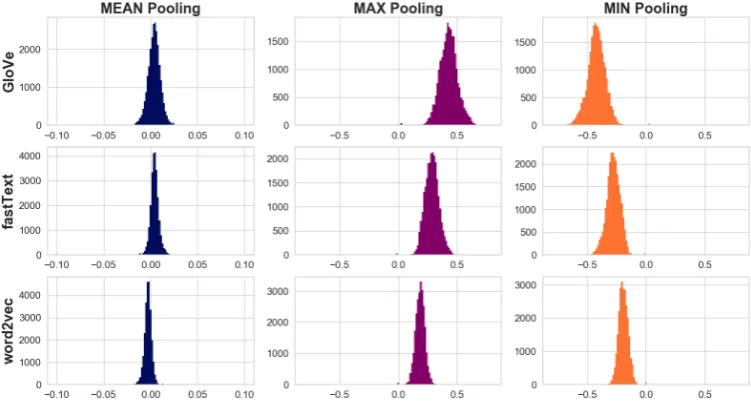
Figure 1: Normalised histograms of the mean distribution for sentence vectors generated by mean-, max- and min-pooling. Sentences were taken from the entire STS dataset (Agirre et al.,2012,2013,2014,2015,2016; Cer et al.,2017), and we utilise three commonly-used word embedding models: GloVe (Pennington et al.,2014), fastText (Bojanowski et al.,2017), and word2vec (Mikolov et al.,2013b,c).
Algorithm 1MaxPool-Spearman
Require: Word embeddings for the first sentence x(1),x(2). . . ,x(k)∈R1×d
Require: Word embeddings for the second sen-tencey(1),y(2). . . ,y(l) ∈R1×d
Ensure: Similarity scoreM S
#Max-pooling performed element-wise
x←MAX POOL(x(1),x(2). . . ,x(k))
y←MAX POOL(y(1),y(2). . . ,y(l))
MS← SPEARMANCORRELATION(x,y)
fixed vector wpool, followed by computing
uni-variate sample correlations. Certainly, these ap-proaches are empirically attractive: not only are they very simple computationally (e.g. see Algo-rithm1) but they also keep us in the realm of uni-variate statisics, where we have an entire arsenal of effective tools for making inferences aboutWpool.
Unfortunately, it is not always clear a priori
what should dictate our choice of the pooling func-tion (though, as we will see shortly, for certain functions some statistical justifications do exist). By far the most common pooling operations for word embedding found in the literature are mean-, max- and min-pooling. It is also very common, with some exceptions, to treat these various pooled representation in a completely identical fashion,
e.g. by comparing them all with cosine similar-ity. Intuitively, however, we suggest that the statis-tics ofWpool must heavily depend on the pooling
functionfpool and thus each such pooled random
variable should be studied in its own right. To illustrate this point, we would like to reveal the very different nature of mean- and max- and min-pooled sentence vectors though a practical exam-ple.
4.2 Statistics of the Pooled Representations: A Practical Analysis
Let us begin by examining sentence vectors ob-tained through mean-pooling. Recall that for com-mon word embedding models, the mean across 300 dimensions of a single word embeddingw(i) happens to be close to zero (relative to the dimen-sions). By the linearity of expectation, we have thatE[Wmean] = E
h Pk
i=1Wi i
= Pk
i=1E[Wi],
and so the mean across wmean will also be close
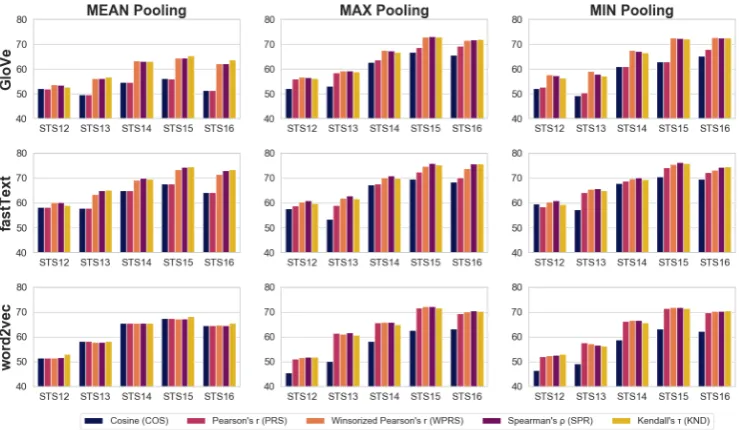
to zero at least for smallk. In practice, this seems to hold even for moderatekin naturally occurring sentences, as seen in Figure1. Based on this, we expect Pearson correlation and cosine similarity to have almost identical performance on the down-stream tasks, which is confirmed in Figure2.
Figure 2: Bar plots of Pearson correlation on STS tasks between human scores and the following set-based simi-larity metrics: Cosine simisimi-larity (COS), Pearson’sr(PRS), Winsorized Pearson’sr(WPRS), Spearman’sρ(SPR), and Kendall’sτ (KND). Plots generated for three pooling methods and the following word embedding models: GloVe (Pennington et al.,2014), fastText (Bojanowski et al.,2017), and word2vec (Mikolov et al.,2013b,c).
to the right because of the max operation, which we see in Figure 1. In this case, cosine similar-ity and Pearson correlation will yield different re-sults and, in fact, Pearson’srconsiderably outper-forms cosine on the downstream tasks (Figure2). This in turn empirically adds weight to the statisti-cal interpretation (correlation) over its geometristatisti-cal counterpart (angle between vectors).
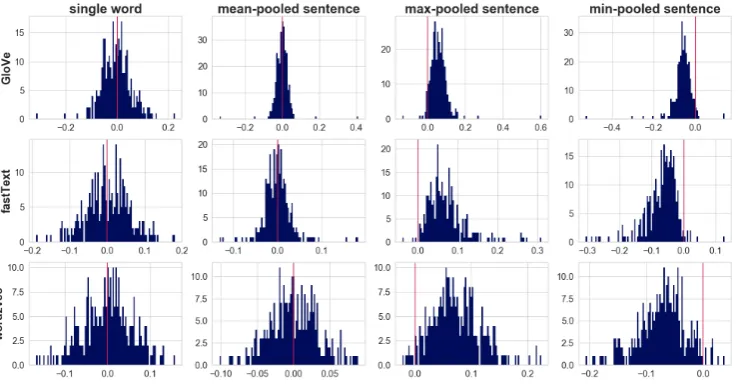
Recall also that unlike word2vec, GloVe and fastText vectors feature heavy univariate outliers, and the same can be expected to hold for the pooled representations; an example is shown in Figure3. In case of mean-pooled vectors, this par-ticular departure from normality can be success-fully detected by the Shapiro-Wilk normality test, informing the appropriate choice of the correla-tion coefficient (Pearson’sror robust rank correla-tion). By contrast, such procedure cannot be read-ily applied to max-pooled and min-pooled vectors as by construction they exhibit additional depar-tures from normality, such as positive and nega-tive skew respecnega-tively. It is always a good idea to consult visualisations for such vectors, such as the ones in Figure3. Interestingly though, we do ob-serve the some noteworthy regularities, which we describe further in Section5.
The above example is meant to illustrate that even the simplest pooled random variables show
strikingly different statistics depending on the ag-gregation. While the abundance of various pooling operations may be intimidating, the resulting vec-tors are always subject to the many tools of uni-variate statistics. As we hope to have shown, even crude analysis can shed light on the nature of these textual representations, which in turn has notable practical implications, as we will see in Section5.
4.3 Correlations between Random Vectors
Exactly as before, suppose we have two sen-tences S1 = {x(1),x(2), . . . ,x(k)} and S2 = {y(1),y(2), . . . ,y(l)} and the corresponding ran-dom vectors X = (X1, X2, . . . , Xk) and Y =
(Y1, Y2, . . . , Yl). At this point it is important to
emphasise again that we relate each word vector xi to a random variableXi and treat the
dimen-sions ofxi asDobservations from that variable,
and similarly for yi and Yi. In contrast with the
pooling-based approaches, our task here is to find a suitable correlation coefficient directly between the random vectorsXandY. We begin by recall-ing the expression for the basic univariate Pear-son’sr:
rXY = EX,Y [(X−µX)(Y −µY)]
Figure 3: Histograms for word embeddings of the word “cats” and pooled representations of the embeddings for the words in the sentence “I like cats because they are very cute animals”.
where
µX =E[X], σX = q
E[X2]−µ2X,
and similarly for µY and σY. The covariance term cov(X, Y)in the numerator is readily gener-alised to random vectors by the following cross-covariance operator between reproducing kernel Hilbert spaces (RKHS)FandG
CXY =EX,Y[(φ(X)−µX)⊗(ψ(Y)−µY)], (2) where ⊗ denotes the tensor product and µX =
EX[φ(X)], µY = EY[ψ(Y)]. Here φ and ψ are the feature maps such thathφ(x), φ(x0)iF = K(x,x0) andhψ(y), ψ(y0)iG = L(y,y0), where KandLare the kernels associated with RKHSF andG respectively. Note that ifφ andψ are the identity maps, the cross-covariance operator (2) simply becomes the cross-covariance matrix
CXY =EX,Y
h
(X−µX) (Y−µY)T
i .
Gretton et al.(2005a) define the Hilbert-Schmidt independence criterion (HSIC) to be the squared Hilbert-Schmidt norm||CXY||2HSof (2) and derive an expression for it in terms of kernelsKandL
HSIC(X,Y, K, L) =
EX,X0,Y,Y0
K(X,X0)L(Y,Y0)
+EX,X0K(X,X0)EY,Y0L(Y,Y0)
−2EX,Y
EX0
K(X,X0)EY0
L(Y,Y0).
They also show the empirical estimate of it to be
HSIC(K,L) = (D−1)−2Tr(KHLH), (3) whereH=I−D111T is the centering matrix and K = K(X(i),X(j)),L = L(Y(i),Y(j)), i, j = 1:D are the kernel (Gram) matrices of observa-tions. Crucially, the kernel evaluations forKtake place between X(i) = (xi(1),xi(2), . . . ,xi(k)) and X(j) = (xj(1),xj(2), . . . ,xj(k))and not between the individual word embeddings x(i) and x(j), and similarly for L. Thus, both Kand L are square matrices of dimension D ×D . Indeed, for (3) to make sense, the dimensions ofKand Lmust match. The matching dimension in our case is the word embedding dimensionD, while the number of wordskandlin the sentences may vary. This is in line with our formalism, which models word vectors as random variables and their dimensions as observations.
Finally, the Centered Kernel Alignment (CKA) (Cortes et al.,2012) is simply defined as
CKA(K,L) = p HSIC(K,L)
HSIC(K,K)pHSIC(L,L).
Approach STS 12 13 14 15 16
Deep Learning Approaches
ELMo (BoW) 55 53 63 68 60 Skip-Thought 41 29 40 46 52
InferSent 61 56 68 71 71 USE (DAN) 59 59 68 72 70 USE (Transformer) 61 64 71 74 74
STN (multitask) 60.6 54.7† 65.8 74.2 66.4 BERT-Base 46.9 52.8 57.2 63.5 64.5 BERT-Large 42.6 47.4 49.3 55.6 60.4
Set-based Approaches
WMD 53.0 45.9 57.2 66.9 63.1
SoftCardinality 55.9 50.5 59.0 66.2 65.1 DynaMax 60.9 60.3 69.5 76.7 74.6 SIF+PCA 58.6 67.3 70.5 73.5 71.7
MeanPool+COS 58.3 57.9 64.9 67.6 64.3 MaxPool+COS 57.7 53.5 67.2 69.5 68.5 MeanPool+SPR 60.2 65.1 70.1 74.4 73.0
MaxPool+SPR³ 61.0 62.9 70.9 75.9 75.8
CKA Linear³ 59.8 62.1 69.5 74.6 70.3 CKA Gaussian³ 60.5 63.8 71.6 76.3 73.7
[image:7.595.71.295.67.392.2]CKA dCor³ 61.0 63.2 71.5 75.6 72.4
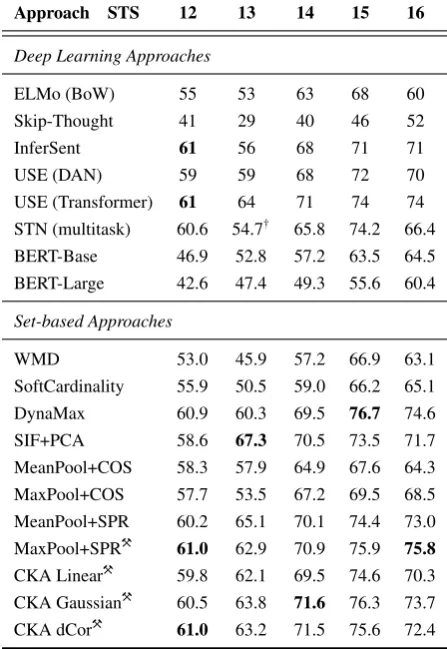
Table 1: Mean Pearson correlation on STS tasks for Deep Learning and Set-based methods using fastText. Methods proposed in this work are denoted with ³. Values in bold indicate best results per task. Previous results are taken fromPerone et al.(2018), Subrama-nian et al.(2018) andZhelezniak et al.(2019b,a).†
in-dicates the only STS13 result (to our knowledge) that includes the SMT subtask.
characteristic kernels), HSIC can detect any exist-ing dependence with high probability, as the sam-ple size increases (Gretton et al.,2005b). One can also consider the Uncentered Kernel Alignment (or simply KA) (Cristianini et al., 2002), which can then be seen as a similar generalisation but for the univariate cosine similarity. To the best of our knowledge, KA and CKA in general have never been applied before to measure semantic similar-ity between sets of word embeddings; therefore this work seeks to introduce them as standard defi-nitions for squared Pearson’srand cosine similar-ity for such sets.
5 Experiments
We now empirically demonstrate the power of the methods and statistical analysis presented in Sec-tion 4, through a set of evaluations on the
Se-mantic Textual Similarity (STS) tasks series 2012-2016 (Agirre et al.,2012,2013,2014,2015,2016;
Cer et al., 2017). For methods involving pre-trained word embeddings, we use fastText ( Bo-janowski et al.,2017) trained on Common Crawl (600B tokens), as previous evaluations have in-dicated that fastText vectors have uniformly the best performance on these tasks out of commonly-used pretrained unsupervised word vectors ( Con-neau et al.,2017;Perone et al.,2018;Zhelezniak et al.,2019a,b). We provide experiments and sig-nificance analysis for additional word vector in the Appendix. The success metric for the STS tasks is the Pearson correlation between the sentence similarity scores provided by human annotators and the scores generated by a candidate algorithm. Note that the dataset for the STS13 SMT subtask is no longer publicly available, so the mean Pear-son correlation for STS13 reported in our exper-iments has been re-calculated accordingly. The code for our experiments builds on the SentEval toolkit (Conneau and Kiela,2018) and is available on GitHub1.
We first conduct a set of experiments to validate the observations of Sections4.1and4.2regarding the performance of cosine similarity and various univariate correlation coefficients when applied to pooled word vectors. These results are depicted in Figure2, for which we can make the following observations.
First, max and min-pooled vectors consistently outperform mean-pooled vectors when all three representations are compared with Pearson cor-relation. We hypothesise that this is in part be-cause max and min-pooling remove the outliers (to which Pearson’sr is very sensitive) from at least one tail of the distribution whereas mean-pooled vectors have outliers in both tails. This outlier-removing property, however, cannot be taken as a sole explanation behind excellent performance of max-pooled vectors, as max-pooling still tends to outperform mean-pooling when both are com-pared with correlations that are robust to outliers, as well as on word vectors that have very few out-liers to begin with (e.g. word2vec).
In addition, the strong performance of rank correlation coefficients (Spearman’s ρ and Kendall’s τ) comes solely from their robustness to outliers, as clipping (winsorizing) the top and
1https://github.com/Babylonpartners/
bottom 5% of the values and then proceeding with Pearson’s r closes the gap almost com-pletely. Consistently, on vectors with few outliers (word2vec), Pearson’s r achieves the same performance as rank correlations even without winsorization. However, unlike outliers, positive (negative) skew of max- (min-) pooled vectors does not seem to hurt Pearson’sron STS tasks.
Next, we conduct evaluations of the methods proposed in this work alongside other deep learn-ing and set-based similarity measures for STS from the literature. The methods we compare are as follows:
• Deep representation approaches: BoW with ELMo embeddings (Peters et al., 2018), Skip-Thought (Kiros et al., 2015), InferSent (Conneau et al., 2017), Universal Sentence Encoder both DAN and Transformer (Cer et al., 2018), STN multitask embeddings (Subramanian et al., 2018), and BERT 12-and 24-layer models (Devlin et al.,2018).
• Set-based similarity measures: Word Mover’s Distance (WMD) (Kusner et al.,
2015), soft-cardinality with Jaccard coeffi-cient (Jimenez et al., 2012), DynaMax with Jaccard (Zhelezniak et al., 2019b), mean-and max-pooled word vectors with cosine similarity (COS), and mean-pooled word vectors with Spearman correlation (SPR) (Zhelezniak et al.,2019a).
• Proposed set-based approaches:max-pooled word vectors with Spearman correlation, CKA with linear kernel (also known as RV-coefficient), CKA with Gaussian kernel (me-dian estimation forσ2), and CKA with dis-tance kernel (disdis-tance correlation).
Note that for BERT we evaluated all pooling strategies available in bert-as-service (Xiao,2018) applied to either the last or second-to-last layers and report results for the best-performing combi-nation, which was mean-pooling on the last layer for both model sizes. Our results are presented in Table 1. We can clearly see that deep learning-based methods do not shine on STS tasks, while simple compositions of word vectors can perform extremely well, especially when an appropriate correlation coefficient is used as the similarity measure. Indeed, the performance of max-pooled vectors with Spearman correlation approaches or
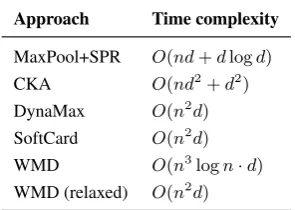
Approach Time complexity
MaxPool+SPR O(nd+dlogd)
CKA O(nd2+d2)
DynaMax O(n2d) SoftCard O(n2d)
WMD O(n3logn·d)
[image:8.595.343.491.64.169.2]WMD (relaxed) O(n2d)
Table 2: Computational complexity of some of the set-based STS methods discussed in this paper. Herenis the sentence length anddis the dimensionality of the word embeddings.
exceeds that of more expensive or offline methods like that of Arora et al. (2017), which performs PCA computations on the entire test set. Addi-tionally, while the multivariate correlation meth-ods such as CKA are more computationally ex-pensive than pooling-based approaches (see Ta-ble 2), they can provide performance boost on some tasks, making the cost worth it depending on the application. Finally, we conducted an ex-ploratory error analysis and found that many errors are due to the well-known inherent weaknesses of word embeddings. For example, the proposed ap-proaches heavily overestimate similarity when two sentences contain antonyms or when one sentence is the negation of the other. We illustrate these and other cases in the Appendix.
6 Conclusion
In this work we investigate the application of sta-tistical correlation coefficients to sets of word vec-tors as a method for computing semantic textual similarity (STS). This can be done either by pool-ing these word vectors and computpool-ing univariate correlations between the resulting representations, or by applying multivariate correlation coefficients to the sets of vectors directly.
supported by a combination of statistical analysis, practical examples and visualisations, and empiri-cal evaluation on standard benchmark datasets.
Both proposed families of approaches serve as strong baselines for future research into STS, as well as useful algorithms for the practitioner, be-ing efficient and simple to implement.
We believe our findings speak to the efficacy of the statistical perspective on word embeddings, which we hope will encourage others to explore further implications of not only this particular framework, but also completely novel interpreta-tions of textual representainterpreta-tions.
Acknowledgements
We would like to thank the three anonymous re-viewers for their useful feedback and suggestions.
References
Eneko Agirre, Carmen Banea, Claire Cardie, Daniel Cer, Mona Diab, Aitor Gonzalez-Agirre, Weiwei Guo, Inigo Lopez-Gazpio, Montse Maritxalar, Rada Mihalcea, German Rigau, Larraitz Uria, and Janyce Wiebe. 2015. Semeval-2015 task 2: Semantic tex-tual similarity, english, spanish and pilot on inter-pretability. InProceedings of the 9th International
Workshop on Semantic Evaluation (SemEval 2015),
pages 252–263. Association for Computational Lin-guistics.
Eneko Agirre, Carmen Banea, Claire Cardie, Daniel Cer, Mona Diab, Aitor Gonzalez-Agirre, Weiwei Guo, Rada Mihalcea, German Rigau, and Janyce Wiebe. 2014. Semeval-2014 task 10: Multilingual semantic textual similarity. InProceedings of the 8th International Workshop on Semantic Evaluation
(SemEval 2014), pages 81–91. Association for
Com-putational Linguistics.
Eneko Agirre, Carmen Banea, Daniel Cer, Mona Diab, Aitor Gonzalez-Agirre, Rada Mihalcea, German Rigau, and Janyce Wiebe. 2016. Semeval-2016 task 1: Semantic textual similarity, monolingual and cross-lingual evaluation. InProceedings of the 10th International Workshop on Semantic
Evalua-tion (SemEval-2016), pages 497–511. Association
for Computational Linguistics.
Eneko Agirre, Daniel Cer, Mona Diab, and Aitor Gonzalez-Agirre. 2012. Semeval-2012 task 6: A pi-lot on semantic textual similarity. In *SEM 2012: The First Joint Conference on Lexical and Compu-tational Semantics – Volume 1: Proceedings of the main conference and the shared task, and Volume 2: Proceedings of the Sixth International Workshop on
Semantic Evaluation (SemEval 2012), pages 385–
393. Association for Computational Linguistics.
Eneko Agirre, Daniel Cer, Mona Diab, Aitor Gonzalez-Agirre, and Weiwei Guo. 2013. *sem 2013 shared task: Semantic textual similarity. InSecond Joint Conference on Lexical and Computational Seman-tics (*SEM), Volume 1: Proceedings of the Main Conference and the Shared Task: Semantic Textual
Similarity, pages 32–43. Association for
Computa-tional Linguistics.
Sanjeev Arora, Yuanzhi Li, Yingyu Liang, Tengyu Ma, and Andrej Risteski. 2016. A latent variable model approach to pmi-based word embeddings. Transac-tions of the Association for Computational Linguis-tics, 4:385–399.
Sanjeev Arora, Yingyu Liang, and Tengyu Ma. 2017. A Simple but Tough-to-Beat Baseline for Sentence Embeddings.International Conference on Learning Representations.
Yoshua Bengio, Rjean Ducharme, Pascal Vincent, and Christian Jauvin. 2003. A neural probabilistic lan-guage model. Journal of Machine Learning Re-search, 3:1137–1155.
Piotr Bojanowski, Edouard Grave, Armand Joulin, and Tomas Mikolov. 2017. Enriching word vectors with subword information. Transactions of the Associa-tion for ComputaAssocia-tional Linguistics, 5:135–146.
Viktor Botev, Kaloyan Marinov, and Florian Sch¨afer. 2017. Word importance-based similarity of doc-uments metric (wisdm): Fast and scalable docu-ment similarity metric for analysis of scientific doc-uments. In Proceedings of the 6th International
Workshop on Mining Scientific Publications, WOSP
2017, pages 17–23, New York, NY, USA. ACM.
Jos´e Camacho-Collados, Mohammad Taher Pilehvar, and Roberto Navigli. 2015. Nasari: a novel ap-proach to a semantically-aware representation of items. In Proceedings of the 2015 Conference of the North American Chapter of the Association for Computational Linguistics: Human Language
Tech-nologies, pages 567–577. Association for
Computa-tional Linguistics.
Daniel Cer, Mona Diab, Eneko Agirre, Inigo Lopez-Gazpio, and Lucia Specia. 2017. Semeval-2017 task 1: Semantic textual similarity multilingual and crosslingual focused evaluation. In Proceedings of the 11th International Workshop on Semantic Eval-uation (SemEval-2017), pages 1–14. Association for Computational Linguistics.
Daniel Cer, Yinfei Yang, Sheng-yi Kong, Nan Hua, Nicole Limtiaco, Rhomni St. John, Noah Constant, Mario Guajardo-Cespedes, Steve Yuan, Chris Tar, Brian Strope, and Ray Kurzweil. 2018. Universal sentence encoder for english. InProceedings of the 2018 Conference on Empirical Methods in
Natu-ral Language Processing: System Demonstrations,
Alexis Conneau and Douwe Kiela. 2018. Senteval: An evaluation toolkit for universal sentence representa-tions. InProceedings of the Eleventh International Conference on Language Resources and Evaluation
(LREC-2018). European Language Resource
Asso-ciation.
Alexis Conneau, Douwe Kiela, Holger Schwenk, Lo¨ıc Barrault, and Antoine Bordes. 2017. Supervised learning of universal sentence representations from natural language inference data. InProceedings of the 2017 Conference on Empirical Methods in
Nat-ural Language Processing, pages 670–680.
Associ-ation for ComputAssoci-ational Linguistics.
Corinna Cortes, Mehryar Mohri, and Afshin Ros-tamizadeh. 2012. Algorithms for learning kernels based on centered alignment. Journal of Machine
Learning Research, 13(Mar):795–828.
Nello Cristianini, John Shawe-Taylor, Andre Elisseeff, and Jaz S Kandola. 2002. On kernel-target align-ment. InAdvances in neural information processing systems, pages 367–373.
C. De Boom, S. Van Canneyt, S. Bohez, T. Demeester, and B. Dhoedt. 2015. Learning semantic similar-ity for very short texts. In2015 IEEE International
Conference on Data Mining Workshop (ICDMW),
pages 1229–1234.
Cedric De Boom, Steven Van Canneyt, Thomas De-meester, and Bart Dhoedt. 2016. Representation learning for very short texts using weighted word embedding aggregation. Pattern Recogn. Lett., 80(C):150–156.
Jacob Devlin, Ming-Wei Chang, Kenton Lee, and Kristina Toutanova. 2018. Bert: Pre-training of deep bidirectional transformers for language understand-ing. arXiv preprint arXiv:1810.04805.
Zhe Gan, Yunchen Pu, Ricardo Henao, Chunyuan Li, Xiaodong He, and Lawrence Carin. 2017. Learning generic sentence representations using convolutional neural networks. InProceedings of the 2017 Con-ference on Empirical Methods in Natural Language
Processing, pages 2390–2400. Association for
Com-putational Linguistics.
Arthur Gretton, Olivier Bousquet, Alex Smola, and Bernhard Sch¨olkopf. 2005a. Measuring statistical dependence with hilbert-schmidt norms. In Inter-national conference on algorithmic learning theory, pages 63–77. Springer.
Arthur Gretton, Ralf Herbrich, Alexander Smola, Olivier Bousquet, and Bernhard Sch¨olkopf. 2005b. Kernel methods for measuring independence.
Jour-nal of Machine Learning Research, 6(Dec):2075–
2129.
Felix Hill, Kyunghyun Cho, and Anna Korhonen. 2016. Learning distributed representations of sentences from unlabelled data. In Proceedings of the 2016 Conference of the North American Chapter of the
Association for Computational Linguistics: Human
Language Technologies, pages 1367–1377.
Associ-ation for ComputAssoci-ational Linguistics.
Sergio Jimenez, Claudia Becerra, and Alexander Gel-bukh. 2012. Soft cardinality: A parameterized sim-ilarity function for text comparison. InProceedings of the First Joint Conference on Lexical and Com-putational Semantics - Volume 1: Proceedings of the Main Conference and the Shared Task, and Volume 2: Proceedings of the Sixth International Workshop
on Semantic Evaluation, SemEval ’12, pages 449–
453, Stroudsburg, PA, USA. Association for Com-putational Linguistics.
Sergio Jimenez, Fabio Gonzalez, and Alexander Gel-bukh. 2010. Text comparison using soft cardinal-ity. InString Processing and Information Retrieval, pages 297–302, Berlin, Heidelberg. Springer Berlin Heidelberg.
Sergio Jimenez, Fabio A. Gonzalez, and Alexander Gelbukh. 2015. Soft cardinality in semantic text processing: Experience of the SemEval international competitions. Polibits, 51:63–72.
Armand Joulin, Edouard Grave, Piotr Bojanowski, and Tomas Mikolov. 2017. Bag of tricks for efficient text classification. InProceedings of the 15th Con-ference of the European Chapter of the Association for Computational Linguistics: Volume 2, Short Pa-pers, pages 427–431. Association for Computational Linguistics.
Ryan Kiros, Yukun Zhu, Ruslan R Salakhutdinov, Richard Zemel, Raquel Urtasun, Antonio Torralba, and Sanja Fidler. 2015. Skip-Thought Vectors. In
Advances in Neural Information Processing Sys-tems, pages 3294–3302.
Simon Kornblith, Mohammad Norouzi, Honglak Lee, and Geoffrey Hinton. 2019. Similarity of neural net-work representations revisited. InICML.
Matt J. Kusner, Yu Sun, Nicholas I. Kolkin, and Kil-ian Q. Weinberger. 2015. From word embeddings to document distances. InProceedings of the 32Nd In-ternational Conference on InIn-ternational Conference
on Machine Learning, volume 37 ofICML’15, pages
957–966. JMLR.org.
Quoc Le and Tomas Mikolov. 2014. Distributed Rep-resentations of Sentences and Documents. In
In-ternational Conference on Machine Learning, pages
1188–1196.
Tomas Mikolov, Kai Chen, Greg Corrado, and Jef-frey Dean. 2013a. Efficient Estimation of Word Representations in Vector Space. arXiv preprint arXiv:1301.3781.
Tomas Mikolov, Ilya Sutskever, Kai Chen, Greg S Cor-rado, and Jeff Dean. 2013b. Distributed representa-tions of words and phrases and their
compositional-ity. InAdvances in Neural Information Processing
Tomas Mikolov, Wen-tau Yih, and Geoffrey Zweig. 2013c. Linguistic Regularities in Continuous Space Word Representations. InProceedings of the 2013 Conference of the North American Chapter of the Association for Computational Linguistics: Human
Language Technologies, pages 746–751.
Jeff Mitchell and Mirella Lapata. 2008. Vector-based models of semantic composition. In Proceedings
of ACL-08: HLT, pages 236–244. Association for
Computational Linguistics.
Giannis Nikolentzos, Polykarpos Meladianos, Francois Rousseau, Yannis Stavrakas, and Michalis Vazir-giannis. 2017. Multivariate Gaussian document rep-resentation from word embeddings for text catego-rization. InProceedings of the 15th Conference of the European Chapter of the Association for Compu-tational Linguistics: Volume 2, Short Papers, pages 450–455, Valencia, Spain. Association for Compu-tational Linguistics.
Matteo Pagliardini, Prakhar Gupta, and Martin Jaggi. 2018. Unsupervised learning of sentence embed-dings using compositional n-gram features. In Pro-ceedings of the 2018 Conference of the North Amer-ican Chapter of the Association for Computational Linguistics: Human Language Technologies,
Vol-ume 1 (Long Papers), pages 528–540. Association
for Computational Linguistics.
Jeffrey Pennington, Richard Socher, and Christopher Manning. 2014. Glove: Global vectors for word representation. In Proceedings of the 2014 Con-ference on Empirical Methods in Natural Language
Processing (EMNLP), pages 1532–1543.
Associa-tion for ComputaAssocia-tional Linguistics.
Christian S Perone, Roberto Silveira, and Thomas S Paula. 2018. Evaluation of sentence embeddings in downstream and linguistic probing tasks. arXiv preprint arXiv:1806.06259.
Matthew Peters, Mark Neumann, Mohit Iyyer, Matt Gardner, Christopher Clark, Kenton Lee, and Luke Zettlemoyer. 2018. Deep contextualized word repre-sentations. InProceedings of the 2018 Conference of the North American Chapter of the Association for Computational Linguistics: Human Language
Technologies, Volume 1 (Long Papers), pages 2227–
2237. Association for Computational Linguistics.
Enrico Santus, Hongmin Wang, Emmanuele Chersoni, and Yue Zhang. 2018. A rank-based similarity met-ric for word embeddings. In Proceedings of the 56th Annual Meeting of the Association for Compu-tational Linguistics (Volume 2: Short Papers), pages 552–557. Association for Computational Linguis-tics.
Sandeep Subramanian, Adam Trischler, Yoshua Ben-gio, and Christopher J Pal. 2018. Learning gen-eral purpose distributed sentence representations via large scale multi-task learning. In International
Conference on Learning Representations.
Shuai Tang, Hailin Jin, Chen Fang, Zhaowen Wang, and Virginia R. de Sa. 2017. Exploring asymmetric encoder-decoder structure for context-based sentence representation learning. CoRR, abs/1710.10380.
Marwan Torki. 2018. A document descriptor using covariance of word vectors. InProceedings of the 56th Annual Meeting of the Association for
Com-putational Linguistics (Volume 2: Short Papers),
pages 527–532, Melbourne, Australia. Association for Computational Linguistics.
Francisco Vargas, Kamen Brestnichki, and Nils Ham-merla. 2019. Model comparison for semantic group-ing. InICML.
John Wieting, Mohit Bansal, Kevin Gimpel, and Karen Livescu. 2016. Towards Universal Paraphrastic Sen-tence Embeddings. InInternational Conference on Learning Representations.
John Wieting and Kevin Gimpel. 2018. Paranmt-50m: Pushing the limits of paraphrastic sentence embed-dings with millions of machine translations. In Pro-ceedings of the 56th Annual Meeting of the Associa-tion for ComputaAssocia-tional Linguistics (Volume 1: Long
Papers), pages 451–462. Association for
Computa-tional Linguistics.
Han Xiao. 2018. bert-as-service. https://
github.com/hanxiao/bert-as-service.
Rui Zhao and Kezhi Mao. 2017. Fuzzy bag-of-words model for document representation. IEEE Transac-tions on Fuzzy Systems, pages 1–1.
Vitalii Zhelezniak, Dan Busbridge, April Shen, Samuel L. Smith, and Nils Y. Hammerla. 2018. De-coding Decoders: Finding Optimal Representation Spaces for Unsupervised Similarity Tasks. CoRR, abs/1805.03435.
Vitalii Zhelezniak, Aleksandar Savkov, April Shen, and Nils Y. Hammerla. 2019a. Correlation coefficients and semantic textual similarity. InNAACL-HLT.
Vitalii Zhelezniak, Aleksandar Savkov, April Shen, Francesco Moramarco, Jack Flann, and Nils Y. Hammerla. 2019b. Don’t settle for average, go for the max: Fuzzy sets and max-pooled word vectors.
InInternational Conference on Learning