Predicting Thread Discourse Structure over Technical Web Forums
Li Wang,♠♥Marco Lui,♠♥Su Nam Kim,♠♥Joakim Nivre♦ and Timothy Baldwin♠♥
♠Dept. of Computer Science and Software Engineering, University of Melbourne
♥NICTA Victoria Research Laboratory
♦Dept. of Linguistics and Philology, Uppsala University
[email protected], [email protected],
[email protected], [email protected], [email protected]
Abstract
Online discussion forums are a valuable means for users to resolve specific information needs, both interactively for the participants and statically for users who search/browse over historical thread data. However, the com-plex structure of forum threads can make it difficult for users to extract relevant informa-tion. The discourse structure of web forum threads, in the form of labelled dependency re-lationships between posts, has the potential to greatly improve information access over web forum archives. In this paper, we present the task of parsing user forum threads to deter-mine the labelled dependencies between posts. Three methods, including a dependency pars-ing approach, are proposed to jointly clas-sify the links (relationships) between posts and the dialogue act (type) of each link. The proposed methods significantly surpass an in-formed baseline. We also experiment with “in situ” classification of evolving threads, and es-tablish that our best methods are able to per-form equivalently well over partial threads as complete threads.
1 Introduction
Web user forums (or simply “forums”) are online platforms for people to discuss information and ob-tain information via a text-based threaded discourse, generally in a pre-determined domain (e.g. IT sup-port or DSLR cameras). With the advent of Web 2.0, there has been an explosion of web authorship in this area, and forums are now widely used in various areas such as customer support, community devel-opment, interactive reporting and online eduction.
In addition to providing the means to interactively participate in discussions or obtain/provide answers to questions, the vast volumes of data contained in forums make them a valuable resource for “support sharing”, i.e. looking over records of past user inter-actions to potentially find an immediately applica-ble solution to a current proapplica-blem. On the one hand, more and more answers to questions over a wide range of domains are becoming available on forums; on the other hand, it is becoming harder and harder to extract and access relevant information due to the sheer scale and diversity of the data.
This research aims at enhancing information ac-cess and support sharing, by mining the discourse structure of troubleshooting-oriented web user fo-rum threads. Previous research has shown that sim-ple thread structure information (e.g. reply-to struc-ture) can enhance tasks such as forum information retrieval (Seo et al., 2009) and post quality assess-ment (Lui and Baldwin, 2009). We aim to move be-yond simple threading, to predict not only the links between posts, but also show the manner of each link, in the form of the discourse structure of the thread. In doing so, we hope to be able to perform richer visualisation of thread structure (e.g. high-lighting the key posts which appear to have led to a successful resolution to a problem), and more fine-grained weighting of posts in threads for search pur-poses.
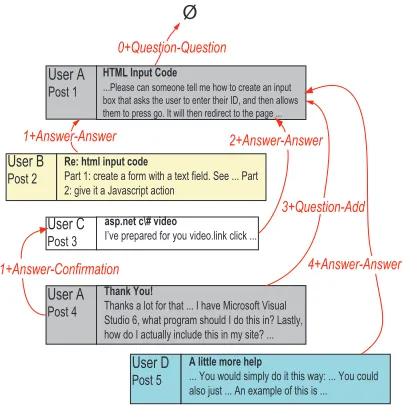
To illustrate the task, we use an example thread, made up of 5 posts from 4 distinct participants, from the CNET forum dataset of Kim et al. (2010b), as shown in Figure 1. The discourse structure of the thread is modelled as a rooted directed acyclic graph
HTML Input Code
...Please can someone tell me how to create an input box that asks the user to enter their ID, and then allows them to press go. It will then redirect to the page ...
User A
Post 1
User B
Post 2
User C
Post 3
Re: html input code
Part 1: create a form with a text field. See ... Part 2: give it a Javascript action
asp.net c\# video
I’ve prepared for you video.link click ...
Thank You!
Thanks a lot for that ... I have Microsoft Visual Studio 6, what program should I do this in? Lastly, how do I actually include this in my site? ...
A little more help
... You would simply do it this way: ... You could also just ... An example of this is ... User A
Post 4
User D
Post 5 0+Question-Question
2+Answer-Answer
4+Answer-Answer 1+Answer-Answer
1+Answer-Confirmation
[image:2.612.86.289.64.267.2]3+Question-Add Ø
Figure 1: A snippeted and annotated CNET thread
(DAG) with a dialogue act label associated with each edge of the graph. In this example, UserA initiates
the thread with a question (dialogue act =
Question-Question) in the first post, by asking how to create an interactive input box on a webpage. In response, UserB and UserC provide independent answers
(di-alogue act =Answer-Answer). UserA responds to
UserC to confirm the details of the solution
(dia-logue act =Answer-Confirmation), and at the same
time, adds extra information to his/her original
ques-tion (dialogue act = Question-Add); i.e., this one
post has two distinct dependency links associated with it. Finally, UserD proposes a different solution again to the original question.
To predict thread discourse structure of this type, we jointly classify the links and dialogue acts be-tween posts, experimenting with a variety of su-pervised classification methods, namely dependency parsing and linear-chain conditional random fields. In this, we build on the earlier work of Kim et al. (2010b) who first proposed the task of thread dis-course analysis, but only carried out experiments on post linking and post dialogue act classification as separate tasks. In addition to achieving state-of-the-art accuracy over the task, we carry out in-depth analysis of classification effectiveness at different thread depths, and establish that the accuracy of our method over partial threads is equivalent to that over
full threads, indicating that the method is applica-ble to situ thread classification. Finally, we in-vestigate the role of user-level features in discourse structure analysis.
2 Related Work
This work builds directly on earlier work of a subset of the authors (Kim et al., 2010b), whereby a novel post-level dialogue act set was proposed, and used as the basis for annotation of a set of threads taken from CNET. In the original work, we proposed a set of novel features, which we applied to the separate tasks of post link classification and dialogue act clas-sification. We later applied the same basic method-ology to dialogue act classification over one-on-one live chat data with provided message dependencies (Kim et al., 2010a), demonstrating the generalisabil-ity of the original method. In both cases, however, we tackled only a single task, either link classifica-tion (opclassifica-tionally given dialogue act tags) or dialogue act classification, but never the two together. In this paper, we take the obvious step of exploring joint classification of post link and dialogue act tags, to generate full thread discourse structures.
2004; Weinberger and Fischer, 2006; Wang et al., 2007; Fortuna et al., 2007; Kim et al., 2010b). For a more complete review of models for discourse dis-entanglement and dialogue act tagging, see Kim et al. (2010b).
Joint classification has been applied in a number of different contexts, based on the intuition that it should be possible to harness interactions between different sub-tasks to the mutual benefit of both. Warnke et al. (1997) jointly performed segmenta-tion and dialogue act classificasegmenta-tion over a German spontaneous speech corpus. In their approach, the predictions of a multi-layer perceptron classifier on
dialogue act boundaries were fed into an n-gram
language model, which was used for the joint seg-mentation and classification of dialogue acts. Sut-ton and McCallum (2005) performed joint parsing and semantic role labelling (SRL), using the results of a probabilistic SRL system to improve the accu-racy of a probabilistic parser. Finkel and Manning (2009) built a joint, discriminative model for pars-ing and named entity recognition (NER), address-ing the problem of inconsistent annotations across the two tasks, and demonstrating that NER bene-fited considerably from the interaction with parsing. Dahlmeier et al. (2009) proposed a joint probabilis-tic model for word sense disambiguation (WSD) of prepositions and SRL of prepositional phrases (PPs), and achieved state-of-the-art results over both tasks. There has been a recent growth in user-level research over forums. Lui and Baldwin (2009) explored a range of user-level features, including replies-to and co-participation graph analysis, for post quality classification. Lui and Baldwin (2010) introduced a novel user classification task where each user is classified against four attributes: clar-ity, proficiency, positivity and effort. User commu-nication roles in web forums have also been studied (Chan and Hayes, 2010; Chan et al., 2010).
Threading information has been shown to en-hance retrieval effectiveness for post-level retrieval (Xi et al., 2004; Seo et al., 2009), thread-level retrieval (Seo et al., 2009; Elsas and Carbonell, 2009), sentence-level shallow information extrac-tion (Sondhi et al., 2010), and near-duplicate thread detection (Muthmann et al., 2009). These results suggest that the thread structural representation used in this research, which includes both linking
struc-ture and the dialogue act associated with each link, could potentially provide even greater leverage in these retrieval tasks.
Another related research area is post-level classi-fication, such as general post quality classification (Weimer et al., 2007; Weimer and Gurevych, 2007; Wanas et al., 2008; Lui and Baldwin, 2009), and post descriptiveness in particular domains (e.g. med-ical forums: Leaman et al. (2010)). It has been demonstrated (Wanas et al., 2008; Lui and Bald-win, 2009) that thread discourse structure can signif-icantly improve the classification accuracy for post-level tasks.
Initiation–response pairs (e.g. question–answer, assessment–agreement, and blame–denial) from on-line forums have the potential to enhance thread summarisation or automatically generate knowledge bases for Community Question Answering (cQA) services such as Yahoo! Answers. While initiation– response pair identification has been explored as a pairwise ranking problem (Wang and Ros´e, 2010), question–answer pair identification has been ap-proached via the two separate sub-tasks of ques-tion classificaques-tion and answer detecques-tion (Cong et al., 2008; Ding et al., 2008; Cao et al., 2009). Our thread discourse structure prediction task includes joint classification of post roles (i.e. dialogue acts) and links, and could potentially be performed at the sub-post sentence level to extract initiation–response pairs.
3 Task Description and Data Set
The main task performed in this research is joint
classification of inter-post links (Link) and dialogue
acts (DA) within forum threads. In this, we assume
that a post can only link to an earlier post (or a vir-tual root node), and that dialogue acts are labels on edges. It is possible for there to be multiple edges from a given post, e.g. if a post both confirms the va-lidity of an answer and adds extra information to the original question (as happens in Post4 in Figure 1).
We experiment with two different approaches to joint classification: (1) a linear-chain CRF over
combined Link/DA post labels; and (2) a
between posts, but it has a number of special prop-erties that distinguish it from standard dependency parsing:
strict reverse-chronological directionality: the head always precedes the dependent, in terms of the chronological sequencing of posts.
non-projective dependencies: threads can contain non-projective dependencies, e.g. in a 4-post thread, posts 2 and 3 may be dependent on post 1, and post 4 dependent on post 2; around 2% of the threads in our dataset contain non-projective dependencies.
multi-headedness: it is possible for a given post to have multiple heads, including the possibility of multiple dependency links to the same post (e.g. adding extra information to a question
[Question-Add] as well as retracting
infor-mation from the original question
[Question-Correction]); around 6% of the threads in our dataset contain multi-headed dependencies.
disconnected sub-graphs: it is possible for there to be disconnected sub-graphs, e.g. in instances where a user hijacks a thread to ask their own unrelated question, or submit an unrelated spam post; around 2% of the threads in our dataset contain disconnected sub-graphs. The first constraint potentially simplifies depen-dency parsing, and non-projective dependencies are relatively well understood in the dependency parsing community (Tapanainen and Jarvinen, 1997; Mc-Donald et al., 2005). Multi-headedness and dis-connected sub-graphs pose greater challenges to de-pendency parsing, although there has been research done on both (McDonald and Pereira, 2006; Sagae and Tsujii, 2008; Eisner and Smith, 2005). The combination of non-projectivity, multi-headedness and disconnected sub-graphs in a single dataset, however, poses a challenge for dependency parsing. In addition to performing evaluation in batch mode over complete threads, we consider the task of “in situ thread classification”, whereby we predict the discourse structure of a thread after each post. This is intended to simulate the more realistic set-ting of incrementally crawling/updaset-ting thread data, but needing to predict discourse structure for partial
threads. We are interested in determining the rela-tive degradation in accuracy for in situ classification vs. batch classification.
As our dataset, we use the CNET forum dataset
of Kim et al. (2010b),1 which contains 1332
an-notated posts spanning 315 threads, collected from the Operating System, Software, Hardware and Web
Development sub-forums ofcnet.2 Each post is
la-belled with one or more links (including the possi-bility of null-links, where the post doesn’t link to any other post), and each link is labelled with a di-alogue act. The didi-alogue act set is made up of 5
super-categories: Question, Answer, Resolution
(confirmation of the question being resolved),
Re-production(external confirmation of a proposed
so-lution working) andOther. TheQuestioncategory
contains 4 sub-classes: Question,Add,
Confirma-tion and Correction. Similarly, the Answer
cate-gory contains 5 sub-classes:Answer,Add,
Confir-mation, Correction and Objection. For example,
the labelQuestion-Addsignifies theQuestion
su-perclass andAddsubclass, i.e. addition of extra
in-formation to a question. For full details of the dia-logue act tagset, see Kim et al. (2010b).
Dependency links are represented by their relative position in the chronologically-sorted list of posts,
e.g. 1 indicates a link back to the preceding post,
and2indicates a link back two posts.
Unless otherwise noted, evaluation is over the combined link and dialogue act tag, including the combination of superclass and subclass for the
Question and Answer dialogue acts. For
ex-ample,1+Answer-Answerindicates a dependency
link back one post, which is an answer to a question.
The most common label in the dataset is
1+Answer-answer(28.4%).
4 Learners and Features 4.1 Learners
To predict thread discourse structure, we use a struc-tured classification approach — based on the find-ings of Kim et al. (2010b) and Kim et al. (2010a) — and a dependency parser. The structured clas-sification approach we experiment with is a
linear-1Available from http://www.csse.unimelb.edu.
au/research/lt/resources/conll2010-thread/
chain conditional random field learner (CRF: Laf-ferty et al. (2001)), within which we explore two simple approaches to joint classification, as is ex-plained in Section 5.1. Dependency parsing (K¨ubler et al., 2009) is the task of automatically predicting the dependency structure of a token sequence, in the form of binary asymmetric dependency relations with dependency types.
Standardly,CRFs have been applied to tasks such
as part-of-speech tagging, named entity recognition, semantic role labelling and supertagging, where the individual tokens are single words. Similarly, de-pendency parsing is conventionally applied to sen-tences, with single-word tokens. In our case, our tokens are thread posts, with much greater scope for feature engineering than single words, and techni-cal challenges in stechni-caling the underlying implemen-tations to handle potentially much larger feature sets.
As our learners, we deployed CRFSGD
(Bot-tou, 2011) to learn theCRF, andMaltParser(Nivre
et al., 2007) as our dependency parser. CRFSGD
uses stochastic gradient descent to efficiently solve the convex optimisation problem, and scales well to large feature sets. We used the default parameter
set-tings forCRFSGD, with feature templates
includ-ing all unigram features of the current token as well as bigram features combining the previous output to-ken with the current toto-ken.
MaltParserimplements transition-based parsing, where no formal grammar is considered, and a tran-sition system, or state machine, is learned to map a sentence onto its dependency graph. One feature of
MaltParserthat makes it well suited to our task is that it is possible to define feature models of arbi-trary complexity for each token. In presenting the
thread data to MaltParser, we represent the
null-link from the initial post of each thread, as well as any disconnected posts, as the root.
To the best of our knowledge, there is no past work on using dependency parsing to learn thread discourse structure. Based on extensive
experimen-tation, we determined that theMaltParser
configu-ration that obtains the best results for our task is the Nivre algorithm in arc-standard mode (Nivre, 2003;
Nivre, 2004), usingLIBSVM(Chang and Lin, 2011)
with a linear kernel as the learner, and a feature model with exhaustive combinations of features re-lating to the features and predictions of the first/top
three tokens from both “Input” and “Stack”.3 As
such,MaltParser is actually unable to predict any
non-projective structures, as experiments with algo-rithms supporting non-projective structures invari-ably led to lower results. In our choice of parsing al-gorithm, we are also unable to detect posts with mul-tiple heads, but can potentially detect disconnected sub-graphs.
4.2 Features
The features used in our classifiers are as follows:
Structural Features:
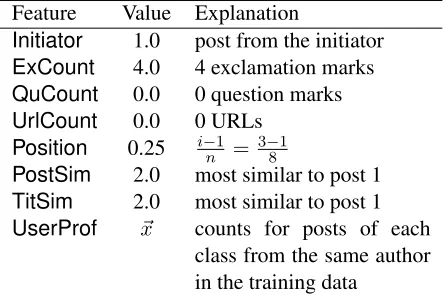
Initiator a binary feature indicating whether the current post’s author is the thread initiator.
Position the relative position of the current post, as a ratio over the total number of posts in the thread.
Semantic Features:
TitSim the relative location of the post which has the most similar title (based on unweighted co-sine similarity) to the current post.
PostSim the relative location of the post which has the most similar content (based on un-weighted cosine similarity) to the current post.
Punct the number of question marks (QuCount),
exclamation marks (ExCount) and URLs
(UrlCount) in the current post.
UserProf the class distribution (in the training thread) of the author of the current post.
These features are drawn largely from the work of Kim et al. (2010b), with two major differences: (1) we do not use post context features because our
learners (i.e.CRFSGDandMaltParser) inherently
capture Markov chains; and (2) ourUserProf
fea-tures are customised to the class set associated with
the task at hand, e.g. theUserProffeatures for the
Feature Value Explanation
Initiator 1.0 post from the initiator
ExCount 4.0 4 exclamation marks
QuCount 0.0 0 question marks
UrlCount 0.0 0 URLs
Position 0.25 i−1 n =3−81
PostSim 2.0 most similar to post 1
TitSim 2.0 most similar to post 1
[image:6.612.76.298.61.209.2]UserProf ~x counts for posts of each class from the same author in the training data
Table 1: The feature presentation of the third post in a thread of length 8
of length 8. The values of each feature are scaled to
the range[0,1]before being fed into the learners.
We also experimented with other features, including raw bag-of-words lexical features, dimensionality-reduced lexical features (using principal components analysis), and different post similarity measures such as longest common subse-quence (LCS) match. While we were able to obtain gains in isolation, when combined with the other features, these features had no impact, and are thus not included in the results presented in this paper.
5 Classification Methodology
All our experiments were carried out based on strati-fied 10-fold cross-validation, stratifying at the thread level to ensure that all posts from a given thread occur in a single fold. The results are primarily evaluated using post-level micro-averaged F-score
(Fµ: β = 1), and additionally with thread-level
F-score/classification accuracy (i.e. the proportion of threads where all posts have been correctly
classi-fied4), where space allows. Statistical significance
is tested using randomised estimation (Yeh, 2000)
with p < 0.05. Initial experiments showed it is
hard for learners to discover which posts have multi-ple links, largely due to the sparsity of multi-headed posts (which account for less than 5% of the total posts). Therefore, only the the most recent link for
3http://maltparser.org/userguide.html#
parsingalg
4Classification accuracy = F-score at the thread-level, as
each thread is assigned a single label of correct or incorrect.
each multi-headed post was included in training, but evaluation still considers all links.
5.1 Joint classification
In our experiments, we test two basic approaches to
joint classification for theCRF: (1) classifying the
LinkandDAseparately, and composing the
predic-tions to form the joint classification (Composition);
and (2) combining theLinkandDAlabels into a
sin-gle class, and applying the learner over the posts
with the combined class (Combine). Note that
Composition has the potential for mismatches in
the number of Link and DA predictions it
gener-ates, causing complications in the class composition. Even if the same number of labels is predicted for
bothLinkand DA, if multiple tags are predicted in
both cases, we are left with the problem of determin-ing which link label to combine with which dialogue act label. As such, we have our reservations about
Composition, but as theCRFperforms strict
1-of-nlabelling, these are not issues in the experiments
reported herein.
MaltParsernatively handles the combination of
LinkandDAin its dependency parsing formulation.
5.2 In Situ Thread Classification
One of the biggest challenges in classifying the dis-course structure of a forum thread is that threads evolve over time, as new posts are posted. In or-der to capture this phenomenon, and compare the accuracy of different models when applied to partial thread data (artificially cutting off a thread at post
N) vs. complete threads.5 This is done in the
fol-lowing way: classification over the first two posts
only ([1,2]), the first four posts ([1,4]), the first six
posts ([1,6]), the first eight posts ([1,8]), and all
posts ([all]). In each case, we limit the test data
only, meaning that the only variable in play is the extent of thread context used to learn the thread dis-course structure for the given set of posts. We break down the results in each case into the indicated
sub-threads, e.g. we take the predictions for [all], and
break them down into the results for [1,2], [1,4],
[1,6],[1,8]and[all], for direct comparison with the predictions over the respective sub-thread data.
5In practice, completeness is defined at a given point in time,
Method Link DA Kim et al. (2010b) .863 / .676 .751 / .543
[image:7.612.327.526.58.183.2]CRFSGD .891 / .727 .795 / .609
Table 2: Post/thread-level component-wise classification F-scores forLinkandDAclasses
6 Experiments and Analysis 6.1 Joint classification
As our baseline for the task, we first use a sim-ple majority class classifier in the form of the
sin-gle joint class of1+Answer-Answer for all posts,
which has a post-level F-score of 0.284. A stronger
baseline is to classify all first posts as
0+Question-Questionand all subsequent posts as 1+Answer-answer, which achieves a post-level F-score of
0.515 (labelled asHeuristic).
As described in Section 5.1, one approach to joint
classification with CRFSGD is to firstly conduct
component-wise classification over Link and DA
separately, and compose the predictions. The results
for the separateLinkandDAclassification tasks are
presented in Table 2, along with the best results for
LinkandDAclassification from Kim et al. (2010b).
At the component-wise tasks, our method is superior to Kim et al. (2010b), based on a different learner and slightly different feature set.
Next, we compose the component-wise
clas-sifications for the CRF into joint classifications
(Composition). We contrast this with the
com-bined class approach forCRFSGDandMaltParser
(jointly presented as Joint in Table 3). With the
combined class results, we additionally ablate each of the feature types from Section 4.2, and also present results for a dummy model, where no fea-tures are provided and the prediction is based simply
on sequential priors (Dummy). The results are
pre-sented in Table 3, along with theHeuristicbaseline
result.
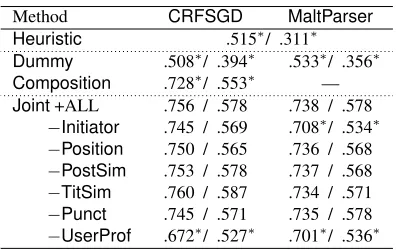
Several interesting things can be observed from the post-level F-score results in Table 3. First, with
no features (Dummy), while CRFSGD performs
slightly worse than the Heuristic baseline,
Malt-Parsersignificantly surpasses the baseline. This is
due to the richer sequential context model of
Malt-Parser. Second, the single feature with the greatest
impact on results isUserProf, i.e. user profile
fea-Method CRFSGD MaltParser
Heuristic .515∗/ .311∗
Dummy .508∗/ .394∗ .533∗/ .356∗ Composition .728∗/ .553∗ — Joint+ALL .756 / .578 .738 / .578
−Initiator .745 / .569 .708∗/ .534∗
−Position .750 / .565 .736 / .568 −PostSim .753 / .578 .737 / .568 −TitSim .760 / .587 .734 / .571 −Punct .745 / .571 .735 / .578 −UserProf .672∗/ .527∗ .701∗/ .536∗
Table 3: Post/thread-levelLink-DAjoint classification F-scores (“∗” signifies a significantly worse result than that
for the same learner with ALL features)
tures extracted from the training data;CRFSGDin
particular benefits from this feature. We return to ex-plore this effect in Section 6.4. Third, although the
Initiatorfeature does not have much effect on
CRF-SGD, it affects the performance ofMaltParser
sig-nificantly. Further experiments shown that the
com-bination of Initiator and UserProf is sufficient to
achieve a competitive result (i.e. 0.731). It therefore
seems that MaltParser is more robust than
CRF-SGD, whose performance relies crucially on
user-level features which must be learned from the
train-ing data (i.e.UserProf).
Looking to the thread-level F-scores, we observe some interesting divergences from the post-level
F-score results. First, with no features (Dummy),
CRFSGDsignificantly outperforms both the
base-line and MaltParser. This appears to be because
CRFSGD performs particularly well over short threads (e.g. of length 3 and 4), but worse over longer threads. Second, the best thread-level
F-scores fromCRFSGD(i.e. 0.587) andMaltParser
(i.e. 0.578) are not significantly different, despite the
discrepancy in post-level F-score (whereCRFSGD
is markedly superior in this case). With the extra
features, the performance of MaltParser on short
threads appears to pick up noticeably, and the differ-ence in post-level predictions is over longer threads.
If we evaluate the two models over DA
super-classes only (ignoring mismatches at the subclass
level forQuestion andAnswer), the post-level
F-scores for joint classification with ALL features for
Approaches Link DA Component-wise .891 / .727∗ .795 / .609 CRFSGDdecomp .893 / .749 .785 / .603 MaltParserdecomp .870∗/ .730∗ .766∗/ .571∗
Table 4: Post/thread-level Link and DA F-scores from component-wise classification, and fromLink-DA clas-sification decomposition (“∗” signifies a significantly
worseresult than thebestresult in that column)
Looking at the performance of CRFSGD (in
Combinemode) andMaltParser on disconnected sub-graphs, while both models did predict a small number of non-initial posts with null-links (includ-ingMaltParserpredicting 5 out of 6 posts in a sin-gle thread as having null-links), none were correct, and neither model was able to correctly predict any of the 6 actual non-initial instances of null-links in the dataset.
Finally, we took the joint classification results from CRFSGD and MaltParser using ALL
fea-tures, and decomposed the predictions intoLinkand
DA. The results are presented in Table 4, along with
[image:8.612.80.291.59.105.2]the results for component-wise classification from Table 2. Somewhat surprisingly, the decomposed predictions are mostly slightly worse than the re-sults for the component-wise classification, despite achieving higher F-score for the joint classification task. This is simply due to the combined method tending to get both labels correct or both labels wrong, for a given post.
6.2 Post Position-based Result Breakdown
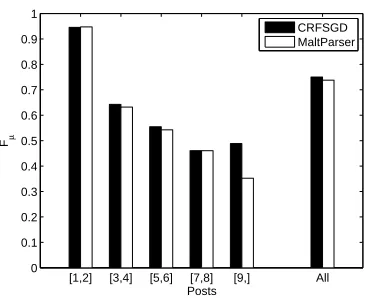
One question in thread discourse structure classifica-tion is how accurate the predicclassifica-tions are at different depths in a thread (e.g. the first two posts vs. the sec-ond two posts). A breakdown of results across posts at different positions is presented in Figure 2.
The overall trend for bothCRFSGD and
Malt-Parseris that it becomes increasingly hard to clas-sify posts as we continue through a thread, due to greater variability in discourse structure and greater sparsity in the data. However, it is interesting to note
that the results forCRFSGDactually improve from
posts 7 and 8 ([7,8]) to posts 9 and onwards ([9,]).
To further investigate this effect, we performed class decomposition over the joint classification predic-tions, and performed a similar breakdown of posts
[1,2] [3,4] [5,6] [7,8] [9,] All 0
0.1 0.2 0.3 0.4 0.5 0.6 0.7 0.8 0.9 1
Posts
Fµ
[image:8.612.327.517.66.215.2]CRFSGD MaltParser
Figure 2: Breakdown of post-levelLink-DAresults for
CRFSGDandMaltParserbased on post position
[1,2] [3,4] [5,6] [7,8] [9,] All 0
0.5 1
Posts
Fµ
Decomposed Link
CRFSGD MaltParser
[1,2] [3,4] [5,6] [7,8] [9,] All 0
0.5 1
Posts
Fµ
Decomposed DA
CRFSGD MaltParser
Figure 3: Breakdown of post-levelLinkandDAF-score based on the decomposition of CRFSGD and Malt-Parserclassifications
for Linkand DA; the results are presented in
Fig-ure 3. It is clear that the anomaly for CRFSGD
comes from theDAcomponent, due to there being
greater predictability in the dialogue for final posts in a thread (users tend to confirm a successful reso-lution of the problem, or report on successful
exter-nal reproduction of the solution).MaltParserseems
less adept at identifying that a post is at the end of a thread, and predicting the dialogue act accord-ingly. This observation is congruous with the find-ings of McDonald and Nivre (2007) that errors
prop-agate, due toMaltParser’s greedy inference
strat-egy. The higher results forLinkare to be expected,
[image:8.612.325.511.277.423.2]XXXX
XXXXX
Test
B/down
[1,2] [1,4] [1,6] [1,8] [All]
[1,2] .947/.947 — — — —
[1,4] .946/.947 .836/.841 — —
[1,6] .946/.947 .840/.841 .800/.794 — —
[image:9.612.150.464.61.139.2][1,8] .946/.947 .840/.841 .800/.794 .780/.769 — [All] .946/.946 .840/.838 .800/.791 .776/.767 .756/.738
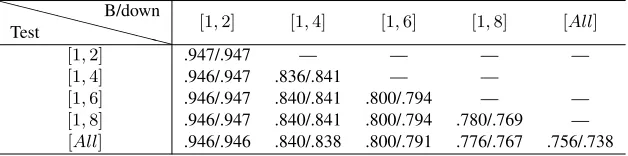
Table 5: Post-levelLink-DAF-score forCRFSGD/MaltParser, based on in situ classification over sub-threads of different lengths (indicated in the rows), broken down over different post extents (indicated in the columns)
6.3 In Situ Structure Prediction
As described in Section 5.2, we simulate in situ thread discourse structure prediction by removing differing numbers of posts from the tail of the thread, and applying the trained model over the resultant sub-threads. The results for in situ classification are presented in Table 5, with the rows indicating the size of the test sub-thread, and the columns being a breakdown of results over different portions of the classified thread. The reason that we do not pro-vide numbers for all cells in the table is that the size of the test sub-thread determines the post extents we can breakdown the results into, e.g. we cannot return
results for posts 1–4 ([1,4]) when the size of the test
thread was only two posts ([1,2]).
From the results, we can see that bothCRFSGD
andMaltParserare very robust when applied to par-tial threads, to the extent that we actually achieve higher results over shortened versions of the thread than over the complete thread in some instances, al-though the only difference that is statistically
signif-icant is over[1,8]forCRFSGD, where the
predic-tion over the partial thread is actually superior to that over the complete thread. From this, we can con-clude that it is possible to apply our method to partial threads without any reduction in effectiveness rela-tive to classification over complete threads. As such, our method is shown to be robust when applied to real-time analysis of dynamically evolving threads.
6.4 User profile feature analysis
In our experiments, we noticed that the user profile
feature (UserProf) is the most effective feature for
bothCRFSGDand MaltParser. To gain a deeper insight into the behaviour of the feature, we binned the posts according to the number of times the author had posted in the training data, evaluated based on a
Bin uscore per userPosts Totalusers Totalposts
High 224.6 251 1 251
Medium 1∼41.7 4∼48 45 395
Low 0 2∼4 157 377
Very Low 0 1 309 309
Table 6: Statistics for the 4 groups of users
user score (uscore) for each user:
uscorei =
Pni
j=1spi,j ni
whereniis the number of posts by useri, andspi,j is
the number of posts by userithat occur as training
instances for other posts by the same author.uscore
reflects the average training–test post ratio per user in cross-validation. Note that as we include all posts from a given thread in a single partition during cross-validation, it is possible for an author to have posted
4 times, but have auscoreof 0 due to those posts all
occurring in the same thread.
We ranked the users in the dataset in descending
order ofuscore, sub-ranking onniin cases of a tie
in uscore. The users were binned into 4 groups
of roughly equal post size. The detailed statistics are shown in Table 6, noting that the high-frequency bin (“High”) contains posts from a single user. We present the post-level micro-averaged F-score for
posts in each bin based onCRFSGD, with and
with-out user profile features, in Figure 4.
Contrary to expectation, the UserProf features
have the greatest impact for users with fewer posts. In fact, a statistically significant difference was ob-served only for users with no posts in the training
data (uscore = 0), where the F-score jumped over
High Median Low Very Low 0
0.1 0.2 0.3 0.4 0.5 0.6 0.7 0.8 0.9 1
User Group
Fµ
[image:10.612.90.271.68.213.2]With UserProf Without UserProf
Figure 4: Post-level joint classification results for users binned byuscore, based onCRFSGDwith and without
UserProffeatures)
lack of user profile information is predictive of the sort of posts we can expect from a user (i.e. they tend to be newbie users, asking questions).
7 Conclusions and Future Work
In this research, we explored the joint classification of web user forum thread discourse structure, in the form of a rooted directed acyclic graph over posts, with edges labelled with dialogue acts. Three classi-fication approaches were proposed: separately
pre-dicting Link and DA labels, and composing them
into a joint class; predicting a combinedLink-DA
class using a structured classifier; and applying de-pendency parsing to the problem. We found the
combined approach based onCRFSGDto perform
best over the task, closely followed by dependency
parsing withMaltParser.
We also examined the task of in situ classification of dialogue structure, in the form of predicting the discourse structure of partial threads, as contrasted with classifying only complete threads. We found that there was no drop in F-score over different sub-extents of the thread in classifying partial threads, despite the relative lack of thread context.
In future work, we plan to delve further into de-pendency parsing, looking specifically at the impli-cations of multi-headedness and disconnected sub-graphs on dependency parsing. We also intend to carry out meta-classification, combining the
predic-tions ofCRFSGDandMaltParser.
Our user profile features were found to be the pick of our features, but counter-intuitively, to
bene-fit users with no posts in the training data, rather than prolific users. We wish to explore this effect further, including incorporating unsupervised user-level fea-tures into our classifiers.
Acknowledgements
The authors wish to acknowledge the development
efforts of Johan Hall in configuringMaltParserto
handle numeric features, and be able to parse thread structures. NICTA is funded by the Australian gov-ernment as represented by Department of Broad-band, Communication and Digital Economy, and the Australian Research Council through the ICT Centre of Excellence programme.
References
L´eon Bottou. 2011. CRFSGD software. http:// leon.bottou.org/projects/sgd.
Xin Cao, Gao Cong, Bin Cui, Christian S. Jensen, and Ce Zhang. 2009. The use of categorization infor-mation in language models for question retrieval. In
Proceedings of the 18th ACM Conference on
Informa-tion and Knowledge Management (CIKM 2009), pages
265–274, Hong Kong, China.
Vitor R. Carvalho and William W. Cohen. 2005. On the collective classification of email ”speech acts”. In
Proceedings of 28th International ACM-SIGIR Con-ference on Research and Development in Information Retrieval (SIGIR 2005), pages 345–352.
Jeffrey Chan and Conor Hayes. 2010. Decomposing dis-cussion forums using user roles. InProceedings of the WebSci10: Extending the Frontiers of Society On-Line
(WebSci10), pages 1–8, Raleigh, USA.
Jeffrey Chan, Conor Hayes, and Elizabeth M. Daly. 2010. Decomposing discussion forums using user roles. InProceedings of the Fourth International AAAI Conference on Weblogs and Social Media (ICWSM
2010), pages 215–8, Washington, USA.
Chih-Chung Chang and Chih-Jen Lin. 2011. LIB-SVM: A library for support vector machines. ACM Transactions on Intelligent Systems and Technology, 2(3):27:1–27:27. Software available at http:// www.csie.ntu.edu.tw/˜cjlin/libsvm. William W. Cohen, Vitor R. Carvalho, and Tom M.
Mitchell. 2004. Learning to classify email into “speech acts”. InProceedings of the 2004 Conference on Empirical Methods in Natural Language
Process-ing (EMNLP 2004), pages 309–316, Barcelona, Spain.
pairs from online forums. InProceedings of 31st Inter-national ACM-SIGIR Conference on Research and De-velopment in Information Retrieval (SIGIR’08), pages 467–474, Singapore.
Daniel Dahlmeier, Hwee Tou Ng, and Tanja Schultz. 2009. Joint learning of preposition senses and seman-tic roles of prepositional phrases. InProceedings of the 2009 Conference on Empirical Methods in Natural
Language Processing (EMNLP 2009), pages 450–458,
Singapore. Association for Computational Linguistics. Shilin Ding, Gao Cong, Chin-Yew Lin, and Xiaoyan Zhu. 2008. Using conditional random fields to extract con-text and answers of questions from online forums. In
Proceedings of the 46th Annual Meeting of the ACL:
HLT (ACL 2008), pages 710–718, Columbus, USA.
Jason Eisner and Noah A. Smith. 2005. Parsing with soft and hard constraints on dependency length. In Pro-ceedings of the Ninth International Workshop on
Pars-ing Technology, pages 30–41, Vancouver, Canada.
Jonathan L. Elsas and Jaime G. Carbonell. 2009. It pays to be picky: An evaluation of thread retrieval in online forums. In Proceedings of 32nd Interna-tional ACM-SIGIR Conference on Research and De-velopment in Information Retrieval (SIGIR’09), pages 714–715, Boston, USA.
Micha Elsner and Eugene Charniak. 2008. You talk-ing to me? a corpus and algorithm for conversation disentanglement. InProceedings of the 46th Annual
Meeting of the ACL: HLT (ACL 2008), pages 834–842,
Columbus, USA.
Jenny Rose Finkel and Christopher D. Manning. 2009. Joint parsing and named entity recognition. In Pro-ceedings of Human Language Technologies: The 2009 Annual Conference of the North American Chap-ter of the Association for Computational Linguistics
(NAACL HLT 2009), pages 326–334, Boulder,
Col-orado. Association for Computational Linguistics. Blaz Fortuna, Eduarda Mendes Rodrigues, and Natasa
Milic-Frayling. 2007. Improving the classification of newsgroup messages through social network analysis.
In Proceedings of the 16th ACM Conference on
In-formation and Knowledge Management (CIKM 2007),
pages 877–880, Lisbon, Portugal.
Barbara J. Grosz and Candace L. Sidner. 1986. Atten-tion, intention and the structure of discourse. Compu-tational Linguistics, 12(3):175–204.
Edward Ivanovic. 2008. Automatic instant messaging dialogue using statistical models and dialogue acts. Master’s thesis, University of Melbourne.
Su Nam Kim, Lawrence Cavedon, and Timothy Bald-win. 2010a. Classifying dialogue acts in one-on-one live chats. InProceedings of the 2010 Conference on Empirical Methods in Natural Language Processing
(EMNLP 2010), pages 862–871, Boston, USA.
Su Nam Kim, Li Wang, and Timothy Baldwin. 2010b. Tagging and linking web forum posts. InProceedings of the 14th Conference on Computational Natural
Lan-guage Learning (CoNLL-2010), pages 192–202,
Upp-sala, Sweden.
Sandra K¨ubler, Ryan McDonald, and Joakim Nivre. 2009. Dependency parsing.Synthesis Lectures on
Hu-man Language Technologies, 2(1):1–127.
John Lafferty, Andrew McCallum, and Fernando Pereira. 2001. Conditional random fields: Probabilistic mod-els for segmenting and labeling sequence data. In Pro-ceedings of the 18th International Conference on
Ma-chine Learning, pages 282–289, Williamstown, USA.
Andrew Lampert, Robert Dale, and C´ecile Paris. 2008. The nature of requests and commitments in email mes-sages. InProceedings of the AAAI 2008 Workshop on
Enhanced Messaging, pages 42–47, Chicago, USA.
Robert Leaman, Laura Wojtulewicz, Ryan Sullivan, An-nie Skariah, Jian Yang, and Graciela Gonzalez. 2010. Towards internet-age pharmacovigilance: Extracting adverse drug reactions from user posts in health-related social networks. In Proceedings of the 2010 Workshop on Biomedical Natural Language
Process-ing (ACL 2010), pages 117–125, Uppsala, Sweden.
Oliver Lemon, Alex Gruenstein, and Stanley Peters. 2002. Collaborative activities and multi-tasking in di-alogue systems. Traitement Automatique des Langues (TAL), Special Issue on Dialogue, 43(2):131–154. Chen Lin, Jiang-Ming Yang, Rui Cai, Xin-Jing Wang,
Wei Wang, and Lei Zhang. 2009. Modeling semantics and structure of discussion threads. InProceedings of the 18th International Conference on the World Wide
Web (WWW 2009), pages 1103–1104, Madrid, Spain.
Marco Lui and Timothy Baldwin. 2009. You are what you post: User-level features in threaded discourse. In
Proceedings of the 14th Australasian Document
Com-puting Symposium (ADCS 2009), Sydney, Australia.
Marco Lui and Timothy Baldwin. 2010. Classifying user forum participants: Separating the gurus from the hacks, and other tales of the internet. InProceedings of the 2010 Australasian Language Technology
Work-shop (ALTW 2010), pages 49–57, Melbourne,
Aus-tralia.
Ryan McDonald and Joakim Nivre. 2007. Charac-terizing the errors of data-driven dependency parsing models. In Proceedings of the 2007 Joint Confer-ence on Empirical Methods in Natural Language Pro-cessing and Computational Natural Language
Learn-ing (EMNLP-CoNLL 2007), pages 122–131, Prague,
Czech Republic.
the European Chapter of the Association for Computa-tional Linguistics (EACL 2006), pages 81–88, Trento, Italy.
Ryan McDonald, Fernando Pereira, Kiril Ribarov, and Jan Hajic. 2005. Non-projective dependency pars-ing uspars-ing spannpars-ing tree algorithms. InProceedings of Human Language Technology Conference and Confer-ence on Empirical Methods in Natural Language Pro-cessing, pages 523–530, Vancouver, Canada.
Gabriel Murray, Steve Renals, Jean Carletta, and Johanna Moore. 2006. Incorporating speaker and discourse features into speech summarization. InProceedings of the Main Conference on Human Language Technol-ogy Conference of the North American Chapter of the Association of Computational Linguistics, pages 367– 374.
Klemens Muthmann, Wojciech M. Barczy´nski, Falk Brauer, and Alexander L¨oser. 2009. Near-duplicate detection for web-forums. InProceedings of the 2009 International Database Engineering & Applications
Symposium (IDEAS 2009), pages 142–151, Cetraro,
Italy.
Joakim Nivre, Johan Hall, Jens Nilsson, Atanas Chanev, G¨ulsen Eryigit, Sandra K¨ubler, Svetoslav Marinov, and Erwin Marsi. 2007. MaltParser: A language-independent system for data-driven dependency
pars-ing.Natural Language Engineering, 13(02):95–135.
Joakim Nivre. 2003. An efficient algorithm for projec-tive dependency parsing. InProceedings of the 8th In-ternational Workshop on Parsing Technologies (IWPT 03), pages 149–160, Nancy, France.
Joakim Nivre. 2004. Incrementality in determinis-tic dependency parsing. In Proceedings of the ACL Workshop Incremental Parsing: Bringing Engineer-ing and Cognition Together (ACL-2004), pages 50–57, Barcelona, Spain.
Carolyn Penstein Ros´e, Barbara Di Eugenio, Lori S. Levin, and Carol Van Ess-Dykema. 1995. Discourse processing of dialogues with multiple threads. In Pro-ceedings of the 33rd Annual Meeting of the Asso-ciation for Computational Linguistics, pages 31–38, Cambridge, USA.
Kenji Sagae and Jun’ichi Tsujii. 2008. Shift-reduce dependency DAG parsing. In Proceedings of the 22nd International Conference on Computational
Lin-guistics (COLING 2008), pages 753–760, Manchester,
UK.
Kenji Sagae. 2009. Analysis of discourse structure with syntactic dependencies and data-driven shift-reduce parsing. InProceedings of the 11th International Con-ference on Parsing Technologies (IWPT-09), pages 81– 84, Paris, France.
Anne Schuth, Maarten Marx, and Maarten de Rijke. 2007. Extracting the discussion structure in comments
on news-articles. InProceedings of the 9th Annual ACM International Workshop on Web Information and
Data Management, pages 97–104, Lisboa, Portugal.
Jangwon Seo, W. Bruce Croft, and David A. Smith. 2009. Online community search using thread struc-ture. In Proceedings of the 18th ACM Conference on Information and Knowledge Management (CIKM
2009), pages 1907–1910, Hong Kong, China.
Elinzabeth Shriberg, Raj Dhillon, Sonali Bhagat, Jeremy Ang, and Hannah Carvey. 2004. The ICSI meeting recorder dialog act (MRDA) corpus. InProceedings of the 5th SIGdial Workshop on Discourse and Dialogue, pages 97–100, Cambridge, USA.
Parikshit Sondhi, Manish Gupta, ChengXiang Zhai, and Julia Hockenmaier. 2010. Shallow information ex-traction from medical forum data. InProceedings of the 23rd International Conference on Computational
Linguistics (COLING 2010), Posters Volume, pages
1158–1166, Beijing, China.
Radu Soricut and Daniel Marcu. 2003. Sentence level discourse parsing using syntactic and lexical infor-mation. In Proceedings of the 2003 Human Lan-guage Technology Conference of the North American Chapter of the Association for Computational
Linguis-tics (HLT-NAACL 2003), pages 149–156, Edmonton,
Canada.
Andreas Stolcke, Klaus Ries, Noah Coccaro, Eliza-beth Shriberg, Rebecca Bates, Daniel Jurafsky, Pail Taylor, Rachel Martin, Carol Van Ess-Dykema, and Marie Meteer. 2000. Dialogue act modeling for automatic tagging and recognition of conversational speech.Computational Linguistics, 26(3):339–373. Charles Sutton and Andrew McCallum. 2005. Joint
parsing and semantic role labeling. InProceedings of the Ninth Conference on Computational Natural
Lan-guage Learning (CoNLL-2005), pages 225–228, Ann
Arbor, Michigan. Association for Computational Lin-guistics.
Pasi Tapanainen and Timo Jarvinen. 1997. A non-projective dependency parser. InProceedings of the Fifth Conference on Applied Natural Language Pro-cessing, pages 64–71, Washington, USA.
Nayer Wanas, Motaz El-Saban, Heba Ashour, and Waleed Ammar. 2008. Automatic scoring of online discussion posts. InProceeding of the 2nd ACM work-shop on Information credibility on the web (WICOW ’08), pages 19–26, Napa Valley, USA.
Yi-Chia Wang and Carolyn P. Ros´e. 2010. Mak-ing conversational structure explicit: identification of initiation-response pairs within online discussions. In
Yi-Chia Wang, Mahesh Joshi, and Carolyn Ros´e. 2007. A feature based approach to leveraging context for classifying newsgroup style discussion segments. In
Proceedings of the 45th Annual Meeting of the As-sociation for Computational Linguistics Companion Volume Proceedings of the Demo and Poster Sessions
(ACL 2007), pages 73–76, Prague, Czech Republic.
Yi-Chia Wang, Mahesh Joshi, William W. Cohen, and Carolyn Ros´e. 2008. Recovering implicit thread structure in newsgroup style conversations. In Pro-ceedings of the Second International Conference on
Weblogs and Social Media (ICWSM 2008), pages 152–
160, Seattle, USA.
V. Warnke, R. Kompe, H. Niemann, and E. N¨oth. 1997. Integrated dialog act segmentation and classification using prosodic features and language models. InProc.
Eurospeech, volume 1, pages 207–210.
Markus Weimer and Iryna Gurevych. 2007. Predicting the perceived quality of web forum posts. In Proceed-ings of the 2007 International Conference on Recent Advances in Natural Language Processing (RANLP 2007), pages 643–648, Borovets, Bulgaria.
Markus Weimer, Iryna Gurevych, and Max M¨uhlh¨auser. 2007. Automatically assessing the post quality in on-line discussions on software. In Proceedings of the 45th Annual Meeting of the ACL: Interactive Poster
and Demonstration Sessions, pages 125–128, Prague,
Czech Republic.
Armin Weinberger and Frank Fischer. 2006. A framework to analyze argumentative knowledge con-struction in computer-supported collaborative learn-ing.Computers & Education, 46:71–95, January. Florian Wolf and Edward Gibson. 2005. Representing
discourse coherence: A corpus-based study. Compu-tational Linguistics, 31(2):249–287.
Wensi Xi, Jesper Lind, and Eric Brill. 2004. Learning effective ranking functions for newsgroup search. In
Proceedings of 27th International ACM-SIGIR Con-ference on Research and Development in Informa-tion Retrieval (SIGIR 2004), pages 394–401. Sheffield, UK.
Alexander Yeh. 2000. More accurate tests for the sta-tistical significance of result differences. In Proceed-ings of the 18th International Conference on
Compu-tational Linguistics (COLING 2000), pages 947–953,