Chinese Zero Pronoun Resolution: Some Recent Advances
Chen Chen and Vincent Ng
Human Language Technology Research Institute University of Texas at Dallas
Richardson, TX 75083-0688 {yzcchen,vince}@hlt.utdallas.edu
Abstract
We extend Zhao and Ng's (2007) Chinese anaphoric zero pronoun resolver by (1) using a richer set of features and (2) exploiting the coreference links between zero pronouns dur-ing resolution. Results on OntoNotes show that our approach significantly outperforms two state-of-the-art anaphoric zero pronoun re-solvers. To our knowledge, this is the first work to report results obtained by an end-to-endChinese zero pronoun resolver.
1 Introduction
A zero pronoun (ZP) is a gap in a sentence that is found when a phonetically null form is used to refer to a real-world entity. An anaphoric zero pronoun (AZP) is a ZP that corefers with one or more preced-ing noun phrases (NPs) in the associated text. Un-like overt pronouns, ZPs lack grammatical attributes that are useful for overt pronoun resolution such as number and gender. This makes ZP resolution more challenging than overt pronoun resolution.
We aim to improve the state of the art in Chinese AZP resolution by proposing two extensions. First, while previous approaches to this task have primarily focused on employing positional and syntactic fea-tures (e.g., Zhao and Ng (2007) [Z&N], Kong and Zhou (2010) [K&Z]), we exploit a richer set of fea-tures for capturing the context of an AZP and its candidate antecedents. Second, to alleviate the diffi-culty of resolving an AZP to an antecedent far away from it, we break down the process into smaller, in-termediate steps, where we allow coreference links between AZPs to be established.
We apply our two extensions to a state-of-the-art Chinese AZP resolver proposed by Z&N and
eval-uate the resulting resolver on the OntoNotes cor-pus. Experimental results show that this resolver sig-nificantly outperforms both Z&N's resolver and an-other state-of-the-art resolver proposed by K&Z. It is worth noting that while previous work on Chinese ZP resolution has reported results obtained via gold information (e.g., using gold AZPs and extracting candidate antecedents and other features from gold syntactic parse trees), this is the first work to report the results of anend-to-endChinese ZP resolver.
The rest of this paper is organized as follows. tion 2 describes the two baseline AZP resolvers. Sec-tions 3 and 4 discuss our two extensions. We present our evaluation results in Section 5 and our conclu-sions in Section 6.
2 Baseline AZP Resolution Systems
An AZP resolution algorithm takes as input a set of AZPs produced by an AZP identification system. Below we first describe the AZP identifier we em-ploy, followed by our two baseline AZP resolvers.
2.1 Anaphoric Zero Pronoun Identification
We employ two steps toidentifyAZPs. In the extrac-tionstep, we heuristically extract candidate ZPs. In theclassificationstep, we train a classifier to distin-guish AZPs from non-AZPs.
To implement the extraction step, we use Z&N's and K&Z's observation: ZPs can only occur before a VP node in a syntactic parse tree. However, accord-ing to K&Z, ZPs do not need to be extracted from every VP: if a VP node occurs in a coordinate struc-ture or is modified by an adverbial node, then only its parent VP node needs to be considered. We extract ZPs from all VPs that satisfy the above constraints.
Syntactic features (13)
whetherzis the first gap in an IP clause; whetherzis the first gap in a subject-less IP clause, and if so, POS(w1); whether POS(w1) is NT; whethert1is a verb that appears in a NP or VP; whetherPlis a NP node; whetherPris a VP node; the phrasal label of the parent of the node containing POS(t1); whether V has a NP, VP or CP ancestor; whether C is a VP node; whether there is a VP node whose parent is an IP node in the path fromt1to C.
Lexical features (13)
the words surroundingzand/or their POS tags, includingw1,w−1, POS(w1), POS(w−1)+POS(w1), POS(w1)+POS(w2), POS(w−2)+POS(w−1), POS(w1)+POS(w2)+POS(w3), POS(w−1)+w1, and
w−1+POS(w1); whetherw1is a transitive verb, an intransitive verb or a preposition; whetherw−1is a transitive verb without an object.
Other fea-tures (6)
whetherzis the first gap in a sentence; whetherzis in the headline of the text; the type of the clause in whichzappears; the grammatical role ofz; whetherw−1is a punctuation; whetherw−1is a comma.
Table 1: Features for AZP identification.zis a zero pronoun. V is the VP node followingz.wiis theith word to the right ofz(ifiis positive) or theith word to the left ofz(ifiis negative). C is lowest common ancestor ofw−1and
w1.PlandPrare the child nodes of C that are the ancestors ofw−1andw1respectively.
Features between a
andz(4)
the sentence distance betweenaandz; the segment distance betweenaandz, where segments are separated by punctuations; whetherais the closest NP toz; whethera andz are siblings in the associated parse tree.
Features ona(12)
whetherahas an ancestor NP, and if so, whether this NP is a descendent ofa's lowest ancestor IP; whetherahas an ancestor VP, and if so, whether this VP is a descendent ofa's lowest ancestor IP; whetherahas an ancestor CP; the grammatical role ofa; the clause type in whichaappears; whether
ais an adverbial NP, a temporal NP, a pronoun or a named entity; whetherais in the headline of the text.
Features onz(10)
whether V has an ancestor NP, and if so, whether this NP node is a descendent of V's lowest ancestor IP; whether V has an ancestor VP, and if so, whether this VP is a descendent of V's lowest ancestor IP; whether V has an ancestor CP; the grammatical role ofz; the type of the clause in which V appears; whetherzis the first or last ZP of the sentence; whetherzis in the headline of the text.
Table 2: Features for AZP resolution in the Zhao and Ng (2007) baseline system.zis a zero pronoun. ais a candidate antecedent ofz. V is the VP node followingzin the parse tree.
To implement the classification step, we train a classifier using SVMlight(Joachims, 1999) to distin-guish AZPs from non-AZPs. We employ 32 features, 13 of which were proposed by Z&N and 19 of which were proposed by Yang and Xue (2010). A brief de-scription of these features can be found in Table 1.
2.2 Two Baseline AZP Resolvers
The Zhao and Ng (2007) [Z&N] baseline. In our implementation of the Z&N baseline, we use SVMlightto train a mention-pair model for determin-ing whether an AZP z and a candidate antecedent of z are coreferent. We consider all NPs preced-ing z that do not have the same head as its parent NP in the parse tree to bez's candidate antecedents. We use Soon et al.'s (2001) method to create train-ing instances: we create a positive instance between an AZP,z, and its closest overt antecedent, and we create a negative instance betweenzand each of the
intervening candidates. Each instance is represented by the 26 features employed by Z&N. A brief de-scription of these features can be found in Table 2. During testing, we adopt theclosest-first resolution strategy, resolving an AZP to the closest candidate antecedent that is classified as coreferent with it.1 The Kong and Zhou (2010) [K&Z] baseline. K&Z employ a tree kernel-based approach to AZP resolution. Like Z&N, K&Z (1) train a mention-pair model for determining whether an AZPz and a candidate antecedent of z are coreferent, (2) use Soon et al.'s method to create training instances, and (3) resolve an AZP to its closest coreferent can-didate antecedent. Unlike Z&N, however, K&Z use the SVMlight−T Klearning algorithm (Moschitti,
1
2006) to train their model, employing a parse sub-tree known as a dynamic expansion sub-tree (Zhou et al., 2008) as a structured feature to represent an instance.
3 Extension 1: Novel Features
We propose three kinds of features to better capture the context of an AZP, as described below.
Antecedent compatibility. AZPs are omitted sub-jects that precede VP nodes in a sentence's parse tree. From the VP node, we can extract its head verb (P redz) and the head of its object NP (Obj), if any.
Note thatP redzandObjcontain important
contex-tual information for an AZP.
Next, observe that if a NP is coreferent with an AZP, it should be able to fill the AZP's gap and be compatible with the gap's context. Consider the fol-lowing example:
E1:他们 那个服务 那 ∗pro∗
们
(They are trying that service. That means ∗pro∗
hope that our visitors can try it when they come in September.)
The head of the VP following ∗pro∗ is (hope). There are two candidate antecedents, 他们 (They) and那个服务 (that service). If we try us-ing them to fill this AZP's gap, we know based on selectional preferences that他们 (They hope) makes more sense than那个服务 (that service hope). We supply the AZP resolver with the fol-lowing information to help it make these decisions. First, we find the head word of each candidate an-tecedent,Headc. Then we form two strings,Headc
+P redz andHeadc+P redz+Obj(if the object
of the VP is present). Finally, we employ them as bi-nary lexical features, setting their feature values to 1 if and only if they can be extracted from the instance under consideration. The training data can be used to determine which of these features are useful.2 Narrative event chains. A narrative event chain is a partially ordered set of events related by a common protagonist (Chambers and Jurafsky, 2008). For ex-ample, we can infer from the chain "borrow-s invest-s invest-spend-invest-s lend-invest-s" that a perinvest-son who borrowinvest-s
(pre-2
We tried to apply Kehler et al.'s (2004) and Yang et al.'s (2005) methods to learn Chinese selectional preferences from unlabeled data, but without success.
sumably money) can invest it, spend it, or lend it to other people.3 Consider the following example:
E2: 国家 ∗pro∗
(The country gives our department money, but all ∗pro∗provides is exactly what we worked for.)
In E2,∗pro∗is coreferent with 国家(The coun-try), and the presence of the narrative event chain − (gives−provides) suggests that the subjects of the two events are likely to be coreferent.
However, given the unavailability of induced or hand-crafted narrative chains in Chinese4, we make the simplifying assumption that two verbs form a lexical chain if they are lexically identical.5 We
create two features to exploit narrative event chains for a candidate NP, c, if it serves as a subject or object. Specifically, let the verb governing c be
P redc. The first feature, which encodes whether
narrative chains are present, has three possible val-ues: 0 if P redc andP redz are not the same; 1 if
P redcand P redz are the same and c is a subject;
and 2 ifP redcandP redz are the same andcis an
object. The second feature is a binary lexical fea-ture,P redc+P redz+Subject/Object; its value is
1 if and only ifP redc,P redz, andSubject/Object
can be found in the associated instance, where
Subject/Objectdenotes the grammatical role ofc. Final punctuation hint. We observe that the punc-tuation (P unc) at the end of a sentence where an AZP occurs also provides contextual information, especially in conversation documents. In conversa-tions, if a sentence containing an AZP ends with a
3"-s" denotes the fact that the protagonist serves as the
gram-matical subject in these events.
4We tried to construct narrative chains for Chinese using
both learning-based and dictionary-based methods. Specifi-cally, we induced narrative chains using Chambers and Juraf-sky's (2008) method, but were not successful owing to the lack of an accurate Chinese coreference resolver. In addition, we constructed narrative chains using both lexically identical verbs and the synonyms obtained from a WordNet-like Chinese re-source called Tongyicicilin, but they did not help improve reso-lution performance.
5Experiments on the training data show that if an AZP and
A:她
(A: How isherlife now? ) B:∗pro1∗
(B:∗pro1∗attitude toward life is plain and simple.) A:
(A: Yes.)
A:∗pro2∗ 国
(A:∗pro2∗is living in Beijing or the USA?) B:∗pro3∗ 国
(B:∗pro3∗is living in the USA.)
Figure 1: An illustrative example.
question mark, the mention this AZP refers to is less likely to be the speaker himself6, as illustrated in the following example:
E3: ∗pro∗
(Are∗pro∗cold in the winter?)
Here,∗pro∗refers to the person the speaker talks with. To capture this information, we create a binary lexical feature, Headc+P unc, whose value is 1 if
and only ifHeadcandP uncappear in the instance
under consideration.
4 Extension 2: Zero Pronoun Links
4.1 Motivation
Like an overt pronoun, a ZP whose closest overt antecedent is far away from it is harder to resolve than one that has a nearby overt antecedent. How-ever, a corpus study of our training data reveals that only 55.2% of the AZPs appear in the same sentence as their closest overt antecedent, and 22.7% of the AZPs appear two or more sentences away from their closest overt antecedent.
Fortunately, we found that some of the difficult-to-resolve AZPs (i.e., AZPs whose closest overt an-tecedents are far away from them) are coreferential with nearby ZPs. Figure 1, which consists of a set of sentences from a conversation, illustrates this phe-nomenon. There are three AZPs (denoted by∗proi∗,
where 1 ≤ i ≤ 3), all of which refer to the overt pronoun她 (She) in the first sentence. In this ex-ample, it is fairly easy to resolve∗pro1∗correctly,
6
One may wonder whether we can similarly identify con-straints on the antecedents of a ZP from clause conjunctions. Our preliminary analysis suggests that the answer is no.
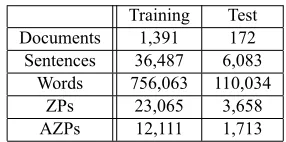
Training Test
Documents 1,391 172
Sentences 36,487 6,083
Words 756,063 110,034
ZPs 23,065 3,658
[image:4.612.354.497.58.129.2]AZPs 12,111 1,713
Table 3: Statistics on the training and test sets.
since its antecedent is the subject of previous sen-tence. However, ∗pro3∗ and its closest overt an-tecedent她(She) are four sentences apart. Together with the fact that there are many intervening candi-date antecedents, it is not easy for a resolver to cor-rectly resolve∗pro3∗.
To facilitate the resolution of∗pro3∗and difficult-to-resolve AZPs in general, we propose the follow-ing idea. We allow an AZP resolver to (1) establish coreferent links between two consecutive ZPs (i.e., ∗pro1∗−∗pro2∗ and∗pro2∗−∗pro3∗in our exam-ple), which are presumably easy to establish because the two AZPs involved are close to each other; and then (2) treat them as bridges and infer that∗pro3∗'s overt antecedent is她(She).
4.2 Modified Resolution Algorithm
We implement the aforementioned idea by modify-ing the AZP resolver as follows. When we resolve an AZPzduring testing, we augment the set of candi-date antecedents forzwith the set of AZPs preceding
z. Since we have only specified how to compute fea-tures for instances composed of an AZP and an overt candidate antecedent thus far (see Section 2.2), the question, then, is: how can we compute features for instances composed of two AZPs?
To answer this question, we first note that the AZPs in a test text are resolved in a left-to-right man-ner. Hence, by the time we resolve an AZPz, all the AZPs precedingzhave been resolved. Hence, when we create a test instanceibetweenzand one of the preceding AZPs (sayy), we createias if the gapy
was filled with the smallest tree embedding the NP to whichywas resolved.
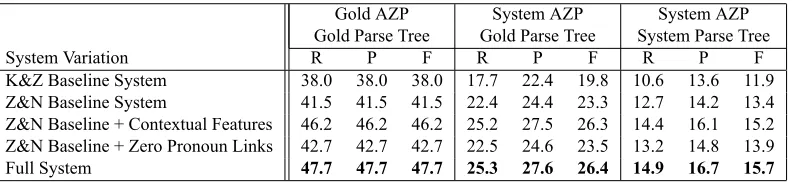
Gold AZP System AZP System AZP
Gold Parse Tree Gold Parse Tree System Parse Tree
System Variation R P F R P F R P F
K&Z Baseline System 38.0 38.0 38.0 17.7 22.4 19.8 10.6 13.6 11.9
Z&N Baseline System 41.5 41.5 41.5 22.4 24.4 23.3 12.7 14.2 13.4
Z&N Baseline + Contextual Features 46.2 46.2 46.2 25.2 27.5 26.3 14.4 16.1 15.2
Z&N Baseline + Zero Pronoun Links 42.7 42.7 42.7 22.5 24.6 23.5 13.2 14.8 13.9
[image:5.612.111.507.59.150.2]Full System 47.7 47.7 47.7 25.3 27.6 26.4 14.9 16.7 15.7
Table 4: Resolution results on the test set.
5 Evaluation
5.1 Experimental Setup
Dataset. For evaluation, we employ the portion of the OntoNotes 4.0 corpus that was used in the official CoNLL-2012 shared task. The shared task dataset is composed of a training set, a development set, and a test set. Since only the training set and the de-velopment set are annotated with ZPs, we use the training set for classifier training and reserve the de-velopment set for testing purposes. Statistics on the datasets are shown in Table 3. In these datasets, a ZP is marked as∗pro∗. We consider a ZP anaphoric if it is coreferential with a preceding ZP or overt NP. Evaluation measures. We express the results of both AZP identification and AZP resolution in terms of recall (R), precision (P) and F-score (F).
5.2 Results and Discussion
The three major columns of Table 4 show the re-sults obtained in three settings, which differ in terms of whether gold/system AZPs and manu-ally/automatically constructed parse trees are used to extract candidate antecedents and features.
In the first setting, the resolvers are provided with gold AZPs and gold parse trees. Results are shown in column 1. As we can see, the Z&N baseline signifi-cantly outperforms the K&Z baseline by 3.5% in F-score.7 Adding the contextual features, the ZP links, and both extensions to Z&N increase its F-score sig-nificantly by 4.7%, 1.2% and 6.2%, respectively.
In the next two settings, the resolvers operate on thesystemAZPs provided by the AZP identification component. When gold parse trees are employed, the recall, precision and F-score of AZP identifica-tion are 50.6%, 55.1% and 52.8% respectively. Col-umn 2 shows the results of the resolvers obtained
7
All significance tests are pairedt-tests, withp <0.05.
when these automatically identified AZPs are used. As we can see, Z&N again significantly outperforms K&Z by 3.5% in F-score. Adding the contextual fea-tures, the ZP links, and both extensions to Z&N in-crease its F-score by 3.0%, 0.2% and 3.1%, respec-tively. The system with contextual features and the full system both yield results that are significantly better than those of the Z&N baseline. A closer ex-amination of the results reveals why the ZP links are not effective in improving performance: when em-ploying system AZPs, many erroneous ZP links were introduced to the system.
Column 3 shows the results of the resolvers when we employ system AZPs and the automatically gen-erated parse trees provided by the CoNLL-2012 shared task organizers to compute candidate an-tecedents and features. Hence, these areend-to-end
ZP resolution results. To our knowledge, these are the first reported results on end-to-end Chinese ZP resolution. Using automatic parse trees, the perfor-mance on AZP identification drops to 30.8% (R), 34.4% (P) and 32.5% (F). In this setting, Z&N still outperforms K&Z significantly, though by a smaller margin when compared to the previous settings. In-corporating the contextual features, the ZP links, and both extensions increase the F-score by 1.8%, 0.5% and 2.3%, respectively. The system with contextual features and the full system both yield results that are significantly better than those of the Z&N baseline.
6 Conclusions
Acknowledgments
We thank the three anonymous reviewers for their detailed and insightful comments on an earlier draft of the paper. This work was supported in part by NSF Grants IIS-1147644 and IIS-1219142. Any opinions, findings, conclusions or recommendations expressed in this paper are those of the authors and do not necessarily reflect the views or official poli-cies, either expressed or implied, of NSF.
References
Nathanael Chambers and Dan Jurafsky. 2008. Unsu-pervised learning of narrative event chains. In Pro-ceedings of the 46th Annual Meeting of the Associa-tion for ComputaAssocia-tional Linguistics: Human Language Technologies, pages 787--797.
Thorsten Joachims. 1999. Making large-scale SVM learning practical. In Bernhard Scholkopf and Alexan-der Smola, editors,Advances in Kernel Methods - Sup-port Vector Learning, pages 44--56. MIT Press. Andrew Kehler, Douglas Appelt, Lara Taylor, and
Alek-sandr Simma. 2004. Competitive self-trained pronoun interpretation. InProceedings of HLT-NAACL 2004: Short Papers, pages 33--36.
Fang Kong and Guodong Zhou. 2010. A tree kernel-based unified framework for Chinese zero anaphora resolution. InProceedings of the 2010 Conference on Empirical Methods in Natural Language Processing, pages 882--891.
Alessandro Moschitti. 2006. Making tree kernels prac-tical for natural language processing. InProceedings of the 11th Conference of the European Chapter of the Association for Computational Linguistics, pages 113--120.
Wee Meng Soon, Hwee Tou Ng, and Daniel Chung Yong Lim. 2001. A machine learning approach to corefer-ence resolution of noun phrases. Computational Lin-guistics, 27(4):521--544.
Yaqin Yang and Nianwen Xue. 2010. Chasing the ghost: recovering empty categories in the Chinese Treebank. In Proceedings of the 23rd International Conference on Computational Linguistics: Posters, pages 1382--1390.
Xiaofeng Yang, Jian Su, and Chew Lim Tan. 2005. Im-proving pronoun resolution using statistics-based se-mantic compatibility information. InProceedings of the 43rd Annual Meeting of the Association for Com-putational Linguistics, pages 165--172.
Shanheng Zhao and Hwee Tou Ng. 2007. Identification and resolution of Chinese zero pronouns: A machine
learning approach. InProceedings of the 2007 Joint Conference on Empirical Methods on Natural guage Processing and Computational Natural Lan-guage Learning, pages 541--550.