Proceedings of the 2011 Conference on Empirical Methods in Natural Language Processing, pages 397–408,
Parser Evaluation over
Local and Non-Local Deep Dependencies in a Large Corpus
Emily M. Bender♠, Dan Flickinger♥, Stephan Oepen♣, Yi Zhang♦ ♠Dept of Linguistics, University of Washington,♥CSLI, Stanford University
♣Dept of Informatics, Universitetet i Oslo,♦Dept of Computational Linguistics, Saarland University
[email protected], [email protected], [email protected], [email protected]
Abstract
In order to obtain a fine-grained evaluation of parser accuracy over naturally occurring text, we study 100 examples each of ten reason-ably frequent linguistic phenomena, randomly selected from a parsed version of the En-glish Wikipedia. We construct a correspond-ing set of gold-standard target dependencies for these 1000 sentences, operationalize map-pings to these targets from seven state-of-the-art parsers, and evaluate the parsers against this data to measure their level of success in identifying these dependencies.
1 Introduction
The terms “deep” and “shallow” are frequently used to characterize or contrast different approaches to parsing. Inevitably, such informal notions lack a clear definition, and there is little evidence of com-munity consensus on the relevant dimension(s) of depth, let alone agreement on applicable metrics. At its core, the implied dichotomy of approaches al-ludes to differences in the interpretation of the pars-ing task. Its abstract goal, on the one hand, could be pre-processing of the linguistic signal, to enable subsequent stages of analysis. On the other hand, it could be making explicit the (complete) contribution that the grammatical form of the linguistic signal makes to interpretation, working out who did what to whom. Stereotypically, one expects correspond-ing differences in the choice of interface representa-tions, ranging from various levels of syntactic anal-ysis to logical-form representations of semantics.
In this paper, we seek to probe aspects of variation in automated linguistic analysis. We make the as-sumption that an integral part of many (albeit not all)
applications of parsing technology is the recovery of structural relations, i.e. dependencies at the level of interpretation. We suggest a selection of ten linguis-tic phenomena that we believe (a) occur with reason-ably high frequency in running text and (b) have the potential to shed some light on the depths of linguis-tic analysis. We quantify the frequency of these con-structions in the English Wikipedia, then annotate 100 example sentences for each phenomenon with gold-standard dependencies reflecting core proper-ties of the phenomena of interest. This gold standard is then used to estimate the recall of these dependen-cies by seven commonly used parsers, providing the basis for a qualitative discussion of the state of the art in parsing for English.
In this work, we answer the call by Rimell et al. (2009) for “construction-focused parser evalua-tion”, extending and complementing their work in several respects: (i) we investigate both local and non-local dependencies which prove to be challeng-ing for many existchalleng-ing state-of-the-art parsers; (ii) we investigate a wider range of linguistic phenomena, each accompanied with an in-depth discussion of relevant properties; and (iii) we draw our data from the 50-million sentence English Wikipedia, which is more varied and a thousand times larger than the venerable WSJ corpus, to explore a more level and ambitious playing field for parser comparison.
2 Background
unlabeled training data. A related dimension of vari-ation is the type of representvari-ations manipulated by the parser. We briefly review some representative examples along these dimensions, as these help to position the parsers we subsequently evaluate.1
2.1 Approaches to parsing
Source of linguistic knowledge At one end of this dimension, we find systems whose linguistic knowl-edge is encoded in hand-crafted rules and lexical en-tries; for English, the ParGram XLE system (Rie-zler et al., 2002) and DELPH-IN English Resource Grammar (ERG; Flickinger (2000))—each reflect-ing decades of continuous development—achieve broad coverage of open-domain running text, for ex-ample. At the other end of this dimension, we find fully unsupervised approaches (Clark, 2001; Klein and Manning, 2004), where the primary source of linguistic knowledge is co-occurrence patterns of words in unannotated text. As Haghighi and Klein (2006) show, augmenting this knowledge with hand-crafted prototype “seeds” can bring strong improve-ments. Somewhere between these poles, a broad class of parsers take some or all of their linguistic knowledge from annotated treebanks, e.g. the Penn Treebank (PTB), which encodes “surface grammati-cal analysis” (Marcus et al., 1993). Such approaches include those that directly (and exclusively) use the information in the treebank (e.g. Charniak (1997), Collins (1999), Petrov et al. (2006), inter alios) as well as those that complement treebank structures with some amount of hand-coded linguistic knowl-edge (e.g. O’Donovan et al. (2004), Miyao et al. (2004), Hockenmaier and Steedman (2007), inter alios). Another hybrid in terms of its acquisition of linguistic knowledge is the RASP system of Briscoe et al. (2006), combining a hand-coded grammar over PoS tag sequences with a probabilistic tagger and statistical syntactic disambiguation.
Design of representations Approaches to parsing also differ fundamentally in the style of represen-tation assigned to strings. These vary both in their 1Additional sources of variation among extant parsing tech-nologies include (a) the behavior with respect to ungrammatical inputs and (b) the relationship between probabilistic and sym-bolic knowledge in the parser, where parsers with a hand-coded grammar at their core typically also incorporate an automati-cally trained probabilistic disambiguation component.
formal nature and the “granularity” of linguistic in-formation (i.e. the number of distinctions assumed), encompassing variants of constituent structure, syn-tactic dependencies, or logical-form representations of semantics. Parser interface representations range between the relatively simple (e.g. phrase structure trees with a limited vocabulary of node labels as in the PTB, or syntactic dependency structures with a limited vocabulary of relation labels as in Johansson and Nugues (2007)) and the relatively complex, as for example elaborate syntactico-semantic analyses produced by the ParGram orDELPH-INgrammars.
There tends to be a correlation between the methodology used in the acquisition of linguistic knowledge and the complexity of representations: in the creation of a mostly hand-crafted treebank like the PTB, representations have to be simple enough for human annotators to reliably manipulate. Deriv-ing more complex representations typically presup-poses further computational support, often involv-ing some hand-crafted linvolv-inguistic knowledge—which can take the form of mappings from PTB-like repre-sentations to “richer” grammatical frameworks (as in the line of work by O’Donovan et al. (2004), and others; see above), or can be rules for creating the parse structures in the first place (i.e. a computa-tional grammar), as for example in the treebanks of van der Beek et al. (2002) or Oepen et al. (2004).2
In principle, one might expect that richer repre-sentations allow parsers to capture complex syntac-tic or semansyntac-tic dependencies more explicitly. At the same time, such “deeper” relations may still be re-coverable (to some degree) from comparatively sim-ple parser outputs, as demonstrated for unbounded dependency extraction from strictly local syntactic dependency trees by Nivre et al. (2010).
2.2 An armada of parsers
Stanford Parser (Klein and Manning, 2003) is a probabilistic parser which can produce both phrase structure trees and grammatical relations (syntactic dependencies). The parsing model we evaluate is the
English factored model which combines the prefer-ences of unlexicalized PCFG phrase structures and of lexical dependencies, trained on sections 02–21 of the WSJ portion of the PTB. We chose Stanford Parser from among the state-of-the-art PTB-derived parsers for its support for grammatical relations as an alternate interface representation.
Charniak&Johnson Reranking Parser (Char-niak and Johnson, 2005) is a two-stage PCFG parser with a lexicalized generative model for the first-stage, and a discriminative MaxEnt reranker for the second-stage. The models we evaluate are also trained on sections 02–21 of the WSJ. Top-50 read-ings were used for the reranking stage. The output constituent trees were then converted into Stanford Dependencies. According to Cer et al. (2010), this combination gives the best parsing accuracy in terms of Stanford dependencies on the PTB.
Enju(Miyao et al., 2004) is a probabilistic HPSG parser, combining a hand-crafted core grammar with automatically acquired lexical types from the PTB.3
The model we evaluate is trained on the same ma-terial from the WSJ sections of the PTB, but the treebank is first semi-automatically converted into HPSG derivations, and the annotation is enriched with typed feature structures for each constituent. In addition to HPSG derivation trees, Enju also pro-duces predicate argument structures.
C&C (Clark and Curran, 2007) is a statistical CCG parser. Abstractly similar to the approach of Enju, the grammar and lexicon are automatically induced from CCGBank (Hockenmaier and Steed-man, 2007), a largely automatic projection of (the WSJ portion of) PTB trees into the CCG framework. In addition to CCG derivations, the C&C parser can directly output a variant of grammatical relations.
RASP (Briscoe et al., 2006) is an unlexicalized robust parsing system, with a hand-crafted “tag se-quence” grammar at its core. The parser thus anal-yses a lattice of PoS tags, building a parse forest from which the most probable syntactic trees and sets of corresponding grammatical relations can be extracted. Unlike other parsers in our mix, RASP did not build on PTB data in either its PoS tagging 3This hand-crafted grammar is distinct from the ERG, de-spite sharing the general framework of HPSG. The ERG is not included in our evaluation, since it was used in the extraction of the original examples and thus cannot be fairly evaluated.
or syntactic disambiguation components.
MSTParser (McDonald et al., 2005) is a data-driven dependency parser. The parser uses an edge-factored model and searches for a maximal span-ning tree that connects all the words in a sentence into a dependency tree. The model we evaluate is the second-order projective model trained on the same WSJ corpus, where the original PTB phrase structure annotations were first converted into de-pendencies, as established in the CoNLL shared task 2009 (Johansson and Nugues, 2007).
XLE/ParGram (Riezler et al., 2002, see also Cahill et al., 2008) applies a hand-built Lexical Functional Grammar for English and a stochastic parse selection model. For our evaluation, we used the Nov 4, 2010 release of XLE and the Nov 25, 2009 release of the ParGram English grammar, with c-structure pruning turned off and resource limita-tions set to the maximum possible to allow for ex-haustive search. In particular, we are evaluating the f-structures output by the system.
Each parser, of course, has its own requirements regarding preprocessing of text, especially tokeniza-tion. We customized the tokenization to each parser, by using the parser’s own internal tokenization or pre-tokenizing to match the parser’s desired input. The evaluation script is robust to variations in tok-enization across parsers.
3 Phenomena
In this section we summarize the ten phenomena we explore and our motivations for choosing them. Our goal was to find phenomena where the relevant de-pendencies are relatively subtle, such that more lin-guistic knowledge is beneficial in order to retrieve them. Though this set is of course only a sampling, these phenomena illustrate the richness of structure, both local and non-local, involved in the mapping from English strings to their meanings. We discuss the phenomena in four sets and then briefly review their representation in the Penn Treebank.
3.1 Long distance dependencies
in the following examples:4
(1) barerel: This is the secondtimein a row Aus-traliahas losttheir home tri-nations’ series. (2) tough: Originalcopiesare very hard tofind. (3) rnr: Il´uvatar, as his names imply, existsbefore
andindependently ofall else.
While the majority of our phenomena involve lo-cal dependencies, we include these long-distance dependency types because they are challenging for parsers and enable more direct comparison with the work of Rimell et al. (2009), who also address right node raising and bare relatives. Ourbarerelcategory corresponds to their “object reduced relative” cate-gory with the difference that we also include adverb relatives, where the head noun functions as a modi-fier within the relative clause, as doestimein (1). In contrast, ourrnrcategory is somewhat narrower than Rimell et al. (2009)’s “right node raising” category: where they include raised modifiers, we restrict our category to raised complements.
Part of the difficulty in retrieving long-distance dependencies is that the so-called extraction site is not overtly marked in the string. In addition to this baseline level of complication, these three construc-tion types present further difficulties: Bare relatives, unlike other relative clauses, do not carry any lexi-cal cues to their presence (i.e., no relative pronouns).
Tough adjective constructions require the presence of specific lexical items which form a subset of a larger open class. They are rendered more difficult by two sources of ambiguity: alternative subcatego-rization frames for the adjectives and the purposive adjunct analysis (akin toin order to) for the infiniti-val VP. Finally, right node raising often involves co-ordination where one of the conjuncts is in fact not a well-formed phrase (e.g.,independently ofin (3)), making it potentially difficult to construct the correct coordination structure, let alone associate the raised element with the correct position in each conjunct.
3.2 Non-dependencies
Two of our phenomena crucially look for the lack of dependencies. These areit expletives (‘itexpl’) and verb-particle constructions (‘vpart’):
4All examples are from our data. Words involved in the rel-evant dependencies are highlighted in italics (dependents) and boldface (heads).
(4) itexpl: Crew negligence is blamed, anditis sug-gestedthat the flight crew were drunk.
(5) vpart: He once threw out two baserunnersat home in the same inning.
The English pronoun it can be used as an ordi-nary personal pronoun or as an expletive: a place-holder for when the language demands a subject (or occasionally object) NP but there is no semantic role for that NP. The expletive it only appears when it is licensed by a specific construction (such as ex-traposition, (4)) or selecting head. If the goal of parsing is to recover from the surface string the de-pendencies capturing who did what to whom, exple-tiveitshould not feature in any of those dependen-cies. Likewise, instances of expletive it should be detected and discarded in reference resolution. We hypothesize that detecting expletiveit requires en-coding linguistic knowledge about its licensers.
The other non-dependency we explore is between the particle in verb-particle constructions and the direct object. Since English particles are almost always homophonous with prepositions, when the object of the verb-particle pair follows the par-ticle, there will always be a competing analysis which analyses the sequence as V+PP rather than V+particle+NP. Furthermore, since verb-particle pairs often have non-compositional semantics (Sag et al., 2002), misanalyzing these constructions could be costly to downstream components.
3.3 Phrasal modifiers
Our next category concerns modifier phrases: (6) ned: Light coloredglazes also have softening
effects when painted over dark or bright images. (7) absol: The formatconsistedof 12 games, each
teamfacingthe other teams twice.
NP followed by a non-finite predicate (such as could appear after the copulabe). The whole phrase mod-ifies a verbal projection that it attaches to. Absolu-tives may be marked withwithor unmarked. Here, we focus on the unmarked type as this lack of lexical cue can make the construction harder to detect.
3.4 Subtle arguments
Our final three phenomena involve ways in which verbal arguments can be more difficult to identify than in ordinary finite clauses. These include de-tecting the arguments of verbal gerunds (‘vger’), the interleaving of arguments and adjuncts (‘argadj’) and raising/control (‘control’) constructions.
(8) vger:Accessingthe websitewithout the “www” subdomainreturneda copy of the main site for “EP.net”.
(9) argadj: The storyshows,throughflashbacks, the differenthistoriesof the characters.
(10) control: Alfred“retired” in 1957 at age 60 but continuedtopaintfull time.
In a verbal gerund, the -ing form a verb retains verbal properties (e.g., being able to take NP com-plements, rather than only PP complements) but heads a phrase that fills an NP position in the syn-tax (Malouf, 2000). Since gerunds have the same morphology as present participle VPs, their role in the larger clause is susceptible to misanalysis.
The argadj examples are of interest because En-glish typically prefers to have direct objects directly adjacent to the selecting verb. Nonetheless, phe-nomena such as parentheticals and heavy-NP shift (Arnold et al., 2000), in which “heavy” constituents appear further to the right in the string, allow for adjunct-argument order in a minority of cases. We hypothesize that the relative infrequency of this con-struction will lead parsers to prefer incorrect analy-ses (wherein the adjunct is picked up as a comple-ment, the complement as an adjunct or the structure differs entirely) unless they have access to linguis-tic knowledge providing constraints on possible and probable complementation patterns for the head.
Finally, we turn to raising and control verbs (‘ con-trol’) (e.g., Huddleston and Pullum (2002, ch. 14)). These verbs select for an infinitival VP complement and stipulate that another of their arguments (sub-ject or direct ob(sub-ject in the examples we explore) is
identified with the unrealized subject position of the infinitival VP. Here it is the dependency between the infinitval VP and the NP argument of the “up-stairs” verb which we expect to be particularly sub-tle. Getting this right requires specific lexical knowl-edge about which verbs take these complementation patterns. This lexical knowledge needs to be repre-sented in such a way that it can be used robustly even in the case of passives, relative clauses, etc.5
3.5 Penn Treebank representations
We investigated the representation of these 10 phe-nomena in the PTB (Marcus et al., 1993) in two steps: First we explored the PTB’s annotation guide-lines (Bies et al., 1995) to determine how the rele-vant dependencies were intended to be represented. We then used Ghodke and Bird’s (2010) Treebank Search to find examples of the intended annotations as well as potential examples of the phenomena an-notated differently, to get a sense of the consistency of the annotation from both precision and recall per-spectives. In this study, we take the phrase structure trees of the PTB to represent dependencies based on reasonable identification of heads.
Thebarerel,vpart, andabsolphenomena are com-pletely unproblematic, with their relevant dependen-cies explicitly and reliably represented. In addition, thetoughconstruction is reliably annotated, though one of the dependencies we take to be central is not directly represented: The missing argument is linked to a null wh head at the left edge of the comple-ment of the toughpredicate, rather than to its sub-ject. Two further phenomena (rnrandvger) are es-sentially correctly represented: the representations of the dependencies are explicit and mostly but not entirely consistently applied. Two out of a sample of 20 examples annotated as containingrnrdid not, and two out of a sample of 35 non-rnr-annotated coordi-nations actually containedrnr. Forvgerthe primary problem is with the PoS tagging, where the gerund is sometimes given a nominal tag, contrary to PTB guidelines, though the structure above it conforms.
lines specify an analysis in which the shared NP is attached as the object of the higher verb, the PTB includes not only structures conforming to that anal-ysis but also “small clause” structures, with the latter obscuring the relationship of the shared argument to the higher verb. In the case of itexpl, the adjoined (S(-NONE- *EXP*)) indicating an expletive use of
it is applied consistently for extraposition (as pre-scribed in the guidelines). However, the set of lex-ical licensers of the expletive is incomplete. For ar-gadjwe run into the problem that the PTB does not explicitly distinguish between post-verbal modifiers and verbal complements in the way that they are at-tached. The guidelines suggest that the function tags (e.g., PP-LOC, etc.) should allow one to distinguish these, but examination of the PTB itself suggests that they are not consistently applied. Finally, the nedconstruction is not mentioned in the PTB guide-lines nor is its internal structure represented in the treebank. Rather, strings likegritty-eyedare left un-segmented and tagged asJJ.
We note that the PTB representations of many of these phenomena (barerel, tough, rnr, argadj, control, itexpl) involve empty elements and/or function tags. Systems that strip these out before training, as is common practice, will not benefit from the informa-tion that is in the PTB.
Our purpose here is not to criticize the PTB, which has been a tremendously important resource to the field. Rather, we have two aims: The first is to provide context for the evaluation of PTB-derived parsers on these phenomena. The second is to high-light the difficulty of producing consistent annota-tions of any complexity as well as the hurdles faced by a hand-annotation approach when attempting to scale a resource to more complex representations and/or additional phenomena (though cf. Vadas and Curran (2008) on improving PTB representations).
4 Methodology
4.1 Data extraction
We processed 900 million tokens of Wikipedia text using the October 2010 release of the ERG, follow-ing the work of the WikiWoods project (Flickfollow-inger et al., 2010). Using the top-ranked ERG deriva-tion trees as annotaderiva-tions over this corpus and sim-ple patterns using names of ERG-specific
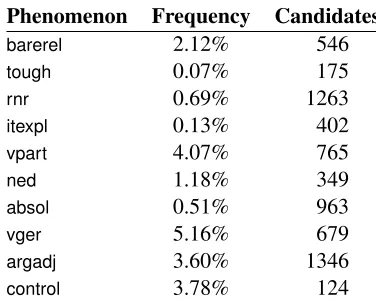
construc-Phenomenon Frequency Candidates
barerel 2.12% 546
tough 0.07% 175
rnr 0.69% 1263
itexpl 0.13% 402
vpart 4.07% 765
ned 1.18% 349
absol 0.51% 963
vger 5.16% 679
argadj 3.60% 1346
[image:6.612.330.518.70.221.2]control 3.78% 124
Table 1: Relative frequencies of phenomena matches in Wikipedia, and number of candidate strings vetted.
tions or lexical types, we randomly selected a set of candidate sentences for each of our ten phenom-ena. These candidates were then hand-vetted in se-quence by two annotators to identify, for each phe-nomenon, 100 examples that do in fact involve the phenomenon in question and which are both gram-matical and free of typos. Examples that were ei-ther deemed overly basic (e.g. plain V+V
coordi-nation, which the ERG treats as rnr) or inappropri-ately complex (e.g. non-constituent coordination ob-scuring the interleaving of arguments and adjuncts) were also discarded at this step. Table 1 summarizes relative frequencies of each phenomenon in about 47 million parsed Wikipedia sentences, as well as the total size of the candidate sets inspected. For thecontrolandtoughphenomena hardly any filtering for complexity was applied, hence these can serve as indicators of the rate of genuine false positives. For phenomena that partially overlap with those of Rimell et al. (2009), it appears our frequency es-timates are comparable to what they report for the Brown Corpus (but not the WSJ portion of the PTB).
4.2 Annotation format
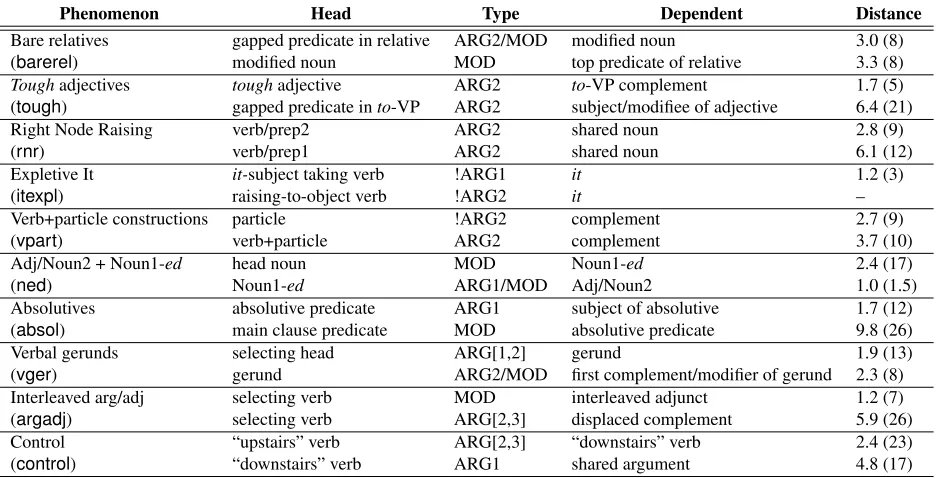
We annotated up to two dependency triples per phe-nomenon instance, identifying the heads and depen-dents by the surface form of the head words in the sentence suffixed with a number indicating word po-sition (see Table 2).6 Some strings contain more
Item ID Phenomenon Polarity Dependency
[image:7.612.108.499.73.120.2]1011079100200 absol 1 having-2|been-3|passed-4 ARG act-1 1011079100200 absol 1 withdrew-9 MOD having-2|been-3|passed-4 1011079100200 absol 1 carried+on-12 MOD having-2|been-3|passed-4
Table 2: Sample annotations for sentence # 1011079100200:The-0 act-1 having-2 been-3 passed-4 in-5 that-6 year-7 Jessop-8 withdrew-9 and-10 Whitworth-11 carried-12 on-13 with-14 the-15 assistance-16 of-17 his-18 son-19.
Phenomenon Head Type Dependent Distance
Bare relatives gapped predicate in relative ARG2/MOD modified noun 3.0 (8)
(barerel) modified noun MOD top predicate of relative 3.3 (8)
Toughadjectives toughadjective ARG2 to-VP complement 1.7 (5)
(tough) gapped predicate into-VP ARG2 subject/modifiee of adjective 6.4 (21)
Right Node Raising verb/prep2 ARG2 shared noun 2.8 (9)
(rnr) verb/prep1 ARG2 shared noun 6.1 (12)
Expletive It it-subject taking verb !ARG1 it 1.2 (3)
(itexpl) raising-to-object verb !ARG2 it –
Verb+particle constructions particle !ARG2 complement 2.7 (9)
(vpart) verb+particle ARG2 complement 3.7 (10)
Adj/Noun2 + Noun1-ed head noun MOD Noun1-ed 2.4 (17)
(ned) Noun1-ed ARG1/MOD Adj/Noun2 1.0 (1.5)
Absolutives absolutive predicate ARG1 subject of absolutive 1.7 (12)
(absol) main clause predicate MOD absolutive predicate 9.8 (26)
Verbal gerunds selecting head ARG[1,2] gerund 1.9 (13)
(vger) gerund ARG2/MOD first complement/modifier of gerund 2.3 (8)
Interleaved arg/adj selecting verb MOD interleaved adjunct 1.2 (7)
(argadj) selecting verb ARG[2,3] displaced complement 5.9 (26)
Control “upstairs” verb ARG[2,3] “downstairs” verb 2.4 (23)
(control) “downstairs” verb ARG1 shared argument 4.8 (17)
Table 3: Dependencies labeled for each phenomenon type, including average and maximum surface distances.
recorded. In addition, some strings evince more than one of the phenomena we are studying. However, we only annotate the dependencies associated with the phenomenon the string was selected to repre-sent. Finally, in examples with coordinated heads or dependents, we recorded separate dependencies for each conjunct. In total, we annotated 2127 depen-dency triples for the 1000 sentences, including 253 negative dependencies (see below). Table 3 outlines the dependencies annotated for each phenomenon.
To allow for multiple plausible attachment sites, we give disjunctive values for heads or dependents in several cases: (i) with auxiliaries, (ii) with com-plementizers (thatorto, as in Table 2), (iii) in cases of measure or classifier nouns or partitives, (iv) with multi-word proper names and (v) where there is genuine attachment ambiguity for modifiers. As these sets of targets are disjunctive, these conven-tions should have the effect of increasing measured parser performance. 580 (27%) of the annotated de-pendencies had at least one disjunction.
4.3 Annotation and reconciliation process The entire data set was annotated independently by two annotators. Both annotators were familiar with the ERG, used to identify these sentences in the WikiWoods corpus, but the annotation was done without reference to the ERG parses. Before begin-ning annotation on each phenomenon, we agreed on which dependencies to annotate. We also communi-cated with each other about annotation conventions as the need for each convention became clear. The annotation conventions address how to handle co-ordination, semantically empty auxiliaries, passives and similar orthogonal phenomena.
[image:7.612.73.541.167.406.2]in an item (59 items) or conflicting elements in a de-pendency (54 items).7 Overall, our initial annotation
pass led to agreement on 79% of the items, and a higher per-dependency level of agreement. Agree-ment could be expected to approach 90% with more experience in applying annotation conventions.
We then reconciled the annotations, using the comparison to address all sources of difference. In most cases, we readily agreed which annotation was correct and which was in error. In a few cases, we decided that both annotations were plausible alter-natives (e.g., in terms of alternative attachment sites for modifiers) and so created a single merged anno-tation expressing the disjunction of both (cf.§4.2).
5 Evaluation
With the test data consisting of 100 items for each of our ten selected phenomena, we ran all seven pars-ing systems and recorded their dependency-style outputs for each sentence. While these outputs are not directly comparable with each other, we were able to associate our manually-annotated tar-get dependencies with parser-specific dependencies, by defining sets of phenomenon-specific regular ex-pressions for each parser. In principle, we allow this mapping to be somewhat complex (and forgiving to non-contentful variation), though we require that it work deterministically and not involve specific lexi-cal information. An example set is given in Fig. 2.
"absol" => {’ARG1’ => [
’\(ncsubj \W*{W1}\W*_(\d+) \W*{W2}\W*_(\d+) _\)’, ’\(ncmod _ \W*{W2}\W*_(\d+) \W*{W1}\W*_(\d+)\)’], ’ARG’ => [
’\(ncsubj \W*{W1}\W*_(\d+) \W*{W2}\W*_(\d+) _\)’, ’\(ncmod _ \W*{W1}\W*_(\d+) \W*{W2}\W*_(\d+)\)’], ’MOD’ => [
’\(xmod _ \W*{W1}\W*_(\d+) \W*{W2}\W*_(\d+)\)’, ’\(ncmod _ \W*{W1}\W*_(\d+) \W*{W2}\W*_(\d+)\)’, ’\(cmod _ \W*{W1}\W*_(\d+) \W*{W2}\W*_(\d+)\)’]}
Figure 2: Regexp set to evaluate C&C forabsol.
These expressions fit the output that we got from the C&C parser, illustrated in Fig. 3 with a relevant por-tion of the dependencies produced for the example in Table 2. Here the C&C dependency (ncsubj passed 4 Act 1 )matches the first target in the
7We do not count typographical errors or incompletely spec-ified conventions as failures of inter-annotator agreement.
gold-standard (Table 2), but no matching C&C de-pendency is found for the other two targets.
(xmod _ Act_1 passed_4) (ncsubj passed_4 Act_1 _) (ncmod _ withdrew,_9 Jessop_8) (dobj year,_7 withdrew,_9)
Figure 3: Excerpts of C&C output for item in Table 2.
The regular expressions operate solely on the de-pendency labels and are not lexically-specific. They are specific to each phenomenon, as we did not at-tempt to write a general dependency converter, but rather to discover what patterns of dependency rela-tions describe the phenomenon when it is correctly identified by each parser. Thus, though we did not hold out a test set, we believe that they would gener-alize to additional gold standard material annotated in the same way for the same phenomena.8
In total, we wrote 364 regular expressions to han-dle the output of the seven parsers, allowing some leeway in the role labels used by a parser for any given target dependency. The supplementary mate-rials for this paper include the test data, parser out-puts, target annotations, and evaluation script.
0 10 20 30 40 50 60 70 80 90 100
vger vpart control argadj barerel rnr tough ned itexpl absol
[image:9.612.103.491.80.311.2]enju xle c&j c&c stanford mst rasp
Figure 1: Individual dependency recall for seven parsers over ten phenomena.
rect any dependency involving referentialit.
We observe fairly high recall of the dependencies forvpartandvger(with the exception of RASP), and high recall for both dependencies representing con-trol for five systems. While Enju, Stanford, MST, and RASP all found between 70 and 85% of the de-pendency between the adjective and its complement in thetough construction, only Enju and XLE rep-resented the dependency between the subject of the adjective and the gap inside the adjective’s comple-ment. For the remaining phenomena, each parser performed markedly worse on one dependency type, compared to the other. The only exceptions here are XLE and C&C’s (and to a lesser extent, C&J’s) scores for barerel. No system scored higher than 33% on the harder of the two dependencies inrnror absol, and Stanford, MST, and RASP all scored be-low 25% on the harder dependency inbarerel. Only XLE scored higher than 10% on the second depen-dency fornedand higher than 50% foritexpl.
6 Discussion
From the results in Fig. 1, it is clear that even the best of these parsers fail to correctly identify a large num-ber of relevant dependencies associated with linguis-tic phenomena that occur with reasonable frequency
in the Wikipedia. Each of the parsers attempts with some success to analyze each of these phe-nomena, reinforcing the claim of relevance, but they vary widely across phenomena. For the two long-distance phenomena that overlap with those studied in Rimell et al. (2009), our results are comparable.9
Our evaluation over Wikipedia examples thus shows the same relative lack of success in recovering long-distance dependencies that they found for WSJ sen-tences. The systems did better on relatively well-studied phenomena includingcontrol,vger, andvpart, but had less success with the rest, even though all but two of those remaining phenomena involve syntac-tically local dependencies (as indicated in Table 3).
noted in Sections 2.1 and 3.5, there is tension be-tween developing sufficiently complex representa-tions to capture linguistic phenomena and keeping an annotation scheme simple enough that it can be reliably produced by humans, in the case of hand-annotation.
7 Related Work
This paper builds on a growing body of work which goes beyond (un)labeled bracketing in parser evalua-tion, including Lin (1995), Carroll et al. (1998), Ka-plan et al. (2004), Rimell et al. (2009), and Nivre et al. (2010). Most closely related are the latter two of the above, as we adopt their “construction-focused parser evaluation methodology”.
There are several methodological differences be-tween our work and that of Rimell et al. First, we draw our evaluation data from a much larger and more varied corpus. Second, we automate the com-parison of parser output to the gold standard, and we distribute the evaluation scripts along with the anno-tated corpus, enhancing replicability. Third, where Rimell et al. extract evaluation targets on the basis of PTB annotations, we make use of a linguistically precise broad-coverage grammar to identify candi-date examples. This allows us to include both local and non-local dependencies not represented or not reliably encoded in the PTB, enabling us to evalu-ate parser performance with more precision over a wider range of linguistic phenomena.
These methodological innovations bring two em-pirical results. The first is qualitative: Where previ-ous work showed that overall Parseval numbers hide difficulties with long-distance dependencies, our re-sults show that there are multiple kinds of reason-ably frequentlocaldependencies which are also dif-ficult for the current standard approaches to pars-ing. The second is quantitative: Where Rimell et al. found two phenomena which were virtually un-analyzed (recall below 10%) for one or two parsers each, we found eight phenomena which were vir-tually unanalyzed by at least one system, includ-ing two unanalyzed by five and one by six. Every system had at least one virtually unanalyzed phe-nomenon. Thus we have shown that the dependen-cies being missed by typical modern approaches to parsing are more varied and more numerous than
previously thought.
8 Conclusion
We have presented a detailed construction-focused evaluation of seven parsers over 10 phenomena, with 1000 examples drawn from English Wikipedia. Gauging recall of such “deep” dependencies, in our view, can serve as a proxy for downstream pro-cessing involving semantic interpretation of parser outputs. Our annotations and automated evaluation script are provided in the supplementary materials, for full replicability. Our results demonstrate that significant opportunities remain for parser improve-ment, and highlight specific challenges that remain invisible in aggregate parser evaluation (e.g. Parse-val or overall dependency accuracy). These results suggest that further progress will depend on train-ing data that is both more extensive and more richly annotated than what is typically used today (seeing, for example, that a large part of more detailed PTB annotation remains ignored in much parsing work).
There are obvious reasons calling for diversity in approaches to parsing and for different trade-offs in, for example, the granularity of linguistic analy-sis, average accuracy, cost of computation, or ease of adaptation. Our proposal is not to substitute construction-focused evaluation on Wikipedia data for widely used aggregate metrics and reference cor-pora, but rather to augment such best practices in the spirit of Rimell et al. (2009) and expand the range of phenomena considered in such evaluations. Across frameworks and traditions (and in principle languages), it is of vital importance to be able to evaluate the quality of parsing (and grammar induc-tion) algorithms in a maximally informative manner.
Acknowledgments
References
Jennifer E. Arnold, Thomas Wasow, Anthony Losongco, and Ryan Ginstrom. 2000. Heaviness vs. newness: The effects of structural complexity and discourse sta-tus on constituent ordering.Language, 76(1):28–55. Ann Bies, Mark Ferguson, Karen Katz, and Robert
Mac-Intyre. 1995. Bracketing guidelines for treebank II style Penn treebank project. Technical report, Univer-sity of Pennsylvania.
Ted Briscoe, John Carroll, and Rebecca Watson. 2006. The second release of the RASP system. In Proceed-ings of the COLING/ACL 2006 Interactive Presenta-tion Sessions, pages 77–80, Sydney, Australia. Aoife Cahill, John T. Maxwell III, Paul Meurer,
Chris-tian Rohrer, and Victoria Ros´en. 2008. Speeding up LFG parsing using c-structure pruning. In Coling 2008: Proceedings of the workshop on Grammar En-gineering Across Frameworks, pages 33–40, Manch-ester, England, August. Coling 2008 Organizing Com-mittee.
John Carroll, Ted Briscoe, and Antonio Sanfilippo. 1998. Parser evaluation: A survey and a new proposal. In Proceedings of the International Conference on Language Resources and Evaluation, pages 447–454, Granada.
Daniel Cer, Marie-Catherine de Marneffe, Daniel Juraf-sky, and Christopher D. Manning. 2010. Parsing to Stanford dependencies: Trade-offs between speed and accuracy. In 7th International Conference on Lan-guage Resources and Evaluation (LREC 2010), Malta. Eugene Charniak and Mark Johnson. 2005. Coarse-to-fine n-best parsing and maxent discriminative rerank-ing. InProceedings of the 43rd Annual Meeting of the Association for Computational Linguistics (ACL’05), pages 173–180, Ann Arbor, Michigan.
Eugene Charniak. 1997. Statistical parsing with a context-free grammar and word statistics. In Proceed-ings of the Fourteenth National Conference on Artifi-cial Intelligence, pages 598 – 603, Providence, RI. Stephen Clark and James R. Curran. 2007.
Wide-coverage efficient statistical parsing with CCG and log-linear models. Computational Linguistics, 33(4):493–552.
Alexander Clark. 2001. Unsupervised induction of stochastic context-free grammars using distribu-tional clustering. In Proceedings of the 5th Confer-ence on Natural Language Learning, pages 105–112. Toulouse, France.
Michael Collins. 1999. Head-Driven Statistical Models for Natural Language Parsing. Ph.D. thesis, Univer-sity of Pennsylvania.
Dan Flickinger, Stephan Oepen, and Gisle Ytrestøl. 2010. WikiWoods. Syntacto-semantic annotation for
English Wikipedia. InProceedings of the 6th Interna-tional Conference on Language Resources and Evalu-ation, Valletta, Malta.
Dan Flickinger. 2000. On building a more efficient grammar by exploiting types. Natural Language En-gineering, 6 (1) (Special Issue on Efficient Processing with HPSG):15 – 28.
Sumukh Ghodke and Steven Bird. 2010. Fast query for large treebanks. In Human Language Technologies: The 2010 Annual Conference of the North American Chapter of the Association for Computational Linguis-tics, pages 267–275, Los Angeles, California, June. Association for Computational Linguistics.
Aria Haghighi and Dan Klein. 2006. Prototype-driven grammar induction. In Proceedings of the 21st In-ternational Conference on Computational Linguistics and 44th Annual Meeting of the Association for Com-putational Linguistics, pages 881–888, Sydney, Aus-tralia, July. Association for Computational Linguistics. Julia Hockenmaier and Mark Steedman. 2007. CCG-bank: A Corpus of CCG Derivations and Dependency Structures Extracted from the Penn Treebank. Com-putational Linguistics, 33(3):355–396.
Rodney Huddleston and Geoffrey K. Pullum. 2002. The Cambridge Grammar of the English Language. Cam-bridge University Press, CamCam-bridge, UK.
Richard Johansson and Pierre Nugues. 2007. Extended constituent-to-dependency conversion for English. In In Proceedings of NODALIDA 2007, pages 105–112, Tartu, Estonia.
Ron Kaplan, Stefan Riezler, Tracy H King, John T Maxwell III, Alex Vasserman, and Richard Crouch. 2004. Speed and accuracy in shallow and deep stochastic parsing. In Susan Dumais, Daniel Marcu, and Salim Roukos, editors,HLT-NAACL 2004: Main Proceedings, pages 97–104, Boston, Massachusetts, USA, May. Association for Computational Linguis-tics.
Dan Klein and Christopher D. Manning. 2003. Fast exact inference with a factored model for natural language parsing. InAdvances in Neural Information Process-ing Systems 15, pages 3–10, Cambridge, MA. MIT Press.
Dan Klein and Christopher Manning. 2004. Corpus-based induction of syntactic structure: Models of de-pendency and constituency. In Proceedings of the 42nd Meeting of the Association for Computational Linguistics, pages 478–485, Barcelona, Spain. Dekang Lin. 1995. A dependency-based method for
evaluating broad-coverage parsers. InProceedings of IJCAI-95, pages 1420–1425, Montreal, Canada. Robert Malouf. 2000. Verbal gerunds as mixed
and Function of Syntactic Categories, pages 133–166. Academic Press, New York.
Mitchell P. Marcus, Beatrice Santorini, and Mary Ann Marcinkiewicz. 1993. Building a large annotated cor-pus of English: The Penn Treebank. Computational Linguistics, 19:313–330.
Ryan McDonald, Fernando Pereira, Kiril Ribarov, and Jan Hajic. 2005. Non-Projective Dependency Pars-ing usPars-ing SpannPars-ing Tree Algorithms. InProceedings of the 2005 Conference on Empirical Methods in Natu-ral Language Processing, pages 523–530, Vancouver, Canada.
Yusuke Miyao, Takashi Ninomiya, and Jun’ichi Tsujii. 2004. Corpus-oriented grammar development for ac-quiring a Head-driven Phrase Structure Grammar from the Penn Treebank. InProceedings of the 1st Interna-tional Joint Conference on Natural Language Process-ing, pages 684–693, Hainan Island, China.
Joakim Nivre, Laura Rimell, Ryan McDonald, and Carlos G´omez Rodr´ıguez. 2010. Evaluation of dependency parsers on unbounded dependencies. InProceedings of the 23rd International Conference on Computa-tional Linguistics, pages 833–841, Beijing, China. Ruth O’Donovan, Michael Burke, Aoife Cahill, Josef
Van Genabith, and Andy Way. 2004. Large-scale in-duction and evaluation of lexical resources from the penn-ii treebank. In Proceedings of the 42nd Meet-ing of the Association for Computational LMeet-inguistics, pages 367–374, Barcelona, Spain.
Stephan Oepen, Daniel Flickinger, Kristina Toutanova, and Christopher D. Manning. 2004. LinGO Red-woods. A rich and dynamic treebank for HPSG. Journal of Research on Language and Computation, 2(4):575 – 596.
Slav Petrov, Leon Barrett, Romain Thibaux, and Dan Klein. 2006. Learning accurate, compact, and inter-pretable tree annotation. InProceedings of the 21st In-ternational Conference on Computational Linguistics and 44th Annual Meeting of the Association for Com-putational Linguistics, pages 433–440, Sydney, Aus-tralia.
Stefan Riezler, Tracy H. King, Ronald M. Kaplan, Richard Crouch, John T. Maxwell III, and Mark John-son. 2002. Parsing the Wall Street Journal using a Lexical-Functional Grammar and discriminative esti-mation techniques. InProceedings of the 40th Meet-ing of the Association for Computational LMeet-inguistics, Philadelphia, PA.
Laura Rimell, Stephen Clark, and Mark Steedman. 2009. Unbounded dependency recovery for parser evalua-tion. In Proceedings of the 2009 Conference on Empirical Methods in Natural Language Processing, pages 813–821, Singapore. Association for Computa-tional Linguistics.
Ivan Sag, Timothy Baldwin, Francis Bond, Ann Copes-take, and Dan Flickinger. 2002. Multiword expres-sions. A pain in the neck for NLP. In Alexander Gel-bukh, editor, Computational Linguistics and Intelli-gent Text Processing, volume 2276 ofLecture Notes in Computer Science, pages 189–206. Springer, Berlin, Germany.
David Vadas and James R. Curran. 2008. Parsing noun phrase structure with CCG. InProceedings of ACL-08: HLT, pages 335–343, Columbus, Ohio, June. As-sociation for Computational Linguistics.
L. van der Beek, Gosse Bouma, Robert Malouf, and Gert-jan van Noord. 2002. The Alpino Dependency Tree-bank. In Mariet Theune, Anton Nijholt, and Hen-dri Hondorp, editors,Computational Linguistics in the Netherlands, Amsterdam, The Netherlands. Rodopi. Luke Zettlemoyer and Michael Collins. 2005.