Exploring the utility of joint morphological and syntactic learning
from child-directed speech
Stella Frank
Frank Keller
ILCC, School of Informatics University of Edinburgh Edinburgh, EH8 9AB, UK
Sharon Goldwater
Abstract
Children learn various levels of linguistic structure concurrently, yet most existing mod-els of language acquisition deal with only a single level of structure, implicitly assum-ing a sequential learnassum-ing process. Developassum-ing models that learn multiple levels simultane-ously can provide important insights into how these levels might interact synergistically dur-ing learndur-ing. Here, we present a model that jointly induces syntactic categories and mor-phological segmentations by combining two well-known models for the individual tasks. We test on child-directed utterances in English and Spanish and compare to single-task base-lines. In the morphologically poorer language (English), the model improves morphological segmentation, while in the morphologically richer language (Spanish), it leads to better syntactic categorization. These results provide further evidence that joint learning is useful, but also suggest that the benefits may be dif-ferent for typologically difdif-ferent languages.
1 Introduction
Models of language acquisition seek to infer lin-guistic structure from data with minimal amounts of prior knowledge, in order to discover which char-acteristics of the input data are useful for learn-ing, and thus potentially utilised by human learners. Most previous work has focused on learning individ-ual aspects of linguistic structure. However, children clearly learn multiple aspects in parallel, rather than sequentially, implying that models of language ac-quisition should also incorporate joint learning. Joint models investigate the interaction between different levels of linguistic structure during learning. These
interactions are often (but not necessarily) synergis-tic, enabling better, more robust, learning by making use of cues from multiple sources. Recent models using joint learning to model language acquisition have spanned various domains including phonology, word segmentation, syntax and semantics (Feldman et al., 2009; Elsner et al., 2012; Doyle and Levy, 2013; Johnson, 2008; Kwiatkowski et al., 2012).
In this paper we examine the joint learning of syntactic categories and morphology, which are ac-quired by children at roughly the same age (Clark, 2003b), implying possible interactions in the learn-ing process. Both morphology and word order de-pend on categorising words based on their morpho-syntactic function. However, previous models of syntactic category learning have relied principally on surrounding context, i.e., word order constraints, whereas models of morphology use word-internal cues. Our joint model integrates both sources of information, allowing the model to flexibly weigh them according to their utility.
Languages differ in the richness of their mor-phology and strictness of word order. These char-acteristics appear to be (anti)correlated, with rich morphology co-occurring with free word order and vice versa (Blake, 2001; McFadden, 2003). The timecourse of acquisition is also influenced by lan-guage typology: learners of morphologically rich languages become productive in morphology ear-lier (Xanthos et al., 2011), suggesting that richer morphology may be more salient for learners than impoverished morphology. Sentence comprehension in children also shows cross-linguistic differences in the cues used to make sense of non-canonical sentence structure: learners of a morphologically rich language (Turkish) disregard word order in
favour of morphology, whereas learners of En-glish favour word order (Slobin, 1982; MacWhin-ney et al., 1984). These interactions between mor-phology and word order suggest that a joint model will be better able to support the differences in cue strength (rich morphology versus strict word order), and thus be more language-general, than single-task models.
Both syntactic category and morphology induc-tion have been the focus of much recent work. (See Hammarstr¨om and Borin (2011) for an overview of unsupervised morphology learning, likewise Christodoulopoulos et al. (2010) for a comparison of part of speech/syntactic category induction sys-tems.) However, given the tightly coupled nature of these two tasks, there has been surprisingly little
work in joint learning of morphology and
syntac-tic categories. Systems for inducing syntacsyntac-tic cat-egories often make use of morpheme-like features, such as word-final characters (Smith and Eisner, 2005; Haghighi and Klein, 2006; Berg-Kirkpatrick et al., 2010; Lee et al., 2010), or model words at the character-level (Clark, 2003a; Blunsom and Cohn, 2011), but do not include morphemes ex-plicitly. Other systems (Dasgupta and Ng, 2007; Christodoulopoulos et al., 2011) use morphologi-cal segmentations learned by a separate morphology model as features in a pipeline approach.
Models of morphology induction generally oper-ate over a lexicon, i.e. a list of word types, rather than token corpora (Goldsmith, 2006; Creutz and Lagus, 2007; Kurimo et al., 2010). These models find morphological categories on the basis of word-internal features, without taking syntactic context into account (which is of course not available in a lexicon).
Lee et al. (2011) and Sirts and Alum¨ae (2012) present models that infer morphological segmenta-tions and syntactic categories jointly, although Lee et al. (2011) do not evaluate the inferred syntactic categories. Both make use of a word-type constraint which limits each word form to a single analysis
(i.e., all instances ofducksare assigned to a single
category and will have the same morpheme analy-sis, ignoring the gold standard distinction between a plural noun and third person singular verb). This can make inference more tractable, and often increases performance, but does not respect the ambiguity
in-herent in natural language, both over syntactic cat-egories and morphological analyses. The degree of ambiguity is language dependent, so that even if a type-constraint is perhaps relatively unproblematic in English, it will pose problems in morphologically richer languages. Furthermore, these two models make use of an array of heuristics that may not allow them to be easily generalisable across languages and datasets (e.g., likelihood scaling (Sirts and Alum¨ae, 2012), sequential suffix matching (Lee et al., 2011)). In this paper, we present a joint model composed of two well-known individual models. This allows us to cleanly investigate the effects of joint learning and its potential benefits over the single task models. The simplicity of our models also allows us to avoid modelling and inference heuristics.
Previous models have used adult-directed written texts, which differs significantly from the type of language available to child learners. We test our joint model on child-directed utterances in English (a morphologically poor language) and Spanish (with
richer morphology)1. Our results indicate that our
joint model is able to flexibly accommodate lan-guages with differing levels of morphological rich-ness. The joint model matches the performance of single task models on both tasks, demonstrating that the additional complexity is not a problem (i.e., it does not add noise). Moreover, the joint model im-proves performance significantly on the task corre-sponding to the language’s weaker cue, indicating a transfer of information from the stronger cue. The fact that the nature of this improvement varies by language provides evidence that joint learning can effectively accommodate typological diversity.
2 Model
The task is to assign word tokens to part of speech categories and simultaneously segment the tokens into morphemes. We assume a relatively simple yet commonly used concatenative morphology which
models a word as a stem plus (possibly null) suffix2.
1There are languages with much richer morphology than
Spanish, but none with a child-directed corpus suitably anno-tated for evaluation.
2Fullwood and O’Donnell (2013) recently presented a
Since this is an unsupervised model, the inferred cat-egories and morphemes lack meaningful labels, but ideally will correspond to gold standard categories and morphemes.
2.1 Word Order
We model a sequence of words as a Hidden Markov Model (HMM) with a non-parametric emission dis-tribution. As usual, the latent states of the HMM rep-resent syntactic categories. The tag sequence is gen-erated by a trigram Dirichlet-multinomial
distribu-tion, where transition parameters τare drawn from
a symmetric Dirichlet distribution with the
hyperpa-rameterαt. Each tagtiin the sequence is then drawn
from the transition distribution conditioned on the previous two tags:
τ(t,t0)∼ Dir(αt)
ti=t|ti−1=t0,ti−2=t00,τ∼ Mult(τ(t0,t00))
This model is token-based, permitting different tokens of the same word type to have different syntactic categories. Most recent models have in-cluded a constraint forcing all tokens of a given type into the same category, which improves per-formance but often complicates inference. The Bayesian HMM’s performance is therefore not state-of-the-art, but is comparable to other token-based models (Christodoulopoulos et al., 2010) and the model is easy to extend within the Bayesian frame-work, allowing us to compare multiple versions.
This part of the model is parametric,
operat-ing over a fixed number of tags T, and is
iden-tical to the formulation of tag transitions in the Bayesian HMM (Goldwater and Griffiths, 2007). However, we replace the BHMM’s emission dis-tribution with the morphologically-informed distri-butions described below. As in the BHMM, the emission distributions are conditioned on the tag, i.e., each tag has its own morphology.
2.2 Morphology
The morphology model introduced by Goldwater et al. (2006) generates morphological analyses for a set of tokens. These analyses consist of a tag plus a stem and suffix pair, which are concatenated to form
the observed words. Both stem s and suffix f are
generated from Dirichlet-multinomials conditioned
on the tagt:
κ∼ Dir(ακ)
t|κ∼ Mult(κ)
σ∼ Dir(αs)
s|t,σ∼ Mult(σt)
φ∼ Dir(αf)
f|t,φ∼ Mult(φt)
The αs are hyperparameters governing the
Dirich-let distributions from which the multinomialsκ,σ,φ
are drawn. In turn,t,s,and f are drawn from these
multinomials.
The probability of a word under this model is the
sum of the probabilities of all possible analysesl=
(t,s,f):
P0(w) =
∑
lP0(l) =
∑
t,s,fs.t.s⊕f=w
P(s|t)P(f|t)P(t) (1)
wheres⊕f =w denotes that the concatenation of
stem and suffix results in the wordw.
On its own, this distribution over morphologi-cal analyses makes independence assumptions that are too strong: most word tokens of a word type
have the same analysis, but P0 will re-generate
that analysis for every token. To resolve this prob-lem, a Pitman-Yor process (PYP) is placed over the generating distribution above. The Pitman-Yor pro-cess has been found to be useful for representing the power-law distributions common in natural lan-guage (Teh, 2006; Goldwater and Griffiths, 2007; Blunsom and Cohn, 2011).
The distribution of draws from a Pitman-Yor pro-cess (which, in our case, determines the distribu-tion of word tokens with each morphological anal-ysis) is commonly described using the metaphor of a Chinese restaurant. A series of customers (tokens z=z1. . .zN) enter a restaurant with an infinite
num-ber of initially empty tables. Upon entering, each
customer is seated at a tablekwith probability
p(zi=k|z1. . .zi−1,a,b) = (2)
(n
k−a
i−1+b if 1≤k≤K Ka+b
tk sk
fk lk
K
zi
wi
[image:4.612.106.266.52.148.2]N
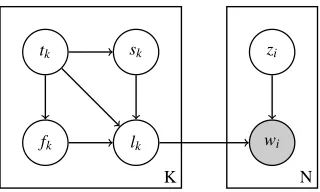
Figure 1: Plate diagram depicting the morphology model (adapted from Goldwater et al. (2006)). Hyperparameters have been omitted for clarity. The left-hand plate depicts the base distributionP0; note that the morphological anal-yseslkare generated deterministically as (tk,sk,fk). The observed wordswiare also deterministic givenzi=kand
lk, sincewi=sk⊕fk.
wherenkis the number of customers already sitting
at tablek,Kis the total number of tables occupied by
thei−1 previous customers, and 0≤a<1 andb≥0
are hyperparameters of the process. The probability of being seated at a table increases with the number of customers already seated at that table, creating a ‘rich-get-richer’ power-law distribution of tokens to
tables;aandbcontrol the amount of reuse of
exist-ing tables, with smaller values leadexist-ing to more reuse. Crucially, each table serves a dish generated by
the base distributionP0—i.e., the dish is a
morpho-logical analysislk= (t,s,f)—and all the customers
seated at the same table share the same dish, which is generated only once (at the point when that table is first occupied). The model can thus reuse the anal-ysis for a particular word and avoid regenerating the same analysis multiple times. Note that multiple
ta-bles may have identical analyses,lk=lk0. Figure 1
illustrates how the full PYP morphology model gen-erates the observed sequence of word tokens.
2.3 Combined Model
The full model (Figure 2) combines the latent tag se-quence with the morphology model. Tag tokens are generated conditioned on local context, not the base distribution, as in the morphology model. Instead of a single PYP generating morphological analyses for all tokens, as in the Goldwater et al. (2006) model, we have a separate PYP for each tag type, i.e., each tag has its own restaurant with its own customers (the tokens labeled with that tag) and its own mor-phological analyses. The distribution of customers
ti−2 ti−1 ti zi
wi
sk fk
lk
N Kt
T
Figure 2: Plate diagram depicting the joint model. Hyper-parameters have been omitted for clarity. The L-shaped plate contains the tokens, while the square plates contain the morphological analyses. Thetare latent tags,ziis an assignment to a morphological analysislk= (sk,fk), and
wiis the observed word.T is the number of distinct tags, andKt the number of tables used by tag typet.
in each of the tag-specific restaurants is still deter-mined by Equation 2, except that all of the counts and indices are with respect to only the tokens and tables assigned to that tag.
Each tag-specific PYP (restaurant) also has a
sep-arate base distribution,P0(t), resulting in distinct
dis-tributions over stems and suffixes for each tag. The analyses generated by the base distributions consist of (stem, suffix) pairs; the tag is given by the identity of the generating PYP.
P0(t)(w) =
∑
l
P0(t)(l= (s,f)) =
∑
s,fs.t. s⊕f=w
P(s|t)P(f|t)
(3) The full joint posterior distribution of a sequence of words, tags, and morpheme analyses is shown in Figure 3. Note that all tag-specific morphology
mod-els share the same Pitman-Yor parametersaandb.
3 Inference
We use Gibbs sampling for inference over the three
sets of discrete variables: tagst, their assignments to
morphological analyses (tables)z, and the analyses
themselvesl.
Each iteration of the sampler has two stages: First
the morphological analyseslare sampled, and then
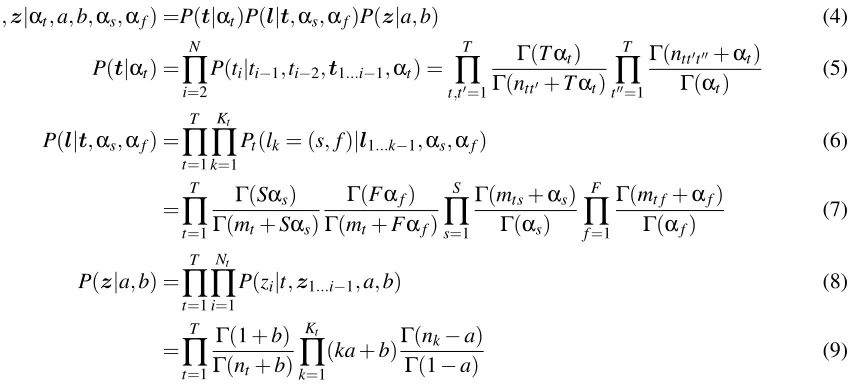
[image:4.612.323.531.52.199.2]P(t,l,z|αt,a,b,αs,αf) =P(t|αt)P(l|t,αs,αf)P(z|a,b) (4)
P(t|αt) = N
∏
i=2
P(ti|ti−1,ti−2,t1...i−1,αt) = T
∏
t,t0=1
Γ(Tαt)
Γ(ntt0+Tαt) T
∏
t00=1
Γ(ntt0t00+αt)
Γ(αt)
(5)
P(l|t,αs,αf) = T
∏
t=1 Kt
∏
k=1
Pt(lk= (s,f)|l1...k−1,αs,αf) (6)
=
T
∏
t=1
Γ(Sαs)
Γ(mt+Sαs)
Γ(Fαf)
Γ(mt+Fαf) S
∏
s=1
Γ(mts+αs)
Γ(αs) F
∏
f=1
Γ(mt f+αf)
Γ(αf)
(7)
P(z|a,b) =
T
∏
t=1 Nt
∏
i=1
P(zi|t,z1...i−1,a,b) (8)
=
T
∏
t=1
Γ(1+b) Γ(nt+b)
Kt
∏
k=1
(ka+b)Γ(nk−a)
[image:5.612.116.543.68.261.2]Γ(1−a) (9)
Figure 3: The posterior distribution of our joint model. Because the sequence of words w is deterministic given analysesland assignments to analyses (tables)z, the joint posterior over all variablesP(w,t,l,z|αt,a,b,αs,αf)is equal toP(t,l,z|αt,a,b,αs,αf)whenlzi=wifor alli, and 0 otherwise. We give equations for the non-zero case.ns
refer to token counts,ms to table counts. We add two dummy tokens at the start, end, and between sentences to pad the context history.
are conditioned on tags (i.e., a token must be as-signed to a table in the correct PYP restaurant) re-sampling the tag requires immediate rere-sampling of the table assignment as well.
3.1 Initialization
The tags are initialized uniformly at random. For each token, a segmentation point is chosen uni-formly at random (we disallow segmentations with a null stem). If this segmentation is new within the PYP associated with that token’s tag, a new table is created for the token in that PYP. If it matches an
ex-isting analysis,ziis sampled from the existing tables
kplus a possible new tablek0.
3.2 Morphological Analyses
Eachlkrepresents the morphological analysis for the
set of tokens assigned to table k. Resampling the
segmentation point (stem and suffix identity) of the analysis changes the segmentation of all of the word tokens assigned to that analysis. Note that the tag is
not included in lk in the combined model, because
the tag identity is dependent on the local contexts of all the tokens seated at the table.
Analyses are sampled from a product of
Dirichlet-multinomial posteriors as follows:
p(lk= (s,f)|t,l\k) =
m\sk+αs m\k+Sα s
m\fk+αf
m\k+Fα f
(10)
where ms and mf are the number of analyses for
this tag that share a stem or suffix with lk, and m
is the total number of analyses for this tag. S and
F are the total number of stems and suffixes in the
model.l\k indicates that the current analysislk has
been removed from the distribution and the appro-priate counts, to create the correct conditioning dis-tribution for the Gibbs sampler.
3.3 Tags
Tags are sampled from the product of posteri-ors of the transition and emission distributions. The transition distribution is a standard Dirichlet-multinomial posterior. Calculating the emission dis-tribution probability, i.e. the marginal probability of the word given the tag, involves summing over the probability of all the existing tables in the given PYP that emit the correct word, plus the probability of a new table being created, which also includes the
More precisely, tags are sampled from the follow-ing distribution:
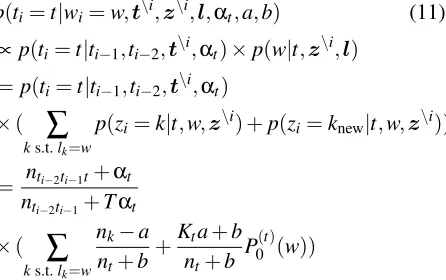
p(ti=t|wi=w,t\i,z\i,l,αt,a,b) (11)
∝p(ti=t|ti−1,ti−2,t\i,αt)×p(w|t,z\i,l)
=p(ti=t|ti−1,ti−2,t\i,αt)
×(
∑
ks.t.lk=w
p(zi=k|t,w,z\i) +p(zi=knew|t,w,z\i))
= nti−2ti−1t+αt
nti−2ti−1+Tαt
×(
∑
ks.t.lk=w
nk−a nt+b
+Kta+b
nt+b
P0(t)(w))
where lk =w matches tables compatible with w,
i.e., the concatenation of stem and suffix form the
word,slk⊕flk =w. nk is the number of words
as-signed to the table k and Kt is the total number of
tables in the PYP for tagt. Note that all counts are
obtained after the removal of the currentti and zi,
i.e., fromt\iandz\i.
3.4 Table Assignments
Once a new tag has been sampled for a token, the ta-ble assignment must be resampled conditioned on
the new tag. The assignment zi is drawn over all
compatible tables in the tag’s PYP (that is, where
lk=w), plus a possible new table:
p(zi=k|ti=t,w,z\i,a,b)∝ (12)
(n
k−a
nt+b if 1≤k≤Kt
Kta+b
nt+b P
(t)
0 (w) ifk=Kt+1
P0(t) is calculated by summing over the probability
of all possible segmentations for a new analysis for
word wi, using Equation 3. If a new table is drawn
(k>Kt) then we also sample a new analysis for that
table fromP0(t).
4 Preliminary Experiments
An important argument for joint learning is that it affords increased flexibility and robustness across a wider range of input data. A model that relies on word order cannot learn syntactic categories from a morphologically complex language with free word order; likewise a model attempting to categorise words using morphology alone will fail on a lan-guage without morphology. An effective joint model
Language A abdc fefh pomo rtut usst cdcc bcba gghh npop npoo cdca aaaa fefh hfeg pnon
Language B
[image:6.612.347.506.66.116.2]noom.no usrs.st bbdb.ac cbab.cc cdaa.cc rttt.uu cbab.aa mnom.oo ccda.bc onmm.om rruu.ts npop.mm gehg.fh trrt.uu tssu.uu
Table 1: Example sentences in the synthetic languages. Words in Category 1 are made of charactersa-d, Cate-gory 2e-h, Category 3m-p, Category 4r-u. Suffixes in Language B are separated with periods (.) for illustrative purposes only.
will be able to make use of the different cues in both language types in a flexible way.
In order to test the proposed model, we run two experiments on synthetic languages, which simulate languages in which either word order or morphology is the sole cue. Most natural languages fall between these extremes, but these experiments show that our model can capture the full spectrum.
Language A is a strict word order language lack-ing morphology. It has a vocabulary of 200 word types, split into four different categories. The 50 word types in each category are created by com-bining four letters, with replacement, into four-letter words, with a different set of letters used in each
cat-egory3. Words within a category may thus share
be-ginning or ending characters, which could be posited as stems or suffixes by the model, but since only 50 of 256 possible strings are used, there will be no strong evidence for consistent stem and suffixes (i.e. stems appearing with multiple suffixes and vice versa). Each sentence in Language A consists of five words in one of twenty possible category sequences. In these sequences, each category is either followed by itself or the next category (i.e. [2,2,2,3,4] is valid but [2,4,3,1,4] is not). Word order is thus strongly constrained by category membership.
Language B has free word order, with category membership signalled by suffixes. Words are
cre-3We achieved the same results with a language using the
[image:6.612.76.299.92.232.2]-70000 -60000 -50000 -40000 -30000 -20000 -10000 0
0 200 400 600 800 1000
Log Probability
Iteration
[image:7.612.74.297.54.224.2]LangA Total LangA Transitions LangA Morphology LangB Total LangB Transitions LangB Morphology
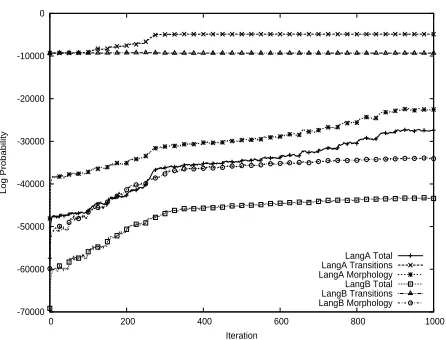
Figure 4: Log probability of the sampler state over 1000 iterations on Languages A and B.
ated by the concatenation of a stem and a suffix, where the stems are the same as the words in lan-guage A (50 stems in each of four categories). One of six category-specific suffixes is appended to each stem, resulting in 300 word types per category. Each suffix is two letters long, created by combining three possible letters (the same letters used to create the stems), thus making mis-segmentation possible (for instance, up to three of the suffixes could have the same final letter). Sentences are again five words long, but the sequence of categories is drawn at ran-dom, resulting in uniformly random word order. See Table 1 for example sentences in both languages.
We create a 5000 word corpus for each language, and run our model on these corpora.
Hyperparame-ters are set to the same values in both languages4.
We run the sampler on each dataset for 1000 it-erations with simulated annealing. In both cases, the correct solution is found by iteration 500. Fig-ure 4 shows that the morphology component con-tinues to increase the log probability by increasing the number of tokens seated at a table. Note that the correct solution in Language A involves learn-ing a very peaked transition distribution as well as an even more extreme distribution over suffixes (where only the null suffix has high probability), whereas the same distributions in Language B are much flat-ter. The fact that the same hyperparameter setting is
4The PYP parameters are set to a=0.1,b=1.0 and the
HMM transition parameterαt=1.0; the parameters in the base
distribution areαs,αf =0.001,αk=0.5.
able to correctly identify the two language extremes indicates that the model is robust to hyperparameter values.
These experiments demonstrate that our joint model is able to learn correctly even when only ei-ther morphology or word order is informative in a language. We now turn to acquisition data from nat-ural languages in which both morphology and word order are useful cues but to varying degrees.
5 CDS Experiments
5.1 Data
We use two corpora, Eve (Brown, 1973) and
Or-nat (OrOr-nat, 1994), from the CHILDES database
(MacWhinney, 2000). These corpora consist of the child-directed utterances heard by two children, the former learning English and the latter Spanish. These have been annotated for part of speech cate-gories and morphemes.
TheCHILDEScorpora are tagged with a very rich set of part of speech tags (74 tags), which we
col-lapse to a smaller set of tags5. The Eve corpus has
61224 tokens and is thus larger than the Spanish cor-pus, which has 40497 tokens. However, the English corpus has only 17 gold suffix types, while Spanish has 83. The increased richness of Spanish morphol-ogy also has an effect on the number of word types in the corpus: the Spanish dataset has 3046 word types, whereas the larger English dataset has only 1957.
Morphology is annotated using a stem-affix en-coding which does not directly correspond to our
segmentation-based model. The wordrunningis
an-notated asrun-ING,jumpingasjump-ING; the
anno-tation is thus agnostic about ortho-morphemic
seg-mentation (i.e., whether to segment asrun.ning or
runn.ing), whereas the model is forced to choose a segmentation point. Syncretic suffixes (sharing
an identical surface form) are disambiguated:sings
is annotated as sing-3S, plums as plum-PL.
Con-versely, the annotation scheme merges allomorphs into a single suffix: infinitive verbs in Spanish,
for instance, are encoded as ending with -INF,
corresponding to -ar, -er, and -ir surface forms.
We ignore irregular/non-affixing forms annotated with & (e.g. was, annotated as be&PAST) and use only hyphen-separated suffixes to evaluate. Where multiple suffixes are concatenated together
(e.g., dog-DIM-PL) we treat this as a single suffix
(-DIM-PL) for evaluation purposes.
In Spanish, many words are annotated as having a suffix of effectively zero length, e.g. the
imper-ative gusta is annotated as gusta-2S&IMP. We
re-place these suffixes (where the stem is equal to the word) with a null suffix, excluding them from eval-uation, as they are impossible for a segmentation-based model to find.
5.2 Evaluation
Tags are evaluated using VM (Rosenberg and Hirschberg, 2007), as has become standard for this task (Christodoulopoulos et al., 2010). VM is a mea-sure of the normalised cross-entropy between gold and proposed clusters; it ranges between 0 and 100, with higher scores being better.
We also use VM to evaluate the morphological segmentation: all tokens with a common suffix are clustered together, and these clusters are compared
against the gold suffix clusters6. Using a clustering
metric avoids the need to evaluate against a gold seg-mentation point (which the annotation lacks). Tag membership is added to the non-null model suffixes,
so that a final-ssuffix found in tag2is distinguished
from the same suffix found in tag8(creating suffixes
-s-T8and-s-T2), analogous to the gold annotation
distinction between syncretic morphemes -PL and
-3S.
Note that ceiling performance of our model on Suffix VM will be below 100, since our model can-not cluster allomorphs, which are represented by a single abstract morpheme in the gold standard.
5.3 Baselines
We test the full model, MORTAG, against a number
of variations to investigate the advantages of jointly modelling the two tasks.
Two variants remove the transition distributions, and thus local syntactic context, from the model.
6We also evaluated stem morpheme clusters and found
near-ceiling performance due to the high number of null-suffix words in both corpora.
MORTAGNOTRANS is the full model without
tran-sitions between tag tokens; morphology PYP draws remain conditioned on token tags. We add a
Dirich-let prior over tags (αt =0.1) to encourage tag
spar-sity (analogous to the transition distribution in the
full model). MORCLUSTERS is the original model
of Goldwater et al. (2006), in which tags (called
clusters in the original) are drawn byP0.
MORTAGNOSEG is a variant in which the only
available suffix is the null suffix; thus segmentations are trivial and only tags are inferred. This model is approximately equivalent to a simple Bayesian HMM but with the addition of PYPs within the emission distribution. We also evaluate against tags found by the BHMM, with a Dirichlet-multinomial emission distribution and no morphology.
MORTAGTRUETAGSis the full model but with all
tags fixed to their gold values. This model gives us oracle-type results for morphology. (Due to the
an-notation scheme used in CHILDES, oracle
morpho-logical segmentations are unavailable, so we were unable to test a model with gold morphology and in-ferred tags.)
5.4 Experimental Procedure
Hyperparameter values for the Pitman-Yor process were found using grid search on a development set (Section 10 of Eve and Section 8 of Ornat; these sec-tions are removed from the dataset we report results on). We use the values which give the best Suffix VM performance on the development data; however we stress that the development results did not vary greatly over a wide range of hyperparameter values, and only deteriorated significantly at extreme values ofa.
There are a number of other hyperparameters in the model which we set to fixed values. The
transi-tion hyperparameter αt is set to 0.1 in all models.
We set the hyperparameters for the stem and suf-fix distributions in the morphology base distribution
P0 to 0.001 for bothαs andαf;αk over tags in the
MORCLUSTERSmodel is set to 0.5. The number of
Tag VM Suffix VM
MORTAG 59.1(1.9) 41.9(10.0)
MORCLUSTERS 22.4(1.0)∗ 28.0(11.9)∗
MORTAGNOTRANS 19.3(1.2)∗ 24.4(5.2)∗
MORTAGNOSEG 59.4(1.7) −
BHMM 56.2(2.3)∗ −
[image:9.612.322.535.56.162.2]MORTAGTRUETAGS − 42.5(5.2)
Table 2: English Eve corpus results. Standard deviations are in parentheses;∗denotes a significant difference from the MORTAGmodel.
Sampling is run for 5000 iterations with anneal-ing. Inspection of the posterior log-likelihood indi-cates that the models converge after about 1000 it-erations. We run inference over all models ten times and report the average performance. Significance is reported using the non-parametric Wilcoxon
rank-sum test with a significance level ofρ<0.05.
5.5 Results: English
Results on the English Eve corpus are shown in
Ta-ble 2. We use PYP parametersa=0.3 andb=10,
though we found similar performance over a wide
range of values ofaandb. Our results show a clear
improvement in the morphological segmentations found by the joint model and stable tagging perfor-mance across all models with context information.
The syntactic clusters found by models using
only morphological patterns, MORTAGNOTRANS
and MORCLUSTERS, are clearly inferior and lead to
low Tag VM results. The models with local syntac-tic context all perform approximately equally well in terms of finding tags. We find no improvement on tagging performance in English when adding
mor-phology, compared to the MORTAGNOSEG
base-line in which words are not segmented. However, we do see a small but significant improvement over the BHMM for both of these models, due to the replace-ment of the multinomial emission distribution in the BHMM with the PYP.
Morphological segmentations, as measured by Suffix VM, clearly improve with the addition of lo-cal contexts (and the ensuing better tags): the full model outperforms the baselines without syntactic
contexts. On this dataset, the joint MORTAGmodel
even matches the performance of the model
us-Tag VM Suffix VM
MORTAG 43.4(2.6) 41.4(2.5)
MORCLUSTERS 20.3(2.5)∗ 46.5(3.2)
MORTAGNOTRANS 14.4(1.7)∗ 36.4(2.0)∗
MORTAGNOSEG 39.6(3.7)∗ −
BHMM 36.4(0.7)∗ −
MORTAGTRUETAGS − 59.8(0.4)∗
Table 3: Spanish Ornat corpus results. Standard devia-tions are in parentheses;∗denotes a significant difference from the MORTAGmodel.
ing oracle tags. The standard deviation over
Suf-fix VM scores is quite large for MORTAG and
MORCLUSTERS; this is due to frequent words
hav-ing two high probability segmentations (most
no-tablyis, which in some runs was segmented asi.s).
5.6 Results: Spanish
For the Spanish Ornat corpus, we found slightly
dif-ferent optimal PYP hyperparameters and seta=0.1
andb=0.1. Results are shown in Table 3.
The Spanish results pattern in the opposite way as English. Here we see a statistically significant improvement in tagging performance of the full joint model over both models without morphology
(MORTAGNOSEG and BHMM). Models without
context information again find much worse tags, mainly because (as in English) function words are not identifiable by suffixes.
However, the full model does not find better
mor-phological segmentations than the MORCLUSTERS
[image:9.612.81.295.56.161.2]6 Conclusion
We have presented a model of joint syntactic cate-gory and morphology induction. Operating within a generative Bayesian framework means that combin-ing scombin-ingle-task components is straightforward and well-founded. Our model is token-based, allowing for syntactic and morphemic ambiguity.
To our knowledge, this is the first joint model to be tested on child-directed speech data, which is less complex than the newswire corpora used by previ-ous joint models. Child-directed speech may be sim-ple enough for joint learning not to be necessary: our results indicate the contrary, namely that joint learn-ing is indeed helpful when learnlearn-ing from realistic acquisition data.
We tested this model on two languages with dif-ferent morphological characteristics. On English, a language with relatively little morphology, espe-cially in child directed speech, we found that bet-ter categorisation of words yielded much betbet-ter mor-phology in terms of suffixes learned. Conversely, in Spanish we saw less difference on the morphology task between models with categories inferred solely from morphemic patterns and models that also used local syntactic context for categorisation. However, in Spanish we saw an improvement in the tagging task when morphology information was included.
This suggests that English and Spanish make dif-ferent word-order and morphology trade-offs. In En-glish, local context provides at least as much in-formation as morphology in terms of determining the correct syntactic category, but knowing a good estimate of the correct syntactic category is use-ful for determining a word’s morphology. In Span-ish, a word’s morphology can more easily be deter-mined simply by looking at frequent suffixes within a purely morphological system. On the other hand, word order is freer, making local syntactic context unreliable, so taking morphological information into account can improve tagging. These differences be-tween languages demonstrate the benefits of joint learning, which enables the learner to more flexibly utilise the information available in the input data.
References
Taylor Berg-Kirkpatrick, Alexandre Bouchard-Cote, John DeNero, and Dan Klein. Painless
unsuper-vised learning with features. InProceedings of the
North American Association for Computational Linguistics (NAACL), 2010.
Barry J. Blake. Case. Cambridge University Press,
2001.
Phil Blunsom and Trevor Cohn. A hierarchical
Pitman-Yor process HMM for unsupervised part
of speech induction. In Proceedings of the 49th
Annual Meeting of the Association for Computa-tional Linguistics (ACL), 2011.
Roger Brown. A first language: The early stages.
Harvard University Press, Cambridge, MA, 1973.
Christos Christodoulopoulos, Sharon Goldwater, and Mark Steedman. Two decades of unsuper-vised POS induction: How far have we come? In
Proceedings of the 48th Annual Meeting of the Association for Computational Linguistics (ACL), 2010.
Christos Christodoulopoulos, Sharon Goldwater, and Mark Steedman. A Bayesian mixture model for part-of-speech induction using multiple
fea-tures. InProceedings of the 16th Conference on
Empirical Methods in Natural Language Process-ing (EMNLP), 2011.
Alexander Clark. Combining distributional and
morphological information for part of speech
in-duction. InProceedings of the 10th annual
Meet-ing of the European Association for Computa-tional Linguistics (EACL), 2003a.
Eve V. Clark. First Language Acquisition.
Cam-bridge University Press, 2003b.
Mathias Creutz and Krista Lagus. Unsupervised
models for morpheme segmentation and
morphol-ogy learning. ACM Transactions on Speech and
Language Processing, 4(1):1–34, 2007.
Sajib Dasgupta and Vincent Ng. Unsupervised part-of-speech acquisition for resource-scarce
lan-guages. In Proceedings of the 12th Conference
on Empirical Methods in Natural Language Pro-cessing (EMNLP), 2007.
Gabriel Doyle and Roger Levy. Combining multi-ple information types in Bayesian word
segmenta-tion. InProceedings of NAACL-HLT 2013, pages
Micha Elsner, Sharon Goldwater, and Jacob Eisen-stein. Bootstrapping a unified model of lexical
and phonetic acquisition. In Proceedings of the
50th Annual Meeting of the Association for Com-putational Linguistics (ACL), 2012.
Naomi Feldman, Thomas Griffiths, and James Mor-gan. Learning phonetic categories by learning a
lexicon. InProceedings of the 31st Annual
Con-ference of the Cognitive Science Society (CogSci), 2009.
Michelle A. Fullwood and Timothy J. O’Donnell.
Learning non-concatenative morphology. In
Pro-ceedings of the Workshop on Cognitive Modeling and Computational Linguistics, 2013.
John Goldsmith. An algorithm for the unsupervised
learning of morphology. Natural Language
Engi-neering, 12(4):353–371, December 2006.
Sharon Goldwater and Thomas L. Griffiths. A
fully Bayesian approach to unsupervised
part-of-speech tagging. In Proceedings of the 45th
An-nual Meeting of the Association for Computa-tional Linguistics (ACL), 2007.
Sharon Goldwater, Thomas L. Griffiths, and Mark
Johnson. Interpolating between types and
to-kens by estimating power-law generators. In
Ad-vances in Neural Information Processing Systems
18, 2006.
Aria Haghighi and Dan Klein. Prototype-driven
grammar induction. In Proceedings of the 44th
Annual Meeting of the Association for Computa-tional Linguistics (ACL), 2006.
Harald Hammarstr¨om and Lars Borin. Unsupervised
learning of morphology. Computational
Linguis-tics, 37(2):309–350, 2011.
Mark Johnson. Using Adaptor Grammars to iden-tify synergies in the unsupervised acquisition of
linguistic structure. In Proceedings of the 46th
Annual Meeting of the Association for Computa-tional Linguistics (ACL), 2008.
Mikko Kurimo, Sami Virpioja, and Ville T. Turunen. Proceedings of the MorphoChallenge 2010
work-shop. Technical Report TKK-ICS-R37, Aalto
University School of Science and Technology, Es-poo, Finland, 2010.
Tom Kwiatkowski, Sharon Goldwater, Luke
Zettel-moyer, and Mark Steedman. A probabilistic
model of syntactic and semantic acquisition from child-directed utterances and their meanings. In
Proceedings of the 13th Conference of the Eu-ropean Chapter of the Association for Computa-tional Linguistics (EACL), 2012.
Yoong Keok Lee, Aria Haghighi, and Regina Barzi-lay. Simple type-level unsupervised POS tagging. InProceedings of the 48th Annual Meeting of the Association for Computational Linguistics (ACL), 2010.
Yoong Keok Lee, Aria Haghighi, and Regina Barzi-lay. Modeling syntactic context improves
mor-phological segmentation. In Proceedings of
Fifteenth Conference on Computational Natural Language Learning, 2011.
Brian MacWhinney. The CHILDES Project: Tools
for Analyzing Talk. Lawrence Erlbaum Asso-ciates, Mahwah, NJ, 2000.
Brian MacWhinney, Elizabeth Bates, and Reinhold Kliegl. Cue validity and sentence interpretation
in English, German, and Italian. Journal of
Ver-bal Learning and VerVer-bal Behavior, 23:127–150, 1984.
Thomas McFadden. On morphological case and
word-order freedom. In Proceedings of the
An-nual Meeting of the Berkeley Linguistics Society, volume 29, pages 295–306, 2003.
S. Lopez Ornat. La adquisicion de la lengua
espag-nola. Siglo XXI, Madrid, 1994.
Andrew Rosenberg and Julia Hirschberg.
V-measure: A conditional entropy-based external
cluster evaluation measure. InProceedings of the
12th Conference on Empirical Methods in Natu-ral Language Processing (EMNLP), 2007.
Kairit Sirts and Tanel Alum¨ae. A hierarchical
Dirichlet process model for joint part-of-speech
and morphology induction. In Proceedings of
the Conference of the North American Chapter of the Association for Computational Linguistics (NAACL), 2012.
Dan Slobin. Universal and particular in the acqui-sition of language. In Eric Wanner and Lila R.
of the art, pages 128–170. Cambridge University Press, 1982.
Noah A. Smith and Jason Eisner. Contrastive esti-mation: Training log-linear models on unlabeled
data. InProceedings of the 43rd Annual Meeting
of the Association for Computational Linguistics (ACL), 2005.
Yee Whye Teh. A hierarchical Bayesian language
model based on Pitman-Yor processes. In
Pro-ceedings of the 44th Annual Meeting of the As-sociation for Computational Linguistics (ACL), 2006.
Aris Xanthos, Sabine Laaha, Steven Gillis, Ursula Stephany, Ayhan Aksu-Koc¸, Anastasia Christofi-dou, Natalia Gagarina, Gordana Hrzica, F. Ni-han Ketrez, Marianne Kilani-Schoch, Katharina Korecky-Kr¨oll, Melita Kovaˇcevi´c, Klaus Laalo, Marijan Palmovi´c, Barbara Pfeiler, Maria D. Voeikova, and Wolfgang U. Dressler. On the role of morphological richness in the early
develop-ment of noun and verb inflection.First Language,