T a g g i n g F r e n c h -
c o m p a r i n g a s t a t i s t i c a l a n d a c o n s t r a i n t - b a s e d m e t h o d
Jean-Pierre
C h a n o d a n d P a s iTapanainen
R a n k X e r o x R e s e a r c h C e n t r e , G r e n o b l e L a b o r a t o r y6, c h e m i n d e M a u p e r t u i s , 3 8 2 4 0 M e y l a n , F r a n c e
Jean. Pierre. Chanod, Pasi. TapanainenOxerox. fr
A b s t r a c t
In this paper we compare two compet- ing approaches to part-of-speech tagging, statistical and constraint-based disam- biguation, using French as our test lan- guage. We imposed a time limit on our experiment: the a m o u n t of time spent on the design of our constraint system was about the same as the time we used to train and test the easy-to-implement statistical model. We describe the two systems and compare the results. T h e accuracy of the statistical m e t h o d is rea- sonably good, comparable to taggers for English. But the constraint-based tagger seems to be superior even with the lim- ited time we allowed ourselves for rule development.
1 O v e r v i e w
In this paper 1 we compare two competing ap- proaches to part-of-speech tagging, statistical and constraint-based disambiguation, using French as our test language. The process of tagging consists of three stages: tokenisation, morphological anal- ysis and disambiguation. The two taggers include the same tokeniser and morphological analyser.
The tokeniser uses a finite-state transducer that reads the input and outputs a token whenever it has read far enough to be sure that a token is detected. The morphological analYser contains a transducer lexicon. It produces all the legiti- mate tags for words that appear in the lexicon. If a word is not in the lexicon, a guesser is con- sulted. T h e guesser employs another finite-state transducer. It reads a token and prints out a set of tags depending on prefixes, inflectional infor- mation and productive endings that it finds.
We make even more use of transducers in the constraint-based tagger. The tagger reads one sentence at a time, a string of words and alterna- tive tags, feeds them to the grammatical transduc-
1There is a ]onger version (17 pages) of this paper in (Chanod and Tapanainen, 1994)
ers that remove all but one alternative tag from all the words on the basis of contextual information. If all the transducers described above (to- keniser, morphological analyser and disambigua- tot) could be composed together, we would get one single transducer that transforms a raw input text to a fully disambiguated output.
The statistical method contains the same to- keniser and morphological analyser. The disam- biguation method is a conventional one: a hidden Markov model.
2 M o r p h o l o g i c a l a n a l y s i s
and
g u e s s i n gThe morphological analyser is based on a lexical transducer (Karttunen et al., 1992). T h e trans- ducer maps each inflected surface form of a word to its canonical lexical form followed by the ap- propriate morphological tags.
Words not found in the lexicon are analysed by a separate finite-state transducer, the guesser. We developed a simple, extremely compact and effi- cient guesser for French. It is based on the gen- eral assumption that neologisms and uncommon words tend to follow regular inflectional patterns. T h e guesser is thus based on productive endings (like merit for adverbs, ible for adjectives, er for verbs). A given ending may of course point to various categories, e.g. er identifies nouns as well as verbs due to possible borrowings from English.
3 T h e s t a t i s t i c a l m o d e l
We use the Xerox part-of-speech tagger (Cutting
et al., 1992), a statistical tagger made at the Xerox Palo Alto Research Center.
3.1
Training
The Xerox tagger is claimed (Cutting el al., 1992) to be adaptable and easily trained; only a lexicon and suitable amount of untagged text is required. A new language-specific tagger can therefore be built with a minimal amount of work. We started our project by doing so. We took our lexicon with the new tagset, a corpus of French text, and
trained the tagger. We ran the tagger on another text and counted the errors. T h e result was not good; 13 % of the words were tagged incorrectly.
T h e tagger does not require a tagged corpus for training, but two types of biases can be set to tell the tagger what is correct and what is not: symbol biases and transition biases. T h e symbol biases describe what is likely in a given ambiguity class. T h e y represent kinds of lexical probabilities. T h e transition biases describe the likelihood of various tag pairs occurring in succession. T h e biases serve as initial values before training.
We spent approximately one man-month writ- ing biases and tuning the tagger. Our training cor- pus was rather small, because the training had to be repeated frequently. When it seemed that the results could not be further improved, we tested the tagger on a new corpus. The eventual result was t h a t 96.8 % of the words in the corpus were tagged correctly. This result is about the same as for statistical tuggers of English.
3.2 M o d i f y i n g the biases
A 4 % error rate is not generally considered a neg- ative result for a statistical tagger, but some of the errors are serious. For example, a sequence of determiner.., noun.., noun/verb...preposition is fre- quently disambiguated in the wrong way, e.g. Le ~rain part ~t cinq heures ( T h e ~rain leaves a~ 5 o'clock). T h e word part is ambiguous between a noun and a verb (singular, third person), and it is disambiguated incorrectly. T h e tagger seems to prefer the noun reading between a singular noun and a preposition.
One way to resolve this is to write new biases. We added two new ones. T h e first one says that a singular noun is not likely to be followed by a noun (this is not always true but we could call this a tendency). T h e second states t h a t a sin- gular noun is likely to be followed by a singular, third-person verb. T h e result was that the prob- lematic sentence was disambiguated correctly, but the changes had a bad side effect. The overall er- ror rate of the tagger increased by over 50 %. This illustrates how difficult it is to write good biases. Getting a correct result for a particular sentence does not necessarily increase the overall success rate.
4
The constraint-based
m o d e l
4.1 A t w o - l e v e l m o d e l f o r tagging
In the constraint-based tagger, the rules are rep- resented as finite-state transducers. T h e trans- ducers are composed with the sentence in a se- quence. Each transducer m a y remove, or in prin- ciple it m a y also change, one or more readings of the words. After all the transducers have been applied, each word in the sentence has only one analysis.
Our constraint-based tagger is based on tech- niques that were originally developed for mor- phological analysis. The disambiguation rules are similar to phonological rewrite rules (Kaplan and Kay, 1994), and the parsing algorithm is similar to the algorithm for combining the morphological rules with the lexicon (Karttunen, 1994).
The tagger has a close relative in (Koskenniemi, 1990; Koskenniemi et al., 1992; Voutilalnen and Tapanainen, 1993) where the rules are represented as finite-state machines that are conceptually in- tersected with each other. In this tagger the dis- ambiguation rules are applied in the same man- ner as the morphological rules in (Koskenniemi, 1983). Another relative is represented in (Roche and Schabes, 1994) which uses a single finite- state transducer to transform one tag into an- other. A constraint-based system is also presented in (Karlsson, 1990; Karlsson et al., 1995). Related work using finite-state machines has been done using local grammars (Roche, 1992; Silberztein, 1993; Laporte, 1994)'.
4.2 Writing the r u l e s
4.2.1 S t u d y i n g a m b i g u i t i e s
One quick experiment that motivated the build- ing of the constraint-based model was the follow- ing: we took a million words of newspaper text and ranked ambiguous words by frequency. We found t h a t a very limited set of word forms covers a large part of the total ambiguity. T h e 16 most frequent ambiguous word forms 2 account for 50 % of all ambiguity. Two thirds of the ambiguity are due to the 97 most frequent ambiguous words 3.
Another interesting observation is t h a t the most frequent ambiguous words are usually words which are in general corpus-independent, i.e. words that belong to closed classes (determin- ers, prepositions, pronouns, conjunctions), auxil- iaries, common adverbials or common verbs, like faire (to do, to make). The first corpus-specific word is in the 41st position.
4.2.2 Principled rules
For the most frequent ambiguous word forms, one m a y safely define principled contextual re- strictions to resolve ambiguities. This is in par- ticular the case for clitic/determiner ambiguities attached to words like le or la. Our rule says t h a t clitic pronouns are attached to a verb and deter- miners to a noun with possibly an unrestricted number of premodifiers. This is a good starting point although some ambiguity remains as in la
2Namely de, la, le, les, des, en, du, un, a, duns, une, pus, est, plus, Le, son
place, which can be read as a determiner-noun or clitic-verb sequence.
Some of the very frequent words have categories t h a t are rare, for instance the auxiliary forms a and est can also be nouns and the pronoun cela is also a very rare verb form. In such a case, we restrict the use of the rarest categories to con- texts where the m o s t frequent reading is not at all possible, otherwise the m o s t frequent reading is preferred. For instance, the word avions m a y be a noun or an auxiliary verb. We prefer the noun reading and accept the verb reading only when the first-person pronoun nous appears in the left cor/text, e.g. as in nous ne les avions pas (we did not have them).
This means t h a t the tagger errs only when a rare reading should be chosen in a context where the m o s t c o m m o n reading is still acceptable. This m a y never actually occur, depending on how accu- rate the contextual restrictions are. It can even be the case t h a t discarding the rare readings would not induce a detectable loss in accuracy, e.g. in the conflict between cela as a pronoun and as a verb. T h e latter is a rarely used tense of a rather literary verb.
T h e principled rules do not require any tagged corpus, and should be thus corpus-independent. T h e rules are based on a short list of extremely c o m m o n words (fewer t h a n 100 words).
4 . 2 . 3 H e u r i s t i c s
T h e rules described above are certainly not suf- ficient to provide full disambiguation, even if one considers only the m o s t ambiguous word forms. We need m o r e rules for cases t h a t the principled rules do not disambiguate.
Some a m b i g u i t y is extremely difficult to resolve using the information available. A very problem- atic case is the word des, which can either be a de- terminer, Jean mange des pommes (Jean eats ap- ples) or an a m a l g a m a t e d preposition-determiner, as in Jean aime le bruit des vagues (Jean likes the sound of waves).
Proper t r e a t m e n t of such an ambiguity would require verb subcategorisation and a description of complex coordinations of noun and prepositional phrases. This goes beyond the scope of b o t h the statistical and the constraint-based taggers. For such cases we introduce ad-hoc heuristics. Some are quite reasonable, e.g. the determiner reading of des is preferred at the begining of a sentence. Some are more or less arguable, e.g. the preposi- tional reading is preferred after a noun.
One m a y identify various contexts in which ei- ther the noun or the adjective can be preferred. Such contextual restrictions (Chanod, 1993) are not always true, but m a y be considered reason- able for resolving the ambiguity. For instance, in the case of two successive n o u n / a d j e c t i v e ambigu- ities like le franc fort (the strong franc or the frank fort), we favour the n o u n - a d j e c t i v e sequence ex-
cept when the first word is a c o m m o n prenominal adjective such as bon, petit, grand, premier, ... as in le petit fort (the small fort) or even le bon petit (the good little one).
4 . 2 . 4 N o n - c o n t e x t u a l r u l e s
Our heuristics do not resolve all the ambigu- ity. To obtain the fully unambiguous result we make use of non-contextual heuristics. T h e non- contextual rules m a y be thought of as lexical prob- abilities. We guess what the m o s t probable tag is in the remaining ambiguities. For instance, preposition is preferred to adjective, pronoun is preferred to past participle, etc. T h e rules are ob- viously not very reliable, but they are needed only when the previous rules fail to fully disambiguate.
4 . 2 . 5 C u r r e n t r u l e s
The current system contains 75 rules, consisting of:
• 39 reliable contextual rules dealing m o s t l y with frequent ambiguous words.
• 25 rules describing heuristics with various de- grees of linguistic generality.
• 11 non-contextual rules for the remaining a m - biguities.
T h e rules were constructed in less t h a n one month, on the basis of 50 newspaper sentences. All the rules are currently represented by 11 trans- ducers.
5
T h e r e s u l t s
5.1 T e s t A
For evaluation, we used a corpus totally unrelated to the development corpus. It contains 255 sen- tences (5752 words) r a n d o m l y selected from a cor- pus of economic reports. About 54 % of the words are ambiguous. The text is first tagged m a n u a l l y without using the disambiguators, and the o u t p u t of the tagger is then compared to the hand-tagged result.
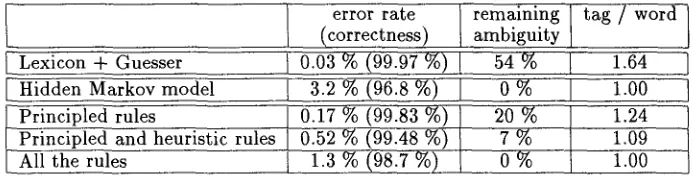
If we apply all the rules, we get a fully disam- biguated result with an error rate of only 1.3 %. This error rate is much lower t h a n the one we get using the hidden Markov model (3.2 %). See Fig- ure 1.
We can also restrict the tagger to using only the most reliable rules. Only 10 words lose the cor- rect tag when almost 2000 out of 3085 ambiguous words are disambiguated. A m o n g the remaining 1136 ambiguous words a b o u t 25 % of the ambigu- ity is due to determiner/preposition ambiguities (words like dn and des), 30 % are a d j e c t i v e / n o u n ambiguities and 18 % are n o u n / v e r b ambiguities. If we use b o t h the principled and heuristic rules, the error rate is 0.52 % while 423 words remain ambiguous. T h e non-contextual rules t h a t elim- inate the remaining 423 ambiguities produce an
error rate (correctness)
Lexicon + Guesser 0.03 % (99.97 %) 54 % Hidden Markov model 3.2 % (96.8 %) 0 % Principled rules 0.17 % (99.83 %) 20 % Principled and heuristic rules 0.52 % (99.48 %) I 7 % All the rules I 1.3% (98.7 %) I 0 %
remaining ambiguity
tag / word
1.64 1.00 1.24 1.09
1.00
Figure 1: The result in the test sample
additional 43 errors. Overall, 98.7 % of the words receive the correct tag.
5.2 T e s t B
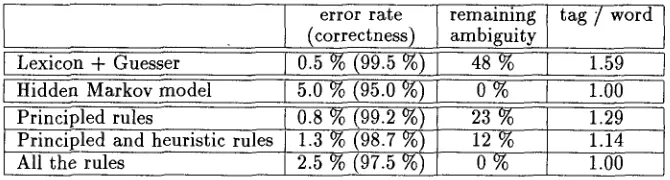
We also tested the tuggers with more difficult text. The 12 000 word sample of newspaper text has typos and proper names 4 t h a t m a t c h an existing word in the lexicon. Problems of the latter type are relatively rare but this sample was exceptional. Altogether the lexicon mismatches produced 0.5 % errors to the input of the tuggers. The results are shown in Figure 2. This text also seems to be generally more difficult to parse than the first one.
5.3 C o m b i n a t i o n o f t h e t u g g e r s
We also tried combining the tuggers, using first the rules and then the statistics (a similar ap- proach was also used in (Tapanainen and Vouti- lainen, 1994)). We evaluated the results obtained by the following sequence of operations:
1) Running the constraint-based tagger without the final, non-contextual rules.
2) Using the statistical disambiguator indepen- dently. We select the tag proposed by the statistical disambiguator if it is not removed during step 1.
3) Solving the remaining ambiguities by run- ning the final non-contextual rules of the constraint-based tagger. This last step en- sures t h a t one gets a fully disambiguated text. Actually only about 0.5 % of words were not fully disambiguated after step 2.
We used the test sample B. After the first step, 1400 words out of 12 000 remain ambiguous. The process of combining the three steps described above eventually leads to more errors than run- ning the constraint-based tagger alone. T h e sta- tistical tagger introduces 220 errors on the 1400 words that remain ambiguous after step 1. In comparison, the final set of non-contextual rules introduces around 150 errors on the same set of 1400 words. We did not expect this result. One possible explanation for the superior performance of the final non-contextual rules is t h a t they are m e a n t to apply after the previous rules failed to disambiguate the word. This is in itself useful
4like Bats, Botta, Ddrnis, Ferrasse, Hersant, ...
information. The final heuristics favour tags t h a t have survived all conditions that restrict their use. For instance, the contextual rules define various contexts where the preposition tag for des is pre- ferred. Therefore, the final heuristics favours the determiner reading for des.
6
Analysis of
e r r o r s6.1 E r r o r s o f p r i n c i p l e d a n d h e u r i s t i c r u l e s
Let us now consider what kind of errors the con- straint-based tagger produced. We do not deal with errors produced by the last set of rules, the non-contextual rules, because it is already known that they are not very accurate. To make the tagger better, they should be replaced by writing more accurate heuristic rules.
We divide the errors into three categories: (1) errors due to multi-word expressions, (2) errors that should/could be resolved and (3) errors t h a t are hard to resolve by using the information that is available.
T h e f i r s t group (15 errors), the multi-word ex- pressions, are difficult for the syntax-based rules because in many cases the expression does not fol- low any conventional syntactic structure, or the structure m a y be very rare. In multi-word expres- sions some words also have categories that m a y not appear anywhere else. The best way to han- dle them is to lexicalise these expressions. When a possible expression is recognised we can either collapse it into one unit or leave it otherwise in- tact except that the most "likely" interpretation is marked.
The biggest group (41 errors) contains errors that could have been resolved correctly but were not. The reason for this is obvious: only a rela- tively small amount of time was allowed for writ- ing the rules. In addition, the rules were con- structed on the basis of a rather small set of ex- ample sentences. Therefore, it would be very sur- prising if such errors did not appear in the test sample taken from a different source. The errors are the following:
[image:4.596.146.493.77.167.2]error rate remaining tag / word (correctness) ambiguity
Lexicon + Guesser 0.5 % (99.5 %) 48 % 1.59
Hidden Markov model 5.0 % (95.0 %) 0 % 1.00 Principled rules I 0.8 % (99.2 %) 23 % 1.29 Principled and heuristic rules ] 1.3 % (98.7 %) 12 % 1.14
All the rules [ 2.5 % (97.5 %) 0 % 1.00
Figure 2: T h e result in a difficult test sample with m a n y lexicon mismatches
to do so correctly in some sentences. Often only a m i n o r correction is needed.
• Some syntactic constructions, or word se- quences, were omitted. This caused 7 er- rors which could easily be avoided by writ- ing more rules. For instance, a construction like "preposition ÷ clitic + finite verb" was not forbidden. T h e phrase h l'est was anal- ysed in this way while the correct analysis is
"preposition ÷ determiner + noun".
• Sometimes a little bit of extra lexical infor- m a t i o n is required. Six errors would require m o r e information or the kind of refinement in the tag inventory t h a t would not have been a p p r o p r i a t e for the statistical tagger.
• Nine errors could be avoided by refining ex- isting heuristics, especially by taking into ac- count exceptions for specific words like point, p e n d a n t and devant.
T h e remaining errors (28 errors) constitute the price we p a y for using the heuristics. Removing the rules which fail would cause a lot of ambiguity to remain. T h e errors are the following:
• Fifteen errors are due to the heuristics for de
and des. There is little r o o m for i m p r o v e m e n t at this level of description (see C h a p t e r 4.2.3). However, the current, simple heuristics fully disambiguate 850 instances of de and des out of 914 i.e. 92 % of all the occurrences were parsed with less t h a n a 2 % error rate.
• Six errors involve n o u n - a d j e c t i v e ambiguities t h a t are difficult to solve, for instance, in a subject or object predicate position.
• Seven errors seem to be beyond reach for various reasons: long coordination , rare con- structions, etc. An e x a m p l e is les boltes (the boxes) where les is wrongly tagged in the test sample because the noun form is misspelled
as boites, which is identified only as a verb by the lexicon.
6.2 D i f f e r e n c e b e t w e e n t h e t a g g e r s
We also investigated how the errors compare be- tween the two taggers. Here we used the fully disambiguated o u t p u t s of the taggers. T h e errors belong m a i n l y to three classes:
* Some errors appear predominantly with the statistical tagger and almost never with the constraint-based tagger. This is particularly the case with the ambiguity between past par- ticiples and adjectives.
• Some errors are common to both taggers, the constraint-based tagger generally being more accurate (often with a ratio of I to 2). These errors cover ambiguities t h a t are known to be difficult to handle in general, such as the al- ready mentioned determiner/preposition a m - biguity.
• Finally, there are errors t h a t are specific to the constraint-based tagger. T h e y are of- ten related to errors t h a t could be corrected with some extra work. T h e y are relatively infrequent, thus the global accuracy of the constraint-based tagger remains higher.
The first two classes of errors are generally dif- ficult to correct. The easiest way to improve the constraint-based tagger is to concentrate on the final class. As we mentioned earlier, it is not very easy to change the behaviour of the statistical tagger in one place without some side-effects else- where. This means t h a t the errors of the first class are probably easiest to resolve by means other t h a n statistics.
The first class is quite annoying for the statisti- cal parser because it contains errors t h a t are intu- itively very clear and resolvable, but which are far beyond the limits of the current statistical tagger. We can take an easy sentence to d e m o n s t r a t e this:
Je ne le pense pas. I do not think so.
T u n e le penses pas. You do not think so.
Il ne le pense pas. He does not think so. T h e verb pense is ambiguous 5 in the first person or in the third person. It is usually easy to determine the person just by checking the personal pronoun nearby. For a h u m a n or a constraint-based tagger this is an easy task, for a statistical tagger it is not. There are two words between the pronoun and the verb t h a t do not carry any information a b o u t the person. T h e personal pronoun m a y thus be too far from the verb because bi-gram models can see backward no farther t h a n le, and t r i - g r a m models
SThat is not case with all the French verbs, e.g. Je crois and //croit.
[image:5.596.109.444.75.165.2]no f a r t h e r t h a n ne le.
Also, as mentioned earlier, resolving the adjec- tive vs. p a s t participle ambiguity is much harder, if the tagger does not know whether there is an auxiliary verb in the sentence or not.
7
C o n c l u s i o n
We have presented two taggers for french: a sta- tistical one and a constraint-based one.
T h e r e are two ways to train the statistical tagger: f r o m a tagged corpus or using a self- organising m e t h o d t h a t does not need a tagged corpus. We h a d a strict t i m e limit of one m o n t h for doing the tagger and no tagged corpus was available. This is a short t i m e for the m a n u a l tag- ging of a corpus and for the training of the tag- ger. It would be risky to spend, say, three weeks for writing a corpus, and only one week for train- ing. T h e size of corpus would have to be limited, because it should be also checked.
We selected the Xerox tagger t h a t learns from an u n t a g g e d corpuS. T h e task was not as straigth- forward as we thought. W i t h o u t h u m a n assistance in the training the result was not impressive, and we h a d to spend m u c h t i m e tuning the tagger and guiding the learning process. In a m o n t h we achieved 95-97 % accuracy.
T h e training process of a statistical tagger re- quires some t i m e because the linguistic informa- tion has to be incorporated into the tagger one way or another, it cannot be obtained for free s t a r t i n g f r o m null. Because the linguistic infor- m a t i o n is needed, we decided to encode the infor- m a t i o n in a m o r e straightforward way, as explicit linguistic disambiguation rules. It has been ar- gued t h a t statistical taggers are superior to rule- b a s e d / h a n d - c o d e d ones because of better accu- racy and b e t t e r a d a p t a b i l i t y (easy to train). In our experiment, b o t h claims turned out to be wrong.
For the constraint-based tagger we set one m o n t h t i m e limit for writing the constraints by hand. We used only linguistic intuition and a very limited set of sentences to write the 75 constraints. We formulated constraints of different accuracy. Some of the constraints are almost 100 % accu- rate, some of t h e m j u s t describe tendencies.
Finally, when we t h o u g h t t h a t the rules were good enough, we took two text samples from dif- ferent sources and tested b o t h the taggers. T h e constraint-based tagger m a d e several naive errors because we had forgotten, miscoded or ignored some linguistic p h e n o m e n a , b u t still, it m a d e only half of the errors t h a t the statistical one made.
A big difference between the taggers is t h a t the tuning of the statistical tagger is very subtle i.e. it is hard to predict the effect of tuning the p a r a m - eters of the system, whereas the constraint-based tagger is very straightforward to correct.
Our general conclusion is t h a t the hand-coded constraints p e r f o r m better t h a n the statistical tag- ger and t h a t we can still refine them. T h e m o s t i m p o r t a n t of our findings is t h a t writing con- straints t h a t contain more linguistic information t h a n the current statisticM model does not take much time.
R e f e r e n c e s
Jean-Pierre Chanod. Probl~mes de robustesse en analyse syntaxique. In Acres de la conf6rence Informatique et langue n alurelle. I R I N , Univer- sit@ de Nantes, 1993.
Jean-Pierre C h a n o d and Past T a p a n a i n e n . Statis- tical and Constraint-based Taggers for French. Technical report MLTT-016, Rank Xerox Re- search Centre, Grenoble, 1994.
Doug Cutting, Julian Kupiec, J a n Pedersen and Penelope Sibun. A Practical Part-of-Speech Tagger. In Third Conference on Applied Natu- ral Language Processing. pages 133-140. Trento, 1992.
Ron Kaplan and Martin Kay. Regular Models of Phonological Rule Systems. Computational Linguistics Vol. 20, N u m b e r 3, pages 331-378. Fred Karlsson. Constraint G r a m m a r as a Frame-
work for Parsing Running Text. In proceedings of Coling-90. Papers presented to the 13th In- ternational Conference on Computational Lin- guistics. Vol. 3, pages 168-173. Helsinki, 1990. Fred Karlsson, Atro Voutilainen, J u h a Reikkil~
and Arto A n t t i l a (eds.). Constraint Grammar: a Language-Independent System for Parsing Unrestricted Text. Mouton de Gruyter, Berlin, 1995.
Lauri Karttunen. Constructing LexicM Trans- ducers. In proceedings of Coling-94. The fif- leenth International Conference on Computa- tional Linguistics. Vol I, pages 406-411. Kyoto, 1994.
Lauri Karttunen, Ron K a p l a n and Annie Zae- nen. Two-level morphology with composition. In proceedings of Colin9-92. The fourteenth In- ternational Conference on Computational Lin- guistics. Vol I, pages 141-148. Nantes, 1992. K i m m o Koskenniemi. Two-level morphology.
A general computational model for word-form recognition and production. University of Helsinki, 1983.
K i m m o Koskenniemi. Finite-state parsing and disambiguation. In proceedings of Coling-90. Papers presented to the 131h International Con- ference on Computational Linguistics. Vol. 2, pages 229-232. Helsinki, 1990.
syntactic rules. In proceedings of Coling-92. The fourteenth International Conference on Computational Linguistics. Vol. I, pages 156- 162. Nantes, 1992.
Eric Laporte. Experiences in Lexical Disambigua- tion Using Local Grammars. In Third Interna- tional Conference on Computational Lexicogra- phy. pages 163-172. Budapest, 1994.
Emmanuel Roche. Text Disambiguation by finite- state automata, an algorithm and experiments on corpora. In proceedings of Coling-92. The fourteenth International Conference on Com- putational Linguistics. Vol III, pages 993-997. Nantes, 1992.
Emmanuel Roche and Yves Schabes. Deter- ministic part-of-speech tagging with finite-state transducers. Technical report TR-94-07, Mit- subishi Electric Research Laboratories, Cam- bridge, USA.
Max Silberztein. Dictionnaires ~lectroniques et analyse automatique de textes. Le systkme IN- TEX. Masson, Paris, 1993.
Pasi Tapanainen and Atro Voutilainen. Tagging accurately - Don't guess if you know. In Fourth. Conference on Applied Natural Language Pro- cessing, pages 47-52. Stuttgart, 1994.
Atro Voutilainen and Pasi Tapanainen. Ambi- guity resolution in a reductionistic parser. In Sixth Conference of the European Chapter of the ACL. pages 394-403. Utrecht, 1993.
A
The restricted tag
s e tIn this appendix the tag set is represented. Be- sides the following tags, there may also be some word-specific tags like PREP-DE, which is the preposition reading for words de, des and du, i.e. word de is initially ambiguous between PREP- DE and PC. This information is mainly for the statistical tagger to deal with, for instance, different prepositions in a different way. The constraint-based tagger does not need this because it has direct access to word forms anyway. Af- ter disambiguation, the word-specific tags may be cleaned. The tag P R E P - D E is changed back into
PREP, to reduce the redundant information.
• D E T - S G : Singular determiner e.g. le, la, mon, ma. This covers masculine as well as feminine forms. Sample sentence: L_ee chien dort dans l__a cuisine. (The dog is sleeping in the kitchen).
• D E T - P L Plural determiner e.g. les, mes.
This covers masculine as well as feminine forms. Sample sentence: Les enfants jouent avec mes livres. (The children are playing with my books.)
• A D J - I N V Adjective invariant in number
e.g. heureux. Sample sentence: Le chien est
heureux quand les enfan'ts sont heureux. (The dog is happy when the children are happy.)
• A D J - S G Singular adjective e.g. gentil, gen- tille. This covers masculine as well as fem- inine forms. Sample sentence: Le chien est gentil. (The dog is nice.)
• A D J - P L Plural adjective e.g. gentils, gen- tilles. This covers masculine as well as femi- nine forms. Sample sentence: Ces chiens sont gentils. (These dogs are nice.)
• N O U N - I N V Noun invariant in number e.g. souris, Frangais. This covers masculine as well as feminine forms. Sample sentence: Les souris dansent. (The mice are dancing.)
• N O U N - S G Singular noun e.g. chien, fleur.
This covers masculine as well as feminine forms. Sample sentence: C'est une jolie fleur. (It is a nice flower.)
• N O U N - P L Plural noun e.g. chiens, fleurs.
This covers masculine as well as feminine forms. Sample sentence: Nous aimons les fleurs. (We like flowers.)
• V A U X - I N F Auxiliary verb, infinitive ~tre, avoir. Sample sentence: Le chien vient d'Etre puni. (The dog has just been punished.) • V A U X - P R P Auxiliary verb, present par-
ticiple grant, ayant.
• V A U X - P A P Auxiliary verb, past participle e.g. dtd, eu. Sample sentence: Le thdor~me a ~t__d ddmontrd. (The theorem has been proved.)
• V A U X - P 1 P 2 Auxiliary verb, covers any 1st or 2nd person form, regardless of number, tense or mood, e.g. 1st person singular present indicative, 2nd person plural impera- tive: ai, soyons, es. Sample sentence: Tu e_ss fort. (You are strong.)
• V A U X - P 3 S G Auxiliary verb, covers any 3rd person singular form e.g. avait, sera, es. Sample sentence: Elle es._tt forte. (She is strong.)
• V A U X - P 3 P L Auxiliary verb, covers any 3rd person plural form e.g. ont, seront, avaient. Sample sentence: Elles avaient dormi. (They had slept.)
• V E R B - I N F Infinitive verb e.g. danser, finir, dormir. Sample sentence: Le chien
aime dormir. (The dog enjoys sleeping.)
• V E R B - P R P Present participle
e.g. dansant, finissant, aboyant. Sample sen- tence: Le chien arrive en aboyant. (The dog is coming and it is barking.)
• V E R B - P I P 2 Any 1st or 2nd person verb form, regardless of number, tense or mood e.g. 1st person singular present indicative,
2nd pers plural imperative: chante, finissons. Sample sentence: Je chante. (I sing.)
• V E R B - P 3 S G Any 3rd person singular verb form e.g. chanlera, finil, aboie. Sample sen- tence: ge chien aboie. (The dog is barking.)
• V E R B - P 3 P L Any 3rd person plural verb form e.g. chanleront, finissen$, aboient. Sam- ple sentence: Les chiens aboient. (The dogs are barking.)
• P A P - I N V Past participle invariant in num- ber e.g. surpris. Sample sentence: Le chien m'a surpris. (The dog surprised me.)
• P A P - S G Singular past participle e.g. fini, finie. This covers masculine as well as femi- nine forms. Sample sentence: La journge est finie. (The day is over.)
• P A P - P L Plural past participle e.g. finis, finies. This covers masculine as well as fem- inine forms. Sample sentence: Les travaux sont finis. (The work is finished.)
• P C Non-nominative clitic pronoun such as me, le. Sample sentence: It me l'a donnL (He gave it to me.)
• P R O N 3rd person pronoun, relative pro- nouns excluded, e.g. il, elles, chacun. Sample sentence: I__l a parle ~ chacun. (He spoke to every person.)
• P R O N - P 1 P 2 1st or 2nd person pronoun e.g. je, ¢u, nous. Sample sentence: Est-ce que t_uu viendras avec moi? (Will you come with me?)
• V O I C I L A Reserved for words voici and voile. Sample sentence: Voici mon chien. (Here is m y dog.)
• A D V Adverbs e.g. finalement. Sample sen- tence: Le jour es¢ finalement arrivd. (The day has finally come.)
• N E G Negation particle. Reserved for the word ne. Sample sentence: Le chien n_~e dor¢ pas. (The dog is not sleeping.)
• P R E P Preposition e.g. dans. Sample sen- tence: Le chien dor¢ dans la cuisine. (The dog sleeps in the kitchen.)
For statistical taggers this group m a y be di- vided into subgroups for different preposition groups, like PREP-DE, PREP-A, etc.
• C O N N Connector. This class includes coor- dinating conjuctions such as el, subordinate conjunctions such as lorsque, relative or in- terrogative pronouns such as lequel. Words like comme or que which have very special behaviour are not coded as CONN. Sample sentence: Le chien e___t le chat dorment quand il pleut. (The dog and the cat sleep when it rains.)
For statistical taggers this group m a y be di- vided into subgroups for different connectors, like CONN-ET, CONN-Q, etc.
• C O M M E Reserved for M1 instances of the word comme. Sample sentence: Il joue
comme un enfant. (He plays like a child.)
• C O N J Q U E Reserved for all instances of the word que.
• N U M Numeral e.g. 12,7, 120/98, 34+0.7.
• H E U R E String representing time e.g. 12h24, 12:45:00.
M I S C Miscellaneous words, such as: inter- jectiorr oh, salutation bonjour, o n o m a t o p o e i a miaou, wordparts i.e. words t h a t only exist as part of a multi-word expression, such as priori, as part of a priori.
• C M Comma.