Tailor knowledge graph for query understanding: linking intent topics by
propagation
Shi Zhao
[email protected] [email protected] Zhang
Department of Machine Intelligence, Peking University, Beijing, China Key Laboratory on Machine Perception, Ministry of Education, Beijing, China
Abstract
Knowledge graphs are recently used for enriching query representations in an entity-aware way for the rich facts
or-ganized around entities in it.
How-ever, few of the methods pay attention to non-entity words and clicked websites in queries, which also help conveying user intent. In this paper, we tackle the prob-lem of intent understanding with innova-tively representing entity words, refiners
and clicked urls asintent topicsin a
uni-fied knowledge graph based framework, in a way to exploit and expand knowl-edge graph which we call ‘tailor’. We collaboratively exploit global knowledge in knowledge graphs and local contexts in query log to initialize intent representa-tion, then propagate the enriched features in a graph consisting of intent topics us-ing an unsupervised algorithm. The ex-periments prove intent topics with knowl-edge graph enriched features significantly enhance intent understanding.
1 Introduction
Query understanding is the process of generating a representation which characterizes a user’s search intent (Croft et al., 2010), which is of vital im-portance for information retrieval. However, users are remarkably laconic in describing their infor-mation needs due to anomalous state of knowledge (Belkin et al., 1982), resulting in vague and under-specified queries, which makes it especially dif-ficult to understand and locate what they intended for in mountains of web data. The problem is often significantly compounded that people convey their intent rather in a series of behaviors called a search session than a single query, leaving a wealth of clues including query reformulations, page visits,
dwell times, etc. What’s more, as entities are tak-ing center stage (Yin and Shah, 2010), strtak-ing-level or phrase-level modeling of intent soon hits the bottleneck, calling for an entity-aware perspective. Knowledge repositories, better known as knowledge graphs, such as Wikipedia, DBpedia and Freebase, have been recently utilized for en-hancing query understanding for the large amounts of world knowledge they’ve harvested about en-tities and facts. A widely accepted way to use knowledge graph is tying queries with it by anno-tating entities in them, also known as entity link-ing.
However, information need is conveyed through more than entities. Quite a few non-entity words, aka refiners or modifiers, as well as many urls are barely included in knowledge graph, while they play an irreplaceable role in intent
understand-ing. For example, a user may querytoyota,volvo
or just enter car soup, cars for sale and click
www.carsoup.com, which should be encoded in a form that we could perceive their closeness in intent. That’s why at-a-glance info cards about merely recognized entity in the query are far from enough and previous methods disregarding refin-ers and urls are too limited to cover queries in ma-jority.
We move one step further to tailor knowledge graph for representing more than entity words. We collect refiners and clicked urls along with en-tity words and model intents they represent us-ing knowledge graph based features. We use
Freebase1, one of the largest available knowledge
graph, in our work and our method can be easily generalized to other knowledge repositories.
We put up an idea of intent topic which can
be query words or urls, whether mean an entity or not, representing an atomic information need.
We identify them withintent featuresby
exploit-ing global knowledge in Freebase and local
con-1http://www.freebase.com
texts in query sessions. Notice the new concept
here is distinguished from query intent or query
facet in previous literature for it is in a holistic view, not specifically meaning subtopics around a certain query.
Our intuitive observations as follows inspire us to represent intent features with topics and do-mains in knowledge graph and propagate the en-riched features in the intent topic graph.
1) Query words and urls within the same session tend to indicate the same query intent.
2) Intent topics sharing similar query intent often relate to similar topics in knowledge graph. 3) Knowledge graph domains sketch the query
in-tent briefly.
Observation 1 indicates domain coherency within sessions is a good starting point to gener-ate intent features, along with Observation 2 and 3 lay the basis of proximity that the propagation rely on.
To the best of our knowledge, we’re the first to represent intent behind entity words, refiners and urls in a unified knowledge graph based frame-work, in a way to exploit and expand knowledge graph which we call ‘tailor’.
Our contributions include:
• An innovative and unified framework to
rep-resent intent topics, whether they can directly link to an entity in knowledge graph or not.
• A novel algorithm to generate a specified
tent topic graph, which enables learning in-tent features in an unsupervised propagation method.
• With intent topic graph we can better
under-stand user intent conducting session-based contextualization and potentially find highly-related intent topic.
The rest of the paper is organized as follows. Sec-tion 2 tells our methods to map queries to Freebase and initialize intent features. Section 3 is about how we model intent topics in a unified graph and the propagation framework to learn intent features. We provide experiments and analysis in Section 4. Related work and conclusions are presented at the end of the paper.
2 Labeling intent topic nodes with Freebase-enriched features
In Freebase, facts around a certain topic and multi-faceted intents they reflect is more like a global domain distribution, what facet do users exactly
intend for is difficult to locate until in a specified context, namely a query session.
We take a line in query log as aquery,
exhibit-ing an interaction with the search engine, includ-ing query words and page clicks. And a sequence of queries with a certain time interval constitute a session, completely conveying an information need.
In existing knowledge graph, only a small part of urls are contained in views of web pages be-yond number online. Even for query words, we can merely get access to some of them, which we call entity words and the rest refiners. To avoid misunderstanding, the url intent topics in the fol-lowing will specially refer to the clicks without di-rectly matched concepts in knowledge graph, oth-erwise they’ll be taken as entity intent topic.
In this section, we propose a framework of knowledge graph enriched representation of in-tent topics, the following propagation in Section3 bases on it.
2.1 Freebase as a knowledge graph
Freebase has over 39 million concepts, aka top-ics, about real-world entities like people, places
and things stored as nodes in a graph. They’re
linked to each other with annotated egdes named asproperty. Theseedgesactually representfacts. There are over a billion such facts or relations that make up the graph and they’re all available for free. Properties are grouped into types, types are grouped into domains, which gives a broad view of knowledge in addtion to specific topics.
We can tap into Freebase through dump data or
API2. In our work, we retrieve related Freebase
topics with relevance scores for entity words via Freebase search API, which is based on combina-tion of topic’s inbound and outbound link counts in Freebase and Wikipedia as well as a popularity score computed by Google, and all the facts about a given topic through Freebase topic API. We use T = {t1, t2, ...tn}, D = {d1, d2, ...dn}to denote
all Freebase topics and domains used in our work.
2.2 Enriching entities and queries with Freebase
We represent a query’s candidate intent topics by
three sets, Eq, Rq, Cq, whereEq includes entity
words and clicks which have equivalents in
Free-base,Rqthe refiner words andCq the rest clicks.
Global knowledge in Freebase can directly enrich
eache inEq with Freebase topics represented in
vectorte, for each candidate topic there’s a
Free-base domain distribution vectordt. As for the rest
inRqandCq, they can learn features in later
prop-agation process.
For any topic ti in te, the relevance of entity
wordseand knowledge graph topictiis estimated
as follows:
tei = maxRelevanceScore(e, ti)
tj∈TRelevanceScore(e, tj)
(1)
And the domain vectordti fortiis:
dti
j = P pr(dj|ti) dk∈Dpr(dk|ti)
(2)
pr(dj|ti) = ##of links of tof all links in domain diin domain dj j
(3) Then we’ll get a knowledge graph enriched in-tent description of the query by combining that of
e,r,c.
tqi = X
e∈Eq
teiwq(e) +
X
r∈Rq
triwq(r) +
X
c∈Cq
tciwq(c)
(4)
wq(e) =NCountq(e)ϕ(e) (5)
Heretetrtccorrespond to the topic vector of each
entity, refiner and click respectively. The weight indicates how dominant it is in conveying intent in the query. It is in proportion to the normalized count as well as each occurrence’s quality denoted
byϕ(e). Such as for entity words in Equation (5),
the qualityϕ(e)can be estimated with the help of
entity linking methods, which describes the
proba-bility ofeas a candidate reference. That for clicks
and refiners will be explained later.
The query’s domain feature can be calculated as follows:
dqi =
P
tj∈Td
tj
i tqj
P
dk∈D
P
tj∈Td
tj
ktqj
(6)
It describes the probability of query q in domain
di, in whichtqj can be calculated by Equation (4)
anddtj
i via facts around topictjby Equation (2).
2.3 Contextualized intent depiction of sessions
The aforesaid enriched features we get about queries rely heavily on global knowledge in Free-base, reflecting prior distribution in the feature
space. In this part, we derive a contextualized de-scription of session intent in a local view by aggre-gating all the global knowledge we get about the session’s queries. The ambiguity of a single query can be alleviated by looking at the dominant do-main within the session.
The intent features ts andds of sessions can
be represented by computations on its query set
Qs={q1, q2, ...qn}with time-order decay.
tsi =
P
q∈Qst
q
iαrank(q)
P
tj∈T
P
q∈Qst
q
jαrank(q) (7)
where we put an exponential decay controlled by
decay factorα. We get domain feature the same
way as Equation (6).
We’ll put up an unsupervised method of learn-ing knowledge graph based intent representation of refiners and clicks in the following part.
3 Propagating intent features in the intent topic graph
In this section, our idea is to characterize entities, refiners and urls uniformly as intent topics, tailor-ing knowledge graph to intent topic graph so as to enrich representations by propagation.
3.1 Modeling intent topic graph
As in last section, with ds featuring the context,
candidate intent topics in sessions can make intent
topic nodes now. We use the conceptintent topic
to stress words with local contexts tell a specified information need, thus making a node. Taking
en-tity word fl as an example, it can be recognized
as the topicFloridain Freebase, while the intent
behind it can hardly be mapped to a single intent
topic, such as traveldomain in hollywood fl,
ed-ucation domain in community college in florida, andflorida department of health actually convey
intent ingovernmentdomain.
So each intent topic node is identified with its name string and Freebase-enriched intent features
t andd. They’re directly linked by co-occurring
in the same line in the query log and implicitly related via intent features similarities, so that
con-stitute a large graph G =< V, E, W >, where
∀w ∈ W denotes an explicit edge weight and
∀v ∈ V an intent topic. With intent topics and
The implicit intent similarityISimof any node
pairnandvcan be encoded as follows.
ISimn,v =βSSimn,v+γDSimn,v+ηT Simn,v
(8)
where SSim denotes the names’ string
similar-ity, DSimthe similarity of their domain feature
and T Simthe topic vector similarity, with β, γ
andηcontrolling the weight. The parameters may
vary due to different scenarios. We just provide a framework of modeling nodes’ intent features, which actually mirror their proximity in query in-tent.
To put it in more details, we use jaccard sim-ilarity for name shinglings and cosine simsim-ilarity for domain and topic vector. As query log in-duced intent topic graph is of considerable large size, the pair-wise similarity is computationally prohibitive, hence we use Local Sensitive Hash (Indyk and Motwani, 1998) for each similarity
metric so as to compute ISim just in candidate
set. We use random hyperplane based hash fam-ily proposed in (Charikar, 2002) and set the hash code dimension and hash table numbers empiri-cally to ensure the number of nodes falling into each bucket is relatively stable.
3.2 Merging nodes
Although our idea of specifying intent topics by context better models the multi-facets of queries, it obviously also brings a sparse issue. For
exam-ple, in one session user querybeep lyricsand click
www.lyricsandsongs.com,lyricsis tagged with the
songbeepand the musicianPussycat Dolls, in
an-other scenario lyrics occurs with the song what
you knowand urlwww.dapslyrics.com, intents be-hind these two nodes are so similar that they should come into one, otherwise connections be-tween the two intent-coherent urls may be lost.
To avoid that, we conduct a merge process to integrate nodes with exactly the same names and contexts into one, combing linked nodes and intent features together.
For a set of nearly duplicate nodes ω the
cal-culation of new node’s features can be written as:
ˆt=
P
u∈ωtu
|ω| (9)
ˆd=
P
u∈ωdu
|ω| (10)
In other words, we gather candidate nodes
re-trieved by LSH and then calculateISimfor them
with η setting to 0. Only node pairs with ISim
higher than a merge threshold θ can be seen as
duplicates. The merge process is summarized in Algorithm 1.
Algorithm 1:Merging similar nodes
Input: G=< V, E, W >, β, γ, η, θ
Output: Gˆ=<V ,ˆ E,ˆ W >ˆ
begin
InitializeΩ←∅
for v∈V do
Find dupsetωvwithISimβ,γ,η
if∃u∈V, ωu ∈Ωandωv∩ωu6=∅ then
ωv ←ωv∪ωu
RemoveωufromΩ
AddωvtoΩ
forω∈Ωdo
Merge nodes inωinto new nodevˆ
UpdateGwith replacing nodes inω
withˆv
3.3 Label propagation
We utilize knowledge graph induced intent fea-tures instead of manually labels as constraints to conduct label propagation(Zhu and Ghahramani, 2002). The idea is that node labels are propa-gated to nearby nodes via weighted edges until convergence, as highly weighted edges indicate high probability of sharing labels.
Nodes in our work have soft labels, where each dimension of intent features denotes a label, such as a topic or domain of knowledge graph. As de-scribed in aforesaid observations, it is intuitively reasonable to propagate on the basis of explicit edges and implicit intent similarities. We illustrate the propagation with topic feature, that of domain feature is similar.
We use matrixYt ∈ R|V|∗|T| to denote the
in-tent topic graph’s initial topic feature labels, with
elementYt
ik indicating node vi’s relevance totk,
wherer tk ∈ T. Yt is initialized based on the
results of the feature enriching step in Section 2, with no manually-labelled instances needed in our model. As only part of nodes can directly map to Freebase topics, those are initialized as labelled
nodes, then propagatetto their linked neighbors.
The number of unlabelled data is written as u,
while that of labelled dataland the total number
The transition matrixT indicates the impact of
nodes on each other. Note that here thewij can
be replaced by other similarity measures such as
ISimin Section 3.2.
Tij = PNwij
k=1wkj (11)
LetDdenote anN×Ndiagonal matrix withdii=
P
jTij. Then we can get a normalized version of
transition matrixP =D−1T.
The normalized transition matrix can be split into 4 sub-matrices.
P =
Pll Plu
Pul Puu
(12)
At each step, we propagate and clamp the labelled
data and repeat untilY converges, the propagation
step can be written as:
ˆ
Yu =PuuYu+PulYl (13)
As is shown in (Zhu and Ghahramani, 2002; Zhu et al., 2003) the solution to the propagation con-verges to:
ˆ
Yu = (I−Puu)−1PulYl (14) 3.4 The propagation framework for intent
features
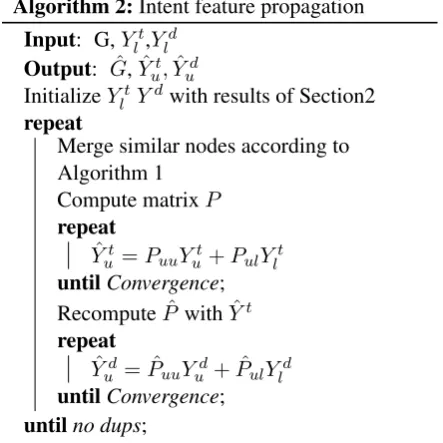
We carry the propagation in an iterative process illustrated in Algorithm 2.
Algorithm 2:Intent feature propagation
Input: G,Yt l,Yld Output: Gˆ,Yˆt
u,Yˆud
InitializeYt
l Ydwith results of Section2
repeat
Merge similar nodes according to Algorithm 1
Compute matrixP
repeat
ˆ
Yt
u =PuuYut+PulYlt untilConvergence;
RecomputePˆwithYˆt
repeat
ˆ
Yd
u = ˆPuuYud+ ˆPulYld untilConvergence;
untilno dups;
Since intent features include both domain vec-tor and topic vecvec-tor, we propagate them in an alter-nating way. At first we label nodes as described in
Section 2, though missing refiners’ and some urls’ intent features, they are just used for initialization. Then we propagate Freebase topic features based on explicit edge weights, so that more nodes in intent topic graph have topic features now. Then fetching the learned topic features, we reinput it into domain feature propagation, which means we recalculate the transition matrix combining the
im-plicit learnedT Siminto edge weight, then
prop-agate domain vector of labelled nodes through the
graph. At each iteration, we first updateYt, then
input it to updateYd, therefore merge near
dupli-cate intent topics to update the whole graph.
4 Experiments 4.1 Data preparation 4.1.1 Search logs
[image:5.595.71.293.487.709.2]We use AOL search log data for experiments. It includes 20 million web queries collected covering 500K users over three months in 2006.
Table 1: The query set # of sessions 35140
# of queries 271127
# of users 21378
# of urls 63019
We preprocess the query log by keeping urls oc-curring more than 3 times and queries with 2 to 40 characters, then extract sessions considering 25 minutes duration. While user session segmenta-tion can be improved with more sophisticated al-gorithms, this simple low-cost heuristic performs adequately for our purposes. We then move on to map queries to Freebase and empirically filter ses-sions that are less entity-centric. We use an anno-tation tool especially for short text (Ferragina and
Scaiella, 2012) called Tagme3to recognize entities
and observe only 16% of all the queries are ex-actly an entity itself, which means most of queries do have refiner words to convey information need. To ensure the precision of recognized entities, we set a significant threshold and bottom line thresh-old , queries should have at least one recognized entity with a likelihood above significant level, and those below bottom line are ignored. They are 0.19 and 0.05 in our work, which may vary with entity recognition method. The normalized
loca% on
organ iza%on
busine ss
book
intern et
travel film
educ a%on
music sports
gove rnme
nt broad
cast people
comp uter tv
avia% on
celeb ri%es
med icine
fic%o nal_u
nivers e
perio dicals
biolog
y
archite cture cvg
media_c ommo
n
visual _art
militar y
autom o%ve
influe nce food
pe
rc
entag
e
[image:6.595.74.527.63.147.2]Query set Test session set Freebase topics Freebase facts
Figure 1: Unbalanced domain distributions in Freebase comparing against query set. Only domains with top proportions are shown.
Table 2: Examples of labelled intent topic nodes with learned feature
Intent topic nodes Original in Freebase After propagation Annotation
travel.yahoo.com Yahoo! Travel
(internet, 0.87), (projects, 0.13)
(location, 0.13), (travel, 0.11), (organization, 0.08), (business, 0.08) ...
Yahoo! Travel offers
travel guides, booking and reservation services.
map quest
www.mapquest.com MapQuest(organization, 0.6),
(book, 0.4)
(location, 0.13), (organization, 0.09), (travel, 0.09), (automotive, 0.06)...
MapQuest is an Ameri-can free online web map-ping service.
likelihood is used as wq(e). Then we drop
ses-sions where tagged entity words weight less than refiners as well as the ones with too many entity words spotted indicating disperse intents. For each recognized entity, only Freebase topics with rele-vance over 0.3 are kept. The query set we finally get is shown in Table 1.
4.1.2 Freebase
To enrich query representations, we collect a sub-set of Freebase including more than 7 millions facts and 4 millions topics in total which also contain 150 thousand topical equivalent websites, though less than 3% urls in query set are covered. The facts and entities in Freebase is rather un-balanced across domains especially against that of recoginized entities in query set as shown in Fig-ure 1. Thus the original global knowledge we use about domain distribution may cause bias, which
makes tailoring necessary for intent
understand-ing.
For both generality and precision, we keep most of Freebase domains except several extreme in-complete ones, instead of retaining a small number of representative domains like many researchers do (Li et al., 2013; Yu et al., 2014; Lin et al., 2012). But generality comes at a price that some domains are confusing and mixed used which we then choose to merge, like celebrities and people,
periodicals and books, tv and broadcast, etc. We finally keep 50 of all 76 domains.
4.2 Intent topic graph 4.2.1 Building the graph
We leverage both Freebase and search sessions to
enrich intent topics. We set α to 0.9 in
calcula-tion of session’s intent features. After labeling the session log, we roughly make a graph with 335206 intent topic nodes, 119364 of them have been labelled with Freebase topic feature, others only have domain feature. Then we conduct a
merge process withβset to 0.7,γ to 0.3 andθto
0.75 in order to merge nodes with duplicate names and similar contexts. We find 46659 duplicate sets covering 140768 nodes. Then we ignore nodes with few links and rare names to reduce sparsity. Finally we’ve got a graph of 209351 intent topics to initialize the propagation, including 78932 la-belled nodes. The merge and propagation progress get converged in less than 4 rounds.
We’ll further evaluate the graph with case study and a session intent understanding task.
4.2.2 Case Study
We demonstrate intent features are good interpre-tations for query intent, whether they’re labelled in Section 2 or learned by propagation in Section 3.
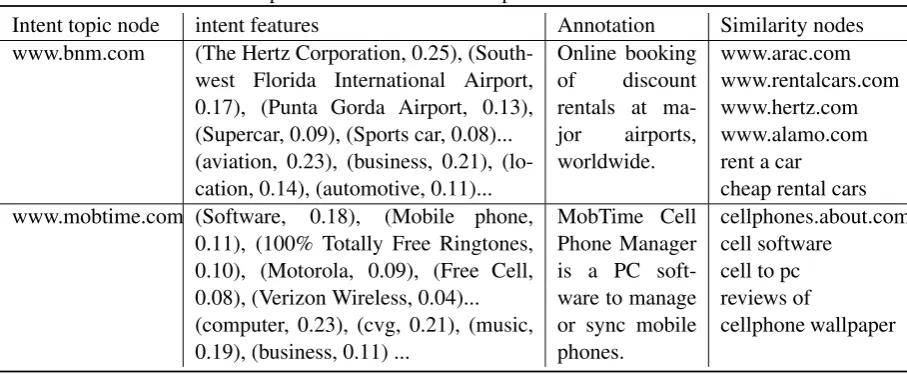
[image:6.595.81.517.220.349.2]Table 3: Examples of unlabelled intent topic nodes with learned feature
Intent topic node intent features Annotation Similarity nodes
www.bnm.com (The Hertz Corporation, 0.25),
(South-west Florida International Airport, 0.17), (Punta Gorda Airport, 0.13), (Supercar, 0.09), (Sports car, 0.08)... (aviation, 0.23), (business, 0.21), (lo-cation, 0.14), (automotive, 0.11)...
Online booking
of discount
rentals at
ma-jor airports,
worldwide.
www.arac.com www.rentalcars.com www.hertz.com www.alamo.com rent a car cheap rental cars www.mobtime.com (Software, 0.18), (Mobile phone,
0.11), (100% Totally Free Ringtones, 0.10), (Motorola, 0.09), (Free Cell, 0.08), (Verizon Wireless, 0.04)... (computer, 0.23), (cvg, 0.21), (music, 0.19), (business, 0.11) ...
MobTime Cell Phone Manager is a PC soft-ware to manage or sync mobile phones.
cellphones.about.com cell software
cell to pc reviews of
cellphone wallpaper
types in Freebase are not proper for describing in-tent, the intent features they get after propagation tend to be more explainable, such as the travel site often co-occurs with city names, tourist attrac-tions, hotels and so on, thus indicating its intent in travel and location domain.
Table 3 shows examples which have no equiv-alents in Freebase. Although some of them may be accessible in other ontologies, we only take them as examples to show our propagation method makes it possible to depict intents behind urls and words in a knowledge graph based way while be-yond the capacity of knowledge graph.
4.3 Session intent understanding task 4.3.1 Experiment Setup
The evaluation of query understanding has long been a challenging task. To judge whether the con-cepts in query are successfully recognized seems too straightforward, and it can hardly be consid-ered understanding the intent until the big idea
about whatkind of topics users emphasis is
cap-tured, which can be briefly sketched by distribu-tion across Freebase domains. Also it is difficult to translate results of previous log analysis methods into knowledge graph domain information, thus hardly fit into our evaluation schema. We take popularity-based method as baseline.
We have few choices but to tag ground truth our-selves for intent understanding evaluation.
We randomly select 150 sessions as test set, the domain distribution of which agrees with the whole query set as shown in Figure 1. As mas-tering meanings of all Freebase domains is too challenging, we ask 5 accessors to describe each
session’s intent broadly with a few natural lan-guage terms, then an expert familiar with Freebase schema translates the words into matched Free-base domains. Each test session is tagged by 2 accessors and 1 expert, we choose to use the tags of the cases in which the accessors reached agree-ment as the gold stantard. For example, if acces-sors tag session intent as pictures, then experts can translate it into Freebase visual art domain. Each
session has 1∼4 tags and 1.6 tags in average. The
tags cover 30 domains.
For each session, we derive the local intent
do-main vectordsfollowing the method in Section 2.
Here we simply set quality functionϕ(r)to a
con-stantλrfor all refiners andϕ(c)toλcfor all clicks,
we’ll dive into more specialized weighting method
in future work.λrandλcare parameters to control
impact of different kinds of intent topics. Based on whether to exploit global intent features of non-entity words, we compare four variations against one baseline.
• Popularity-based (GP). We use domains’
fre-quency in the query set as a baseline.
• Entity-based (E). We only use entity nodes’
original intent features without propagation.
• Entity+Clicks (EC). Both intent features of
entity words and clicks are used, controlled
withλc.
• Entity+Refiners (ER). Intent features of
en-tity words and refiner words are used,
refin-ers’ impact is controlled byλr.
• Entity+Clicks+Refiners (ECR). All intent
0 0.1 0.2 0.3 0.4 0.5 0.6 0.7 0.8 0.9 1 0
0.1 0.2 0.3 0.4 0.5 0.6 0.7 0.8 0.9 1
0.672 0.678 0.684 0.690 0.696 0.702 0.708 0.714 0.720
(a) MAP@5
0 0.1 0.2 0.3 0.4 0.5 0.6 0.7 0.8 0.9 1 0
0.1 0.2 0.3 0.4 0.5 0.6 0.7 0.8 0.9 1
0.18 0.21 0.24 0.27 0.30 0.33 0.36 0.39
(b)GMAP@5
0 0.1 0.2 0.3 0.4 0.5 0.6 0.7 0.8 0.9 1 0
0.1 0.2 0.3 0.4 0.5 0.6 0.7 0.8 0.9 1
0.708 0.714 0.720 0.726 0.732 0.738 0.744 0.750 0.756
(c)MAP@10
0 0.1 0.2 0.3 0.4 0.5 0.6 0.7 0.8 0.9 1 0
0.1 0.2 0.3 0.4 0.5 0.6 0.7 0.8 0.9 1
0.375 0.400 0.425 0.450 0.475 0.500 0.525 0.550 0.575
[image:8.595.136.447.66.338.2](d)GMAP@10
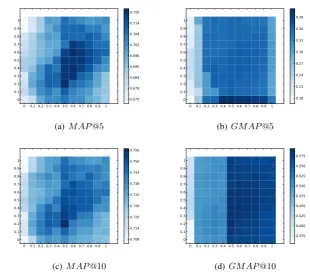
Figure 2: The impact of λrand λc on ECR methods in four metrics, with vertical axis indicating λr,
horizontal axis as λc. The first column on the left denotes ER method, while the bottom row the EC
method.
4.3.2 Evaluation metrics
We use each approach to rank domains accord-ing to its derived weight, then compare it with golden standard set. It can be evaluated using Mean Average Precision (MAP), Geometric MAP
and Precision@K. We use GMAP because it is
more robust to outliers than the arithmetic mean.
For test set of sizeN, the MAP and GMAP can
be calculated as follows:
MAP@k= N1
N
X
i=1
APi@k (15)
GMAP@k= N
v u u tYN
i=1
APi@k (16)
4.3.3 Results and analysis
We first study impact of parameters λr and λc,
which is shown in Figure 2.
It roughly demonstrates different combinations of parameters’ impact on ECR methods, perfor-mance is evaluated in four metrics, with deeper color indicating better result.
Best results comes with a λc larger thanλr in
all four subfigures. This trend seems more
obvi-ous in (d) where right part with largerλcget better
results. Also, deeper colors around diagonal line in (a) (c) indicate a more balanced combination of refiners and urls are more likely to enhance in-tent understanding. Thus we conclude clicks has a weak advantage over refiners in improving the re-sult, while combining both with proper parameters can get the best result.
When comparing between MAP and GMAP, we can see while GMAP stays a high value when am-plifying the impact of clicks, MAP changes with
the variation ofλrfor better or worse. As GMAP
is a more robust metric, we can then infer that in-creasing weight of refiners could bring more out-liers, implying refiners’ intent features are more susceptible to noise.
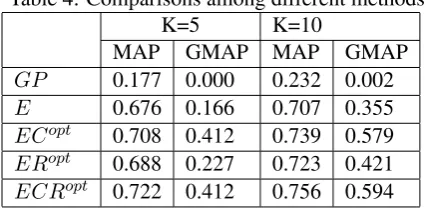
Then we use ER with λr = 0.5 asERopt, EC
with λc = 0.5 as ECopt and ECR with λr =
0.2, λc= 0.5asECRopt.
[image:8.595.116.293.545.626.2]con-0 0.1 0.2 0.3 0.4 0.5 0.6 0.7 0.8
1 3 5 10 20 50
Preci
si
on
@K
[image:9.595.74.289.61.192.2]K GL E ER EC ECR
Figure 3: Precision@K results for different ap-proaches, by varying number of k
Table 4: Comparisons among different methods
K=5 K=10
MAP GMAP MAP GMAP
GP 0.177 0.000 0.232 0.002
E 0.676 0.166 0.707 0.355
ECopt 0.708 0.412 0.739 0.579
ERopt 0.688 0.227 0.723 0.421
ECRopt 0.722 0.412 0.756 0.594
tribute a lot to improve naive entity-based method, which do validate an complment effect of their learned intent features.
5 Related Work
5.1 Query intent understanding
Query intent or search intent has been studied in-tensively from various views.
A popular paradigm is to label several intents for each query, also called facets subgoals and subtopics in the literature, manully or by min-ing methods and then do classification (Hu et al., 2009; Li et al., 2008) based on that. Manually in-tent schemas range from 3 top level (Broder, 2002) to fine-grained subcatogories (Rose and Levinson, 2004) and taxonomy (Yin and Shah, 2010). Intent tasks in NTCIR-10 (Sakai et al., 2013) also pro-vide subtopic pools made by accessors.
Another view of intent is more generic, min-ing or learnmin-ing search intents without any kind of pre-defined intent category and clustering method is often used. Methods including (Sadikov et al., 2010; Yamamoto et al., 2012; Cheung and Li, 2012) cast intent as represented by a pattern or template consisting of a sequence of semantic con-cepts or lexical items. (Tan et al., 2012) encode intent in language models, aware of long-lasting interests. (Ren et al., 2014) uses an unsupervised
heterogeneous clustering. (Yin and Shah, 2010) capture generic intents around a certain named en-tities and model their relationships in a tree tax-onomy and (Wang et al., 2009) mine broad latent modifiers of intent aspect , which are similar to our motivation, while we model more than intent phrases, but intent topics. We do not split queries into clusters or subtopics relevant to the original query to indicate a intent, but link them in an graph with intent feature similarity, weakly or strongly, in a holistical view.
On the other hand, previous research can be categorized by what kind of resources they rely on. Quite an amount of work leverage query logs (Jiang et al., 2013), including query reformula-tions (Radlinski et al., 2010), click-through data (Li et al., 2008). There are also works using spon-sered data (Yamamoto et al., 2012) and interactive data (Ruotsalo et al., 2013). The new trend of in-tegrating knowledge graph will be discussed next.
5.2 Knowledge graph on intent understanding
Instead of summarizing queries into concepts by clustering, recently there appears a tendency to use concpets from knowledge graph resources. Some researchers manage to build entity graph from queries (Bordino et al., 2013a) (Bordino et al., 2013b; Yu et al., 2014), some in a structure view, interpret quries into knowledge base fit template (Pound et al., 2012; Li et al., 2013). (Pantel et al., 2012) models latent intent to mine entity type dis-tributions. (Ren et al., 2014) utilizes knowledge graph resources in a hetrogeneous view. (Lin et al., 2012) also pays attention to refiners, but re-stricted to limited domains, while our method is more general.
6 Conclusion
[image:9.595.71.284.256.362.2]There are several directions for future work, in-cluding using both types and domains in Free-base schema, diving into refiners and looking for a proper weighting method, developing a query rec-ommendation framework based on the intent topic graph and user interest modeling.
Acknowledgments
We sincerely thank all the anonymous reviewers for their valuable comments, which have helped to improve this paper greatly. This work is supported by NSFC with Grant No.61370054, and 973 Pro-gram with Grant No.2014CB340405.
References
Nicholas J Belkin, Robert N Oddy, and Helen M Brooks. 1982. Ask for information retrieval: Part i.
background and theory. Journal of documentation,
38(2):61–71.
Ilaria Bordino, Gianmarco De Francisci Morales, Ing-mar Weber, and Francesco Bonchi. 2013a. From machu picchu to rafting the urubamba river: antici-pating information needs via the entity-query graph. InProceedings of the sixth ACM international con-ference on Web search and data mining, pages 275– 284. ACM.
Ilaria Bordino, Yelena Mejova, and Mounia Lalmas. 2013b. Penguins in sweaters, or serendipitous entity
search on user-generated content. In Proceedings
of the 22nd ACM international conference on Con-ference on information & knowledge management, pages 109–118. ACM.
Andrei Broder. 2002. A taxonomy of web search.
SI-GIR Forum, 36(2):3–10, September.
Moses S Charikar. 2002. Similarity estimation
tech-niques from rounding algorithms. InProceedings of
the thiry-fourth annual ACM symposium on Theory of computing, pages 380–388. ACM.
Jackie Chi Kit Cheung and Xiao Li. 2012. Sequence clustering and labeling for unsupervised query intent
discovery. InProceedings of the fifth ACM
interna-tional conference on Web search and data mining, pages 383–392. ACM.
W Bruce Croft, Michael Bendersky, Hang Li, and Gu Xu. 2010. Query representation and
understand-ing workshop. In SIGIR Forum, volume 44, pages
48–53.
Paolo Ferragina and Ugo Scaiella. 2012. Fast and accurate annotation of short texts with wikipedia
pages. IEEE software, 29(1).
Jian Hu, Gang Wang, Fred Lochovsky, Jian-tao Sun, and Zheng Chen. 2009. Understanding user’s query
intent with wikipedia. In Proceedings of the 18th
international conference on World wide web, pages 471–480. ACM.
Piotr Indyk and Rajeev Motwani. 1998. Approxi-mate nearest neighbors: towards removing the curse
of dimensionality. In Proceedings of the thirtieth
annual ACM symposium on Theory of computing, pages 604–613. ACM.
Daxin Jiang, Jian Pei, and Hang Li. 2013. Mining search and browse logs for web search: A survey.
ACM Trans. Intell. Syst. Technol., 4(4):57:1–57:37, October.
Xiao Li, Ye-Yi Wang, and Alex Acero. 2008. Learn-ing query intent from regularized click graphs. In
Proceedings of the 31st Annual International ACM SIGIR Conference on Research and Development in Information Retrieval, SIGIR ’08, pages 339–346, New York, NY, USA. ACM.
Yanen Li, Bo-June Paul Hsu, and ChengXiang Zhai. 2013. Unsupervised identification of synonymous
query intent templates for attribute intents. In
Pro-ceedings of the 22nd ACM international conference on Conference on information & knowledge management, CIKM ’13, pages 2029–2038, New York, NY, USA. ACM.
Thomas Lin, Patrick Pantel, Michael Gamon, Anitha Kannan, and Ariel Fuxman. 2012. Active objects:
Actions for entity-centric search. In Proceedings
of the 21st international conference on World Wide
Web, pages 589–598. ACM.
Patrick Pantel, Thomas Lin, and Michael Gamon. 2012. Mining entity types from query logs via user
intent modeling. In Proceedings of the 50th
An-nual Meeting of the Association for Computational Linguistics: Long Papers-Volume 1, pages 563–571. Association for Computational Linguistics.
Jeffrey Pound, Alexander K Hudek, Ihab F Ilyas, and Grant Weddell. 2012. Interpreting keyword queries
over web knowledge bases. In Proceedings of the
21st ACM international conference on Information and knowledge management, pages 305–314. ACM. Filip Radlinski, Martin Szummer, and Nick Craswell. 2010. Inferring query intent from reformulations
and clicks. InProceedings of the 19th international
conference on World wide web, pages 1171–1172. ACM.
Xiang Ren, Yujing Wang, Xiao Yu, Jun Yan, Zheng Chen, and Jiawei Han. 2014. Heterogeneous graph-based intent learning with queries, web pages and
wikipedia concepts. InProceedings of the 7th ACM
International Conference on Web Search and Data Mining, WSDM ’14, pages 23–32, New York, NY, USA. ACM.
Daniel E. Rose and Danny Levinson. 2004.
Un-derstanding user goals in web search. In
Wide Web, WWW ’04, pages 13–19, New York, NY, USA. ACM.
Tuukka Ruotsalo, Jaakko Peltonen, Manuel Eugster, Dorota Głowacka, Ksenia Konyushkova, Kumari-paba Athukorala, Ilkka Kosunen, Aki Reijonen, Petri Myllym¨aki, Giulio Jacucci, et al. 2013. Di-recting exploratory search with interactive intent
modeling. InProceedings of the 22nd ACM
interna-tional conference on Conference on information & knowledge management, pages 1759–1764. ACM. Eldar Sadikov, Jayant Madhavan, Lu Wang, and Alon
Halevy. 2010. Clustering query refinements by user
intent. InProceedings of the 19th international
con-ference on World wide web, pages 841–850. ACM. Tetsuya Sakai, Zhicheng Dou, Takehiro Yamamoto,
Yiqun Liu, Min Zhang, Ruihua Song, MP Kato, and M Iwata. 2013. Overview of the ntcir-10 intent-2
task. Proceedings of NTCIR-10, pages 94–123.
Bin Tan, Yuanhua Lv, and ChengXiang Zhai. 2012. Mining long-lasting exploratory user interests from
search history. InProceedings of the 21st ACM
in-ternational conference on Information and knowl-edge management, pages 1477–1481. ACM. Xuanhui Wang, Deepayan Chakrabarti, and Kunal
Punera. 2009. Mining broad latent query aspects
from search sessions. In Proceedings of the 15th
ACM SIGKDD international conference on Knowl-edge discovery and data mining, pages 867–876. ACM.
Takehiro Yamamoto, Tetsuya Sakai, Mayu Iwata, Chen Yu, Ji-Rong Wen, and Katsumi Tanaka. 2012. The wisdom of advertisers: mining subgoals via query
clustering. In Proceedings of the 21st ACM
inter-national conference on Information and knowledge management, pages 505–514. ACM.
Xiaoxin Yin and Sarthak Shah. 2010. Building taxon-omy of web search intents for name entity queries. InProceedings of the 19th international conference on World wide web, pages 1001–1010. ACM. Xiao Yu, Hao Ma, Bo-June (Paul) Hsu, and Jiawei Han.
2014. On building entity recommender systems
us-ing user click log and freebase knowledge. In
Pro-ceedings of the 7th ACM International Conference on Web Search and Data Mining, WSDM ’14, pages 263–272, New York, NY, USA. ACM.
Xiaojin Zhu and Zoubin Ghahramani. 2002. Learning from labeled and unlabeled data with label propa-gation. Technical report, Technical Report CMU-CALD-02-107, Carnegie Mellon University. Xiaojin Zhu, Zoubin Ghahramani, John Lafferty, et al.
2003. Semi-supervised learning using gaussian
fields and harmonic functions. InICML, volume 3,