1326
Adaptation of Hierarchical Structured Models for Speech Act Recognition
in Asynchronous Conversation
Tasnim Mohiuddin1∗and Thanh-Tung Nguyen1? and Shafiq Joty1,2?
?Nanyang Technological University, Singapore
†Salesforce Research Asia, Singapore
{mohi0004@e.,NG0155NG@e.,srjoty@}ntu.edu.sg
Abstract
We address the problem of speech act recog-nition (SAR) in asynchronous conversations (forums, emails). Unlike synchronous conver-sations (e.g., meetings, phone), asynchronous domains lack large labeled datasets to train an effective SAR model. In this paper, we propose methods to effectively leverage abun-dant unlabeled conversational data and the available labeled data from synchronous do-mains. We carry out our research in three main steps. First, we introduce a neural architec-ture based on hierarchical LSTMs and condi-tional random fields (CRF) for SAR, and show that our method outperforms existing methods when trained on in-domain data only. Second, we improve our initial SAR models by semi-supervised learning in the form of pretrained word embeddings learned from a large unla-beled conversational corpus. Finally, we em-ploy adversarial training to improve the results further by leveraging the labeled data from synchronous domains and by explicitly mod-eling the distributional shift in two domains.
1 Introduction
With the ever-increasing popularity of Internet and mobile technologies, communication media like emails and forums have become an inte-gral part of people’s daily life where they discuss events, issues and experiences. Participants inter-act with each other asynchronously in these me-dia by writing at different times, generating a type of conversational discourse that is different from synchronous conversations such as meeting and phone conversations (Louis and Cohen,2015). In the course of the interactions, the participants per-form certain communicative acts like asking ques-tions, requesting information, or suggesting some-thing, which are known as speech acts (Austin,
∗
All authors contibuted equally.
C1:hoping to do the XinJiang Tibet Highway. [Statement]
Has anyone done it? [Question]
Am hoping to hire a 4-wheel drive. [Statement]
I know the roads are bad and I would need an experienced
driver and guide - any recommendations? [Question]
C2:I never done this routine,however i been to Xinjiang
twice,in my opinion the local people not friendly, not safe
to do this. [Response]
I still have relative stay in Xinjiang, however don’t know
what they can offer for help... [Response]
C3:I’m not sure if travelling overland from Xinjiang to Tibet
is officially legal yet. [Response]
You might want to post your question on the North-East Asia branch of Lonely Planet’s ThornTree forum for
more (useful) answers. [Suggestion]
C4:a frend and i are trying this route as well, we will likely
be in urumuqi and northern part of xinjiang from 8th apr to end apr; looking at doing the xin jiang tibet highway
from end apr. (truncated) [Statement]
contact me at [email] if you want to hook up for possible
transport sharing [Suggestion]
cheers. [Polite]
Figure 1: Example of speech acts in a forum thread.
1962). For example, consider the forum conversa-tion in Figure1. The participant who posted the initial comment C1, describes his situation and
asks a couple ofquestions. Other participants re-spondto the initial post with more information and providesuggestions. In this process, the partici-pants get into a conversation by taking turns, each of which consists of one or more speech acts.
Speech act recognition (SAR) is an
are not available in the asynchronous domains, and many of the existing (small-sized) ones use task-specific tagsets as opposed to a standard one. The unavailability of large annotated datasets with standard tagsets is one of the main reasons for SAR not getting much attention in asynchronous domains, and it is often quite expensive to anno-tate such datasets for each domain of interest.
SAR methods proposed before the neural ‘tsunami’, e.g., (Qadir and Riloff, 2011; Jeong et al., 2009; Tavafi et al., 2013), used mostly bag-of-ngram representation (e.g., unigram, bi-gram) of a sentence, and most of these methods disregard conversational dependencies (discourse structure) between sentences. Recently, Joty and Hoque(2016) proposed a neural-CRF framework for SAR in forum conversations. In their ap-proach, a bi-LSTM (trained on the SAR task) first encodes the sentences separately into task-specific embeddings, which are then used in a separate CRF model to capture the conversational depen-dencies between sentences. They also use la-beled data from the MRDA meeting corpus, with-out which their LSTMs perform worse than simple feed-forward networks. Although their method at-tempts to model sentence structure (using LSTM) and conversational dependencies (using CRF), the approach has several limitations.
First, the LSTM-CRF framework was disjoint, and thus cannot be trained end-to-end. Second, when using the MRDA meeting data, their method simply concatenates it with the target domain data assuming they have the same distribution. How-ever, asynchronous domains (forum, email) dif-fer from synchronous (MRDA) in their underlying conversational structure (Louis and Cohen,2015), in style (spoken vs. written), and in vocabulary us-age (meetings on some focused us-agenda vs. conver-sations on any topic of interests in a public forum). Therefore, we hypothesize that to make the best use of labeled data from synchronous domains, one needs to model the shift in domains.
In this work, we advance the state-of-the-art of SAR in asynchronous conversations in three main steps. First, we introduce an end-to-end neural architecture based on a hierarchical LSTM en-coder with a Softmax or CRF output layer. Sec-ond, we improve our initial SAR model by semi-supervised learning in the form of word embed-dings learned from a large unlabeled conversa-tional corpus. Most importantly, we adapt our
hi-erarchical LSTM encoder using domain adversar-ial training (Ganin et al.,2016) to leverage the la-beled data from synchronous domains by explic-itly modeling the shift in the two domains.
We evaluate our models on three different asyn-chronous datasets containing forum and email conversations, and on the MRDA meeting cor-pus. Our main findings are: (i) the hierarchi-cal LSTMs outperform existing methods when trained on in-domain data for both synchronous and asynchronous domains, setting a new state-of-the-art; (ii) conversational word embeddings yield significant improvements over off-the-shelf ones; and (iii) domain adversarial training im-proves the results by inducing domain-invariant features. The source code, the conversational word embeddings, and the datasets are avail-able at https://ntunlpsg.github.io/ demo/project/speech-act/.
2 Related Work
Previous studies on SAR in asynchronous
con-versation have used supervised, semi-supervised
and unsupervised methods. Cohen et al. (2004) classify emails into acts like ‘deliver’ and ‘meet-ing’. Their approach however does not take email context into account. Carvalho and Cohen(2005) use an iterative algorithm containing two different classifiers: the content classifier that only looks at the content of the message, and the context clas-sifier that takes into account both the content and contextual speech acts in the email thread struc-ture. Other supervised approaches use classifiers and sequence taggers with hand-crafted features (Qadir and Riloff,2011;Tavafi et al.,2013).
The unsupervised methods use variations of Hidden Markov Models (HMM) including HMM-Topic (Ritter et al.,2010), HMM-Mix (Joty et al., 2011), and Mixed Membership (Paul,2012).
Several neural methods have been proposed in recent years for SAR in synchronous
con-versations. Kalchbrenner and Blunsom (2013)
use a simple recurrent neural network (RNN) to model sequential dependencies between act types in phone conversations. They use a convolutional network to compose sentence representations from word vectors. Lee and Dernoncourt (2016) use a similar model, but also experiment with RNNs to compose sentence representations. Khanpour et al. (2016) use a stacked LSTM to compose word vectors into a sentence vector. Kumar et al. (2018) also use a hierarchical LSTM-CRF. How-ever, none of these methods were applied to asyn-chronous conversations, where not much labeled data is available. Also to the best of our knowl-edge, no prior work attempted to do domain adap-tation from the synchronous conversation, which is our main contribution in this paper.
3 The Base Model
We use a bidirectional long short-term memory or bi-LSTM (Hochreiter and Schmidhuber,1997) to encode each sentence into a vector representation. Given an input sentence xi = (w1,· · ·, wm) of
length m, we first map each word wt to its
cor-responding vector representationvtby looking up
the word embedding matrix. The LSTM recurrent layer then computes a compositional representa-tionztat every time steptby performing
nonlin-ear transformations of the current inputvtand the
output of the previous time stepzt−1. The output of the last time stepzmis considered as the
repre-sentation of the sentence. A bi-LSTM composes a sentence in two directions: left-to-right and right-to-left, yielding a representation hi = [−z→m;←z−m],
where ‘;’ denotes concatenation. Similar to (Joty and Hoque,2016), we could usehito classify
sen-tencexi into one of the speech act types using a
Softmax output layer. However, in that case, we would disregard the discourse-level dependencies between sentences in a conversation. To take con-versational dependencies into account, we explore two methods as we describe below.
3.1 Hierarchical LSTM
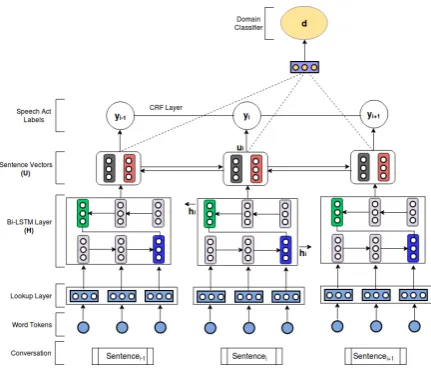
[image:3.595.309.525.60.245.2]We consider a conversation as a sequence of utter-ances (sentences). Given an input sequence of n
Figure 2: Hierarchical bi-LSTM-CRF model with do-main adversarial training for speech act recognition.
sentencesX = (x1,· · ·,xn), the sentence-level
bi-LSTM generates a sequence ofnvectorsH = (h1,· · · ,hn). To consider interdependencies
be-tween sentences, we place another bi-LSTM layer on top of H to connect the sentence vectors se-quentially in both directions, and encode each sen-tence within its left and right contexts. As shown in Figure2, the upper bi-LSTM combines the cur-rent inputhi with its previous hidden state−→ui−1 (resp.,←u−i+1) to generate a representation for the current sentence −→ui (resp., ←u−i). The
hierarchi-cally encoded sentence vectorsU= (u1,· · · ,un)
(whereui = [−→ui;←u−i]) are fed into a Softmax
clas-sifier for speech act classification.
p(yi =k|X, W, θ) =
exp (wT kui)
PK
k=1exp (wTkui)
whereW are the classifier weights, andθare the parameters of the hierarchical LSTM encoder. We train the model by minimizing the cross entropy:
Lc(W, θ) =− n
X
i=1
K
X
k=1
yi,klogp(yi =k|X, W, θ)
withyi,k being the one-hot encoding of the label.
3.2 Hierarchical LSTM with CRF
to structured models that use global inference to model consistency in the output, especially when there are strong dependencies between output la-bels (Collobert et al.,2011). Therefore, instead of classifying sentences independently with a Soft-max layer, our second method is to model them jointly with a CRF layer (Lafferty et al., 2001). For an input-output sequence pair(X,y), we de-fine the joint probability distribution:
p(y|X) = 1
Z(U, A, V, θ)
n Y
i=1
ψn(yi|ui, V) | {z }
node factor
n Y
i=0
ψe(yi,i+1|A)
| {z }
edge factor
whereU= (u1,· · ·,un)is the hierarchically
en-coded sentence vectors as before, and ψn(yi =
k|ui, V) = exp(VkTui) is the node-level score
with V being the weight matrix, ψe is the
tran-sition matrix parameterized byA, andZ(.) is the global normalization constant that ensures a valid probability distribution. The cross entropy loss for the(X,y)sequence pair can be written as:
Lc(V, A, θ) =− n X
i=1
logψn(yi|ui, V)− n X
i=0
logAi,i+1+logZ
We use Viterbi decoding to infer the most probable tag sequence for an input sequence of sentences,
y∗= argmaxyp(y|X, V, A, θ). We will demon-strate later in our experiments that a CRF layer helps the H-LSTM to adapt quickly (i.e.,with less labeled data) to a target domain by exploiting the tag dependencies in the source domain.
4 Adaptation Methods
The hierarchical models have many parameters. Given enough training data, they should be able to encode a sentence, capturing its syntactic and se-mantic properties, and discourse-level dependen-cies. However, when it comes to SAR in asyn-chronous domains, not many large annotated cor-pora are available. Because of the large number of parameters, the models usually overfit when trained on small datasets of asynchronous conver-sations (shown in Sec. 6). We propose two solu-tions to address this problem. Our first (simple but effective) solution is to leverage large unlabeled conversational corpus to learn better task-agnostic word embeddings, and use it to initialize our mod-els for better generalization. In the interests of co-herence, we present this method in Section5.
Our second solution is to leverage data from synchronous domains for which large annotated
corpus is available (e.g., MRDA corpus). How-ever, as we will see, simple concatenation of the datasets is not quite effective in our case, be-cause the conversations in synchronous and asyn-chronous domains differ in their conversational structures, modality (spoken vs. written), and vo-cabulary usage. To get the best out of the available synchronous domain data, we need to adapt our models by explicitly modeling the domain shift. More precisely, our goal is to adapt the hierarchi-cal encoder so that it learns to encode sentence representations U (i.e., features used for classi-fication) that is not only discriminative for the act classification, but also invariant across the do-mains. We propose to use thedomain adversarial
trainingproposed byGanin et al.(2016).
LetDS ={Xp,yp}Pp=1 denote the set ofP la-beled training conversations in thesourcedomain (MRDA). We consider two adaptation scenarios.
(i) Unsupervised adaptation: In this scenario,
we have onlyunlabeledexamples in thetarget do-main (e.g.,forum). LetDu
T ={Xp}Qp=P+1be the set of(Q−P−1)unlabeled training instances in the target domain withQbeing the total number of training instances in the two domains.
(ii) Semi-supervised/supervised adaptation:
In addition to the unlabeled instancesDu
T, here we
have access to somelabeledtraining instances in the target domain,Dl
T ={Xp,yp}Rp=Q+1, withR being the total number of training examples in the two domains. Depending on the amount of labeled data in the target domain, this setting is referred to as semi-supervised or supervised adaptation.
4.1 Unsupervised Adaptation
The dashed lines in Figure 2show the extension of our base model for adaptation. The input con-versationXis sampled either from a synchronous domain (e.g., meeting) or from an asynchronous domain (e.g., forum). Our goal is to adapt the H-LSTM encoder (parameterized by θ) to gener-ateU such that it is not only informative for the SAR task but also invariant across domains. Upon achieving this, we can use the adapted encoder to encode a target sentence, and use the source clas-sifier (Softmax or CRF) to classify the sentences.
We achieve this by adding a domain discrimina-tor (dashed lines in Figure2), another neural net-work that takesUas input, and tries to discrimi-nate the domains of the input conversationX(e.g.,
discrimina-tor is defined by a sigmoid function:
ˆ
dω =p(d= 1|ui, ω, θ) = sigm(wTdhd) (1)
whered∈ {0,1}denotes the domain (1for meet-ing,0for forum),wdare the final layer weights of
the discriminator, and hd = g(Udui) defines the
hidden layer of the discriminator with Ud being
the layer weights, andg(.) being the activations. We use cross entropy as the discrimination loss:
Ld(ω, θ) =−dlog ˆdω−(1−d) log
1−dˆω
(2)
The composite network has three players: the hier-archicalLSTM encoder, theclassifier(Softmax or CRF), and the domain discriminator. Dur-ing trainDur-ing, the encoder and the classifier play a co-operative game, while the encoder and the dis-criminator play an adversarial game. The training objectiveL(W, θ, ω)of the composite model is:
P X
p=1
Lpc(W, θ)
| {z }
act classif (src)
−λh
P X
p=1
Lpd(ω, θ)
| {z }
domain disc (src) +
Q X
p=P+1
Lpd(ω, θ)
| {z }
domain disc (tar)
i
(3)
where θ are the parameters of the encoder, W
are the classifier weights, andω = {Ud,wd}are
the parameters of the discriminator.1 The hyper-parameter λ controls the relative strength of the act classifier and the discriminator. We learnθthat optimizes the followingmin-maxcriterion:
θ∗ = argmin
W,θ
max
Ud,wd
L(W, θ, ω) (4)
Note that the updates of the shared encoder for the two networks (classifier and discrimina-tor) workadversariallywith respect to each other. Algorithm1 provides pseudocode of our training method. The main challenge in adversarial train-ing is to balance the networks (Arjovsky et al., 2017). In our experiments, we found the discrim-inator to be weaker initially. To balance the two components, we would need the error signals from the discriminator to be fairly weak initially, with full power unleashed only as the classification er-rors start to dominate. We follow the weighting schedule proposed in (Ganin et al.,2016, p. 21), which initializesλto0, and then changes it grad-ually to1as training progresses.
1For simplicity, we describe adaptation of the encoder
with Softmax output, but this generalizes naturally to CRF.
Algorithm 1:Adversarial training with SGD.
Input :DataDS,DuT, and batch sizeb
Output:Adapted model parametersθ, W 1. Initialize model parameters;
2.repeat
(a) Randomly sampleb
2 labeled examples fromDS
(b) Randomly sampleb
2 unlabeled examples from
Du T
(c) ComputeLc(W, θ)andLd(ω, θ)
(d) Setλ=1+exp(−10∗2 p)−1;pis the training
progress linearly changing form0to1.
// Classifier & Encoder
(e) Take a gradient step for2b∇W,θLc(W, θ)
// Discriminator
(f) Take a gradient step for2bλ∇Ud,wdLd(ω, θ)
// Gradient reversal
(g) Take a gradient step for−2λ
b ∇θLd(ω, θ)
untilconvergence;
4.2 Semi-supervised/supervised Adaptation
It is straight-forward to extend our adaptation method to a semi-supervised/supervised setting. Similar to the instances in the source domain, the labeled instances in the target domainDl
T are used
for act classification and domain discrimination. The total training loss in this case is
L(W, θ, ω) =
P X
p=1
Lpc(W, θ)
| {z }
act classif. (source) +
R X
p=Q+1
Lpc(W, θ)
| {z }
act classif. (target)
− λh P X p=1 Lp d(ω, θ)
| {z }
dom classif. (source) +
R X
n=P+1
Lp d(ω, θ)
| {z } dom classif. (target)
i
where the second term is the classification loss on the target datasetDl
T, and the last term is the
discrimination loss on both labeled and unlabeled data in the target domain.
5 Corpora
We now describe the datasets and the act tagset that we use, and the conversational word embed-dings that we learn from a large unlabeled corpus.
5.1 Labeled Datasets
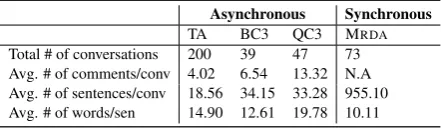
Asynchronous Synchronous
TA BC3 QC3 MRDA
[image:6.595.306.526.63.138.2]Total # of conversations 200 39 47 73 Avg. # of comments/conv 4.02 6.54 13.32 N.A Avg. # of sentences/conv 18.56 34.15 33.28 955.10 Avg. # of words/sen 14.90 12.61 19.78 10.11
Table 1: Basic statistics about our corpora.
Asynchronous Synchronous
Tag Description TA BC3 QC3 MRDA
SU Suggestion 7.71 5.48 17.38 5.97
R Response 2.4 3.75 5.24 15.63
Q Questions 14.71 8.41 12.59 8.62
P Polite 9.57 8.63 6.13 3.77
[image:6.595.74.295.64.128.2]ST Statement 65.62 73.72 58.66 66.00
Table 2: Distribution of speech acts in our corpora.
and Hoque,2016) used these datasets but grouped the 12 acts into 5 coarser classes. Joty and Hoque (2016) also created a new dataset of QatarLiving2
forum threads called QC3.3 We use these three
asynchronous datasets in our experiments. For our experiments on synchronous domains, we use the
MRDA meetingcorpus that was also used in
re-lated studies (Jeong et al.,2009;Joty and Hoque, 2016). Tables 1 and 2 show some basic statis-tics of the datasets and the tag distributions. Note that the tagset used by us and other related studies in asynchronous (written) conversation is differ-ent from the one used in synchronous spoken con-versations (Lee and Dernoncourt,2016;Khanpour et al.,2016;Kumar et al.,2018). The later tagset contains acts likebackchannel, filter and disrup-tionthat are more specific to speech.
The train-dev-test splits of the asynchronous datasets are done uniformly at random at the
con-versation level. Since the asynchronous datasets
are quite small in size, to have a reliable test set, we create the train:test splits with an equal number of conversations (Table3).Joty and Hoque(2016) also created conversation level datasets to train and test their CRF models. Their test sets however contain only 20% of the conversations, providing only 5 conversations for QC3 and BC3, and 20 for TA. Our experiments on these small test sets showed unstable results for all the models. There-fore, we use a larger test set (50%), and we report more general results on the whole corpus based on
2-foldcross-validation, where the second fold was
2
http://www.qatarliving.com/
3https://ntunlpsg.github.io/project/speech-act/
Train Dev. Test
Source MRDA 59 (50865) 6 (8366) 8 (10492)
Target
TA 90 (1667) 20 (427) 90 (1617)
QC3 20 (675) 7 (230) 20 (660)
BC3 16 (557) 7 (233) 16 (542)
Total 126 (2899) 34 (890) 126 (2819)
Table 3: Train, dev. and test sets for the datasets. Num-bers in parentheses indicate the number of sentences.
# of Threads # of Tokens # of Words
W3C 23,940 21,465,830 546,921
TripAdvisor 25,000 2,037,239 127,333
Qatar Living 219,690 103,255,922 1,157,757
MRDA - 675,110 18,514
[image:6.595.74.293.168.249.2]SWBD - 1,131,516 57,075
Table 4: Datasets and their statistics used for training the conversational word embeddings.
created by interchanging the train and test splits in Table 3. The same development set was used to tune the hyperparameters of the models for exper-iments on each fold. For experexper-iments on MRDA, we use the same train:test:dev split as in (Jeong et al.,2009;Joty and Hoque,2016).
5.2 Conversational Word Embeddings
One simple and effective approach to semi-supervised learning is to use word embeddings pretrained from a large unlabeled corpus. In our work, we use genericoff-the-shelf pretrained em-beddings to boost the performance of our models. In addition, we have also trained word embeddings from a large conversational corpus to get more rel-evantconversationalword embeddings.
We use Glove (Pennington et al.,2014) to train our word embeddings from a corpus that con-tains 24K email threads from W3C (w3c.org), 25K threads from TripAdvisor, 220K threads from QatarLiving, and all conversations from SWBD and MRDA (a total of 120M tokens). Table 4 shows some statistics of the datasets used for train-ing the conversational word embeddtrain-ings. We also trained skip-gram word2vec (Mikolov et al., 2013), but its performance was worse than Glove.
6 Experiments
[image:6.595.306.528.184.261.2]compar-QC3 TA BC3 MRDA SVMc-gl 16.96±0.00 20.17±0.00 17.20±0.00 31.47±0.00
FFNc-gl 48.29±0.25 61.36±0.21 39.58±0.26 71.12±0.13
FFNskip-th 50.80±1.21 61.44±0.92 47.67±0.74 71.73±0.48
B-LSTMrand 50.25±0.57 62.11±0.64 45.08±1.03 70.72±0.02
B-LSTMgl 53.21±0.77 63.23±0.80 49.04±0.90 72.23±0.18
B-GRUc-gl 60.50±0.36 67.23±0.76 55.45±1.05 72.04±0.35
B-LSTMc-gl 61.01±0.60 67.23±0.70 55.32±0.68 72.42±0.14
S-LSTMc-gl 56.70±0.58 62.28±1.23 52.31±0.86 71.32±0.28
[image:7.595.142.456.58.207.2]H-LSTMc-gl 60.76±0.99 68.38±0.65 57.17±0.87 72.91±0.14 H-LSTM-CRFc-gl 59.83±1.27 68.10±0.68 56.37±0.61 72.77±0.17
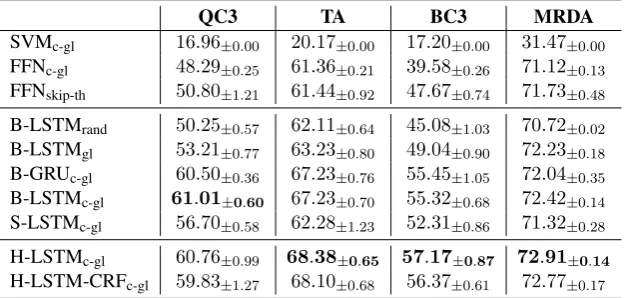
Table 5: Macro-F1scores for in-domain training.
ison, we useaccuracyandmacro-F1. Like other
related studies, we consider macro-F1 as the main metric (more appropriate when class distributions are imbalanced), and select our model based on the bestF1 on the development set. Due to space limitations, we report only macro-F1 here. Please refer to the Appendix for the accuracy numbers.
6.1 Experiments on In-domain Training
We first evaluate our base models on in-domain datasets by comparing with state-of-the-art mod-els. In the next subsection, we evaluate our adap-tation method in the three adapadap-tation scenarios.
Settings. To validate the efficacy of our model,
we compare it with two baselines: a Support Vec-tor Machine (SVM) and a feed-forward network (FFN). In one setting, we use the concatenated word vectors as the input sentence representa-tion, while in another, we use the pretrained skip-thought vectors (Kiros et al.,2015). We also com-pare our models with the bi-LSTM (B-LSTM) model ofJoty and Hoque(2016) and the stacked LSTM (S-LSTM) ofKhanpour et al.(2016).
We use the Adam optimizer (Kingma and Ba, 2014) with a learning rate of 0.001, and use dropout to avoid over-fitting. We use the Xavier initializer (Glorot and Bengio, 2010) to initialize the weights, and uniform U(−0.05,0.05) to ini-tialize the word vectors randomly. For pretrained word embeddings, we experiment with off-the-shelf embeddings that come with Glove as well as with our conversational word embeddings. For both random and pretrained initialization, we fine-tuneour word embeddings on the SAR task.
We construct sequences from thechronological
order of the sentences in a conversation. Since
MRDA conversations are much longer compared to those in asynchronous domains (955 vs. 18-34
sentences in Table 1), we split the MRDA con-versations into smaller parts containing a maxi-mum of 100 sentences.4 The number of epochs and batch size were fixed to 30 and 5 (conver-sations), respectively. We ran each experiment
5 times, each time with a different random seed, and report the average of the (2-fold×5=10) runs along with the standard deviation. Recently,Crane (2018) show that the main source of variability in results for neural models come from the random seed, and the author has recommended to report the distribution of results from a range of seeds.
Results. We present the results in Table5. From
thefirst blockof results, we notice that both SVM
and FFN baselines perform poorly compared to other models that tune the word embeddings and learn the sentence representation on the SAR task.
Thesecond blockcontains five LSTM variants:
(i)B-LSTMrand, referring to bi-LSTM with
ran-dominitialization; (ii)B-LSTMgl, referring to
bi-LSTM initialized withoff-the-shelf Glove embed-dings; (iii) B-GRUc-gl, referring to bidirectional
Gated Recurrent Unit (Cho et al.,2014) initialized with ourconversational Glove; (iv) B-LSTMc-gl,
referring to bi-LSTM initialized with conversa-tionalGlove, and (v)S-LSTMc-gl, referring to a
2-layer stacked LSTM withconversational Glove.5 From the results, we can make the following con-clusions. First, B-LSTMrandoverfits extremely on
4
In a different setting, we created sequences by connect-ing each non-initial comment with the initial comment gen-erating many 2-comment sequences. This is considering the fact that in many QA forums, users mostly answer to the questions asked in the initial post. In our experiments on in-domain training, we found this competitive with our ‘one long-chain’ structure. However, the adaptation in this setting was much worse because of the mismatch in discourse struc-tures of synchronous and asynchronous conversations.
5Increasing the number of layers inS-LSTM
c-gldid not
the asynchronous datasets, giving the worst results among the LSTMs. Second, pretrained vectors help to achieve better results, however, compared to the off-the-shelf vectors, our conversational word vectors yield much higher F1, especially, in the asynchronous datasets that are smaller in size (5 - 11% absolute gains). This demonstrates that pretrained word embeddings provide an effec-tive method to perform semi-supervised learning, when they are learned from relevant datasets.
Thelast blockshows the results of our models.
It is evident that both H-LSTM and H-LSTM-CRF outperform other models in all the datasets except QC3 where the difference is very small. They also give the bestF1reported so far on MRDA, outper-forming the B-LSTM models of Joty and Hoque (2016) and S-LSTM model of Khanpour et al. (2016). When we compare the two models, we notice that H-LSTM outperforms H-LSTM-CRF in all the datasets. A reason for this could be that the contextual dependency is already captured by the upper LSTM layer and the data may be too small for the CRF to offer anything more.
6.2 Experiments on Domain Adaptation
Settings. We compare our adversarial
adapta-tion method with three baseline methods: Trans-fer, Merge and Fine-tune. Transfer models are trained on the source (MRDA) and tested on the target (QC3, TA, BC3). Our adversarial
unsu-pervised adaptationmethod is comparable to the
transfer method as they use labeled data only from the source domain. InMerge, models are trained on the concatenated training set of source and tar-get datasets. Fine-tune is a widely used adapta-tion method for neural models (Chu and Wang, 2018). In this method, we first train a model on the source domain until convergence, then we fine-tune it on the target by training it further on the target dataset. Both merge and fine-tune are com-parable to oursemi-supervised/supervised
adap-tationas these methods use labeled data from the
target domain. For semi-supervised experiments, we take smaller subsets (e.g.,25%, 50%, and 75% of the labeled data) from the target domain.
We also compare our method withNeural SCL
(Ziser and Reichart, 2017), which is another do-main adaption method in the neural framework. We used the implementation made available by the authors.6 For training our adaptation models,
6
https://github.com/yftah89/structural-correspondence-learning-SCL
Method Model QC3 TA BC3
Transfer
SVM 17.78±0.00 20.44±0.00 17.85±0.00
FFN 46.91±0.00 56.30±0.00 46.74±0.00
S-LSTM 49.89±1.29 62.52±1.49 36.36±1.28
B-LSTM 50.50±0.91 65.47±0.62 35.92±0.62
H-LSTM 50.22±0.64 64.43±0.52 35.11±1.64
H-LSTM-CRF 50.83±0.70 63.80±0.81 34.45±1.42
Unsup. adapt
Neural SCL 37.73±0.92 53.98±0.33 46.90±0.89
Adv-S-LSTM 43.36±1.44 48.51±0.51 42.05±0.21
Adv-B-LSTM 47.39±0.74 58.49±1.29 32.86±1.35
Adv-H-LSTM 46.53±1.48 52.90±1.20 31.36±1.91
Adv-H-LSTM-CRF 47.06±1.24 61.58±0.78 29.54±1.06
Merge (50%)
S-LSTM 55.39±0.29 67.79±0.15 50.82±0.98
B-LSTM 55.08±0.67 68.99±0.35 51.05±0.60
H-LSTM 51.74±0.44 69.09±0.64 47.82±1.47
H-LSTM-CRF 50.92±0.48 68.66±0.12 48.58±0.59
Fine-tune (50%)
S-LSTM 53.94±1.04 66.07±0.67 51.73±1.53
B-LSTM 54.81±0.48 68.43±0.51 52.26±0.82
H-LSTM 54.34±0.71 69.16±0.66 50.81±0.97
H-LSTM-CRF 54.97±0.87 69.91±0.53 51.42±1.24
Semisup. adapt (50%)
Neural SCL 41.46±0.75 58.85±0.27 48.32±0.19
Adv-S-LSTM 60.20±0.32 68.71±0.75 57.97±0.39
Adv-B-LSTM 58.57±0.80 66.51±0.81 54.39±1.28
Adv-H-LSTM 60.19±1.10 69.43±0.64 58.39±1.12
Adv-H-LSTM-CRF 61.81±0.63 70.34±0.62 59.43±1.41
Merge (100%)
S-LSTM 59.18±1.40 66.93±1.70 54.87±1.47
B-LSTM 58.33±0.84 70.12±0.39 55.89±0.89
H-LSTM 59.85±0.57 70.40±0.41 57.19±0.87
H-LSTM-CRF 59.53±0.66 69.88±0.68 56.04±1.15
Fine-tune (100%)
S-LSTM 56.67±0.85 67.41±0.34 56.40±0.44
B-LSTM 59.74±0.53 69.87±0.82 57.09±1.14
H-LSTM 60.12±0.44 70.96±0.61 58.09±1.03
H-LSTM-CRF 59.95±0.59 70.44±0.76 57.17±0.97
Sup. adapt
Neural SCL 43.35±0.30 60.40±0.23 48.88±0.70
Adv-S-LSTM 61.15±0.48 70.33±0.66 59.19±0.67
Adv-B-LSTM 60.60±0.68 69.30±0.50 60.12±1.26
Adv-H-LSTM 63.10±0.83 72.82±0.59 60.38±1.07
[image:8.595.308.535.63.399.2]Adv-H-LSTM-CRF 62.24±0.74 73.04±0.38 59.84±0.75
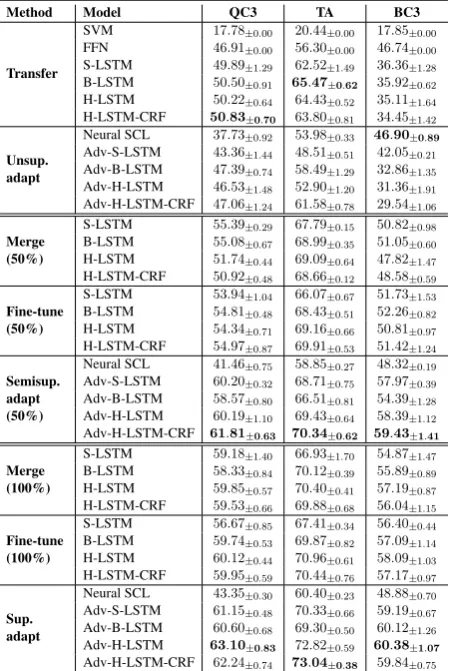
Table 6: Domain adaptation results on our datasets. All models use conversational word embeddings. Results are averaged over (2 folds×5) 10 runs.
we use SGD (Algorithm 1 in the Appendix) with a momentum term of 0.9 and a dynamic learning rate as suggested byGanin et al.(2016).
Results. The adaptation results are shown in
Ta-ble 6. We observe that without any labeled data from the target (Unsup. adap), our adversarial adapted models (Adv-H-LSTM, Adv-H-LSTM-CRF) perform worse than the transfer baseline in all three datasets. In this case, since the out-of-domain labeled dataset (MRDA) is much larger, it overwhelms the model inducing features that are not relevant for the task in the target do-main. However, when we provide the models with some labeled in-domain examples in the
semi-supervised (50%)setting, we observe about 11%
0 25 50 75 100 30
50 60 70
Amount of Target Labeled Data [%] F1
Score QC3Adv-H-LSTM
QC3Adv-H-LSTM-CRF
TAAdv-H-LSTM
TAAdv-H-LSTM-CRF
BC3Adv-H-LSTM
[image:9.595.319.515.59.430.2]BC3Adv-H-LSTM-CRF
Figure 3:F1with varying amount of target labels.
Also notice that our adversarial adaptation outper-forms Merge and Fine-tune methods for all models over all datasets, showing its effectiveness.
Figure3 presents theF1 scores of our adapted models with varying amount of labeled data in the target domain. We notice that the largest improve-ments for all three datasets come from the first 25% of the target labels. The gains from the sec-ond quartile are also relatively higher than the last two quartiles for TA and BC3. Another interesting observation is that H-LSTM-CRF performs better in unsupervised and semi-supervised settings (i.e.,
with less target labels). In other words, H-LSTM-CRF adapts better than H-LSTM with small target datasets by exploiting the tag dependencies in the source. As we include more labeled data from the target, H-LSTM catches up with H-LSTM-CRF. Surprisingly, Neural SCL performs the worst. We suspect this is due to the mismatches between pivot features of the source and target domains.
If we compare ouradaptation resultswith the
in-domain results in Table 5, we notice that
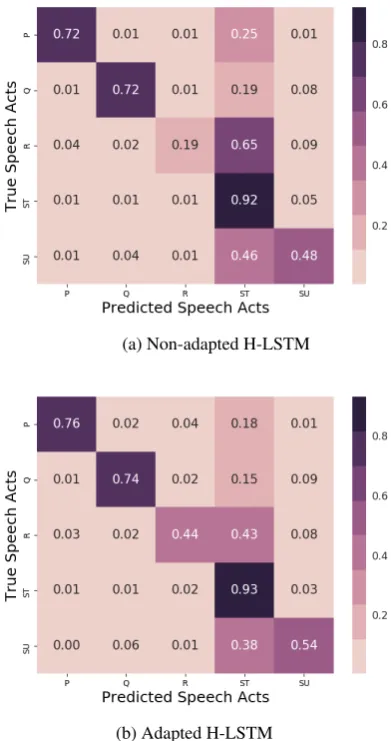
us-ing the same amount of labeled data in the target, our supervised adaptation gives 3-4% gains across the datasets. Our semi-supervised adaptation us-ing half of the target labels (50%) also outperforms the in-domain models that use all the target labels. To further analyze the cases where our adapted models make a difference, Figure4shows the con-fusion matrices for the adapted H-LSTM and the non-adapted H-LSTM on the concatenated test-sets of QC3, TA, and BC3. In general, our clas-sifiers get confused betweenResponseand State-ment, and betweenSuggestion andStatementthe most. We noticed similar phenomena in the hu-man annotations, where annotators had difficulties
(a) Non-adapted H-LSTM
(b) Adapted H-LSTM
Figure 4: Confusion matrices on the combined test sets.
with these three acts. It is however noticeable that the adapted H-LSTM is less affected by class im-balance, and it can detect theSuggestionandPolite
acts more correctly than the non-adapted one.
7 Conclusion
We proposed an adaptation framework for speech act recognition in asynchronous conversation. Our base model is a hierarchical LSTM encoder with a Softmax or CRF output layer, which achieves state-of-the-art results for in-domain training. Crucial to its performance is the conversational word embeddings. We adapted our base model with adversarial training to effectively leverage out-of-domain meeting data, and to improve the results further. A comparison with existing meth-ods and baselines in different training scenarios demonstrates the effectiveness of our approach.
Acknowledgments
[image:9.595.76.292.59.233.2]References
Mart´ın Arjovsky, Soumith Chintala, and L´eon Bottou. 2017. Wasserstein GAN. CoRR, abs/1701.07875.
John Langshaw Austin. 1962. How to do things with words. Harvard University Press.
Vitor R. Carvalho and William W. Cohen. 2005. On the collective classification of email ”speech acts”. InSIGIR ’05, pages 345–352, New York, NY, USA.
Kyunghyun Cho, Bart van Merri¨enboer, C¸ alar G¨ulc¸ehre, Dzmitry Bahdanau, Fethi Bougares, Hol-ger Schwenk, and Yoshua Bengio. 2014. Learning phrase representations using rnn encoder–decoder for statistical machine translation. In EMNLP’14, Doha, Qatar.
Chenhui Chu and Rui Wang. 2018. A survey of do-main adaptation for neural machine translation. In
Proceedings of the 27th International Conference on Computational Linguistics, pages 1304–1319. Asso-ciation for Computational Linguistics.
William W. Cohen, Vitor R. Carvalho, and Tom M. Mitchell. 2004. Learning to classify email into “speech acts”. InEMNLP’04, pages 309–316.
Ronan Collobert, Jason Weston, L´eon Bottou, Michael Karlen, Koray Kavukcuoglu, and Pavel Kuksa. 2011. Natural language processing (almost) from scratch. JMLR, 12:2493–2537.
Matt Crane. 2018. Questionable answers in question answering research: Reproducibility and variability of published results. TACL’18, 6:241–252.
Rajdip Dhillon, Sonali Bhagat, Hannah Carvey, and Elizabeth Shriberg. 2004. Meeting Recorder Project: Dialog Act Labeling Guide. Technical re-port, ICSI Tech. Report.
Yaroslav Ganin, Evgeniya Ustinova, Hana Ajakan, Pascal Germain, Hugo Larochelle, Franc¸ois Lavi-olette, Mario Marchand, and Victor Lempitsky. 2016. Domain-adversarial training of neural net-works. JMLR, 17(1):2096–2030.
Kevin Gimpel, Nathan Schneider, Brendan O’Connor, Dipanjan Das, Daniel Mills, Jacob Eisenstein, Michael Heilman, Dani Yogatama, Jeffrey Flanigan, and Noah A Smith. 2011. Part-of-speech tagging for twitter: Annotation, features, and experiments. InHLT’11: short papers-Volume 2, pages 42–47.
Xavier Glorot and Yoshua Bengio. 2010. Understand-ing the difficulty of trainUnderstand-ing deep feedforward neural networks. InJMLR, Sardinia, Italy.
Sepp Hochreiter and J¨urgen Schmidhuber. 1997. Long short-term memory. Neural computation, 9(8):1735–1780.
Minwoo Jeong, Chin-Yew Lin, and Gary Geunbae Lee. 2009. Semi-supervised speech act recognition in emails and forums. In EMNLP’09, pages 1250– 1259, Singapore.
Shafiq Joty, Giuseppe Carenini, and Chin-Yew Lin. 2011. Unsupervised Modeling of Dialog Acts in Asynchronous Conversations. In IJCAI’11, pages 1–130, Barcelona.
Shafiq Joty and Enamul Hoque. 2016.Speech act mod-eling of written asynchronous conversations with task-specific embeddings and conditional structured models. InACL ’16, pages 1746–1756, Berlin, Ger-many.
Dan Jurafsky, Liz Shriberg, and Debra Biasca. 1997. Switchboard SWBD-DAMSL Shallow-Discourse-Function Annotation Coders Manual. Technical re-port, UC Boulder & SRI International.
Nal Kalchbrenner and Phil Blunsom. 2013. Recurrent convolutional neural networks for discourse compo-sitionality. InCVSC’13, pages 119–126.
Hamed Khanpour, Nishitha Guntakandla, and Rod-ney Nielsen. 2016. Dialogue act classification in domain-independent conversations using a deep re-current neural network. In COLING’16, pages 2012–2021.
Diederik P. Kingma and Jimmy Ba. 2014. Adam: A method for stochastic optimization. CoRR, abs/1412.6980.
Ryan Kiros, Yukun Zhu, Ruslan Salakhutdinov, Richard S. Zemel, Antonio Torralba, Raquel Ur-tasun, and Sanja Fidler. 2015. Skip-thought vec-tors. InProceedings of the 28th International Conference on Neural Information Processing Systems -Volume 2, NIPS’15, pages 3294–3302, Cambridge, MA, USA.
Harshit Kumar, Arvind Agarwal, Riddhiman Dasgupta, Sachindra Joshi, and Arun Kumar. 2018. Dia-logue act sequence labeling using hierarchical en-coder with CRF. InAAAI’18.
John Lafferty, Andrew K. McCallum, and Fernando Pereira. 2001. Conditional Random Fields: Prob-abilistic models for segmenting and labeling se-quence data. InICML.
Ji Young Lee and Franck Dernoncourt. 2016. Sequen-tial short-text classification with recurrent and con-volutional neural networks. InHLT’16, pages 515– 520.
Annie P Louis and Shay B Cohen. 2015. Conversa-tion trees: A grammar model for topic structure in forums. InACL ’15.
Tomas Mikolov, Wen-tau Yih, and Geoffrey Zweig. 2013. Linguistic Regularities in Continuous Space Word Representations. InNAACL-HLT ’13, pages 746–751, Atlanta, GA, USA.
Michael J. Paul. 2012. Mixed Membership Markov Models for Unsupervised Conversation Modeling. InEMNLP-CoNLL ’12, pages 94–104, Stroudsburg, PA, USA.
Jeffrey Pennington, Richard Socher, and Christopher Manning. 2014. Glove: Global vectors for word representation. In EMNLP’14, pages 1532–1543, Doha, Qatar.
Ashequl Qadir and Ellen Riloff. 2011.Classifying sen-tences as speech acts in message board posts. In
EMNLP’11, pages 748–758, Edinburgh, Scotland, UK.
A. Ritter, C. Cherry, and B. Dolan. 2010. Unsuper-vised modeling of twitter conversations. In HLT: NAACL’10, LA, California.
Iulian V. Serban, Alessandro Sordoni, Yoshua Bengio, Aaron Courville, and Joelle Pineau. 2016. Building end-to-end dialogue systems using generative hier-archical neural network models. InAAAI’16.
Maryam Tavafi, Yashar Mehdad, Shafiq Joty, Giuseppe Carenini, and Raymond Ng. 2013. Dialogue act recognition in synchronous and asynchronous con-versations. InSIGDIAL’13, Metz, France.
Jan Ulrich, Gabriel Murray, and Giuseppe Carenini. 2008. A publicly available annotated corpus for supervised email summarization. In AAAI’08, Chicago, USA.
Yftah Ziser and Roi Reichart. 2017. Neural structural correspondence learning for domain adaptation. In