Proceedings of NAACL-HLT 2019, pages 1208–1218 1208
Rethinking Action Spaces for Reinforcement Learning in End-to-end
Dialog Agents with Latent Variable Models
Tiancheng Zhao1, Kaige Xie2 and Maxine Eskenazi1
1Language Technologies Institute, Carnegie Mellon University 2Shanghai Jiao Tong University
{tianchez, max+}@cs.cmu.edu, [email protected]
Abstract
Defining action spaces for conversational agents and optimizing their decision-making process with reinforcement learning is an en-during challenge. Common practice has been to use handcrafted dialog acts, or the output vocabulary, e.g. in neural encoder decoders, as the action spaces. Both have their own limita-tions. This paper proposes a novel latent action framework that treats the action spaces of an end-to-end dialog agent as latent variables and develops unsupervised methods in order to in-duce its own action space from the data. Com-prehensive experiments are conducted exam-ining both continuous and discrete action types and two different optimization methods based on stochastic variational inference. Results show that the proposed latent actions achieve superior empirical performance improvement over previous word-level policy gradient meth-ods on both DealOrNoDeal and MultiWoz di-alogs. Our detailed analysis also provides in-sights about various latent variable approaches for policy learning and can serve as a founda-tion for developing better latent acfounda-tions in fu-ture research.1
1 Introduction
Optimizing dialog strategies in multi-turn dialog models is the cornerstone of building dialog sys-tems that more efficiently solve real-world chal-lenges, e.g. providing information (Young,2006), winning negotiations (Lewis et al.,2017), improv-ing engagement (Li et al., 2016) etc. A clas-sic solution employs reinforcement learning (RL) to learn a dialog policy that models the opti-mal action distribution conditioned on the dialog state (Williams and Young,2007). However, since there are infinite human language possibilities, an enduring challenge has been to define what the
1Data and code are available at https://github. com/snakeztc/NeuralDialog-LaRL
action space is. For traditional modular systems, the action space is defined by hand-crafted seman-tic representations such as dialog acts and slot-values (Raux et al., 2005;Chen et al.,2013) and the goal is to obtain a dialog policy that chooses the best hand-crafted action at each dialog turn. But it is limited because it can only handle simple domains whose entire action space can be captured by hand-crafted representations (Walker,2000;Su et al., 2017). This cripples a system’s ability to handle conversations in complex domains.
Conversely, end-to-end (E2E) dialog systems have removed this limit by directly learning a re-sponse generation model conditioned on the dia-log context using neural networks (Vinyals and Le,
2015;Sordoni et al.,2015). To apply RL to E2E systems, the action space is typically defined as the entire vocabulary; every response output word is considered to be an action selection step (Li et al., 2016), which we denote as the word-level RL. Word-level RL, however, has been shown to have several major limitations in learning dialog strategies. The foremost one is that direct appli-cation of word-level RL leads to degenerate be-havior: the response decoder deviates from human language and generates utterances that are incom-prehensible (Lewis et al., 2017;Das et al.,2017;
Kottur et al.,2017). A second issue is that since a multi-turn dialog can easily span hundreds of words, word-level RL suffers from credit assign-ment over a long horizon, leading to slow and sub-optimal convergence (Kaelbling et al., 1996; He et al.,2018).
ac-tions. These actions must be expressive enough to capture response semantics in complex domains (i.e. have the capacity to represent a large num-ber of actions), thus decoupling the discourse-level decision-making process from natural lan-guage generation. Then any RL technique can be applied to this induced action space in the place of word-level output. We propose a flexible latent variable dialog framework and investigate several approaches to inducing latent action space from natural conversational data. We further propose (1) a novel training objective that outperforms the typical evidence lower bound used in dialog gen-eration and (2) an attention mechanism for inte-grating discrete latent variables in the decoder to better model long responses.
We test this on two datasets, DealOrN-oDeal (Lewis et al., 2017) and Multi-Woz (Budzianowski et al., 2018), to answer two key questions: (1) what are the advantages of LaRL over Word-level RL and (2) what effective methods can induce this latent action space. Results show that LaRL is significantly more effective than word-level RL for learning dialog policies and it does not lead to incomprehensible language generation. Our models achieve 18.2% absolute improvement over the previous state-of-the-art on MultiWoz and discover novel and diverse negotiation strategies on DealOrNoDeal. Besides strong empirical improvement, our model analysis reveals novel insights, e.g. it is crucial to reduce the exposure bias in the latent action space and discrete latent actions are more suitable than continuous ones to serve as action spaces for RL dialog agents.
2 Related Work
Prior RL research in modular dialog manage-ment has focused on policy optimization over hand-crafted action spaces in task-oriented do-mains (Walker,2000;Young et al.,2007). A di-alog manager is formulated as a Partially Observ-able Markov Decision Process (POMDP) (Young et al., 2013), where the dialog state is estimated via dialog state tracking models from the raw di-alog context (Lee,2013;Henderson et al., 2014;
Ren et al.,2018). RL techniques are then used to find the optimal dialog policy (Gasic and Young,
2014;Su et al.,2017;Williams et al.,2017). Re-cent deep-learning modular dialog models have also explored joint optimization over dialog
pol-icy and state tracking to achieve stronger per-formance (Wen et al., 2016;Zhao and Eskenazi,
2016;Liu and Lane,2017).
A related line of work is reinforcement learn-ing for E2E dialog systems. Due to the flexibility of encoder-decoder dialog models, prior work has applied reinforcement learning to more complex domains and achieved higher dialog-level rewards, such as open-domain chatting (Li et al.,2016; Ser-ban et al.,2017a), negotiation (Lewis et al.,2017), visual dialogs (Das et al., 2017), grounded dia-log (Mordatch and Abbeel, 2017) etc. As dis-cussed in Section 1, these methods consider the output vocabulary at every decoding step to be the action space; they suffer from limitations such as deviation from natural language and sub-optimal convergence.
Finally, research in latent variable dialog mod-els is closely related to our work, which strives to learn meaningful latent variables for E2E di-alog systems. Prior work has shown that learn-ing with latent variables leads to benefits like di-verse response decoding (Serban et al., 2017b;
Zhao et al., 2017; Cao and Clark, 2017), inter-pretable decision-making (Wen et al.,2017;Zhao et al.,2018) and zero-shot domain transfer (Zhao and Eskenazi,2018). Also, driven by similar mo-tivations of this work, prior studies have explored to utilize a coarse discrete node, either handcrafted or learned, to decouple the word generation pro-cess from dialog policy in E2E systems for better dialog policy (He et al.,2018;Yarats and Lewis,
2017). Our work differs from prior work for two reasons: (1) latent action in previous work is only auxiliary, small-scale and mostly learned in a supervised or semi-supervised setting. This paper focuses on unsupervised learning of latent variables and learns variables that are expressive enough to capture the entire action space by itself. (2) to our best knowledge, our work is the first comprehensive study of the use of latent variables for RL policy optimization in dialog systems.
3 Baseline Approach
tex-Figure 1: High-level comparison between word-level and latent-action reinforcement learning in a sample multi-turn dialog. The decoder network generates the response given the latent codez. Dashed line denotes places where policy gradients from task rewards are applied to the model.
tual raw dialog history (Vinyals and Le,2015) to visual and textual context (Das et al.,2017). Train-ing with RL usually has 2 steps: supervised pre-training and policy gradient reinforcement learn-ing (Williams and Zweig, 2016; Dhingra et al.,
2017;Li et al.,2016). Specifically, the supervised learning step maximizes the log likelihood on the training dialogs, whereθis the model parameter:
LSL(θ) =Ex,c[logpθ(x|c)] (1)
Then the following RL step uses policy gradients, e.g. the REINFORCE algorithm (Williams,1992) to update the model parameters with respect to task-dependent goals. We assume that we have an environment that the dialog agent can interact with and that there is a turn-level rewardrtat ev-ery turntof the dialog. We can then write the ex-pected discounted return under a dialog modelθas J(θ) = E[PT
0 γtrt], whereγ ∈ [0,1]is the dis-counting factor andT is the length of the dialog. Often a baseline functionb is used to reduce the variance of the policy gradient (Greensmith et al.,
2004), leading toRt=PTk=0−tγk(rt+k−b).
Word-level Reinforcement Learning: as shown in Figure1, the baseline approach treats ev-ery output word as an action step and its policy gradient is:
∇θJ(θ) =Eθ[ T X
t=0 Ut
X
j=0
Rtj∇θlogpθ(wtj|w<tj,ct)]
(2) whereUtis the number of tokens in the response at turntandjis the word index in the response. It is evident that Eq2has a very large action space, i.e.|V|and a long learning horizon, i.e.T U. Prior work has found that the direct application of Eq2
leads to divergence of the decoder. The common solution is to alternate with supervised learning with Eq 2 at a certain ratio (Lewis et al., 2017). We denote this ratio as RL:SL=A:B, which means
for every A policy gradient updates, we run B su-pervised learning updates. We use RL:SL=off for the case where only policy gradients are used and no supervised learning is involved.
4 Latent Action Reinforcement Learning
We now describe the proposed LaRL framework. As shown in Figure 1, a latent variable z is in-troduced in the response generation process. The conditional distribution is factorized intop(x|c) = p(x|z)p(z|c)and the generative story is: (1) given a dialog contextc we first sample a latent action
zfrompθe(z|c)and (2) generate the response by samplingxbased onzviapθd(x|z), wherepθe is the dialog encoder network andpθdis the response decoder network. Given the above setup, LaRL treats the latent variable z as its action space in-stead of outputting words in response x. We can now apply REINFORCE in the latent action space:
∇θJ(θ) =Eθ[ T X
t=0
Rtlogpθ(z|ct)] (3)
Compared to Eq2, LaRL differs by:
• Shortens the horizon fromT U toT.
• Latent action space is designed to be low-dimensional, much smaller thanV.
• The policy gradient only updates the encoder θeand the decoderθdstays intact.
[image:3.595.70.524.68.140.2]z and optimization methods for learningz in the supervised pre-training step.
4.1 Types of Latent Actions
Two types of latent variables have been used in previous research: continuous isotropic Gaussian distribution (Serban et al.,2017b) and multivariate categorical distribution (Zhao et al.,2018). These two types are both compatible with our LaRL framework and can be defined as follows:
Gaussian Latent Actions follow M dimen-sional multivariate Gaussian distribution with a di-agonal covariance matrix, i.e. z ∼ N(µ,σ2I). Let the encoderpθe consist of two parts: a context encoderF, a neural network that encodes the dia-log contextcinto a vector representationh, and a feed forward networkπthat projectshintoµand σ. The process is defined as follows:
h=F(c) (4)
µ log(σ2)
=π(h) (5)
p(x|z) =pθd(z) z∼ N(µ,σ
2I) (6)
where the sampled z is used as the initial state of the decoder for response generation. Also we usepθ(z|c) = N(z;µ,σ2I)to compute the pol-icy gradient update in Eq3.
Categorical Latent Actions are M indepen-dent K-way categorical random variables. Each
zm has its own token embeddings to map latent symbols into vector space Em ∈ RK×D where m ∈ [1, M]andD is the embedding size. Thus Mlatent actions can represent exponentially,KM, unique combinations, making it expressive enough to model dialog acts in complex domains. Similar to Gaussian Latent Actions, we have
h=F(c) (7)
p(Zm|c) =softmax(πm(h)) (8) p(x|z) =pθd(E1:M(z1:M)) zm ∼p(Zm|c)
(9)
For the computing policy gradient in Eq 3, we havepθ(z|c) =
QM
m=1p(Zm=zm|c)
Unlike Gaussian latent actions, a matrixRM×D comes after the embedding layers E1:M(z1:M), whereas the decoder’s initial state is a vector of size RD. Previous work integrated this matrix with the decoder by summing over the latent em-beddings, i.e. x = pθd(
PM
1 Em(zm)), denoted asSummation Fusionfor later discussion (Zhao
et al.,2018). A limitation of this method is that it could lose fine-grained order information in each latent dimension and have issues with long re-sponses that involve multiple dialog acts. There-fore, we propose a novel method, Attention Fu-sion, to combine categorical latent actions with the decoder. We apply the attention mechanism ( Lu-ong et al.,2015) over latent actions as the follow-ing. Letibe the step index during decoding. Then we have:
αmi=softmax(hTi WaEm(zm)) (10)
ci = M X
m=1
αmiEm(zm) (11)
e
hi =tanh(Ws
hi ci
) (12)
p(wi|hi,ci) =softmax(Wohei) (13)
The decoder’s next state is updated by hi+1 = RNN(hi, wi+1),hei) and h0 is computed via
summation-fusion. Thus attention fusion lets the decoder focus on different latent dimensions at each generation step.
4.2 Optimization Approaches
Full ELBO: Now given a training dataset{x,c}, our base optimization method is via stochastic variational inference by maximizing the evidence lowerbound (ELBO), a lowerbound on the data log likelihood:
Lf ull(θ) =pq(z|x,c)(x|z)−DKL[q(z|x,c)kp(z|c)]
(14) whereqγ(z|x,c)is a neural network that is trained to approximate the posterior distributionq(z|x,c) and p(z|c) and p(x|z) are achieved by F, π and pθd. For Gaussian latent actions, we use the reparametrization trick (Kingma and Welling,
2013) to backpropagate through Gaussian latent actions and the Gumbel-Softmax (Jang et al.,
2016) to backpropagate through categorical latent actions.
Lite ELBO: a major limitation is that Full ELBO can suffer from exposure bias at latent space, i.e. the decoder only seesz sampled from q(z|x,c) and never experiences z sampled from pθ(z|c), which is always used at testing time. Therefore, in this paper, we propose a simplified ELBO for encoder-decoder models with stochas-tic latent variables:
Llite(θ) =pp(z|c)(x|z)−βDKL[p(z|c))kp(z)]
Essentially this simplified objective sets the pos-terior network the same as our encoder, i.e. qγ(z|x,c) = pθe(z|c), which makes the KL term in Eq 14 zero and removes the issue of expo-sure bias. But this leaves the latent spaces un-regularized and our experiments show that if we only maximize pp(z|c)(x|z) there is overfitting. For this, we add the additional regularization term βDKL[p(z|c))kp(z)]that encourages the posterior
be similar to certain prior distributions and β is a hyper-parameter between 0 and 1. We set the p(z) for categorical latent actions to be uniform, i.e. p(z) = 1/K, and set the prior for Gaussian latent actions to beN(0,I), which we will show that are effective.
5 Experiment Settings
5.1 DealOrNoDeal Corpus and RL Setup
DealOrNoDeal is a negotiation dataset that con-tains 5805 dialogs based on 2236 unique scenar-ios (Lewis et al., 2017). We hold out 252 sce-narios for testing environment and randomly sam-ple 400 scenarios from the training set for valida-tion. The results are evaluated from 4 perspec-tives: Perplexity (PPL), Reward, Agree and Di-versity. PPL helps us to identify which model pro-duces the most human-like responses, while Re-ward and Agree evaluate the model’s negotiation strength. Diversity indicates whether the model discovers a novel discourse-level strategy or just repeats dull responses to compromise with the op-ponent. We closely follow the original paper and use the same reward function and baseline calcu-lation. At last, to have a fair comparison, all the compared models shared the identical judge model and user simulator, which are a standard hierarchi-cal encoder-decoder model trained with Maximum Likelihood Estimation (MLE).
5.2 Multi-Woz Corpus and Novel RL Setup
Multi-Woz is a slot-filling dataset that contains 10438 dialogs on 6 different domains. 8438 di-alogs are for training and 1000 each are for val-idation and testing. Since no prior user simu-lator exists for this dataset, for a fair compari-son with the previous state-of-the-art we focus on the Dialog-Context-to-Text Generation task pro-posed in (Budzianowski et al., 2018). This task assumes that the model has access to the ground-truth dialog belief state and is asked to generate the next response at every system turn in a
di-alog. The results are evaluated from 3 perspec-tives: BLEU, Inform Rate and Success Rate. The BLEU score checks the response-level lexical sim-ilarity, while Inform and Success Rate measure whether the model gives recommendations and provides all the requested information at dialog-level. Current state-of-the-art results struggle in this task and MLE models only achieve 60% suc-cess (Budzianowski et al., 2018). To transform this task into an RL task, we propose a novel ex-tension to the original task as follows:
1. For each RL episode, randomly sample a di-alog from the training set
2. Run the model on every system turn, and do not alter the original dialog context at every turn given the generated responses.
3. Compute Success Rate based on the gener-ated responses in this dialog.
4. Compute policy gradient using Eq3and up-date the parameters.
This setup creates a variant RL problem that is similar to the Contextual Bandits (Langford and Zhang, 2008), where the goal is to adjust its pa-rameters to generate responses that yield better Success Rate. Our results show that this problem is challenging and that word-level RL falls short.
5.3 Language Constrained Reward (LCR) curve for Evaluation
It is challenging to quantify the performance of RL-based neural generation systems because it is possible for a model to achieve high task reward and yet not generate human language (Das et al.,
2017). Therefore, we propose a novel measure, the Language Constrained Reward (LCR) curve as an additional robust measure. The basic idea is to use an ROC-style curve to visualize the tradeoff be-tween achieving higher reward and being faithful to human language. Specifically, at each check-pointiover the course of RL training, we record two measures: (1) the PPL of a given model on the test datapi =PPL(θi)and (2) this model’s av-erage cumulative task reward in the test environ-mentRt
i. After RL training is complete, we create a 2D plot where the x-axis is the maximum PPL al-lowed, and the y-axis is the best achievable reward within the PPL budget in the testing environments:
As a result, a perfect model should lie in the upper left corner whereas a model that sacrifices language quality for higher reward will lie in the lower right corner. Our results will show that the LCR curve is an informative and robust measure for model comparison.
6 Results: Latent Actions or Words?
We have created 6 different variations of latent ac-tion dialog models under our LaRL framework. To demonstrate the advantages of LaRL, during
Model Var Type Loss Integration Gauss Gaussian Lf ull /
Cat Categorical Lf ull sum
AttnCat Categorical Lf ull attn
LiteGauss Gaussian Llite /
LiteCat Categorical Llite sum
[image:6.595.306.535.62.160.2]LiteAttnCat Categorical Llite attn
Table 1: All proposed variations of LaRL models.
the RL training step, we set RL:SL=off for all la-tent action models, while the baseline word-level RL models are free to tune RL:SL for best formance. For latent variable models, their per-plexity is estimated via Monte Carlo p(x|c) ≈
Ep(z|c)[p(x|z)p(z|c)]. For the sake of clarity, this section only compares the best performing latent action models to the best performing word-level models and focuses on the differences between them. A detailed comparison of the 6 latent space configurations is addressed in Section7.
6.1 DealOrNoDeal
The baseline system is a hierarchical recur-rent encoder-decoder (HRED) model (Serban et al., 2016) that is tuned to reproduce results from (Lewis et al., 2017). Word-level RL is then used to fine-tune the pre-trained model with RL:SL=4:1. On the other hand, the best perform-ing latent action model is LiteCat. Best models are chosen based on performance on the validation en-vironment.
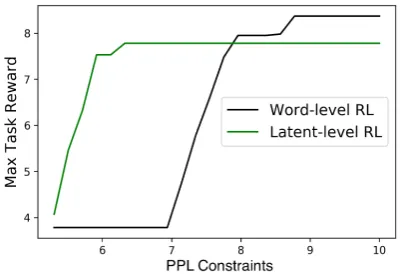
The results are summarized in Table2and Fig-ure2shows the LCR curves for the baseline with the two best models plus LiteAttnCat and baseline without RL:SL. From Table2, it appears that the word-level RL baseline performs better than Lite-Cat in terms of rewards. However, Figure2shows that the two LaRL models achieve strong task re-wards with a much smaller performance drop in language quality (PPL), whereas the word-level
PPL Reward Agree% Diversity
Baseline 5.23 3.75 59 109
LiteCat 5.35 2.65 41 58
Baseline +RL
8.23 7.61 86 5
LiteCat +RL
6.14 7.27 87 202
Table 2: Results on DealOrNoDeal. Diversity is mea-sured by the number of unique responses the model used in all scenarios from the test data.
model can only increase its task rewards by de-viating significantly from natural language.
Figure 2: LCR curves on DealOrNoDeal dataset.
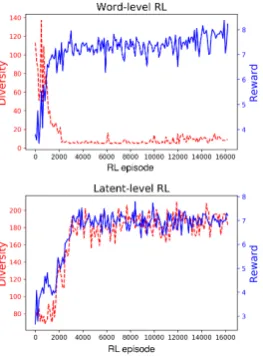
[image:6.595.316.517.261.399.2]Figure 3: Response diversity and task reward learn-ing curve over the course of RL trainlearn-ing for both word RL:SL=4:1 (left) and LiteCat (right).
6.2 MultiWoz
For MultiWoz, we reproduce results
from (Budzianowski et al., 2018) as the baseline. After RL training, the best LaRL model is LiteAt-tnCat and the best word-level model is word RL:SL=off. Table3shows that LiteAttnCat is on
PPL BLEU Inform Success
Human / / 90% 82.3%
Baseline 3.98 18.9 71.33% 60.96%
LiteAttnCat 4.05 19.1 67.98% 57.36%
Baseline +RL
17.11 1.4 80.5% 79.07%
LiteAttnCat +RL
[image:7.595.310.528.93.193.2]5.22 12.8 82.78% 79.2%
Table 3: Main results on MultiWoz test set. RL models are chosen based on performance on the validation set.
par with the baseline in the supervised learning step, showing that multivariate categorical latent variables alone are powerful enough to match with continuous hidden representations for modeling dialog actions. For performance after RL training, LiteAttnCat achieves near-human performance in terms of success rate and inform rate, ob-taining 18.24% absolute improvement over the MLE-based state-of-the-art (Budzianowski et al.,
2018). More importantly, perplexity only slightly increases from 4.05 to 5.22. On the other hand, the word-level RL’s success rate also improves to 79%, but the generated responses completely de-viate from natural language, increasing perplexity from 3.98 to 17.11 and dropping BLEU from 18.9
to 1.4.
Figure 4: LCR curves on the MultiWoz dataset.
Figure4 shows the LCR curves for MultiWoz, with a trend similar to the previous section: the word-level models can only achieve task reward improvement by sacrificing their response decoder PPL. Figure4 also shows the LCR curve for the baseline trained with RL:SL=100:1, hoping that supervised learning can force the model to con-form to natural language. While PPL and BLEU are indeed improved, it also limits final reward performance. The latent-level models, on the con-trary, do not suffer from this tradeoff. We also observe that LiteAttnCat consistently outperforms LiteCat on MultiWoz, confirming the effective-ness of Attention Fusion for handling long dialog responses with multiple entities and dialog acts. Lastly, Table 4 qualitatively exhibits the genera-tion differences between the two approaches. The RL:SL=off model learns to continuously output entities to fool the evaluation script for high suc-cess rate, whereas LiteCatAttn learns to give more information while maintaining the language qual-ity.
[image:7.595.71.292.405.518.2] [image:7.595.306.536.563.717.2]Context Sys I have [value count] trains matching your request . Is there a specific day and time you would like to travel? UsrI would like to leave on [value day] and arrive by [value time].
Model Generated Response
word RL:SL=off
[train id] is leaving [value place] on [value day] on [value day] on [train id] [train id] [value count] [train id] leaving ... word
RL:SL=100
[train id] leaves at [value time] . would you like me to book you a ticket ?
LiteAttnCat [train id] leaves [value place] at [value time] and arrives in [value place] at [value time]. Would you like me to book that for you ?
7 Model Analysis
We compare the 6 variants of latent action mod-els on DealOrNoDeal and MultiWoz. Table 5
Deal PPL Reward Agree% Diversity
Baseline 3.23 3.75 59 109
Gauss 110K 2.71 43 176
LiteGauss 5.35 4.48 65 91
Cat 80.41 3.9 62 115
AttnCat 118.3 3.23 51 145
LiteCat 5.35 2.67 41 58
LiteAttnCat 5.25 3.69 52 75
MultiWoz PPL BLEU Inform% Succ%
Baseline 3.98 18.9 71.33 60.96
Gauss 712.3 7.54 60.5 23.0
LiteGauss 4.06 19.3 56.46 48.06
Cat 7.07 13.7 54.15 42.04
AttnCat 12.01 12.6 63.9 45.8
LiteCat 4.10 19.1 61.56 49.15
LiteAttnCat 4.05 19.1 67.97 57.36
Table 5: Comparison of 6 model variants with only su-pervised learning training.
shows performance of the models that are pre-trained only with supervised learning. Figure 5
[image:8.595.72.295.119.338.2]shows LCR curves for the 3 models pre-trained withLliteand fine-tuned with policy gradient re-inforcement learning. The following are the main
Figure 5: LCR curves on DealOrNoDeal and Multi-Woz. Models withLf ullare not included because their
PPLs are too poor to compare to the Lite models.
findings based on these results.
Llite outperforms Lf ull as a pre-train
ob-jective. Table 5 shows that models with Lf ull fall behind their Lite counterparts on PPL and
BLEU. We attribute this to the exposure bias in the latent space, i.e. the decoder is not trained to consider the discrepancy between the poste-rior network and actual dialog policy network. Meanwhile, the full models tend to enjoy higher diversity at pre-training, which agrees with the diversity-promoting effect observed in prior re-search (Zhao et al.,2017). However, our previous discussion on Figure3shows that Lite models are able to increase their response diversity in order to win more in negotiation through RL training. This is fundamentally different from diversity in pre-training, since diversity in LaRL is optimized to improve task reward, rather than to better model the original data distribution. Table 6 shows the
β 0.0 0.01 β 0.0 0.01
LiteCat 4.23 7.27 LiteGauss 4.83 6.67
Table 6: Best rewards in test environments on DealOrNoDeal with variousβ.
importance of latent space regularization. Whenβ is0, both LiteCat and LiteGauss reach suboptimal policies with final reward that are much smaller than the regularized versions (β = 0.01). The reason behind this is that the unregularized pre-trained policy has very low entropy, which pro-hibits sufficient exploration in the RL stage.
Categorical latent actions outperform Gaus-sian latent actions. Models with discrete ac-tions consistently outperform models with Gaus-sian ones. This is surprising since continuously distributed representations are a key reason for the success of deep learning in natural language pro-cessing. Our finding suggests that (1) multivari-ate cmultivari-ategorical distributions are powerful enough to model complex natural dialog responses seman-tics, and can achieve on par results with Gaussian or non-stochastic continuous representations. (2) categorical variables are a better choice to serve as action spaces for reinforcement learning. Figure5
[image:8.595.114.250.467.649.2]8 Conclusion and Future Work
In conclusion, this paper proposes a latent vari-able action space for RL in E2E dialog agents. We present a general framework with a regularized ELBO objective and attention fusion for discrete variables. The methods are assessed on two dialog tasks and analyzed using the proposed LCR curve. Results show our models achieve superior perfor-mance and create a new state-of-the-art success rate on MultiWoz. Extensive analyses enable us to gain insight on how to properly train latent vari-ables that can serve as the action spaces for dialog agents. This work is situated in the approach con-cerning practical latent variables in dialog agents, being able to create action abstraction in an unsu-pervised manner. We believe that our findings are a basic first step in this promising research direc-tion.
References
Paweł Budzianowski, Tsung-Hsien Wen, Bo-Hsiang Tseng, I˜nigo Casanueva, Stefan Ultes, Osman Ra-madan, and Milica Gasic. 2018. Multiwoz-a large-scale multi-domain wizard-of-oz dataset for task-oriented dialogue modelling. InProceedings of the 2018 Conference on Empirical Methods in Natural Language Processing, pages 5016–5026.
Kris Cao and Stephen Clark. 2017. Latent variable di-alogue models and their diversity. InProceedings of the 15th Conference of the European Chapter of the Association for Computational Linguistics: Volume 2, Short Papers, volume 2, pages 182–187.
Yun-Nung Chen, William Yang Wang, and Alexander I Rudnicky. 2013. Unsupervised induction and fill-ing of semantic slots for spoken dialogue systems using frame-semantic parsing. InAutomatic Speech Recognition and Understanding (ASRU), 2013 IEEE Workshop on, pages 120–125. IEEE.
Kyunghyun Cho, Bart Van Merri¨enboer, Caglar Gul-cehre, Dzmitry Bahdanau, Fethi Bougares, Holger Schwenk, and Yoshua Bengio. 2014. Learning phrase representations using rnn encoder-decoder for statistical machine translation. arXiv preprint arXiv:1406.1078.
Abhishek Das, Satwik Kottur, Jos´e MF Moura, Stefan Lee, and Dhruv Batra. 2017. Learning cooperative visual dialog agents with deep reinforcement learn-ing. InComputer Vision (ICCV), 2017 IEEE Inter-national Conference on, pages 2970–2979. IEEE.
Bhuwan Dhingra, Lihong Li, Xiujun Li, Jianfeng Gao, Yun-Nung Chen, Faisal Ahmed, and Li Deng. 2017. Towards end-to-end reinforcement learning of dia-logue agents for information access. In Proceed-ings of the 55th Annual Meeting of the Association
for Computational Linguistics (Volume 1: Long Pa-pers), volume 1, pages 484–495.
Milica Gasic and Steve Young. 2014. Gaussian pro-cesses for pomdp-based dialogue manager optimiza-tion. IEEE/ACM Transactions on Audio, Speech, and Language Processing, 22(1):28–40.
Evan Greensmith, Peter L Bartlett, and Jonathan Bax-ter. 2004. Variance reduction techniques for gradi-ent estimates in reinforcemgradi-ent learning. Journal of Machine Learning Research, 5(Nov):1471–1530.
He He, Derek Chen, Anusha Balakrishnan, and Percy Liang. 2018. Decoupling strategy and generation in negotiation dialogues. In Proceedings of the 2018 Conference on Empirical Methods in Natural Lan-guage Processing, pages 2333–2343.
Matthew Henderson, Blaise Thomson, and Steve Young. 2014. Word-based dialog state tracking with recurrent neural networks. In Proceedings of the 15th Annual Meeting of the Special Interest Group on Discourse and Dialogue (SIGDIAL), pages 292– 299.
Eric Jang, Shixiang Gu, and Ben Poole. 2016. Categor-ical reparameterization with gumbel-softmax. arXiv preprint arXiv:1611.01144.
Leslie Pack Kaelbling, Michael L Littman, and An-drew W Moore. 1996. Reinforcement learning: A survey. Journal of artificial intelligence research, 4:237–285.
Diederik P Kingma and Max Welling. 2013. Auto-encoding variational bayes. arXiv preprint arXiv:1312.6114.
Satwik Kottur, Jos´e Moura, Stefan Lee, and Dhruv Ba-tra. 2017. Natural language does not emerge nat-urallyin multi-agent dialog. InProceedings of the 2017 Conference on Empirical Methods in Natural Language Processing, pages 2962–2967.
John Langford and Tong Zhang. 2008. The epoch-greedy algorithm for multi-armed bandits with side information. InAdvances in neural information pro-cessing systems, pages 817–824.
Sungjin Lee. 2013. Structured discriminative model for dialog state tracking. InProceedings of the SIG-DIAL 2013 Conference, pages 442–451.
Mike Lewis, Denis Yarats, Yann Dauphin, Devi Parikh, and Dhruv Batra. 2017. Deal or no deal? end-to-end learning of negotiation dialogues. InProceedings of the 2017 Conference on Empirical Methods in Nat-ural Language Processing, pages 2443–2453.
Bing Liu and Ian Lane. 2017. An end-to-end train-able neural network model with belief tracking for task-oriented dialog. Proc. Interspeech 2017, pages 2506–2510.
Thang Luong, Hieu Pham, and Christopher D Man-ning. 2015. Effective approaches to attention-based neural machine translation. In Proceedings of the 2015 Conference on Empirical Methods in Natural Language Processing, pages 1412–1421.
Igor Mordatch and Pieter Abbeel. 2017. Emergence of grounded compositional language in multi-agent populations. arXiv preprint arXiv:1703.04908.
Antoine Raux, Brian Langner, Dan Bohus, Alan W Black, and Maxine Eskenazi. 2005. Lets go pub-lic! taking a spoken dialog system to the real world. Inin Proc. of Interspeech 2005. Citeseer.
Liliang Ren, Kaige Xie, Lu Chen, and Kai Yu. 2018. Towards universal dialogue state tracking. In Pro-ceedings of the 2018 Conference on Empirical Meth-ods in Natural Language Processing, pages 2780– 2786.
Iulian V Serban, Chinnadhurai Sankar, Mathieu Ger-main, Saizheng Zhang, Zhouhan Lin, Sandeep Sub-ramanian, Taesup Kim, Michael Pieper, Sarath Chandar, Nan Rosemary Ke, et al. 2017a. A deep reinforcement learning chatbot. arXiv preprint arXiv:1709.02349.
Iulian V Serban, Alessandro Sordoni, Yoshua Bengio, Aaron Courville, and Joelle Pineau. 2016. Building end-to-end dialogue systems using generative hier-archical neural network models. InProceedings of the 30th AAAI Conference on Artificial Intelligence (AAAI-16).
Iulian Vlad Serban, Alessandro Sordoni, Ryan Lowe, Laurent Charlin, Joelle Pineau, Aaron Courville, and Yoshua Bengio. 2017b. A hierarchical latent variable encoder-decoder model for generating di-alogues. InThirty-First AAAI Conference on Artifi-cial Intelligence.
Alessandro Sordoni, Michel Galley, Michael Auli, Chris Brockett, Yangfeng Ji, Margaret Mitchell, Jian-Yun Nie, Jianfeng Gao, and Bill Dolan. 2015. A neural network approach to context-sensitive gen-eration of conversational responses. In Proceed-ings of the 2015 Conference of the North Ameri-can Chapter of the Association for Computational Linguistics: Human Language Technologies, pages 196–205.
Pei-Hao Su, Paweł Budzianowski, Stefan Ultes, Mil-ica Gasic, and Steve Young. 2017. Sample-efficient actor-critic reinforcement learning with supervised data for dialogue management. In Proceedings of the 18th Annual SIGdial Meeting on Discourse and Dialogue, pages 147–157.
Oriol Vinyals and Quoc Le. 2015. A neural conversa-tional model. arXiv preprint arXiv:1506.05869.
Marilyn A. Walker. 2000. An application of reinforce-ment learning to dialogue strategy selection in a spo-ken dialogue system for email. Journal of Artificial Intelligence Research, pages 387–416.
Tsung-Hsien Wen, Milica Gasic, Nikola Mrksic, Lina M Rojas-Barahona, Pei-Hao Su, Stefan Ultes, David Vandyke, and Steve Young. 2016. A network-based end-to-end trainable task-oriented dialogue system. arXiv preprint arXiv:1604.04562.
Tsung-Hsien Wen, Yishu Miao, Phil Blunsom, and Steve Young. 2017. Latent intention dialogue mod-els. InInternational Conference on Machine Learn-ing, pages 3732–3741.
Jason D Williams, Kavosh Asadi, and Geoffrey Zweig. 2017. Hybrid code networks: practical and efficient end-to-end dialog control with supervised and rein-forcement learning. InProceedings of the 55th An-nual Meeting of the Association for Computational Linguistics (Volume 1: Long Papers), volume 1, pages 665–677.
Jason D Williams and Steve Young. 2007. Partially observable markov decision processes for spoken dialog systems. Computer Speech & Language, 21(2):393–422.
Jason D Williams and Geoffrey Zweig. 2016. End-to-end lstm-based dialog control optimized with su-pervised and reinforcement learning. arXiv preprint arXiv:1606.01269.
Ronald J Williams. 1992. Simple statistical gradient-following algorithms for connectionist reinforce-ment learning. Machine learning, 8(3-4):229–256.
Zichao Yang, Diyi Yang, Chris Dyer, Xiaodong He, Alex Smola, and Eduard Hovy. 2016. Hierarchi-cal attention networks for document classification. InProceedings of the 2016 Conference of the North American Chapter of the Association for Computa-tional Linguistics: Human Language Technologies, pages 1480–1489.
Denis Yarats and Mike Lewis. 2017. Hierarchical text generation and planning for strategic dialogue. arXiv preprint arXiv:1712.05846.
Stephanie Young, Jost Schatzmann, Karl Weilhammer, and Hui Ye. 2007. The hidden information state ap-proach to dialog management. InAcoustics, Speech and Signal Processing, 2007. ICASSP 2007. IEEE International Conference on, volume 4, pages IV– 149. IEEE.
Steve Young, Milica Gaˇsi´c, Blaise Thomson, and Ja-son D Williams. 2013. Pomdp-based statistical spo-ken dialog systems: A review. Proceedings of the IEEE, 101(5):1160–1179.
Tiancheng Zhao and Maxine Eskenazi. 2016. Towards end-to-end learning for dialog state tracking and management using deep reinforcement learning. In 17th Annual Meeting of the Special Interest Group on Discourse and Dialogue, page 1.
Tiancheng Zhao and Maxine Eskenazi. 2018. Zero-shot dialog generation with cross-domain latent ac-tions. In Proceedings of the 19th Annual SIGdial Meeting on Discourse and Dialogue, pages 1–10.
Tiancheng Zhao, Kyusong Lee, and Maxine Eskenazi. 2018. Unsupervised discrete sentence representa-tion learning for interpretable neural dialog gener-ation. InProceedings of the 56th Annual Meeting of the Association for Computational Linguistics (Vol-ume 1: Long Papers), volume 1.
Tiancheng Zhao, Ran Zhao, and Maxine Eskenazi. 2017. Learning discourse-level diversity for neural dialog models using conditional variational autoen-coders. In Proceedings of the 55th Annual Meet-ing of the Association for Computational LMeet-inguistics (Volume 1: Long Papers), volume 1, pages 654–664.
A Supplemental Material
A.1 Training Details
Supervised Pre-train
Word Embedding 256
Utterance Encoder Attn GRU (128) Context (De)Encoder GRU (256) Optimizer Adam (lr=1e-3)
Dropout 0.5
β 0.01
Categoricalz M=10, K=20 Gaussianz M=200
Reinforce
Optimizer SGD (lr=0.2 grad clip=0.1)
[image:11.595.307.526.59.364.2]γ 0.95
Table 7: Training details for DealOrNoDeal experi-ments. Attn GRU refers to (Yang et al.,2016)
Supervised Pre-train
Word Embedding 256
Encoder Attn GRU (300) Decoder LSTM (150) Optimizer Adam (1e-3)
Dropout 0.5
β 0.01
Categoricalz M=10, K=20 Gaussianz M=200
Reinforce
Optimizer SGD(lr=0.01 grad clip=0.5)
γ 0.99
Table 8: Training details for MultiWoz experiments
A.2 DealOrNoDeal Example Conversations
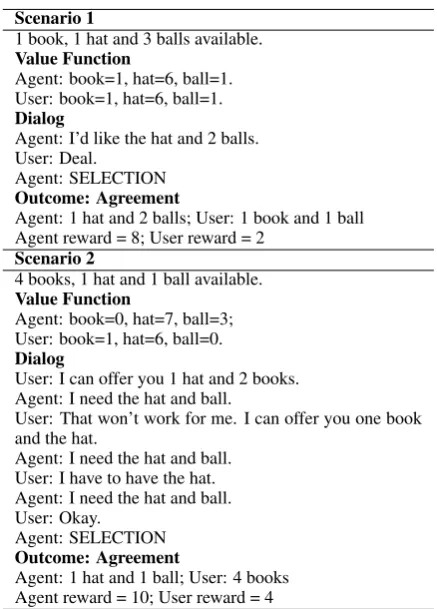
The followings are examples dialogs generated from word-level models (Table9) and latent-level models (Table10).
Scenario 1
1 book, 1 hat and 3 balls available.
Value Function
Agent: book=1, hat=6, ball=1. User: book=1, hat=6, ball=1.
Dialog
Agent: I’d like the hat and 2 balls. User: Deal.
Agent: SELECTION
Outcome: Agreement
Agent: 1 hat and 2 balls; User: 1 book and 1 ball Agent reward = 8; User reward = 2
Scenario 2
4 books, 1 hat and 1 ball available.
Value Function
Agent: book=0, hat=7, ball=3; User: book=1, hat=6, ball=0.
Dialog
User: I can offer you 1 hat and 2 books. Agent: I need the hat and ball.
User: That won’t work for me. I can offer you one book and the hat.
Agent: I need the hat and ball. User: I have to have the hat. Agent: I need the hat and ball. User: Okay.
Agent: SELECTION
Outcome: Agreement
[image:11.595.70.293.361.495.2]Agent: 1 hat and 1 ball; User: 4 books Agent reward = 10; User reward = 4
Table 9: Example dialogs between baseline with the user model. Agent is trained with word-level policy gradient and the user is a supervised pre-trained model.
Scenario 1
2 books, 2 hats and 1 ball available.
Value Function
Agent: book=3, hat=0, ball=4; User: book=2, hat=3, ball=0.
Dialog
Agent: Can i have the books and one ball? User: I would like the books and the hats then. Agent: I would like the ball and books. User: Deal.
Agent: SELECTION
Outcome: Agreement
Agent: 2 books and 1 ball User: 2 hats
Agent reward = 10, User reward = 6
Scenario 2
2 books, 1 hat and 3 ball available.
Value Function
Agent: book=0, hat=4, ball=2; User: book=3, hat=1, ball=1.
Dialog
Agent: I would like the hat and balls.
User: I cannot accept that. I need the hat and books. Agent: Can I have the hat and balls, you get the rest? User: Okay, deal.
Agent: SELECTION.
Outcome: Agreement
Agent: 1 hat and 3 ball User: 2 books
Agent reward = 10, Simulator reward = 6
[image:11.595.70.291.545.670.2]