Supervised Text-based Geolocation
Using Language Models on an Adaptive Grid
Stephen Roller† Michael Speriosu‡ Sarat Rallapalli† Benjamin Wing‡ Jason Baldridge‡
†
Department of Computer Science, University of Texas at Austin ‡
Department of Linguistics, University of Texas at Austin
{roller, sarat}@cs.utexas.edu,{speriosu, jbaldrid}@utexas.edu, [email protected]
Abstract
The geographical properties of words have re-cently begun to be exploited for geolocating documents based solely on their text, often in the context of social media and online content. One common approach for geolocating texts is rooted in information retrieval. Given training documents labeled with latitude/longitude co-ordinates, a grid is overlaid on the Earth and
pseudo-documentsconstructed by concatenat-ing the documents within a given grid cell; then a location for a test document is chosen based on the most similar pseudo-document. Uniform grids are normally used, but they are sensitive to the dispersion of documents over the earth. We define an alternative grid con-struction using k-d trees that more robustly adapts to data, especially with larger training sets. We also provide a better way of choosing the locations for pseudo-documents. We eval-uate these strategies on existing Wikipedia and Twitter corpora, as well as a new, larger Twit-ter corpus. The adaptive grid achieves com-petitive results with a uniform grid on small training sets and outperforms it on the large Twitter corpus. The two grid constructions can also be combined to produce consistently strong results across all training sets.
1 Introduction
The growth of the Internet in recent years has provided unparalleled access to informational re-sources. It is often desirable to extract summary metadata from such resources, such as the date of writing or the location of the author – yet only a small portion of available documents are explicitly annotated in this fashion. With sufficient training
data, however, it is often possible to infer this infor-mation directly from a document’s text. For exam-ple, clues to the geographic location of a document may come from a variety of word features, e.g. to-ponyms (Toronto), geographic features (mountain), culturally local features (hockey), and stylistic or di-alectical differences (coolvs.kewlvs.kool).
This article focuses on text-based document ge-olocation, the prediction of the latitude and lon-gitude of a document. Among the uses for this are region-based search engines; tracing the sources of historical documents; location attribution while summarizing large documents; tailoring of ads while browsing; phishing detection when a user account is accessed from an unexpected location; and “activist mapping” (Cobarrubias, 2009), as in the Ushahidi project.1 Geolocation has also been used as a fea-ture in automatic news story identification systems (Sankaranarayanan et al., 2009).
One of the first works on document geolocation is Ding et al. (2000), who attempt to automatically de-termine the geographic scope of web pages. They focus on named locations, e.g. cities and states, found in gazetteers. Locations are predicted based on toponym detection and heuristic resolution al-gorithms. A related, recent effort is Cheng et al. (2010), who geolocate Twitter users by resolving their profile locations against a gazetteer of U.S. cities and training a classifier to identify geographi-cally local words.
An alternative to using a discrete set of locations from a gazetteer is to use information retrieval (IR) techniques on a set of geolocated training docu-ments. A new test document is compared with each
1http://ushahidi.com/
training document and a location chosen based on the location(s) of the most similar training docu-ment(s). For image geolocation, Chen and Grauman (2011) perform mean-shift clustering over training images to discretize locations, then estimate a test image’s location with weighted voting from the k
most similar documents. For text, both Serdyukov et al. (2009) and Wing and Baldridge (2011) use a similar approach, but compute document similarity based on language models rather than image fea-tures. Additionally, they group documents via a uni-form geodesic grid rather than a clustered set of lo-cations. This reduces the number of similarity com-putations and removes the need to perform location clustering altogether, but introduces a new param-eter controlling the granularity of the grid. Kinsella et al. (2011) predict the locations of tweets and users by comparing text in tweets to language models as-sociated with zip codes and broader geopolitical en-closures. Sadilek et al. (2012) discretize by simply clustering data points within a small distance thresh-old, but only perform geolocation within fixed city limits.
While the above approaches discretize the contin-uous surface of the earth, Eisenstein et al. (2010) predict locations based on Gaussian distributions over the earth’s surface as part of a hierarchical Bayesian model. This model has many advantages (e.g. the ability to compute a complete probability distribution over locations), but we suspect it will be difficult to scale up to the large document collections needed for high accuracy.
We build on the IR approach with grids while ad-dressing some of the shortcomings of a uniform grid. Uniform grids are problematic in that they ignore the geographic dispersion of documents and forgo the possibility of greater-granularity geographic resolu-tion in document-rich areas. Instead, we construct a grid using ak-d tree, which adapts to the size of the training set and the geographic dispersion of the documents it contains. This can better benefit from more data, since it enables the training set to support more pseudo-documents when there is sufficient ev-idence to do so, while still ensuring that all pseudo-documents contain comparable amounts of data. It also has the desirable property of generally requiring fewer active cells than a uniform grid, drastically re-ducing the computation time required to label a test
document.
We show that consistently strong results, robust across both Wikipedia and Twitter datasets, are ob-tained from the union of the pseudo-documents from a uniform and adaptive grid. In addition, a sim-ple difference in the choice of location for a given grid cell – the centroid of the training documents in the cell, rather than the cell midpoint – results in across-the-board improvements. We also con-struct and evaluate on a much larger dataset of ge-olocated tweets than has been used in previous pa-pers, demonstrating the scalability and robustness of our methods and confirming the ability of the adap-tive grid to more effecadap-tively use larger datasets.
2 Data
We work with three datasets: a corpus of geotagged Wikipedia articles and two corpora of geotagged tweets.
GEOWIKIis a collection of 1,019,490 geotagged English articles from Wikipedia. The dump from Wikimedia requires significant processing to obtain article text and location, so we rely on the prepro-cessed data used by Wing and Baldridge (2011).
GEOTEXT is a small dataset consisting of 377,616 messages from 9,475 users tweeting across 48 American states, compiled by Eisenstein et al. (2010). A document in this dataset is the concate-nation of all tweets by a single user, with a location derived from the earliest tweet with specific, GPS-assigned latitude/longitude coordinates.
robots, we only kept users following 5 to 1000 people, followed by at least 5 users, and author-ing no more than 1000 tweets in the three month period. The resulting dataset contains 38 million tweets from 449,694 users, or roughly 85 tweets per user on average. We randomly selected 10,000 users each for development and held-out test eval-uation. The remaining 429,694 users serve as a training set termedUTGEO2011-LARGE. We also randomly selected a 10,000 user training subset (UTGEO2011-SMALL) to facilitate comparisons with GEOTEXTand allow us to investigate the rel-ative improvements for different models with more training data.
Our code and the UTGEO2011 data set are both available for download.2
3 Model
Assume we have a collection d of documents and their associated location labels l. These docu-ments may be actual texts, or they can be pseudo-documents comprised of a number of texts grouped via some algorithm (such as the grids discussed in the next section).
For a test document di, its similarity to each la-beled document is computed, and the location of the most similar document assigned todi. Given an ab-stract functionsimthat can be instantiated with an appropriate similarity function (e.g. cosine distance or Kullback-Leibler divergence),
loc(di) =loc(arg max
dj∈d
sim(di, dj)).
This is a winner-takes-all strategy, which we follow in this paper. In related work on image geoloca-tion, Hays and Efros (2008) use the same general framework, but compute the location based on the
k-nearest neighbors (kNN) rather than the top one. They compute a distribution from the 120 nearest neighbors using mean shift clustering (Comaniciu and Meer, 2002) and choose the cluster with the most members. This produced slightly better re-sults than choosing only the closest image. In future work, we will explore the kNN approach to see if it is more effective for text geolocation.
2https://github.com/utcompling/
textgrounder/wiki/RollerEtAl_EMNLP2012
Following previous work in document geoloca-tion, particularly Serdyukov et al. (2009) (hence-forth SMvZ) and Wing and Baldridge (2011) (henceforth W&B), we geolocate texts using a lan-guage modeling approach to information retrieval (Ponte and Croft, 1998; Zhai and Lafferty, 2001). For each documentdi, we construct a unigram prob-ability distributionθdi over the vocabulary.
We smooth documents using the pseudo-Good-Turing method of W&B, a nonparametric discount-ing model that backs off from the unsmoothed distri-butionθ˜diof the document to the unsmoothed distri-butionθ˜D of all documents. A general discounting model is as follows:
P(w|θdi) =
(
(1−λdi)P(w|θ˜di), ifP(w|θ˜di)>0
λdiP(w|θ˜D)
Udi , otherwise,
whereUdi = 1−Pw∈diP(w|θ˜D) is a normaliza-tion factor that is precomputed when the distribunormaliza-tion fordi is constructed. The discount factorλdi indi-cates how much probability mass to reserve for un-seen words. For pseudo-Good-Turing, it is
λdi =
|w∈dis.t. count(w∈di) = 1|
|w∈di|
,
i.e. the fraction of words seen once indi.
We experimented with other smoothing methods, including Jelinek-Mercer and Dirichlet smoothing. A disadvantage of these latter two methods is that they have an additional tuning parameter to which their performance is highly sensitive, and even with optimal parameter settings neither consistently out-performed pseudo-Good-Turing. We also found no consistent improvement from using interpolation in place of backoff.
We also follow W&B in using Kullback-Leibler (KL) divergence as the similarity metric, since it out-performed both naive Bayes classification probabil-ity and cosine similarprobabil-ity:
KL(θdi||θdj) =
X
k
θdi(k) log
θdi(k)
θdj(k)
.
4 Collapsing Documents with an Adaptive Grid
In the previous section, we used the term “docu-ment” loosely when speaking of training documents. A simplistic approach might indeed involve com-paring a test document to each training document. However, in the winner-takes-all model described above, we can rely only on the result of comparing with the single best training document, which may not contain enough information to make a good pre-diction.
A standard strategy to deal with this problem is to collapse groups of geographically nearby docu-ments into larger pseudo-docudocu-ments. This also has the advantage of reducing the computation time, as fewer training documents need to be compared against. Formally, this involves partitioning the training documents into a set of sets of documents
G = {g1. . . gn}. A collection ˜d of pseudo-documents is formed from this set, such that the pseudo-document for a particular groupgiis simply the concatenation of the documents in the group:
˜
dgi =
[
dj∈gi
dj.
A location must be associated with each pseudo-document. This can be chosen based on the parti-tioning function itself or the locations of the docu-ments in each group.
Both W&B and SMvZ useuniformgrids consist-ing of cells of equal degree size to partition doc-uments. We explore an alternative that uses k-d (k-dimensional) trees to construct a non-uniform grid that adapts to training sets of different sizes more gracefully. It ensures a roughly equal num-ber of documents in each cell, which means that all pseudo-documents compete on similar footing with respect to the amount of training data.
W&B define the location for a cell to be its ge-ographic center, while SMvZ only perform error analysis in terms of choosing the correct cell. We obtain consistently improved results using the cen-troid of the cell’s documents, which takes into ac-count where the documents are concentrated.
4.1 k-d Trees
Ak-d tree is a space-partitioning data structure for storing points ink-dimensional space, which groups nearby points into buckets. As one moves down the tree, the space is split into smaller regions along chosen dimensions. In this way, it is a generaliza-tion of a binary search tree to multiple dimensions. Thek-d tree was first introduced by Bentley (1975) and has since been applied to numerous problems, e.g. Barnes-Hut simulation (Anderson, 1999) and nearest-neighbors search (Friedman et al., 1977).
Partitioning geolocated documents using a k-d tree provides finer granularity in dense regions and coarser granularity elsewhere. For example, doc-uments from Queens and Brooklyn may show sig-nificant cultural distinctions, while documents sepa-rated by the same distance in rural Montana may ap-pear culturally identical. A uniform grid with large cells will mash Queens and Brooklyn together, while small cells will create unnecessarily sparse regions in Montana.
An important parameter for ak-d tree is itsbucket size, which determines the maximum number of points (documents in our case) that a cell may con-tain. By varying the bucket size, the cells can be made fine- or coarse-grained.
4.2 Partitioning with ak-d Tree
For geolocation, we consider the surface of earth to be a2-dimensional space (k=2) over latitude, longi-tude pairs. We form ak-d tree by a recursive proce-dure over the training data. Initially, all documents are placed in the root node of the tree. If the number of documents in the node exceeds the bucket size, the node is split into two nodes along a chosen split dimension and point. This procedure is recursively called on each of the new child nodes, and repeats until no node is overflowing. The resulting leaves of the k-d tree form a patchwork of rectangles which cover the entire earth.3
When splitting an overflowing node, the choice of splitting dimension and point can greatly impact the structure of the resultingk-d tree. Following Fried-man et al. (1977), we choose to always split a node
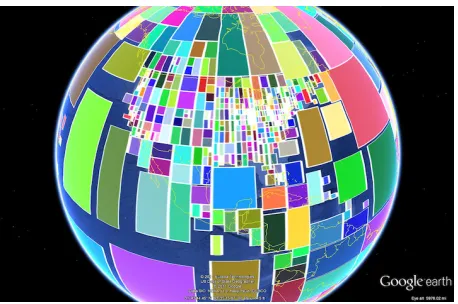
Figure 1: View of North America showingk-d leaves cre-ated from GEOWIKI with a bucket size of 600 and the
[image:5.612.73.299.268.378.2]MIDPOINTmethod, as visualized in Google Earth.
Figure 2: k-d leaves over the New York City and nearby areas from the same dataset and parameter settings as in Figure 1.
along the dimension exhibiting the greatest range of values. However, there still exist multiple methods for determining the split point, i.e. the point separat-ing documents into “left” and “right” nodes. In this paper, we consider two possibilities for selecting this point: theMIDPOINTmethod, and theFRIEDMAN
method. The latter splits at the median of all the points, resulting in an equal number of points in both the left and right nodes and a perfectly balancedk-d tree. The former splits at the midpoint between the two furthest points, allowing for a greater difference in the number of points in each bin. For geolocation, the FRIEDMAN splitting method will likely lead to less sparsity, and therefore more accurate cell selec-tion. On the other hand, the MIDPOINT method is likely to draw more geographically desirable bound-aries.
Figure 1 shows the leaves of thek-d tree formed over North America using the GEOWIKI dataset,
the MIDPOINTnode division method, and a bucket size of 600. Figure 2 shows the leaves over New York City and its surrounding area for the same dataset and settings. More densely populated ar-eas of the earth (which in turn tend to have more Wikipedia documents associated with them) contain smaller and more numerous leaf cells. The cells over Manhattan are significantly smaller than those of Queens, the Bronx, and East Jersey, even at such a coarse bucket size. Though the leaves of thek-d tree implicitly cover the entire surface of the earth, our illustrations limit the size of each box by its data, leaving gaps where no training documents exist.
4.3 Selecting a Representative Location
W&B use the geographic center of a cell as the geolocation for the pseudo-document it represents. However, this ignores the fact that many cells will have imbalances in the dispersion of the documents they contain – typically, they will be clumpy, with documents clustering around areas of high popula-tion or activity. An alternative is to select the cen-troidof the locations of all the documents contained within a cell. Uniform grids with small cells are not especially sensitive to this choice since the abso-lute distance between a center or centroid prediction will not be great, and empty cells are simply dis-carded. Nonetheless, using the centroid has the ben-efit of making a uniform grid less sensitive to cell size, such that larger cells can be used more reliably – especially important when there are few training documents.
In contrast, when choosing representative loca-tions for the leaves of ak-d tree, it is quite important to use the centroid because the leaves necessarily span the entire earth and none are discarded (since all have a roughly similar number of documents in them). Some areas with low document density are thus assigned very large cells, such as those over the oceans, as seen in Figures 1 and 2. Using the centroid allows these large leaves to be in the mix, while still predicting the locations in them that have the greatest document density.
5 Experimental Setup
0 200 400 600 800
200
250
300
350
Bucket Size Mean Error (km) ooo
o o
o o
o o o
o
xx x
x x x
x x x x
x o
x Midpoint Friedman
200 400 600 800 1000 1200
850
900
950
1000
Bucket Size
Mean Error (km)
Midpoint Friedman
200 400 600 800 1000 1200
1100
1120
1140
1160
1180
Bucket Size
Mean Error (km)
Midpoint Friedman
[image:6.612.79.534.57.203.2](a) (b) (c)
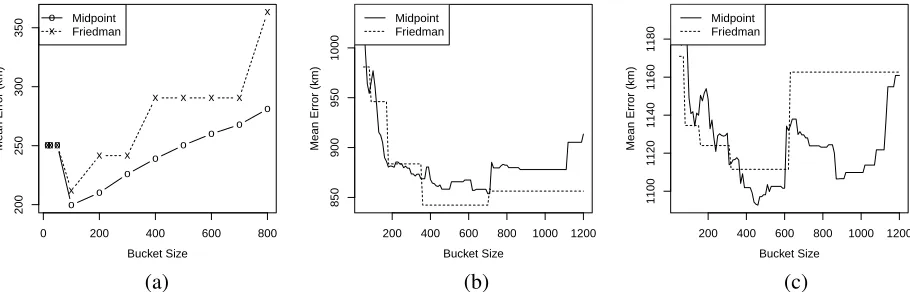
Figure 3: Development set comparisons for (a) GEOWIKI, (b) GEOTEXT, and (c) UTGEO2011-SMALL.
W&B refers to a uniform grid and geographic-center location selection, UNIFCENTROID to a uniform grid with centroid location selection,
KDCENTROID to a k-d tree grid with centroid location selection, and UNIFKDCENTROID to the union of pseudo-documents constructed by UNIFCENTROIDand KDCENTROID.
We also provide two baselines, both of which are based on a uniform grid with centroid location selec-tion.RANDOMpredicts a grid cell chosen at random uniformly; MOSTCOMMONCELLalways predicts the grid cell containing the most training documents. Note that a most-commonk-d leaf baseline does not make sense, as allk-d leaves contain approximately the same number of documents.
Evaluation. We use three metrics to measure ge-olocation performance. The output of each exper-iment is a predicted coordinate for each test docu-ment. For each prediction, we compute the error dis-tance along the surface of the earth to the gold coor-dinate. We report themeanandmedianof all such distances as in W&B and Eisenstein et al. (2011). We also report thefraction of error distances less than 161 km, corresponding to Cheng et al. (2010)’s measure of predictions within 100 miles of the true location. This third measure can reveal differences between models not obvious from just mean and me-dian.
6 Results
This section provides results for the datasets described previously: GEOWIKI, GEOTEXT, UTGEO2011-LARGE and UTGEO2011-SMALL.
We first give details for how we tuned parameters and algorithmic choices using the development sets, and then provide performance on the test sets based on these determinations.
6.1 Tuning
The specific parameters are (1) the partition location method; (2) the bucket size fork-d partitioning; (3) the node division method fork-d partitioning; (4) the degree size for uniform grid partitioning. We tune with respect to mean error, like W&B.
Partition Location Method. Development set results show that the centroid always performs bet-ter than the cenbet-ter for all datasets, typically by a wide margin (especially for large partition sizes). To save space, we do not provide details, but point the reader to the differences in test set results between W&B and UNIFCENTROID(which are identical ex-cept that the former uses the center and the latter uses the centroid) in Tables 1 and 2. All further pa-rameter tuning is done using the centroid method.
k-d Tree Bucket Size. Bucket size should not be too large as a proportion of the total number of train-ing documents. Larger bucket sizes tend to produce larger leaves, so documents in a partition will have a higher average distance to the center or centroid point. This will result in predictions being made at too coarse a granularity, greatly limiting obtainable precision even when the correct leaf is chosen.
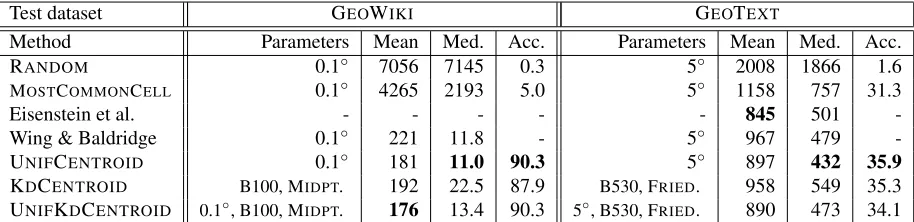
Test dataset GEOWIKI GEOTEXT
Method Parameters Mean Med. Acc. Parameters Mean Med. Acc.
RANDOM 0.1◦ 7056 7145 0.3 5◦ 2008 1866 1.6
MOSTCOMMONCELL 0.1◦ 4265 2193 5.0 5◦ 1158 757 31.3
Eisenstein et al. - - - 845 501
-Wing & Baldridge 0.1◦ 221 11.8 - 5◦ 967 479
-UNIFCENTROID 0.1◦ 181 11.0 90.3 5◦ 897 432 35.9
KDCENTROID B100, MIDPT. 192 22.5 87.9 B530, FRIED. 958 549 35.3
[image:7.612.77.534.57.168.2]UNIFKDCENTROID 0.1◦, B100, MIDPT. 176 13.4 90.3 5◦, B530, FRIED. 890 473 34.1
Table 1: Performance on the held-out test sets of GEOWIKIand GEOTEXT, comparing to the results of Wing and Baldridge (2011) and Eisenstein et al. (2011).
is likely to perform very poorly for the 1NN rule we adopt. It would also require efficient similarity com-parisons, using techniques such as locality-sensitive hashing (Kulis and Grauman, 2009).
The graphs in Figure 3 show development set per-formance when varying bucket size. For GEOWIKI and UTGEO2011-LARGE(not shown), increments of 100 were used, but for the smaller GEOTEXT and UTGEO2011-SMALL, more fine-grained incre-ments of 10 were used. In the case of plateaus, as was common with the FRIEDMANmethod, we chose the middle of the plateau as the bucket size. Overall, we found optimal bucket sizes of 100 for GEOWIKI, 530 for GEOTEXT, 460 for UTGEO2011-SMALL, and 1050 for UTGEO2011-LARGE. That the Wikipedia data requires a smaller bucket size is un-surprising: the documents themselves are generally longer and there are many more of them, so a small bucket size provides good coverage and granularity without sacrificing the ability to estimate good lan-guage models for each partition.
Node Division Method. The graphs in Fig-ure 3 also display the difference between the two splitting methods. MIDPOINT is clearly bet-ter for GEOWIKI, while FRIEDMAN is better for GEOTEXT in the range of bucket sizes produc-ing the best results. FRIEDMAN is best for UTGEO2011-LARGE(not shown), but MIDPOINT is best for UTGEO2011-SMALL.
These results only partly confirm our expecta-tions. We expected FRIEDMAN to perform bet-ter on smaller datasets, as it distributes the doc-uments evenly and avoids many sparsity issues. We expected MIDPOINT to win on larger datasets, where all nodes receive plentiful data and the k-d
tree would choose more representative geographical boundaries.
Cell Size. Following W&B, we choose a cell degree size of 0.1◦ for GEOWIKI, and a cell degree size of 5.0◦ for GEOTEXT. For UTGEO2011-LARGE and UTGEO2011-SMALL, we follow the procedure of W&B, trying sizes 0.1◦,0.5◦, 1.0◦, 5.0◦, and 10.0◦, selecting the one which performed best on the development set. For UTGEO2011-SMALL, this resulted in coarse cells of10.0◦, while for UTGEO2011-LARGE, cell sizes of0.1◦ were best.
With these tuned parameters, the average num-ber of training tokens per k-d leaf was approx-imately 26k for GEOWIKI, 197k for GEOTEXT, 250k for UTGEO2011-SMALL, and 954k for UTGEO2011-LARGE.
6.2 Held-out Test Sets
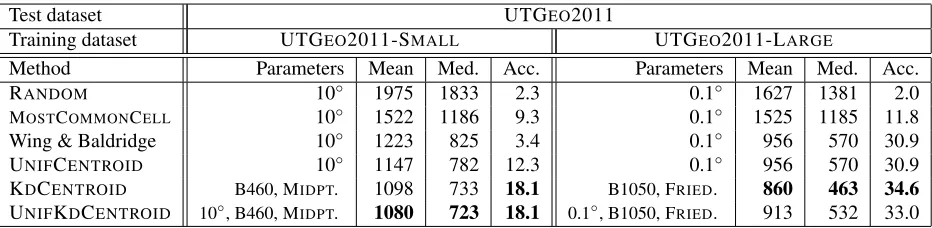
Test dataset UTGEO2011
Training dataset UTGEO2011-SMALL UTGEO2011-LARGE
Method Parameters Mean Med. Acc. Parameters Mean Med. Acc.
RANDOM 10◦ 1975 1833 2.3 0.1◦ 1627 1381 2.0
MOSTCOMMONCELL 10◦ 1522 1186 9.3 0.1◦ 1525 1185 11.8
Wing & Baldridge 10◦ 1223 825 3.4 0.1◦ 956 570 30.9
UNIFCENTROID 10◦ 1147 782 12.3 0.1◦ 956 570 30.9
KDCENTROID B460, MIDPT. 1098 733 18.1 B1050, FRIED. 860 463 34.6
[image:8.612.74.540.56.170.2]UNIFKDCENTROID 10◦, B460, MIDPT. 1080 723 18.1 0.1◦, B1050, FRIED. 913 532 33.0
Table 2: Performance on the held-out test set of UTGEO2011 for different configurations trained on UTGEO2011-SMALL(comparable in size to GEOTEXT) and UTGEO2011-LARGE. The numbers given for W&B were produced from their implementation, and correspond to uniform grid partitioning with locations from centers rather than centroids.
robust for fact-oriented texts that are rich in explicit toponyms and geographically relevant named enti-ties.
For GEOTEXT, the results show that the uniform grid with centroid locations is the most effective of our configurations. It improves on Eisenstein et al. (2011) by 69 km with respect to median error, but has 52 km worse performance than their model with respect to mean error. This indicates that our model is generally more accurate, but that it is compara-tively more wildly off on some documents. Their model is a sophisticated one that attempts to build detailed models of the geographic linguistic varia-tion found in the dataset. Dialectal cues are actually the most powerful ones in the GEOTEXT dataset, and it seems our general approach of winner-takes-all (1NN) hurts performance in this respect, espe-cially with a very small training set.
Table 2 shows the performance on the test set of UTGEO2011 with the UTGEO2011-SMALL and UTGEO2011-LARGE training sets. (Performance for W&B is obtained from their code.4) With
the small training set, error is worse than with GEOTEXT, reflecting the wider geographic scope of UTGEO2011. KDCENTROIDis much more effec-tive than the uniform grids, but combining it with the uniform grid in UNIFKDCENTROIDedges it out by a small amount. More interestingly, KDCENTROID is the strongest on all measures when using the large training set, beating UNIFCENTROID by an even larger margin for mean and median error than with
4https://bitbucket.org/utcompling/
textgrounder/wiki/WingBaldridge2011
the small training set. The bucket size used with the large training set is double that for the small one, but there are many more leaves created since there are 42 times more training documents. With the ex-tra data, the model is able to adapt better to the dis-persion of documents and still have strong language models for each leaf that work well even with our greedy winner-takes-all decision method.
Note that the accuracy measurements for all UTGEO2011 experiments are substantially lower than those reported by Cheng et al. (2010), who report a best accuracy within 100 miles of 51%. While UTGEO2011-LARGE contains a substan-tially larger number of tweets, Cheng et al. (2010) limit themselves to users with at least 1,000 tweets, while we have an average of 85 tweets per user. Their reported mean error distance of 862 km (versus our best mean of 860 km on UTGEO2011-LARGE) indicates that their perfor-mance is hurt by a relatively small number of ex-tremely incorrect guesses, as ours appears to be.
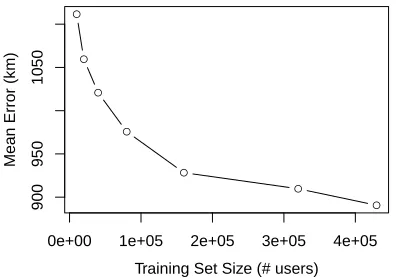
Figure 4 provides a learning curve on UTGEO2011’s development set for KDCENTROID. Performance improves greatly with more data, indicating that GEOTEXT performance would also improve with more training data. Parameters, espe-cially bucket size, need retuning as data increases, which we hope to estimate automatically in future work
0e+00 1e+05 2e+05 3e+05 4e+05
900
950
1050
Training Set Size (# users)
Mean Error (km)
●
●
●
●
●
●
[image:9.612.79.277.56.195.2]●
Figure 4: Learning curve of KDCENTROID on the UTGEO2011 development set.
1.38 seconds per test document), KDCENTROID took only 80 minutes (.078 s/doc). Similarly, UNIFCENTROID took about 67 minutes to run on UTGEO2011-LARGE (0.34 s/doc), but KDCENTROIDtook only 27 minutes (0.014 s/doc). Generally, the KDCENTROID partitioning results in fewer cells, and therefore fewer KL-divergence comparisons. As expected, the UNIFKDCENTROID model needs as much time as the two together, taking roughly 21 hours for GEOWIKI(1.52 s/doc) and 85 minutes for UTGEO2011-LARGE (0.36 s/doc).
7 Discussion
7.1 Error Analysis
We examine some of the greatest error distances to better understand and improve our models. In many cases, landmarks in Australia or New Zealand are predicted in European locations with similarly-named landmarks, or vice versa — e.g. theTheatre Royal, Hobartin Australia is predicted to be in Lon-don’s theater district, and theEmbassy of Australia, Paris is predicted to be in the capital city of Aus-tralia. Thus, our model may be inadvertently cap-turing what Clements et al. (2010) callwormholes, places that are related but not necessarily adjacent.
Some of the other large errors stem from incorrect gold labels, in particular due to sign errors in latitude or longitude, which can place documents 10,000 or more km from their correct locations.
Word Error Word Error
paramus 78 6100 130
ludlow 79 figueroa 133
355 99 dundas 138
ctfuuu 101 120th 139
74th 105 mississauga 140
5701 105 pulaski 144
bloomingdale 122 cucina 146
covina 133 56th 153
lawrenceville 122 403 157
ctfuuuu 124 428 161
Table 3: The 20 words with least average error (km) in the UTGEO2011 development set, trained on the UTGEO2011-SMALL training set, using the
KDCENTROIDapproach with our best parameters. Only
words that occur in at least 10 documents are shown.
Word Error Word Error
seniorpastor 1.1 KS01 2.4 prebendary 1.6 Keio 2.5
Wornham 1.7 Vrah 2.5
Owings 1.9 overspill 2.5 Londoners 2.0 Oriel 2.5 Sandringham 2.1 Holywell 2.6 Sheffield’s 2.2 \’vr&h 2.6 Oxford’s 2.2 operetta 2.6 Belair 2.3 Supertram 2.6
[image:9.612.323.533.57.208.2]Beckton 2.4 Chanel 2.7
Table 4: Top 20 words with the least average er-ror (km) in the GEOWIKI development set, using the
UNIFKDCENTROIDapproach with our best parameters.
Only words occurring in at least 10 documents are shown.
7.2 Most Predictive Words
Our approach relies on the idea that the use of certain words correlates with a Twitter user or Wikipedia article’s location. To investigate which words tend to be good indicators of location, we computed, for each word in a development set, the average error distance of documents containing that word. Table 3 gives the 20 words with the least error, among those that occur in at least 10 documents (users), for the UTGEO2011 development set, trained on UTGEO2011-SMALL.
[image:9.612.329.527.291.444.2]120th), area codes (403), and street numbers (5701, 6100). All are highly locatable terms, as we would expect. Many of the street addresses are due to check-ins with the location-based social networking service Foursquare (e.g. the tweetI’m at Starbucks (7301 164th Ave NE, Redmond Town Center, Red-mond)), where the user is literally broadcasting his or her location. The tokenctfuuu(u)—an elongation of the internet abbreviationctfu, orcracking the fuck up—is a dialectal or stylistic feature highly indica-tive of the Washington, D.C. area.
Similarly, several place names (Wornham,Belair, Holywell) appear in GEOWIKI.Operettas are a cul-tural phenomenon largely associated with France, Germany, and England and particularly with specific theaters in these countries. However, other highly specific tokens such asKS01 have a very low aver-age error because they occur in few documents and are thus highly unambiguous indicators of location. Other terms, likeseniorpastor and\’vr&h, are due to extraction errors in the dataset created by W&B, and are carried along because of a high correlation with specific documents.
8 Conclusion
We have shown how to construct an adaptive grid with k-d trees that enables robust text geolocation and scales well to large training sets. It will be inter-esting to consider how it interacts with other strate-gies for improving the IR-based approach. For ex-ample, the pseudo-document word distributions can be smoothed based on nearby documents or on the structure of thek-d tree itself. Integrating our system with topic models or Bayesian methods would likely provide more insight with regard to the most dis-criminative and geolocatable words. We also expect predicting locations based on multiple most similar documents (kNN) to be more effective in predict-ing document location, as the second and third most similar training documents together may sometimes be a better estimation of its distribution than just the first alone. EmployingkNearest Neighbors also al-lows for more sophisticated methods of location es-timation than a single leaf’s centroid. Other possi-bilities include constructing multiplek-d trees using random subsets of the training data to reduce sensi-tivity to the bucket size.
In this article, we have considered each user in isolation. However, Liben-Nowell et al. (2005) show that roughly 70% of social network links can be de-scribed using geographic information and that the probability of a social link is inversely proportional to geographic distance. Backstrom et al. (2010) ver-ify these results on a much larger scale using ge-olocated Facebook profiles: their algorithm geolo-cates users with only the social graph and signif-icantly outperforms IP-based geolocation systems. Given that both Twitter and Wikipedia have rich, linked document/user graphs, a natural extension to our work here will be to combine text and network prediction for geolocation. Sadilek et al. (2012) also show that a combination of textual and so-cial data can accurately geolocate individual tweets when scope is limited to a single city.
Tweets are temporally ordered and the geographic distance between consecutive tweeting events is constrained by the author’s movement. For tweet-level geolocation, it will be useful to build on work in geolocation that considers the temporal dimen-sion (Chen and Grauman, 2011; Kalogerakis et al., 2009; Sadilek et al., 2012) to make better predictions for documents/images that are surrounded by others with excellent cues, but which are hard to resolve themselves.
9 Acknowledgments
We would like to thank Matt Lease and the three anonymous reviewers for their feedback. This re-search was supported by a grant from the Morris Memorial Trust Fund of the New York Community Trust.
References
Richard J. Anderson. 1999. Tree data structures for n-body simulation. SIAM Journal on Computing, 28(6):1923–1940.
Lars Backstrom, Eric Sun, and Cameron Marlow. 2010. Find me if you can: improving geographical prediction with social and spatial proximity. InProceedings of the 19th International Conference on World Wide Web, pages 61–70.
Chao-Yeh Chen and Kristen Grauman. 2011. Clues from the beaten path: Location estimation with bursty se-quences of tourist photos. InProceedings of the IEEE Conference on Computer Vision and Pattern Recogni-tion, pages 1569–1576.
Zhiyuan Cheng, James Caverlee, and Kyumin Lee. 2010. You are where you tweet: A content-based approach to geo-locating twitter users. In Proceedings of the 19th ACM International Conference on Information and Knowledge Management, pages 759–768. Martin Clements, Pavel Serdyukov, Arjen P. de Vries, and
Marcel J.T. Reinders. 2010. Finding wormholes with flickr geotags. In Proceedings of the 32nd European Conference on Information Retrieval, pages 658–661. Sebastian Cobarrubias. 2009. Mapping machines: ac-tivist cartographies of the border and labor lands of Europe. Ph.D. thesis, University of North Carolina at Chapel Hill.
Dorin Comaniciu and Peter Meer. 2002. Mean shift: a robust approach toward feature space analysis. IEEE Transactions on Pattern Analysis and Machine Intelli-gence, 24(5):603–619.
Junyan Ding, Luis Gravano, and Narayanan Shivaku-mar. 2000. Computing geographical scopes of web resources. In Proceedings of the 26th International Conference on Very Large Data Bases, pages 545–556. Jacob Eisenstein, Brendan O’Connor, Noah A. Smith, and Eric P. Xing. 2010. A latent variable model for geographic lexical variation. In Proceedings of the 2010 Conference on Empirical Methods in Natu-ral Language Processing, pages 1277–1287.
Jacon Eisenstein, Ahmed Ahmed, and Eric P. Xing. 2011. Sparse additive generative models of text. In
Proceedings of the 28th International Conference on Machine Learning, pages 1041–1048.
Jerome H. Friedman, Jon Louis Bentley, and Raphael Ari Finkel. 1977. An algorithm for finding best matches in logarithmic expected time. ACM Transactions on Mathematical Software, 3:209–226.
James Hays and Alexei A. Efros. 2008. im2gps: esti-mating geographic information from a single image. InProceedings of the IEEE Conference on Computer Vision and Pattern Recognition, pages 1–8.
Evangelos Kalogerakis, Olga Vesselova, James Hays, Alexei Efros, and Aaron Hertzmann. 2009. Image se-quence geolocation with human travel priors. In Pro-ceedings of the IEEE 12th International Conference on Computer Vision, pages 253–260.
Sheila Kinsella, Vanessa Murdock, and Neil O’Hare. 2011. “I’m eating a sandwich in Glasgow”: Model-ing locations with tweets. In Proceedings of the 3rd International Workshop on Search and Mining User-generated Contents, pages 61–68.
Brian Kulis and Kristen Grauman. 2009. Kernelized locality-sensitive hashing for scalable image search. In Proceedings of the 12th International Conference on Computer Vision, pages 2130–2137.
David Liben-Nowell, Jasmine Novak, Ravi Kumar, Prab-hakar Raghavan, and Andrew Tomkins. 2005. Geo-graphic routing in social networks. Proceedings of the National Academy of Sciences of the United States of America, 102(33):11623–11628.
Jay M. Ponte and W. Bruce Croft. 1998. A language modeling approach to information retrieval. In Pro-ceedings of the 21st Annual International ACM SIGIR Conference on Research and Development in Informa-tion Retrieval, pages 275–281.
Adam Sadilek, Henry Kautz, and Jeffrey P. Bigham. 2012. Finding your friends and following them to where you are. InProceedings of the 5th ACM Inter-national Conference on Web Search and Data Mining, pages 723–732.
Jagan Sankaranarayanan, Hanan Samet, Benjamin E. Teitler, Michael D. Lieberman, and Jon Sperling. 2009. Twitterstand: news in tweets. InProceedings of the 17th ACM SIGSPATIAL International Confer-ence on Advances in Geographic Information Systems, pages 42–51.
Pavel Serdyukov, Vanessa Murdock, and Roelof van Zwol. 2009. Placing flickr photos on a map. In Pro-ceedings of the 32nd International ACM SIGIR Con-ference on Research and Development in Information Retrieval, pages 484–491.
Benjamin Wing and Jason Baldridge. 2011. Simple su-pervised document geolocation with geodesic grids. InProceedings of the 49th Annual Meeting of the As-sociation for Computational Linguistics: Human Lan-guage Technologies, pages 955–964.