Topic Models + Word Alignment = A Flexible Framework for Extracting
Bilingual Dictionary from Comparable Corpus
Xiaodong Liu, Kevin Duh and Yuji Matsumoto Graduate School of Information Science Nara Institute of Science and Technology 8916-5 Takayama, Ikoma, Nara 630-0192, Japan
{xiaodong-l,kevinduh,matsu}@is.naist.jp
Abstract
We propose a flexible and effective frame-work for extracting a bilingual dictionary from comparable corpora. Our approach is based on a novel combination of topic modeling and word alignment techniques. Intuitively, our approach works by con-verting a comparable document-aligned corpus into a parallel topic-aligned cor-pus, then learning word alignments us-ing co-occurrence statistics. This topic-aligned corpus is similar in structure to the sentence-aligned corpus frequently used in statistical machine translation, enabling us to exploit advances in word alignment re-search. Unlike many previous work, our framework does not require any language-specific knowledge for initialization. Fur-thermore, our framework attempts to han-dle polysemy by allowing multiple trans-lation probability models for each word. On a large-scale Wikipedia corpus, we demonstrate that our framework reliably extracts high-precision translation pairs on a wide variety of comparable data condi-tions.
1 Introduction
A machine-readable bilingual dictionary plays a very important role in many natural language pro-cessing tasks. In machine translation (MT), dic-tionaries can help in the domain adaptation set-ting (Daume III and Jagarlamudi, 2011). In cross-lingual information retrieval (CLIR), dictio-naries serve as efficient means for query trans-lation (Resnik et al., 2011). Many other multi-lingual applications also rely on bimulti-lingual dictio-naries as integral components.
One approach for building a bilingual dictio-nary resource uses parallel sentence-aligned cor-pora. This is often done in the context of Statis-tical MT, using word alignment algorithms such as the IBM models (Brown et al., 1993; Och and Ney, 2003). Unfortunately, parallel corpora may be scarce for certain language-pairs or domains of interest (e.g., medical and microblog).
Thus, the use of comparable corpora for bilin-gual dictionary extraction has become an active research topic (Haghighi et al., 2008; Vuli´c et al., 2011). Here, a comparable corpus is defined as collections of document pairs written in dif-ferent languages but talking about the same topic (Koehn, 2010), such as interconnected Wikipedia articles. The challenge with bilingual dictionary extraction from comparable corpus is that exist-ing word alignment methods developed for paral-lel corpus cannot be directly applied.
We believe there are several desiderata for bilin-gual dictionary extraction algorithms:
1. Low Resource Requirement: The approach should not rely on language-specific knowl-edge or a large scale seed lexicon.
2. Polysemy Handling: One should handle the fact that a word form may have multiple meanings, and such meanings may be trans-lated differently.
3. Scalability: The approach should run effi-ciently an massively large-scale datasets.
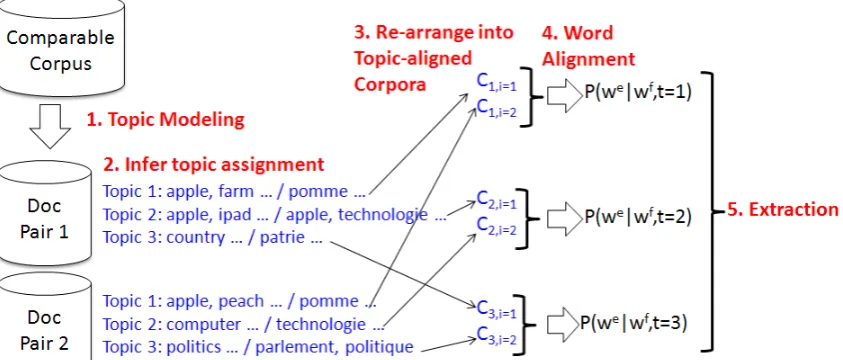
Our framework addresses the above desired points by exploiting a novel combination of topic models and word alignment, as shown in Figure 1. Intuitively, our approach works by first converting a comparabledocument-aligned corpus into a
Figure 1: Proposed Framework
alleltopic-aligned corpus, then apply word align-ment methods to model co-occurence within top-ics. By employing topic models, we avoid the need for seed lexicon and operate purely in the realm of unsupervised learning. By using word alignment on topic model results, we can easily model polysemy and extract topic-dependent lexi-cons.
Specifically, let we be an English word and
wf be a French word. One can think of
tradi-tional bilingual dictionary extraction as obtaining
(we, wf)pairs in which the probabilityp(we|wf) or p(wf|we) is high. Our approach differs
by modeling p(we|wf, t) orp(wf|we, t) instead,
where tis a topic. The key intuition is that it is
easier to tease out the translation of a polysemous word e given p(wf|we, t) rather than p(wf|we).
A word may be polysemous, but given a topic, there is likely a one-to-one correspondence for the most appropriate translation. For example, un-der the simple modelp(wf|we), the English word “free“ may be translated into the Japanese word 自由 (as in free speech) or 無料 (as in free
beer) with equal 0.5 probability; this low
proba-bility may cause both translation pairs to be re-jected by the dictionary extraction algorithm. On the other hand, givenp(wf|we, t), wheretis “pol-itics“ or “shopping“, we can allow high probabili-ties for both words depending on context.
Our contribution is summarized as follows:
• We propose a bilingual dictionary
extrac-tion framework that simultaneously achieves all three of the desiderata: low resource re-quirement, polysemy handling, and scalabil-ity. We are not aware of any previous works that address all three.
• Our framework is extremely flexible and
simple-to-implement, consisting of a novel combination of existing topic modeling tools from machine learning and word alignment tools from machine translation.
2 Related Work
There is a plethora of research on bilingual lexi-con extraction from comparable corpora, starting
with seminal works of (Rapp, 1995; Fung and Lo, 1998). The main idea is to assume that translation pairs have similar contexts, i.e. thedistributional hypothesis, so extraction consists of 3 steps: (1) identify context windows around words, (2) trans-late context words using a seed bilingual dictio-nary, and (3) extract pairs that have high result-ing similarity. Methods differ in how the seed dictionary is acquired (Koehn and Knight, 2002; D´ejean et al., 2002) and how similarity is defined (Fung and Cheung, 2004; Tamura et al., 2012). Projection-based approaches have also been pro-posed, though they can be shown to be related to the aforementioned distributional approaches (Gaussier et al., 2004); for example, Haghighi (2008) uses CCA to map vectors in different lan-guages into the same latent space. Laroche (2010) presents a good summary.
Vuli´c et al. (2011) pioneered a new approach to bilingual dictionary extraction based on topic modeling approach which requires no seed dictio-nary. While our approach is motivated by (Vuli´c et al., 2011), we exploit the topic model in a very different way (explained in Section 4.2). They do not use word alignments like we do and thus can-not model polysemy. Further, their approach re-quires training topic models with a large number of topics, which may limit the scalability of the approach.
Recently, there has been much interest in mul-tilingual topic models (MLTM) (Jagarlamudi and Daume, 2010; Mimno et al., 2009; Ni et al., 2009; Boyd-Graber and Blei, 2009). Many of these mod-els givep(t|e)andp(t|f), but stop short of
extract-ing a bilextract-ingual lexicon. Although topic models can group relatedeandfin the same topic cluster, the
extraction of a high-precision dictionary requires additional effort. One of our contributions here is an effective way to do this extraction using word alignment methods.
3 System Components: Background This section reviews MLTMs and Word Align-ment, the main components of our framework. The knowledgeable readers may wish to skim this section for notation and move to Section 4, which describes our contribution.
3.1 Multilingual Topic Model
al. (2009), which extends the monolingual La-tent Dirichlet Allocation model (Blei et al., 2003). Given a comparable corpus E in English and F in a foreign language, we assume that the docu-ment pair boundaries are known. For each doc-ument pair di = [dei, d
f
i] consisting of English document dei and Foreign document dfi (where i∈ {1, . . . , D},Dis number of document pairs),
we know that dei and dfi talk about the same
topics. While the monolingual topic model lets each document have its own so-called document-specific distribution over topics, the multilingual topic model assumes that documents in each tu-ple share the same topic prior (thus the compara-ble corpora assumption) and each topic consists of several language-specific word distributions. The generative story is shown in Algorithm 1.
foreach topickdo
for l∈ {e, f}do
sampleϕl
k∼Dirichlet(βl); end
end
foreach document pairdido sampleθi∼Dirichlet(α); for l∈ {e, f}do
samplezl ∼M ultinomial(θi); foreach wordwlindli do
samplewl ∼p(wl|zl, ϕl);
end end end
Algorithm 1:Generative story for (Mimno et al., 2009). θi is the topic proportion of document pair di. Words wl are drawn from language-specific distributions p(wl|zl, ϕl), where
lan-guage l indexes English e or Foreign f. Here
pairs of language-specific topics ϕl are drawn from Dirichlet distributions with priorβl.
3.2 Statistical Word Alignment
For a sentence-pair (e,f), let e = [we
1, w2e, . . . w|ee|]be the English sentence with|e|
words and f = [wf1, w2f, . . . wf|f|]be the foreign
sentence with |f| words. For notation, we will index English words by i and foreign words
by j. The goal of word alignment is to find an
alignment functiona:i→ jmapping words ine
to words inf (and vice versa).
We will be using IBM Model 1 (Brown et al.,
1993; Och and Ney, 2003), which proposes the following probabilistic model for alignment:
p(e, a,|f)≈ |e|
Y
i=1
p(wie|wfa(i)) (1)
Here,p(wie|wfa(i))captures the translation
prob-ability of the English word at position ifrom the foreign word at positionj = a(i), where the
ac-tual alignmentais a hidden variable, and training
can be done via EM. Although this model does not incorporate much linguistic knowledge, it enables us tofind correspondence between distinct objects from paired sets. In machine translation, the dis-tinct objects are words from different languages while the paired sets are sentence-aligned corpora. In our case, our distinct objects are also words from distinct languages but our pair sets will be topic-aligned corpora.
4 Proposed Framework for Bilingual Dictionary Extraction
The general idea of our proposed framework is sketched in Figure 1: First, we run a multilin-gual topic model to convert the comparable cor-pora to topic-aligned corcor-pora. Second, we run a word alignment algorithm on the topic-aligned corpora in order to extract translation pairs. The innovation is in how this topic-aligned corpora is defined and constructed, the link between the two stages. We describe how this is done in Section 4.1 and show how existing approaches are subsumed in our general framework in Section 4.2.
4.1 Topic-Aligned Corpora
Suppose the original comparable corpus has D
document pairs [de i, d
f
i]i=1,...,D. We run a
mul-tilingual topic model with K topics, where K
is user-defined (Section 3.1). The topic-aligned corpora is defined hierarchically as aset of sets: On the first level, we have a set of K topics,
{t1, . . . , tk, . . . , tK}. On the second level, for each topic tk, we have a set of D “word
col-lections“{Ck,1, . . . , Ck,i, . . . , Ck,D}. Each word collectionCk,irepresents the English and foreign words that occur simultaneously in topic tk and documentdi.
For clarity, let us describe the topic-aligned corpora construction process step-by-step together with a flow chart in Figure 2:
Figure 2: Construction of topic-aligned corpora.
2. Infer a topic assignment for each token in the comparable corpora, and generate a list of word collectionsCk,ioccurring under a given topic. 3. Re-arrange the word collections such thatCk,i belonging to the same topic are grouped together. This resulting set of sets is called topic-aligned corpora, since it represents word collections linked by the same topics.
4. For each topic tk, we run IBM Model 1 on
{Ck,1, . . . , Ck,i, . . . , Ck,D}. In analogy to statis-tical machine translation, we can think of this dataset as a parallel corpus ofD“sentence pairs“,
where each “sentence pair“ contains the English and foreign word tokens that co-occur under the same topic and the same document. Note that word alignment is run independently for each topic, resulting in K topic-dependent lexicons p(we|wf, t
k).
5. To extract a bilingual dictionary, we find pairs
(we, wf)with high probability under the model:
p(we|wf) =X
k
p(we|wf, tk)p(tk|wf) (2)
The first term is the topic-dependent bilingual lex-icon from Step 4; the second term is the topic pos-terior from the topic model in Step 1.
In practice, we will compute the probabilities of Equation 2 in both directions: p(we|, wf)as in
Eq. 2 andp(wf|we) =Pkp(wf|we, tk)p(tk|we). The bilingual dictionary can then be extracted based on a probabilities threshold or some bidirec-tional constraint. We choose to use a bidirecbidirec-tional constraint because it gives very high-precision
dictionaries and avoid the need to tune probability thresholds. A pair (˜e,f˜) is extracted if the
following holds:
˜
e= arg max
e
p(e|f = ˜f); ˜f = arg max
f
p(f|e= ˜e)
(3) To summarize, the main innovation of our ap-proach is that we allow for polysemy as topic-dependent translation explicitly in Equation 2, and use a novel combination of topic modeling and word alignment techniques to compute the term
p(we|wf, t
k)in an unsupervised fashion.
4.2 Alternative Approaches
To the best of our knowledge, (Vuli´c et al., 2011) is the only work focuses on using topic models for bilingual lexicon extraction like ours, but they exploit the topic model results in a different way. Their “Cue Method“ computes:
p(we|wf) =X
k
p(we|tk)p(tk|wf) (4)
This can be seen as a simplification of our Eq. 2, where Eq. 4 replaces p(we|tk, wf) with the simpler p(we|t
k). Another vari-ant is the so-called Kullback-Liebler (KL) method, which scores translation pairs by
−Pkp(tk|we) logp(tk|we)/p(tk|wf). In either case, their contribution is the use of topic-word distributions likep(tk|wf)orp(wf|tk)to compute translation probabilities.1 Our formulation can be
considered more general because we do not have the strong assumption that we is independent of
wf giventk, and focus on estimatingp(we|wf, t k) directly with word alignment methods.
5 Experimental Setup 5.1 Data Set
We perform experiments on the Kyoto Wiki Cor-pus2. We chose this corpus because it is aparallel
corpus, where the Japanese edition of Wikipedia is translated manually into English sentence-by-sentence. This enables us to use standard word alignment methods to create a gold-standard lexi-con for large-scale automatic evaluation.3
From this parallel data, we prepared several datasets at successively lower levels of compara-bility. As shown in Table 1,Comp100%is a com-parable version of original parallel data, deleting all the sentence alignments but otherwise keeping all content on both Japanese and English sides. Comp50% and Comp20% are harder datasets that keep only 50% and 20% (respectively) of ran-dom English sentences per documents. We further use a real comparable corpus (Wiki)4, which is
prepared by crawling the online English editions of the corresponding Japanese articles in the Ky-oto Wiki Corpus. The Comp datasets are con-trolled scenarios where all English content is anteed to have Japanese translations; no such guar-antee exists in ourWikidata.
5.2 Experimental Results
1. How does the proposed framework compare to previous work?
We focus on comparing with previous topic-modeling approaches to bilingual lexicon extrac-tion, namely (Vuli´c et al., 2011). The methods are:
• Proposed: The proposed method which exploits a combination of topic modeling and word alignment to incorporate topic-dependent translation probabilities (Eq. 2).
• Cue: From (Vuli´c et al., 2011), i.e. Eq. 4. 2http://alaginrc.nict.go.jp/WikiCorpus/index E.html 3We trained IBM Model 4 using GIZA++ for both direc-tionsp(e|f)andp(f|e). Then, we extract word pair(˜e,f˜)as a “gold standard“ bilingual lexicon if it satisfies Eq. 3. Due to the large data size and the strict bidirectional requirement imposed by Eq. 3, these “gold standard“ bilingual dictionary items are of high quality (94% precision by a manual check on 100 random items). Note sentence alignments are used only for creating this gold-standard.
4The English corresponding dataset, gold-standard and ML-LDA software used in our experiments are available at https://sites.google.com/site/buptxiaodong/home/resource
Dataset #doc #sent(e/j) #voc(e/j) Comp100% 14k 472k/472k 152k/116k Comp50% 14k 236k/472k 100k/116k Comp20% 14k 94k/472k 62k/116k
[image:5.595.308.529.63.137.2]Wiki 3.6k 127k/163k 88k/61k
Table 1: Datasets: the number of document pairs (#doc), sentences (#sent) and vocabulary size (#voc) in English (e) and Japanese (j). For pre-processing, we did word segmentation on Japanese using Kytea (Neubig et al., 2011) and Porter stemming on English. A TF-IDF based stop-word lists of 1200 in each language is ap-plied. #doc is smaller for Wiki because not all Japanese articles inComp100%have English ver-sions in Wikipedia during the crawl.
• JS: From (Vuli´c et al., 2011). Symmetrizing KL by Jensen-Shannon (JS) divergence im-proves results, so we report this variant.5
We also have a baseline that uses no topic models: IBM-1runs IBM Model 1 directly on the compa-rable dataset, assuming each document pair is a “sentence pair“.
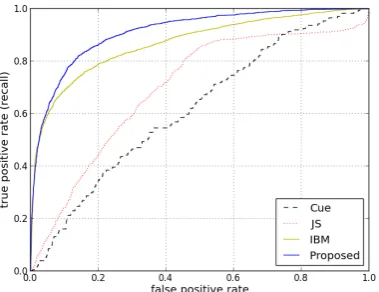
Figure 3 shows the ROC (Receiver Operat-ing Characteristic) Curve on the Wiki dataset. The ROC curve lets us observe the change in Recall as we gradually accept more translation pairs as dictionary candidates. In particular, it measures the true positive rate (i.e. recall =
|{Gold(e, f)}T{Extracted(e, f)}|/#Gold)
and false positive rate (fraction of false extractions over total number of extractions) at varying levels of thresholds. This is generated by first computing
p(e|f) + p(f|e) as the score for pair (e, f) for each method, then sorting the pairs by this score and successive try different thresholds.
The curve of the Proposed method dominates those of all other methods. It is also the best in Area-Under-Curve scores (Davis and Goadrich, 2006), which are 0.96, 0.90, 0.85 and 0.71, for Proposed,IBM-1,Cue, andJS, respectively.6
ROC is insightful if we are interested in com-paring methods for all possible thresholds, but in practice we may desire a fixed operating point. Thus we apply the bidirectional heuristic of Eq. 5Topic model hyperparameters for Proposed, Cue, and
JSareα= 50/Kandβ= 0.1following (Vuli´c et al., 2011). 6The Precision-Recall curve gives a similar conclusion. We do not show it here since the extremely low precision of
Figure 3: ROC curve on theWikidataset. Curves on upper-left is better. Cue,JS,Proposedall use
K=400 topics. Note thatProposedis best.
K Method Prec ManP #Extracted
100
Cue 0.027 0.02 3800
JS 0.013 0.01 3800
Proposed 0.412 0.36 3800
400
Cue 0.059 0.02 2310
JS 0.075 0.02 2310
Proposed 0.631 0.56 2310
- IBM-1 0.514 0.42 2310
[image:6.595.317.516.75.233.2]- IBM-1* 0.493 0.39 3714
Table 2: Precision on the Wiki dataset.
K=number of topics. Precision (Prec) is defined
as |{Gold(e,f)}T{Extracted(e,f)}|
#Extracted . ManP is preci-sion evaluated manually on 100 random items.
3 to extract a fixed set of lexicon for Proposed. For the other methods, we calibrated the thresh-olds to get the same number of extractions. Then we compare the precision, as shown in Table 2.
1. Proposed outperforms other methods, achieving 63% (automatic) precision and 56% (manual) precision.
2. The JS and Cue methods suffer from ex-tremely poor precision. We found that this is due to insufficient number of topics, and is consistent with the results by (Vuli´c et al., 2011) which showed best results withK >
2000. However, we could not train JS/Cue
on such a large number of topics since it is computationally-demanding for a corpus as large as ours.7 In this regard, theProposed
7The experiments in (Vuli´c et al., 2011) has vocabulary
Figure 4: Robustness of method under different data conditions.
method is much more scalable, achieving good results with low K, satisfying one of
original desiderata.8
3. IBM-1 is doing surprisingly well, consider-ing that it simply treats document pairs as sentence pairs. This may be due to some extent to the structure of the Kyoto Wiki dataset, which contains specialized topics (about Kyoto history, architecture, etc.), lead-ing to a vocabulary-document co-occurrence matrix with sparse block-diagonal structure. Thus there may be enough statistics train IBM-1on documents.
2. How does the proposed method perform un-der different degrees of “comparability“? We next examined how our methods perform un-der different data conditions. Figure 4 plots the re-sults in terms of Precision evaluated automatically. We observe thatProposed (K=400) is relatively stable, with a decrease of 14% Precision going from fully-comparable to real Wikipedia compa-rable corpora. The degradation for K=100 is much larger (31%) and therefore not recommended. We believe that robustness depends onK, because the size of 10k, compared to 150k in our experiments. We have attempted largeK≥1000butCuedid not finish after days. 8We have a hypothesis as to whyCueandJSdepend on largeK. Eq. 2 is a valid expression forp(we|wf)that makes little assumptions. We can view Eq. 4 as simplifying the first term of Eq. 2 fromp(we|tk, wf)top(we|tk). Both prob-ability tables have the same output-space (we), so the same number of parameters is needed in reality to describe this dis-tribution. By throwing outwf, which has large cardinality,t
[image:6.595.72.291.289.422.2]5 10 15 20
0
10000
30000
5 10 15 20
0
10000
30000
W
ord
C
ou
nt
Topic Count
en jp
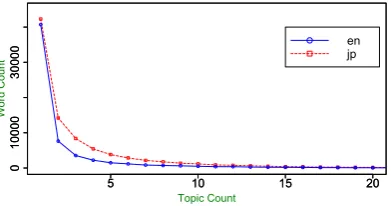
Figure 5: Power-law distribution of number of word types with X number of topics.
topic model of (Mimno et al., 2009) assumes one topic distribution per document pair. For low-levels of comparability, a small number of topics may not sufficiently model the differences in top-ical content. This suggests the use of hierarchtop-ical topic models (Haffari and Teh, 2009) or other vari-ants in future work.
3. What are the statistical characteristics of topic-aligned corpora?
First, we show the word-topic distribution from multilingual topic modeling in theK = 400
sce-nario (first step of Proposed, Cue, and JS). For each word typew, we count the number of topics
it may appear in, i.e. nonzero probabilities accord-ing top(w|t). Fig. 5 shows the number of word
types that have xnumber of topics. This
power-law is expected since we are modeling all words.9
Next we compute the statistics after construct-ing the topic-aligned corpora (Step 3 of Fig. 2). For each part of the topic-aligned corpora, we compute the ratio of distinct English word types vs. distinct Japanese word types. If the ratio is close to one, that means the partition into topic-aligned corpora effectively separates the skewed word-topic distribution of Fig 5. We found that the mean ratio averaged across topics is low at 1.721 (variance is 1.316), implying that within each topic, word alignment is relatively easy. 4. What kinds of errors are made?
We found that the proposed method makes sev-eral types of incorrect lexicon extractions. First, Word Segmentation “errors“ on Japanese could 9This means that it is not possible to directly extract lexi-con by taking the cross-product(wf, we)of the top-n words inp(wf|tk)andp(we|tk)for the same topictk, as suggested by (Mimno et al., 2009). When we attempted to do this, us-ing top-2 words perp(wf
|tk)andp(we
|tk), we could only obtain precision of 0.37 for 1600 extractions. This skewed distribution similarly explains the poor performance ofCue.
make it impossible to find a proper English trans-lation (e.g., 高市皇子should translate to “Prince-Takechi“ but system proposes ““Prince-Takechi“). Sec-ond, an unrelated word pair (we, wf) may be in-correctly placed in the same topic, leading to an Incorrect Topicerror. Third, even if(we, wf)
in-tuitively belong to the same topic, they may not be direct translations; an extraction in this case would be a Correct Topic, Incorrect Alignment error (e.g. もんじゃ焼き, a particular panfried snack, is incorrectly translated as “panfry“).
Table 3 shows the distribution of error types by a manual classification. Incorrect Alignment er-rors are most frequent, implying the topic models are doing a reasonable job of generating the topic-aligned corpus. The amount ofIncorrect Topicis not trivial, though, so we would still imagine more advanced topic models to help. Segmentation er-rors are in general hard to solve, even with a better word segmenter, since in general one-to-one cross-lingual word correspondence is not consistent–we believe the solution is a system that naturally han-dles multi-word expressions (Baldwin, 2011).
Word Segmentation Error 14
Incorrect Topic 29
Correct Topic, Incorrect Alignment 40
[image:7.595.73.269.76.179.2]Reason Unknown 7
Table 3: Counts of various error types.
5. What is the computation cost?
Timing results on a 2.4GHz Opteron CPU for var-ious steps ofProposedandCueare shown in Ta-ble 5. The proposed method is 5-8 times faster than Cue. For Proposed, computation time is dominated by topic modeling while GIZA++ on topic-aligned corpora is extremely fast.Cue addi-tionally suffers from computational complexity in calculating Eq.4, especially when both p(we|tk) andp(tk|wf) have high cardinality. In compari-son, calculating Eq.2 is fast sincep(we|wf, t
k)is in practice quite sparse.
6. What topic-dependent lexicons are learned and do they capture polysemy?
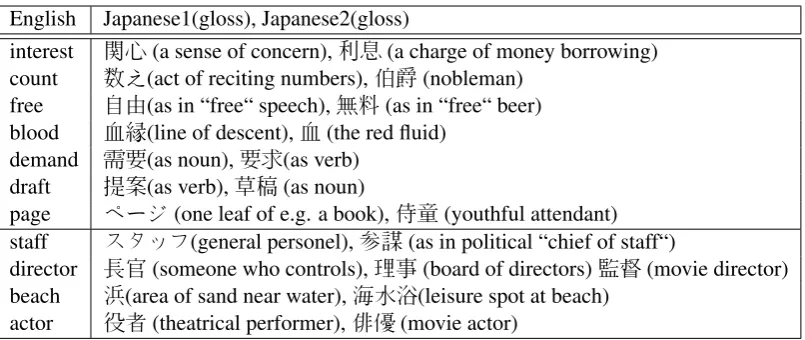
In our evaluation so far, we have only produced an one-to-one bilingual dictionary (due to the bidirec-tionality constraint of Eq.3). We have seen how topic-dependent translation models p(wf|we, t
[image:7.595.323.513.384.455.2]English Japanese1(gloss), Japanese2(gloss)
interest 関心(a sense of concern),利息(a charge of money borrowing) count 数え(act of reciting numbers),伯爵(nobleman)
free 自由(as in “free“ speech),無料(as in “free“ beer)
blood 血縁(line of descent),血(the red fluid) demand 需要(as noun),要求(as verb)
draft 提案(as verb),草稿(as noun)
page ページ(one leaf of e.g. a book),侍童(youthful attendant) staff スタッフ(general personel),参謀(as in political “chief of staff“)
director 長官(someone who controls),理事(board of directors)監督(movie director) beach 浜(area of sand near water),海水浴(leisure spot at beach)
actor 役者(theatrical performer),俳優(movie actor)
Table 4: Examples of topic-dependent translations given by p(wf|we, tk). The top portion shows ex-amples of polysemous English words. The bottom shows exex-amples where English is not decisively polysemous, but indeed has distinct translations in Japanese based on topic.
K topic giza Eq.2 Eq.4 Prp Cue
100 180 3 20 1440 203 1620
200 300 3 33 2310 336 2610
400 780 5 42 3320 827 4100
Table 5: Wall-clock times in minutes for Topic Modeling (topic), Word Alignment (giza), and
p(we|wf) calculation. Overall time for
Pro-posed (Prp) is topic+giza+Eq.2 and for Cue is topic+Eq.4.
Here, we explore the modelp(wf|we, tk)learned at Step 4 of Figure 2 to see whether it captures some of the polysemy phenomenon mentioned in the desiderata. It is not feasible to automatically evaluate topic-dependent dictionaries, since this requires “gold standard“ of the form(e, f, t). Thus we cannot claim whether our method successfully extracts polysemous translations. Instead we will present some interesting examples found by our method. In Table 4, we look at potentially pol-ysemous English words we, and list the
highest-probability Japanese translations wf conditioned on differenttk. We found many promising cases
where the topic identification helps divide the dif-ferent senses of the English word, leading to the correct Japanese translation achieving the highest probability.
6 Conclusion
We proposed an effective way to extract bilin-gual dictionaries by a novel combination of topic modeling and word alignment techniques. The key innovation is the conversion of a
compara-bledocument-aligned corpus into a parallel topic-aligned corpus, which allows word alignment techniques to learn topic-dependent translation models of the formp(we|wf, t
k). While this kind of topic-dependent translation has been proposed for the parallel corpus (Zhao and Xing, 2007), we are the first to enable it for comparable cor-pora. Our large-scale experiments demonstrated that the proposed framework outperforms existing baselines under both automatic metrics and man-ual evaluation. We further show that our topic-dependent translation models can capture some of the polysemy phenomenon important in dictionary construction. Future work includes:
1. Exploring other topic models (Haffari and Teh, 2009) and word alignment techniques (DeNero and Macherey, 2011; Mermer and Saraclar, 2011; Moore, 2004) in our framework.
2. Extract lexicon from massive multilingual col-lections. Mausum (2009) and Shezaf (2010) show that language pivots significantly improve the pre-cision of distribution-based approaches. Since multilingual topic models can easily be trained on more than 3 languages, we expect it will give a big boost to our approach.
Acknowledgments
[image:8.595.99.502.60.230.2]References
Timothy Baldwin. 2011. Mwes and topic mod-elling: enhancing machine learning with linguis-tics. InProceedings of the Workshop on Multiword Expressions: from Parsing and Generation to the Real World, MWE ’11, pages 1–1, Stroudsburg, PA, USA. Association for Computational Linguistics.
D. Blei, A. Ng, and M. Jordan. 2003. Latent dirichlet allocation.Journal of Machine Learning Research.
Jordan Boyd-Graber and David M. Blei. 2009. Multi-lingual topic models for unaligned text. InUAI.
P. Brown, S. Della Pietra, V. Della Pietra, and R. Mer-cer. 1993. The mathematics of statistical machine translation: Parameter estimation. Computational Linguistics, 19(2).
Hal Daume III and Jagadeesh Jagarlamudi. 2011. Do-main adaptation for machine translation by min-ing unseen words. In Proceedings of the 49th An-nual Meeting of the Association for Computational Linguistics: Human Language Technologies, pages 407–412, Portland, Oregon, USA, June. Association for Computational Linguistics.
Jesse Davis and Mark Goadrich. 2006. The relation-ship between precision-recall and ROC curves. In
ICML.
Herv´e D´ejean, ´Eric Gaussier, and Fatia Sadat. 2002. An approach based on multilingual thesauri and model combination for bilingual lexicon extraction. InProceedings of the 19th international conference on Computational linguistics - Volume 1, COLING ’02, pages 1–7.
John DeNero and Klaus Macherey. 2011. Model-based aligner combination using dual decomposi-tion. In Proceedings of the Association for Com-putational Linguistics (ACL).
Pascale Fung and Percy Cheung. 2004. Mining verynon-parallel corpora: Parallel sentence and lex-icon extraction via bootstrapping and em. In Pro-ceedings of the Conference on Empirical Methods in Natural Language Processing.
Pascale Fung and Yuen Yee Lo. 1998. Translating un-known words using nonparallel, comparable texts. InCOLING-ACL.
Eric Gaussier, J.M. Renders, I. Matveeva, C. Goutte, and H. Dejean. 2004. A geometric view on bilin-gual lexicon extraction from comparable corpora. In
Proceedings of the 42nd Meeting of the Association for Computational Linguistics (ACL’04), Main Vol-ume, pages 526–533, Barcelona, Spain, July.
Ghloamreza Haffari and Yee Whye Teh. 2009. Hier-archical dirichlet trees for information retrieval. In
NAACL.
Aria Haghighi, Percy Liang, Taylor Berg-Kirkpatrick, and Dan Klein. 2008. Learning bilingual lexicons from monolingual corpora. InProceedings of ACL-08: HLT, pages 771–779, Columbus, Ohio, June. Association for Computational Linguistics.
Jagadeesh Jagarlamudi and Hal Daume. 2010. Ex-tracting multilingual topics from unaligned compa-rable corpora. InECIR.
Philipp Koehn and Kevin Knight. 2002. Learn-ing a translation lexicon from monolLearn-ingual corpora. In Proceedings of ACL Workshop on Unsupervised Lexical Acquisition.
Philipp Koehn. 2010.Statistical Machine Translation. Cambridge University Press, New York, NY, USA, 1st edition.
Audrey Laroche and Philippe Langlais. 2010. Re-visiting context-based projection methods for term-translation spotting in comparable corpora. In
Proceedings of the 23rd International Conference on Computational Linguistics (Coling 2010), pages 617–625, Beijing, China, August. Coling 2010 Or-ganizing Committee.
Mausam, Stephen Soderland, Oren Etzioni, Daniel S. Weld, Michael Skinner, and Jeff Bilmes. 2009. Compiling a massive, multilingual dictionary via probabilistic inference. InACL.
Coskun Mermer and Murat Saraclar. 2011. Bayesian word alignment for statistical machine translation. InACL.
David Mimno, Hanna Wallach, Jason Naradowsky, David A. Smith, and Andrew McCallum. 2009. Polylingual topic models. InEMNLP.
Robert Moore. 2004. Improving IBM word alignment model 1. InACL.
Graham Neubig, Yosuke Nakata, and Shinsuke Mori. 2011. Pointwise prediction for robust, adaptable japanese morphological analysis. In The 49th An-nual Meeting of the Association for Computational Linguistics: Human Language Technologies (ACL-HLT) Short Paper Track, pages 529–533, Portland, Oregon, USA, 6.
Xiaochuan Ni, Jian-Tao Sun, Jian Hu, and Zheng Chen. 2009. Mining multilingual topics from wikipedia. InWWW.
Franz Josef Och and Hermann Ney. 2003. A sys-tematic comparison of various statistical alignment models. Comput. Linguist., 29(1):19–51, March.
Philip Resnik, Douglas Oard, and Gina Levow. 2011. Improved cross-language retrieval using backoff translation. InProceedings of the First International Conference on Human Language Technology.
Daphna Shezaf and Ari Rappoport. 2010. Bilingual lexicon generation using non-aligned signatures. In
Proceedings of the 48th Annual Meeting of the As-sociation for Computational Linguistics, ACL ’10, pages 98–107. Association for Computational Lin-guistics.
Akihiro Tamura, Taro Watanabe, and Eiichiro Sumita. 2012. Bilingual lexicon extraction from compara-ble corpora using label propagation. InProceedings of the 2012 Joint Conference on Empirical Meth-ods in Natural Language Processing and Compu-tational Natural Language Learning, pages 24–36, Jeju Island, Korea, July. Association for Computa-tional Linguistics.
Ivan Vuli´c, Wim De Smet, and Marie-Francine Moens. 2011. Identifying word translations from compa-rable corpora using latent topic models. In Pro-ceedings of the 49th Annual Meeting of the Asso-ciation for Computational Linguistics: Human Lan-guage Technologies, pages 479–484, Portland, Ore-gon, USA, June. Association for Computational Lin-guistics.