Constrained grammatical error correction using
Statistical Machine Translation
Zheng Yuan Computer Laboratory University of Cambridge
United Kingdom
Mariano Felice Computer Laboratory University of Cambridge
United Kingdom
Abstract
This paper describes our use of phrase-based statistical machine translation (PB-SMT) for the automatic correction of er-rors in learner text in our submission to the CoNLL 2013 Shared Task on Gram-matical Error Correction. Since the lim-ited training data provided for the task was insufficient for training an effective SMT system, we also explored alternative ways of generating pairs of incorrect and correct sentences automatically from other existing learner corpora. Our approach does not yield particularly high perfor-mance but reveals many problems that re-quire careful attention when building SMT systems for error correction.
1 Introduction
Most approaches to error correction for non-native text are based on machine learning classifiers for specific error types (Leacock et al., 2010; Dale et al., 2012). Thus, for correcting determiner or preposition errors, for example, a multiclass model is built that uses a set offeatures from the local context around the target and predicts the ex-pected article or preposition. If the output of the classifier is the same as the original sentence, the sentence is not corrected. Otherwise, a correction is made based on the predicted class. This is the de facto approach to error correction and is widely adopted in previous work.
Building effective classifiers requires identifica-tion of features types from the text that discrimi-nate well correcting each specific error type, such as part-of-speech tags of neighbouring words, n-gram statistics, etc., which in turn require addi-tional linguistic resources. Classifiers designed to correct only one type of error do not perform well on nested or sequential errors. Correcting more
than one type of error requires building and com-bining multiple classifiers. These factors make the solution highly dependent on engineering de-cisions (e.g. as regards features and algorithms) as well as complex and laborious to extend to new types.
An attractive and simpler alternative is to think of error correction as a translation task. The un-derlying idea is that a statistical machine transla-tion (SMT) system should be able to translate text written in ‘bad’ (incorrect) English into ‘good’ (correct) English. An advantage of using this ap-proach is that there is no need for an explicit en-coding of the contexts that surround each error (i.e. features) since SMT systems learn contextually-appropriate source-target mappings from the train-ing data. Likewise, they do not require any special modification for correcting multiple error types se-quentially, since they generate an overall corrected version of the sentence fixing as much as possible from what they have learnt. Provided the system is trained using a sufficiently large parallel corpus of incorrect-to-correct sentences, the model should handle all the observed errors without any further explicit information like previously detected error types, context or error boundaries, and so forth.
The increasing performance of state-of-the-art SMT systems also suggests they could prove suc-cessful for other applications, such as error cor-rection. In fact, SMT systems have been success-fully used in a few such experiments, as we re-port below. The work presented here builds upon these initial experiments and explores the factors that may affect the performance of such systems.
The remainder of this paper is organised as fol-lows: Section 2 gives a summary of previous re-search using SMT for error correction, Section 3 describes our approach and resources, and tion 4 reports our experiments and results. Sec-tion 5 discusses a number of issues related to the performance of our system and reports some
tempts at improving it while Section 6 includes our official performance in the shared task. Fi-nally, Section 7 provides conclusions and ideas for future work.
2 Related Work
Brockett et al. (2006) describe the use of an SMT system for correcting a set of 14 count-able/uncountable nouns which are often confus-ing for learners of English as a second language. Their training data consists of a large corpus of sentences extracted from news articles which were deliberately modified to include typical countabil-ity errors involving the target words as observed in a Chinese learner corpus. Artificial errors are introduced in a deterministic manner using hand-coded rules including operations such as chang-ing quantifiers (much→many), generating plurals (advice→advices) or inserting unnecessary deter-miners. Experiments show their SMT system was generally able to beat the standard Microsoft Word 2003 grammar checker, although it produced a rel-atively higher rate of erroneous corrections.
Similar experiments were carried out by Mizu-moto et al. (2011) for correcting Japanese as a second language. However, their training corpus comprised authentic learner sentences together with corrections made by native speakers on a so-cial learning network website. Because the origi-nal data has no explicit annotation of error types, the resulting SMT system is not type-constrained. Their results show that the approach is a viable way of obtaining very high performance at a rela-tively low cost provided a large amount of train-ing data is available. These claims were later supported by similar experiments using English texts written by Japanese students (Mizumoto et al., 2012)
Ehsan and Faili (2013) trained SMT systems for correcting grammatical errors and context-sensitive spelling mistakes in English and Farsi. Datasets are obtained by injecting artificial errors into well-formed treebank sentences using prede-fined error templates. Whenever an original sen-tence from the corpus matches one of these tem-plates, a pair of correct and incorrect sentences is generated. This process is repeated multiple times if a single sentence matches more than one error template, thereby generating many pairs for the same original sentence. A comparison be-tween the proposed systems and rule-based
gram-mar checkers show they are complementary, with a hybrid system achieving the best performance.
Other approaches using machine translation for error correction are not aimed at training SMT sys-tems but rather at using them as auxiliary tools for producinground-triptranslations (i.e. translations into a pivot foreign language and back into En-glish) which are used for subsequent post-editing of the original sentence (Hermet and D´esilets, 2009; Madnani et al., 2012). This differs from our work in that we focus on training and adapt-ing SMT systems to make all the targeted correc-tions sequentially rather than using them as ‘black boxes’ on top of which other systems are built.
3 Method
We approach error correction as a translation task from incorrect into correct English. Several SMT systems are built using different training data and the best one is selected for further refine-ment. Given the CoNLL-2013 shared task spec-ification, systems are required to correct five spe-cific error types involving articles and determin-ers (ArtOrDet), noun number (Nn), prepositions (Prep), subject-verb agreement (SVA) and verb forms (Vform) and must ignore other errors in or-der to achieve a good score.
3.1 Data
The training data provided for the task is a sub-set of the NUCLE v2.3 corpus (Dahlmeier et al., 2013), which comprises essays written in English by students at the National University of Singa-pore. The original corpus contains around 1,400 essays, which amount to 1,220,257 tokens, but since a portion of this data (25 essays of about 500 words each) was included in the test set, we es-timate the remaining 1,375 essays in the training set contain around 1,207,757 tokens. All the sen-tences were manually annotated by human experts using a set of 27 error types, although we used a filtered version containing only the five types se-lected for the shared task.
Because the size of the supplied training data is too small to train an effective SMT system, we used additional data from the Cambridge Learner Corpus1 (CLC). In particular, we derived new pairs of incorrect and correct sentences using the
1http://www.cup.cam.ac.uk/gb/elt/
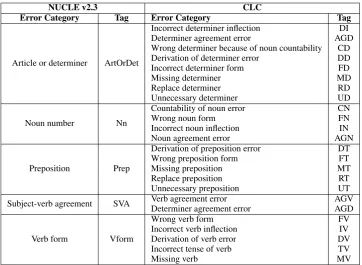
publicly available scripts from the First Certificate in English (FCE) (Yannakoudakis et al., 2011) and others from the International English Language Testing System (IELTS) examinations, which in-clude mainly academic writing. These corpora include about 16,068 sentences (532,033 tokens) and 64,628 sentences (1,361,841 tokens) respec-tively. Given that the error annotation scheme used in the CLC is more detailed than the one used in NUCLE, a mapping had to be defined so that we could produce corrections only for the five target error types (Table 1).
3.2 Generating Artificial Errors
Following previous approaches, we decided to in-crease the size of our training set by introducing new sentences containing artificial errors. This has many potential advantages. First, it is an eco-nomic and efficient way of generating error-tagged data, which otherwise requires manual annotation and is difficult to obtain. Second, it allows us to introduce only the types of errors we want, thus giving us the ability to imitate the original NU-CLE data and circumvent annotation incompati-bility. Finally, we can choose our initial sentences so that they match specific requirements, such as topic, length, linguistic phenomena, etc.
Again, we use a publicly available portion of the CLC formed by all the corrected samples featured on the English Vocabulary Profile2(EVP) website. These sentences come from a variety of examina-tions at different levels and amount to 18,830 sen-tences and approximately 351,517 tokens.
In order to replicate NUCLE errors in EVP sen-tences as accurately as possible, we applied the following procedure:
1. We extract all the possible correction pat-terns from the NUCLE v2.3 gold standard and rewrite them as correct-fragment →
incorrect-fragment. Two types of patterns are extracted, one in terms of lexical items (i.e. surface forms/words) and another using part-of-speech (PoS) tags. Table 2 shows some sample patterns.
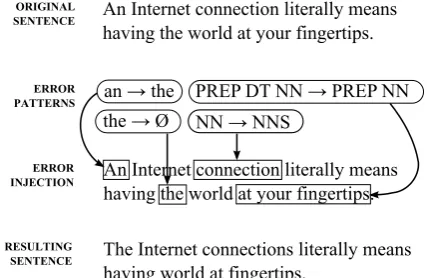
2. For each correct sentence in the EVP (target), we generate a pseudo-source sentence by ap-plying zero or more of extracted rules.
2http://www.englishprofile.org/index.
[image:3.595.309.523.62.201.2]php?option=com_content&view=article&id= 4&Itemid=5
Figure 1: An example of the artificial error injec-tion process.
Our approach is very naive and assumes all error-injection rules have equal probability. The injection of errors is incremental and non-overlapping. Figure 1 illustrates this pro-cedure.
3. Lexical patterns take precedence over PoS patterns. However, because the application of a rule is decided randomly, a sentence might end up being distorted by both types of pat-terns, only one, or none at all (i.e. no er-rors are introduced). In the last case, both the source and target sentences contain cor-rect versions.
4. A parallel corpus is built using the error-injected sentences on the source side and their original (correct) versions on the target side.
As we explain in Section 4, this corpus is com-bined with other training data in order to build dif-ferent SMT systems.
3.3 Tools
NUCLE v2.3 CLC
Error Category Tag Error Category Tag
Article or determiner ArtOrDet
Incorrect determiner inflection DI Determiner agreement error AGD Wrong determiner because of noun countability CD Derivation of determiner error DD
Incorrect determiner form FD
Missing determiner MD
Replace determiner RD
Unnecessary determiner UD
Noun number Nn
Countability of noun error CN
Wrong noun form FN
Incorrect noun inflection IN
Noun agreement error AGN
Preposition Prep
Derivation of preposition error DT
Wrong preposition form FT
Missing preposition MT
Replace preposition RT
Unnecessary preposition UT
Subject-verb agreement SVA Verb agreement error AGV
Determiner agreement error AGD
Verb form Vform
Wrong verb form FV
Incorrect verb inflection IV
Derivation of verb error DV
Incorrect tense of verb TV
Missing verb MV
Table 1: Mapping of error tags between NUCLE v2.3 and the CLC.
Lexical PoS
Pattern Example Pattern Example
has→have temperaturehasrisen→ temperaturehaverisen
NN→NNS information→
informations
to be used→to be use technology to beused→ technology to beuse
DT NNP→NNP the US→US
during→for duringthe early 60s→
forthe early 60s
[image:4.595.118.481.60.325.2]NN VBZ VBN→NN VBP VBN expenditureisreduced→ expenditurearereduced
Table 2: Sample error injection patterns extracted from the NUCLE v2.3 corpus.
4 Experiments and Results
We first built a baseline SMT system using only the NUCLE v2.3 corpus and compared it to other systems trained on incremental additions of the re-maining corpora. All our systems were trained us-ing 4-fold cross-validation where the trainus-ing set for each run always included the full FCE, IELTS and EVP corpora but only 3/4 of the NUCLE data, leaving the remaining fourth chunk for testing. This training method allowed us to concentrate on how the system performed on NUCLE data.
Performance was evaluated in terms of preci-sion, recall and F1 as computed by the M2 Scorer
(Dahlmeier and Ng, 2012), with the maximum number of unchanged words per edit set to 3 (an initial suggestion by the shared task organisers which was eventually changed for the official eval-uation). The average performance of each system is reported in Table 3.
In general, results show that precision tends to drop as we add more training data whereas recall and F1 slightly increase. This suggests that our
Model P R F1 σ
[image:5.595.306.527.62.111.2]NUCLE 0.1505 0.1530 0.1517 0.0201 NUCLE+FCE 0.1547 0.1518 0.1532 0.0216 NUCLE+FCE+IELTS 0.1217 0.2068 0.1532 0.0151 NUCLE+FCE+IELTS+EVP 0.1187 0.2183 0.1538 0.0206
Table 3: Performance of our lexical SMT models. The best results are marked in bold. Standard devi-ation (σ) indicates how stable/homogeneous each dataset is (lower values are better).
certainly have an impact on the quality of the gen-erated sentences and may introduce noise if not controlled. Nevertheless, the system trained on all four corpora yields the best F1performance.
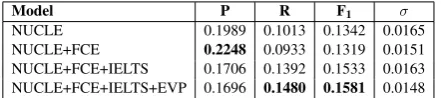
We also tested factored models which include PoS information. Results are shown in Table 4. The same behaviour is observed for the metrics, although values for precision are now generally higher while values for recall are lower. Again, the best system in terms of F1is the one trained on
all our corpora, slightly outperforming our previ-ous best system.
5 Error Analysis and Further Improvements
When building error correction systems, minimis-ing the number of cases where correct language is flagged as incorrect is often regarded as more important than covering a large number of errors. Technically, this means high precision is often pre-ferred over high recall, especially when it is diffi-cult to achieve both (as is the case for our systems). A closer observation of the training data, transla-tion tables and system output reveals a series of issues that are affecting performance, which are summarised below.
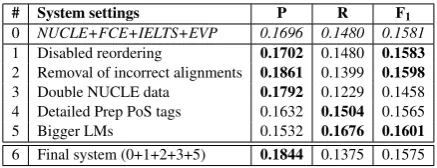
In order to test some solutions to these prob-lems, we used our best system as a baseline and retrained it to include each proposed modification individually. Results are included in Table 5 and referenced accordingly.
5.1 Size of training corpus
With slightly over a million tokens, the NUCLE corpus seems too small to train an efficient SMT system. However, the additional data we were able to use differs from the NUCLE corpus in terms of learner-level, native language, and the tasks being attempted.
Model P R F1 σ
NUCLE 0.1989 0.1013 0.1342 0.0165 NUCLE+FCE 0.2248 0.0933 0.1319 0.0151 NUCLE+FCE+IELTS 0.1706 0.1392 0.1533 0.0163 NUCLE+FCE+IELTS+EVP 0.1696 0.1480 0.1581 0.0148
Table 4: Performance of our PoS factored SMT models. The best results are marked in bold. Standard deviation (σ) indicates how sta-ble/homogeneous each dataset is (lower values are better).
5.2 Word reordering
In many cases, our system made corrections by re-ordering words. Since the five error types in the shared task rarely implied reordering, this caused unnecessary edits that harmed precision, as in the following example.
Original sentence
High Temperture Behaviour Of Candidate...
System hypothesis
High Behaviour Of Temperture Candidate...
Gold standard
High Temperture Behaviour Of Candidate... (unchanged)
Disabling word reordering in our system helped to avoid this problem and increased precision without harming recall (Table 5 #1).
5.3 Limited translation model
Because of the relatively small size of our train-ing corpus, the resulttrain-ing phrase tables used by our SMT systems contain very general alignments (i.e. corrections) with high probability, which are often applied in inappropriate contexts and result in a large number of miscorrections.
[image:5.595.75.290.62.111.2]re-sults in higher precision but lower recall, as shown in Table 5 #2.
We also observed that the system was bi-ased towards making unnecessary insertions of the definite article before some specific nouns. This means that the system would almost always change words likecost,elderlyorgovernmentfor the cost,the elderlyorthe government, regardless of whether this fits the context or not. We believe this is due to the lack of sufficient training sam-ples where these words remained unaltered on the source and target side, so we decided to augment the NUCLE corpus by adding a copy of all the corrected versions of the sentences on both sides. Then, the system should learn that these words can also remain unchanged in corrections. Table 5 #3 shows this improves precision but harms recall.
Out-of-vocabulary words (i.e. words not seen during training) are a also common problem in SMT systems, and this is directly related to the amount of data available for training. In our sys-tems, all out-of-vocabulary words were directly transferred from source to target. That is, when-ever our system encounters a word it has not seen previously, it keeps it unchanged. Because of the way our SMT system works, there is no explicit generation of verb or noun forms so unless the sys-tem has learnt this from appropriate contexts (for example, that a progressive tense is consistently being used after a preposition), it is unable to make such corrections.
5.4 Inability to distinguish between prepositions
We also observed that our systems did not often correct prepositions. We believed this was due to the PoS language model using the same tag for all prepositions and therefore being unable to dis-tinguish when each preposition must be used. In fact, when using an ordinary PoS language model, the original PoS patterns match those of the ex-pected corrections (i.e. the exex-pected correction has a preposition and the hypothesis has one too) so no change is proposed. The following example illus-trates this problem.
Original sentence
... the need toward energy ...
DT NN PREP NN
System hypothesis
... the need toward energy ...
DT NN PREP NN
(unchanged)
Expected output (not in gold standard) ... the need for energy ...
DT NN PREP NN
However, when the PoS language model is modified to use preposition-specific tags, the dif-ference between the original sentence and the ex-pected output should be detected and fixed by the system, as shown below.
Original sentence
... the need toward energy ...
DT NN PREP TOWARD NN
System hypothesis
... the need for energy ...
DT NN PREP FOR NN
(unchanged)
Expected output (not in gold standard) ... the need for energy ...
DT NN PREP FOR NN
We expected this change to improve system per-formance. Although it increased recall, it lowered precision (Table 5 #4).
5.5 Unnecessary edits
In many cases, our system makes good corrections which are not considered to belong to any of the target error types, as illustrated in the following example.
Original sentence
Thus, we should not compare now with the past but we need to worried about the future prob-lems that caused by this situation.
System hypothesis
Thus, we should not compare now with the past but we need toworryabout the future problems thatarecaused by this situation.
Gold standard
Thus, we should not compare now with the past but we need toworryabout the future problems that caused by this situation.
target set and miss others which are actually use-ful. For example, it is not clear if ‘verb form’ er-rors (Vform) include change of tense or the addi-tion of missing verbs. Second, because SMT sys-tems learn from all parts of a parallel corpus and maximise fluency using a general language model, it is hard to limit the corrections to a predefined set of error types. Using a larger language model based on the corrected version of the CLC con-firms this: precision drops while recall improves (Table 5 #5).
5.6 Gold-standard annotation
The original NUCLE corpus contains corrections for 27 error types. However, the version used for the shared task only includes 5 error types and discards all the remaining corrections. Be-cause nested and context-dependent errors are very frequent, the systematic removal of annota-tions which do not belong to these five types often generates mutilated or partly-corrected sentences, a deficiency that has also been reported in other shared tasks (Kochmar et al., 2012). Here is a typ-ical example.
Original sentence
These approaches may not produce effect soon, but it is sustainable for the future generation.
Corrected sentence
These approaches may not produce [immediate effects]Wci, but [they]Pref [are]SVA [useful]Wci
for the future [generations]Nn.
Type-constrained sentence
These approaches may not produce effect soon, but it [are]SVA sustainable for the future
[generations]Nn.
These ill-formed sentences are particularly harmful for SMT systems which, unlike classi-fiers, work at a global rather than local level. As a result, many corrections proposed by our sys-tem are considered incorrect because they do not match the gold-standard version, as shown below.
Original sentence
Although it is essential for all the fields, ...
System hypothesis
Although it is essential for all the fields, ... (unchanged)
# System settings P R F1
0 NUCLE+FCE+IELTS+EVP 0.1696 0.1480 0.1581 1 Disabled reordering 0.1702 0.1480 0.1583
2 Removal of incorrect alignments 0.1861 0.1399 0.1598
3 Double NUCLE data 0.1792 0.1229 0.1458 4 Detailed Prep PoS tags 0.1632 0.1504 0.1565 5 Bigger LMs 0.1532 0.1676 0.1601
[image:7.595.306.525.61.145.2]6 Final system (0+1+2+3+5) 0.1844 0.1375 0.1575
Table 5: Performance of the baseline system plus different individual settings. Bold values indicate an improvement over the original baseline system.
Gold standard
Although it [are]SVA essential for all the fields,
...
This raises the question of how to design an ef-fective and challenging shared task.
5.7 Scoring criteria
The official evaluation using the M2scorer is sen-sitive to capitalisation and white space, although these error types were not part of the task. Both this fact and the lack of alternative corrections for each gold-standard edit leave out many other valid corrections, which in turn means true system per-formance is underestimated.
5.8 Other factors
Differences between the training and test data can also affect performance, such as changes in the writers’ native language, their level of language proficiency or the topic of their compositions.
The final system submitted to the shared task is a combination of our best factored model (i.e. baseline) plus a selection of improvements (Ta-ble 5 #6).
6 Official Evaluation Results
Systems were evaluated using a set of 50 essays containing about 500 words each (∼25,000 words in total) which were written in response to two dif-ferent prompts. One of these prompts had been used for a subset of the training data while the other was new. No error annotations were initially available for this set. As we mentioned above, the M2scorer was set to be sensitive to capitalisa-tion and white space as well as limit the maximum number of unchanged tokens per edit to 2.
Evaluation round Corr. edits
Prop. edits
Gold edits
P R F1
First (pre-revision) 166 424 1643 0.3915 0.1010 0.1606 Second (post-revision) 222 426 1565 0.5211 0.1419 0.2230
Table 6: Official results of our system before and after revision of the test set annotations. The num-ber of correct, proposed and gold edits are also in-cluded for comparison.
many participants raised concerns about their ac-curacy so they were given the opportunity to sub-mit alternative annotations. These suggestions were manually revised by a human annotator and merged into a new test set which was used to re-score all the submitted systems in a second official evaluation round. Evaluation results of our sys-tem in both rounds (before and after revision of the test set annotations) are included in Table 6. Although this measure helped overcome some of the problems described in Section 5.6, other prob-lems such as whitespace and case sensitivity were not addressed.
In both evaluation rounds, our system scores third in terms of precision, which is particularly encouraging for error correction environments where precision is preferred over recall. How-ever, these values should be considerably higher in order to prove useful in applications like self-assessment and tutoring systems (Andersen et al., 2013).
Results also reveal precision on the test set is considerably higher than in our cross-validation experiments. This may be partly a result of the larger amount of training data in our final system and/or greater grammatical or thematic similarity between the test and training sets.
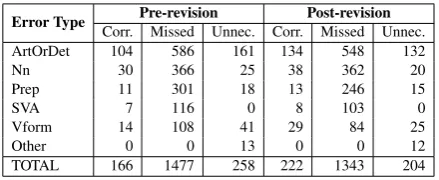
Table 7 shows the distribution of system edits by error type. The results suggest that lexical het-erogeneity in the contexts surrounding errors is a factor in performance, which might be improved through larger training sets.
7 Conclusions and Future Work
In this paper we have described the use of SMT techniques for building an error correction system. We trained lexical and factored phrase-based sys-tems using incremental combinations of training data and observed that, in general, recall increases at the expense of precision. However, this might be due to structural and thematic differences in the corpora we used. We also tried a relatively sim-ple mechanism for injecting artificial errors into
Error Type Pre-revision Post-revision
Corr. Missed Unnec. Corr. Missed Unnec. ArtOrDet 104 586 161 134 548 132
Nn 30 366 25 38 362 20
Prep 11 301 18 13 246 15
SVA 7 116 0 8 103 0
Vform 14 108 41 29 84 25
Other 0 0 13 0 0 12
TOTAL 166 1477 258 222 1343 204
Table 7: Distribution of system edits by error type for the two official evaluation rounds (before and after revision of the test annotations). ‘Corr.’ stands for correct edits, ‘Missed’ for missed ed-its and ‘Unnec.’ for unnecessary eded-its. The cate-gory ‘Other’ includes changes made by our system which do not belong to any of the other categories.
new data, which caused a drop in precision but in-creased recall and F1.
Cross-validation experiments show that our sys-tems were unable to achieve particularly high per-formance (with precision, recall and F1
consis-tently below 0.20). A careful analysis revealed many factors that affect system performance, such as annotation criteria, training parameters and cor-pus size and heterogeneity. Our final system sub-mitted to the CoNLL 2013 shared task was de-signed to circumvent some of these problems and maximise precision.
Plans for future work include more detailed er-ror analysis and the implementation of new solu-tions to avoid drops in performance. We would also like to test our approach in an unrestricted scenario (i.e. using corpora which are not limited to a fixed number of error types) and use more flexible evaluation schemes. We believe further study of the methods used for generating artificial errors is also vital to help SMT systems become a useful approach to error correction.
Acknowledgements
[image:8.595.306.526.61.151.2] [image:8.595.73.292.62.98.2]References
Øistein E. Andersen, Helen Yannakoudakis, Fiona Barker, and Tim Parish. 2013. Developing and test-ing a self-assessment and tutortest-ing system. In Pro-ceedings of the Eighth Workshop on Innovative Use
of NLP for Building Educational Applications, BEA
2013, pages 32–41, Atlanta, GA, USA, June. Asso-ciation for Computational Linguistics.
Steven Bird, Edward Loper, and Ewan Klein. 2009. Natural Language Processing with Python. O’Reilly Media Inc.
Ted Briscoe, John Carroll, and Rebecca Watson. 2006. The second release of the RASP system. In Pro-ceedings of the COLING/ACL on Interactive
presen-tation sessions, COLING-ACL ’06, pages 77–80,
Sydney, Australia. Association for Computational Linguistics.
Chris Brockett, William B. Dolan, and Michael Ga-mon. 2006. Correcting ESL Errors Using Phrasal SMT Techniques. In Proceedings of the 21st In-ternational Conference on Computational Linguis-tics and 44th Annual Meeting of the Association for
Computational Linguistics, pages 249–256, Sydney,
Australia, July. Association for Computational Lin-guistics.
Daniel Dahlmeier and Hwee Tou Ng. 2012. Bet-ter evaluation for grammatical error correction. In
Proceedings of the 2012 Conference of the North American Chapter of the Association for
Computa-tional Linguistics: Human Language Technologies,
NAACL 2012, pages 568 – 572, Montreal, Canada.
Daniel Dahlmeier, Hwee Tou Ng, and Siew Mei Wu. 2013. Building a Large Annotated Corpus of Learner English: The NUS Corpus of Learner En-glish. In Proceedings of the 8th Workshop on In-novative Use of NLP for Building Educational
Ap-plications, BEA 2013, Atlanta, Georgia, USA. To
appear.
Robert Dale, Ilya Anisimoff, and George Narroway. 2012. Hoo 2012: A report on the preposition and determiner error correction shared task. In Pro-ceedings of the Seventh Workshop on Building
Ed-ucational Applications Using NLP, pages 54–62,
Montr´eal, Canada, June. Association for Computa-tional Linguistics.
Nava Ehsan and Heshaam Faili. 2013. Grammatical and context-sensitive error correction using a sta-tistical machine translation framework. Software:
Practice and Experience, 43(2):187–206.
Marcello Federico, Nicola Bertoldi, and Mauro Cet-tolo. 2008. IRSTLM: an open source toolkit for handling large scale language models. In Proceed-ings of the 9th Annual Conference of the
Interna-tional Speech Communication Association,
INTER-SPEECH 2008, pages 1618–1621, Brisbane, Aus-tralia, September. ISCA.
Jennifer Foster and Øistein Andersen. 2009. Gen-errate: Generating errors for use in grammatical er-ror detection. In Proceedings of the Fourth Work-shop on Innovative Use of NLP for Building
Edu-cational Applications, pages 82–90, Boulder,
Col-orado, June. Association for Computational Linguis-tics.
Matthieu Hermet and Alain D´esilets. 2009. Using first and second language models to correct preposition errors in second language authoring. InProceedings of the Fourth Workshop on Innovative Use of NLP
for Building Educational Applications, EdAppsNLP
’09, pages 64–72, Boulder, Colorado. Association for Computational Linguistics.
Ekaterina Kochmar, Øistein Andersen, and Ted Briscoe. 2012. Hoo 2012 error recognition and cor-rection shared task: Cambridge university submis-sion report. InProceedings of the Seventh Workshop
on Building Educational Applications Using NLP,
pages 242–250, Montreal, Canada. Association for Computational Linguistics.
Philipp Koehn, Hieu Hoang, Alexandra Birch, Chris Callison-Burch, Marcello Federico, Nicola Bertoldi, Brooke Cowan, Wade Shen, Christine Moran, Richard Zens, Chris Dyer, Ondˇrej Bojar, Alexandra Constantin, and Evan Herbst. 2007. Moses: open source toolkit for statistical machine translation. In
Proceedings of the 45th Annual Meeting of the ACL
on Interactive Poster and Demonstration Sessions,
ACL ’07, pages 177–180, Prague, Czech Republic. Association for Computational Linguistics.
Philipp Koehn. 2010.Statistical Machine Translation. Cambridge University Press, New York, NY, USA, 1st edition.
Claudia Leacock, Martin Chodorow, Michael Gamon, and Joel Tetreault. 2010. Automated Grammatical
Error Detection for Language Learners. Morgan
and Claypool Publishers.
Nitin Madnani, Joel Tetreault, and Martin Chodorow. 2012. Exploring grammatical error correction with not-so-crummy machine translation. InProceedings of the Seventh Workshop on Building Educational
Applications Using NLP, pages 44–53, Montreal,
Canada. Association for Computational Linguistics.
Tomoya Mizumoto, Mamoru Komachi, Masaaki Na-gata, and Yuji Matsumoto. 2011. Mining Re-vision Log of Language Learning SNS for Auto-mated Japanese Error Correction of Second Lan-guage Learners. InProceedings of 5th International
Joint Conference on Natural Language Processing,
pages 147–155, Chiang Mai, Thailand, November. Asian Federation of Natural Language Processing.
Tomoya Mizumoto, Yuta Hayashibe, Mamoru Ko-machi, Masaaki Nagata, and Yuji Matsumoto. 2012. The effect of learner corpus size in grammatical er-ror correction of ESL writings. InProceedings of
India, December. The COLING 2012 Organizing Committee.
Franz Josef Och and Hermann Ney. 2003. A sys-tematic comparison of various statistical alignment models. Comput. Linguist., 29(1):19–51, March.
Jonas Sj¨obergh and Ola Knutsson. 2005. Faking er-rors to avoid making erer-rors: Very weakly supervised learning for error detection in writing. In
Proceed-ings of RANLP 2005, pages 506–512, Borovets,
Bul-garia, September.
Helen Yannakoudakis, Ted Briscoe, and Ben Medlock. 2011. A new dataset and method for automatically grading esol texts. InProceedings of the 49th An-nual Meeting of the Association for Computational
Linguistics: Human Language Technologies, pages