Generative Goal-Driven User Simulation for Dialog Management
Aciel Eshky
ILCC
School of Informatics University of Edinburgh [email protected]
Ben Allison
ILCC
School of Informatics University of Edinburgh
{ballison, steedman}@inf.ed.ac.uk
Mark Steedman
ILCC
School of Informatics University of Edinburgh
Abstract
User simulation is frequently used to train statistical dialog managers for task-oriented domains. At present, goal-driven simula-tors (those that have a persistent notion of what they wish to achieve in the dialog) re-quire some task-specific engineering, making them impossible to evaluate intrinsically. In-stead, they have been evaluated extrinsically by means of the dialog managers they are in-tended to train, leading to circularity of argu-ment. In this paper, we propose the first fully generative goal-driven simulator that is fully induced from data, without hand-crafting or goal annotation. Our goals are latent, and take the form of topics in a topic model, clustering together semantically equivalent and phoneti-cally confusable strings, implicitly modelling synonymy and speech recognition noise. We evaluate on two standard dialog resources, the Communicator and Let’s Go datasets, and demonstrate that our model has substantially better fit to held out data than competing ap-proaches. We also show that features derived from our model allow significantly greater im-provement over a baseline at distinguishing real from randomly permuted dialogs.
1 Introduction
Automatically simulating user behaviour in human-machine dialogs has become vital for training sta-tistical dialog managers in task-oriented domains. These managers are often trained with some vari-ant of reinforcement learning (Sutton and Barto, 1998), where optimal behaviour is sought or learnt through the exploration of the space of possible di-alogs. Although learning by interacting with human
subjects is a possibility (Ga˘si´c et al., 2011), it has been argued that user simulation avoids the expen-sive, labour intenexpen-sive, and error-prone experience of exposing real humans to fledgling dialog systems (Eckert et al., 1997).
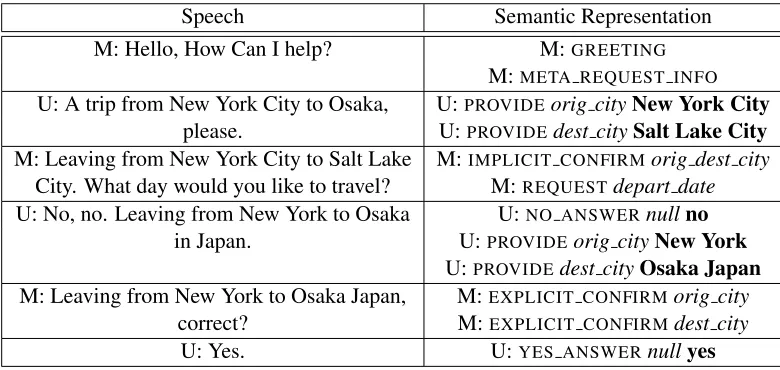
Training effective dialog managers should benefit from exposure to properties exhibited by real users. Table 1 shows an example dialog in a domain such as we consider, where the objective is to simulate at the semantic level. In such task oriented domains, the user has a goal (in this case, to book a flight from New York to Osaka), and the machine is tasked with fulfilling it. Notice that the user is consistent with this goal throughout the dialog, in that they do not provide contradictory information (although an ASR error is present), but that every mention of their destination city uses a different string. This moti-vates our first desideratum: that simulation be con-sistent over the course of a dialog. Furthermore, one can imagine users not always responding identically in identical situations: we thus additionally require
variability. In this paper we demonstrate a fully gen-erative, latent variable probability model exhibiting both of these properties.
Thus far, consistent simulators have been par-tially deterministic and have required some hand-engineering. As a result, it has only been possible to evaluate them extrinsically using dialog managers. This is circular because we need simulators to train managers, but need managers to evaluate simulators. The issue is that judgements of quality of each de-pend on the specifics of the other and that a proper evaluation of one depends on the correct function-ing of the other. Furthermore, there is little reason to assume that because a simulator performs well with a certain dialog manager, it would perform similarly
Speech Semantic Representation
M: Hello, How Can I help? M:GREETING
M:META REQUEST INFO U: A trip from New York City to Osaka, U:PROVIDEorig cityNew York City
please. U:PROVIDEdest citySalt Lake City
M: Leaving from New York City to Salt Lake M:IMPLICIT CONFIRMorig dest city
City. What day would you like to travel? M:REQUESTdepart date
U: No, no. Leaving from New York to Osaka U:NO ANSWERnullno
in Japan. U:PROVIDEorig cityNew York
U:PROVIDEdest cityOsaka Japan M: Leaving from New York to Osaka Japan, M:EXPLICIT CONFIRMorig city
correct? M:EXPLICIT CONFIRMdest city
[image:2.612.110.500.59.244.2]U: Yes. U:YES ANSWERnullyes
Table 1: An example of a dialog in speech and its semantic equivalent. M and U denote machine and user utterances respectively. Note how a single speech utterance is split by the semantic parser into multiple logical utterances, each of which is broken down to anACT,slot, andvalue. We consider resources where gold standard transcriptions are not available; thus there will be speech recognition noise, e.g. Osakarendered asSalt Lake City, something our model is able to capture.
well with other managers. In contrast, a probabilistic formulation such as we propose allows us to evalu-ate our models intrinsically using standard machine learning metrics, and without reference to aspecific
manager, thus breaking the circularity, and guarding against such experimental biases.
We demonstrate the efficacy of our model on two tasks, and compare it to two other approaches. Firstly we use a standard bigram model as conceived by Eckert et al. (1997) and Levin and Pieraccini (2000); secondly we compare to a probabilistic goal-based simulator where the goals are string literals, as envisaged by Scheffler and Young (2002) and Schatzmann et al. (2007b). We demonstrate sub-stantial improvement over these models in terms of predicting heldout data on two standard dialog re-sources: DARPA Communicator (Levin et al., 2000; Georgila et al., 2005b) and Let’s Go (Black and Es-kenazi, 2009).
2 Related Work
2.1 Related Work on User Simulation
User simulation as a stochastic process was first en-visioned by Eckert et al. (1997): theirBigrammodel conditions user utterances exclusively on the pre-ceding machine utterance. This was extended by Levin and Pieraccini (2000), who manually restrict
the model to estimating “sensible” pairs of user and machine utterances by assigning all others probabil-ity zero.
Bigram models ensure that a locally sensible response to a machine utterance is provided by the simulator; however, they do not ensure that it provides responses consistent with one another throughout the dialog. Several approaches have at-tempted to overcome this problem. Pietquin (2004), for example, explicitly models a user goal as a set of slot-value pairs randomly generated once per dia-log. He then hand selects parameters to ensure that the user’s actions are in accordance with their goal.
Jung et al. (2009) use large amounts of dialog state annotations (e.g. what information has been provided so far) to learn Conditional Random Fields over the user utterances, and assume that those fea-tures ensure user consistency. Georgila et al. (2005a) instead consider only act-slot pairs, and thus incon-sistency is not a factor.
user goal which is either induced from data (Schatz-mann et al., 2007b), or is manually set when no data is available (Schatzmann et al., 2007a). An agenda, which is a stack-like structure of utterances to be produced given the goal, is then devised determin-istically. Keizer et al. (2010) combine the decision network with the agenda and goal to allow for some variability for some actions. These models ensure consistency but restrict the variability in user be-haviour that can be accommodated. Furthermore, because these approaches do not define a complete probability distribution over user behaviour, they re-strict possibilities for their evaluation, a point to which we now turn.
2.2 Related Work on Simulator Evaluation
No standardised metric of evaluation has been estab-lished for user simulators largely because they have been so inextricably linked to dialog managers. The most popular method of evaluation relies on gener-ating synthetic dialogs through the interaction of the user simulator with some dialog manager. Schatz-mann et al. (2005) hand-craft a simple determin-istic dialog manager based on finite automata, and compute similarity measures between these synthet-ically produced dialogs and real dialogs. Georgila et al. (2006) use a scoring function to evaluate syn-thetic dialogs using accuracy, precision, recall, and perplexity, while Schatzmann et al. (2007b) rely on dialog completion rates. Williams (2008) use a Cramer–von Mises test, a hypothesis test to de-termine whether simulated and real dialogs are sig-nificantly different, while Janarthanam and Lemon (2009) use Kullback Leibler Divergence between the empirical distributions over acts in real and simu-lated dialogs. Singh et al. (2000) and Ai and Lit-man (2008) judge the consistency of huLit-man quality ranked synthetic dialogs generated by different sim-ulators interacting with the IT-SPOKE dialog sys-tem.
Schatzmann et al. (2007b) use a simulator to train a statistical dialog manager and then evaluate the learned policy. Because this only indirectly evalu-ates the simulator, it is inappropriate as a sole mea-sure of quality.
There has been far less evaluation of simulators without a dialog manager. The main approach is to compute precision and recall on an utterance
ba-sis, which is intended to measure the similarity be-tween real user responses in the corpora and simu-lated user responses produced under similar circum-stances (Schatzmann et al., 2005; Georgila et al., 2006). However, this is a harsh evaluation as it as-sumes a correct or “best” answer, and penalises valid variability in user behaviour.
3 Dialog as a Statistical Process
We consider a dialog to be a series of turns, com-prised of multipleutterances. Each Utterance con-sists of anACT, aslot, and avalue, as shown in Ta-ble 1. Dialogs proceed by the user and the machine alternating turns. Because the dialogs are of mixed initiative, there is no restriction on the number of contiguous machine or user utterances.
Our aim is to model the user, and are interested in the conditional distribution of the user utterances given the dialog up to that point. In other words, we are interested in the distribution p(ui|d1. . . di−1), wherednis either a machine utterancemnor a user utteranceun.
4 Models of Users in Dialogs
This section describes several models of increas-ing complexity: a Bigram model, which serves as a baseline; an upper-bound on String-Goal models, which we design to mimic the behaviour of previous goal-based approaches, but with a probabilistic for-mulation; and finally our approach, the Topic-Goal model.
4.1 Bigram Model
The simplest model we define over dialogs is the bi-gram model of Eckert et al. (1997):
p(ui|m) = p(ui|mi−1) (1)
p(u|m) = Y
i
p(ui|m) (2)
one another. (Georgila et al. (2006) found no bene-fit from increasing the Markov horizon). Since each utterance is generated independently of others in the dialog with the same context, there is no enforced consistency between utterances.
Since we require a distribution over all possible utterances, assigning non–zero probability to cases outside of the training data, our bigram model is terpolated with a unigram model, which itself is in-terpolated with a smoothing model which assumes independence between the act, slot, and value el-ements of the utterance. Interpolation weights are set to maximise probability of a development set of dialogs. Each sub-model uses the maximum like-lihood estimator (the relative frequency of the ut-terance), and unseen machine utterances place full weight on the unigram/smoothed model (ignoring the bigram probability since it has no meaning if
mi−1 is unobserved). We label this model the Bi-gram model in subsequent experiments.
4.2 Goal-Based Models
One way to ensure consistency and more realistic behaviour is to have a goalfor the user in the dia-log, which corresponds to values for slots required in the problem. For instance, they might be the origin and destination cities in a flight booking domain. In standard machine learning terms, the goal becomes a latent variable g in a probability model. We can then define a distribution over utterances as:
p(ui|m, g) = p(ui|mi−1, g) (3)
p(u|m) = X
g
p(g)Y
i
p(ui|mi−1, g)(4)
4.3 An Upper-Bound on String-Goal Models
The simplest variant ofghas string values for each of the slots the user is required to provide in order for the dialog to succeed. Thus we may have:
g= [orig city:New York;dest city:Osaka]
as presented in Schatzmann et al. (2005) and Schatz-mann et al. (2007b). However, in these simulators, while the goal is probabilistic, there is no distribu-tion over utterances given the goal because utter-ances are assembled deterministically from a series of rule applications. There is also no marginalisation over the goal as in (4) above.
The issue with a model of user goals as strings in this fashion is that users describe the same val-ues in multiple ways (Osaka Japan, Osaka), and speech recognition errors corrupt consistent user input (Osaka mis-recognised as Salt Lake City). Users also might legitimately switch their goals mid-dialog. Inference in the model would have allow for these possibilities: we would have to marginalise over all possible goal switches.
For the sake of comparison, we compute an upper-bound on string-goal models, which gives a flavour for how such models would performoptimistically. The upper-bound assigns probability to dialogs as follows: for each utteranceui if the corresponding valuevihas been seen before in the dialog, the prob-ability used for that utterance is justp(ai, si|mi−1), that is, the probability of the actaiand slotsionly; there is no penalty for repetition of the value. If the value is unseen in the dialog, we use the full proba-bility of the utterance from the bigram model as de-scribed above. This is optimistic because there is no penalty for repeated goal changes besides that im-posed by the bigram model itself, and no penalty is imposed for choosing between previously sampled goals as would be necessary in a probability model. Any string-based model necessarily assigns lower probabilities to data than the upper bound, because it would penalise goal changes (in a probabilistic sense; that is, there would be a term to reflect the probability of some new goal given the old) to al-low for the discrepancy in values present in dialogs. In contrast, our upper bound does not include such a term. Furthermore, once multiple goal values had been uttered in the dialog, we would have to sample one to use for the next utterance, which would again incur some cost: again, we do not have such a cost in our upper bound.
We could in theory use an external model of noise to account for these value discrepancies (and the ASR errors we model in the next section). However, this would further decrease the probability, as some probability mass currently assigned to the heldout data would have to be reserved for the possibility of string renderings other than those we observe.
comparison. Although not technically a model, we refer to this as the String-Goal model for the remain-der of the paper.
4.4 Topic-Goal Model
To motivate our proposal, consider that over the course of a dialog one could look at the set of all values used for some slot, for example the destina-tion city, as a count vector:
vdest city =Salt Lake:1;Osaka:2;Osaka Japan:1
The above vector may arise because the user actu-ally wants to go to Osaka, but the destination is initially mis-recognised as Salt Lake, and the user finally disambiguates with the addition of the coun-try. Such situations are common in the noisy dia-log resources from which simulators are induced— however, any string-based goal will necessarily con-sider these different renderings to be different goals, and will require resampling or smoothing terms to deal with them.
Our approach instead treats the count vector as samples from a topic model; that is, a mixture over multinomial distributions. Whilst by far the most popular topic model is LDA (Blei et al., 2003), it provides too flexible a distribution over count vec-tors to be used with such small samples (we con-firmed the poor suitability of this model in pre-liminary experiments). Instead we use the simpler Mixture-of-Multinomials model, where the latent topic is sampled once per dialog instead of once per value uttered. We describe below how parameters to this model are estimated, and focus for now on how the resulting model assigns probability to dialogs.
In this formulation, the latent goal for each slot, which was previously a string, now becomes an in-dicator for a topic in a topic model. Each topic can in theory generate any string (so the model is inher-ently smoothed), but most strings in most topics will have only the smoothing weight and most probabil-ity mass will be on a small number of highly corre-lated strings. We treat the slots as being independent of one another in the goal, and thus:
p(g) =Y
s
p(zs) (5)
Wherezsis the topic indicator for some slots. If slot
shas associated with it a count vector of valuesvs,
each looking like the example above, then the distri-bution over the values used for each slot becomes:
p(vs) =
X
zs
p(zs)p(vs|zs) (6)
We then define a bigram-based Act model to de-scribe the probabilities of the{ACT, slot} pairs to which these values belong, so that:
p(u|m) =Y
s
p(zs)·
Y
i
p(ai, si|mi−1)p(vi|zsi)
(7) In reality, some slots will not have corresponding values, or will be slots whose values are not appro-priate to model in the above way. Dates and times, for example, have ordinal and structural relations be-tween them, and a model which treats them as dis-connected entities is inappropriate. For utterances defined over such slots we use a standard bigram model as in (1), and for appropriate utterances we use a topic-goal model as in (7). This constitutes the only domain knowledge necessary to adapt the model for a new resource. We refer to this model as the Topic-Goal model.
4.4.1 Topic Model Parameter Estimation
Our topic model is a Bayesian version of the Mixture-of-Multinomials model. Under this model, each dialog has associated with it a latent variable
zsfor each slotsin the goal, which indicates which topic is used to draw the values for that slot. Con-ditioned onz, independent samples are drawn from the distribution over words to which that value of
zcorresponds—however, the effect in the marginal distribution over words is to strongly prefer sets which have co-occurred in training as these are as-signed to the same topic.
components z parameterised by γrz (the Dirichlet parameter for thez-th mixture component in ther -th sample) andαrzjfor each wordjin thez-th topic for ther-th sample. The•notation indicates a sum over the corresponding index, i.e. γr• = Pzγrz. Then:
p(v) = 1 |r|
X
r
X
z
γrz
γr•
p(v|αrz) (8)
p(v|α) = Γ (α•) Γ (α•+v•)
Y
j
Γ (vj+αj)
Γ (αj) (9)
This states that each of the r samples has topics z
which are multinomial distributions with posteriors governed by parametersαrz. For any of these top-ics, the distribution over v is as given in Equation (9) (we suppress the subscripting ofα here for the different samples and topics, since this holds what-ever its value). The final predictive probability given in Equation (8) averages over the samplesrand the topics z (with topics weighted by their parameters
γrz).
5 Experimental Setup
Our experiments use two standard corpora, the first of which is DARPA Communicator (DC), a flight booking domain collected between 2000-2001 through the interaction of real users with 10 different systems (Levin et al., 2000). It was later automati-cally annotated by Georgila et al. (2005b) to include semantic information. The second corpora is Let’s Go (LG), years 2007, 2008, and 2009, distributed as part of the Spoken Dialog Challenge (Black and Es-kenazi, 2009). Let’s Go is a bus routing domain in Pittsburgh collected by having the general public in-teract with the CMU dialog system to find their way through the city. The dialogs in both corpora are of mixed-initiative, having a free number of contiguous system and user responses.
We preprocessed the corpora, converting Com-municator XML-tagged files and Let’s Go system log files into sequences ofACT, slot, and value ut-terances. Table 2 gives examples. We then divided the corpora into training, development and test sets as follows: Communicator contains 2285 dialogs in total, and Let’s Go contains 17992, and in each case we selected 80% of dialogs at random for training, 10% for development, and 10% for testing.
DC: PROVIDE INFOorig cityBoston LG: INFORMplace[departure placeCMU,
arrival placeairport]
Table 2: Example utterances from the two corpora. Note how in addition to the value, the Let’s Go utterances con-tain properties (departure place and arrival place).
Let’s Go is a noisy corpus that contains far more speech recognition errors than Communicator. In addition, users tend to be more flexible with their bus routes than they are with their flight destinations, and so values are a lot more varied throughout the course of Let’s Go dialogs than Communicator ones. Furthermore, Let’s Go semantic parses contain am-biguity not present in Communicator; the parser fails to distinguish departure from arrival places over 90% of the time, and instead assigns them a generic Single Place property. Our current model assumes the decisions made by the semantic parser are cor-rect. In reality however, a better model would in-corporate potential noise in the semantic parse in a joint model. We defer this more complex treatment for future work.
Free model parameters are set by a simple search on the development set, where the objective is likelihood—for the bigram model the parameters are the interpolation weights, and for the topic model we search for the number of topics and smoothing con-stant for the topic distributions. For Let’s Go, since we can have multiple places provided in a single act, we treat each utterance as containing a set of values and build the count vector for the topic model as the union of these sets over the whole dialog. The slots over which the topic model is defined for Commu-nicator aredest cityandorig city(this takes into ac-countPROVIDEandREPROVIDEacts). For Let’s Go we derive the model over the three properties: sin-gle place, arrival place and departure place, as op-posed to the less informative slotplace.
6 Evaluating the Simulators
Model DC(A) DC(P) LG(A) LG(P)
Topic 252.78 860.2 113.45 1417.06
String 270.09 1286.03 169.87 4578.23 Bigram 347.88 5979.53 223.23 10125.87
[image:7.612.313.540.58.279.2]Act 9.56 5.2 2.77 2.34
Table 3: The mean per-utterance perplexity on heldout data. DC-A is all acts for Communicator, while DC-P is the calculated onPROVIDEacts alone (the acts on which our model is designed to improve prediction). LG-A and LG-P have the same meaning for Let’s Go.
is a distribution over possible responses. Because the models we define are full probability models, we are able to compute this metric and do not need to use an arbitrarily selected dialog manager for evalu-ation.
The heldout probability metric should be under-stood as a means of comparing the relative viabil-ity of different models of the same data. Note that we are reporting the probability of unobserved data, rather than data from which the models were in-duced, and are thus measuring the generalisability of the models (in contrast, maximising the proba-bility of the training data would simply encourage overfitting). The absolute numbers are hard to inter-pret, as there is no hard upper bound; while it may be appealing to think of an upper bound of 1, this is incorrect as it would imply that there was no vari-ability in the data. However, it should be understood that assigning particular behaviour higher probabil-ity means that the model is more likely to exhibit it when run in simulation mode—and since the user behaviour in question has not been seen at training time, this measures the extent to which the models have generalised beyond the training data relative to one another.
We report the mean per-utterance log probability of unseen data, that is, the probability of the whole heldout corpus divided by the number of user utter-ances.
6.1 Results
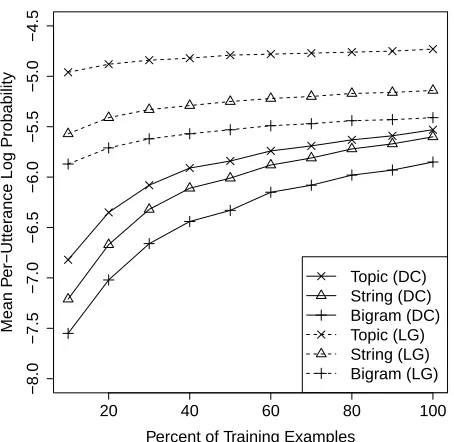
Figure 1 shows the results of our evaluation. We see that the Bigram model is weak on both resources. The results of the String Goal model suggest that, even using the generous evaluation we do here, there
20 40 60 80 100
−8.0
−7.5
−7.0
−6.5
−6.0
−5.5
−5.0
−4.5
Percent of Training Examples
Mean P
er−Utter
ance Log Probability
[image:7.612.71.303.60.138.2]Topic (DC) String (DC) Bigram (DC) Topic (LG) String (LG) Bigram (LG)
Figure 1: Heldout probability of the two resources for varying percentages of training dialogs. Note that while the percentages match across resources, Let’s Go is much larger and thus the absolute numbers of dialogs are differ-ent, which explains the better performance on Let’s Go.
is much variability due to synonymy and recognition errors which string goals are unable to capture (in contrast to our Topic Goal model). The Topic Goal model explains this much more easily by grouping commonly co–occurring values into the same topic. Table 3 shows the perplexities corresponding to the performances with 100% training data for all acts and justPROVIDEacts (perplexity is2−lpwherelpis the log probability). Improvements are more appar-ent when we compute the probability overPROVIDE acts alone, which the models are designed to handle. And since perplexity is not on a log scale, the differ-ences are more pronounced. The Act model, which is a bigram model over{ACT, slot}pairs alone ex-cluding the values, demonstrates the vast discrep-ancy in uncertainty between the full problem and the valueless prediction problem. We note that the per-plexity of our Act model on Communicator is com-parable to that of Georgila et al. (2006).
6.2 Example Simulator Behaviour
d zdest city[probability] proportion user utterance given topiczdest cityand of samples machine utteranceREQUEST INFOdest city
Norfolk Virginia[0.562] 0.264 PROVIDE INFOdest cityNorfolk Virginia
Norfolk[0.234] 0.111 PROVIDE INFOdest cityNorfolk
1 Newark Virginia[0.088] 0.039 PROVIDE INFOdest cityNewark Virginia
Virginia Beach[0.0412] 0.028 PROVIDE INFOorig cityLas Vegas Nevada
Newark[0.040] 0.028 NO ANSWERnullno
0.025 COMMANDstart overstart over
Chicago[0.350] 0.164 PROVIDE INFOdest cityChicago
Chicago Illinois[0.182] 0.082 PROVIDE INFOdest cityChicago Illinois
2 Duluth Minnesota[0.124] 0.057 PROVIDE INFOdest cityNew Orleans
New Orleans[0.122] 0.055 PROVIDE INFOdest cityDuluth Minnesota
New Orleans Louisiana[0.085] 0.039 PROVIDE INFOdest cityNew Orleans Louisiana
0.028 NO ANSWERnullno
Anchorage[0.539] 0.252 PROVIDE INFOdest cityAnchorage
Anchorage Alaska[0.148] 0.072 PROVIDE INFOdest cityAnchorage Alaska 3 Jacksonville Florida[0.124] 0.056 PROVIDE INFOdest cityJacksonville Florida
Great Anchorage Alaska[0.098] 0.048 PROVIDE INFOdest cityGreat Anchorage Alaska Duluth Minnesota[0.057] 0.047 PROVIDE INFOorig cityHartford Connecticut
[image:8.612.74.553.58.344.2]0.026 PROVIDE INFOdest cityDuluth Minnesota
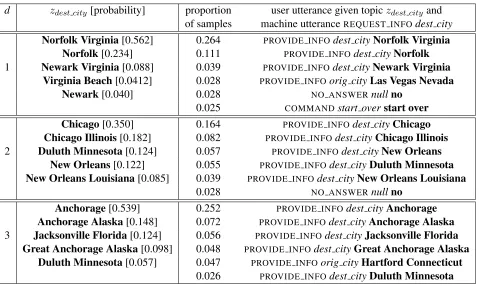
Table 4: Examples of sampling from the topic goal model. Left: top 5 strings (with probabilities) sampled from topics for three different dialogsd. Right: top 6 utterances (plus fraction of samples in 10,000) generated in response to the machine utterance “REQUEST INFOdest city” and conditioned on the topiczdest city.
Our examples are drawn from the model induced for the Communicator data. Sampling from stan-dard distributions can be implemented following the algorithms in Bishop (2006) and other statisti-cal resources. Utterances are sampled by sampling ACT,slotpairs from the distributionp(ai, si|mi−1) (drawing a value from a multinomial distribution). If we sample aPROVIDE INFO act, we check whether we have sampled a topic for the corresponding slot thus far in the dialog. If not, we sample one by drawing a topic indicator fromp(zs) = γγrz•• and then drawing a multinomial distribution over strings from the Dirichlet posterior corresponding toz. Once the topic for the slot is set, we samplevalues as draws from the fixed multinomial and add these to theACT,
slotpair.
Table 4 shows some examples drawn from the model. For each row in the table (corresponding to a new dialog d), we sample a topic for the dest city
and orig city as needed, and sample 10000 utter-ances given that topic. The left hand side of the ta-ble shows the top five strings in the sampled topic,
while the right hand side shows the top six utter-ances in response toREQUEST INFOdest city. Note that the proportion of utterances on the right does not match the probability of the values on the left because of the presence of other user acts besides PROVIDEdest city.
7 Evaluating Model Consistency
Having shown in the previous section that our Topic Goal model is a much better predictor of heldout data than the String Goal model or Bigram model, we now turn to a demonstration of the model’s cap-turing of consistency.
In the face of value synonymy and ASR errors, we defineinconsistentdialogs to be ones that are lo-cally coherent but lack the structure of a real dialog from one turn to the next. We then suggest that an appropriate task for consistent models is distinguish-ing between consistent and inconsistent dialogs.
Baseline Dialog length (turns)
Mean, standard deviation, min and max acts per turn Presence of special machine acts (flight offer and confirm)
Presence of user acts (provide a dest city and arrival city) Proportion of acts which were provides
String Consistency Did the user provide inconsistent information about dest city? Did the user provide inconsistent information about orig city? Topic Model Ranked list of posterior probabilities of top 50 topics
[image:9.612.111.507.59.187.2]Normalised probability of dialog for topic model
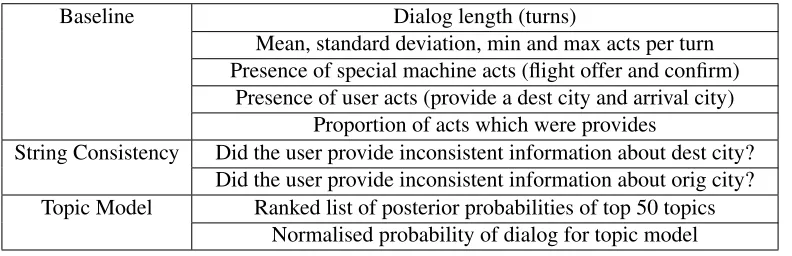
Table 5: Feature sets for consistency experiments
real dialogs and those generated by randomly sam-pling turns from different dialogs? In this section we induce classifiers over various feature sets to demon-strate that we can, and that the Topic Goal model contains far more useful information in this regard than string-based consistency features. (The bigram model by definition provides no help here, since the units of which dialogs consist contain the entire win-dow of context used for the bigram model).
We take our training and development data from the Communicator corpus in the previous section, and create a classification problem as follows: real dialogs form positive examples in the classification problem. To create negative examples, we sample {machine, user}turns at random from the appropri-ate resource. We keep a histogram over real dia-log lengths, and sample a number of turns for our “fake” dialogs proportional to this histogram. We then sample this many turns from the frequency dis-tribution over turns in the real data, and create ex-actly as many dialogs in this fashion as real dialogs in the data. The result is an equal number of dialogs comprised of real turns, of (expected) real length, but where the sequence of turns is highly unlikely to be coherent given the random sampling. The classi-fication problem is thus far from trivial. We do this from our training data to produce data with which to train the classifier, and from our development data to provide test instances. This gives rise to 2500 training instances, and 500 test instances.
We learn linear SVMs with various features de-scribed in Table 6. These feature sets are designed to capture different aspects of consistency: the base-line features are intended to capture surface level features of the dialogs, inspired by (Schatzmann et
al., 2005) where they provide trivial separation of real from simulated dialogs. However, our setting is different: we do not seek to tell real dialogs from fully simulated ones, but real dialogs from scram-bled versions of real dialogs. In addition to length-based features, we add binary presence indicator for several user and machine acts highly correlated with the completion of dialogs, as well as for acts which indicate the provision of information and the propor-tion of all acts occupied by these. The table gives a complete list of these Baseline (B) features.
We derive a second set of features intended to replicate the utility of string-based goals: we set up binary features to fire if contradictory information is provided for the slots over the course of the dialog. These are our String Consistency (SC) features.
Finally, we use our topic-model simulator to de-rive consistency features. Our features are the pos-terior distribution over topics for each slot given that dialog. Our topics are induced from the real training dialogs, and their posterior probabilities computed for all dialogs relative to this model. We take poste-rior probabilities of the fifty most probable topics for each of thedest cityandorig cityslots as features, as well as the normalised log probability of the di-alog (the log probability divided by the number of user utterances). These form our Topic Model (TM) features.
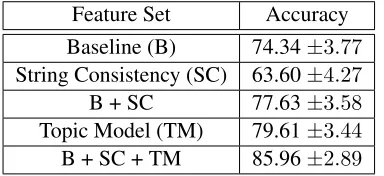
Feature Set Accuracy Baseline (B) 74.34±3.77
String Consistency (SC) 63.60±4.27
B + SC 77.63±3.58
Topic Model (TM) 79.61±3.44
[image:10.612.91.283.60.148.2]B + SC + TM 85.96±2.89
Table 6: Performances for the classifiers. Errors are 95% intervals to the accuracies assuming they are parameters to a binomial distribution
7.1 Results
The results of the classifiers are shown in Table 5. Since we have an equally balanced binary classifi-cation task, accuracy is the most appropriate metric. Here we see that the baseline and string consistency features have roughly the same discriminatory po-tential, and their union produces a slight improve-ment. The topic model features are far superior to this, and the union of all three sets gives a further improvement.
These results demonstrate that our model encodes notions of consistency which go substantially be-yond those defined at the level of strings. Features defined over the latent topic goal space substantially improve performance in a difficult discrimination task, demonstrating that our model captures an im-portant notion of how real dialogs appear that is not shared by the other models we consider.
8 Concluding Remarks and Future Work
This paper presents a fully generative goal driven user simulator, the first to merge both consistency and variability within a fully probabilistic frame-work. We evaluate our model on two task-based di-alog domains, Let’s Go and Communicator, and find it to outperform both a simple bigram model and an upper bound on probability models where the strings are represented as goals, in terms of the probability the model assigns to heldout dialogs.
We then move on to show that features derived from the model lead to substantial improvement in detecting real dialogs from those where the turns have been selected at random from all turns in the training data: this is a fairly difficult task, but our model allows significant improvement over strong and sensible baselines.
Our model could be extended in a number of ways. It could be improved to incorporate noise resulting from the decisions made by the semantic parser. Another possible improvement is to explore the effects of introducing dependency between the slots in the user goal, which would enforce more plausible values pairings and would potentially im-prove the simulator’s performance. The effects of a dependence assumption between the different utter-ances occurring in a single user turn under the act model can also be explored. We would also like to use our simulator to train a POMDP-based dialog manager using a form of reinforcement learning.
References
Hua Ai and Diane J. Litman. 2008. Assessing dialog sys-tem user simulation evaluation measures using human judges. InProceedings of ACL-08: HLT.
Christopher M. Bishop. 2006. Pattern Recognition and Machine Learning (Information Science and
Statis-tics). Springer-Verlag New York, Inc.
Alan W. Black and Maxine Eskenazi. 2009. The Spo-ken Dialogue Challenge. InProceedings of SIGDIAL 2009, SIGDIAL ’09.
David M. Blei, Andrew Y. Ng, and Michael I. Jordan. 2003. Latent dirichlet allocation. Journal of Machine
Learning Research, 3:993–1022, March.
Chih-Chung Chang and Chih-Jen Lin. 2011. LIBSVM: A library for support vector machines. ACM
Transac-tions on Intelligent Systems and Technology, 2:27:1–
27:27.
Wieland Eckert, Esther Levin, and Roberto Pieraccini. 1997. User modeling for spoken dialogue system eval-uation. In Proceedings of IEEE Workshop on
Auto-matic Speech Recognition and Understanding.
M. Ga˘si´c, F. Jurcicek, B. Thomson, K. Yu, and S. Young. 2011. On-line policy optimisation of spoken dia-logue systems via live interaction with human subjects.
InAutomatic Speech Recognition and Understanding,
2011 IEEE Workshop on, Hawaii, December.
Kallirroi Georgila, James Henderson, and Oliver Lemon. 2005a. Learning user simulations for information state update dialogue systems. InProceedings InterSpeech
2005.
Kallirroi Georgila, Oliver Lemon, and James Henderson. 2005b. Automatic annotation of communicator dia-logue data for learning diadia-logue strategies and user simulations. In Proceedings Ninth Workshop on the
Semantics and Pragmatics of Dialogue.
Learning and Evaluation. InProceedings InterSpeech
2006.
Thomas L. Griffiths and Mark Steyvers. 2004. Finding scientific topics. PNAS, 101(suppl. 1):5228–5235. Srinivasan Janarthanam and Oliver Lemon. 2009. A
two-tier user simulation model for reinforcement learn-ing of adaptive referrlearn-ing expression generation poli-cies. InProceedings of SIGDIAL 2009, SIGDIAL ’09, pages 120–123.
Sangkeun Jung, Cheongjae Lee, Kyungduk Kim, Min-woo Jeong, and Gary Geunbae Lee. 2009. Data-driven user simulation for automated evaluation of spoken dialog systems. Computer Speech &
Lan-guage, 23(4):479–509.
Simon Keizer, Milica Gaˇsi´c, Filip Jurˇc´ıˇcek, Franc¸ois Mairesse, Blaise Thomson, Kai Yu, and Steve Young. 2010. Parameter estimation for agenda-based user simulation. InProceedings of SIGDIAL 2010. Esther Levin and Roberto Pieraccini. 2000. A stochastic
model of human-machine interaction for learning di-alog strategies. InIEEE Transactions on Speech and
Audio Processing.
E. Levin, S. Narayanan, R. Pieraccini, K. Biatov, E. Bocchieri, G. Di Fabbrizio, W. Eckert, S. Lee, A. Pokrovsky, M. Rahim, P. Ruscitti, and M. Walker. 2000. The AT&T-DARPA communicator mixed-initiative spoken dialog system. InIn ICSLP.
Radford Neal. 1991. Bayesian Mixture Modeling by Monte Carlo Simulation. Technical report, University of Toronto.
Olivier Pietquin. 2004. A Framework for Unsupervised
Learning of Dialogue Strategies. Ph.D. thesis, Facult´e
Polytechnique de Mons, TCTS Lab (Belgique), apr. Jost Schatzmann, Kallirroi Georgila, and Steve Young.
2005. Quantitative evaluation of user simulation tech-niques for spoken dialogue systems. InProceeings of
6th SIGDIAL Workshop.
Jost Schatzmann, Blaise Thomson, Karl Weilhammer, Hui Ye, and Steve Young. 2007a. Agenda-based user simulation for bootstrapping a POMDP dialogue sys-tem. In HLT-NAACL (Short Papers), NAACL-Short ’07.
Jost Schatzmann, Blaise Thomson, and Steve Young. 2007b. Statistical User Simulation with a Hidden Agenda. In Proceedings 8th SIDdial Workshop on
Discourse and Dialogue, September.
Konrad Scheffler and Steve Young. 2002. Automatic learning of dialogue strategy using dialogue simula-tion and reinforcement learning. In Proceedings of
HLT 2002.
Satinder P. Singh, Michael J. Kearns, Diane J. Litman, and Marilyn A. Walker. 2000. Empirical evaluation of a reinforcement learning spoken dialogue system. In
Proceedings of the Seventeenth National Conference on Artificial Intelligence and Twelfth Conference on
Innovative Applications of Artificial Intelligence.
Richard S. Sutton and Andrew G. Barto. 1998.
Re-inforcement Learning: An Introduction. MIT Press,
Cambridge, MA.
Jason D. Williams. 2008. Evaluating user simulations with the Cramer-von Mises divergence. Speech