Factored Statistical Machine Translation for Grammatical Error
Correction
Yiming Wang
,
Longyue Wang, Derek F. Wong, Lidia S. Chao, Xiaodong Zeng, Yi Lu
Natural Language Processing & Portuguese-Chinese Machine Translation Laboratory,
Department of Computer and Information Science,
University of Macau, Macau S.A.R., China
{wang2008499,vincentwang0229}@gmail.com,[email protected],
[email protected],[email protected],[email protected]
Abstract
This paper describes our ongoing work on grammatical error correction (GEC). Focusing on all possible error types in a real-life environment, we propose a factored statistical machine translation (SMT) model for this task. We consider error correction as a series of language translation problems guided by various linguistic information, as factors that influence translation results. Factors included in our study are morphological information, i.e. word stem, prefix, suffix, and Part-of-Speech (PoS) information. In addition, we also experimented with different combinations of translation models (TM), phrase-based and factor-based, trained on various datasets to boost the overall performance. Empirical results show that the proposed model yields an improvement of 32.54% over a baseline phrase-based SMT model. The system participated in the CoNLL 2014 shared task and achieved the 7th and 5th F0.5 scores
1
on the official test set among the thirteen participating teams.
1
Introduction
The task of grammatical error detection and correction (GEC) is to make use of computational methods to fix the mistakes in a written text. It is useful in two aspects. For a non-native English learner it may help to improve the grammatical quality of the written text. For a native speaker the tool may help to remedy mistakes automatically. Automatic
1
These two rankings are based on gold-standard edits without and with alternative answers, respectively.
correction of grammatical errors is an active research topic, aiming at improving the writing process with the help of artificial intelligent techniques. Second language learning is a user group of particular interest.
Recently, Helping Our Own (HOO) and CoNLL held a number of shared tasks on this topic (Dale et al., 2012, Ng et al., 2013, Ng et al., 2014). Previous studies based on rules (Sidorov et al., 2013), data-driven methods (Berend et al., 2013, Yi et al., 2013) and hybrid methods (Putra and Szabó, 2013, Xing et al., 2013) have shown substantial gains for some frequent error types over baseline methods. Most proposed methods share the commonality that a sub-model is built for a specific type of error, on top of which a strategy is applied to combine a number of these individual models. Also, detection and correction are often split into two steps. For example, Xing et al. (2013) presented the UM-Checker for five error types in the CoNLL 2013 shared task. The system implements a cascade of five individual detection-and-correction models for different types of error. Given an input sentence, errors are detected and corrected one-by-one by each sub-model at the level of its corresponding error type. The specifics of an error type are fully considered in each sub-model, which is easier to realize for a single error type than for multiple types in a single model. In addition, dividing the error detection and correction into two steps alleviates the application of machine learning classifiers. However, an approach that considers error types individually may have negative effects:
This approach assumes independence between each error type. It ignores the interaction of neighboring errors. Results (Xing et al., 2013) have shown that
consecutive errors of multiple types tend to hinder solving these errors individually.
As the number of error types increases, the complexities of analyzing, designing, and implementing the model increase, in particular when combinatorial errors are taken into account.
Looking for an optimal model combination becomes complex. A simple pipeline approach would result in interference and the generation of new errors, and hence to propagating those errors to the subsequent processes.
Separating the detection and correction tasks may result in more errors. For instance, once a candidate is misidentified as an error, it would be further revised and turned into an error by the correction model. In this scenario the model risks losing precision. In the shared task of this year (Ng et la., 2014), two novelties are introduced: 1) all types of errors present in an essay are to be detected and corrected (i.e., there is no restriction on the five error types of the 2013 shared task); 2) the official evaluation metric of this year adopts F0.5,
weighting precision twice as much as recall. This requires us to explore an alternative universal joint model that can tackle various kinds of grammatical errors as well as join the detection and correction processes together. Regarding grammatical error correction as a process of translation has been shown to be effective (Ehsan and Faili, 2013, Mizumoto et al., 2011, Yoshimoto et al., 2013, Yuan and Felice, 2013). We treat the problematic sentences and golden sentences as pairs of source and target sentences. In SMT, a translation model is trained on a parallel corpus that consists of the source sentences (i.e. sentences that may contain grammatical errors) and the targeted translations (i.e. the grammatically well-formed sentences). The challenge is that we need a large amount of these parallel sentences for constructing such a data-driven SMT system. Some researches (Brockett et al., 2006, Yuan and Felice, 2013) explore generating artificial errors to resolve this sparsity problem. Other studies (Ehsan and Faili, 2013, Yoshimoto et al., 2013, Yuan and Felice, 2013) focus on using syntactic information (such as PoS or tree structure) to enhance the SMT models.
In this paper, we propose a factored SMT model by taking into account not only the surface information contained in the sentence, but also morphological and syntactic clues (i.e., word
stem, prefix, suffix and finer PoS information). To counter the sparsity problem we do not use artificial or manual approaches to enrich the training data. Instead we apply factored and transductive learning techniques to enhance the model on a small dataset. In addition, we also experimented with different combinations of translation models (TM), phrase- and factor-based, that are trained on different datasets to boost the overall performance. Empirical results show that the proposed model yields an improvement of 32.54% over a baseline phrase-based SMT model.
The remainder of this paper is organized as follows: Section 2 describes our proposed methods. Section 3 reports on the design of our experiments. We discuss the result, including the official shared task results, in Section 4,. We summarize our conclusions in Section 5.
2
Methodology
In contrast with phrase-based translation models, factored models make use of additional linguistic clues to guide the system such that it generates translated sentences in which morphological and syntactic constraints are met (Koehn and Hoang, 2007). The linguistic clues are taken as factors in a factored model; words are represented as vectors of factors rather than as a single token. This requires us to pre-process the training data to factorize all words. In this study, we explore the use of various types of morphological information and PoS as factors. For each possible factor we build an individual translation model. The effectiveness of all factors is analyzed by comparing the performance of the corresponding models on the grammatical error correction task. Furthermore, two approaches are proposed to combine those models. One adopts the model cascading method based on transductive learning. The second approach relies on learning and decoding multiple factors learning. The details of each approach are discussed in the following sub-sections.
2.1 Data Preparation
data. We removed these unparalleled sentences from the data. Secondly, the initial capitalizations of sentences are converted to their most probable casing using the Moses truecaser2. URLs are quite common in the corpus, but they are not useful for learning and even may cause the model to apply unnecessary correction on it. Thus, we mark all of the ULRs with XML markups, signaling the SMT decoder not to analyze an URL and output it as is.
2.2 Model Construction
In this study we explore four different factors: prefix, suffix, stem, and PoS. This linguistic information not only helps to capture the local constraints of word morphologies and the interaction of adjacent words, but also helps to prevent data sparsity caused by inflected word variants and insufficient training data.
Word stem: Instead of lemmas, we prefer word stemming as one of the factors, considering that stemming does not requires deep morphological analysis and is easier to obtain. Second, during the whole error detection and correction process, stemming information is used as auxiliary information in addition to the original word form. Third, for grammatical error correction using word lemmas or word stems in factored translation model shows no significant difference. This is because we are translating text of the same language, and the translation of this factor, stem or lemma, is straightforwardly captured by the model. Hence, we do not rely on the word lemma. In this work, we use the English Porter stemmer (Porter, 1980) for generating word stems.
Prefix: The second type of morphological information we explored is the word prefix. Although a prefix does not present strong evidence to be useful to the grammatical error correction, we include it in our study in order to fully investigate all types of morphological information. We believe the prefix can be an important factor in the correction of initial capitalization, e.g. “In this era, engineering designs…” should be changed to “In this era, engineering designs…” In model construction, we take the first three letters of a word as its prefix. If the length of a word is less than three, we use the word as the prefix factor.
Suffix: Suffix, one of the important factors, helps to capture the grammatical agreements between predicates and arguments within a
2
After decoding, we will de-truecase all these words.
sentence. Particularly the endings of plural nouns and inflected verb variants are useful for the detection of agreement violations that shown up in word morphologies. Similar to how we represent the prefix, we are interested in the last three characters of a word.
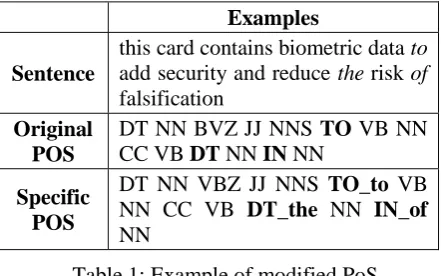
Examples
Sentence
this card contains biometric data to add security and reduce the risk of falsification
Original POS
DT NN BVZ JJ NNS TO VB NN CC VB DT NN IN NN
Specific POS
DT NN VBZ JJ NNS TO_to VB NN CC VB DT_the NN IN_of
[image:3.595.307.528.152.290.2]NN
Table 1: Example of modified PoS.
According to the description of factors, Figure 1 illustrates the forms of various factors extracted from a given example sentence.
Surface
constantly combining ideas will result in better solutions being formulated
Prefix con com ide wil res in bet sol bei for
Suffix tly ing eas ill ult in ter ons ing ted
Stem constantli combin idea will result in
better solut be formul
Specific POS
RB VBG NNS MD VB IN JJR NNS VBG VBN
Figure 1: The factorized sentence.
DT, are revised to TO_to, IN_of and DT_the,
respectively.
2.3 Model Combination
In addition to the design of different factored translation models, two model combination strategies are designed to treat grammatical error correction problem as a series of translation processes, where an incorrect sentence is translated into the correct one. In both approaches we pipeline two translation models,
and . In the first approach, we derive four combinations of different models that trained on different sources.
In case I, and are both factored models but trained on different factors, e.g. for training on “surface + factori” and
on “surface + factorij”. Both models use the same training sentences, but different factors.
In case II, is trained on sentences that paired with the output from the previous model, , and the golden correct sentences. We want to create a second model that can also tackle the new errors introduced by the first model.
In case III, similar to case II, the second translation model, is replaced by a phrase-based translation model.
In case IV, the quality of training data is considered vital to the construction of a good translation model. The present training dataset is not large enough. To complement this, the second model, , is trained on an enlarged data set, by combining the training data of both models, i.e. the original parallel data (official incorrect and correct sentence pairs) and the supplementary parallel data (sentences output from the first model, , and the correct sentences). Note that we do not de-duplicate sentences.
In all cases, the testing process is carried out as follows. The test set is translated by the first translation model, . The output from the first model is then fed into the second translation model, . The output of the second model is used as the final corrections.
The second combination approach is to make use of multiple factors for model construction. The question is whether multiple factors when used together may improve the correction results. In this setting we combine two factors together
with the word surface form to build a multi-factored translation model. All pairs of factors are used, e.g. stem and PoS. The decoding sequence is as follows: translate the input stems into target stems; translate the PoS; and generate the surface form given the factors of stem and PoS.
3
Experiment Setup
3.1 Dataset
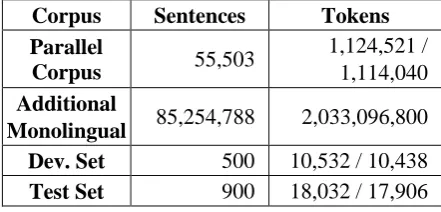
We pre-process the NUCLE corpus (Dahlmeier et al., 2013) as described in Section 2 for training different translation models. We use both the official golden sentences and additional WMT2014 English monolingual data3 to train an in-domain and a general-domain language model (LM), respectively. These language models are linearly interpolated in the decoding phase. We also randomly select a number of sentence pairs from the parallel corpus as a development set and a test set, disjoint from the training data. Table 2 summarizes the statistics of all the datasets.
Corpus Sentences Tokens
Parallel
Corpus 55,503
1,124,521 / 1,114,040
Additional
Monolingual 85,254,788 2,033,096,800
Dev. Set 500 10,532 / 10,438
[image:4.595.304.525.368.474.2]Test Set 900 18,032 / 17,906
Table 2: Statistics of used corpora.
The experiments were carried out with MOSES 1.04 (Philipp Koehn et al., 2007). The translation and the re-ordering model utilizes the “grow-diag-final” symmetrized word-to-word alignments created with GIZA++5 (Och and Ney, 2003) and the training scripts of MOSES. A 5-gram LM was trained using the SRILM toolkit6 (Stolcke et al., 2002), exploiting the improved modified Kneser-Ney smoothing (Kneser and Ney, 1995), and quantizing both probabilities and back-off weights. For the log-linear model training, we take minimum-error-rate training (MERT) method as described in (Och, 2003). The result is evaluated by M2 Scorer (Dahlmeier and Ng, 2012) computing precision, recall and F0.5.
3
http://www.statmt.org/wmt14/translation-task.html.
4
http://www.statmt.org/moses/.
5
http://code.google.com/p/giza-pp/.
6
In total, one baseline system, five individual systems, and four combination systems are evaluated in this study. The baseline system (Baseline) is trained on the words-only corpus using a phrase-based translation model. For the individual systems we adopt the factored translation model that are trained respectively on 1) surface and stem factors (Sys+stem), 2) surface
and suffix factors (Sys+suf), 3) surface and prefix
factors (Sys+pref), 4) surface and PoS factors
(Sys+PoS), and 5) surface and modified-PoS
factors (Sys+MPoS). The combination systems
include: 1) the combination of “factored + phrase-based” and “factored + factored” for models cascading; and 2) the factors of surface, stem and modified-PoS (Sys+stem+MPoS) are
combined for constructing a correction system based on a multi-factor model.
4
Results and Discussions
We report our results in terms of the precision, recall and F0.5 obtained by each of the individual
models and combined models.
4.1 Individual Model
Table 3 shows the absolute measures for the baseline system, while the other individual models are listed with values relative to the baseline.
Model Precision Recall F0.5
Baseline 25.58 3.53 11.37
Sys+stem -14.84 +13.00 +0.18
Sys+suf -14.57 +14.77 +0.60
Sys+pref -15.74 +12.20 -0.77
Sys+PoS -11.63 +9.79 +2.45
Sys+MPoS -10.25 +10.60 +3.70
Table 3: Performance of various models.
The baseline system has the highest precision score but the lowest recall. Nearly all individual models except Sys+pref show improvements in the
correction result (F0.5) over the baseline. Overall,
Sys+MPoS achieves the best result for the
grammatical error correction task. It shows a significant improvement over the other models and outperforms the baseline model by 3.7 F0.5
score. The Sys+stem and Sys+suf models obtain an
improvement of 0.18 and 0.60 in F0.5 scores,
respectively, compared to the baseline. Although the differences are not significant, it confirms our hypothesis that morphological clues do help to improve error correction. The F0.5 score of
Sys+pref is the lowest among the models including
the baseline, showing a drop of 0.77 in F0.5 score
against the baseline. One possible reason is that few errors (in the training corpus) involve word prefixes. Thus, the prefix does not seem to be a suitable factor for tackling the GEC problem.
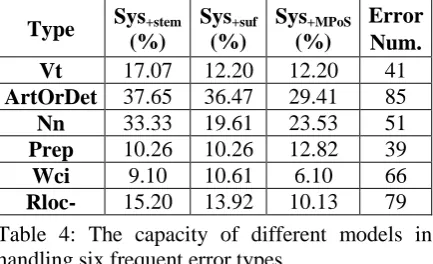
Type Sys+stem (%)
Sys+suf
(%)
Sys+MPoS
(%)
Error Num.
Vt 17.07 12.20 12.20 41
ArtOrDet 37.65 36.47 29.41 85
Nn 33.33 19.61 23.53 51
Prep 10.26 10.26 12.82 39
Wci 9.10 10.61 6.10 66
Rloc- 15.20 13.92 10.13 79
Table 4: The capacity of different models in handling six frequent error types.
We analyze the capacities of the models on different types of errors. Sys+PoS and Sys+MPoS are
built by using the PoS and modified PoS. Both of them yield an improvement in F0.5 score. Overall,
Sys+MPoS produces more accurate results than
Sys+pref. Therefore, we specifically compare and
evaluate the best three models, Sys+stem, Sys+suf
and Sys+MPoS. Table 4 presents evaluation scores
of these models for the six most frequent error types, which take up a large part of the training and test data. Among them, Sys+stem displays a
powerful capacity to handle determiner and noun/number agreement errors, up to 37.65% and 33.33%. Sys+suf shows the ability to correct
determiner errors at 36.47%; Sys+MPoS yields a
similar performance to Sys+suf. All three
individual models exhibit a relatively high capacity to handle determiner errors. The likely reason is that this mistake constitutes the largest portion in training data and test set, giving the learning models many examples to capture this problem well. In the case of preposition errors,
Sys+MPoS demonstrates a better performance. This,
once again, confirms the result (Yuan and Felice, 2013) that the modified PoS factor is effective for every preposition word. For these six error types, the individual models show a weak capacity to handle the word collocation or idiom error category (Wci). Although Sys+MPoS
achieves the highest F0.5 score in the overall
evaluation, it only achieves 6.10% in handling this error type. The likely reason is that idioms are not frequent in the training data, and also that in most of the cases they contain out-of-vocabulary words never seen in training data.
4.2 Model Combination
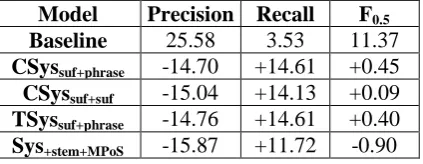
[image:5.595.308.525.128.260.2] [image:5.595.71.291.452.547.2]combining the strengths of individual models through model combination, and compare against the baseline. The systems compared here cover three pipelined models and a multi-factored model, as described earlier in Section 3. The combined systems include: 1) CSyssuf+phrase: the
combination of Sys+suf and the baseline
phrase-based translation model; 2) CSyssuf+suf: we
combine two similar factored models with suffix factors, Sys+suf, which is trained on the same
corpus; and 3) TSyssuf+phrase: similar to
CSyssuf+phrase, but the training data for the second
phrase-based model is augmented by adding the output sentences from the previous model (paired with the correct sentences). Our intention is to enlarge the size of the training data. The evaluation results are presented in Table 5.
Model Precision Recall F0.5
Baseline 25.58 3.53 11.37
CSyssuf+phrase -14.70 +14.61 +0.45
CSyssuf+suf -15.04 +14.13 +0.09
TSyssuf+phrase -14.76 +14.61 +0.40
Sys+stem+MPoS -15.87 +11.72 -0.90
Table 5: Evaluation results of combined models.
In Table 5 we observe that Sys+stem+MPoS hurts
performance and shows a drop of 0.9% in F0.5
score. Both the CSyssuf+phrase and CSyssuf+suf
show minor improvements over the baseline system. Even when we enrich the training data for the second model in TSyssuf+phrase, it cannot
help in boosting the overall performance of the system. One of the problems we observe is that, with this combination structure, new incorrect sentences are introduced by the model at each step. The errors are propagated and accumulated to the final result. Although CSyssuf+phrase and
CSyssuf+suf produce a better F0.5 score over the
baseline, they are not as good as the individual models, Sys+PoS and Sys+MPoS, which are trained
on PoS and modified-PoS, respectively.
4.3 The Official Result
After fully evaluating the designed individual models as well as the integrated ones, we adopt
Sys+MPoS as our designated system for this
grammatical error correction task. The official test set consists of 50 essays, and 2,203 errors. Table 6 shows the final result obtained by our submitted system.
Table 7 details the correction rate of the five most frequent error types obtained by our system. The result suggests that the proposed system has
a better ability in handling the verb, article and determiner error than other error types.
Criteria Result Alt. Result
P 0.3127 0.4317
R 0.1446 0.1972
F0.5 0.2537 0.3488
Table 6: The official correction results of our submitted system.
Type Error Correct %
Vt 203/201 21/22 10.34/10.94
V0 57/54 9/9 15.79/16.67
Vform 156/169 11/18 7.05/10.65
ArtOrDet 569/656 84/131 14.76/19.97
[image:6.595.73.285.292.374.2]Nn 319/285 31/42 9.72/10.91
Table 7: Detailed error information of evaluation system (with alternative result).
5
Conclusion
This paper describes our proposed grammatical error detection and correction system based on a factored statistical machine translation approach. We have investigated the effectiveness of models trained with different linguistic information sources, namely morphological clues and syntactic PoS information. In addition, we also explore some ways to combine different models in the system to tackle the correction problem. The constructed models are compared against the baseline model, a phrase-based translation model. Results show that PoS information is a very effective factor, and the model trained with this factor outperforms the others. One difficulty of this year’s shared task is that participants have to tackle all 28 types of errors, which is five times more than last year. From the results, it is obvious there are still many rooms for improving the current system.
Acknowledgements
References
Gábor Berend, Veronika Vincze, Sina Zarriess, and Richárd Farkas. 2013. LFG-based Features for Noun Number and Article Grammatical Errors. CoNLL-2013.
Chris Brockett, William B. Dolan, and Michael Gamon. 2006. Correcting ESL errors using phrasal SMT techniques. Proceedings of the 21st International Conference on Computational Linguistics and the 44th annual meeting of the Association for Computational Linguistics pages 249–256. Daniel Dahlmeier, Hwee Tou Ng, and Siew Mei
Wu. 2013. Building a Large Annotated Corpus of Learner English: The NUS Corpus of Learner English. Proceedings of the Eighth Workshop on Innovative Use of NLP for Building Educational Applications. pages 22-31.
Robert Dale, Ilya Anisimoff, and George Narroway. 2012. HOO 2012: A report on the preposition and determiner error correction shared task. Proceedings of the Seventh Workshop on Building Educational Applications Using NLP pages 54–62.
Nava Ehsan, and Heshaam Faili. 2013. Grammatical and context-sensitive error correction using a statistical machine translation framework. Software: Practice and Experience. Wiley Online Library.
D. Klein, and C. D. Manning. 2002. Fast exact inference with a factored model for natural language parsing. Advances in neural information processing systems.
Reinhard Kneser, and Hermann Ney. 1995. Improved backing-off for m-gram language modeling. Acoustics, Speech, and Signal Processing, 1995. ICASSP-95., 1995 International Conference on Vol. 1, pages 181–184.
P. Koehn, and H. Hoang. 2007. Factored translation models. Proceedings of the Joint Conference on Empirical Methods in Natural Language Processing and Computational Natural Language Learning (EMNLP-CoNLL) Vol. 868, pages 876–876.
Philipp Koehn, Hieu Hoang, Alexandra Birch, Chris Callison-Burch, Marcello Federico, Nicola Bertoldi, Brooke Cowan, et al. 2007. Moses: Open source toolkit for statistical machine translation. Proceedings of the 45th Annual Meeting of the ACL on Interactive Poster and Demonstration Sessions pages 177–180.
M. P. Marcus, M. A. Marcinkiewicz, and B. Santorini. 1993. Building a large annotated corpus of English: The Penn Treebank. Computational linguistics. MIT Press.
Tomoya Mizumoto, Mamoru Komachi, Masaaki Nagata, and Yuji Matsumoto. 2011. Mining Revision Log of Language Learning SNS for Automated Japanese Error Correction of Second Language Learners. IJCNLP pages 147–155.
Hwee Tou Ng, Siew Mei Wu, Ted Briscoe, Christian Hadiwinoto, Raymond Hendy Susanto, and Bryant Christopher. 2014. The conll-2014 shared task on grammatical error correction. Proceedings of CoNLL. Baltimore, Maryland, USA.
Hwee Tou Ng, Siew Mei Wu, Yuanbin Wu, Christian Hadiwinoto, and Joel Tetreault. 2013. The conll-2013 shared task on grammatical error correction. Proceedings of CoNLL.
Franz Josef Och. 2003. Minimum Error Rate Training in Statistical Machine Translation, 160–167.
Franz Josef Och, and Hermann Ney. 2003. A systematic comparison of various statistical alignment models. Computational linguistics. MIT Press.
Martin F. Porter. 1980. An algorithm for suffix stripping. Program: electronic library and information systems. MCB UP Ltd.
Desmond Darma Putra, and Lili Szabó. 2013. UdS at the CoNLL 2013 Shared Task. CoNLL-2013.
Grigori Sidorov, Anubhav Gupta, Martin Tozer, Dolors Catala, Angels Catena, and Sandrine Fuentes. 2013. Rule-based System for Automatic Grammar Correction Using Syntactic N-grams for English Language Learning (L2). CoNLL-2013.
Andreas Stolcke, and others. 2002. SRILM-an extensible language modeling toolkit. INTERSPEECH.
Junwen Xing, Longyue Wang, Derek F. Wong, Lidia S. Chao, and Xiaodong Zeng. 2013. UM-Checker: A Hybrid System for English Grammatical Error Correction. Proceedings of the Seventeenth Conference on Computational Natural Language Learning: Shared Task, 34–42. Sofia, Bulgaria: Association for Computational Linguistics. Retrieved from http://www.aclweb.org/anthology/W13-3605 Bong-Jun Yi, Ho-Chang Lee, and Hae-Chang
Task. CoNLL-2013.
Ippei Yoshimoto, Tomoya Kose, Kensuke Mitsuzawa, Keisuke Sakaguchi, Tomoya
Mizumoto, Yuta Hayashibe, Mamoru
Komachi, et al. 2013. NAIST at 2013 CoNLL grammatical error correction shared task. CoNLL-2013.
Zheng Yuan, and Mariano Felice. 2013. Constrained grammatical error correction using Statistical Machine Translation. CoNLL-2013.