Collocation Polarity Disambiguation Using Web-based Pseudo Contexts
Yanyan Zhao, Bing Qin and Ting Liu∗
Harbin Institute of Technology, Harbin, China {yyzhao, bqin, tliu}@ir.hit.edu.cn
Abstract
This paper focuses on the task of colloca-tion polarity disambiguacolloca-tion. Thecollocation refers to a binary tuple of a polarity word and a target (such as⟨long, battery life⟩or⟨long, startup⟩), in which the sentiment orientation of the polarity word (“long”) changes along with different targets (“battery life” or “startup”). To disambiguate a collocation’s polarity, pre-vious work always turned to investigate the polarities of its surrounding contexts, and then assigned the majority polarity to the collo-cation. However, these contexts are limited, thus the resulting polarity is insufficient to be reliable. We therefore propose an unsuper-vised three-component framework to expand some pseudo contexts from web, to help dis-ambiguate a collocation’s polarity.Without us-ing any additional labeled data, experiments show that our method is effective.
1 Introduction
In recent years, more attention has been paid to sentiment analysis as it has been widely used in various natural language processing applications, such as question answering (Wiebe et al., 2003; Yu and Hatzivassiloglou, 2003), information extrac-tion (Riloff et al., 2005) and opinion-oriented sum-marization (Hu and Liu, 2004; Liu et al., 2005). Meanwhile, it also brings us lots of interesting and challenging research topics, such as subjectivity analysis (Riloff and Wiebe, 2003), sentiment clas-sification (Pang et al., 2002; Kim and Hovy, 2005;
∗Correspondence author: [email protected]
Wilson et al., 2009; He et al., 2011), opinion re-trieval (Zhang et al., 2007; Zhang and Ye, 2008; Li et al., 2010) and so on.
One fundamental task for sentiment analysis is to determine the semantic orientations of words. For example, the word “beautiful” is positive, while “ugly” is negative. Many researchers have devel-oped several algorithms for this purpose and gener-ated largestaticlexicons of words marked with prior polarities (Hatzivassiloglou and McKeown, 1997; Turney et al., 2003; Esuli, 2008; Mohammad et al., 2009; Velikovich et al., 2010). However, there exist some polarity-ambiguous words, which can dynam-icallyreflect different polarities along with different contexts. A typical polarity-ambiguous word “长” (“long” in English) is shown with two example sen-tences as follows.
1. 该相机的[电池寿命]t很[长]p。(Positive)
Translated as: The [battery life]tof this camera is [long]p. (Positive)
2. 该相机的[启动时间]t很[长]p。(Negative) Translated as: This camera has [long]p [startup]t. (Negative)
The phrases marked with p superscript are the polarity-ambiguous words, and the phrases marked withtsuperscript are targets modified by the polar-ity words. In the above two sentences, the sentiment orientation of the polarity word “长” (“long” in En-glish) changes along with different targets. When modifying the target “电池寿命” (“battery life” in English), its polarity is positive; and when modify-ing “启动时间” (“startup” in English), its polarity is
negative. In this paper,we especiallydefinethe col-locationas a binary tuple of the polarity-ambiguous word and its modified target, such as⟨长,电池寿命⟩ (⟨long, battery life⟩ in English) or ⟨长,启动时间⟩ (⟨long, startup⟩in English). This paper concentrates on the task ofcollocation polarity disambiguation. This is an important task as the problem of polarity-ambiguity is frequent. We analyze 4,861 common binary tuples of polarity words and their modified targets from 478 reviews1, and find that over 20% of them are the collocations defined in this paper. Therefore, the task of collocation polarity dis-ambiguation is worthy of study.
For a sentence scontaining such a collocation c, since the in-sentence features are always ambiguous, it is difficult to disambiguate the polarity ofcby us-ing them. Thus some previous work turned to in-vestigate its surrounding contexts’ polarities (such as the sentences before or afters), and then assigned the majority polarity to the collocationc (Hatzivas-siloglou and McKeown, 1997; Hu and Liu, 2004; Kanayama and Nasukawa, 2006). However, since the amount of contexts from the original review is very limited, the final resulting polarity for the col-locationcis insufficient to be reliable.
Fortunately, most collocations may appear multi-ple times, in different forms, both within the same review and within topically-related reviews. Thus for a collocation, we can collect large amounts of contexts from other reviews to improve its polarity disambiguation. These expanded contexts are called pseudo contextsin this paper. Some previous work used the similar methods. For example, Ding (Ding et al., 2008) expanded some pseudo contexts from a topically-related review set. But since the review set is limited, the expanded contexts are still lim-ited and unreliable. In order to overcome this prob-lem, we propose an unsupervised three-component framework to expand more pseudo contexts from web for the collocation polarity disambiguation.
Without using any labeled data, experiments on a Chinese data set from four product domains show that the three-component framework is feasible and the web-based pseudo contexts are useful for the collocation polarity disambiguation. Compared to other previous work, our method achieves an F1
1
The dataset will be introduced in Section 4.1 in detail.
score of 72.02%, which is about 15% higher. The remainder of this paper is organized as fol-lows. Section 2 introduces the related work. Section 3 shows the proposed approach including three in-dependent components. Section 4 and 5 presents the experiments and results. Finally we conclude this paper in Section 6.
2 Related Work
The key of the collocation polarity disambigua-tion task is to recognize the polarity word’s sen-timent orientation of a collocation. There are ba-sically two types of approaches for word polar-ity recognition: corpus-based and dictionary-based approaches. Corpus-based approaches find co-occurrence patterns of words in the large corpora to determine the word sentiments, such as the work in (Hatzivassiloglou and McKeown, 1997; Wiebe, 2000; Riloff and Wiebe, 2003; Turney et al., 2003; Kaji and Kitsuregawa, 2007; Velikovich et al., 2010). On the other hand, dictionary-based ap-proaches use synonyms and antonyms in WordNet to determine word sentiments based on a set of seed polarity words. Such approaches are studied in (Kim and Hovy, 2006; Esuli and Sebastiani, 2005; Kamps et al., 2004). Overall, most of the above approaches aim to generate a largestatic polarity word lexicon marked with prior polarities.
However, it is not sensible to predict a word’s sen-timent orientation without considering its context. In fact, even in the same domain, a word may indi-cate different polarities depending on what targets it is applied to, especially for the polarity-ambiguous words, such as “长” (“long” in English) shown in Section 1. Based on these, we need to consider both the polarity words and their modified targets, i.e., the collocations mentioned in this paper, rather than only the polarity words.
took into account many contextual information of the word within the sentence, such as exclamation words, emoticons and so on. However, the experi-mental results show that these in-sentence features are not rich enough.
Instead of considering the current sentence alone, some researchers exploited external information and evidences in other sentences or other reviews to infer the collocation’s polarity. For a collocation, Hu (Hu and Liu, 2004) analyzed its surrounding sentences’ polarities to disambiguate its polarity. Ding (Ding et al., 2008) proposed a holistic lexicon-based ap-proach of using global information to solve this problem. However, the contexts or evidences from these two methods are limited and unreliable. Ex-cept for the above unsupervised methods, some re-searchers (Wilson et al., 2005; Wilson et al., 2009) proposed supervised methods for this task, which need large annotated corpora.
In addition, many related works tried to learn word polarity in a specific domain, but ignored the problem that even the same word in the same do-main may indicate different polarities (Jijkoun et al., 2010; Bollegala et al., 2011). And some work (Lu et al., 2011) combined difference sources of informa-tion, especially the lexicons and heuristic rules for this task, but ignored the important role of the con-text. Besides, there exists some research focusing on word sense subjectivity disambiguation, which aims to classify a word sense into subjective or ob-jective (Wiebe and Mihalcea, 2006; Su and Markert, 2009). Obviously, this task is different from ours.
3 The Proposed Approach
3.1 Overview
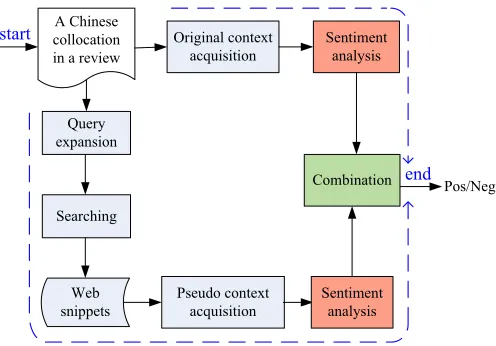
The motivation of our approach is to make full use of web sources to collect more useful pseudo contexts for a collocation, whose original contexts are lim-ited or unreliable. The framework of our approach is illustrated in Figure 1.
In order to disambiguate a collocation’s polarity, three components are carried out:
1. Query Expansion and Pseudo Context Ac-quisition: This paper uses the collocation as query. For a collocation, three heuristic query expansion strategies are used to generate more flexible queries, which have the same or completely opposite
polar-A Chinese collocation in a review
Query expansion
Searching
Web snippets
Original context acquisition
Sentiment analysis
Pseudo context acquisition
Sentiment analysis
Combination Pos/Neg
start
[image:3.612.317.565.55.228.2]end
Figure 1: The framework of our approach.
ity with this collocation. Searching these queries in the domain-related websites, lots of snippets can be acquired. Then we can extract the pseudo contexts from these snippets.
2. Sentiment Analysis: For both original con-texts and the expanded pseudo concon-texts from web, a simple lexicon-based sentiment computing method is used to recognize each context’s polarity.
3. Combination: Two strategies are designed to integrate the polarities of the original and pseudo contexts, under the assumption that these two kinds of contexts can be complementary to each other.
It is worth noting that this three-component framework is flexible and we can try to design dif-ferent strategies for each component. Next sections will give a simple example strategy for each compo-nent to show its feasibility and effectiveness.
3.2 Query Expansion and Pseudo Context Acquisition
3.2.1 Why Expanding Queries
For a collocation, such as⟨长,电池寿命⟩(⟨long, battery life⟩ in English), the most intuitive query used for searching is constructed by the form of “tar-get + polarity word”, i.e., 电 池 寿 命 长 (battery life long in English). Even if we search this query alone, a great many web snippets covering the po-larity word and target will be retrieved. But why do we still need to expand the queries?
polarity words in some snippets do not really mod-ify the targets, such as in the sentence “Thebattery lifeis short, and finds few buyers for along time.” There exist no modifying relation between “battery life” and “long”.
In order to filter these meaningless snippets, we can simply search with a new query “电池寿命长” bysurrounding it with quotes(noted asStrategy0). However, this can drastically decline the amount of snippets. In addition, as the new query is short, in many retrieved snippets, there also exist no modify-ing relations between the polarity words and targets. As a result, if we just use this query strategy, the ex-panded pseudo contexts are limited and cannot yield ideal performance.
Therefore, we need to design some effective query expansion strategies to ensure that (1) the po-larity words do modify the targets in the retrieved web snippets, and (2) the snippets are more enough.
3.2.2 Query Expansion Strategy
We first investigate the modifying relations be-tween polarity words and the targets, and then con-struct effective queries.
Observed from previous work (Bloom et al., 2007; Kobayashi et al., 2004; Popescu and Etzioni, 2005), there are two kinds of common relations be-tween the polarity words and their targets. One is the “subject-copula-predicate” relation, such as the relationship between “long” and “battery life” in the sentence “The battery life of this camera is long”. The other is the “attribute-head” relation, such as the relationship between them in the sentence “This camera haslong battery life”.
As a result, three heuristic query expansion strate-gies are adopted to construct efficient queries for searching. Take the collocation ⟨长,电 池 寿 命⟩ (⟨long, battery life⟩ in English) as an example, the strategies are described as follows.
Strategy1: target + modifier + polarity word: Such as the query “电池寿命很长” or “电池寿命 非常长” (“the battery life isverylong” in English). Different from Strategy0, this strategy adds a mod-ifier element. It refers to the words that are used to change the degree of a polarity word, such as “很” or “非常” (“very” in English). Due to the usage of the modifiers, the queries from this strategy can satisfy the “subject-copula-predicate” relation.
Strategy2: modifier + polarity word + 的+ tar-get: Such as the query “很长的电池寿命” or “非 常长的电池寿命” (“verylong battery life” in En-glish). This strategy also usesmodifiersto modify polarity words, and the generated queries can satisfy the “attribute-head” relation.
Strategy3: negation word+ polarity word +的+ target: Such as the query “不长的电池寿命” or “没 有长的电池寿命” (“not long battery life” in En-glish). This strategy usesnegation wordsto modify the polarity words. And the queries from this strat-egy can satisfy the “attribute-head” relation. The only difference is that the polarity of this kind of queries is opposite to that of the collocation.
Similar to the queries from Strategy0, the queries generated by Strategy1∼3 are all searched with quotes. In addition, note that the modifier and the negation wordare taken fromModifier Lexiconand Negation Lexiconintroduced in Table 2.
3.2.3 Pseudo Context Acquisition
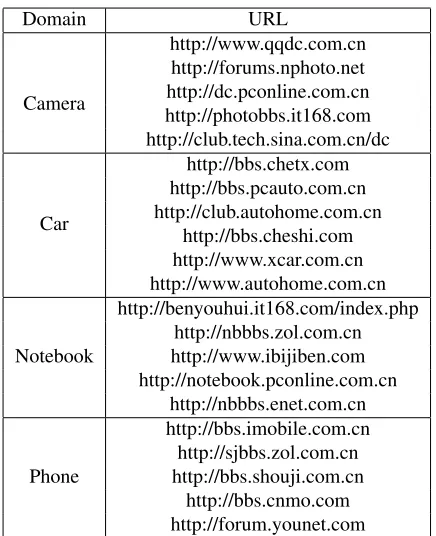
For each query from Strategy0∼3, we search it in some websites to acquire the related snippets. If we directly search it using Google without site restric-tions, it does return all the snippets containing the query, but lots of them are non-reviews. Further, the pseudo contexts generated by these non-reviews are useless or even harmful. To overcome this problem, theadvanced searchof Google is used to search the query within theforum sitesof the product domain. We can flexibly choose several popular forum sites for each domain. The URLs of the forum sites used in this paper are listed in Table 1.
Formally, given a collocation c, the expanded pseudo contextsConx(c)can be obtained using the following function:
Conx(c) = ∪3i=0f(Queryi)
= ∪3i=0∪nj=1f(queryij)
(1)
Here,Queryiis the query set generated by theith
query expansion strategy; queryij is the jth query
Domain URL
Camera
http://www.qqdc.com.cn http://forums.nphoto.net http://dc.pconline.com.cn http://photobbs.it168.com http://club.tech.sina.com.cn/dc
Car
http://bbs.chetx.com http://bbs.pcauto.com.cn http://club.autohome.com.cn
http://bbs.cheshi.com http://www.xcar.com.cn http://www.autohome.com.cn
Notebook
http://benyouhui.it168.com/index.php http://nbbbs.zol.com.cn http://www.ibijiben.com http://notebook.pconline.com.cn
http://nbbbs.enet.com.cn
Phone
http://bbs.imobile.com.cn http://sjbbs.zol.com.cn http://bbs.shouji.com.cn
[image:5.612.77.295.54.322.2]http://bbs.cnmo.com http://forum.younet.com
Table 1: The URLs used in context expansion for differ-ent domains.
In detail, the pseudo context acquisition algorithm for a collocation c is illustrated in Figure 2. Note that, the original context acquisition ofccan be con-sidered as a simplified version of the pseudo context acquisition. That’s because the current review con-taining c can be considered as only one snippet in pseudo context acquisition. Thus, we can just carry out the two steps in (2) of Figure 2 to obtain the orig-inal contexts.
Analyzing either the pseudo contexts or the orig-inal contexts, we can find that not all of them are useful contexts. Thus we will simply filter the noisy ones by context sentiment computation, and choose the contexts showing sentiment orientations as the useful contexts.
3.3 Sentiment Analysis
For both the original and expanded pseudo contexts, we employ the lexicon-based sentiment computing method (Hu and Liu, 2004) to compute the polarity value for each context. This unsupervised approach is quite straightforward and makes use of the senti-ment lexicons in Table 2.
The polarity valuePolarity(con) for a contextcon
Algorithm: Pseudo Context Expansion Algorithm
Input: A collocation c and the URL list
Output: The pseudo context set Conx(c)
1. Use Strategy0~3 to expand cand the expanded queries are saved as a set Query(c).
2. For any query q Query(c), acquire its pseudo contexts Conx(q) as follows:
(1) search qin the domain-related URL list, the top 100 retrieved snippets for each URL are collected as Snip(q)
(2) for each snippet sp Snip(q) find the sentence scontaining q
obtain the two sentences before and after sas the contexts of qin this sp, noted as Conx(q, sp) Conx(q) =
3. Conx(c) = = ∈
∈
U
) () , (
q Snip sp
sp q Conx ∈
U
) (
) (
c Query q
q Conx
∈
U
()U
( )) , (
c Query
q sp Snipq
sp q Conx
∈ ∈
Figure 2: The algorithm for pseudo context acquisition.
Lexicon Content
Modifier Lexicon
很,比较,非常,十分,太,特,
特别,挺,相当,格外,分外
(“very” or “quite” in English)
Negation Lexicon 没有,不,不是 (“no” or “not” in English)
Positive Lexicon There are 3,730 Chinese words are collected from HOWNET1.
Negative Lexicon There are 3,116 Chinese words are collected from HOWNET. 1http://www.keenage.com/html/e index.html.
Table 2: The lexicons used in this paper.
is computed by summing up the polarity values of all words incon, making use of both the word polarity defined in the positive and negative lexicons and the contextual shifters defined in the negation lexicon. The algorithm is illustrated in Figure 3.
In this algorithm, n is the parameter controlling the window size within which the negation words have influence on the polarity words, and herenis set to 3.
[image:5.612.313.535.316.438.2]Domain # of reviews # ofc # of singlec Sig / All # of multiplec (All) (Sig) (%) / kinds of multiplec
Camera 138 295 183 62.03 112 / 35
Car 161 232 131 56.47 101 / 33
Notebook 56 147 94 63.95 53 / 20
Phone 123 327 192 58.72 135 / 35
[image:6.612.136.481.58.144.2]Total 478 1001 600 59.94 401 / 123≈3.3
Table 3: Statistics for the Chinese collocation corpus.
Algorithm: Sentiment Analysis
Input: a context con, and three lexicons: Positive_Dic,
Negative_Dic, Negation_Dic
Output: Polarity value Polarity(con)
1. Segment coninto word set W(con)
2. For each word w W(con), compute its polarity value
Polarity(w) as follows:
(1) if w Positive_Dic, Polarity(w) = 1;
(2) if w Negative_Dic, Polarity(w) = -1;
(3) otherwise, Polarity(w) = 0;
(4) Within the window of n words previous to w, if
there is a word w′ Negation_Dic,
Polarity(w) = -Polarity(w) 3. Polarity(con) =
∈ ∈
∑
∈ ( )
) (
con W w
w Polarity
∈ ∈
Figure 3: The algorithm for context polarity computation.
3.4 Combination
After the pseudo context acquisition and polarity computation, two kinds of effective contexts: orig-inal contextsand pseudo contexts, and their corre-sponding polarities can be obtained.
In order to yield a relatively accurate polarity Po-larity(c) for a collocationc, we exploit the following combination methods:
1. Majority Voting: Rather than considering the difference between the two kinds of contexts, this combination method relies on the polarity tag of each context. Suppose c has n effective contexts (including original and pseudo contexts), it can ob-tainnpolarity tags based on the individual sentiment analysis algorithm. The polarity tag receiving more votes is chosen as the final polarity ofc.
2. Complementation: For a collocation c, we first employ “Majority Voting” method just on the expanded pseudo contexts to obtain the polarity tag.
If the polarity ofc cannot be recognized2, the ma-jority polarity tag voted on the original contexts is chosen as the final polarity tag.
4 Experimental Setup
4.1 Dataset and Evaluation Metrics
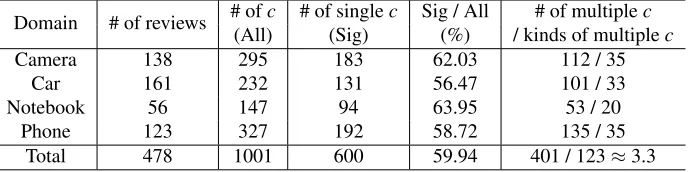
We conduct the experiments on a Chinese colloca-tion corpus of four product domains, which is from the Task3 of the Chinese Opinion Analysis Evalua-tion (COAE)3(Zhao et al., 2008). Table 3 describes the corpus in detail.
From 478 reviews, 1,001 collocations (454 pos-itive and 547 negative) with polarity-ambiguous words are found and manually annotated by two an-notators. Cohen’s kappa (Cohen, 1960), a measure of inter-annotator agreement ranging from zero to one, is 0.83, indicating a good strength of agree-ment4. In Table 3,Sigof the fourth column denotes the collocations that appear once in all the domain-related reviews. And multiple in the last column denotes the collocations that appear several times. From Table 3, we can find that among all the re-views, nearly 60% collocations only appear once. Even for the multiple collocations, they averagely appear less than 4 times. Therefore, for a colloca-tion, if we only consider its original contexts alone or the expanded pseudo contexts from the domain-related review set alone, the contexts are obviously limited and unreliable.
Instead of using accuracy, we use precision (P), recall (R) and F-measure (F1) to measure the perfor-mance of this task. That’s because two kinds of col-locations’ polarities cannot be disambiguated. One
2The reason will be explained in the last paragraph of
Sec-tion 4.1.
3http://www.ir-china.org.cn/coae2008.html 4
is the sparse collocations, which obtain no effective contexts. The other is the collocations that acquire the same amount of positive and negative contexts. The metrics are defined as follows.
P = correctly disambiguated collocations disambiguated collocations (2)
R= correctly disambiguated collocations all collocations (3)
F1 = 2P R
P+R (4)
4.2 System Description
In order to compare our method with previous work, we build several systems as follows:
N oExp: Following the method proposed by Hu (Hu and Liu, 2004), without using the expanded pseudo contexts, we only consider the two original contextsSenbef andSenaf tof a collocationcin the
current review. IfSenbef expresses the polarity
po-lar, then P olarity(ac) = polar. Else if Senaf t
expresses the polaritypolar′, thenP olarity(ac) = polar′. Else, this method cannot disambiguate the polarity ofc. In this method, the transitional words, such as “但是” (“but” in English) are considered.
Expdataset: Following the method proposed by
Ding (Ding et al., 2008), we solve this task with the help of the pseudo contexts in the domain-related re-view dataset. For a collocationcappearing in many domain-related reviews, this method refers to the po-larities of the samecin other reviews. The majority polarity is chosen as final polarity.
Expweb+sig: This method is the same as our
method in this paper, except for (1) not combining the original contexts, and (2) not using all the three query expansion strategies, but just using the sin-gle(abbv. sig) Strategy0. This method expands the pseudo contexts from theweb. The majority polarity is chosen as the final polarity.
Expweb+exp: This method is the same as our
pro-posed method in this paper, except for not combin-ing the original contexts. It expands the pseudo con-texts from theweb. And the “exp” in the subscript means that this method uses all the query expansion strategies. The majority polarity of all the pseudo contexts is chosen as the final polarity.
Expmv/cweb+exp+com: This is the method proposed in this paper, which combines the original and ex-panded pseudo contexts. The superscript “mv/c” is short for the two combination methods: Majority
Voting andComplementation.
5 Results
5.1 Comparisons among All the Systems
In fact, all the systems shown in Section 4.2 can be considered ascontextbased methods. The essential difference among them lies in the contexts they used. For a collocation, the contexts forN oExpare two original contexts from the current review. Breaking down the boundary of the current review,Expdataset
explores the pseudo contexts from other domain-related reviews. Further,Expweb+sig, Expweb+exp
and Expmv/cweb+exp+com expand the pseudo contexts from web, which can be considered as a large corpus and can provide more evidences for the collocation polarity disambiguation.
System P(%) R(%) F1(%)
N oExp 67.32 41.16 51.08
Expdataset 68.14 47.85 56.22
Expweb+sig 70.00 53.85 60.87
Expweb+exp 74.97 63.14 68.55
Expmv
web+exp+com 75.53 67.83 71.47
Expc
[image:7.612.75.302.130.265.2]web+exp+com 74.36 69.83 72.02
Table 4: Comparative results for the collocation polarity disambiguation task.
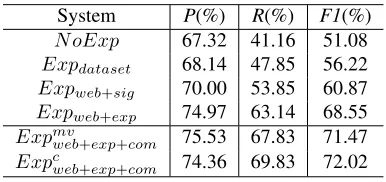
Table 4 illustrates the comparative results of all systems for collocation polarity disambiguation. It can be observed that our system Expmvweb+exp+com andExpcweb+exp+com outperform all the other sys-tems. We discuss the experimental results as fol-lows:
N oExpyields the worst performance, especially on the recall. The reason is that the original con-texts used in this system are limited, and some of them are even noisy. In comparison, Expdataset
[image:7.612.330.523.353.444.2]However, Expdataset is just effective in
disam-biguating the polarity of such a collocationc, which appears many times in the domain-related reviews. From Table 3, we can notice that this kind of collo-cations only accounts for 40% in all the collocollo-cations, and further they appear less than 4 times on average. Thus, for such a collocationc, the pseudo contexts expanded from other reviews that contain the same care still far from enough, since the review set size in this system is not very large.
In order to avoid the context limitation problem, we expand more pseudo contexts from web for each collocation. We first try to use a simple query form (Strategy0) for web mining. Table 4 illustrates that the corresponding system Expweb+sig
outper-forms the system Expdataset. It can demonstrate
that our web mining based pseudo context expan-sion is useful for disambiguating the collocation’s polarity, since this system can explore more con-texts. However, we can find that the performance is not very ideal. This system can generate some harmful contexts for the reason of the wrong mod-ifying relations between polarity words and targets in the retrieved snippets.
Thus this paper adds three query expansion strate-gies to generate more and accurate pseudo con-texts. Table 4 shows that the corresponding sys-temExpweb+expcan achieve a better result withF1
= 68.55%, which is significantly (χ2 test with p< 0.01) outperformsExpweb+sig. It demonstrates that
the query expansion strategies are useful.
Finally, Table 4 gives the results of our method in this paper,Expmv
web+exp+com andExpcweb+exp+com,
which combines the original and expanded pseudo contexts to yield a final polarity. We can ob-serve that both of these systems outperform the sys-temN oExpof just using the original contexts and the systemExpweb+exp of just using the expanded
pseudo contexts. This can illustrate that the two kinds of contexts are complementary to each other. In addition, we can also find that the two combi-nation methods produce similar results. In detail, Expmvweb+exp+com disambiguates 899 collocations, 679 of them are correct; Expcweb+exp+com disam-biguates 940 collocations, 699 of them are correct.
We can further find that, although the amount of original contexts is small, it also plays an important role in disambiguating the polarities of the
collo-cations that cannot be recognized by the expanded pseudo contexts.
5.2 The Contributions of the Query Expansion Strategies
The expanded pseudo contexts from our method can be partly credited to the query expansion strategies. Based on this, this section aims to analyze the differ-ent contributions of the query expansion strategies in our method.
Strategy P(%) R(%) F1(%) Avg(#) Strategy0 70.00 53.85 60.87 71 Strategy1 74.14 55.84 63.70 112 Strategy2 61.84 37.56 46.74 26 Strategy3 64.34 33.17 43.77 20
Expweb+exp 74.97 63.14 68.55 229
Table 5: The performance of our method based on each query expansion strategy for collocation polarity disam-biguation.
Table 5 provides the performance of our method based on each query expansion strategy for collo-cation polarity disambiguation. For each strategy, “Avg” in Table 5 denotes the average number of the expanded pseudo contexts for each collocation. From this table, we can find that the larger the “Avg” is, the better (F1) the strategy is. In detail, Strategy1 with the largest “Avg” has the best performance; and Strategy3 with the fewest “Avg” has the worst per-formance. This can further demonstrate our idea that more and effective pseudo contexts can improve the performance of the collocation polarity disam-biguation task. Expweb+exp integrates all the query
expansion strategies and obtains much more “Avg”. Therefore, this can significantly increase the recall value, and further produce a better result. On the other hand, the results in Table 5 show that these heuristic query expansion strategies are effective.
5.3 Deep Experiments in the Three-Component Framework
In order to do a detailed analysis into our three-component framework, some deep experiments are made:
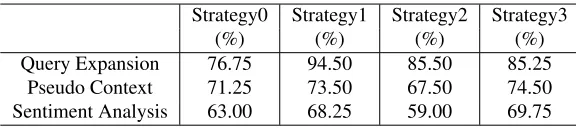
Strategy0 Strategy1 Strategy2 Strategy3
(%) (%) (%) (%)
Query Expansion 76.75 94.50 85.50 85.25
Pseudo Context 71.25 73.50 67.50 74.50
[image:9.612.161.449.56.120.2]Sentiment Analysis 63.00 68.25 59.00 69.75
Table 6: The accuracies of the query expansion, pseudo context and sentiment analysis for each strategy.
snippet, if the polarity word of the collocation does modify the target, we consider this snippet as a cor-rect query expansion result.
Pseudo Context For each expanded pseudo con-text from web, if it shows the same sentiment ori-entation with the collocation (or opposite with the collocation’s polarity because of the usage of transi-tional words), we consider this context as a correct pseudo context.
Sentiment Analysis For each expanded pseudo context, if its polarity can be correctly recognized by the polarity computation method in Figure 3, and meanwhile it shows the same sentiment orientation with the collocation, we consider this context as a correct one.
Table 6 illustrates the accuracy of each experi-ment for each strategy in detail, where 400 web re-trieved snippets for Query Expansion and 400 ex-panded pseudo contexts for Pseudo Context and Sentiment Analysisare randomly selected and man-ually evaluated for each strategy.
Seen from Table 6, we can find that:
1. ForQuery Expansion, all strategies yield good accuracies except for Strategy0. This can draw a same conclusion with our analysis in Section 3.2.1. The queries from Strategy0 are short, thus in many retrieved snippets, there exist no modifying relations between the polarity words and targets. Accord-ingly, the pseudo contexts from these snippets are incorrect. This can result in the low accuracy of Strategy0. On the other hand, we can find that the other three query expansion strategies perform well. 2. Although the final result of our three-component framework is good, the accuracies of Pseudo Context and Sentiment Analysis for each strategy is not very high. This is perhaps caused by unrefined work on the specific sub-stages. For ex-ample, we get all the pseudo contexts using the al-gorithm in Figure 2. However, in some reviews, the two sentences before and after the target sentence
have no polarity relation with the target sentence it-self. This can bring in some noises. On the other hand, the context polarity computation algorithm in Figure 3 is just a simple attempt, which is not the best way to compute the context’s polarity.
In fact, this paper aims to try some simple algo-rithms for each component to validate the effective-ness of the three-component framework. We will polish every component of our framework in future.
6 Conclusion and Future Work
This paper proposes a web-based context expan-sion framework for collocation polarity disambigua-tion. The basic assumption of this framework is that, if a collocation appears in different forms, both within the same review and within topically-related reviews, then the large amounts of pseudo contexts from these reviews can help to disambiguate such a collocation’s polarity. Based on this assumption, this framework includes three independent compo-nents. First, the heuristic query expansion strate-gies are adopted to expand pseudo contexts from web; then a simple but effective polarity computa-tion method is used to recognize the polarities for both the original contexts and the expanded pseudo contexts; and finally, we integrate the polarities from the original and pseudo contexts as the collocation’s polarity. Without using any additional labeled data, experiments on a Chinese data set from four product domains show that the proposed framework outper-forms other previous work.
This paper can be concluded as follows:
1. A framework including three independent com-ponents is proposed for collocation polarity disambiguation. We can try other different al-gorithms for each component.
3. The query expansion strategies are promising, which can generate more useful and correct contexts.
4. The initial contexts from current reviews and the expanded contexts from web are comple-mentary to each other.
The immediate extension of our work is to polish each component of this framework, such as improv-ing the accuracy of query expansion and pseudo con-text acquisition, using other effective polarity com-puting methods for each context and so on. In ad-dition, we will explore other query expansion strate-gies to generate more effective contexts.
Acknowledgments
We thank the anonymous reviewers for their helpful comments. This work was supported by National Natural Science Foundation of China (NSFC) via grant 61133012, the National “863” Leading Tech-nology Research Project via grant 2012AA011102, the Ministry of Education Research of Social Sci-ences Youth funded projects via grant 12YJCZH304 and the Fundamental Research Funds for the Central Universities via grant No.HIT.NSRIF.2013090.
References
Kenneth Bloom, Navendu Garg, and Shlomo Argamon. 2007. Extracting appraisal expressions. In HLT-NAACL 2007, pages 308–315.
D. Bollegala, D. Weir, and J. Carroll. 2011. Using mul-tiple sources to construct a sentiment sensitive the-saurus for cross-domain sentiment classification. In Proceedings of the 49th Annual Meeting of the Asso-ciation for Computational Linguistics: Human Lan-guage Technologies-Volume 1, pages 132–141. Asso-ciation for Computational Linguistics.
Jacob Cohen. 1960. A coefficient of agreement for nom-inal scales. Educational and Psychological Measure-ment, 20(1):37–46.
Xiaowen Ding, Bing Liu, and Philip S. Yu. 2008. A holistic lexicon-based approach to opinion mining. In Proceedings of the Conference on Web Search and Web Data Mining (WSDM), pages 231–240.
A. Esuli and F. Sebastiani. 2005. Determining the se-mantic orientation of terms through gloss analysis. In Proceedings of the ACM SIGIR Conference on Infor-mation and Knowledge Management (CIKM), pages 617–624.
A. Esuli. 2008. Automatic generation of lexical re-sources for opinion mining: models, algorithms and applications. InACM SIGIR Forum, volume 42, pages 105–106. ACM.
V. Hatzivassiloglou and K.R. McKeown. 1997. Predict-ing the semantic orientation of adjectives. In Proceed-ings of the eighth conference on European chapter of the Association for Computational Linguistics, pages 174–181. Association for Computational Linguistics. Yulan He, Chenghua Lin, and Harith Alani. 2011.
Auto-matically extracting polarity-bearing topics for cross-domain sentiment classification. InProceedings of the 49th Annual Meeting of the Association for Compu-tational Linguistics: Human Language Technologies, pages 123–131, Portland, Oregon, USA, June. Associ-ation for ComputAssoci-ational Linguistics.
M. Hu and B. Liu. 2004. Mining and summarizing customer reviews. In Proceedings of the tenth ACM SIGKDD international conference on Knowledge dis-covery and data mining, pages 168–177. ACM. V. Jijkoun, M. De Rijke, and W. Weerkamp. 2010.
Gen-erating focused topic-specific sentiment lexicons. In Proceedings of the 48th Annual Meeting of the Associ-ation for ComputAssoci-ational Linguistics, pages 585–594. Association for Computational Linguistics.
N. Kaji and M. Kitsuregawa. 2007. Building lexicon for sentiment analysis from massive collection of html documents. In Proceedings of the Joint Conference on Empirical Methods in Natural Language Process-ing and Computational Natural Language LearnProcess-ing (EMNLP-CoNLL), pages 1075–1083.
Jaap Kamps, Maarten Marx, R. ort. Mokken, and Maarten de Rijke. 2004. Using wordnet to measure semantic orientation of adjectives. InProceedings of LREC-2004, pages 1115–1118.
H. Kanayama and T. Nasukawa. 2006. Fully auto-matic lexicon expansion for domain-oriented senti-ment analysis. InProceedings of the 2006 Conference on Empirical Methods in Natural Language Process-ing, pages 355–363. Association for Computational Linguistics.
Soo-Min Kim and Eduard Hovy. 2005. Automatic detec-tion of opinion bearing words and sentences. In Pro-ceedings of IJCNLP-2005, pages 61–66.
S.-M. Kim and E. Hovy. 2006. Identifying and analyz-ing judgment opinions. In Proceedings of the Joint Human Language Technology/North American Chap-ter of the ACL Conference (HLT-NAACL), pages 200– 207.
Binyang Li, Lanjun Zhou, Shi Feng, and Kam-Fai Wong. 2010. A unified graph model for sentence-based opin-ion retrieval. InProceedings of the 48th Annual Meet-ing of the Association for Computational LMeet-inguistics, page 1367–1375.
Bing Liu, Minqing Hu, and Junsheng Cheng. 2005. Opinion observer: analyzing and comparing opinions on the web. In Proceedings of WWW-2005, pages 342–351.
Y. Lu, M. Castellanos, U. Dayal, and C.X. Zhai. 2011. Automatic construction of a context-aware sentiment lexicon: an optimization approach. InProceedings of the 20th international conference on World wide web, pages 347–356. ACM.
S. Mohammad, C. Dunne, and B. Dorr. 2009. Generat-ing high-coverage semantic orientation lexicons from overtly marked words and a thesaurus. InProceedings of the 2009 Conference on Empirical Methods in Nat-ural Language Processing: Volume 2-Volume 2, pages 599–608. Association for Computational Linguistics. Bo Pang, Lillian Lee, and Shivakumar Vaithyanathan.
2002. Thumbs up? sentiment classification using ma-chine learning techniques. InProceedings of EMNLP-2002, pages 79–86.
Ana-Maria Popescu and Oren Etzioni. 2005. Extract-ing product features and opinions from reviews. In hltemnlp2005, pages 339–346.
Ellen Riloff and Janyce Wiebe. 2003. Learning extrac-tion patterns for subjective expressions. In Proceed-ings of EMNLP-2003, pages 105–112.
Ellen Riloff, Janyce Wiebe, and William Phillips. 2005. Exploiting subjectivity classification to improve in-formation extraction. In Proceedings of AAAI-2005, pages 1106–1111.
Fangzhong Su and Katja Markert. 2009. Subjectivity recognition on word senses via semi-supervised min-cuts. In Human Language Technologies: The 2009 Annual Conference of the North American Chapter of the ACL, pages 1–9.
Yasuhiro Suzuki, Hiroya Takamura, and Manabu Oku-mura. 2006. Application of semi-supervised learn-ing to evaluative expression classification. In Com-putational Linguistics and Intelligent Text Processing, pages 502–513.
P. Turney, M.L. Littman, et al. 2003. Measuring praise and criticism: Inference of semantic orientation from association. ACM Transactions on Information Sys-tems (TOIS), 21(4):315–346.
Leonid Velikovich, Sasha Blair-Goldensohn, Kerry Han-nan, and Ryan McDonald. 2010. The viability of web-derived polarity lexicons. InThe 2010 Annual Confer-ence of the North American Chapter of the Association for Computational Linguistics, pages 777–785.
Jan Wiebe and Rada Mihalcea. 2006. Word sense and subjectivity. In Proceedings of the Conference on Computational Linguistics / Association for Computa-tional Linguistics (COLING/ACL), pages 1065–1072. Janyce Wiebe, Eric Breck, and Chris Buckley. 2003.
Recognizing and Organizing Opinions Expressed in the World Press. In Papers from the AAAI Spring Symposium on New Directions in Question Answering, pages 24–26.
Janyce Wiebe. 2000. Learning subjective adjectives from corpora. In Proceedings of AAAI, pages 735– 740.
Theresa Wilson, Janyce Wiebe, and Paul Hoffmann. 2005. Recognizing contextual polarity in phrase-level sentiment analysis. InProceedings of HLT/EMNLP-2005, pages 347–354.
Theresa Wilson, Janyce Wiebe, and Paul Hoffmann. 2009. Recognizing contextual polarity: an exploration of features for phrase-level sentiment analysis. Com-putational Linguistics, 35(3).
Hong Yu and Vasileios Hatzivassiloglou. 2003. Towards answering opinion questions: separating facts from opinions and identifying the polarity of opinion sen-tences. InProceedings of EMNLP-2003, pages 129– 136.
Min Zhang and Xingyao Ye. 2008. A generation model to unify topic relevance and lexicon-based sentiment for opinion retrieval. InProceedings of the ACM Spe-cial Interest Group on Information Retrieval (SIGIR), pages 411–419.
Wei Zhang, Clement Yu, and Weiyi Meng. 2007. Opin-ion retrieval from blogs. InIn proceedings of CIKM, page 831–840.