Forest Reranking through Subtree Ranking
Rich´ard Farkas, Helmut Schmid
Institute for Natural Language Processing University of Stuttgart
{farkas,schmid}@ims.uni-stuttgart.de
Abstract
We propose the subtree rankingapproach to parse forest reranking which is a general-ization of current perceptron-based reranking methods. For the training of the reranker, we extract competing local subtrees, hence the training instances (candidate subtree sets) are very similar to those used during beam-search parsing. This leads to better param-eter optimization. Another chief advantage of the framework is that arbitrary learning to rank methods can be applied. We evaluated our reranking approach on German and En-glish phrase structure parsing tasks and com-pared it to various state-of-the-art reranking approaches such as the perceptron-based for-est reranker. The subtree ranking approach with a Maximum Entropy model significantly outperformed the other approaches.
1 Introduction
Reranking has become a popular technique for solving various structured prediction tasks, such as phrase-structure (Collins, 2000) and depen-dency parsing (Hall, 2007), semantic role labeling (Toutanova et al., 2008) and machine translation (Shen et al., 2004). The idea is to (re)rank candi-dates extracted by a base system exploiting a rich feature set and operating at a global (usually sen-tence) level. Reranking achieved significant gains over the base system in many tasks because it has access to information/features which are not com-putable in the base system. Reranking also outper-forms discriminative approaches which try to han-dle the entire candidate universe (cf. Turian et al.
(2006)) because the base system effectively and ef-ficiently filters out many bad candidates and makes the problem tractable.
The standard approach for reranking is then-best list ranking procedure, where the base system ex-tracts its topnglobal-level candidates with associ-ated goodness scores that define an initial ranking. Then the task is to rerank these candidates by us-ing a rich feature set. The bottleneck of this ap-proach is the small number of candidates consid-ered. Compared ton-best lists, packed parse forests encode more candidates in a compact way. For-est rerankingmethods have been proposed, which can exploit the richer set of candidates and they have been successfully applied for phrase-structure (Huang, 2008), dependency (Hayashi et al., 2011) parsing and machine translation (Li and Khudanpur, 2009) as well.
Huang (2008) introduced the perceptron-based forest reranking approach. The core of the algo-rithm is a beam-search based decoder operating on the packed forest in a bottom-up manner. It follows the assumption that the feature values of the whole structure are the sum of the feature values of the lo-cal elements and they are designed to the usage of the perceptron update. Under these assumptions a
1-best Viterbi or beam-search decoder can be effi-ciently employed at parsing and training time. Dur-ing trainDur-ing, it decodes the 1-best complete parse then it makes the perceptron update against the or-acle parse, i.e. the perceptron is trained at the global (sentence) level.
We propose here a subtree ranker approach which can be regarded as a generalization of this
est reranking procedure. In contrast to updating on a single (sub)tree per sentence using only the1-best parse (perceptron-based forest reranking), the sub-tree ranker exploits subsub-trees of all sizes from a sen-tence and trains a (re)ranker utilising several deriva-tions of the constituent in question. During parsing we conduct a beam-search extraction by asking the ranker to select thek best subtrees among the pos-sible candidates of each forest node. The chief mo-tivation for this approach is that in this way, train-ing and prediction are carried out on similar local candidate lists which we expect to be favorable to the learning mechanism. We empirically prove that the trained discriminative rankers benefit from hav-ing access to a larger amount of subtree candidates. Moreover, in this framework any kind of learning to rank methods can be chosen as ranker, including pair-wise and list-wise classifiers (Li, 2011).
The contributions of this paper are the following:
• We extend the perceptron-based forest rerankers to the subtree ranker forest reranking framework which allows to replace the per-ceptron update by any kind of learning to rank procedure.
• We report experimental results on German and English phrase-structure parsing compar-ing subtree rerankers to various other rerankers showing a significant improvement over the perceptron-based forest reranker approach.
2 Related Work
Our method is closely related to the work of Huang (2008), who introduced forest-based reranking for phrase structure parsing. The proposed frame-work can be regarded as an extension of this ap-proach. It has several advantages compared with the perceptron-based forest reranker. In this paper we focus on the most important one – and briefly discuss two others in Section 5 – which is enabling the use of any kind of learning to rank approaches. While the perceptron is fast to train, other machine learning approaches usually outperform it. Most of the existing learning to rank approaches are built on linear models and evaluate the candidates indepen-dently of each other (such as MaxEnt (Charniak and Johnson, 2005), SVMRank (Joachims, 2002), Soft-Rank (Guiver and Snelson, 2008)). Thus the choice
of the learning method does not influence parsing time. We believe that the real bottleneck of parsing applications is parsing time and not training time. On the other hand, they can learn a better model (at the cost of higher training time) than the Per-ceptron. In theory, we can imagine learning to rank approaches which can not be reduced to the indi-vidual scoring of candidates at prediction time, for instance a decision tree-based pairwise ranker. Al-though such methods would also fit into the general subtree framework, they are not employed in prac-tice (Li, 2011).
The subtree ranking approach is a generalization of the perceptron-based approach. If the ranking algorithm is the Averaged Perceptron, the parsing algorithm reduces to perceptron-based forest pars-ing. If the “selection strategy” utilizes the base sys-tem ranking and training starts with a filtering step which keeps only candidate sets from the root node of the forest we get the offline version of the training procedure of the perceptron-based forest reranker of Huang (2008).
As our approach is based on local ranking (local update in the online learning literature), it is highly related to early update which looks for the first lo-cal decision point where the oracle parse falls out from the beam. Early update was introduced by Collins and Roark (2004) for incremental parsing and adopted to forest reranking by Wang and Zong (2011).
Besides phrase structure parsing, the forest reranking approach was successfully applied for de-pendency parsing as well. Hayashi et al. (2011) in-troduced a procedure where the interpolation of a generative and a forest-based discriminative parser is exploited.
framework. In a wider sense, our approach can be regarded – like Searn – as an Inverse Reinforcement Learning approach where “one is given an environ-ment and a set of trajectories and the problem is to find a reward function such that an agent acting opti-mally with respect to the reward function would fol-low trajectories that match those in the training set” (Neu and Szepesv´ari, 2009). Neu and Szepesv´ari (2009) introduced the top-down parsing Markov De-cision Processes and experiment with several inverse reinforcement learning methods. The forest rerank-ing approaches are bottom-up parsers which would require a new (non-straightforward) definition of a corresponding Markov Decision Process.
3 Subtree Ranking-based Forest Reranking
Apacked parse forestis a compact representation of possible parses for a given sentence. A forest has the structure of a hypergraph, whose nodesV are the elementary units of the underlying structured predic-tion problem and the hyperedgesE are the possible deductive steps from the nodes. In this paper we experimented with phrase-structure parse reranking. In this frameworknodes correspond to constituents spanning a certain scope of the input sentence and a
hyperedgeelinks a parent nodehead(e)to its chil-drentails(e)(i.e. a hyperedge is a CFG rule in con-text).
The forest is extracted from the chart of a base PCFG parser, usually employing a heavy pruning strategy. Then the goal of a forest reranker is to find the best parse of the input sentence exploiting a fea-ture representation of (sub)trees.
We sketch the parsing procedure of the subtree ranker in Algorithm 1. It is a bottom-up beam-search parser operating on the hypergraph. At each nodevwe store thekbest subtreesS(v)headed by the node. The S(v) lists contain the k top-ranked subtrees by the rankerRamong the candidates in the beam. The set of candidate subtrees at a node is the union of the candidates at the different hyperedges. The set of candidate subtrees at a certain hyperedge, in turn, is formed by the Cartesian product⊗S(vi)
of the k-best subtrees stored at the child nodes vi.
The final output of forest ranking is the1-best sub-tree headed by the goal nodeS1(vgoal).
Algorithm 1Subtree Ranking
Require: hV, Eiforest,Rranker
for allv∈V in bottom-up topological orderdo
C← ∅
for alle∈E, head(e) =vdo
C←C∪(⊗S(vi)), vi ∈tails(e)
end for
S(v)←Rk(C)
end for
return S1(vgoal)
Fortrainingthe ranker we propose to extract lo-cal candidate lists from the forests which share the characteristics of the candidates at parsing time. Al-gorithm 2 depicts the training procedure of the sub-tree ranker.
As forests sometimes do not contain the gold stan-dard tree, we extract an oracle tree instead, which is the closest derivable tree in the forest to the gold standard tree (Collins, 2000). Then we optimize the parser for ranking the oracle tree at the top. This pro-cedure is beneficial to training since the objective is a reachable state. In Algorithm 2, we extract the ora-cle tree from the parses encoded in the foresthV, Eii
for theith training sentence, which is the tree with the highest F-score when compared to the gold stan-dard treeyi. For each of the training sentences we
calculate the oracle subtrees for each node{Ov}of the corresponding parse forest. We follow the dy-namic programming approach of Huang (2008) for the extraction of the forest oracle. The goal of this algorithm is to extract the full oracle tree, but as a side product it calculates the best possible subtree for all nodes including the nodes outside of the full oracle tree as well.
After computing the oracle subtrees, we crawl the forests bottom-up and extract a training instance
hC, Oviat each nodevwhich consists of the candi-date setC and the oracleOv at that node. The
cre-ation of candidate lists is exactly the same as it was at parsing time. Then we create training instances from each of the candidate lists and form the set of subtreesS(v) which is stored for candidate extrac-tion at the higher levels of the forest (later steps in the training instance extraction).
A crucial design question is how to form theS(v)
Algorithm 2Subtree Ranker Training
Require: {hV, Eii, yi}N1 ,SSselection strategy
T ← ∅
for alli←1...Ndo
O←oracle extractor(hV, Eii, yi)
for allv ∈ Vi in bottom-up topological order
do
C ← ∅
for alle∈E, head(e) =vdo
C ←C∪(⊗S(vj)), vj ∈tails(e)
end for
T ←T ∪ hC, Ovi S(v)←SS(C, Ov)
end for end for
R←train reranker(T) return R
strategySS. One possible solution is to keep thek
best oracle subtrees, i.e. theksubtrees closest to the gold standard parse, which is analogous to using the gold standard labels in Maximum Entropy Markov Models for sequence labeling problems (we refer this selection strategy as ’oracle subtree’ later on). The problem with this solution is that if the rankers have been trained on the oracle subtrees potentially leads to a suboptimal performance as the outputs of the ranker at prediction time are noisy. Note that this approach is not a classical beam-based decod-ing anymore as the “beam” is maintained accorddecod-ing to the oracle parses and there is no model which in-fluences that. An alternative solution – beam-based decoding – is to use a ranker model to extract the
S(v) set in training time as well. In the general reranking approach, we assume that the ranking of the base parser is reliable. So we store the k best subtrees according to the base system in S(v) (the ’base system ranking’ selection strategy). Note that the general framework keeps this question open and lets the implementations define a selection strategy
SS.
After extracting the training instances T we can train an arbitrary ranker R offline. Note that the extraction of candidate lists is exactly the same in Algorithm 1 and 2 while the creation ofSv can be
different.
4 Experiments
We carried out experiments on English and German phrase-structure reranking. As evaluation metric, we used the standardevalb implementation of PAR-SEVAL on every sentence without length limitation and we start from raw sentences without gold stan-dard POS tagging. As the grammatical functions of constituents are important from a downstream ap-plication point of view – especially in German – we also report PARSEVAL scores on the conflation of constituent labels and grammatical functions. These scores are shown in brackets in Table 2.
4.1 Datasets
We used the Wall Street Journal subcorpus of the Ontonotes v4.0 corpus (Weischedel et al., 2011)1for English. As usual sections 2-21, 23 and 24 served as training set (30,060 sentences), test set (1,640 sen-tences), and development set (1,336 sensen-tences), re-spectively. Using the Ontonotes version enables us to assess parser robustness. To this end, we eval-uated our models also on the weblog subcorpus of the Ontonotes v4.0 corpus which consists of 15,103 sentences.
For German we used the Tiger treebank (Brants et al., 2002). We take the first 40,474 sentences of the Tiger treebank as training data, the next 5,000 sentences as development data, and the last 5,000 sentences as test data.
4.2 Implementation of the Generic Framework
We investigate the Averaged Perceptron and a Maxi-mum Entropy ranker as the rerankerRin the subtree ranking framework. The Maximum Entropy ranker model is optimized with a loss function which is the negative log conditional likelihood of the ora-cle trees relative to the candidate sets. In the case of multiple oracles we optimize for the sum of the ora-cle trees’ posterior probabilities (Charniak and John-son, 2005).
In our setup the parsing algorithm is identical to the perceptron-based forest reranker of Huang (2008) because both the Averaged Perceptron and the Maximum Entropy rankers score the local sub-tree candidates independently of each other using
1Note that it contains less sentences and a slightly modified
a linear model. There is no need to compute the global normalization constant of the Maximum En-tropy model because we only need the ranking and not the probabilities. Hence the difference is in how to train the ranker model.
We experimented with both the ’oracle subtree’ and the ’base system ranking’ selection strategies (see Section 3).
4.3 Five Methods for Forest-based Reranking
We conducted comparative experiments employing the proposed subtree ranking approach and state-of-the-art methods for forest reranking. Note that they are equivalent in parsing time as each of them uses beam-search with a linear classifier, on the other hand they are radically different in their training.
• The original perceptron-based forest reranker of Huang (2008) (’perceptron with global train-ing’).
• The same method employing the early-update updating mechanism instead of the global up-date. Wang and Zong (2011) reported a signif-icant gain using this update over the standard global update (’perceptron with early update’).
• Similar to learning a perceptron at the global level and then applying it at local decisions, we can train a Maximum Entropy ranker at the global level utilizing then-best full parse can-didates of the base parser, then use this model for local decision making. So we train the standardn-best rerankers (Charniak and John-son, 2005) and then apply them in the beam-search-based Viterbi parser (’n-best list train-ing’). Applying the feature weights adjusted in this approach in the forest-based decoding out-performs the standard n-best list decoding by an F-score of0.3on the German dataset.
• The subtree ranker method using the Averaged Perceptron reranker. This is different from the ’perceptron with global training’ as we conduct updates at every local decision point and we do offline training (’subtree ranking by AvgPer’).
• The subtree ranker method using Maximum Entropy training (’subtree ranking by Max-Ent’).
We (re)implemented these methods and used the same forests and the same feature sets for the com-parative experiments.
4.4 Implementation Details
We used the first-stage PCFG parser of Charniak and Johnson (2005) for English and BitPar (Schmid, 2004) for German. BitPar employs a grammar engi-neered for German (for details please refer to Farkas et al. (2011)). These two parsers are state-of-the-art PCFG parsers for English and German, respectively. For German the base parser and the reranker oper-ate on the conflation of constituent labels and gram-matical functions. For English, we used the forest extraction and pruning code of Huang (2008). The pruning removes hyperedges where the difference between the cost of the best derivation using this hy-peredge and the cost of the globally best derivation is above some threshold. For German, we used the pruned parse forest of Bitpar (Schmid, 2004). Af-ter computing the posAf-terior probability of each hy-peredge given the input sentence, Bitpar prunes the parse forest by deleting hyperedges whose posterior probability is below some threshold. (We used the threshold0.01).
We employed an Averaged Perceptron (for ’per-ceptron with global training’, ’per’per-ceptron with early update’ and ’subtree ranking by AvgPer’) and a Maximum Entropy reranker (for ’subtree ranking by MaxEnt’ and ’n-best list training’). For the per-ceptron reranker, we used the Joshua implementa-tion2. The optimal number of iterations was deter-mined on the development set. For the Maximum Entropy reranker we used theRankMaxEnt imple-mentation of the Mallet package (McCallum, 2002) modified to use the objective function of Charniak and Johnson (2005) and we optimized the L2 regu-larizer coefficient on the development set.
The beam-size were set to15(the value suggested by Huang (2008)) during parsing and the training of the ’perceptron with global training’ and ’percep-tron with early update’ models. We usedk = 3for training the ’subtree ranking by AvgPer’ and ’sub-tree ranking by MaxEnt’ rankers (see Section 5 for a discussion on this).
In the English experiments, we followed (Huang,
Tiger test WSJ dev WSJ test WB base system (1-best) 76.84 (65.91) 89.29 88.63 81.86 oracle tree 90.66 (80.38) 97.31 97.30 94.18
Table 1: The lower and upper bounds for rerankers on the four evaluation datasets. The numbers in brackets refers to evaluation with grammatical function labels on the German dataset.
Tiger test WSJ dev WSJ test WB perceptron with global training 78.39 (67.79) 90.58 89.60 82.87 perceptron with early update 78.83 (68.05) 90.81† 90.01 83.03† n-best list training 78.75 (68.04) 90.89 90.11 83.55 subtree ranking by AvgPer 78.54†(67.97†) 90.65† 89.97 83.04†
subtree ranking by MaxEnt 79.36 (68.72) 91.14 90.32 83.83
Table 2: The results achieved by various forest rerankers. The difference between the scores marked by†and the ’perceptron with global training’ were not statistically significant withp <0.005according to the the McNemar test. All other results are statistically different from this baseline.
2008) and selectively re-implementedfeature tem-platesfrom (Collins, 2000) and Charniak and John-son (2005). For German we re-implemented the feature templates of Versley and Rehbein (2009) which is the state-of-the-art feature set for German. It consists of features constructed from the lexical-ized parse tree and its typed dependencies along with features based on external statistical informa-tion (such as the clustering of unknown words ac-cording to their context of occurrence and PP attach-ment statistics gathered from the automatically POS tagged DE-WaC corpus, a 1.7G words sample of the German-language WWW). We filtered out rare fea-tures which occurred in less than 10 forests (we used the same non-tuned threshold for the English and German training sets as well).
We also re-implemented the oracle extraction pro-cedure of Huang (2008) and extended its convolu-tion and translaconvolu-tion operators for using the base sys-tem score as tie breaker.
4.5 Results
Table 1 shows the results of the 1-best parse of the base system and the oracle scores – i.e. thelower and upper boundsfor the rerankers – for the four evaluation datasets used in our experiments. The German and the weblog datasets are more difficult for the parsers.
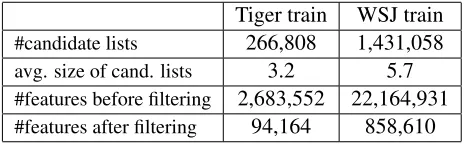
The following table summarizes the characteris-tics of the subtree ranker’s training sample of the
German and English datasets by employing the ’or-acle subtree’ selection strategy:
Tiger train WSJ train
#candidate lists 266,808 1,431,058
avg. size of cand. lists 3.2 5.7
#features before filtering 2,683,552 22,164,931
[image:6.612.312.544.333.405.2]#features after filtering 94,164 858,610
Table 3: The sizes of the subtree ranker training datasets atk= 3.
Using this selection strategy the training dataset is smaller than the training dataset of then-best list rankers – where offline trainers are employed as well – as the total number of candidates is similar (and even less in the Tiger corpus) while there are fewer firing features at the subtrees than at full trees.
rerankers on the English datasets (while achieving a smaller F-score than the perceptron with early up-date on the Tiger corpus) which demonstrates the potential of utilizing larger candidate lists for dis-criminative training of rerankers. The comparison of the ’subtree ranking by AvgPer’ row and the ’subtree ranking by MaxEnt’ row shows a clear advantage of the Maximum Entropy training mechanism over the Averaged Perceptron.
Besides the ’oracle subtree’selection strategywe also experimented with the ’base system ranking’ selection strategy with subtree Maximum Entropy ranker. Table 4 compares the accuracies of the two strategies. The difference between the two strate-gies varies among datasets. In the German dataset, they are competitive and the prediction of grammati-cal functions benefits from the ’base system ranking’ strategy, while it performs considerably worse at the English datasets.
Tiger test WSJ test WB oracle SS 79.36 (68.72) 90.32 83.83 base sys SS 79.34 (68.84) 89.97 83.34
Table 4: The results of the two selection strategies. Using the oracle trees proved to be better on each of the datasets.
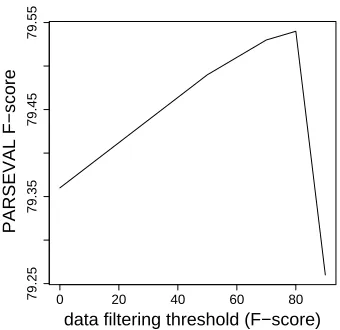
Extracting candidate lists from each of the local decision points might seem to be redundant. To gain some insight into this question, we investigated the effect of training instance filtering strategies on the Tiger treebank. We removed the training instances from the training sample T where the F-score of the oracle (sub)tree against the gold standard tree is less than a certain threshold (this data selection pro-cedure was inspired by Li and Khudanpur (2008)). The idea behind this data selection is to eliminate bad training examples which might push the learner into the wrong direction. Figure 1 depicts the results on the Tiger treebank as a function of this data se-lection threshold.
With this data selection strategy we could further gain 0.22 F-score percentage points achieving 79.58 (68.87) and we can conclude that omitting candidate sets far from the gold-standard tree helps training. Figure 1 also shows that too strict filtering hurts the performance. The result with threshold=90 is worse than the result without filtering. We should note that similar data selection methods can be applied
0 20 40 60 80
79.25
79.35
79.45
79.55
data filtering threshold (F−score)
[image:7.612.341.511.69.234.2]PARSEVAL F−score
Figure 1: The effect of data selection on the Tiger test set.
to each of the baseline systems and the comparison to them would be fair with conducting that. Thus we consider our results without data selection to be final.
5 Discussion
We experimentally showed in the previous section that the subtree forest reranking approach with Max-imum Entropy models significantly outperforms the perceptron-based forest reranking approach. This improvement must be the result of differences in the training algorithms because there is no difference between the two approaches at parse time, as we dis-cussed in Section 4.2.
sources of improvements. If we use (i) and stay with the Averaged Perceptron as learning algorithm we get ’subtree ranking by AvgPer’. If we additionally replace the Averaged Perceptron by Maximum En-tropy – i.e. follow (ii) – we arrive at ’subtree ranking by MaxEnt’. On the other hand, the ’n-best training’ uses global trees and Maximum Entropy for train-ing, so the reason of the difference between ’per-ceptron with global training’ and ’n-best training’ is (ii). Then we arrive at ’subtree ranking by MaxEnt’ by (i). This line of thoughts and the figures of Ta-ble 2 indicate that the added value of (i) and (ii) are similar in magnitude.
5.1 Error Analysis
For understanding the added value of the proposed subtree ranking method, we manually investigated sentences from the German development set and compared the parses of the ’perceptron with global training’ with the ’subtree ranking by MaxEnt’. We could not found any linguistic phenomena which was handled clearly better by the subtree ranker3, but it made considerably more fixes than errors in the following cases:
• the attachment of adverbs,
• the unary branching verbal phrases and
• extremely short sentences which does not con-tain any verb (fragments).
5.2 Novel Opportunities with the Subtree Ranking Framework
A generalization issue of the subtree ranking ap-proach is that it allows to useany kind of feature representation and arbitrary aggregationof local features. The basic assumption of training on the global (sentence) level in the perceptron reranking framework is that the feature vector of a subtree is the sum of the feature vectors of the children and the features extracted from the root of the subtree in question. This decomposability assumption pro-vides a fine framework in the case of binary features which fire if a certain linguistic phenomenon occurs. On the other hand, this is not straightforward in the
3We believe that this might be the case only if we would
introduce new information (e.g. features) for the system.
presence of real valued features. For example, Ver-sley and Rehbein (2009) introduce real-valued fea-tures for supporting German PP-attachment recogni-tion – the mutual informarecogni-tion of noun and preposi-tion co-occurrence estimated from a huge unlabeled corpus – and this single feature template (about 80 features) could achieve a gain of 1 point in phrase structure parsing accuracy while the same improve-ment can be achieved by several feature templates and millions of binary features. The aggregation of such feature values can be different from summing, for instance the semantics of the feature can demand averaging, minimum, maximum or introducing new features etc. Another opportunity for extending cur-rent approaches is to employ utility functions on top of the sum of the binary feature values. Each of these extensions fits into the proposed framework.
The subtree ranking framework also enables the usage of different models at different kinds of nodes. For example, different models can be trained for ranking subtress headed by noun phrases and for verb phrases. This is not feasible in the perceptron-based forest ranker which sums up features and up-dates feature weights at the sentence level while the rankerRin Algorithm 2 can refer to several models because we handle local decisions separately. This approach would not hurt parsing speed as one par-ticular model is asked at each node, but it multiplies memory requirements. This is an approach which the subtree ranking framework allows, but which would not fit to the global level updates of the per-ceptron forest rerankers.
and it seems that a better model can be learned from a much bigger but more heterogeneous dataset.
5.3 On the Efficiency of Subtree Ranking
In subtree ranking, we extract a larger number of training instances (candidate lists) than the perceptron-based approach which extracts exactly one instance from a sentence. Moreover, the can-didate lists are longer than the perceptron-based ap-proach (where 2 “candidates” are compared against each other). Training on this larger set (refer Table 3 for concrete figures) consumes more space and time. In our implementation, we keep the whole train-ing dataset in the memory. With this implementation the whole training process (feature extraction, can-didate extraction and training the Maximum Entropy ranker) takes 3 hours and uses 10GB of memory at
k= 1and it takes 20 hours and uses 60GB of mem-ory atk = 3((Huang, 2008) reported 5.3 and 27.3 hours at beam-sizes of 1 and 15 respectively but it used only 1.2GB of memory). The in-depth investi-gation of the effect ofkis among our future plans.
6 Conclusions
We presented a subtree ranking approach to parse forest reranking, which is a generalization of current reranking methods. The main advantages of our ap-proach are: (i) The candidate lists used during train-ing are very similar to those used durtrain-ing parstrain-ing, which leads to better parameter optimization. (ii) Arbitrary ranking methods can be applied in our ap-proach. (iii) The reranking models need not to be decomposable.
We evaluated our parse reranking approach on German and English phrase structure parsing tasks and compared it to various state-of-the-art rerank-ing approaches such as the perceptron-based for-est reranker (Huang, 2008). The subtree reranking approach with a Maximum Entropy model signifi-cantly outperformed the other approaches.
We conjecture two reasons for this result: (i) By training on all subtrees instead of Viterbi parses or
n-best parses only, we use the available training data more effectively. (ii) The subtree ranker frame-work allows us to use a standard Maximum Entropy learner in parse-forest training instead of the Percep-tron, which is usually superior.
Acknowledgements
We thank Liang Huang to provide us the modi-fied version of the Charniak parser, which output a packed forest for each sentence along with his forest pruning code.
References
Sabine Brants, Stefanie Dipper, Silvia Hansen, Wolfgang Lezius, and George Smith. 2002. The TIGER tree-bank. InProceedings of the Workshop on Treebanks and Linguistic Theories, pages 24–41.
Eugene Charniak and Mark Johnson. 2005. Coarse-to-fine n-best parsing and maxent discriminative rerank-ing. In Proceedings of the 43rd Annual Meeting on Association for Computational Linguistics, ACL ’05, pages 173–180.
Michael Collins and Brian Roark. 2004. Incremental parsing with the perceptron algorithm. InProceedings of the 42nd Meeting of the Association for Computa-tional Linguistics (ACL’04), Main Volume, pages 111– 118.
Michael Collins. 2000. Discriminative reranking for nat-ural language parsing. In Proceedings of the Seven-teenth International Conference on Machine Learning, ICML ’00, pages 175–182.
Hal Daum´e, III, John Langford, and Daniel Marcu. 2009. Search-based structured prediction. Machine Learn-ing, 75(3):297–325, June.
Rich`ard Farkas, Bernd Bohnet, and Helmut Schmid. 2011. Features for phrase-structure reranking from dependency parses. InProceedings of the 12th Inter-national Conference on Parsing Technologies, pages 209–214.
John Guiver and Edward Snelson. 2008. Learning to rank with softrank and gaussian processes. In Pro-ceedings of the 31st annual international ACM SIGIR conference on Research and development in informa-tion retrieval, SIGIR ’08, pages 259–266.
Keith Hall. 2007. K-best spanning tree parsing. In Pro-ceedings of the 45th Annual Meeting of the Association of Computational Linguistics, pages 392–399, June. Katsuhiko Hayashi, Taro Watanabe, Masayuki Asahara,
and Yuji Matsumoto. 2011. Third-order varia-tional reranking on packed-shared dependency forests. In Proceedings of the 2011 Conference on Empiri-cal Methods in Natural Language Processing, pages 1479–1488.
Liang Huang. 2008. Forest reranking: Discriminative parsing with non-local features. In Proceedings of ACL-08: HLT, pages 586–594.
T. Joachims. 2002. Optimizing search engines using clickthrough data. In ACM SIGKDD Conference on Knowledge Discovery and Data Mining (KDD), pages 133–142.
Zhifei Li and Sanjeev Khudanpur. 2008. Large-scale discriminative n-gram language models for statistical machine translation. InProceedings of the 8th AMTA conference, pages 133–142.
Z. Li and S. Khudanpur, 2009. GALE book chapter on ”MT From Text”, chapter Forest reranking for machine translation with the perceptron algorithm.
Hang Li. 2011. Learning to Rank for Information Re-trieval and Natural Language Processing. Synthesis Lectures on Human Language Technologies. Morgan & Claypool Publishers.
David M. Magerman. 1995. Statistical decision-tree models for parsing. InProceedings of the 33rd Annual Meeting of the Association for Computational Linguis-tics, pages 276–283, June.
Andrew Kachites McCallum. 2002. Mal-let: A machine learning for language toolkit. http://mallet.cs.umass.edu.
Gergely Neu and Csaba Szepesv´ari. 2009. Training parsers by inverse reinforcement learning. Machine Learning, 77(2–3):303–337.
Helmut Schmid. 2004. Efficient parsing of highly am-biguous context-free grammars with bit vectors. In Proceedings of Coling 2004, pages 162–168.
Libin Shen, Anoop Sarkar, and Franz Josef Och. 2004. Discriminative reranking for machine translation. In Daniel Marcu Susan Dumais and Salim Roukos, ed-itors, HLT-NAACL 2004: Main Proceedings, pages 177–184.
Kristina Toutanova, Aria Haghighi, and Christopher D. Manning. 2008. A global joint model for semantic role labeling. Computational Linguistics, 34(2):161– 191.
Joseph P. Turian, Benjamin Wellington, and I. Dan Melamed. 2006. Scalable discriminative learning for natural language parsing and translation. In NIPS, pages 1409–1416.
Yannick Versley and Ines Rehbein. 2009. Scalable dis-criminative parsing for german. InProceedings of the 11th International Conference on Parsing Technolo-gies (IWPT’09), pages 134–137.
Zhiguo Wang and Chengqing Zong. 2011. Parse rerank-ing based on higher-order lexical dependencies. In Proceedings of 5th International Joint Conference on Natural Language Processing, pages 1251–1259. Ralph Weischedel, Eduard Hovy, Martha Palmer, Mitch