Sharding
Search
by
Emiel Mols
A thesis submitted in partial fulfillment for the degree of Master of Science
in the
Faculty of Electrical Engineering, Mathematics and Computer Science Department of Computer Science
Abstract
Faculty of Electrical Engineering, Mathematics and Computer Science
Department of Computer Science
Master of Science
by Emiel Mols
We rationalise and describe a prototype implementation of a term sharded full text
search architecture. The system’s requirements are based on the use case of searching
for music in the Spotify catalogue. We benchmark the system using non-synthethic data
This thesis finds its genesis in a healthy quantity of happenstance. Perhaps a
combina-tion of me having a fascinacombina-tion for the country of Sweden, inspiracombina-tion for a technically
interesting side project1, and then this endevour to change the music marketplace called Spotify existing in the first place.
And these things only relate to the likeliness of this research project getting off the
ground. During the last ten months, there have been more than a few moments of
doubt and self reservation. Ultimately, though, those reservations never overtook my
appreciation for academia.
Many of my fellow students seem to regard academia as another hurdle between them
and a bigshot carreer, university as a tool to bump their salary or a graduation project
at an established company as some shiny star on their resume.
I am convinced these are the smallest of merits. Academia enabled me to question the
most fundamental of concepts and helped me to understand the world a little better.
That’s what made it worthwhile. 2
1A personal project got some press and allowed me to of do this thesis project at Spotify; http:
//thenextweb.com/insider/2011/05/20/how-to-give-spotify-no-choice-but-to-hire-you/. 2
The articulate reader might have noticed that the inspirational quote on the previous page was put forth by a man who is well known for stimulating people to drop out of university. I don’t agree with mister Thiel in this regard, but, well, it’s just a great quote.
Contents
Abstract ii
Preface iii
1 Introduction 1
1.1 Full text search systems . . . 1
1.1.1 Index construction . . . 1
1.1.2 Distribution . . . 2
1.2 Spotify . . . 4
1.3 Goal . . . 5
1.4 Contributions . . . 5
1.5 Contents. . . 6
2 Database techniques 7 2.1 Inverted index construction . . . 7
2.2 Data isolation and consistency . . . 9
2.3 Index segmentation . . . 10
2.4 Database distribution . . . 11
2.5 Query pipelining . . . 12
3 Search at Spotify 14 3.1 Spotify client . . . 14
3.2 Infrastructure . . . 14
3.3 Usage analyses . . . 16
4 swarm: a term distributed full text search service 20 4.1 Scope . . . 20
4.2 Architecture overview . . . 21
4.3 Data transport . . . 22
4.4 Query pipelining . . . 22
4.4.1 Query planner . . . 25
4.5 Concurrency . . . 26
4.6 Storage . . . 27
4.7 List subdistribution . . . 28
5 Performance analyses 32 5.1 Global setup . . . 32
5.2 Load distribution . . . 33
5.3 Latency and throughput . . . 38
5.4 Comparative performance tests . . . 40
6 Conclusions 42 6.1 Search at Spotify . . . 42
6.2 swarm techniques . . . 42
6.3 swarm performance . . . 43
6.4 Future work . . . 44
Chapter 1
Introduction
1.1
Full text search systems
A full text search system (fts-system) enables information retrieval by responding to a user’s query string with an ordered set of documents. The role of the system is to
identify the relevant documents for each query and minimize the time a user of the
system would need to access the document she or he is looking for.
Well known fts-systems include Google web search [Brin and Page 1998], Facebook friend
search [Lampe et al. 2006] and the computerized catalog system at your local library.
A principal property of such information retrieval systems is that the amount of
docu-ments contained in it (or, corpus) is often significant, presenting algorithmic and
archi-tectural challenges related to result latency, result relevancy and user scalability.
Requirements of fts-systems are diverse: for instance, where a web search engine could
order results by a single metric such as percieved global relevance of the document, a
product search system could allow ordering by arbitrary fields (e.g. price, release year,
delivery time). Also, even though almost all systems are built to support a corpus of
significant size, the order of magnitude of documents in a modern web search engine
differs from the amount of news articles of an online paper. In spite of this, fundamental
techniques between such diverse systems are often similar, or even identical.
1.1.1 Index construction
The most often used indexing technique in fts-systems isinverted listconstruction [Man-ning et al. 2008]: input documents are tokenized into words, or terms. These are then
used to construct a mapping from terms to an ordered list of document identifiers.
Us-ing this mappUs-ing and a query, the result space can be obtained by merge joining the
document identifiers of the lists associated with the query terms.
An in-depth overview of theinverted list approach and associated algorithms is given in
section 2.1.
1.1.2 Distribution
When considering the distribution of an inverted full text index over multiple hosts, the
distinction can be made betweendocument based distribution andterm based distribution
sharding [Moffat et al. 2007] (sometimes calledlocal index construction andglobal index construction, respectively [Ribeiro-Neto and Barbosa 1998]). Both paradigms employ a number of subsystems to host the partitions (or, shards), and additional controlling
functionality, such as aquery broker to execute queries or anindexer to add data to the index.
Document-wise sharding entails distributing the data across different hosts as collections
of input documents: each shard maintains a complete vocabulary and inverted full text
index for the assigned documents.
In a term distributed architecture the inverted index is sharded by term: a shard hosts
a set of complete inverse lists; document identifiers in these lists can be the same at
multiple shards.
Document distribution, compared to term distribution, has the following advantageous
characteristics:
• Simplicity. Document distribution is a simple extension of a non-distributed
index; some relatively simple merger logic is required on the query broker [Banon
2012].
• Latency and parallizability. A broker can query the different shards in
paral-lel, and for a reasonable amount of shards the query latency, excluding network
overhead, will be similar to that of a non-distributed index (for a large number of
shards, latency variance can increase significantly [Dean 2010]).
• Indexing is well distributed. The operation of amending a document to the
3
• Balanced shards. Because there is no correlation between the nature of the
sharded data and the shard itself (assuming a large amount of similarly sized
documents), both query and indexing load between the shards is uniform.
• Predictable network load. Only result sets - predictable in size - will be
trans-ferred over the network.
• Graceful degradation. When a shard (and its replicas - copies holding the same
data - if applicable) are unavailable, the merger could still choose to merge and
return data from the other shards.
Term distribution performs generally better on the following criteria:
• Accessed shards bound by term in query. For term distribed systems, the
amount of shards touched when executing a query is bound by the amount of
terms in the query; for document distributed systems (a fixed ratio of) all shards
need to be accessed - this figure relates to the corpus size. As a consequence, term
distribution allows for much more granular sharding without negatively influencing
query performance. Also, best-case query latency (namely for single term queries)
is better when the shard count is more than one.
• Fewer seeks. A document distributed system consists, in effect, of parallel index
segments that all need to be accessed for each query: subsequently, the cumulative
number of seeks per query is lower for term distributed systems [Moffat et al.
2007]. This is particularly influential on performance if the data structures are
saved on hard disk media.
• Reusability as distributed cache. Because the data is inherently distributed
by term (as implied by the name), a term distributed system can distribute its
query cache (caching results of complete user queries) using the same
term-to-shard mapping. For instance, when executingrobbie williamswould imply the
inverted list ofrobbiewould be accessed first, this shard could also hold the cache
for the complete query. For document distributed systems, the cache size is often
limited to memory capacity of the query broker and does not scale with the amount
of hosts.
These two approaches have been compared extensively, but the conclusions of individual
works differ, based on the exact performance criteria, datasets used, etc. [Ribeiro-Neto
and Barbosa 1998] [Moffat et al. 2007] [Jeong and Omiecinski 1995] [Tomasic and
and Yahoo [Baeza-Yates and Cambazoglu 2008] use document distribution. A possible
reason for this is that the non-uniform distribution of inverse list sizes makes term based
distribution problematic [Baeza-Yates and Cambazoglu 2008].
Existing distributed fts products also favor document distribution (e.g. ElasticSearch
[Banon 2012], SOLR [Smiley and Pugh 2009] and IndexTank [Perez 2012]), and are
often implemented by reusing an existing single-host system (e.g. Lucene [Hatcher and
Gospodnetic 2004]).
1.2
Spotify
Spotify is a music streaming service, offering more than 15 million (active) users access to
a library of more than 15 million music tracks [Kreitz and Niemela 2010] [Spotify 2012].
Distributing the music data is done through a combination of a Spotify-operated backend
infrastructure and a peer-to-peer network, in which most non-mobile clients participate.
The peer-to-peer network is solely used for offloading track data distribution. Metadata
retrieval, search, and other services are handled by the Spotify backend.
The Spotify search backend service is implemented around Lucene and scales through
replication of the indexes across several identical search servers. Separate Lucene indexes
are maintained for artists, albums, tracks and public playlists and these are accessed in
parellel for query requests. The cumulative corpus size of the indexes is around 30m.
Indexes are kept in-memory, and currently take up around 7 gigabytes.
For the current dataset, the search service in its current incarnation performs
satisfac-torily, while leaving decent headroom for scaling in the near future. However, changing
requirements could make the the index outgrow the availability of main memory by
orders of magnitude, for instance if:
• a (much) larger corpus would need to be supported;
• more metadata might need to be added for the documents in the system, e.g. lyrics
associated with songs, more extensive genre classification or biographical text with
artists.
In chapter3, we offer analyses on user behavior of the Spotify search system. The data
gathered underlines arguments that support the case for term distribution:
• Few terms in each query. Queries entered into the system consist of relatively
5
• Few updates. Changes to the index are rare in comparison to the query volume:
hundreds of millions of queries are handled on a monthly basis, while the amount
of updates over the same period is in the order of magnitude of 100.000.
• High cache sensitivity. A lot of queries, or parts thereof, are repetitious.
Reusing the term distributed system as distributed cache might yield performance
benefits. In combination withquery pipelining (see section2.5), we might even use
such a cache to partially evaluate queries, e.g. use a cached result for the query
hans zimmer to boost evaluation performance of queries such as hans zimmer
dark knight.
1.3
Goal
The main goal of designing a new search architecture is to overcome the limits of the
scalability of Spotify’s current system through design and implementation of a new,term
distributed search system.
By designing such a new architecture from the ground up, we can choose the specific
data manipulation and distribution primitives tailored to the data domain and use case
of Spotify.
The previous section outlines our main argument supporting the feasibility of such an
architecture for the use case at hand. Additionally, we feel that the lack of proper
implementations of term distributed systems thus far is specifically something academic
research could tackle; a successful prototype could encourage the development - or even
be the starting point - of a more full-fledged and usable system.
The primary goal for this research is therefore to present a functioning prototype of a
term distributed fts-system. We compare its performance for Spotify’s use case to the
current backend service in use and a distributed setup of ElasticSearch - an open source
distributed fts-system that employs document distribution [Banon 2012].
1.4
Contributions
We make the following contributions:
• Insight into user behavior in the Spotify search system, and, by generalization,
• The design and implementation of a prototype term distributed fts-system.
Specif-ically, we developed three novel approaches to tackle existing problems that plague
implementations of term distributed systems:
– granular sharding of inverted lists that allow for parts of large inverted lists to be distributed among different shards, providing highly distributed read
workloads;
– index segmentation through a forked read process, where we use copy-on-write virtual memory semantics, allowing agressive read optimizations (and resulting in eventual read/write consistency of the index);
– complex query pipelining, allowing arbitrarily complex boolean query expres-sions to be executed in a query pipeline.
• Determine the value of a term distributed search architecture over a document
distributed one in the data domain of Spotify.
1.5
Contents
Chapter2will discuss a collection of engineering techniques foundamental to our
proto-type system. In chapter 3, we analyse Spotify’s document collection and user behavior
of the search system. Both chapters make arguments that influence the main design
de-cisions of our new system, which we present in chapter4. We then benchmark our new
system through a series of - individual and comparitive - performance benchmarks in
chapter5. Finally, we validate our hypotheses around the system in chapter6; for failed
expectiations, we present directions for future research that might mitigate encountered
Chapter 2
Database techniques
In this chapter we discuss a collection of engineering techniques used in various existing
database applications and have relevancy to our engineering efforts forswarm.
2.1
Inverted index construction
Aninverted index, constructed in fts-systems to prevent a completecorpus scanfor each query, maps terms to an ordered list of documents that contain this term. The indexing
step still requires scanning the entire corpus. Asingle term query subsequently consists
of a simple index lookup.
Fundamentally, an inverted index consists of thevocabulary and thepostings list
[Man-ning et al. 2008].
• Thevocabulary is a data structure that maps the terms to the associatedpostings
lists. Implementations often use a B+-tree, trie or hash map.
• Thepostings list is an ordered list of the document identifiers that the term occurs
in. For each document in a posting list, contextual data might be amended (e.g. a
hit list, a list of offsets of the specific term in the document). Implementations
often use unrolled linked list or skip lists.
The explicit distinction between these two structures is done because in many full text
systems the vocabulary, orders of magnitude smaller in size, is suitable for in-memory
operation, while the postings list may reside on a slower and larger storage medium,
such as a hard disk [Manning et al. 2008].
In principle, though, postings lists can be integrated directly in the vocabulary’s data
structure, preventing a level of indirection and creating a clustered index.
On index generation, certain stop words can be ignored to prevent large lists in the inverted indexed (e.g. in or and), and stemming rules can be used to map different
inflections of a word to a single term or term id (e.g. dancing and dance); the same
stemming rules should be applied to terms in any query. Stop word filters or stemming
rules are dependent on the locale of the indexed data, and most systems require them to
be configured manually (e.g. Lucene’s default installation is configured for the English
locale [Hatcher and Gospodnetic 2004]).
The query model of a single term can be extended in various ways. Common methods
described in literature and seen in popular full text retrieval systems are [Manning et
al. 2008]:
• Disjunction (abba OR queen) involves a join strategy to find the union of two
posting lists. A sorted merge join is applicable.
• Conjunction(queen AND bicycle, or implicitlyqueen bicycle) is similar, yet
should yield the intersection of the relevant lists. Again a sorted merge join is
often applicable, but there are exceptions. For instance, in the case of a
sig-nificant difference in the amount of documents that match each term (e.g. the
cranberries, wherethe’s cardinality is probably orders of magnitude higher than
cranberries), a zip-join is probably more effective: for every item in the smaller list, a binary search is performed in the larger list.
• Phrasing ("hotel california") would require appending the index with the
positional data of the encounters of the term in the document. Subsequently, one
would apply a merge strategy similar to conjunction with additionally filtering
out documents that have no subsequent hits. Alternatively, an approach might be
to add all subsequent word combinations to the reverse index (making the index
significantly larger). The positional data is then not required, though. For phrase
queries of three or more terms, different such index entries need to be merged
and verified against the original documents in order to prevent “to be or” from
matching “to be something, be or”.
• Wildcard matching (ca*or*ia) can be done more efficiently using a separate
tree-based dictionary structure, and additionallypermuterm ork-gram dictionary
indexes. Trailing wildcard queries benefit mainly from a tree structure in the
dictionary. Permuterm indexes, in which anend of word symbol is introduced and
9
explode the dictionary size. K-gram limits the key size of permuterm, at the costs
of more lookups for queries, joining and an additional post-processing step.
As the above shows, the exact encoding of the document list in the inverted index
depends on the type of queries that are to be supported and time and space requirements.
The index can be sorted by either a unique document identifier, or some other
semi-unique property such as global relevance score (this refers to some property that indicates
the order it should be presented in the search results, such as a webpage’s PageRank used
by Google [Brin and Page 1998]). In case of any type of positional (i.e. phrase) support,
the positional data has to be added in the document lists, making alignment harder due
to the data’s variable length (e.g. a term may appear multiple times in a document,
so the postings list has no length bound). An option is to amend the document list
with skip pointers; a single level skip list structure withp|docs|distributed pointers is
suggested [Manning et al. 2008].
Multiple algorithms exist to find intersections or unions of posting lists, and their
ap-plicability and performance depends on whether the lists are sorted,aligned (indicating
that list items always take up a fixed amount of bytes) and how many lists are to be
joined [Barbay et al. 2009].
To sacrifice some processing power for space complexity, posting lists can be compressed
[Bell et al. 1993]. Besides using a common block compression scheme such as deflate
compression, the integers that are used to represent the sorted key in the index record
(document id or relevance score) can be saved using delta compression. Experiments
using variable length encoding for these identifiers show significant space savings [Bell
et al. 1993].
2.2
Data isolation and consistency
Arguably, the holy grail in traditional, relational database management systems (RDMS) is finding a query planning approach that allows non-blocking concurrent transaction
execution, while guaranteeing complete isolation between all transactions [Gray and Reuter 1993].
Since no such miracle algorithm exists, well-known RDMS systems (e.g. MySQL [MySQL
2005] or PostgreSQL [Douglas 2005]) resolve the tradeoff betweenisolation and perfor-mance by letting users choose the appropriateisolation level over the data these systems
giving any performance guarantees (or the guarantee of a successful execution, for that
matter) on specific transactions.
Eventual consistency refers to those systems in which read operations after write
opera-tions are not guaranteed to yield the most recent value (i.e. they may returnstale data), possibly even in the same transaction that did the write.
2.3
Index segmentation
A few, non-relational data stores such as Google BigTable [Chang et al. 2008], Apache
Cassandra [Lakshman and Malik 2010] [Ellis 2011] and LevelDB [Dean and Ghemawat
2012] employ so-calledSSTables (sorted string tables) to improve write performance on media that has slow seek times, such as spinning hard disks.
In principle, SSTables work by grouping updates into tables (or segments) performing
in-memory updates on a singleactive segment only, flushing this segment sequentually to disk and starting a new segment at given intervals. The active segment in such systems
is able to serialize any write operation (including operations such as delete), since non-active segments cannot be written to. Read operations are done by incrementally trying
older segments, starting at the newest and reading progessively older tables until the
value (or delete operation) for the key is found.
As a consequence, the most costly read operation from the store requires accessing all
segments (namely when a key is chosen whose latest update was written in the oldest
segment). To prevent those read operations from getting too costly, the systems can opt
tocompact multiple segments at certain triggers (e.g. “there are more thanxsegments” or “every 120 seconds”).
Lucene, a Java library implementing full text indexing and searching, uses a similar
tech-nique to maintain its inverted list index [Hatcher and Gospodnetic 2004]; for keys and
valuesit hastermsandinverted lists, respectively, and a merge operation for similar keys consists of taking the union of both lists. Additionally, Lucene uses this segmentation
to implement concurrency - allowing multiple readers and a single writer:
• Readers from the index will only consider the non-active (static) segments when
looking up term lists (in effect being eventually consistent).
• A single writer can be writing to the active segment. Upon commit the segment
is marked non-active and the writer starts a new segment.
11
– starts merging some non-active segments into a single segment;
– once merged it atomically updates the global list of segment references;
– once the last reader has stopped reading from the old, unmerged segments, they can be removed.
2.4
Database distribution
When data volumes outgrow a single system, databasedistributionprovides mechanisms
to split up (or,shard) the data among different nodes (shards). One way to achieve such distribution, is through hash code sharding, requiring a hash function h that maps the
data space to a linear space.
Given such a functionh, assuming its range is [0,1i, it is trivial to construct a mapping
to an arbitrary amount of shards: n(δ) =bh(δ)∗Nc, whereN is the amount of available
nodes,δrepresents some granular unit of data depending on the type of database (e.g. a
table row, key/value tuple, etc.), and function n yields the shard number the piece of
data should be placed.
The distribution of the hash function ought to be uniform to achieve a equally sized
shards.
Generic distributed database systems that employ hash code sharding (e.g. Cassandra
[Lakshman and Malik 2010], MegaStore [Baker et al. 2011], Riak [Klophaus 2010],
HyperDex [Escriva et al. 2011]) often extend this basic model, for instance by any of
the following approaches:
• Map multiple shards to a single host. By mapping multiple shards to any
single host (or by using real - non-integer - shard identifiers), adding or removing
hosts from the cluster can be done simply by remapping some shards to a different
host. Additionally, duplicating more granular shards over different hosts in a
cross-over fashion allows for balancing the load of any failed node among the others.
• Maintain the order of a primary key in the distribution. When using a
primary key (e.g. of a table row, or the key of a key/value tuple), the distribution
function could maintain the lexical order of this key. As a result, each shard will
serve a range of rows (allowing prefix searches, ranged queries, etc.). Consequently,
the sharding space will almost definitely be non-uniform, but mechanisms such as
• Let the application specify supergrouping. By letting the application spec-ify supergroups of data, and using these as most significant denominator in the
sharding space, data within the same group can be distributed on the same host
(or on closely located hosts). MegaStore uses this, and allows relatively strong
consistency guarantees within supergroups, but not between them [Baker et al.
2011].
• Use multiple properties for the distribution. When considering data items
with multiple properties (e.g. table rows), this approach would use them all to map
to a predictable spot in the distribution space. When querying for data items, the
constraints on any properties can be used to narrow the set of hosts that should
be queried. As a consequence, data items would quite likely have to move when
any of their properties change. HyperDex employs this [Escriva et al. 2011].
2.5
Query pipelining
In term distributed fts-systems, queries may be executed using the pipeline paradigm:
the nodes that contain the inverted lists associated with the terms in a query are
config-ured to process (or, accumulate) intermediate result sets in a pipeline fashion until the
final result set is obtained [Moffat et al. 2007].
In a pipeline that supports matching on a combination of terms, the intermediate result
sets consist of an ordered set of document identifiers - while each nodes applies asorted
merge join.
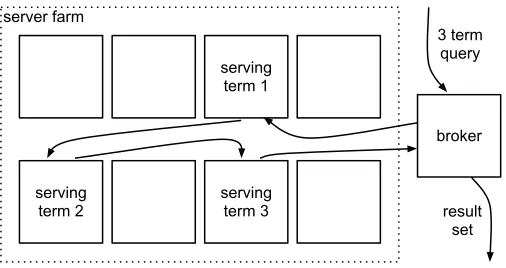
Figure 2.1 demonstrates the pipeline paradigm, by illustrating how a three term query
is executed.
serving term 1
serving term 2
serving term 3
broker 3 term
query
result set server farm
Figure 2.1: Example pipelined query over term distributed index.
To prevent intermediate result sets in a pipeline from overusing network resources, it is
[image:18.596.191.444.555.689.2]13
of document identifiers in these sets, on the order of magnitude of 100.000 documents
Search at Spotify
3.1
Spotify client
Figure3.1shows the version 0.8.4 of the Spotify desktop client, just after startup.
Find-ing music through search is a common use pattern, and the search field is prominently
shown. After executing a search query, the user is presented with an interface similar to
that shown in figure 3.2: artists, albums, public playlists and individual track matches
are shown.
3.2
Infrastructure
The Spotify search service is a loosely coupled service implemented around Lucene.
The majority of its requests originate from user-entered queries in a Spotify client.
Separate Lucene indexes are maintained for artists, albums, tracks and public playlists
and these are accessed in parallel for query requests. The total number of searchable
entities (documents in Lucene terminology) in the indexes is around 30m (in part because
of the differences in geographic availability there are significantly more than 15m track
entities). Indexes are kept in-memory, and take up around 7 gigabytes. Although most
metadata fields (e.g. track artist, track genre, playlist author) areindexed (the document
identifiers are added to the inverted lists of the terms occuring in those fields), the records
themselves are notstored: the original document cannot be retrieved from the index and, consequently, the search service only yields document ids for queries; another backend
service is used to map these to the document’s metadata.
15
Figure 3.1: Interface after startup
[image:21.596.121.512.433.732.2]Due to different availability restrictions of content based on geographic regions and
subscription status of the user, an additional filter is applied before serving the results,
filtering out content unavailable to the requester.
A global popularity score is associated with each item in the different indexes, used as
a significant factor in ordering the search results. It is combined with Lucene’s built-in
approach to reorder based on similarity to the original query.
Indexes are built and distributed in a daily batch; any changes between those batches are
distributed and applied as live changesets on the index. The daily batches are used for
robustness (eventual recovery from possibly failure to apply some changesets), a baseline
for the changesets and a logical point where any index structures might be compacted.
The amount of changes (added or removed documents) per day is in the order of tens
of thousands.
Every 7 days, new popularity scores are calculated for all the entities in the collection,
in effect changing all the documents in the index.
The total amount of queries served per month is in the order of magnitude of hundreds of
millions, and scaling is handled through service replication and round robin distribution
of requests.
3.3
Usage analyses
Performance of any database system is largely dependent on user behavior, and to allow
sensible reasoning about the system’s performance, we present a number of different
analyses, performed on the complete search query log of November 2011.
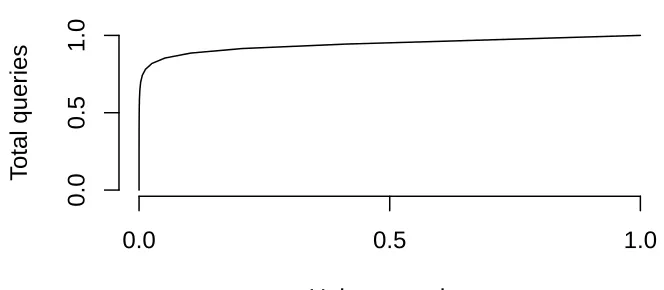
• Query frequency distribution. Figure 3.3 shows a cumulative distribution
(cdf) plot of the the unique queries versus the total query volume in the sample set, indicating the repetitiveness of certain queries (for example, 75% of the total
query volume consists of approximately 0.85% of the unique queries). The long tail shape of this graph is as expected. The repetitiveness is presumably higher
than that of web search engine systems: in 1999, the 25 most common queries
made up 1.5% of the query volume of the AltaVista search engine [Silverstein et
al. 1999]; for Spotify, the top single query constitutes almost 2% of the volume.
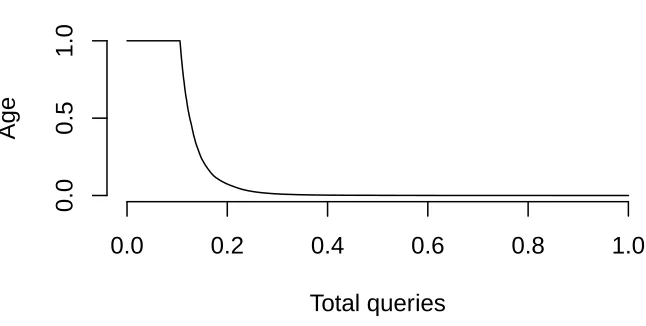
• Query cachability distribution. We analyzed the cachability of the queries by
pulling in 105xquery records from the query log stream: the first 100xwere used
17
age 0.00), wherex is in the order of magnitude 227. For each of the remaining 5x
entries, the map was consulted to determine how long ago the query was performed
before (if not found, the age becomes 1.00). Its distribution is shown in figure3.4.
• Inverted list size distribution. By counting the occurence of different terms in
the searchcorpus, we estimate the size distribution of the different inverted lists. The distribution is shown in figure 3.5; as shown, the most common terms (the
first three are, in order,the,ofandin) take up a signifant amount of the inverted
lists sizes (when they would not bestop words).
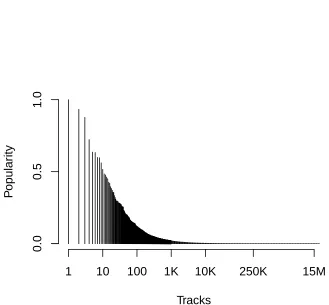
• Popularity distribution. The primary sorting variable used for sorting results
is a document’spopularity. Figure3.6shows the distribution of this constant over
thetrack collection.
Unique queries
T
otal quer
ies
0.0
0.5
1.0
[image:23.596.136.468.355.500.2]0.0
0.5
1.0
0.0
0.2
0.4
0.6
0.8
1.0
Total queries
Age
0.0
0.5
[image:24.596.141.470.117.709.2]1.0
Figure 3.4: Query cachability distribution
Inverse lists
List siz
e
1
10
100
1K
10K
100K
1M
[image:24.596.142.465.155.318.2]19
Tracks
P
opular
ity
1
10
100
1K
10K
250K
15M
0.0
0.5
[image:25.596.137.466.233.538.2]1.0
swarm: a term distributed full
text search service
This chapter presents the term distributed fts-system we implemented for this research,
dubbed swarm. Additionally, we highlight three unconventional techniques used:
• Enhanced pipeline model. We describe a pipeline model that allows arbitrary
boolean query expressions, herewith improving on the model described by Moffat
e.a. [Moffat et al. 2007]; see section4.4.
• Index segmentation through forked read process. We separate each shard
into a read and write process and use Linux (or Darwin) copy-on-write semantics
to minimize write contention on a shard without adding to program complexity;
see section4.5.
• Inverted list subdistribution. To mitigate the problem of unbalanced shards,
we distribute large inverted lists among different shards; see section4.7.
4.1
Scope
Because of the scale of the project, the prototype we present will have a series of
func-tional limitations.
• High availability: Replication and dynamicly moving around individual shards
based on resource usage is not implemented.
• Caching: Updating local caches at the different shards is not implemented.
21
• Complex query planning: The query to query plan conversion, as we will
elaborate in section4.4.1, is rudimentary.
4.2
Architecture overview
The two main design criteria for the prototype of our term distributed full text index,
based on the premise as given in section1.2and the current system design (section3.2),
are as follows:
• Optimize for read. The architecture should be highly optimized for read
per-formance, where write performance comes secondary. This is similar to one of the
design philosophies of MegaStore: reads dominate writes in our target applications,
so it pays to move work from read time to write time [Baker et al. 2011].
• In-memory storage. The cumulative amount of available main memory over
all the shards is in the order of magnitude of hundreds of gigabytes on modern
hardware, even with only a few nodes in the cluster. We therefor opt to keep
the entire index in-memory. Besides the latency and throughput gains, using main
memory only should lower the latency variance and improve relative random access
performance (requiring less data locality of the algorithms we use). This is similar
to Google’s web index since 2004 [Dean 2010].
The cluster architecture consists of three distinct, orthogonal services.
• routerd (one per host) Keeps transport links to all other routers, and routes
messages both to shards in the cluster both on the local and remote hosts.
• queryd (one per host) Parse query and construct a query pipeline to execute on
the cluster. Waits for all responses from the cluster, and forwards the result on to
the requesting client. Possibly forwards results to appropriate shards if they need
to cache it.
• shardd(multiple) Does the legwork by executing the pipeline, or a part thereof.
If the complete remainder of the pipeline is executed at this node, the result is
sent back to the appropriate queryd instance. If only a part is executed, the intermediate result and remainder is forwarded to a shard responsible for the
remainder.
4.3
Data transport
As a data transport between the swarm services, we use ZeroMQ, a message queueing
library. ZeroMQ exposes an API not unlike POSIX sockets, but implements some
higher-level message exchange paradigms (e.g. request/reply,push/pull, orpublish/subscribe)
[iMatrix 2012].
All services communicate through the local routerd process over Unix named pipes.
routerd maintains outgoing push sockets to all other routers over TCP. Doing local communication throughrouterd allows atomichand overs when new shardd processes
are forked (due to the concurrency model we use, new processes are forked at regular intervals - see section 4.5).
ZeroMQ allows sending data from arbitrary buffers, without copying the data first (zero
copy). Because the list chunks in memory are formatted similarly to how they are sent between nodes (see section4.6), we use this to prevent unnecessary data copying or
transformation. For read (merge) operations, the list data is only copied when traversing theuser-kernel space barrier: once when sending the data (data is copied into the kernel’s
TCPsend buffer) and once when receiving (data is copied from the TCP recv buffer).
An overview of an instance of the system noting the involved ZeroMQ socket types and
data flow is shown in figure4.1.
4.4
Query pipelining
To merge the document lists at different shards, a pipeline architecture, as suggested by
Moffat e.a (see section 2.5) is a good fit in many ways:
• Simple and stateless. It allows asynchonous operation in a merge and forget
manner: shards handle the first item in a merge queue, pass it on to the next
shard and are done. Merge operations could even be split up to different hosts
serving the same shard, similar to the packet switching paradigm in networking.
Furthermore, the processing of a single query is inherently distributed and the
possibility of dividing up the work in arbitrary small units should, theoretically,
allow for more effective work queue scheduling and subsequently preventing varying
workloads or load congestion.
• Latency optimized. By limiting network roundtrips as one would incur in a
23 VKDUGG
URXWHUG
'( $ /( 5 '( $ /( 5 '( $/( 5 52 87 ( 5 '( $/( 5 '( $/( 5 3 8/ / '( $ /( 5 VKDUGG VKDUGG VKDUGG TXHU\GURXWHUG
'( $ /( 5 '( $ /( 5 '( $ /( 5 '( $/( 5 52 87 ( 5 '( $/( 5 '( $/( 5 3 8/ / '( $ /( 5 VKDUGG VKDUGG 3 86 + 3 86 + VKDUGGURXWHUG
'( $/( 5 '( $ /( 5 '( $ /( 5 52 87 ( 5 '( $ /( 5 '( $ /( 5 3 8/ / '( $/( 5 VKDUGG VKDUGG VKDUGG LQGH[HUURXWHUG
386 + '( $/( 5 '( $ /( 5 '( $ /( 5 52 87 ( 5 '( $ /( 5 '( $ /( 5 3 8/ / '( $/( 5 VKDUGG VKDUGG 3 86 + 3 86 + 3 86 + 3 86 + 3 86 + 3 86 + 3 86 + 3 86 + 3 86 + 3 86 + FRQW FRQW FRQW VHDUFKHU VHDUFKHU VHDUFKHU VHDUFKHU VHDUFKHUVHDUFKHU 5(4
[image:29.596.140.490.80.750.2]5(4 5(4 5(4 5( 4 5( 4 52 87 ( 5 FRQW
• (Partial) cachability. Workers in the pipeline might choose to cache a combi-nation of lists and use this cache to shorten subsequent query pipelines.
The basic query pipeline (dubbed a query bundle by [Moffat et al. 2007]) as described in section2.5can be regarded as a simple list, where each list node (specifying a pipeline
node) contains the term (which implies the shard). Execution of the pipeline starts at the shard specified by the tail element of this list, and ends at the shard specified by thehead element.
We extend this model by associating the following data fields with each pipeline node:
• term, the term associated with this operation, as present in the simplified model;
• level increment, integer indicating depth increase of the associated query tree;
• instruction list, where each instruction contains an
– instruction, indicating the type of merge operation (see below for some
example types);
– level decrement, indicating the depth decrease of the associated query tree
for this operation;
• result cutoff, indicating after what amount of results the shard can stop
process-ing.
The proposed extension consists of two parts:
• Specification of multiple and different instructions for each pipeline node. The
instruction field specifies thesorted merge join filter to use (e.g. intersect,union,
intersect for specific field,intersect if words form a phrase).
• Thelevel delta fields, that specify alevel value for every shard (and every
instruc-tion at every shard). Over all the shards, the sum of all thelevel increment should match the sum of all the elements of all the elements of level decrement values.
Using these integer values, we support querying for arbitrary boolean expression
trees.
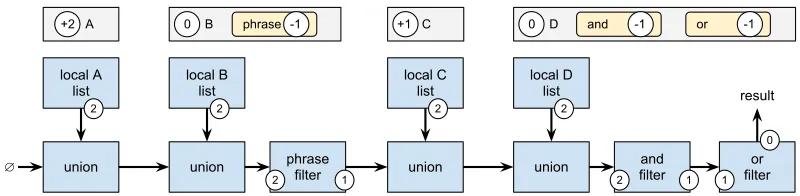
A query pipeline list is formed by a depth-first traversal of the applicable boolean query
tree. As an example, we consider the query "A B" or (C and D); its query tree is
shown in figure 4.2. The associated pipeline specification, and a block diagram of the
25 phrase
A
B
and orC
D
Figure 4.2: Example query tree
local B list
union
+2 A 0 B phrase -1
local A list union phrase filter 2 2 1 2 local C list union
+1 C
2 local D list union and -1 and filter 2 1 2 or -1 0 D
[image:31.596.116.516.215.313.2]or filter 0 1 result ∅
Figure 4.3: Example pipeline and execution diagram
The gray blocks in figure 4.3 indicate different pipeline list nodes, the integers in the
circles inside indicate the level delta values.
In the lower part of the diagram, the arrows represent a stream of
(docid,level,hits)-triplets between the blue operation blocks, where an order based on (docid,level) is
always maintained. The operation blocks are marked with numbers that signify the
input and output levels: documents that do not have a similar input level are not
processed (and simply passed along); matching documents are processed and ultimately
marked with the output level.
Theand filter matches if two subsequent document identifiers are identical. Thephrase
filter can be regarded as a specialization hereof: it only matches if two subsequent document identifiers are identical and thehits value of both instances indicate there is
a document field where the two terms occur at a specified offset of each other.
4.4.1 Query planner
The queryd processes take care of query planning: converting user queries to a query pipeline specification. After parsing a query tree, any operations in the query pipeline
can be reordered based on an efficiency prediction of the query plan. The prediction heuristic uses the globally sharedterm-to-distribution mapping (see section4.7) and (to
a lesser significance) word length of the terms associated with the operations. Operations
cardinality, on the premise that longer words generally are less common in natural
language) are pushed to the back of the pipeline list.
4.5
Concurrency
As explained in section1.1.2, a property of term distribution is that the sharding space can be split up indefinitely without negatively influencing query performance. As a
consequence, we can keep shards small, and allow
• a single-threaded shardd process, because the many other shards on a single host
will make it likely load is distributed on multi-core systems;
• more granularity when load balancing through replication or moving shards
be-tween hosts, because it is cheaper to transfer a shard’s dataset.
Eachsharddseparates reading and writing into two separate processes: when launching,
a writer process is spawned. The writer process fork()s a new reader subprocess at
fixed rolling intervals; when a new reader is spawned, it signals the previous reader to
stop operation.
The (Linux and Darwin) fork call has copy on write semantics: the operating system
will mark the memory pages in the writer’s process space as read-only, only physically
copying a page when it changes, and subsequently mapping the virtual memory
trans-parently. This makes launching the reader process cheap (as opposed to copying the
all the physically mapped memory in the process space directly!), and only requires
so much memory overhead to accomodate changes. This approach bears resemblence
to how key-value store Redis persists snapshots of its data on disk: it forks a
subpro-cess that simply does a linear scan over the subprosubpro-cess’ view of the data and dumps
this to disk, while, the main process can continue updating data structures in memory
uninterrupted [Sanfilippo and Noordhuis .
This approach introduces two major benefits:
• Write operations do not significantly worsen query latency. Because of
the separated processes, read and write operations can occur simultaneously. In
case all write operations are small atomic operations, the advantages do not show
directly and one could use a single process to handle both reads and writes in a
single queue (as Redis does). However, we also use this mechanism to execute a
27
• No application level locking. shardd uses no locks at all, greatly increasing
application simplicity. Complex locking procedures are executed by the system’s
kernel or the hardware itself (e.g. most machines use hardware-assisted TLBs that
will atomically remap virtual memory).
As a trade-off, changes to the index are not visible immediately, but - worst case - after
the rolling interval time. Even combined with the behavior of merge operations between
different shards, this results in aneventually consistent view of the index.
When comparing our approach to Lucene’s (as detailed in section2.3), we see that both
offereventual consistency. However, we believe that our approach offers more flexibility
in data optimization strategies: the writer process could change (i.e. optimize) whatever
piece of data it sees fit, at any time, and data is only duplicated at the granularity of
page sizes. If Lucene would want to change anything in the non-active segments, it
would have to make a complete segment copy. Furthermore, shard’s implementation in
this regard is much simpler, because the logic to atomically keep track of the segments
is not required.
Of course, our approach is limited to in-memory operation, while Lucene can use any
storage medium.
4.6
Storage
Anunrolled doubly linked list data structure is used to save parts of the inverted lists in
theirwire format. Unrolling entails saving a set of sequential items with a single set of list pointers. In our implementation we align these chunks with the system’s page size.
It significantly decreases the pointer overhead per list item, increases data locality when
iterating over the list. Combined with saving list chunks in the same binary format that
is used to transfer them over the network, this allows complete list chunks to be pushed
on the network stack when executing queries.
A consequence of aligning the list structures on page boundaries is that a large amount
of short lists (see section 3.3) would have an excessive memory footprint: a page is
commonly 4kb large and very small lists rarely larger than 100 bytes. To mitigate, we
merge those smaller lists (calledtail merging) into a single page at thecollapse step.
All the data contained in thesharddprocesses is contained in a single contingent block
of virtual memory, allocated using the mmap()system call. The linked list pointers use
blob to move to a different virtual address region (e.g. when moving to a different host),
and to be persisted to and reloaded from disk without any processing.
For thevocabularystructure, C++ stdlib’sstd::mapimplementation is used, which uses a red-black tree internally.
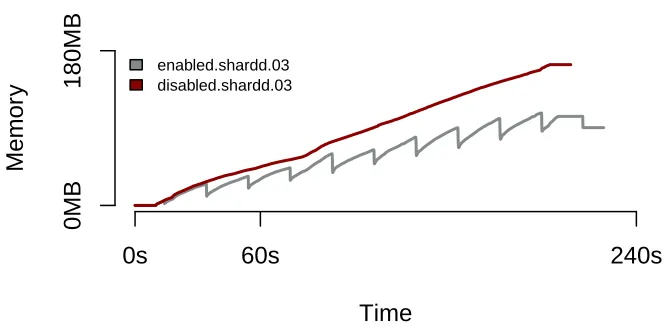
The effect of tail merging is shown in figure 4.4, which shows the cumulative allocated
block size over 2sharddprocess instances - one where tail merging is enabled, one where
it is disabled. Over the x-axis, 1M Spotify track documents are added to the index. The
rolling interval is set to 20 seconds, and the sharding factor (i.e. shardd processes used)
is 4.
Time
Memor
y
0s
60s
240s
0MB
[image:34.596.138.474.301.466.2]180MB
enabled.shardd.03disabled.shardd.03Figure 4.4: Effect of cycled tail merging on memory consumption
4.7
List subdistribution
The inverted lists are distributed through the most elemental form of hashing the list’s
key (term), as described in section2.4. Most advanced features as seen in other database
systems and discussed in section2.4, seemed either unnecessary or not applicable: there
is no naturalsupergrouping in a set of inverted lists; ordered traversal through different inverted lists is unnecessary and there are no secondary properties that could be used
to form ahyperspace. We do map multiple shards to a single physical host, but have no
As we showed in section 3.3, the distribution of inverted list sizes is unbalanced. To
mitigate the problem of unbalanced load when sharding solely on the list key, swarm
29
It keeps track of a term-distribution mapping on all nodes and query services. The distribution indicates how many sublists a list is split into. Additionally, a sublist
identifier is added to the inverted list key (and, as such, used by the sharding function).
Whenever a list is considered too large for the current distribution factor of that list,
all nodes that serve a part of the list split their lists and redistribute a part of it (quite
likely, but not necessarily, to a different shard). This term-distribution mapping is shared
among all nodes (we sacrificedshared nothing). Since only terms that have splitted lists
need to be saved in this map, the mapping will use a relative small (although not
constant) amount of memory. Its size complexity isc∗sqrtn, wherenis the corpus size
(we assume natural language and sqrt(n) as the number of inverse lists, see 2.1. It is
hard to formally find bounds for c: its value is dependent on the split threshold that is chosen. In our practical setups, its value has been approximately 0.5 (e.g. a corpus
size of 20M documents with a split threshold of 30000 results in a size of the mapping of around 250).
In the execution phase of a query pipeline, the distribution mapping is checked to see if
the subsequent execution should be split to different shards. To illustrate this process,
figure4.5shows an example pipeline execution of the querythe black keys, where the
term the has a granularity integer of 4. The thickness of the lines between the nodes
indicate possible (sub)result set sizes.
keys
the-0
the-2
the-3 the-1
black
doc order
queryd
pipeline execution
[image:35.596.197.435.436.612.2]client
Figure 4.5: Example query execution
Lists are split up through linearly dividing the absolutely ordered document space: all
documents have a unique ordering identifier, that we assume to be linearly distributed
for all documents in the system. For an 8-way distributed term, for instance, sublist i
serves the document range [(i−1)/8, i/8i, assuming a total document range of [0,1i.
might be the global popularity value of a track) to be uniformly divided over this space
(currently not the case; see figure 3.6).
The shard that serves the first part of the list (range [0, xi) is authorative on the
granu-larity value (in other words, it determines when parts should split). When a new value is
broadcasted, shards serving parts of the listsrepel smaller parts to other shards (and can remove the parts locally). Because of this single authority and the fact that we assume
the distribution integer only increases (e.g. parts are only splitted, never merged), no
distributed locking is necessary.
We suspect that stop word filtering (see section 2.1) would also have helped mitigate
some list distribution issues. However, our approach to evaluating phrase queries that
contain such stop words, such as "in the middle", requires that all the inverted lists
are available; we do no additional filtering or query reevaluation when we have a result set. Additionally, our approach is content agnostic (other systems often use language based stop word lists).
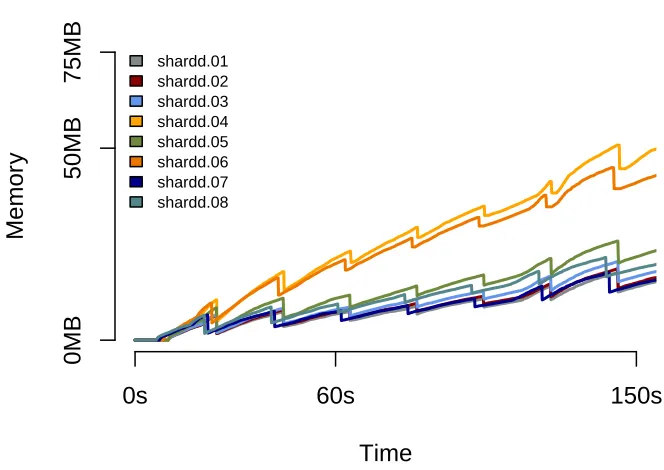
The plots in figures 4.6 and 4.7 show the effect of list subdistribution on the memory
sizes of different shards, in a run of indexing 1M Spotify track documents over 8 shardd
processes on a single machine with the rolling interval set to 20 seconds; the sublist
threshold for the run depicted in figure4.7is set at 5000 documents. The additional run
time needed when subdistribution is enabled, is significant: it takes almost 50% longer.
However, the memory distribution between shards is a lot better with the subdistribution
31
Time
Memor
y
0s
60s
150s
0MB
50MB
[image:37.596.138.470.134.369.2]75MB
shardd.01shardd.02 shardd.03 shardd.04 shardd.05 shardd.06 shardd.07 shardd.08Figure 4.6: Effect of list subdistribution on shard sizes: disabled
Time
Memor
y
0s
60s
150s
320s
0MB
50MB
75MB
shardd.01shardd.02 shardd.03 shardd.04 shardd.05 shardd.06 shardd.07 shardd.08 [image:37.596.139.470.481.719.2]Performance analyses
This chapter presents a series of performance experiments done on swarm. For each
experiment we present the rationale, detail the specific setup and present and interpret
the results.
Because our prototype has become a relatively complex system, there are virtually
unlim-ited performance experiments that one could perform. Due to the scope and associated
time contraints of any research, we had to make some choices here. Generally, we chose
experiments that evaluate the read performance of the system as a whole. In section
6.4, we propose some additional experiments that could be performed to quantitatively
evaluate individual features.
5.1
Global setup
All benchmarks in this chapter were performed on 8 identical hosts in the Spotify
back-end, each with 2 quadcore Intel Xeon processors and 16GB of physical memory,
con-nected over a gigabit network. We configured 8sharddprocesses per instance,
amount-ing to 64 shards in total. Each host runs an additional routerd and queryd instance.
The number of 8 shards per host was chosen to map on the physical processing units
available.
Because the subdistribution feature of swarmrequires a linear distribution of the global
order property over the corpus, we did not use the track’s popularity property (which is non-linearly distributed; see figure3.6), but assigned a random value over the space.
Although this generates unusable results for a practical search application, it should not
make much of a difference for the test results: in a practical setup one could apply some
normalization function to thepopularity property.
33
5.2
Load distribution
The goal of these tests is to ascertain to what degree the load of the system is distributed
among the hosts we use in our cluster: we aim for a uniform load distribution, as
this allows maximization of available hardware resources and implies favourable scaling
characteristics. To accomplish a uniform load distribution of hosts, we actually strive for
load uniformity of the individual shard processes. Our measurements are thus performed
at shard granularity, where possible.
Used memory blocks. Firstly, we gauged our implementation by monitoring the
amount of actual page-sized blocks used for the list chunks. We believe tracking these
used blocks is slightly more precise than the more traditional metric of wired process memory (reported by tools such as ps), since it is independent of the system’s
mem-ory allocation semantics (e.g. in practice the system could allocate larger, contingent
chunks). More importantly, though, optimizing our system for specific kernel behaviour
is outside the scope of this research, so measuring closer to the implementation makes
more sense.
Figure5.1shows the distribution of thisused block metric over 64 shards with 20 million track documents in the index. As shown, the distribution is fairly uniform. We used a
sublist split threshold of 30,000 .
Shards
Memor
y
0MB
[image:39.596.139.463.485.604.2]150MB
memoryFigure 5.1: Memory distribution; 20M corpus
Secondly, we want to find out the distribution of load when running queries on the
cluster. A traditional metric we could use here would be CPU utilization by sampling the kernel’s process wait queue (through tools such as uptime). The resulting metric
keep track of the CPU time for each process, indicating how much cumulative CPU time the process has had scheduled to it. Both figures could be used to determine the
CPU load on system or process level granularity. However, similar to the argument
above (favoring measuring the used blocks over the actual wired memory), we feel there
are more accurate metrics here - closer to the scope of this research, and less prone to
influences from other layers (e.g. the operating system’s SMT scheduling behavior).
Operation distribution. We measure the amount of merge operations each shard
has to perform. Merge operations can vary a bit in size (e.g. can contain both a small
number or a couple of thousand of documents to merge), so we additionally count the
number of documents each shard outputs. Since the actual implementation has some
overhead per merge operation, and additionally uses resources for each document, a
uniform distribution of both figures would imply a uniform distribution of the resulting
load. Figures5.2through5.4show the merge operation distribution for different corpus
sizes. As the graphs show, the distribution becomes more uniform as the corpus size
increases. Again, a sublist split treshold of 30,000 was used.
Shards
Read v
olume distr
ib
ution
0%
2%
5%
ops [image:40.596.139.463.417.583.2]docs
35
Shards
Read v
olume distr
ib
ution
0%
2%
5%
ops [image:41.596.135.465.120.715.2]docs
Figure 5.3: Read distribution; 10M corpus
Shards
Read v
olume distr
ib
ution
0%
2%
5%
opsdocs
[image:41.596.141.463.149.318.2]Waiting queues. I/O-bound database systems that employ slower, physical storage systems often do performance benchmarking with a metric that involves the I/O’s
cumu-lative wait timeoroutstanding queue size. Although we do not use hard-disk I/O queues, ZeroMQ (used by swarm’s transport layer), uses message queues internally. Since
Ze-roMQ does not expose such statistics itself, we wrote a tool that can access the library’s
internal state1: we are able to sample thebacklog size, measured in ZeroMQ messages, of a socket, indicating the amount of unhandled messages in the ZeroMQ receive buffers.
Figures5.5through5.7show the relative sizes of these queues over all the shards, while
replaying the 1M query log, measured by sampling the shard’s communication socket’s
backlog size every 10ms.
Shards
Messages
0%
2%
[image:42.596.140.460.310.490.2]5%
Figure 5.5: Message backlog distribution; 2M corpus
1
37
Shards
Messages
0%
2%
[image:43.596.140.462.146.321.2]5%
Figure 5.6: Message backlog distribution; 10M corpus
Shards
Messages
0%
2%
5%
Both the uniform memory usage and the uniform operation distribution is exactly as
hypothesized during the design of the system, and caused by the list subdistribution
feature: as the number of split lists increases, memory usage and load distribution
become more uniform. Thesublist split threshold should be adjusted to thecorpus size
andshard count to achieve reasonable load distribution (e.g. in these benchmarks a value
of 30,000 is too high for the corpus of 2M documents and causes an unbalanced load).
The backlog measurements support the observations and conclusions for the operation
distribution experiments (backlog size gets more uniform as corpus size increases), except
for perhaps the significant difference in backlog size for shards 1-8 and 49-64 in the 20M
experiment. We cannot present a viable explanation for this inconsistency, but it might
be grounded in a different (hardware or software) configuration of two of the machines
(a single machine hosts shard 1 through 8, a single machine hosts shards 49 through 64).
Additional experimentation is necessary to determine the exact cause.
5.3
Latency and throughput
The goal of these tests is to determine the latency and throughput of the system, and
which variables influence these metrics. We note that there is no caching whatsoever implemented in our prototype implementation, which if implemented would yield
signif-icant latency and throughput improvements: a cached result would make the pipeline
only 1 host long (mainly improving latency), and prevent possibly large intermediate
re-sult sets from being transferred over the network (mainly improving throughput). Figure
3.4suggests that more than 70% of the query volume could be served from a relatively
small cache.
As first experiment, we replayed 1M user queries on the cluster, which was populated
with 2M track documents, using different values for the maximum outstanding queries
(moq) variable. This variable is controlled by the script that replays the query log; a moq of 256 would indicate new queries are only executed when there are less than 256
queries for which a response has not been received yet. We measured the response time
for the queries, and plotted the corresponding distribution graph in figure 5.8. For the
outstanding query limit we tried values 64, 128, 256 and 1024. The run times of the
individual experiments is shown in table5.1, with the corresponding query throughput.
These figures are as can be expected: a higher moq value yields better throughput,
sacrificing a better (lower) latency.
Additionally, we experimented with the influence of the corpus size on latency and
39
Queries
Response time
0
200K
400K
600K
800K
1M
1ms
10ms
100ms
1s
64 [image:45.596.140.464.133.356.2]128 256 1024
Figure 5.8: Latency distribution; 2M corpus; varying moq
moq run time (s) throughput (q/s)
64 204 4902
128 178 5618
256 157 6369
[image:45.596.204.428.403.475.2]1024 134 7463
Table 5.1: Run time and throughput; varying moq
corpus run time (s) throughput (q/s)
0 30 33333
2M 204 4902
10M 757 1321
20M 1512 661
Table 5.2: Run time and throughput; varying corpus size
and 20M. Again, 1M user queries were replayed in each instance. The run time and
throughput figures are shown in table5.2.
These results do not show good scaling behavior in terms of corpus size: the decrease
in throughput is significant when we grow the corpus. This, at least to a degree, is
expected for the current implementation: larger intermediate result sets need more
[image:45.596.199.435.506.578.2]Queries
Response time
0
200K
400K
600K
800K
1M
1ms
10ms
100ms
1s
0 [image:46.596.140.463.132.357.2]2m 10m 20m
Figure 5.9: Latency distribution; varying corpus size; 64 moq
5.4
Comparative performance tests
To put the latency response distribution of swarmin perspective, we obtained a similar
metric of the system currently in use by Spotify, and a distributed setup of ElasticSearch
[Banon 2012].
We used an out-of-the-box ElasticSearch setup, where the index was distributed over
16 shards on the 8 available machines. Additionally, we used a replication factor of 2,
resulting in each host serving 4 shards. For data, we used a track index of 10M documents
(we did not use the full index mainly due to the fact that adding documents over the
HTTP API interface is tediously slow on ElasticSearch - adding 10M documents took
more than 3 days). The track index was generated by extracting the exact document
entries (consisting of field-value tuples) that would normally have been inserted into
the Spotify’s service Lucene index. As a result, the documents ultimately stored in the
Lucene index were consistent between the ElasticSearch setup and the Spotify service
setup, and e.g. field-based searches yielded similar results.
The Spotify service was set up on a single host with 32G of available memory and 4
quadcore processors. We used a more or less vanilla version of the service, as used
in the Spotify backend itself (and, in fact, temporarily repurpused a normal backend
41
from generating and presenting did you mean?-suggestions. The service used the full Spotify catalog, searched in all the (track, artist, album and playlist) indexes and filtered
for correct geographic availability.
Queries
Response time
0
200K
400K
600K
800K
1M
1ms
10ms
100ms
[image:47.596.139.465.189.420.2]1s
elasticsearch spotifysearchConclusions
In this chapter, we summarize our analysis of the Spotify search service. We elaborate on
the various database techniques used to implementswarm, our term distributed full text
search index prototype. Additionally, we analyse its performance through interpretation
of the findings of chapter5.
6.1
Search at Spotify
We charted the Spotify track indexes and search logs (figures3.3through3.6) to be able
to reason about appropriate data primitives for the search system’s use case. Comparing
those figures to to similar systems in the domain of web search, we found that users use
fewer terms in their search queries and (perhaps related) that queries are more repetitive.
6.2
swarm techniques
Several unconventional techniques in our prototype implementation, which were used in
an attempt to overcome limitations of the term sharded search architecture, to improve
performance or to support more expressive searching, are discussed below.
• Index segmentation through forked read process. Our approach of
attain-ing rollattain-ing updates and separation of readattain-ing and writattain-ing processes around the
fork() API was loosely based on a similar application in redis (see section 4.5). The experiments we performed do not allow us to quantitatively make assertions
about this approach by itself (compared to more traditional approaches, for
in-stance). We are confident, however, that it does not significantly impede write