DEPARTMENT OF COMPUTER SCIENCE UNIVERSITY OF CANTERBURY
A VIRTUAL MEMORY TECHNIQUE FOR A BCPL COMPILER
Alan Mayo
Page Number
1. Introduction 1
2. BCPL language Overview 2
3. Statement of the Problem 3
3.1 Present Operation of the BCPL Compiler 3
3.1.1 0-code
3.1.2 Phases
3.1.3 Intermediate Code
3.1.4 Overlay Structure
3.1.5 Syntax Tree and Symbol Table
3.2 Deficiencies of the Compiler 5
3.3 Objectives of the Project 5
4. Studies of Compiler Operation 7
4.1 The Hash Table 7
4.1.1 Hash Table Size
4.1.2 Experiments
4.2 Syntax Tree and Symbol Table 13
4.2.1 Storage Method
4.2.2 Node Size Distribution
4.2.3 Relative Sizes
5. Design of a Paging System 17
5.1 Criteria Used 17
5.2 Choice of Hash Table Size 17
5.3 The Replacement Strategy 18
5.4 What to Page 18
5.5 To Split or Not to Split 19
5.6 How to Store Two Data Structures in Disc 23
5.7 Increasing the Maximum Program Size 24
5.8 Page Size and Number of~Pages 25
6. Implementation 29
6.1 Code 29
7. Results 32
7.1 Compilation Time 32
7.2 Compiler Size 33
7.3 Page Wastage 34
7.4 Confirmation of the Design 34
8. Conclusions 35
References 36
Bib 1 i ography 36
Appendix A - Program listing of Paging Software 37
1. INTRODUCTION
The topic of this honours project is "A virtual memory technique for a BCPL compiler". BCPL is a high level languag~ suitable for writing system software such as editors and compilers. It is available on the Computer Science Department•s Data General Eclipse S/130 computer. The compiler is '.'Jritten in BCPL.
During a compilation the BCPL compiler creates a syntax tree and a symbol table in a work-space of fixed size. This places a limit on the size
'
of a compilable BCPL program, \'lhich would be removed if a virtual memory technique for the storage of the syntax tree and the symbol table was to be implemented.
The aim of this project was to investigate this possibility. The first step was to gain some knowledge of the working of the compiler by studying the code and to obtain some statistics by inserting probes into the compiler. Using the knowledge gained and by simulating various virtual memory techniques a paging algorithm was designed and implemented.
This report begins with a brief overview of BCPL and a detailed statement of the problem. The studies, design, implementation, and results are then presented followed by a conclusion.
2. BCPL LANGUAGE OVERVIEW
BCPL stands for Basic Combined Programming Language. A language CPL (Combined Programming Language), developed jointly at Cambridge and London Universities, was simplified by Martin Richards of Cambridge University to BCPL.
The language has most commands offered by other high-level languages, with some additions, but supports only simple data structures. It has
advanced looping constructs, call by value (but not name), recursion, Pascal-like local variables and vectors (one dimensional arrqys), a global vector (similar to Fortran's Common), and very flexible syntax rules.
The basic unit of data is a cell which is one word of memory. A cell may contain an integer, a bit pattern (e.g. an Ascii code), a pointer to another cell, or a pointer to program code. How the content of a cell is
interprete~is determined by the context in which it is used. This gives
the language flexibility, but means that checking for such errors as 'invalid index' cannot be done.
3. STATEMENT OF THE PROBLEM
3.1 Present Operation of the BCPL Compiler. 3.1.1 0-code
Source programs are translated into a language, between high level and assembly language, called 0-code, which is then translated into assembly code. 0-code commands perform basic operations on a hypo-thetical stack machine. The use of 0-code increases the machine inde-pendency and portability of the compiler and simplifies the writing of new code generators (0-code to assembly code) for the BCPL compiler.
3.1. 2 Phases
A BCPL compilation is comprised of 4 main phases:
i) Lexical and syntactical analysis of the source program to produce a complete syntax tree of the program and a symbol table.
ii) Translation of the syntax tree into 0-code.
iii) Generation of Eclipse assembly code from the 0-code. iv) Assembly to produce relocatable binary code.
3.1. 3 Intermediate Code
The syntax tree and symbol table produced by lexical and syntact-ical analysis are stored in a vector declared in the compiler. The 0-code produced is written to a disc file.
The 0-code is translated to assembly code which is then assembled to relocatable binary code. Both the assembly code and the re.locatable binary code are stored on disc.
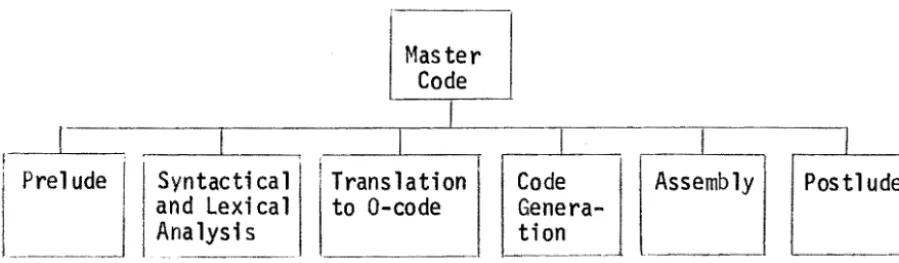
3.1.4 Overlay Structure
Master Code
j
I
I
I I II
Prel
~dj
j Syntacti ca 1 i TranslationCo~
J
Assembly Postlude and Lexical to 0-codeGenera-j Analysis tion
3.1.5 Syntax Tree and Symbol Table
The syntax tree and the symbol table are stored in one vector. Space for the vector is allocated in 'nodes' of varying sizes. The function which allocates and creates nodes returns the actual storage address of the node and these addresses are used to link the structure together.
The syntax tree is a single root tree with a variable number of branches off each node. It also has links to the symbol table.
The symbol table is referenced through a hash table whose entries point to linked lists of nodes containing identifiers. The symbol table contains program-declared identifiers and compiler-declared identifiers (i.e. system words). The format of a node is
I
type [image:7.610.75.525.43.174.2]The syntol' table organisation is drawn below:
1
0 100
Hash Table
Nodes 3.2 Deficiencies of the Compiler.
i} Since the syntax tree and the symbol table are stored in a vector
of fixed length, a program's size is limited to approximately 500
lines of uncommented code. Because of this, when changing a
program, a ·user may inadvertently exceed the maximum program size.
To split up a section of code or to move code to another section
can require a complex rearrangement of functions and a revision
of the global declarations.
ii) The size of the compiler is increased by requiring a large vector
in which to store the syntax tree and syntol table •. 24K words of
memory are needed to run the compiler, which.is a limitation when
the Eclipse runs in a 2-user mode.
3.3 Objectives of the Project.
The objectives were to investigate the possibility of, and if
possible to design and implement, a virtual memory system for the
of a program and should decrease the size of the compiler. The data
structures considered for paging were the symbol table, the syntax tree,
and the hash table.
A proviso to the above was that the compilation time of a program
should not increase significantly. Lexical and syntactical analysis
·of the source program and translation of the tree to 0-code are the
only phases affected by the paging. These phases only take up
approx-imately 20% of the total compilation time, so that a proportionally
large increase in their time would not have the same proportional effect
4. STUDIES OF COMPILER OPERATION
4.1 The Hash table.
4.1.1 Hash Table Size
The original compiler's hash table size was 100. This meant that as the total number of identifiers increased beyond two or three hundred,
the linked lists would become long, and thus the average number of
accesses to locate an identifier would increase.
To further investigate this, code was added to the compiler to
accumulate both the number of 'lookups' of identifiers in the symbol
table, and the number of accesses to symbol table nodes. The ratio of
accesses to lookups could then be compared with the theoretical minimum
of 1.
To analyse the operation of the compiler in this and other areas,
six sample programs were used. They are sections of a compiler and so
should be representative of the type of software the compiler can be
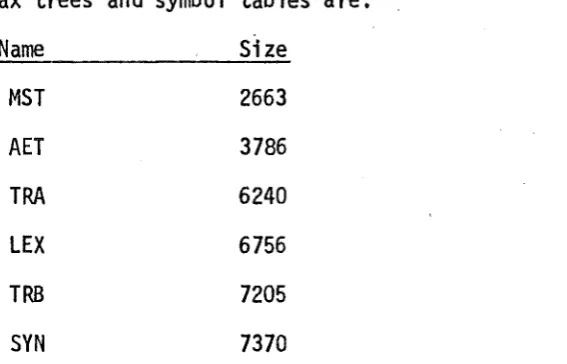
expected to compile. The programs and the number of words in their
respective syntax trees and symbol tables are:
Name Size
MST 2663
AET 3786
TRA 6240
LEX
T~
SYN
6756
7205
7370
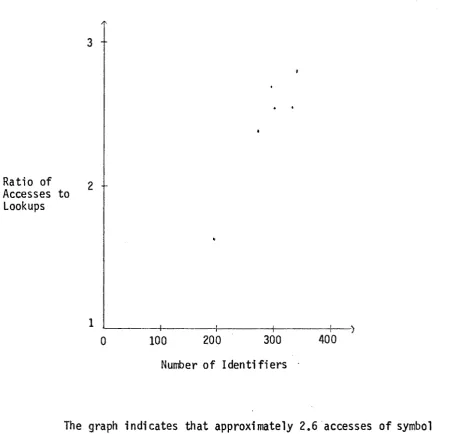
The results from compiling these six programs are shown on the
[image:10.595.187.471.458.640.2]Ratio of Accesses to lookups
3
2
1 ~----~---~---~---+.~)
0 100 200 300 400
Number of Identifiers
The graph indicates that approximately 2.6 accesses of symbol
table nodes per lookup can be expected for a compilation of a program
with 300 identifiers. Such programs are common and were found to have
greater than 1000 lookups.
If the symbol table was to be paged, the number of page faults, in
the worst possible case of a page fault per access, would be greater than
2,600. Since accesses to the symbol table are approximately random, the
expected number of page faults should be of the same order of magnitude
as the worst case. As this order of magnitude is unacceptably high,
[image:11.595.62.521.65.499.2]4.1.2 Experiments.
The original compiler's hash table size is determined by a constant in one of the program sections. To evaluate various hash table sizes by changing this constant requires the editing and compiling of the relevant program section, and the reloading of the compiler.
To enable hash table sizes to be evaluated without this rebuilding
of the compiler each time, the hash table vector was declared to be the maximum hash table size to be tested (as BCPL does not allow dynamic
sizing of vectors). When a compilation started the hash table size to be evaluated was read from a 'command file'. This mechanism has been used throughout the design to allow different values of various para-meters to be tested without rebuilding the compiler.
Experiment 1
Hash table sizes of 100 to 1300 in steps of 200 were evaluated. As explained by Knuth( 1) the exact hash table size should be chosen
with care to ensure a minimum number of collisions. The graphs at the end of the section and especially the anomaly which they show at a hash table size of 900, confirm the value of this advice.
Experiment 2
Knuth( 1) gives a method for finding hash table sizes as follows:
Choose H, the hash table size, such that i) H is prime
i i) 0 ( ( ( rk Modu 1 o H)
< (
HFor example the prime numbers 101 and 109 give the following
results.
(256k Modulo 101) yields 54, 88, 5, 68
(256k Modulo 109) yields 38, 27, 45, 75
The hash table size 109 meets the criteria but 101 does not.
Some of the sizes that meet the criteria gave poor results when
tested by the compilation of a small program. This m~ be because the range of k was too small. Other sizes were tested until the following
acceptable hash table sizes were found: 109, 307, 521, 701, 881, 1123,
and 1303. These sizes were evaluated using all the sample programs and
gave good results as shown by the graphs at the end of this section.
Experiment 3
During compilation, identifier nodes are added onto the front end
of symbol table linked lists. Therefore program-declared identifiers
will ~e in front of system-declared identifiers, as all system words are.declared by the compiler at the beginning of a compilation. For
example if SUM, TOTAL, and DO have the same hash value and SUM is found
before TOTAL the logical organisation will be
I 1
is.Narne[
15-~S.Nare[ I[G-~1s.oo[
oilolo
hash table
Whenever DO is searched for, SUM and TOTAL must be tested first. If
SUM and TOTAL are rarely referenced this will be inefficient.
The compiler was modified to add new identifier nodes onto the ends
of the linked lists.
The graphs below show that for small programs the initial ordering
is better than the new ordering. For some large programs the new ordering
3
Accesses Lookups
2
1
0 100
Program MST (small)
300 500 700
Hash Table Size (Words)
Experiment 1
Experiment 2
Experiment 3
-.
-
~~ -,....--
· - .---
" ' :-900 1100
Ratio of Accesses to Lookups for different Hash Table Sizes and Symbol Table Organisations
Accesse Lookups
2
1
0
3
Accesse Lookups
2
1
0
ioo
100
Program TRA (large)
---...___ - · - .
- ·
--
-
..· . .
-300 500 700
Hash Table Size (Words)
Program SYN (large)
\
\ \
'
'
/...-·-
'
.
'
~·'
---~-·~ .. . ~--·-
--300 500 700 900
Hash Table Size (Words)
doo
4.2 Syntax Tree and Symbol Table. 4.2.1 Storage Method
The symbol table and the syntax tree are stored in a vector of fixed size with nodes of each structure intermingled throughout the vector.
During translation, the order in which syntax tree nodes are accessed depends on their positions in the 'logical' syntax tree. Any correlation between nodes logical positions and their physical positions in the vector may be able to be exploited by a paging system to reduce page faults.
By examining the compiler code it was apparent that during syntax analysis a mixture of recursive and iterative techniques were used. The recursion is often embedded within procedures which create nodes. This results in the sub-branches of the tree being created first. Inter-ation has the opposite effect; the roots are created first.
The structure is further complicated by the symbol table nodes. The node for a •new' identifier is created when the identifier is first
found by the lexical analysis procedure, which is called from many dif-ferent syntactical analysis procedures. This means that when a specific construct is analysed, the positions· of the resulting syntax tree nodes will have little correlation to the positions of the resulting symbol
table nodes.
A desk check of the syntactical and lexical analysis of a small program confirmed the above. There was some relationship between the
4.2.2 Node Size Distribution
Statements were inserted into the compiler to accumulate and print out the number of nodes of each size for the syntax tree and the symbol table.
500
400
Symbol Table
300
Frequency
2oo
100
.
-0
-,
1 2 3 4 5 6 7 8 9 )9
Node Size {Words}
5000
4000
Syntax Tree
3000 Frequency
2000
1000
0
-1 2 3 4 5 6 )6
Node Size (Words)
The distributions show that the majority of nodes are syntax tree
nodes of 2, 3, or 4 words (note the different frequency scales).
4.2.3 Relative sizes
The figures totalled for the six programs were:
Syntax Tree 25,030 words
Symbol Table 9,960 words
The ratio of tree words to table words is approximately 5/2. This
ratio is used later in determining how the syntax tree and symbol table
5. DESIGN OF A PAGING SCHEME
5.1 Criteria used.
In the following design, whenever practicable. simulation has been
used to evaluate different paging strategies. The inputs to these
simu-lations were the compilation records of the 6 sample programs used in
the previous section.
When making design decisions the following criteria were used:
i) When there has been a conflict between maximising the compiler's
performance for compilations of large programs and small programs,
more emphasis has been placed on the compilations of large programs.
This is because a proportionally large increase in the compilation
time of a small program is preferable to the same increase in a
large program (most BCPL programs are •systems software•. and thus
tend to be large programs).
ii) A proportionally large increase in the time taken by the lexical
and syntactical analysis phase plus the translation phase is
allow-able. as this time constitutes only approximately 20% of the total compilation time.
iii) To ensure a decrease in the compiler1s size, any data structures
and code inserted must occupy less space than the compiler
work-space that will be removed.
5.2 Choice of a Hash Table Size.
By examining the graphs of section 4.1 it can be seen that a
signi-ficant improvement is gained by increasing the hash table size beyond
300 but no significant improvement is gained from increasing the size beyond 701. To determine which size to use (521 or 701), and which order-ing of the linked lists to use, the weighted averages of the ratio of
lookups to accesses over all the sample programs were computed. The
7
weights used were the number of lookups. The weighted averages were:
Size (Words) Order
521 701 Initial Order 1.56 1.52 Reverse Order 1.51 1.50
The improvement gained by the reverse order is not enough to justify the added complexity that is involved in the code, and the improvement gained by having a size of 721 is not enough to justify the extra 180 words of memory. Therefore the initial order and a hash table
size of 521 were decided upon.
5.3 The Replacement Strategy.
The replacement strategy chosen was 'Least Recently Used' (LRU). LRU is generally accepted to be the best replacement s~rategy, but is not often used by virtual-memory operating systems due to its high cost in terms of hardware and time. Normally an approximation of LRU is used. Since the paging of the syntax tree and symbol table is to be per-formed solely by software, the cost of implementing LRU is not high. As pointed out by Shaw( 2), the page size and the number of pages are more
critical factors than the replacement strategy.
For the above reasons LRU was chosen and no other replacement strategies have been considered.
5.4 What to Page.
The three data structures which can be paged are the hash table, the syntax tree, and the symbol table.
The compilation of a typical large program generates approximately 1000 calls to 'lookup' identifiers, which results in 1000 accesses of the hash table. If the hash table is paged, the number of page faults
Number of faults
=
Total accesses x Probability of a fault1
=
1000 X 5!fA saving of one word of memory does not warrant the cost of 2 page faults
so the hash table was not paged.
Paging only one of the syntax tree or the symbol table would not
remove the arbitrary limit placed on a program due to the fixed size of
the other data structure. Therefore it was decided to page both data
structures.
5.5 To Split or not to Split.
The original compiler created the syntax tree and symbol table in
the same area of memory. The paging could either be done using this
organisation, or the two data structures could be paged separately.
If the combined scheme was to be implemented, accesses to nodes
would be made by two relatively independent processes. Accesses to symbol
table nodes would be approximately random, but accesses to the syntax
tree might have some order, which could be utilised by the paging system
to produce better results. Therefore combining the two sequences of
accesses into one might nullify any improvement gained from the order of
syntax tree accesses.
To compare the two methods, the compiler was altered to produce a
file of node access numbers, and a simulation program was written as
follows:
i) Code was inserted in the compiler to allow the data structures to
grow separately from opposite ends of the vector or together from
one end of the vector. A parameter in the command file controlled
ii) All references to the syntax tree and symbol table were replaced
by procedure calls to enable these references to be trapped.
These procedures performed the appropriate referencing, and also
calculated and wrote to disc the displacement of the referenced
address from the end of the vector from which the data structure
was growing. This displacement is shown as 'disp' in the diagrams
below.
combined scheme
/
separate' scheme
] Symbol table
1<:-di
sp---:,T
access~ syntax tree
t
1<:---dispaccess
}syntax tree and symbol table -7
1{'-_
disp---:~
access
The displacement represents the virtual address of the word
accessed in a paged memory system.
Separate files of numbers were produced for the lexical and
syntactical phase and for the translation phase. Thus for the
combined scheme two files were produced and for the separate scheme
four files were produced.
iii) Parts of the compiler had to be rewritten due to some variables
being able to contain program addresses or syntax tree addresses,
which complicated the insertion of paging procedure calls.
iv) A simulation program was written to simulate a paging scheme with
a least recently used replacement algorithm. Inputs to the program
were: a page size, a number of pages and a file. The program
processed the file and produced the number of page faults.
Files of accesses were.obtained from the compilation of sample
programs MST and TRA. The files were processed by the simulation program
with total memory sizes of lK and 2K words, and for page sizes of 64,
For the separate scheme the total number of pages had to be divided between the syntax tree and the symbol table. A ratio of three pages of symbol table to one page of syntax tree was found to be superior to
other simple ratios.
Page Faults
(% of total accesses)
Page Faults
(% of total accesses) 15 10 5 0 20 15 10 5 0
Program MST
1K / / / I I / I I / 1K I I 2K
.._
~K
--~/-~
64 128 256
Page Size (Words)
Program TRA
/ / / / / / / 1K / / / y / /
----·
.._-64 128 256
Page Size (Words)
/
/
/
/
512
corrbi ned scheme separate scheme
)K / / / 2K / ' / / 2K 512
For the large program (TRA) the graph shows that the separate scheme is superior for both memory sizes and all page sizes. For the smaller program (MST) the best results obtained were for the separate scheme.
It was therefore decided to implement the separate scheme, but to do it in such a way that with only minor changes the performance of the combined scheme could also be evaluated.
5.6 How to store Two Data Structures on Disc.
One storage possibility was for the syntax tree and symbol table
to be paged to two different disc files. However, to avoid the compli-cations of having to handle two files, it was decided to store both
data structures in one file as done by the CHEF editor on the Eclipse S/130.
To achieve this, it was decided to calculate different disc block numbers for each data structure; this was done in such a way that the two structures would be interleaved in the file. Since the ratio of syntax tree words to symbol table words is approximately 5/2, the disc file blocks were allocated in this way, resulting in the following organisation.
block number: 0 1 2 3 4 5 6 7 8 9 10 11 12 13 Syntax tree symbol
table Syntax tree symbol table
Since the ratio 5 to 2 is an average ratio, there may be gaps in the file, but as it is a temporary file this is unimportant.
The disc block numbers of the two data structures are computed from the virtual block numbers as
follows:-Let DB be the disc block number and VB be the virtual block number. For the syntax tree:
For the symbol table:
DB = (VB DIV 2)
*
7 + (VB REM 2) + 5.5.7 Increasing the Maximum Program Size.
The restriction on source program size is imposed by the size of
the vector which stores the syntax tree and symbol table. The vector's
size is 8K words which requires only 13 out of the 16 bits available
for addressing purposes. In a virtual memory system, the size of the
virtual memory space is determined by the addressing range of the word
us.ed, and the size of the 'addressable unit'.
The addressing range of a 16-bit word is 64K, which gives a
theoret-ical 8-fold increase in the memory available for the syntax tree and
symbol table. Due to links in the syntax tree. which may point to syntax
tree or symbol table nodes, one bit of the addressing word must be used
to indicate the type of link. To achieve this, it was decided to use
the positive numbers for syntax tree virtual addresses, and the negative
numbers for symbo 1 tab 1 e vi rtua 1 addresses. As the ratio of syntax
tree words to symbol table words is 5 to 2, only 70% or 44.8K words
of the virtual memory space is likely to be utilised, but this still
increases the maximum program size to 5.6 times the original size.
This increase is quite sufficient, but if more space was required
the addressing range could be split at -14,000 instead of 0 to give no
wastage.
If sti 11 more space is required, or if some of the bits of the
addressing word are required for other purposes, the addressable unit
size could be increased to 3 words. Using the figures from section
4.2.3, this would result in 20% wastage due to unused words in 3 word
To get the maximum possible usage of the virtual memory space,
nodes could be allowed to overlap page boundaries. Accessing overlap-ping symbol table nodes would produce a page fault which might not have occurred if overlapping nodes were not allowed.
For this reason, and because not allowing overlapping nodes results in little wastage of virtual memory space (since the majority of nodes are 3, 4, or 5 words long), it was decided not to allow overlapping nodes.
5.8 Page Size and Number of Pages.
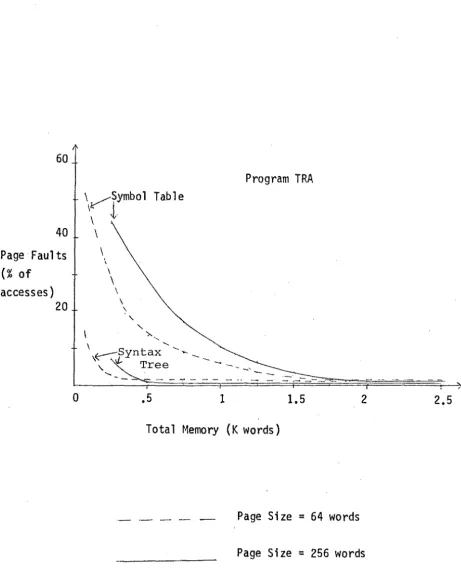
Since the cost of evaluating page sizes and numbers of pages would be high, if performed once the virtual memory system was implemented, it was decided to do some preliminary investigation. It was not expected that this would give the final page size and number of pages but that the effect that the page size and number of pages have on the number of page faults would be shown. To obtain a detailed appraisal of the system, the lexical and syntactical analysis phase and the translation phase were considered separately for the syntax tree and the symbol table.
Page sizes of 64 and 256 words .and a tota 1 memory space of up to 2K words for each data structure were tested. One page size is small and the other is relatively large, and both sizes can be read or written via Eclipse S/130 system directives. No special system directives exist for other page sizes.
The software additions to the compiler described in section 5.5 were used to obtain files of access numbers for four sample programs. Simulations were performed, using these files as input. for varying numbers of pages and the two page sizes.
80
I I
\ 1symbol Table
\
\
'
Program TRA
60 \
Page Faults .
(%
ofaccesses}40
20
\ \
\ \
\
\ \
\ \
\ \
\
'
Syntax Tree ' ,
,j\
""-"..__~--- - · -
.:::.
---
-~-_
_....,.0 .5 1 1.5 2
Total Memory (K words}
Page Size
=
64 wordsPage Size
=
256 words2.5
60
40 Page·Faults
(%
ofaccesses)
20
0
\~Symbol Table
' L
\\ \
\ \
\
\ \
\
.5
Program TRA
1 1.5 2
Total t1emory (K words)
Page Size
=
64 wordsPage Size
=
256 words2.5
[image:30.602.60.521.63.646.2]The graphs show that very little memory is required for the syntax tree, and that the page size is not critical as the number of page faults is small.
As the amount of time a page fault uses is not known, it is impossible to put an upper limit on the number of permissible page faults. If the ratio of page faults to accesses is to be kept below 2% for the symbol table, many pages are needed and the page size is not critical.
If more than a 2% ratio is acceptable, the 64 word page size is better. The symbol table lines indicate a nearly linear relationship between page faults and size of memory. Therefore, up to a certain limit, each extra page used gives a constant decrease in the number of page
6. IMPLEMENTATION
6.1 Code.
The design of the previous section was implemented. The calls to
procedures required for the paging scheme had been inserted previously
to enable the collection of access numbers, and so only the paging
pro-cedures had to be written. These were grouped together in a new compiler
section (see Appendix A) that was made memory-resident, since two overlays
syntactical and lexical analysis, and translation, contain calls to the
procedures.
Procedures were written to return the value stored at a virtual
address, and to return the actual storage address corresponding to a
virtual address. These procedures make calls, where appropriate, to
procedures which pick the least recently used page, write a page to
disc, and read a page from disc.
A record of whether a page has been written on while in memory, is
kept to avoid writing unaltered pages to disc. The time of the last
access to each page in memory is kept to enable the least recently used
page to be determined.
The procedures which read and write pages, call BCPL library
pro-cedures which use system directives to perform the reading and writing.
The debugging of the software proved difficult and it was only by
stepping through a compilation of a small program that all the bugs
were removed. To gauge the performance of the compiler, counters were
inserted to count accesses and faults and to time the compiler, and
were removed after the page size and number of pages to use were
deter-mined. A sample of the output produced by these counters is presented
in Appendix B.
6.2 Page Size and Number of Pages.
The first organisation tried was a 256 word page, 4 pages of syntax
original non-paged compiler and the new paged compiler were:
Lexical and Syntactical, and Translation Phases
Other Phases
Total
Non-paged Paged
21 26
115 115
136 141
As this organisation gave a very small increase in time, others
were tried as shown below. The times are the total time ofthe
syntact-ical and lexsyntact-ical analysis phase and the translation phase, in seconds.
Page Size Ratio of Tree
Memory Pages to Syrrbo 1
(K words) 64 words 256 words Table Pages
3.5 28 26 5:2
3 28 27 3:1
2.5 29 31 7:3
2.0 30 47 3:1
1.5 32 69 5:1
1.25 37 84 4:1
1 42 100 3:1
Since a decrease in the compiler's size was desirable a page size
of 64 was chosen. A page size of 256 words was slightly superior for 3.5K and 3K words of memory, but for the more important smaller memory
A total amount of memory of 1.5K words was chosen, as increasing
the amount of memory above 1.5K gives only a slight decrease in time
(1 or 2 seconds per .5K words), and decreasing the amount of memory
gives a significant increase in time (10 seconds per .5K words).
The 1.5K words of memory in the table above were split into 4 pages
of syntax tree and 20 pages of symbol table for the 64 word page. This
split was obtained by trial and error and is approximately optimal for
the compilation of the sample program TRA, but different programs will
have different optimal splits. A total memory size of 3.5K words split
into 16 pages of syntax tree and 40 pages of symbol table, which gives
each data structure at least as many pages as likely in any split of 1.5K
words, decreased the compilation time by a maximum of 4 seconds when
tested on 4 programs. Therefore it is safe to assume that TRA's ~ptimal
split is approximately optimal for all programs.
In summary the following values were chosen
Page size
=
64 wordsTotal memory = 1.5K words
Syntax Tree pages
=
47. RESULTS
7.1 Compilation Time.
The two most \'lidely used operating systems on the Eclipse are
NEWSYS and CUSYS, both which support Foreground/Background operation.
With NEWSYS there is 42K of memory available for user programs, but as
CUSYS has smaller buffers there is SOK avai 1 able.
The following results from timing complete compilations were obtained
with NEWSYS.
Program Non-paged Paged % Increase
Compiler Compiler
MST 59 62 5.1
AET 90 98 8.9
TRA 138 157 13.8
LEX 148 164 12.2
TRB 149 170 14.1
SYN 152 170 13.8
The compiler was tested with CUSYS to determine the effects of the
system buffers. The time taken for the total of the syntactical and
lexical analysis phase and the translation phase is shown below for two
sample programs.
Program
MST
TRA
NEWSYS
13
30
CUSYS
17
48
The results show that the size of the operating system buffers has
The compiler was altered to allow the two data structures to be
combined into one as in the original compiler. The total time of the
syntactical and lexical phase and the translation phase is shown below.
Page Size
Memory 64 words 256 words
(K words) Separate Combined Separate Combined
2 30 47 47 79
1.5 32 48 69 99
1.25 37 51 84 114
1.1 42 55 100 136
7.2 Compiler Size.
The changes to the compiler size due to the removal of the work-space
vector, the addition of page buffers and tables, a larger hash table, and
the addition of extra code are summarised below.
Increases - Code
.. Hash table
- Page buffers and tables
Decreases - removal of vector
Net decrease in size
Original Compiler Size
Less Net decrease
New Compiler Size
1.26K
.41K
1.57K
3.24K
7.75K
4.51K
23.61K
4.51 K
7.3 Page Wastage.
The maximum wastage of virtual memory space due to nodes not being
allowed to overlap page boundaries was 180 words, which is only 2% of
the total space used.
7.4 Confirmation of the Design.
The results obtained from testing various page sizes and numbers
of pages confirmed that:
1. a 64 word page produces fewer page faults than a 256 word page;
2. the best results are obtained by having more syntax tree pages
than tree pages;
3. the projected numbers of faults produced by the simulation
program are accurate;
4. separating the syntax tree and the symbol table is worthwhile
as it reduces compilation time;
5. page wastage due to not allowing nodes to overlap page boundaries
8. CONCLUSIONS
The implementation of the paging system was successful because:
i} the limit on source program size was increased 5.6 times to approximately
3,000 lines of uncommented code,
ii} the increase in compilation time averaged 11.3% or 14 seconds which is
quite acceptable,
iii) the compiler's size was decreased from 23.61K words to 19.10K words. The hash table size and the page size have a significant effect on the
compiler•s performance.
The sp 1 i tti ng up of the syntax tree and the symbo 1 tab 1 e .improves the
REFERENCES
1. Knuth, D.E. (1973) 'The Art of Computer Programming, Vol. 3.'
Addison-Wesley, p. 508-509 •.
2. Shaw, A.C. (1976) 'The Logical Design of Operating Systems',
Prentice-Hall, p. 143.
BIBLIOGRAPHY
1. Habermann, A.N. (1976}, 'Introduction to Operating Systems',
Science Research Associates.
2. Knuth, D.E. (1973}, 'The Art of Computer Programming, Vol. 3.'
3. Madnick, S.E. and Donovan, J.J. (1974}, 'Operating Systems'
4. Richards, M. 'BCPL: A Tool for Compiler Writing and Systems Programming',
AFIPS Conference Proceedings, Vol. 34 (1969), p. 557-566.
5. Richards, M. and Whitby-Strevens, C. (1979), 'BCPL the Language and
it's Compiler', Cambridge University. Press.
6. Shaw, A.C. (1976), 'The Logical Design of Operating Systems',
APPENDIX A: Program Listing of Paging Software
1- fiET
/ / / / / / / / / / / / / / / / / / / / / / / / / / / / / / / / / / / / / / / / / / / / / / / / / / / / / / / / / / / / / / / / / / / / / / / / / / / / / / /
/ /
/ /
/ / THIS C0f1PILER SECTION CONTfiiNS fiLL THE PfiGING FUNCTIONS AND ROUTINES.
/ /
/ /
/ / THE FUNCTIONS JU THIS SECTION C:(ILLED FRON THE OUTSIDE J.IORLD ARE 1
/ /
/ / BCPL TO_NC:ODE
/ / fiETVA1
,"/ fiETVA2
/ / AETAD1
/ / AETfiD2
/ /
PARAf1ETER. ".t"fiET:t:"G18?. 18?" GET. "PGHDR"
/ /
//---/ //---/ / / / / / / CONSTANTS---NANJFEST $(
/ /
= 64 / / PfiGE SIZE IN 1-JORDS.
= 20 / / # OF S~'NBOL TABLE PfiGES 1N NE!WR~'.
= 4 / / # OF SYNTA,\' TREE PAGES IN NEll OR~'.
PAGESJZE S~'NB_PAGES TREE-PAGES NLS'r'NB PI'L TREE TREE
= 2 / / # OF S~'NB PfiGES .JN THE ·'FILE NI8'.
= 5 / / # OF TREE PAGES If./ THE 'FILE NIX'.
= 0 / / USED {IS fiN INDICfiTOR. SYNB = 1 / / USED fiS AN INDICATOR. TOTALPAGES = SYNB_P{IGES + TRELPfiGES
PI'L TOTfiL = P!LS~'NB + NL TREE
$)
//---/ //---/ / / / / / / / /SENl-PERNANENT VARIABLES
STATIC $(
/ /
/ /
/ /
TREEP = 1
S~'NBP = 1
TRELPG_NAX = -1 SYNB_PG_NAX = -1
CLOCK = a
BfiSE_fiDD = a
PfiGJNG_STRE~N = a
/ / TREE POINTER.
/ / Si'NBOL TfiBLE POINTER. / / f1A.'< TREE PAGE # USED .
// NAX Si'NBOL TABLE PAGE # USED .
/ / A SORT OF CLOCK 1 1 TICK PER ACCESS
/ / B{ISE ADDRESS OF PAGES IN NENORi1 •
// l/0 STREAN FOR DATA.
//. THE FOLLOJHNG ARE ARR1W NfiNES ({ILLOCfiTED SPfiCE LATER).
PAGLN = t:1 / / VIRTUAL PAGE # 'S IN NENORi'. WRITTEN - · a // TRLiE IF ABOVE PAGES J.JRITTEN ON.
TINER = (1 / / T!f1E OF THE LfiST ACCESS TO fiBOVE PAGES.
/ / / / 2- AET
//---/ //---/ / / / / / / / /BCPL T0_/1CODE ALLOCATES SPf1CE FOR THE ARRiH'S AND Cf1LLS BCPL TO_NCODE2 NHICH DOES THE ACTUAL CONVERSION OF SOURCE PROGRAN TO NCO DE. (NCO DE = OC:ODE).
LET BCPL TO_NCODE( .> = VAL OF
/ /
/ /
$( 1 LET V = UEC TOTALPAGES PAGLN := V
FOR I = 1 TO TOTALPRGES DO PAGLN!l ·- -1
$( LET V = VEC TOTALPf1GES IJRITTHI :::: V
· $( LET V = VEC TOTALPAGES i TINER U
$( LET U VEC PAGESJZEUOTALPAGES ; BASLADD ·- V-PAGESIZE F'AGJNG_STREAN := CREATEOUTPL/T( PAGIHGJILE )
IF NOT BCPL TI..1_NCODE2() THEN RESULT IS FALSE
SELECTOUTPUT< CONSOLLOULSTREAN )
J.JRITEF< nTF\'EE SIZE = .~15:t:N.t:
:t:S~'NBOL TABLE SIZE = /.I5.t:N:t:N", TREEP,S't'NBP ) RESULT IS TRUE
$)1
//---/ //---/ / / / / / / , ' / / /AETVA1 f1ND AETIJA2 ACCEPT A VIRTUAL ADDRESS .. CALL· CELL AD TO FIND THE CORRESPONDING STORAGE_ ADDRESS,AND RETURN THE VRLUE STORED AT THAT ADDRESS.
AND AETVAHN) = !CELLAD( N .. FALSE ) AND AETVA2( N .• t1.> = VAL OF
/ / / /
$( TEST N<O THEN
N ::::: N - N
ELSE
N·:=N+N
RESUL TIS AETVAH N ) $)
//---·---.---:---,-.---/ //---·---.---:---,-.---/ / / / / / / / /
AETAD1 AND f1ETAD2 ACCEPT A VIRTUAL ADDRESS AND RETURN THE CORRESPONDING STORAGE ADDRESS.
AND AETRD1( N.> = CELLAD< N.• TRUE ) AND AETAD2(N .. /O = VALOF
$( TEST N<O THEN
/ /
/ / / /
N := N - N
ELSE
N :::: N + N
//---~---~---~---/ //---~---~---~---/
/ / NENVEC AND STVEC ALLOCATE STORi-?GE IN THE $)-'NTfJX TREE i-?ND Si"'·tBOL TiiBLE
/ / VIRTUi-?L ADDRESS SPi-?CES. THE\' C:HECI( FOR OVERLi-?PPING /WOES. THE VALUE / / RETUlmED IS THE VIRTIJRL 1/DDRESS OF THE FIRST NORD 1/LLOCHTED ..
/ /
liND NENVEC(N.> = Vi-?LOF
$( IF (TREEP RE/'1 PAGESIZE.> + N ) PIIGESIZE THEN TREEP :=: UREEP /' PIIGESIZE + 1) :t Pi-?GESIZE TREEP I;;: TREEP + N
RESUL TIS ( Tli:EEP-N )
$)
liND STVEC(N) = I)(ILOF
$( IF ( S\'NBP /T.'E/1 Pi'tGESIZ£.) + N > PflGESIZE THEN. S'r'NBP : == ( S'r'NBP / PRGESIZE + 1) :1: PAGESIZE S'r'NBP := S\·'NBP + N
RESLIL TIS ( N-S'r'NBP )
$) / /
//---/ //---/ / / / / / / / / / /CELLAD IICCEPTS EITHER VIRTUAL TREE IIDRESSES <+V£.) OR ,VIRTUAL S'r'f180L TIIBLE ADDRESS ( -V£) .. IT C:IILLS LORD Ttl ENSURE THE RELEIJIINT PAGE IS
IN NENOR'r'.• UPDATES THE PrtGES T1 NER, AND RETURNS THE STORAGE flDOF.:ESS OF THE VIRTUAL IIO(JR.f.. .. SS PIISSED TO IT..
AND CELLHD( N.• STORE ) = IJALOF
/ /
$( LET BUFFER, TYPE .• PAGE, OFFSET = g, TREE,@, 0
IF N < 0 THEN
N, T'r'PE : = -N .. Sl'I'IB PAGE :: N / PflGESIZE OFFSET '"' N REN PAGESIZE BUFFER :::::LOAD< PRGE,TYPE > CLOCK := CLOCK + 1
IF CLOCK = 20000 THEN
FOR I = 1 TO TOTIILPIIGES DO TINER!I ·- TlNER!I - 21:1t11:10 T1 NER! BUFFER : = CLOCK
IF STORE.THEN
NR I TTEN! BUFFER : = TRUE
RESUL TIS ( BASLADD + BUFFER:tPAGESIZE + OFFSET )
$)
//---~---/ //---~---/
/ / LOAD CHECKS THE PAGE NUNBER.IF NOT R NHI PAGE IT TRIES TO FIND IT Ill / / !1El10RY.IF FOUND THE BUFFER NUNBER I·UUCH IT IS IN, IS RETURNED.
/ / OTHERNISE PICKPRGE IS CALLED TO FIND AN ENPn' BUFFER OF: THE LEi'tST
/ / RECENTL \·' USED PAGE liND SI-JRP IS CALLED TO GET THE PAGE INTO NEf10R\' ..
/ /
AND LOAD( PAGE, HPE ) = (tRL.OF
$( LET BUFFER = 0
$)
IF PAGE <= ( n'PE -..> S'r'f1B_PG_f1AX, TRELPG_f'IMO THEN
$( BUFFER ::::: Fl/W_PRGE< PIIGL TYPE .>
IF BUFFER ·-= -1 THEN RESULTIS BUFFER $)
BUFFER : =: PI CK_PIIGE< T'r'PE )
4- RET
//---~---/ //---~---/
/ / FINO_PflGE SEARCHES FOR A PAGE IN NENOR~'. IF FOUND IT RETURNS THE BUFFER
/ / NU!1BER. IF NOT FOUND IT RETURN$ -1 .
/ /
AND F JNO_PAGE< PAGE .• T'r'PE > VAL OF
:f( FOR I = ( H'PE=S~·'NB -> 1 , Sri'/B_PAGES + 1)
TO ( T\'PE=SWIB -.> S)·'NB_PAGES , S~'/'IB_PAGES + TRELPAGE$ > DO IF PAGLN! I = PAGE THEN
RESULT IS I
RESLIL TIS -1
:f.>
/ /
//---~---/ //---~---/
/ / PICK_PAGE LOOKS FOR AN ENPT'r' BUFFER. IF FOUND THEN THE BUFFER NUNBER IS
/ / RETURNED. OTHERJ.IISE THE LEAST RECENTL )"' USED PAGE IN NEf·IOR\' IS
/ / OETERNINED AND NUNBER OF THE BUFFER CCINTfHNING IT IS RETURNED.
/ / / /
AND PICK-PAGE( TYPE > = VALOF
:f( LET IT}/11N = 1:.1 •• 326?6
:f)
/ /
FOR I = ( T'r'PE=S'r'NB -,'> 1 , S\'NB_PAGES + 1)
TO (TYPE=S\'NB -.> S\"'f'iB_PAGES , TOTALPAGES) DO
:f( IF PAGLN! I = -1 THEN
:f)
RESUL TIS I
IF TINER! I < NIH TH6N
IT,NIN 1= I.TINER!I
· RESUL TIS IT
//---:---:---;---.---/ //---:---:---;---.---/
/ / . SNAP_PAGE TESTS THE PAGE TO BE SNAPPED OUT OF NENORL IF NRITTEN ON
// THEN THE PAGE IS SAUED <URITTEN TO DISC). IT THEN CALLS RESTORE
/ / TO GET THE PAGE INTO NHIOR\·':
/ /
/ /
ANV SNAP< PAGE.• BUFFER, T'r'PE ) BE
/ /
$(IF NRITTEN!BUFFER LOGAND (PAGLN!BUFFER NEQIJ -1) THEN
SAVE( BUFFER .. T'r'PE .>
:f)
TEST T'r'PE = S\'NB THEN
SYNB_PG_NAX 1 = RESTORE( PAGE .. BUFFER.· SW1B )
ELSE
TRELPG_/off~X 1 = RESTOR£( PAGE .. BUFFER .. TREE )
PAGLN! BUFFER • = PAGE
~JR IT TEN! BUFFER • = FALSE
//---~--~---.----v---/ //---~--~---.----v---/
/ / SAVLPAGE SAVES A Pf1GE BY URITING IT TO DISC.
/ /
AND SAVE( BUFFER.· TYPE > BE
$( LET PAGE = ( T'r'PE = SYNB -> REALS~'NB_PG( PAGLN! BUFFER ), REAL TRELPG( PAGLN! BUFFER )) URI TEREC( PAGING_ STREAN.· BflSLADO+BUFFER.l:PAGESI ZE .• PAGE )
5- RET
/ /
//---/ //---/
/ / RESTORE CHECKS FOR. A NEU PAGE. IF A NEU PAGE TUEN THE VALUE OF TUE
/ / f1AXINUN PAGE NUNBER USED SO FAR IS UF'DHTED AND RETVRNED. IF NOT
/ / THE OLD PAGE IS READ OFF DISC.
/ /
/ /
AND RESTORE( PAGE .. BUFFER .• H'PE .> = VALOF
$( LET 1\'EALF'AGE = 0
$)
/ /
IF P(!GE > < H'PE = S\'NB -> S\"'f'IB_PG_NAX .. TRELPG_NAX .> THEN RESULTIS PAGE
REAL PAGE 1 = (TYPE = S\·'NB -.J REflLS\'NB_PG< PAGE ),
REAL TRELPG( PAGE ) )
READREC( PAGING_STREAf't, BASLAOD+BUFFER.t.PAGESIZE .. REflLPAGE .>
RESUL TIS ( Ti'PE = S\·'NB -> Sf'NB_PG_NAX, TRELF'G-NMO
//---~---/ //---~---/
/ / REALS\'/'IB_PAGE AND REAL TRELPAGE ACCEPT A VIRTUAL PAGE NUNBER AN[I
// RETURN THE CORRESPONDING DISC PAGE NUNBER.
/ / / /
AND REALS'INB_PG<' PAGE ) =
(PAGE / P!LS'INB .> :t: PIL TOTAL + (PAGE RE/1 PILS\·'NB) + PIL TREE AND REAL TRELPG<' PAGE ) =
<PAGE / PfL TREE) t PIL TOTAL + (PAGE RE/1 PIL TREE.>
//---.---·---/ //---.---·---/
/1' LIST1 TO LIST6 CJ\'EATE AND INITIALISE S\'NTAX TREE NODES.
/ / / /
AND LISTHXJ = VALOF
$( LET VIRTUAL = NEIWEC( 1 J
LET 1\'ERL = AETADHVIf?TURU
REAL!O :=X
RESUL TIS VIRTUAL $)
AND LIST2< X, 'I J = VAL OF
$( LET VIRTUAL = NEI.JVEC( 2.>
LET RERL = AETI1D1<V!f?TUAL)
REALJO .• REAL!! ::::X, f'
RESUL TIS VIRTUAL $)
AND LIST30<.', '/, Z) = VAL OF
$( LET VIRTURL = NEJ.IIJEC( 3.>
LET REAL = AETf}DJ( VII?TUAL .>' REAL! H .. REAL! L REAL!2 :::: X, y, l RE~-:ULTIS VIRTUAL . i.>
AND LIST40{· Y .• z .. T> = VALOF
$( LET VIRTUAL = NEIJVEC<' 4)
LET REAL = AETADHVIRTUAU
REALJL'i .• REAL/1, REAL!2.• REf}L!3 :=X, Y, z, T.
=
1( LET VIRTUAL = NEJJUEC( 5)
LET REAL = AETADHVIRTUAL)
REAL!O.· F:EAL!L REAL!2.· RERL!3, REAL!4 ·- ,'>(, y, Z, L Ll
RESUL TIS VIRTUAL :P
flHD LJST6(.\'.• y, z, L u .. V.> = VALOF
/ /
$( LET VIRTURL = NEUVEC(6)
LET REAL :::: AETADH VIRTUPIL)
REAL!O .• REAL!L RERL!2.• REAL/3, REflL!4.• REAL!5·:=X, ~',.Z, T, ll, IJ
RESULTIS VIRTUAL $)
/ /
APPENDIX B: Sample Output
UBC- BCPL/RDOS VERSION 2 (76-08-1::18.> NNf1,'='<: = t:1634?6 .. HNA = 873777
SOURCE FILE = TRf1 S'r'NTf1.:)· ONL )·'
=
TRUE LISTING=
FALSE SAVE ASSEMBL )·'=
FALSE SAUE NCODE = FALSE SECTION G392SETTINGS:
Pf1GESIZE = 256 TREE PAGES
=
1 S'l'NBOL TABLE PAGES = 5 TREE SIZE = 4895S'r'NBOL TABLE SIZE
=
1847TREE l.JASTAGE = 16
SYNBOL TABLE l.JASTHGE = 15
t:ICCESSES:
TREE = 9637
S)·'NBOL TABLE = 5668 FAULTS:
TREE READS
=
459 l.JRITES = 44 S)·'NBOL TABLE READS=
516l·JR I TES
=
438TRANSLATION TO ASSENBLER SUPPRESSED TINING RESULTS=
START TINE 23:44:15 BCPL_NCODE FINISHED 23:45=24 NCODE_ASf1 FINISHED
ASN_RB FINISHED
·UBC - BCF'L··RDOS VERSION 2
<
76-08-08) NNH.'x.'=
1::163476 .. HNH=
07377?SOURCE FILE
=
NST Si·'NTHX ONL ''l = Tf;.'LIELISTING
=
FHLSESHVE HSSENBL 'r' = FHL SE SHVE NCODE
=
FHLSE SECTION NSTSETTINGS:
F'HGESIZE = 64
TREE F'HGES = · 4
Si·'NBOL THBLE F'HGES
=
21::.1TREE SIZE
=
Si·'NBOL THBLE SIZE
=
TREE J.JHSTHGE
=
S'r'NBOL Tf:IBLE J.JHSTHGE
=
HCCESSES:
TREE
=
Si·'NBOL THBLE
=
FHUL TS:
TREE REHDS
=
J.JR I TES -Si·'NBOL THBLE REHDS
=
J.JRITES
=
TRHNSLHTION TO HSSENBLER TINING RESULTS:STHRT TINE
1868 1141::.1 }125 34 3131::.1 1171 55 44 1::.1 1::.1 SUPPRESSED
BC:F'L_NC:ODE FINISHED 23:41::.1:08 NCODE_HSN FINISHED
HS~LRB FINISHED
0 BCF'L ERRORS DETECTED
UBC - BCPL/RDOS VERSION 2 (76-08-88)
NNf1.'x.'
=
1::1634?6 .. HN.ct = B?3???·SOURCE FILE
=
L£.!.;'S'r'NTA.\' ONL )·'
=
FALSE LISTING=
FALSE SAVE AS!3Ef'1EiL }·· :::: FALSESAVE NCODE :::: FALSE
SETTINGS:
PAGESIZE = 2.56
TREE P.ctGES = 4
S'r'NBOL TABLE PAGES = 18
TREE SIZE :::: .5091
S)·'NBOL TABLE SIZE = 166?
TREE NASTAGE = •:) •:)
,:_;:_
S'r'NBOL TABLE NASTAGE ::::: 1.5
Ht-:CESSES :
TREE
=
99H.lS'r'Nfit..1L Tf'IBLE :::: 4238
FAULTS:
TREE REfiDS = 36
NRITES
=
32 S'r'NBOL Tf'IBLE REfiDS= ·
0t•!R I TES = t1
ASSENBLER CODE= 3114(006B52) LINES NRC LEX. HD L£.:...;. CD.: POP
. TITL LE.'x.'
TINING RESULTS: STI1RT TINE
BC:PL_NCODE FINISHED NCODE_ASN FINISHED RSfLRB FINISHED
0 BCPL ERF:OF:S DETECTED
... IELP & GF8