in
the beginning ·
god created the
hea.vens and the
earth
now the earth was
f
orm1ess
and
empty
darkness
was
over
the
sur
-dee
spi
ho,
wa
A
d
t
ry ...
I
magine yourself in ten years time. Ethernet now does run
through the ether, and communication costs are minimal. All
computing is now done distributively, and if the loads are too
high on the local network, it is worthwhile to log into a computer
in Hong Kong.
A
distributed database has been set up with all literature,
encyclopaedias, official statistics, software and news available.
Technology has continued its rampant progress, but as usual,
human society with its understandable reactionary tendencies has
remained much less 'globalised'. In particular, no language group
is willing to give up the special cultural identity represented by
their language or dialect. This means that this huge database has
to be maintained in a host of different languages. Machine
translation, always recognised as a difficult problem has not yet
advanced to such a point as to fool readers into thinking that they
are reading a document written in their own native language, so a
complete version of the database has to be stored for each
language.
The database is as large as it is allowed to be, and Parkinson's law
still holds -
there is still not enough space for everyone!
Language groups small in number are not adequately represented
in this global system, and the nations that most need the
information are unable to support the maintenance costs of a
version in their native tongue. Meanwhile, special interest groups
are clamouring for representation of their literature in the
database, and the international system administrators are the most
loved and hated people in the world.
Sigh.
"What we need," cry the peoples of the word, "is some way of
storing all these different versions, semantically identical, in an
even more concise form than they are. Surely it must be
'bl ' "
Contents
1 Introduction ... 3
1 .1 Parallel Texts 3 1.2 Compression 3 1 .3 Parallel Texts and Compression 4 1 .4 Overview of the Report 6 2 The Competition ... 7
2.1 Aims 7 2.2 Method 8 2.2.1 NextText - an Automated Betting Program 8 2.2.2 Operation and Mathematical Relationships 11 2.2.3 User Interface 12 2.3 Organising People 1 3 2.4 Texts 1 3 2.5 Results 15 2 .6 Conclusion 1 8
3
Extraction of Synonyms from Parallel Texts ... 19
3 .1 The Expectations 1 9 3.2 The Problems 19 3.3 Significance Criteria 3.4 Results 20 20
4
Compression as Encryption ... 22
4.1 Finding a Thesaurus 22 4.2 Finding Texts 2 3
5
Implementation of Parallel Compression ... 25
· 5.1 PPM Model 25 5.2 Parallel Model 5.3 Combining the Models 5.4 Tuning 26 27
29
6 Conclusion ... 387 References ... 40
Appendix A: Quantisation of Betting Levels ... 41
Appendix B: Implementation of Synonym Extraction ... 42
Appendix C: Synonyms Deduced from Parallel Texts ... 44
P A R A L L E L T E X T C O M P R E S S I O N
1
1 .1
1.2
Introduction
Parallel Texts
Parallel texts come in two forms: either the two texts are in the same language, or in two different languages. The most common origin of a pair of parallel texts is some translation process. A text may be available in different languages, for example an English translation of French novel, or the translation of a technical paper from Russian. Also, several translations of significant texts may have been made into the same language, for example Classical texts or the Bible translated into English.
The two cases are quite different in the sense that while the same-language pairs (or parallel translations) are few (they occur mostly in translation from ancient documents such as the Bible or Classical writings), they are significant and widely used. Two language pairs appear wherever translations are held together with the source document, or where documents are maintained in several different languages. This may occur especially in multi-lingual environments· such as multi-national organisations and governments of multi-lingual countries (for example, Canada).
While the two cases are different, a two-language pair of texts can be transformed into a same-language pair by the automatic translation of one text into· the language of the other. For the purposes of compression (see next section) this translation does not have to be stylistically perfect, so existing techniques of machine translation could be used to convert a two-language pair into a same-language pair. This reduces the problem addressed by this report to the treatment of same-language texts.
An informal definition of parallel texts with relevance to compression is "a pair of texts which say approximately the same thing using different words", or more formally, "a pair of natural-language texts with equivalent semantic content"
Compression
In the 1940s, Shannon heralded the birth of a new discipline,
Information Theory, with a paper showing how the
predictability or redundancy of a text was related to its information content, or entropy. His thesis was essentially this: if it is possible to predict with a high degree of accuracy what will follow a given portion of text, the amount of information contained in the text predicted is small. The
entropy, or lack of predictability of the text is where the actual information lies. The aim of compression is to store
_ _.)
P A R A L L E L T E X T C O M P R E S S I O N
1.3
part of the text is not stored, as it is predictable, and can therefore be re-created when the information is 'decompressed'.
Many different models of a text can be constructed, ranging from those which look only at the frequency of individual letters , through those that look at groups of letters, up to the most sophisticated models which exist only in the human mind. The latter are based on an understanding of the text, on the experience of different texts of the same genre, and on many other cognitive processes not yet properly understood. The better the model of the text, the more redundancy is apparent, and the more concisely the information is stored. For example, rarely does the human brain store a piece of text verbatim; when it is recalled, the information is usually re-created in a slightly different way, due to the redundancy of natural language and human communication, but it retains its essential meaning.
This is obviously a very vague description of the mechanics of actual compression, but it is sufficient for the moment to note that the better the model of a piece of text, the better the predictions made by the model, the less redundancy is stored, the smaller the compressed text is, and the better the compression: prediction is tantamount to compression. In his work, Shannon quantified the information content of a symbol with respect to a certain model. The entropy (H),
or information content of a symbol s if it is predicted with probability p, is
H(s) = -logzp(s) bits
A bit is the basic measure of information, and is equivalent to one yes or no, true or false answer.
This means that if you are 90% sure that the letter after "Mary had a little l" is an 'a', and that letter occurs, the information content is H('a') = -logz 0.9 ~ 0.05 bits. If however the
phrase is "Mary had a little lemma", and an 'e' was assigned a probability of 2%, the information content of the 'e' would be H('e') = -logz 0.02 ~ 1.7 bits.
One final note about models. Most good models of text adapt
as they find out more about the text. Human models tend to classify the text quickly, and use experience with that genre as a starting point for the model (all this is of course subconscious). After that point, both human and automated models adapt to the specific vocabulary and style of a text, getting better as they learn more. In the case of a computer model being used for compression, the compression usually improves as processing proceeds.
Parallel Texts and Compression
P A R A L L E L T E X T C O M P R E S S I O N
"How can parallel texts help prediction?"
To answer this, consider an example. The following text finishes in the middle of a word. Without looking at the text below it, try to predict what will come next:
Yet the age was not so barren in noble qualities, as not also to exhibit examples of virtue. Mothers accompanied the flight of their sons; wives followed their husbands into exile; there were brave kinsmen and faithful sons in law; there were slaves whose fidelity
defied even t
Tacitus: The Histories 1.3 Translation: Wellesley Hopefully, given enough guesses, it would be possible to
complete word correctly. Armed with a parallel text, however, the problem becomes greatly easier:
However, the period was not so barren of merit that it failed to teach some good lessons as well. Mothers
accompanied their children in flight, wives followed their husbands into exile. Tbere were resolute kinsmen, sons-in-law who showed stead/ ast fidelity, and slaves whose loyalty scorned the rack. Distinguished men driven to suicide ... (etc)
Tacitus: The Histories 1.3 Translation: Hadas The problem is still not trivial, but the choices are narrower.
The phrase could be 'the rack' - but it isn't. The rack is a form of torture, and this is in fact what the word is.
An even more marked example is where a proper noun is involved - proper nouns are usually invariant between parallel texts, for example
Among the provinces, Spain was under the government of Cluvius Rufus, an eloquent man, who had all the accomplishments of civil life, but who was without experience in war.
Of the provinces, Spain was governed by C_ R_, a fine orator, who was tried in the arts of peace, but
untried in wars
No prizes for guessing what the missing letters are!
Several useful properties of parallel texts become apparent when an attempt at prediction is made.
There are four broad levels at which texts correspond:
P A R A L L E L T E X T C O M P R E S S I O N
1.4
change the style). In this case, it is very easy to predict the target text.
(ii) As the two texts contain the same information, synonyms of words often appear in the target text. In this case, a thesaurus can be used to generate candidate words for the target text.
(iii) Usually not all of the words correspond exactly to themselves or to synonyms in the target text. However, there is often some phra,se which corresponds between the texts. Thus a phrase can be related to a synonym phrase in the target text. A model using these correspondences would either need a very large thesaurus relating phrases to phrases, or be able to understand the two texts.
(iv) The very worst case is where no words or phrases correspond in the texts, but the whole texts are known to have the same semantic content. Practically, this very worst case does not arise, but it is not uncommon for the smallest corresponding chunks to be a sentence, paragraph or some other chunk. Very powerful artificial intelligence techniques would be required for a model which will take advantage of these, so that the actual meaning of the text will be reduced to some internal meaning representation and re-created in the style of the target text.
Parallel texts can help prediction, and can therefore enable compression to a degree not obtainable otherwise.
Overview of the Report
This report describes an investigation of the feasibility of parallel text compression, and experiments with practical algorithms to take advantage of the properties of parallel texts.
To investigate the feasibility of parallel text compression, a series of experiments was run based on existing techniques for estimating the entropy of text. These experiments required subjects to predict characters in a text given the preceding text, as well as a parallel text. Their performance was measured against a control group without a parallel text. The implementation of a practical compressor was the
P A R A L L E L T E X T C O M P R E S S I O N
2
The Competition
2.1
Aims
To determine the degree of success that could be expected from parallel text compression, an experiment was conducted in which subjects were asked to predict a text letter by letter, betting money on the possible letters.
This was an extension of work by Shannon [Shannon], Cover and King [Cover], and Zunde and Kelman [Zundel. Shannon originally tried to place bounds on the entropy of English by asking subjects to guess the next letter of a text until they were correct. The number of guesses needed was used as a measure of the entropy of the text. Cover and King performed similar experiments, requiring subjects not only to guess a letter, but also to say how sure they were that they were right - introducing the concept of betting money on letters. Zunde and Kelman let subjects choose sets of letters to bet on, narrowing down their options until they found the one correct letter. They also automated the process using character terminals.
The subject's aim is to maximise their winnings. It can be shown (see Operation and Mathematical Relationships) that
this minimises the entropy reflected by their bets. To maximise winnings, they must place their money according to their best judgement. In other words, they must be risk neutral - a risk taker will lose more by ending up with less to bet on other letters when their initial guesses are wrong, while a risk averse person will not obtain the optimal return for their bet each time. The percentage of the money that the subject bets on a letter should therefore reflect the likelihood of that letter according to their internal 'model' of the text.
In this way, the entropy of the text being predicted with respect to the subject's internal model can be determined. The lower bound on this entropy over several subjects indicates the actual information content of that piece of text with respect to the best possible model.
The aim of the experiments in the context of parallel text compression was to ascertain the amount of help a parallel text is in the prediction of a given text.
To see how this could work, imagine a pair of identical twins who have the peculiar property of thinking about a problem in exactly the same way. Given identical texts, they will
assign exactly the same probabilities to the possible letters. A technique known as arithmetic coding will take a stream of
probabilities and will convey this information in exactly the number of bits dictated by the entropy. - i.e. transmit
P A R A L L E L T E X T C O M P R E S S I O N
Letter
s h a 1 1
no more. If the predictions of one of the twins are used as the basis for a compressor, the text can be encoded using the exact number of bits represented by the probabilities assigned to the letters. The other twin's predictions could then be used as the basis of a decompressor, enabling the compressed text to be decompressed. This situation has its analog in automated compression, where the twins are just two identical programs running on two identical machines. Machines, however, are not as clever as humans!
One set of subjects were were asked to predict a portion of text, given the preceding text for about ten pages. The other group were also given a parallel text up to and past the point at which the corresponding unknown text started. For example, subjects were given the text up to and including
"What do you want? Tell me and you ", where the text
following was "shall have it.", and the parallel text was "What is thy petition, queen Esther? and it shall be granted thee:".
The predictions of the best person with the parallel text and those of the best person without were:
Prediction Entropy Prediction Entropy with parallel (bits) without (bits) text parallel text
85 0.23 40 1.3 90 0.15 80 0.23 99 0.014 95 0.074 99 0.014 95 0.074 99 0.014 98 0.029 Total Entropy 0.422 1.707
2.2
Over several experiments, the difference between the lowest entropy without a parallel text and the lowest entropy with a
parallel text should give a quantitative indication of the helpfulness of a parallel text in terms of a change of entropy.
Method
2.2.1
NextText - an Automated Betting ProgramTo automate the betting procedure, and to speed the learning of the subjects, a Macintosh Hypercard Stack, NextText,
P A R A L L E L T E X T C O M P R E S S I O N
MB c 11. HD: Use rs :Tim: st B ck s: Ne H tT e Ht 3. 0
That's right. You won 1.37 points.
Figure 2.2 The new NextText format
The slider overcame problems with the selection of percentages. It was labelled from "No Idea" through "Conceivably", "Possibly", "Likely", "Probably", "Quite Sure" "Very Sure" to "Certain". The reason why eight graduations were chosen was firstly to conform to the 7±2 rule for cognitive processes [Miller], and to be an even number, so that there is no 'middle' graduation might encourage people to be lazy in their decision-making and take the middle mark. Nevertheless, the slider can be placed at any position on the scale, at any point between these graduations. The position of the slider relates to the amount of money bet, and therefore the amount to be potentially won or lost. Before a slider was implemented, a version was used which had
[image:11.595.39.555.65.426.2]P A R A L L E L T E X T C O M P R E S S O N
The slider can only select a percentage from the breakeven point to 95%. The breakeven point is where the probability assigned to each character is the same - so the breakeven percentage for m characters out of n left where there is
Pio
of the original amount of money left is:m
breakeven =
nP
The rationale for imposing a lower limit was that betting lower than the breakeven point implied that this selection was less likely than its complement. In this case, the subject should really select the complement and bet a higher than breakeven percentage on it.
The upper limit of of 95% prevents rash bets being made. In the first set of experiments, subjects would often bet 99% or 99.99% of their money if they were very sure. As explained below, the gains of such high percentages are very small, while the potential losses are great.
2.2.2
Operation and Mathematical Relationships
Several letters can be selected at one time. The process of finding the correct letter is therefore reduced to a series of two-way chqices. The slider position represents the probability that the correct letter is one of those selected.
If the subject selects more than one letter and is correct, the letters not selected disappear from the keyboard, and the subject has to make a further selection from those left. The amount of money left is equal to whatever was bet on the selection.
If the correct letter is not in the subject's selection, the letters in the selection are removed from the keyboard, and the subject must make a further selection. The amount of money left is the previous total less the amount bet on the selected letters.
This process continues until either the correct letter is selected on its own, or the correct letter is the only one remaining. At this point, the final percentage bet on the correct letter is used to calculate the change in winnings.
The winnings multiplier (m) is related to the proportion bet (p)
by
27
m=-p
n
where there are 27 characters available (a .. z + space) and n
letters are selected.
Because the winnings rapidly became large, e.g. $1020, a points value was also shown, where
points = log10 m
P A R A L L E L T E X T C O M P R E S S I O N
This information is updated as the slider is moved up and down before the subject commits themselves to a particular choice. This was an important addition - it gives the subject a feel for the relationship between the slider markings, the percentage, and the winnings.
The entropy, H, of a certain choice is related top thus:
also,
H(choice) = -log2p
~points = log1027p
= log1027 + log10p
log2J)
= log1027 + logzlO
H(choice) = -log210.(~points - log1027)
,,,. 3.32(1.43 - ~points)
So the points and the entropy are linearly related - as the points increase, the entropy decreases, so maximising the points (and thus the winnings) means minimising the entropy.
As noted before, betting higher than about 95% was undesirable, as the gain in winnings was very small, but if the selection was wrong, a much smaller amount of money was left to bet on.
For example, if a single letter is selected as the first bet, and a 95% probability is chosen, the entropy if right is -logz 0.95 =
0.074 bits, and if wrong (on average) is -logz(0.05 I 26) = 9.0
bits.
If the probability chosen is 99.9%, the entropy if right is -log20.999 = 0.015 bits, and if wrong (on average) are
-log2(0.0l I 26) = 11.3 bits - so there is a very small change
in the points if right (0.059 bits less), but a large change if wrong (2.3 bits more).
2.2.3
User InterfaceBecause the betting system doesn't use the keyboard, people inexperienced in using a computer only have to get to grips with a mouse.
Betting can be thought of in several ways, letting the subject choose the most meaningful for them. It can be thought of as betting money on a letter, giving a probability, or selecting a word which best describes · the subjects confidence.
P A R A L L E L T E X T C O M P R E S S O N
2.3
2.4
Organising People
To find people who were willing to take part in the competition, an advertisement was placed in the University
Chronicle. It was hoped that that the competition would attract 'educated intellectuals' eager to prove their quickness of mind. Barring people who were never in their office and those who caught the 'flu the day before they were to take part, 10 people were found to participate. The competition was organised as a tournament so that the best people took part several times. They were organised in two groups, with a text each. Three out of each group were asked to predict the text given a parallel text, the other three predicted the text without a parallel text, as a control.
The winner from each group went through to the semi-finals, where those that had a parallel text in the first instance had none, and vice versa. Finally, the winner from each of the two groups went through to the finals, which were with a parallel text. A control wasn't possible in the finals since this would mean an unfair competition between the last two people.
One thing that I-learnt when conducting the competition was that the process could not be too well explained. At least half an hour should be spent explaining the operation of the stack ,and especially how the scoring worked. Practice runs on another piece of text were essential.
I found organisation very time consuming, with letters, telephone calls, finding texts, explaining procedures, checking on subjects, analysing results, improving methods of running the tournament, notifying people of results ... Ideally, the experiment should be run with lots of people, preferably on larger texts, but the process is very time consuming and tiring for the subjects, and after one bout of three or four hours, most have had enough. In fact, after finding three groups of three people for the heats, it was not possible to find more than one person for the last heat. The semi-finals coincided with a very busy time at the end of the year, and the two fourth year Computer Science students who had reached the semi-finals were not willing to spend the hours needed to complete the competition, so this will be completed later.
Texts
There were three parallel texts involved: two for the heats and one for the semi-finals.
Text for heat one:
'And so the King and Haman went to eat with Esther for a second time. over the wine the king asked her again, "no
P A R A L L E L T E X T C O M P R E S S I O N
Queen Esther answered, "If it please your majesty to grant my humble request, my wish is that I may live and that my people may live ... "'
Esther 7:2-3, Today's English Version Bible Parallel text for heat one:
" .. . And the king said again unto Esther on the second
day at the banquet of wine, What is thy petition, queen Esther? and it shall be granted thee: and what is thy request? it shall be performed, even to the half of the kingdom.
Then Esther the queen answered and said,
If
I have found favour in thy sight, 0 king, and if it please the king, let my life be given me at my petition and my people at my request: "Esther, King James Version Bible Text for heat two:
"King Xerxes asked Queen Esther, "Who ts he? Where ts the man who has dared to do such a thing?" Esthe
r said, "The adversary and enemy is this vile Haman." Then Haman was terrified be/ ore the king and queen. The king got up in a rage, left his wine and went out into the palace garden. But Haman, realizing that the king had already decided his fate ... "
Esther 7:6-7, New International Version Bible Parallel text for heat two:
... Then King Xerxes asked Queen Esther, "Who dares to
do such a thing? Where is this man?"
Esther answered, "Our enemy, our persecutor, is this evil man Haman!"
Haman stared at the king an queen in terror. The king hot up in a fury, left the room, and went outside to the palace gardens. Haman could see that the king was determined to punish him for this, so he stayed behind to beg Queen Esther for his life ...
Esther 7:5-7, Today's English Version Bible Text for semi-final:
He was son of that Vitellius who was censor and three times consu~· this was thought sufficient recommendation. In the army of Britain there was no angry feeling; indeed no tro
ops behaved more blamelessly throughout all the troubles of these civil wars, either because they were far away and separated by the ocean from the rest of
the empire, or because continual warfare had taught them to concentrate their hatred on the enemy.
_:_\
··-)
P A R A L L E L T E X T C O M P R E S S I O N
2.5
Table 2.1 Text One Parallel 0.47 0.71 0.90
Aulus Vitellius, son of the Vitellius who had held the censorship and three consulships. These, it seemed, were qualifications enough.
In the army of Britain there were no hard feelings. Indeed, throughout the period of civil war, no other legions acted with greater propriety. The reason may lie in .the fact that they were far away, beyond the barrier of the North Sea; or perhaps they had learnt from continual campaigning to reserve their hatred for
the enemy.
Tacitus: The Histories 1.9 (Translation Wellesley)
Results
Results were gleaned from log files which were kept by the betting program. The log files contain information about what letters were selected, what probability was given, and the time of each bet. From this, the entropy of each bet, the total entropy and the average entropy can be determined.
The final entropies for each of the subjects for the three texts are given in ta_ble 2.1.
Text Two Text Three
No Parallel Parallel No Parallel Parallel No Parallel 0.92 1.0 1.5 1.2 1.5
1.3 1.1 3.4 1.7
(all quantities are in bits per character)
A few of the results were unexpected - the 3.4 bits per character was due to one subject who had trouble with the concept of the prediction, and with the operation of the program, and eventually gave up. The 1.7 bits per character was due to a similar situation. Age se.emed to play a large part in how well subjects picked up the concepts involved and therefore the subjects' final entropy.
Overall, however, the average entropy of subjects supplied with a parallel text was significantly lower than that those without, about twice as well for the first text, and about one third better for the second text (although more samples would be needed to verify this second result). The third text seems even harder, with only one fifth improvement. Apart from the actual entropy statistics, there were many
interesting properties to note from graphs taken from the log files of the subjects.
[image:16.598.78.512.400.483.2].c:)
I
·\
-;J
p A R A L L E L T E
x
Tc
0 M p R Es s
I 0 N12
11
10 9
'i:' 8
~
7.a
6u
~ 5
4)
Q.
4
$
....
e
3~
20
~
1~
100 120 140 160 180 200 220 240
Character
w Queen Esth r what do yo want Tell me and you sh 1 have it Ill even give you half the mpire Queen Esther answered I
it please your majesty to grant my hu le request my wish is that I may live an d that my people may live
20 characters
Figure 2.3 Entropy of the characters in a text
[image:17.597.94.499.84.549.2])
P A R A L L E L T E X T C O M P R E S S I O N
16
14
12
10
8
;.,....
C4
0 6
~
;..i
Q
~
4
2
[:]
[:] [:]
•
[:]•
[:] [:]•
1111 El I:]•
•
..
•
l:Ji.
•
[:]
•
•
•
•
Ill
•
•
I:]
•
I\ [:]•
[:] [:]
l.ll 0.7 bits/char
• 0.9 bits/char
l.ll
[:]
•
Ell.ll
•
I:] El[:]
•
•
•
• ••
•
[:]
0 20 40 60 80 100 120 140 160 180 200 220 240
Character
Figure 2.4 Analysis of two subjects' entropies
What makes the difference between a good better and a bad one? In figure 2.4, the entropy for each character for two different subjects are graphed together. One produced a final entropy of 0.9 bits/char, the other 0.7 bits/char. The difference does not seem to lie so much in the (many) values near zero, but instead in the high values. The better subject (entropy of 0. 7) has managed to 'cut their losses' probably by not making rash bets, and always having some reasonable probability to fall back on.
[image:18.597.92.519.68.563.2]P A R A L L E L T E X T C O M P R E S S I O N
2.6
~
0
80 .l:1
5
60
-~
~40 0
20
5
b
~
~ 0
0 10 20 30 40 50 60 70 80 90 100
Percent of Characters
Figure 2.5 How the Entropy is accounted for
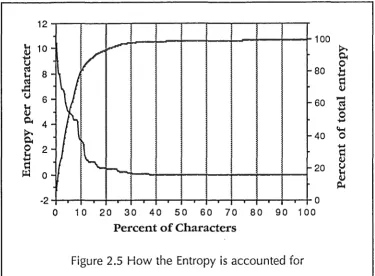
The line falling to the right in figure 2.5 is the entropy used by each character, sorted into descending order of entropy, from least expected symbol to most predictable. The line
rising to the right is the cumulative sum of these entropies. This is the amount of the final entropy accounted for by symbols whose entropy are over a given value. For example, 80% of the entropy is accounted for by 10% of the symbols - those with an individual entropy of three or more.
This reinforces once more the value of minimising the losses incurred by these bad predictions.
Conclusion
The results of the competition have shown that parallel texts
are helpful, but their usefulness varies. Some parallel texts can reduce the entropy of a text by a factor of two, others take a third or a fifth off.
When compressing, special note needs to be taken of catering for unexpected characters - damage control and not dare-devil tactics are required
[image:19.597.161.537.89.365.2]P A R A L L E L T E X T C O M P R E S S I O N
3
Extraction of Synonyms
from Parallel Texts
3.1
3.2
The Expectations
In the introduction, it was noted that the first requirement for a practical parallel compression technique was a thesaurus. This presented a problem: no thesaurus was readily available in machine-readable form. However, a possible solution became apparent after a little thought: if a pair of parallel texts were related partly by the fact that words corresponded with synonyms, it should be possible, over a large enough piece of text, to deduce those synonyms and thereby build up a static thesaurus for that pair o texts. Come correspondences may be peculiar to that combination of texts, but many should be general enough to be useful as a basis for a general-purpose static thesaurus. Two texts were available: the Bible in Today's English Version
(obtained from the English Bible Society) and the New Testament in 'the King James Version (obtained from a public domain HyperCard Stack).
The algorithm for the extraction of synonyms was fairly simple: Firstly, read a verse from each version. For each word in the source version, make a note of its occurrence with every word in the target version. Do this for each verse in the texts. At the end, apply some selection criteria for extracting valid synonyms.
The Problems
One problem become immediately apparent: the memory requirements of this algorithm are huge. Given the whole of the New Testament, with 8000 distinct words and 7000 verses, the number of correspondences that have to be recorded is huge.
One way to reduce the number of candidate synonym pairs is to tag words with their parts of speech. As synonyms must have the same part of speech, correspondences between two words can be immediately ruled out if they have different parts of speech.
To this end, 2246 words were manually tagged with their parts of speech. Many had to be tagged with several tags, for example most ending in 'ed', such as 'borrowed' were recorded as both an adjective ('a borrowed book') and the past participle of a verb ('she borrowed a book'). Some words, like still (noun, verb, adjective, and adverb) and
P A R A L L E L T E X T C O M P R E S S I O N
3.3
3.4
tagged with even more tags. This whole process was very time-consuming, but made the synonym finding feasible. Static tagging is only a small part of determining the
grammatical category h of a word in context; there have been several papers published on dynamic disambiguation, where context and syntax are taken into account to decide on the part of speech of a word an a specific context. This would have made the process more fruitful, as the more combinations that can be ruled out on the basis of grammatical category, the less have to be weeded out statistically later on.
For a description of the implementation of the program and the special memory problems associated with the thousands of connections, see Appendix B.
Significance Criteria
The selection of sensible, effective selection criteria was difficult, but finally, the following criterion was chosen. The number of times that two words occur together in a verse must be more than the number of times that they would be expected to occur together by chance.
The number of times the synonym is expected in a verse in th . synonym frequency in target Th b
e target text is number of target verses · e num er of times the two words would be expected to be heard
h . synonym frequency in target
*
word frequencytoget er is number of target verses ·
Here, word frequency (the number of times this word has appeared in the source text) acts as an approximation to the number of verses that this word has appeared in. If the number of times this combination has occurred is greater than the value of the above expression by a certain factor, then that combination is selected.
Selecting an appropriate threshold factor was interesting - the value that didn't print too many 'silly' combinations and didn't exclude too many useful ones was about 500. This means that a pair must occur with a frequency 500 times higher than would have been expected to be significant!
Results
The result of this process were disappointing. The reasons for this are several:
(i) it is not possible to distinguish between synonyms and words that simply occur often together (e.g. antonyms!) (ii) Grammatical category disambiguation would produce
much more accurate results
)
P A R A L L E L T E X T C O M P R E S S I O N
(iv) Larger texts should be used. Correspondences can only be deduced when words occur many times. The ideal texts for a more successful attempt would be many times longer than those that were available
(v) The most common words are often common because they do not have many synonyms, but they are the only words that occur often enough to be statistically significant, and worthwhile tagging. The more interesting words that make up the bulk of the unique words (80%) make up only 20% of the actual text; they are too numerous to be tagged, and do not occur often enough.
Despite this, some interesting results were obtained; full lists can be found in Appendix C. A selection of interesting ones are:
TEV
KJV
despiseth rejects covetous greedy pit abyss purified salted grumbling murmured bag purse Noah Noe closed straitened cold hot
Priscilla Aquila
. )
P A R A L L E L T E X T C O M P R E S S O N
4 Compression as Encryption
4.1
Finding
a Thesaurus
A good thesaurus is essential to a realistic attempt at parallel compression. The only thesaurus in computer-readable form that was readily available was the "Word Finder" desk accessory for the Apple Macintosh. Word Finder consists of two files - the program, and a 305 kilobyte 'Large Thesaurus' file. A scan of the latter for English words revealed nothing, os it was assumed that the thesaurus was compressed in some way.
Several properties of the compression method could be assumed based on the type of access needed. Firstly, as random access into the file would be required, the compression scheme could not rely on a context model built over a large part of the file - it would have to be static. The main candidate. was a form of Huffman coding. Random access also implied some sort of alignment of each word or list of words, as this would simplify indexing.
Studying the file·, it became apparent that it was divided into blocks of 512 bytes, padded with Oxff bytes if necessary. Apart from this, there was very little to offer a foothold for the attack. What was really required was some idea of where a given piece of information was located, and from there, a known or even chosen plaintext attack could be mounted. In other words, there had to be some way of 'seeing' the information that the Word Finder was getting from the disk. To this end, the Large Thesaurus file was transferred to the Sun
network using the Apple-Unix file server (Aufs). A weekend-long examination and modification of the server code yielded a version that would display information on a Sun about which portion of the file was being read by Word Finder, which was running on the Macintosh. It was immediately obvious that the file was read in blocks of 512 bytes - which meant that no accurate knowledge of the correspondence between a word displayed on the Macintosh and a sequence of bytes in the main file could be gleaned.
. ·.)
.\
.. }
P A R A L L E L T E X T C O M P R E S S O N
4.2
Secondly, the position of the block read in the first half of the file was roughly proportional to the position of the word in lexical order.
Thirdly, it was found that finding synonyms for words starting with 'a' produced accesses to the early part of the second half of the file, however, as the word chosen moved along the alphabet, the accesses became less predictable.
Due to this last property, it was possible to compile a list of all the words contained in the first block of the second half of the file by asking for words in alphabetical order until an access was made to the second block in the second half .. The words and the corresponding block from the file (in hexadecimal) were painstakingly compared, and there seemed to be a relationship between them, but the exact connection was rather elusive. Finally, as a last resort, a binary dump of the block in question was made, and after an hour of study, all became clear.
The basis of the compression technique was exceedingly simple - each character was represented by a five bit number; 1 for 'a', 2 for 'b', ... , 26 for 'z', 27 for '-', 28 for ''' and 299 for a space. Each word ended with five zero bits, and each list of words ended with five one bits. Each list of words corresponding to one entry in the thesaurus was preceded by four bits representing the part of speech of that particular list. These four bits at the start of each list were byte-aligned.
The first half of the file consisted of a word in the five-bit code described above, followed by a series of 21-bit numbers pointing to the synonym lists in the second half of the file. The first ten bits of the pointer was the offset in blocks from the start of the second half, the last ten bits were the byte-offset from the start of the block, and the bit in the middle was set if this pointer was the last list for the word. Having spent a week following red herrings and making the
occasional discovery, it was time to write some more code to decode the thesaurus. Soon it appeared in text form, all ready to be used in the rest of the project. The obvious thing to do now was to write a UNJXTM program that would find a synonym given a word. Using the experience in hashing gained with the synonym-generator, a program was written that would find a list of synonyms and write them to a file, taking about 2 ms per word.
Finding Texts
P A R A L L E L T E X T C O M P R E S S I O N
P A R A L L E L T E X T C O M P R E S S I O N
5
Implementation of Parallel
Compression
5.1
Throughout the design of this project, constant recourse has been made to the human model - how would a human predict text given a parallel text? The human model in this case really consists of two parts - knowledge about English text quite apart from the parallel text, and the special clues provided by the parallel text. When nothing sensible seems to be suggested by the parallel text, a human will rely simply on the style and meaning of the target text, as well as on their general grasp of English expression. This subconscious model-switching ensures that prediction is, on average, no worse than what it would be without a parallel text. Sometimes a parallel text will be a hindrance, if it is not close enough to the target to be useful, but mostly it will be useful to some degree.
The goal of this project is to compress better than the best compression possible without a parallel text. The marriage of a model specific to parallel texts and a general-purpose model would take the following form: Both models must monitor how well they they think that they are doing. A parallel model will sometimes be totally stumped, if the letters appearing in the target text do not seem to correspond to any word, synonym, synonym phrase or chunk of the source. In this case, the general model will take over. Sometimes the opposite may be true, and the parallel model will take over then the general model runs into difficulty. Controlling the whole operation will be some blending program which will take the two sets of predictions for letters, blend them together according to the confidence of each of the models, and perform the compression.
This concept applies more generally than to parallel text compression. In the future, for compression to improve, Artificial Intelligence techniques will need to be used in conjunction with the present models to take advantage of both the semantic and the syntactic components of texts. This follows closely the way a human performs prediction, and involves the blending of at least two different models. The design decisions made here for parallel compression may well be precursors of those made in the near future for . the next generation of text compression techniques.
PPM Model
P A R A L L E L T E X T C O M P R E S S I O N
5.2
PPM works by keeping a note of which characters occur in which contexts for a number of different context lengths. When a character is to be predicted, PPM looks at the preceding three characters. If the character to be predicted has been seen in this context before, the probability assigned to that character is the number of times that it has occurred in that context over the total number of times that context has been seen. If it does not occur int he three-chara cter context, PPM looks at the preceding two
characters and does the same thing. PPM continues until it finds a context in which it has seen the character to be encoded, otherwise it encodes the character with the probability it would have if every letter was given an equal probability.
This means that PPM can adapt to find the best context length to predict a given character. However, this freedom of choice does have its costs. Because the decoder has to generate exactly the same probabilities for characters, it needs to know if the encoder changes to a shorter context. To this end, part of the codespace (the range from O to 1 which all the probabilities must fit into) is reserved as an
escape. Before encoding a symbol, PPM can encode a number of escapes, notifying the decoder that it has gone to a smaller context.
For example, if the character 'x' is to be encoded, and it has been seen before in the same three-character context, it can be encoded using the probability mentioned above. If 'x' has only been seen in the same one-character context, PPM
will encode <esc><esc>x, and the decoder will know to change to a one-letter context. An escape is encoded as if it were just another character, but it has special significance to the encoder and decoder. An escape has its own probability as well; the version of PPM, PPMC calculates the probability that it assigns to the escape in a context by
number of different characters seen in this context total number of characters seen in this context
Parallel Model
In the introduction, four levels of relationships between parallel text pairs were outlined. These corresponding to four levels of increasing sophistication required for the model to take advantage of these relationships. The model actually implemented only covers the first two cases - the trivial case where words correspond to words, and the slightly harder case where words correspond to synonyms. Using the thesaurus, the source (parallel) text is pre-processed
-_·.~~
-•/
P A R A L L E L T E X T C O M P R E S S I O N
5.3
The parallel model reads a chunk of the source (where a chunk is the smallest portion of the text for which an exactly equivalent portion can be found in the target text) and sets about predicting the target text.
The original implementation worked in the following way: each word in the parallel text is compared to the context from the target text. If there is a match, the next letter in the source word is noted as a candidate for the next letter in the target text. For example, given the texts used in the introduction:
Yet the age was not so barren in noble qualities, as not also to exhibit examples of virtue. Mothers accompanied the flight of their sons,· wives followed their husbands into exile,· there were brave kinsmen and faithful sons in law; there were slaves whose fidelity
defied even t
And the parallel text:
However, the period was not so barren of merit that it
failed to teach some good lessons as well. Mothers accompanied their children in flight, wives followed their husbands into exile. There were resolute kinsmen, sons-in-law who showed stead/ ast fidelity, and slaves whose loyalty scorned the rack. Distinguished men driven to suicide ... (etc)
To predict the letter following the 't', the simplest technique is to look at all the words in the parallel text beginning with 't': the, that, teach, their and there. Candidates for the next letter would be 'h' (x4) and 'e'.
If the source word is completely matched by the incoming letters, a space is noted as a candidate for the next letter. Noting a candidate simply involves adding a value to an array of weights for letters.
Next, the synonyms for the the first word are searched for ones which start with the letters given. If one is found, the procedure is the same as for a word, except that the weighting is less. For example, one of the synonyms for 'rack' could be 'torture', so 'o' would be noted as a candidate for the next letter.
Combining the Models
P A R A L L E L T E X T C O M P R E S S I O N
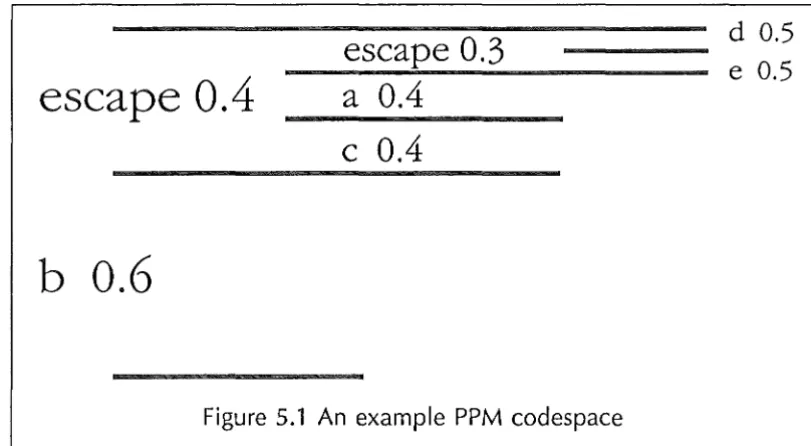
described above, and the calculation of the confidence estimate is described in the discussion of tuning below. PPMC is a somewhat more difficult case, as the distribution it creates has some of the codespace put aside for the escape, and the codespace for some characters lie within the escape (see figure 5.1)
However, all the effective probabilities for all the symbols in the alphabet still add up to 1. This means that all the probabilities of all the symbols can be moved from their position within the escape codespace to their place in alphabetical order (figure 5.1)
escape
0.3
escape
0.4
a
0.4
c
0.4
b 0.6
Figure 5.1 An example PPM codespace
d
0.5
e
0.5
The code for the PPMC model was that written by Alistair Moffat. The algorithm to produce the distribution is this: a real variable escape is initially set to 1. Each of the symbols which have occurred in the longest context are given their normal probabilities as calculated above, multiplied by the escape (which is 1 at this point). Next, escape is multiplied by the escape probability in that context. The symbols that have occurred in the next context level are assigned probabilities as before, but scaled by the new value of
escape. This continues until all letters are accounted for. In the above example,
p(a)
p(c) = 0.4 x 0.4
p(a) = 0.4
x
0.3p(e) = 0.4
x
0.3x
0.5p(d) = 0.4 x 0.3 x 0.5
Total
= 0.6
= 0.16 = 0.12 = 0.06
= 0.06
[image:29.598.128.534.237.460.2]P A R A L L E L T E X T C O M P R E S S O N
5.4
These probabilities are then put into the required array.
The final product is an array of the effective probabilities that the PPMC model would have produced for each symbol. Using these probabilities will achieve exactly the same compression as the original compressor.
Two notes about the recording the occurrences of a symbol. In the actual implementation, if a 'b' is seen in the context 'bab', 'b's count in that context will be incremented, but its count in the contexts 'ab', 'b', and so on will not be changed. This is called update exclusion, and speeds the algorithm, as well as usually increasing compression.
Also, the original model updated the model as it encoded a symbol, but this is unsuitable in this context, because a probability for each of the symbols have to be generated under the same conditions to produce the distribution. A new procedure, build_ppm_distribution searches through the data structure (a trie) to gather the probabilities.
The first requirements for this blended models compressor have now been satisfied: a parallel model producing predictions for the next letter in a text, and a PPMC model producing similar predictions.
The main program was relatively easy to write once the two models had been developed. The main problem was integrating the reading of characters so that the models were kept in step.
Originally, blending was fairly simple; no adaptive blending was implemented; the function determining the weighting given to each model was constant throughout the compression. The application was compiled, the first one hundred verses from Genesis in the Revised Standard Version were passed through the modified thesaurus program, and stored in the file source, and the same portion of the King James Version
stored in a file target. The program was run, and produced a file 2750 bytes long. It even decompressed! The target text was originally 12672 bytes. By setting the parallel model confidence to 0, the parallel model is ignored, and the whole model is equivalent to the PPMC. The size of the compressed file without the parallel model was 3443 bytes, so the parallel model yielded another 20% compression.
Tuning
From the results of the competition, it seemed that it could be possible on some texts to achieve up to twice the compression with a parallel text as without. A realistic goal, I thought was 30-40% better with tuning.
P A R A L L E L T E X T C O M P R E S S I O N
'O
Q.)
~
r:J') r/) Q.)
~
~
200
100
0
Firstly, when looking at a pair of parallel texts, it is obvious that the more letters a model has of a word, the more sure it is about the predictions that it makes. Exactly how this 'confidence function' varies with the length of the string had to be determined.
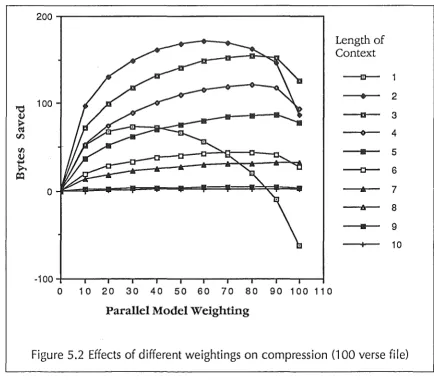
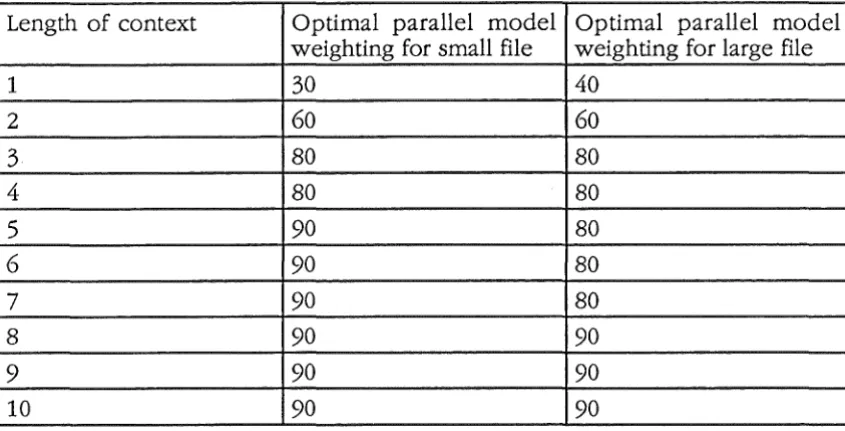
One very useful property of the model is that the optimal weights for different lengths are independent of one another. For example the weight given to the parallel model if three letters of a word have been seen is completely irrelevant if only two letters have been seen! Therefore, to find the optimal value for the weighting for a given string length, all that is necessary is to set all other weights to 0, and vary the weight in question. The parallel model weighting is given as a percentage, and the PPMC model receives the rest of the weighting out of 100%. For example, a 30% weighting would mean that PPMC would get 70%; about a 1:2 weighting in favour of PPMC. The model was tested with 11 different weightings (0 to 100% in 10% increments), for lengths from 1 to 10. The graph of the number of bytes saved by each of the weightings is in figure 5.2. The optimal values of each of the weightings is where each line is at its maximum.
Length of Context
~
2
1:1 3
4
1!11 5
- - 0 - - 6
*
76 8
1111 9
10
0 10 20 30 40 50 60 70 80 90 100 110
Parallel Model Weighting
[image:31.597.79.514.376.764.2]P A R A L L E L T E X T C O M P R E S S I O N
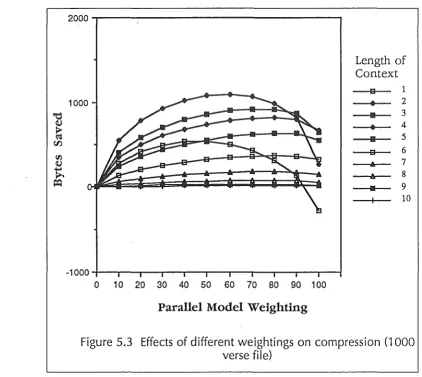
Because the weights are independent, the number of bytes saved for the optimal value of each weight can be summed to produce the total number of bytes saved by the parallel model. For example, if by tuning the weight for context lengths of one gains 500 bytes over ignoring the parallel model, tuning for lengths of two gains 300, 200 for lengths of three and so on, the total number of bytes gained by tuning all of them is 500 + 300 + 200 + ... Note that the amount of compression gained by the tuning of each weight from two onwards decreases. This is probably simply due to the rarity of the longer words. Probably the most important point about the shape of these graphs is the insensitivity of the compression ratio to the weights around the optimal weight. This means that the selection of weights is not critical, and could possibly be static. The same optimisation was tried on a larger (more realistic) 1000 verse file (130 kilobytes) (see figure 5.3), producing reassuringly similar results (see table 5.1).
Length of
"d
(l)
~
ti')
rJ) (l)
~
~
Context
El 1
2
1111 3 4
1111 5
El 6
A 7
A 8 1111 9
10
-1000 -+--.--.--.----..---.----.--.--..----.--...--i
0 10 20 30 40 50 60 70 80 90 100
Parallel Model Weighting
[image:32.597.115.538.345.722.2]P A R A L L E L T E X T C O M P R E S S I O N
Table 5.1 Optimal weights for small and large files
Length of context Optimal parallel model Optimal parallel model
1 2 3 4 5 6
7
8
9
10
weighting for small file weighting for large file
30 40
60 60
80 80
80 80
90 80
90 80
90 80
90 90
90 90
90 90
Using these optimal weights reduced the size of the file by another
2-3%.-The next parameter needing optimisation was the weighting of unexpected symbols. The dilemma was essentially this: if a completely unexpected letter occurs, it must still have been assigned some codespace, otherwise it cannot be encoded. However, if all of the letters are weighted, the codespace for
expected letters becomes smaller. The PPMC model caters for unexpected symbols by switching to a shorter context; should the PPMC model do the same? Looking at the issue from a practical point of view, it was found when analysing the results of the competition that it was desirable to limit the maximum bet to 95%, in order to leave some room for error. The extra compression from a 99% bet over a 95% bet was little, but the possible losses were higher.
The original version assigned a count of one to everything, then added 40 for a matching word, and 20 for a matching synonym. Changing the model to assign zero to all counts before building the distribution produced a 2300 byte file -a 5% improvement! It seems that letting PPMC cater for the unexpected symbols is desirable.
[image:33.597.88.511.116.331.2]__ ,.;
P A R A L L E L T E X T C O M P R E S S I O N
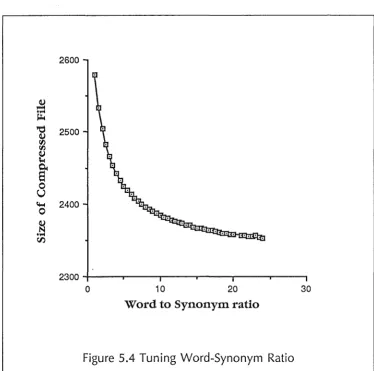
less than 1/20. This indicated that synonyms were practically useless.
0
~
~
"d 2500
0
Cf) Cf)
0
l,m(
~
0
u
11"'4
0 2400
~
·~
Cl'}
0 10 20 30
Word to Synonym ratio
Figure 5.4 Tuning Word-Synonym Ratio
After examination of the synonyms produced for the words in a verse, the problem became clear. The most lucrative time for the parallel model was in the first few characters (see figure 5.2) - the most compression can be gained from making good predictions based on two or three letters. The number of synonyms produced by a verse were huge. This means that for a given one- or two-letter string, many matching but totally useless synonyms can be found. This information is more of a hindrance than a help, so compression is better without it. Another reason for the lack of usefulness for synonyms was that the RSV-KJV pair are very close, in that the RSV was a revision of the K]V, and many original wordings have been retained. For this reason, words were much more useful than synonyms for this particular text.
[image:34.597.160.535.98.469.2]P A R A L L E L T E X T C O M P R E S S I O N
using synonyms only when no matching words could be found, provided the context length was greater than two. This meant that the previous confusion caused by the large number of words matching small contexts was removed. The condition for use of synonyms was changed from
(words_matched O && length> threshold)
to
(words_matched == 0 I I length> threshold)
which meant that synonyms would be used if there were no more matching words or the context length is long enough to reduce the number of matching synonyms. In the first case, there is no time when both words and synonyms are used, so the weightings are independent. The only parameter to optimise is the threshold at which synonyms are used. After tuning, a threshold of two was found to be best.
In the second case, the word to synonym ratio has to be re-optimised. It became evident after all this testing that the amount of extra compression involved in these choices was negligible, so the most straightforward option, where weightings are independent, was chosen.
Next, some atte'ntion needs to be paid to the position of a candidate word or synonym in a verse. If exactly one word or exactly one synonym is matched completely, the model should assume that the position of that word is the current position in the text. If such a position is found, each candidate for the next word should be weighted according to its distance from the assumed position. If the next word, when completely read, is not matched exactly once, the assumed position is incremented, but the confidence that this is the correct position is reduced, to a point where after several unmatched words, it is no longer considered. In this way, if phrases are interchanged, the model can easily follow the appropriate path.
However, the improvement in compression when this was added was negligible - it is interesting to note that the very simplest of techniques yield large returns, while the more sophisticated ones yield only small improvements.
P A R A L L E L T E X T C O M P R E S S I O N
symbols this represents about one seventh of the symbols in the target file. A large part of the size of the compressed file was coming from the larger entropy symbols.
~
0
1-c
~
~
,....;
~
;..,
0
~
20000
10000
Total Entropy
Number of Symbols
15000
10000
5000
n-!---.-~~~.--...-...-...--.-....---.:=!:;::=*=-.,i...--l-0
0 2 4 6 8 10
Minimum Entropy (bits)
Figure 5.5 Where does the entropy come from?
Looking more closely at the file, it was evident that a lot of the bits were being generated on the first character of a word. This is consistent with the results from the competition -most of the losses in compression are made at the start of the word, as the later characters in a word are usually predicted highly accurately. To predict the first character of a word, the PPMC model has to look at the contexts where the last letter was a space, so has no more idea about the next word than the parallel model. The parallel model should have some idea of the possible first letters of a word; if the position is correct, it should give a very good indication. Using the parallel model to generate a distribution for the first character of a word, and after tuning had been performed, it was found that it predictions were worth a weighting of about 60%, and reduced the size of the file to 2089, about 40% better than PPMC.
Up to this point, the model did not learn; the model was a
static one, which did not adapt to the text. What would be
fl)
,....; 0
~
I>-ti)
lo-I
0
1-c v
~
[image:36.597.158.532.121.451.2]j
P A R A L L E L T E X T C O M P R E S S I O N
desirable is if a word corresponds to itself often, to record this, but if it often corresponds to some synonym, then that connection should also be recorded. As the model goes along, then, it may learn for example that the word 'food' in one text corresponds to the word 'nourishment' in the other. In this way, it should improve its predictions as it gets further through the file.
This was implemented using two hash tables of words; one containing counts for the number of times a word corresponds to itself, and the other containing references to common synonyms. When a full target word has been processed, any connections found are noted (in fact, at the same time as the position is found). As words are searched, common synonyms have the same priority (i.e. other synonyms will be searched only if all the words and the common synonyms have been exhausted). This produced no real increase in compression, but would be useful on more demanding files.
This discussion has described the increase in compression on one file, the first one hundred verses of Genesis, with the RSV as the