warwick.ac.uk/lib-publications
Manuscript version: Author’s Accepted Manuscript
The version presented in WRAP is the author’s accepted manuscript and may differ from the
published version or Version of Record.
Persistent WRAP URL:
http://wrap.warwick.ac.uk/131258
How to cite:
Please refer to published version for the most recent bibliographic citation information.
If a published version is known of, the repository item page linked to above, will contain
details on accessing it.
Copyright and reuse:
The Warwick Research Archive Portal (WRAP) makes this work by researchers of the
University of Warwick available open access under the following conditions.
Copyright © and all moral rights to the version of the paper presented here belong to the
individual author(s) and/or other copyright owners. To the extent reasonable and
practicable the material made available in WRAP has been checked for eligibility before
being made available.
Copies of full items can be used for personal research or study, educational, or not-for-profit
purposes without prior permission or charge. Provided that the authors, title and full
bibliographic details are credited, a hyperlink and/or URL is given for the original metadata
page and the content is not changed in any way.
Publisher’s statement:
Please refer to the repository item page, publisher’s statement section, for further
information.
Implicit Personalization in Driving Assistance:
State-of-the-Art and Open Issues
Dewei Yi
∗, Jinya Su, Liang Hu, Cunjia Liu,
Member, IEEE
, Mohammed Quddus, Mehrdad Dianati,
Senior
Member, IEEE
and Wen-Hua Chen,
Fellow, IEEE
Abstract—In recent decades, driving assistance systems have been evolving towards personalization for adapting to different drivers. With the consideration of driving preferences and driver characteristics, these systems become more acceptable and trustworthy. This paper presents a survey on recent ad-vances in implicit personalized driving assistance. We classify the collection of work into three main categories: 1) personalized Safe Driving Systems (SDS), 2) personalized Driver Monitoring Systems (DMS), and 3) personalized In-vehicle Information Systems (IVIS). For each category, we provide a comprehensive review of current applications and related techniques along with the discussion of industry status, benefits of personalization, application prospects, and future focal points. Both relevant driving datasets and open issues about personalized driving assistance are discussed to facilitate future research. By creating an organized categorization of the field, we hope that this survey could not only support future research and the development of new technologies for personalized driving assistance but also facilitate the application of these techniques within the driving automation community.
Index Terms—Intelligent vehicles; driver behavior analy-sis; personalization; Advanced Driver Assistance Systems;
I. INTRODUCTION
Safety, efficiency, and convenience are three key concerns raised in recent studies on intelligent vehicles [1–8]. According to a World Health Organization report, up to 50 million people are injured or disabled in road accidents worldwide every year with 90% of deaths occurred in developing nations [9]. As reported by the U.S. National Highway Traffic Safety Admin-istration, 32,719 fatalities and 2.3 million injuries occurred in the US in 2013 [10]. In addition, according to the 2015 Urban Mobility Scorecard report, traffic congestion costs $160 billion per year and causes the waste of three billion gallons of fuel. Moreover, the environment is polluted by vehicles’ tailpipe emissions. To this end, a number of in-vehicle advanced
This work was supported by the U.K. Engineering and Physical Sciences Research Council (EPSRC) Autonomous and Intelligent Systems programme under the grant number EP/J011525/1 with BAE Systems as the leading industrial partner. (Corresponding author: Dewei Yi∗).
Dewei Yi and Mehrdad Dianati are with Warwick Manufacting Group, Uni-versity of Warwick, Coventry CV4 7AL. (e-mail: [email protected]; [email protected]).
Jinya Su and Liang Hu are with the School of Computer Science and Electronic Engineering, University of Essex, Colchester CO4 3SQ, UK. (e-mail: [email protected]; [email protected]).
Cunjia Liu and Wen-Hua Chen are with the Department of Aeronautical and Automotive Engineering, Loughborough University, Loughborough LE11 3TU, U.K. (e-mail: [email protected]; [email protected]).
Mohammed Quddus is with School of Civil and Building Engineer-ing, Loughborough University, Loughborough LE11 3TU, U.K. (e-mail: [email protected]).
functions have been developed and implemented. In this paper, the baseline we used to classify driving assistance systems is the application domains of these systems. Typically, three application domains are considered: (i) the vehicle; (ii) the driver; (iii) the service that the vehicle provides for the driver. Corresponding to the three domains respectively, three kinds of categories are summarized for driving assistance systems as follows: (i) Safe Driving Systems (SDS), which work on the vehicle, especially on vehicle dynamics and control, are designed to reduce potential risks of accidents and even avoid collisions [11–13]. Typical functions of SDS include adaptive cruise control, collision avoidance, lane-keeping assistance, lane change assistance, and intersection assistance; (ii)Driver Monitoring Systems (DMS)are designed to monitor the status of drivers so that they can be warned about abnormal driv-ing behaviors and cognitive states [14]. Typical functions of DMS include fatigue and distraction detection, driving style recognition (range prediction), and affective state recognition; (iii) In-Vehicle Information Systems (IVIS) provide in-time information and services for the driver [15]. Typical functions of IVIS include route recommendations, entertainment ser-vices recommendations, notification serser-vices, and interactive assistance.
Internal data sources
External data sources
Sensors
Measurements
Rule based approach
Machine learning Driving behaviors Driving features
Driving behavior recognition
Feature selection New measurements
Generic predictor
Driving behavior
Model based approach
GPS V2X
Traffic management
centres Cameras
Lidar/Radar IMU
Driving Assistance
Corresponding service Driving
features
[image:2.612.316.560.472.626.2]All drivers’ data
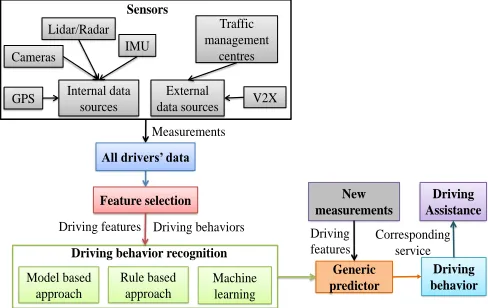
Fig. 1. Process of generic driving assistance, where V2X means vehicle-to-everything (e.g. vehicle, infrastructure) communication [16, 17]. Internal data sources denote data collected by vehicle embedded sensors. External data sources denote data collected by broadcasts, communicating with others vehicles and road infrastructures. “all drivers’ data” imply that no driver ID is recorded in data collection.
framework in Fig. 1. In a generic system, measurements from internal data sources (the sensors embedded in a vehicle, e.g. GPS, camera, IMU, Lidar and radar) and external data sources (the data obtained from communication networks and traffic radios, e.g. traffic management centers and V2X communication) are treated indiscriminately even though these measurements may be collected from different drivers. Next, the principal features are chosen by using feature selection techniques so as to conspicuously link the driving features to the corresponding driving behaviors. After obtaining the principal driving features and labels of the corresponding driving behaviors, driving behaviors can be recognized by three different approaches including: model based approaches, rule based approaches, and machine learning approaches. The predictors of model based approaches are derived from driver models (e.g. intelligent driver model and car-following model) as in [19–21]. The predictors using rule based approaches are often used to recognize driver behaviors based on a predetermined threshold [22–24]. The predictors of machine learning approaches are obtained by training a classifier or regressor (e.g. Bayesian network, decision tree, and support vector machine) as in [5, 25, 26]. Then, the predictor can be deployed in a generic system. When the new measurements are received by sensors, the corresponding driving behaviors (e.g. fatigue, distraction) are recognized by the generic predictor so that corresponding services (e.g. guiding drivers to rest stops, alerting drivers) can be provided. It is noticeable that the generic approach trains or designs a model by using the driving data of all drivers indiscriminately, and, as a result, per-sonalized driving characteristics and preferences of individual drivers may be neglected [27]. In practice, different drivers may have distinct driving characteristics and preferences even in a similar driving scenario [3]. Therefore, it is not surprising that a conventional generic approach may provide limited per-formance and satisfaction for individual drivers. This motivates the introduction of personalized driving assistance, implicitly embedding personalized styles, preferences, and characteris-tics. Here, thedriving stylesrefer to drivers’ personal feelings about whether their driving is normal, moderate or aggressive. The procedure of collecting normal and aggressive driving data for individual drivers is outlined in [28]. Driving preference and characteristic refer to personal driving behaviors such as preferred distance to the car in-front [20, 26] and adaptive lane change assistance [29].
This paper presents a comprehensive review of personalized driving assistance. Personalization of driving assistance is discussed from three different aspects, where the taxonomy and related techniques of driving assistance are presented in Fig. 2. To the best of the authors’ knowledge, this is the first attempt to conduct a comprehensive review of implicit personalized driving assistance. The main contributions are summarized as follows:
• In review of different application domains, driving assis-tance systems are divided into SDS, DMS, and IVIS with the corresponding functions.
• The motivations and key components of personalized driv-ing assistance systems are discussed.
Personalized Driving Assistance
Driver Monitoring
Systems In-Vehicles
Information Systems
Safe Driving Systems
Route Recommendations
Entertainment Services Recommendations Notification
Services Interactive Assistance
Affective State Recognition Distraction Detection
Fatigue Detection Lane Change
Assistance
Intersection Assistance
Adaptive Cruise Control
Collision Avoidance
Lane Keeping Assistance
[image:3.612.316.559.53.220.2]Driving Style Recognition
Fig. 2. The Categories of Personalized Driving Assistance.
• State-of-the-art implicit personalized driving assistance techniques in SDS, DMS, and IVIS are elaborated along with dataset types, inputs, algorithms, pros, and cons.
• Detailed discussions are conducted on SDS, DMS, and
IVIS in terms of industry status, benefits of personalization, application prospects, and future focal points. The literature of SDS, DMS, and IVIS covers from 1999 to 2019, from 2009 to 2019, and from 2001 to 2019 respectively. • Open issues on implicit personalized driving assistance are
highlighted to inspire future research.
II. PERSONALIZATION INDRIVINGASSISTANCE
According to [3, 22, 26, 30–34], driving assistance systems should be safe, effective, and comfortable. To meet these criteria, personalization is introduced to understand the status of a specific driver [35], and take individual driving styles [29], requirements, and preferences [36] into account.
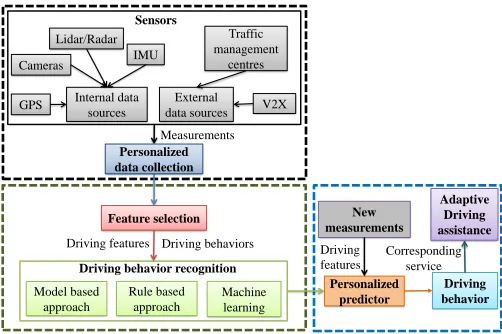
Personalized systems are often realized in implicit ways using data-driven approaches. This is because implicit per-sonalization allows a system to adapt to the user through interactions and historical usage data with little direct input from the driver [37, 38]. For instance, the parameters of an intelligent driver model [39] can be tuned from individual his-torical driving data. The key components of the personalization process include observing the driving behaviors, modelling human driving behaviors and validating the models as shown
in Fig. 3. These components are explained as follows. 1)
safety. To this end, human in the loop simulation [32, 43] is a promising, efficient and meaningful alternative.
Internal data sources
External data sources Sensors
Measurements
Rule based approach
Machine learning Driving behaviors Driving features
Driving behavior recognition
Feature selection New measurements
Personalized predictor
Driving behavior Model based
approach
GPS V2X
Traffic management
centres Cameras
Lidar/Radar IMU
Adaptive Driving assistance Corresponding
service Personalized
data collection
[image:4.612.49.300.90.257.2]Driving features
Fig. 3. Personalized process, where the blocks within black dashed lines are for observing the driving behaviors, the blocks within dark green dashed lines are for human driving behaviors and preferences modelling, and the blocks within dark blue dashed lines are for the validation of a personalized model.
III. PERSONALIZEDSAFEDRIVINGSYSTEMS(SDS)
SDS have evolved substantially in the past decades and have become a significant component of intelligent vehicles. SDS are focused on external environment (e.g. road types, traffic conditions, and other road users) rather than in-vehicle environment (e.g. drivers, passengers). Therefore, “out-vehicle assistance” links more closely to vehicle dynamic control. This section reviews the related studies in five different aspects: adaptive cruise control, collision avoidance, lane keeping assistance, lane change assistance and intersection assistance. The related literature of personalized SDS, presented in this paper, is summarized in Table I and Table II along with the description of dataset types, inputs, used algorithms, pros, and cons.
A. Adaptive Cruise Control
Adaptive cruise control focuses on the longitudinal control of a vehicle, which drives a vehicle at a pre-defined speed whilst maintaining a desired gap with the vehicle in-front. However, conventional adaptive cruise control systems only provide a limited number of pre-defined gaps. Such design makes these systems difficult to satisfy the requirements of different drivers. To overcome this weakness, a large number of personalized adaptive cruise control systems have been de-veloped over recent decades. In [23, 47, 51, 66], personalized adaptive cruise control systems adapt to drivers in real-time based on the observation of the drivers’ style and preferences. Here, artificial neural networks, linear models or a combina-tion of the two are used to generate time gaps of a specific driver according to the driver’s historical driving data. In [44], authors design a fuzzy controller based on evolutionary strate-gies, which can generate fuzzy rules by using the driving data of a specific driver such that a variety of behaviors can imitated with improved accuracy. Different from the aforementioned approaches, learning-based approaches that use Model Pre-dictive Control are used in [21, 53, 57, 58]. This allows them
to imitate each driver’s style and preferences so as to achieve personalized adaptive cruise control of a vehicle. In addition, [20] predicts a driver’s throttle and braking pedal operations according to time headway and inverse time to collision. In contrast to previous research that mainly focuses on imitating a specific driver’s behaviors, [18, 19, 65] reduce the errors of longitudinal control by building a personalized driving model. Driver’s behaviors are modeled using a Gaussian Mixture Model approach. In general, most of the personalized adaptive cruise control functions can provide reasonable performance. One big challenge is how to define principal features for different drivers, because different drivers have different driv-ing characteristics and therefore useful features for different drivers may be entirely different. Inspired by [73, 74], the principal individual driving characteristics can be extracted by using model selection techniques (e.g. Wald statistics) [73] or feature selection algorithms (e.g. sequential forward floating selection) [74].
B. Collision Avoidance
Collision avoidance systems enhance driving safety by alerting drivers to an impending collision or automatic braking for avoiding potential collisions. However, different drivers have different driving styles, preferences, and characteristics. A generic model based collision avoidance approach cannot perform well for all drivers. To reduce the false alarms and extend the reaction time, personalized driving characteristics can be considered for these systems [23, 67, 68, 70, 75]. Rule based collision avoidance algorithms are intuitive approaches to predict a crash event, where a threshold for autonomous braking is learned from personalized historical driving data [23]. In [67], a statistical behavior modeling approach is proposed to estimate the danger level probability distribution of a particular driver such that an activation threshold can be determined to warn them of the potential of an emerging crash. However, the warning threshold of different driving situations should be different. Therefore, authors in [68] develop an online learning forward collision warning algorithm which adjusts the warning threshold automatically by considering the current driving situation. In contrast to the aforementioned studies, [70] implements personalized steering assistance by introducing a personalized potential field. In the proposed system, a personalized potential map is built up to represent hazard awareness of each driver. In brief, online learning algorithms can be promising solutions which can adjust the threshold of a specific driver over time. Additionally, return-ing uncertainty is significant for decision makreturn-ing on vehicle dynamics control, where systems can provide the probability of potential collision [76]. However, the approaches used here are “offline”, which means they cannot tune the threshold over time as in [23].
C. Lane-Keeping Assistance
TABLE I
SUMMARY OF THEPRESENTEDRESEARCH INPERSONALIZEDSDS (PARTA)
Type Ref Dataset Inputs Algorithms Pros Cons
Adaptive Cruise Control
[44] Real-world -Space headway, speed of the leading vehicle, speed of the following vehicle, relative speed
Evolutionary strategies, Fuzzy logic
-Direct for real valued parame-ter optimization; Rule structure and membership functions are evolved simultaneously; [45]
-Fuzzy control is not easy to conduct stability analysis; [46]
[47] Real-world -Space headway, speed of the leading vehicle, speed of the following vehicle
Artificial Neural Network, Linear model
-Flexible nonlinear capability; data-driven method; [48, 49]
-Hard to design layers and neu-rons; large volume of iterations to converge [49, 50]; [23, 51] Real-world -Space headway, relative
speed, speed of the lead-ing vehicle
Linear model -Simple implementation; ro-bustness;
-Limited accuracy;
[21] Simulation -Velocity Gaussian
Mixture Model
-Low computation load [52]; easy to implement; arbitrary feature distribution;
-Hard to tune parameters; hard to extend in high dimensional applications;
[53] Simulation& Real-world
-Longitudinal position, longitudinal velocity of the ego vehicle, relative distance to the preceding vehicle
Hidden Markov Model + Gaus-sian Mixture Re-gression
-Time-sequential learning [54]; arbitrary feature distribution; utilization of prior knowledge [55];
-High model complexity [56]; underperform in high dimen-sional problems;
[57] Real-world -Relative distance to the preceding vehicle, relative velocity to the preceding vehicle, velocity of the ego vehicle
Hidden Markov Model + Gaus-sian Mixture Re-gression
-Time-sequential learning [54]; arbitrary feature distribution; utilization of prior knowledge [55];
-High model complexity [56]; underperform in high dimen-sional problems;
[58] Simulation -Position, velocity Random Forest
Regression
-Always converge and
overfitting-free; robustness to residual features;[59] little pre-defined parameters [60];
-“black box” approach [61]; lo-cal optima; large model size [62];
[20] Real-world -Headway, speed of the
host vehicle, relative speed to the leading vehicle
Recursive Least Square
-Robustness; online adaptation; [63]
-Roundoff error sensitivity [64];
[18, 65] Real-world -Speed of the following vehicle, relative distance, relative speed, change rate of relative speed, follow-ing vehicle acceleration
Gaussian Mixture Model
-Low computation load [52]; easy to implement; arbitrary feature distribution;
-Hard to tune parameters; un-derperform in high dimensional problems;
[19] Simulation -Following distance (Ft), Velocity (Vt),∆Ft,∆Vt,
∆2F
t,∆2Vt, Gas pedal pattern (Gt), Brake pedal pattern (Bt),∆Gt,∆Bt
Gaussian Mixture Model
-Low computation load [52]; easy to implement; arbitrary feature distribution;
-Hard to tune parameters; un-derperform in high dimensional problems;
[66] Simulation -Maximum acceleration,
maximum deceleration, mean of time headway
(THW), standard
deviation of mean THW, standard deviation of THW, maximum inverse time to collision (TTC), minimum inverse TTC;
Multi-model based artificial neural network
-More precise modeling, flexi-ble nonlinear capability; [48]
-Hard to tune parameters; un-derperform in high dimensional problems;
Collision Avoid-ance
[67] Simulation -Wheelbase, distance of the center of gravity to the front axle, distance of the center of gravity to the rear axle, vehicle mass, moment of inertia to the yaw axis, relative front cornering stiffness, rear cornering stiffness
Neural Network -Flexible nonlinear capability; data-driven method; [48, 49]
-Hard to design layers and neu-rons; large volume of iterations to converge; [49, 50]
[68] Real-world -Speed of host vehicle, weighted following dis-tance, weighted relative speed
Recursive least square
-Online adaptation and compu-tational efficiency [69]; well in-terpretation; robustness;
-Explicit relation between in-puts and outin-puts;
[70] Simulation -Distance to left boundary, distance to right boundary
Potential field -Unrestraint with shapes of ob-jects; [71]
-Unstable motion [72];
[23] Real-world -Relative velocity Rule-based
model
TABLE II
SUMMARY OF THEPRESENTEDRESEARCH INPERSONALIZEDSDS (PARTB)
Type Ref Dataset Inputs Algorithms Pros Cons
Lane-Keeping Assistance
[57] Real-world -Longitudinal velocity, distance to the lane center (y), orientation with respect to the lane center (θ), derivative of y, derivative of θ, road curvature
Hidden Markov Models + Gaus-sian Mixture Re-gression
-Time-sequential learning [54]; arbitrary feature distribution; utilization of prior knowledge [55];
-High model complexity [56]; underperform in high dimen-sional problems;
[77] Real-world -Vehicle speed, relative yaw angle, relative yaw rate, road curvature, lat-eral displacement
Gaussian Mixture Models
+ Hidden
Markov Models
-Time-sequential learning [54]; arbitrary feature distribution; utilization of prior knowledge [55];
-High model complexity [56]; underperform in high dimen-sional problems;
Lane Change Assistance
[29] Real-world -Distance of gap, relative speed of interest
Gaussian Mixture Models
-Low computation load [52]; easy to implement; arbitrary feature distribution;
-Hard to tune parameters; un-derperform in high dimensional problems;
[27] Simulation -Steering wheel angle, the error between desired path and current path
Lateral driver model
-Intuitive interpretation; easy realization;
-Hard to guarantee accuracy;
[78] Simulation -Distance of ego-car (E) and merging-car (M); rel-ative velocity between E and M; relative accelera-tion between E and lead-ing car; relative distance to the end of acceleration lane; length of recogniz-able area;
Decision entropy +Randomized Model Predictive Control+logistic regression model
-Low computation load [52]; easy to implement; take human drivers’ preferences and uncer-tainty into account;
-Neglect the personality and preferences of drivers;
[79] Simulation -Distance of gap and ve-hicle position
Logistic regres-sion model
-Easy to implement; Fast run-time [52];
-The diversity of the partici-pants is not enough (it had bet-ter include drivers from differ-ent age groups and genders); [80] Simulation -Longitudinal Vehicle
Speed, yaw angle, lateral Deviations, steering wheel angle
Human-Centered Feed-forward Control
-Feedback-free [81]; -Slow response; unstable; [81]
[82] Simulation -Electroencephalography Extend queuing network
-High accuracy with low cost; well structure model; [83]
-Low anti-interference ability (single source) [84];
[85] Simulation –Speed, proximities to in-ner/outer road boundary
Inverse optimal control
-Constructive; stability; [86] -Model-dependent; priori-dependent; [87]
[88] Real-world -Velocity, relative velocity and distance
fuzzy c-mean
clustering +
fuzzy knn +
intelligent driver model
-Labeling-free and model-free; easy to implement; arbitrary feature distribution;
-Hard to choose distance crite-ria in feature space and tune the threshold for convergence; high computation load;
Intersection Assistance
[89] Simulation -Traffic lights location and timing data for each one of them on the route, traffic flow speed (V2I needed), fuel consump-tion, time of arrival
Sequential Quadratic Programming
-High flexibility; nonlinear models; multiple objectives; [90]
-High computation load [90];
[91] Simulation -Historical gap size Maximum
Like-lihood
-Consistent parameter estima-tion; solid theoretical basis;
-Biased for small samples; lo-cal optima;
[23] Real-world -Relative velocity Rule based
model
-Simplicity; robustness; -Thresholds and features selec-tion; limited performance;
abandon lane-keeping assistance systems [26, 92]. To reduce false positive rate, Hidden Markov Models, Gaussian Mixture Models, and their combination are used in personalized lane-keeping assistance systems [57, 77]. These systems can learn a driver’s preferences when a human-driver keeps driving in a lane. Subsequently, these systems accommodate to each driver by considering his/her driving preferences and characteristics. In general, the Gaussian Mixture Models is robust to the feature distribution and is able to deal with nonlinear prob-lems. Hidden Markov Models can process sequential data (or streaming data). It is not surprising that their combination, which inherits the advantages of Gaussian Mixture Models and Hidden Markov Models, outperforms both of them.
D. Lane Change Assistance
characteristics of drivers. Here, the fuzzy c-mean clustering algorithm is combined with a Kalman filter to estimate the distance from the following vehicle to the heading vehicle more accurately. Another approach implements personalized lane changing by proposing a compensatory transfer function based on a driver model in combination with a feedforward an-ticipatory subsystem [27]. Furthermore, [85] learns a driver’s steering characteristics by using inverse optimal control. In this research, inverse optimal control is used to identify the parameters of a driver, where the cost function is designed by considering speed, steering, and the inner/outter road bound-ary. In addition, lane change assistance plays a significant role in merging tasks. In [78, 79], logistic regression models are used to determine the acceptability of merging tasks. Compared to [79], [78] also takes preferences of drivers on the main lane into account, which is achieved by minimizing decision entropy. Such design makes driving assistance more acceptable and efficient. Lane change assistance is also a sharing control task, where a human driver and the vehicle controller are able to collaborate with each other. To this end, [80, 93] develop a Human-Centered Feed-forward Control system, where a driver’s steering characteristics and the human driver’s steering inputs are both taken into account for vehicle steering control. More interesting research in personalized lane change assistance is to predict steering angle by the electroencephalography signal[82]. This study shows that a human driver’s intention can be reflected by his/her electroen-cephalography signal.
E. Intersection Assistance
Intersection crossing is one of the most frequent driving maneuvers in urban and metropolitan areas. To make inter-section assistance more desired, several interinter-section assistant systems are proposed with the consideration of personal driv-ing preferences [23, 89, 91]. The distance of brakdriv-ing or the distance required to release the accelerator can be expressed by a polynomial regression model, where the coefficients of the model are calibrated by personal driving data in order to adapt to different drivers [23]. In [89], the authors propose a personalized pace optimization algorithm to help drivers approach and cross through a signalized interaction. The proposed algorithm optimizes pace on a route by considering driver characteristics so that fuel use and waiting time are minimized. Different from conventional methods (e.g., Trout-beck [94], Raff [95]), authors in [91] estimate a critical gap by using Maximum Likelihood Estimation. The critical gap is the smallest acceptable gap for a specific driver. According to experimental results, the false alarm rate can be reduced from 11.8% to 9.8% by introducing the critical gap. Overall, the polynomial regression model is a feasible approach to predict braking and accelerator release behaviors. However, are there any better models to describe these behaviors? For instance, the Gaussian Process may provide a better model for these behaviors, which has the additional advantages of providing confidence intervals and not requiring the order of the regression model to be defined a priori [96]. Furthermore, Maximum Likelihood Estimation is numerically stable and straightforward to implement.
F. Discussion
Industry status:Adaptive cruise control functions are pro-vided by many models of cars (e.g. Audi A8, Volkswagen Touareg, BMW 5 and 6 series) [97]. Similarly, collision avoid-ance systems have also been successfully used in many brands and models such as Audi (A8, A7, A3), Dodge Durango, Honda (Accord, Inspire), Lexus (LS, GS, IS, RX), Skoda Octavia, Tesla Model S [97]. However, these functions are often implemented using rule-based approaches, which cannot adapt to individual drivers in an online manner. Although lots of studies have been conducted on personalized SDS, automotive manufacturers have not rushed to promote per-sonalized functions of SDS. This may be because integrating the personalized learning algorithms into existing SDS needs careful testing to guarantee compatibility and security.
Benefits of personalization:Safe driving systems can obtain several benefits by introducing personalization. The primary benefit is the enhanced acceptability [26, 68]. In [26], the false-warning rate of a lane departure warning system can be reduced to 3.13%. In [68], the false positive rate of a forward collision warning system is decreased below 10%. The secondary benefit is safety. When the false alarm is too high, the systems can become annoying to drivers and may be abandoned [18, 29]. Therefore, the enhanced acceptability can encourage drivers to keep SDS, which leads to an improvement in driving safety.
Future focal points: Firstly, safe interaction amongst users (human drivers or even autonomous vehicles) on the road needs to be prioritized [98]. The implementation of safe interaction is challenging because human actions and be-haviors are often unpredictable [99]. Fortunately, studies in [98, 100] provide some promising ideas (such as developing robust informative models or regenerative stochastic models). Secondly, intersection assistance may become a focal point with the development of vehicle embedded devices (e.g. communication modules, high-performance CPU/GPUs) and road infrastructures (e.g. roadside units), which can not only make approaching an intersection safer and more smooth (for example, by reducing unnecessary braking and providing collision warnings), but also provide clearer communication amongst drivers to improve the fluency of their interactions.
IV. PERSONALIZEDDRIVERMONITORINGSYSTEMS
(DMS)
In recent years, in-vehicle monitoring systems have been de-veloped rapidly and pervasively applied in healthcare and cog-nitive workload recognition [101]. Driver monitoring systems can detect abnormal driving behaviors (drowsiness, fatigue, distraction) or driving styles (normal, moderate, aggressive) via vehicle dynamic measurements or vision measurements. Moreover, driver monitoring systems are one of the most sig-nificant components of vehicular safety applications detecting fatigue, distractions and the driving style/cognitive state of a driver [102]. However, several challenges, such as trust, acceptance, and unpredictability [98, 103, 104], may slow down the development of these systems. To overcome these issues, personalized driver monitoring may be a promising solution, which makes driving assistance more trustworthy and acceptable. Moreover, driving performances of different drivers are quite different even in the same driving scenarios. The limited feedback of personalized driving behaviors make it difficult to evaluate the performance of plug-in hybrid electric vehicles [105]. Personalized driver monitoring systems are to detect abnormal behaviors and driving styles based on indi-vidual drivers. For instance, the heart rate and blood pressure are two popular measurements to assess abnormal driving behaviors (drowsiness, fatigue, distraction) [24, 106, 107]. However, classifying based on average statistics of these two measurements easily leads to a higher false positive rate, especially for drivers with cardiovascular diseases. Because of this, personalized driver monitoring systems urgently need to be developed. Compared to SDS, the personalization in driver monitoring systems has not attracted significant attention in the past decade. Table III summarizes the relevant techniques in personalized driver monitoring systems along with the description of dataset types, inputs, used algorithms, pros, and cons.
A. Fatigue and Distraction Detection
Driver inattention monitoring can be classified into distrac-tion and fatigue [123]. Some studies attempt to detect fatigue and distraction via video [40, 41, 109]. Vision measurements contain eye blink duration, nodding frequency, and head poses.
These measurements have been proved useful to detect abnor-mal driving behaviors [123]. However, vision measurements are often obtained using computer vision techniques which are sensitive to light condition. Moreover, the privacy issue involved in vision also needs to be addressed. Compared to vision measurements, vehicle dynamic measurements are more robust against light condition [3]. Vehicle dynamic measure-ments include steering angle, lateral acceleration, longitudinal acceleration, vehicle velocity amongst others. Moreover, more features can be generated by using vehicle dynamic measure-ments such as steering entropy, steering reversal rate, and speed prediction error. In [108], speed prediction error and steering entropy are used as features to train a support vector machine, which can achieve high overall accuracy of 95% and a false positive rate about 78.3% based on a specific driver’s data. It is found that a personalized drowsiness detection system outperforms the generic system when sufficient person-alized data is available for training the classifier. Personperson-alized data collection is always challenging in a personalized applica-tion. In [101], a personalized monitoring system is proposed, where captive electrocardiogram and ballistocardiogram data can be obtained in real-time and recognize fatigue. In contrast to [101], eye blink activities are also considered in [24] and therefore the false alarms of fatigue detection can be reduced.
B. Driving Style Recognition
TABLE III
SUMMARY OF THEPRESENTEDRESEARCH INPERSONALIZEDDRIVERMONITORINGSYSTEMS
Type Ref Dataset Inputs Algorithms Pros Cons
Fatigue and Distraction Detection
[108] Real-world -Steering entropy; mean absolute speed prediction error;
Nonlinear Autoregressive
Exogenous model
+Support Vector
Machines
-Fast runtime; flexi-ble nonlinear capabil-ity; [48]
-Not easy to select an appropriate kernel;
[109] Real-world -Labelled images Neural Network -Flexible nonlinear
capability; data-driven method; [48, 49]
-Hard to design lay-ers and neurons; large volume of iterations to converge; [49, 50] [101] Real-world -Capacitive Electrocardiogram,
Ballistocardiogram
Rule based approach -Simplicity; robustness;
-Hard to determine threshold; limited performance; high requirement of feature selection;
[24] Simulation -Capacitive Electrocardiogram, Ballistocardiogram, Eye blink activity
Rule based approach -Simplicity; robustness;
-Hard to determine threshold; limited performance; high requirement of feature selection;
Driving Style Recognition
[105] Real-world -Speed, acceleration, road type, road condition
Classification and Regression Tree, wavelet-based filtering
-Easy to implement; well interpretation; [110]
-Local optima; may
give misleading
results; [110, 111]
[112] Real-world -Continuous average speed, decel-eration tuple, acceldecel-eration tuple, gyroscope tuple, auxiliary load of idling, vehicle weight, total idle duration
Energy consumption model
-Intuitive
interpretation; easy to implement;
-Hard to guarantee ac-curacy;
[113] Real-world -Biometric measures, vehicle dy-namic measures
Gaussian Mixture Model
-Low computation load [52]; easy to imple-ment; arbitrary feature distribution;
-Hard to tune param-eters; underperform in high dimensional prob-lems;
[114] Simulation -Distance between vehicle and traffic signal, durations of red and green light, traffic light cycle number
Scenario tree based stochastic model
-Solve constratined stochastic optimal
problem [115];
context aware; feasible
computation load
[116];
-Low robustness (high sensitivity for parame-ters) [117];
[32, 43] Simulation -Vehicle acceleration, Adjusted headway time, relative distance, Relative velocity
Probability weighted autoregressive exoge-nous model
-Time-varying processes; distribution-free; consideration of uncertainty;
-Poor at long-term pre-diction; sensitive with outliers;
[118] Real-world -Average speed, deceleration tu-ple, acceleration tutu-ple, total idle duration, mean absolute of gyro-scope, Auxiliary load of idling
Similiarty matching + driving habit match-ing
-Low complexity; well interpretation; [119]
-Static model [120]; slow response time [121];
[122] Real-world -Throttle position, brake pressure, vehicle speed
Neural network -Flexible nonlinear
capability; data-driven method; [48, 49]
-Hard to design lay-ers and neurons; large volume of iterations to converge; [49, 50] Affective
State Recognition
[103] Simulation -kinematic (relative distance, ve-locity, and acceleration at the lead vehicle’s brake start time), elec-troencephalography (mean and standard deviation of each chan-nel’s absolute intensity, relative levels for each band power, spec-trum analysis features) and ther-mal facial analysis (forehead, left eye, right eye, and nose)
k-nearest neighbors, random forests
-High accuracy, easy to implement and used by industry (k-nearest neighbors); arbitrary feature distribution; well interpretation (random forests have tree-based structure); [110]
-Cost of thermal cam-era is higher than an infrared camera or a RGB camera;
[3] Real-world -Speed, three dimensional accel-erations
Fuzzy c-means clus-tering, Gaussian Mix-ture Model, Support Vector Machine
-Easy to implement; arbitrary feature dis-tribution; unsupervised approach;
stochastic model is introduced to adapt to a specific driver so that vehicle acceleration and braking can be reduced [114]. In [32, 43], probability weighted autoregressive exogenous models are used to learn individual driving behaviors for a specific driver so that fuel consumption can be estimated more precisely. Driving style and state are also important in driving safety and vehicle security. In [122], a neural network is trained to build a customized driver model for recognizing abnormal driving such as drunk driving detection. In [113], Gaussian Mixture Models are utilized to extract features which can effectively infer the driver’s identification via vehicle-related measures.
C. Affective State Recognition
Affective state recognition is another significant direction for human-in-the-loop systems, especially in personalized ADAS. In [103], features related to predicting the brake reaction time of the driver are generated by analyzing kine-matic, electroencephalography, and thermal facial data. Taking affective sensing into account, the precision can be enhanced from 10 % to 40-50 %. Moreover, in order to adapt to different drivers, the fuzzy c-means clustering algorithm is adopted in [3] to achieve personalization and then Gaussian mixture models and support vector machines are compared to find out the best combination to recognize driver workload.
D. Discussion
Industry status:In recent years, automobile manufacturers have tended to pay more attention to DMS. Honda proposes a project called Honda’s automated assistant (HANA) to adjust control performance based on driver state, where driver state is measured by features such as facial expressions, voice, and heart rate [103]. Likewise, the “Sixth Sense” project of Jaguar Land Rover also intends to detect driver’s stress and alertness by measuring the driver’s heart rate, respiration rate, and brain activity [103]. In addition, other automobile manufacturers also develop their own DMS, including Audi (Rest Recommendation System), BMW (Active Driving As-sistant), Bosch (Driver Drowsiness Detection), Ford (Driver Alert), Volkswagen (Fatigue Detection System), and Volvo (e.g. Driver Alert Control) [97]. However, all of them attempt to build a generic system rather than a personalized system.
Benefits of personalization: DMS can obtain several ben-efits by introducing personalization. The primary benefit is the improved safety [108]. In [108], the driver’s state (i.e. distracted or attentive) can reach a high overall accuracy of 95% when the classifier is trained on individual driver data. A secondary benefit is efficiency, especially in the distance-to-empty prediction. By introducing personalization, the predic-tion error of distance-to-empty can be reduced to 5% [118].
Application prospects: In fatigue and distraction detection, the combination of nonlinear autoregressive exogenous models and support vector machines is a practical approach. The required features of such approaches are easy to access and its performance is validated by a test vehicle in real-time [108]. It may be insufficient to detect drowsiness purely by
eye blinking. For instance, Carsafe can only achieve 60%
detection rate for drowsy driving events. To achieve a high sensitivity in monitoring driver state, the measurements of electrocardiography and electroencephalography are combined with eye blinking detection. However, it is only proved by using a driving simulator and the cost of electroencephalogra-phy sensors are also a concern for automobile manufacturers. In driving style recognition, compared to biometrics-based signals [113], participatory sensing signals (e.g. mobile mea-surements, geographic penetrations) are easy to access using existing navigation systems (e.g. Google Maps and Waze). In [118], a similarity matching approach based on driving habits from participatory sensing data proves to be a practical solution of range prediction for electric vehicles, which is vali-dated by off-line playback. In state recognition (e.g. workload levels, emotions), random forests [103], k-nearest neighbors [103], and support vector machines [3] are promising methods. Among them, random forests and support vector machines
may be more practical because the computation load of k
-nearest neighbour increases rapidly with the increase of data dimensions and size. The recognition accuracy of random forests can achieve 86.7% by considering vehicle kinematics, thermal facial analysis, and electroencephalography together.
Future focal points: Firstly, affective state recognition should be a research emphasis due to its significance for developing provably safe human-in-the-loop systems, espe-cially for ADAS [104]. Secondly, online unsupervised learning systems should be developed for personalized DMS. There are two main reasons: (1) manually labeling a large volume of personal data is painful and inefficient so unsupervised methods are required to achieve auto-tagging; (2) the personal driving characteristics may change with accumulation of more driving experience which needs to adapt to individual drivers in an online way.
V. PERSONALIZEDIN-VEHICLEINFORMATIONSYSTEMS
(IVIS)
IVIS not only can provide navigation services, but also offer valuable information to drivers (e.g. traffic conditions, time delays, and alternative routes), entertainments services (e.g. music recommendation). Moreover, it can determine when, how and which services should be provided based on the current situation, which makes services more acceptable and efficient. In contrast to SDS and DMS, IVIS concentrate on in-vehicle services including route and entertainment services recommendations, notification services, and interactive assis-tance. Table IV summarizes categories of the relevant research literature in personalized IVIS with dataset types, inputs, used algorithms, pros, and cons.
A. Route Recommendations
TABLE IV
SUMMARY OF THEPRESENTEDRESEARCH INPERSONALIZEDIVIS
Type Ref Dataset Inputs Algorithms Pros Cons
Route
Recommendations
[33] Real-world -Taxi GPS digital
footprints
Location-based Social Network
-Learn popularity, travel history from users
-Large volume data required;
[124] Real-world -Taxi GPS traces
Variance-Entropy-Based Clustering
- Time-variant distribu-tions
-Hard to obtain precise labels;
[125] Simulation -Start and goal lo-cation
Collaborative Case-based Reasoning
-No knowledge elicita-tion to create rules or methods; easy to im-plement and maintain; share solutions among agents
-Local optimization; large storing space; long time to processing; create cases manually
[126] Real-world -Links of traffic
flow, parking loca-tion, time index
Autoregressive model
-Time-varying processes; distribution-free;
-Poor at long-term prediction; sensitive to outliers;
[127] Simulation -Occupancy of
predictor link, desired velocity,
occupancy of
downstream links
Artificial neural
networks +
stochastic routing policy
-Decentralized structure (lower running load); good scalability;
-Poor at explicit interpretability; insufficient performance in long-term prediction;
Entertainment Services Recommendations
[25] Real-world -Weather and
temperature, season, time of day, periods, user location
Bayesian Network -Tackle incomplete datasets; build casual relationship; utilize prior knowledge; avoid over-fitting;
-High cost of computation; poor at high dimensional data; compli-cate interpretation;
[128] Simulation -Usage records of
services in certain situations
Statistical analysis -Easy to implement; ro-bustness;
-Adapt to limited scenarios; of-fline training;
[129] Simulation -Voice Filtered-X Least
Mean Squares
-Simple implementation; low computation cost; robustness; [130]
-Slow convergence; [130]
Notification Services
[131] Simulation -Steering wheel
angle, speed,
road-center distance
Iterative design -Early detection of de-fects; adjusting model via feedbacks; cost effi-ciency;
-Occupy more resources; high re-quirement of risk analysis; rigid successive phase;
[132] Real-world -Context factors,
event factors
Incremental naive Bayes
-Low computational
complexity; online
learning;
-Strong feature independence as-sumptions;
[133] Simulation -Maximum
eyes-off-road time, Pro-portion of eyes-off-road time
Random coefficient model
-Varied parameters
of models; estimate shrunken residuals; [134]
-Neglect correlation among re-gressors;
Interactive Assistance
[135] Real-world -Voice (Speaker
Classification);
eye gaze (eye
tracker);
Incremental Gaussian Mixture Model + Support Vector Machine
-Self-adaption; arbitrary feature distribution;
-Hard to tune parameters; difficult to determine kernal function;
[136, 137] Simulation -Questionnaire or manually input personal data
ANOVA F-values -Robustness; low com-putation load;
-Assumptions need to be fulfilled;
community and in industry. TRIPPLANNER achieves person-alized, interactive and traffic-aware trip planning by combining location-based social network and taxi GPS digital footprints [33]. In [124], driving behaviors of taxi drivers and end-users are learned by Variance-Entropy-Based Clustering to adapt to individual requirements, such that personalized route recommendations service can be provided to customers. Ad-ditionally, it is extremely challenging to provide personalized routes in unfamiliar territory. To mitigate this problem, [125] shares problem-solving experiences amongst multiple agents using a collaborative case-based reasoning framework to help adapt parking guiding to an individual driver’s personal pref-erences. In [126], personalized routing instructions of parking guidance are generated by using an autoregressive model which is able to reduce, amongst other things, driving stress, as well as saving fuel. With the development of the vehicle network, road users can share their in-vehicle information such
as intended destination (e.g. location) and vehicle state (e.g. speed). To this end, [127] meets individual requirements by using other vehicles’ information, where an artificial neural network is combined with stochastic routing policy to generate personalized routing recommendations.
B. Entertainment Services Recommendations
develop an intelligent In-Car-Information Systems, which is able to automatically execute an in-car-information function according to driver preferences in certain situations. It is achieved by integrating a contextual personalized shortcut method and a contextual personalized automation method. To provide media choice for a specific user, a Personalized Audio Zone system is designed that prevents cacophony by using Filter-X Least Mean Squares [129].
C. Notification Services
Notification services (e.g., calendar reminders, message and email alerts, callback reminders and news feeds) for the in-vehicle environment should be user-adaptive and context-aware to different drivers so as to guarantee safety and effi-ciency. In [132], an intelligent notification system is developed to provide an Intelligent Callback Reminder service, where incremental naive Bayes is utilized to understand the driver’s situation for providing callback reminder at a right time. It is found that text entry tasks tend to increase glance duration whereas text reading tasks do not, and random coefficient models can reliably estimate individual performance when significant differences exist among different drivers [133]. These two findings are able to guide the design of personalized in-vehicle technologies.
D. Interactive Assistance
To cooperate with driver seamlessly and naturally, digital driving assistants should be able to recognize emotions or states of a specific driver by using speech and video as indicated by [135–137]. In [136, 137], an in-car assistant robot is developed to interact with a driver socially. Therefore, the robot can understand a driver’s requirements better so as to provide proper assistance. It does not only improve the individual driving experience but is able to explore deep personalization for a specific driver over time.
E. Discussion
Industry status: IVIS do not just provide radio or en-tertainment or navigation, but also combinations of all of these. VOLOV develops a proactive recommendation system called “Volov Intelligent News” to present information at the appropriate time [131]. Moreover, other automotive companies have developed lots of speech recognizers (such as BMW Voice Control System, Nissan Pivo, Audi AIDA, Ford Model U) to enhance interaction between driver and IVIS [138]. In addition, internet companies (e.g. Google, Apple) develop IVIS related APPs (Apple CarPlay, Android Auto) to enhance human-machine interaction [138]. However, the performance of recommender systems (e,g. entertainment services, notifi-cation services) requires further improvement. Online learning mechanisms need to be integrated into IVIS so that a driver’s requirement can be adapted continuously.
Benefits of personalization:IVIS can obtain several benefits by introducing personalization. The primary benefit is the improved efficiency [124]. In [124], on average, 50% of routes can be achieved at least 20% faster than the com-peting approaches by taking personalization into account.
The secondary benefit is the enjoyment, where entertainment services (e.g. music, radios) and recommendation services (e.g. restaurants, scenic spots) can be provided at the right time and in the appropriate place [25, 129]. More precisely, personal-ized recommender system can achieve a 19% deviation from baseline driving, which outperforms the generic systems.
Application prospects: In route recommendations, TRIP-PLANNER [33] is a promising solution and its efficiency and effectiveness is quantitatively evaluated in terms of computa-tion time cost and route score using a large real-world dataset (more than 391900 passenger delivery trips in six months). In entertainment service recommendations, Bayesian networks [25] and filtered-X least mean squares [129] are two practical solutions, which are fast, well-understood, easy to implement, and tested on a real-world dataset. For entertainment ser-vice recommendations, playback is a common and effective method to evaluate performance [128]. In notification services, iterative design is applied in the “Volvo Intelligent News” system, but the system is only tested by a simulator [131]. Compared to [131], the incremental naive Bayes approach is better. This learns a driver’s preferences incrementally
and is embedded into an Android App, named smartNoti.
In interactive assistance, compared to explicit personalization [136, 137] which relies on manual setting, implicit methods (e.g. the combination of incremental Gaussian mixture models and support vector machines [135]) are more convenient and efficient which is demonstrated in real-time vehicle tests.
Future focal points: Firstly, social interactive assistance may attract more attentions. Nowadays, the interaction be-tween driver and IVIS is achieved by speech recognition and eye tracking [135], which is only partially capable of understanding the driver’s intentions and behaviors. Social interaction needs IVIS to have a cognitive understanding of drivers. For example, the moods (e.g. anger, frustration, and sadness) of drivers should be further explored to provide the appropriate interaction (such as pacifying drivers). Second, personalized on-demand notification and recommendation ser-vices should be more advanced, which can not only provide services based on personal preferences but also determine when and how to present service by accommodating context information (e.g. location, time, priority, and driver’s mood).
VI. OPENISSUES
On the basis of the literature review on state-of-the-art technologies for implicit personalized driving assistance, this section further highlights some open issues in personalized driving assistance so as to facilitate its future research.
A. Utilization of Existing Driving Dataset and Personal Data Collection
TABLE V
DATASETS ANDPOTENTIALAPPLICATIONS
Dataset Period Scope Source Type Applications Open Assess
AMUSE N. A 24.4 km driving, 7 trips, 1,169 GB; Omnidirectional multi-camera, height sensors, IMU, velocity, GPS;
Environment perception, local-ization and mapping;
Yes
UAH-DriveSet
N. A 6 drivers and 500 minutes driving; Camera, accelerometer, gyros, GPS;
Driving state recognition, drowsy detection, object recognition;
Yes
HCILab N. A 10 drivers, 10 trips, approximate 30 minutes for per trip;
Camera, GPS, SCR, ECG, Tem-perature sensor, brightness sensor, accelerometer;
Driver workload estimation; Yes
IVSSG N. A 3 drivers and 10 passes in each of the 6 possible manoeuvres at a T-intersection;
GNSS, IMU; Driver intention prediction,
analysis of driver behaviors at T-intersection;
Yes
UDRIVE 2.5 years 120 car drivers from France, Ger-many, Netherlands, Poland, UK; 40 drivers of powered two-wheelers;
Cameras, IMU sensors, Mobil Eye smart camera, CAN data, sound level;
Driver behavior analysis; Eco-driving;
No
Naturalistic Teen Driving Study
18 months 42 teenage drivers, 446,040 km driving;
Kinematic data, GPS, video recorder;
Prevent crash and near-crash, kinematic risky driving recog-nition, distraction detection;
No
SHRP2 NDS
3 years 5.4 million trips, 3147 drivers, nearly 50 million miles of driving from Indiana, Central Pennsylva-nia, Florida, New York, North Car-olina, Washington in U.S.
Cameras, eyes forward monitor, lane tracker, accelerometer, rate sensors, GPS, forward radar, cell phone, illuminance sensor, passive alcohol sensor, incident push button (audio), turn signal, vehicle net-work data;
Safety on curves; Rear-end crashes; Driver inattention; Offset left-turn lanes;
No
Oxford RobotCar Dataset
20 months 20 million images, 1000 km driving in central oxford;
Cameras, LIDAR, GPS, INS; Multiple object recognition, lo-calization and mapping;
Yes
Naturalistic Truck Driving Study
N. A 100 participants, approximately
735,000 vehicles miles and 14,500 hours of driving data;
Camera, forward radar, accelerom-eters, gyro, GPS, CAN data;
Identifying safety critical event;
No
source types, and potential applications are elaborated in this
section and summarized in Table V. In particular, AMUSE
Dataset consists of inertial and other complementary sensor data combined with monocular, omnidirectional, high frame rate visual data taken in real traffic scenes during multiple test drives [141].UAH-DriveSetis a publicly available dataset which was collected in 2016 by using a smartphone app DriveSafe for in-depth analysis of driving behaviors [28]. HCILab Dataset is collected to assess driver workload and includes a variety of physiological data, video data, GPS,
accelerometer data are measured [142]. IVSSG is collected
from a vehicle driving in urban streets around the Australian Centre for Field Robotics in Sydney and includes data from
a GPS, gyroscopes, and odometers [143]. UDRIVE is the
first large-scale European Naturalistic Driving Study on cars, trucks and powered two-wheelers. The acronym stands for “European naturalistic Driving and Riding for Infrastructure & Vehicle safety and Environment”. The purpose of the study is to gain a better understanding of what happens on
the road in everyday traffic situations [144]. SHRP2 NDS
is a very large-scale follow-up study which is the second Strategic Highway Research Program (SHRP2) [145]. This study involved more than 3000 participants in six sites of U.S. Naturalistic Truck Driving Study fits nine trucks with a suite of sensors. This study recruited 100 drivers from four different trucking fleets across seven terminals for exploring commercial motor vehicle risk by identifying safety-critical
events [146]. Oxford RobotCar Dataset is collected by the
Oxford Robotics Institute. The driving data was recorded from May 2014 to December 2015. As a result, 1000 km driving data were collected including image, LIDAR, GPS and INS data [147].Naturalistic Teenage Driving Study is focused on teenage drivers to explore their risks in driving. The study lasted for 18 months and involved 42 teenage drivers [145].
However, most of the aforementioned datasets do not pro-vide unique IDs to indicate different drivers, which causes difficulties to test personalized driving assistance services. It should be noted that personal data collection is the basis of per-sonalized services. The perper-sonalized systems can outperform the generic systems when sufficient personal data is available. Until now, most data acquisition systems collect driving data indiscriminately. As a result, personalized driving characteris-tics and preferences of individual drivers are overlooked when several drivers share a vehicle. Therefore, how to implement personal data collection is an important outstanding problem for personalized driving assistance.
B. Cold-start Problems
driver to provide a better driving experience. Cold-start prob-lems are significant for driving assistance applications because drivers may abandon the applications if false positive rate is too high during its initial phase.
C. Personalization in Driver Monitoring Systems
It is outlined in Section IV that several human factor challenges, such as trust, acceptance, and unpredictability [98, 103, 104], may slow down the development of DMS. For now, not many studies have been conducted on personalized DMS. Most studies in DMS are to build generic models, find more relevant indicators or improve performance by developing or using more advanced algorithms. To fill this research gap, more research about personalized driver monitoring systems needs to be done for trustworthy collaboration between human drivers and vehicles.
D. Personalization for Surrounding Vehicles
Driving is a cooperative task, where ego-vehicle needs to interact with surrounding vehicles [149]. This requires the ability to make decisions in dynamic and potentially uncertain environments [150]. The uncertainty does not only come from noisy sensor data, but also is due to the fact that human actions and behaviors are very difficult to predict [98]. In order to enhance prediction accuracy, the surrounding vehicles should be personalized (e.g. aggressive driver, conservative driver) so that the intentions of surrounding vehicles can be made more
predictable. The problem can be summarized as: (1) what
is the most useful indicators? (2) how to predict a driver’s intention by only observing her/his driving behaviors for a short period (minutes, even seconds)?
E. Online Unsupervised Personalized Learning Problems
Personalization is often viewed as a static process. Once a personalized model is constructed, its parameters and construc-tion cannot be tuned or changed any more until the personal-ized model is completely retrained. In real-life applications, a personalized system needs to be updated and improved continuously by using cues from driver interaction, i.e. online personalized learning systems. This is due to the fact that driving preferences and characteristics may change with time even for the same driver. For instance, driving preferences and characteristics may change from a cautious style to a normal style when drivers accumulate more driving experience. This issue is also highlighted in [42]. However, only achieving online learning is not enough for personalized application. This is due to the fact that manually labeling personal data is laborious and inefficient. To this end, realizing personalization in the online and unsupervised way is a big challenge for personalized driving assistance systems.
F. Social Interactive Assistance
Another poorly explored aspect is the social interactive assistance between a personalized smart vehicle and a driver. Compared to a conventional human-machine interface design,
social interactive assistance is more advanced and more chal-lenging which needs to provide humanized services at the cor-rect context (e.g. time and place) and in the appropriate manner (e.g. mood, audio, and vision). The interaction between vehi-cles and drivers affects the quality of personalization. A user may make a trade-off between side effects (e.g., high false alarm rate, complex operation) and benefits of personalized systems. This issue is discussed comprehensively in [151].
VII. CONCLUSIONS
This paper provides an overview of state-of-the-art de-velopments in implicit personalized driving assistance and discusses open issues that still need to be addressed. The previous achievements of personalized driving assistance are investigated in SDS, DMS, and IVIS. Based on this review, some open issues are discovered such as utilization of ex-isting driving dataset and personal data collection, cold-start problems, limited work in personalized DMS, online unsuper-vised personalized learning, personalization for surrounding vehicles, and personalized social interactive assistance. Addi-tionally, implicit personalized driving assistance is generally implemented by using driven approaches which are data-intensive applications. Therefore, we also summarize relevant driving datasets and explore their potential applications. It is anticipated that this survey paper would be particularly useful for researchers who are about to enter this exciting area.
To aid drivers with appropriate assistance at the right time, driving assistance systems require a deeper understanding of drivers’ behaviors. Data-driven approaches are promising solutions which can process large-scale data and adapt to indi-vidual drivers. With more personalized data, future work shall concentrate on mining of big data. More advanced machine learning algorithms, such as deep reinforcement learning and transfer learning, should be applied in formulating personal-ized preferences and characteristics. Another trend shall focus on seamlessly integrating personalized learning algorithms into vehicle control systems. A barrier of popularizing driverless cars is about how to make drivers trust and enjoy driverless cars so as to enhance the riding experience. Personalized driving assistance could give a promising answer to this question. Personalized driving assistance is not only important to support manual driving but also making fully autonomous driving better for individual needs.
Moreover, this paper mainly focuses on categorizing driving assistance systems according to their application domains, which are SDS (vehicle dynamics and control related func-tions), DMS (human driver surveillance and forewarning), and IVIS (information provision and interaction). However, driving assistance systems can also be categorized based on automation levels and/or human-vehicle shared control types. These taxonomies are not covered due to length limitation, which are treated as future work for interested researchers.
REFERENCES
[1] K. Liu, J. Gong, A. Kurt, H. Chen, and U. Ozguner, “Dy-namic modeling and control of high-speed automated vehicles for lane change maneuver,”IEEE Transactions on Intelligent