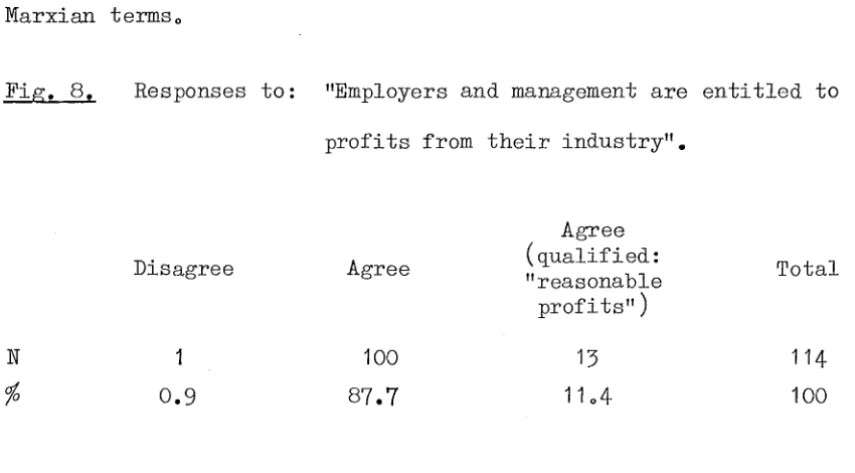
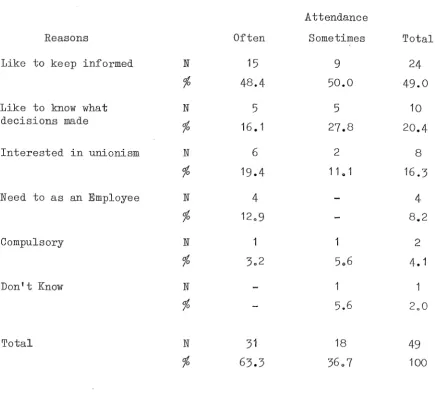
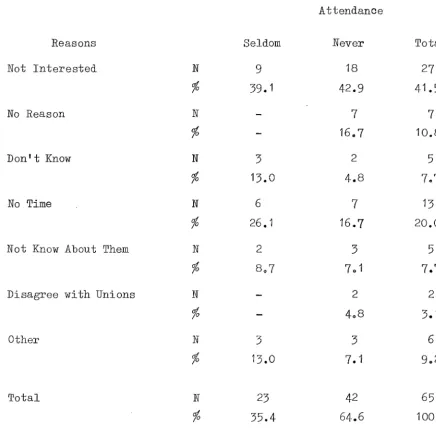
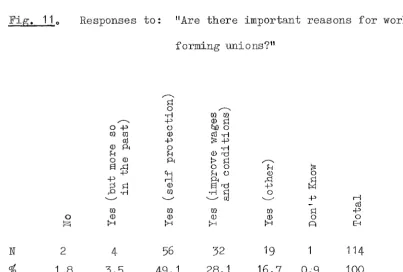
WORKERS' PERCEPTIONS OF INDUSTRY, AND THEIR COMMITMENT TO THEIR UNIONo
A thesis presented in the
Department of Psychology
&
Sociology, University of Canterbury,in partial fulfilment of the requirements for the Degree of
Master of Arts by
Owen Francis Coup
University of Canterbury
·ACKNOWLEDGEMENT§
Many thanks are due to the officials and members of the two unions involved in this resear9h, for, without their assistance and co-operation, this project small though it is, could not have been undertaken.
My thanks also to those persons, who, by their supervision, comment or general support have been of assistance in this
CONTENTS
ACKNOWLEDGEMENTS
ABSTRACT
CHAPrER 1:
CHAPrER 2:
CHAPrER
3:
CHAPrER
4:
CHAPrER 5:
Industrial Sociology Research New Zealand Industrial Research
Introduction to the Research Project - Marx and Class
"Quasi Groups" and "Interest Groups"
The Model
Introduction
Outline of the Model
The Research Project Sampling Procedure - Data Collection
Observations on the Sample and Interviews Completed
- Analysis of Data
Research Findings - Marx and Class
The Model
Page
3 7
15
16
20
25
25
27
33 34
35
37
39
42
42
CHAPTER 6:
BIBLIOGRAPHY
APPENDICES
Conclusions
The Marxian Perspective The Model
Suggestions for Further Research
* * * * * * *
Page
72 72 75
80
84
ABSTRACT
In the field of industrial sociology, little research has been done which views industry and the organisations associated with it, from the worker's perspectiveo There is agreement among
those associated with the field in this country, that very little is known about the attitudes, perceptions and expectations that the New Zealand industrial worker has of industry, employer and job. It is important that research be done on the worker's views, since this would establish a better basis for our industrial relations policy0
The present research was designed as an exploratory study, to examine workers' perceptions of their industry, their relationship with their employer, and their union. Essentially, there were two specific points considered. The first was an examination of the adequacy of Marxian theory as an explanation for the relationship that exists between employer and worker in the New Zealand industrial setting. The second was a preliminary analysis of the validity of a model, which attempts to predict the commitment of workers to their union, on the basis of certain preconditions which are outlined as a
series of five stages.
two unions in the Christchurch areao The analysis of the data did not use any sophisticated statistical techniques, since these were not appropriate for a preliminary study, or the size of the sample involved.
2.
The conclusions reached on the first point were, that although these workers do display certain characteristics that would be
expected on the basis of a Marxian perspective, they also have other characteristics (notably an awareness of the interdependence
of worker and employer), which Marxian theory cannot explain adequately. With regard to the model, the trends that it predicts definitely occur in this data, but the model does not account for all factors affecting
the commitment of union members. It needs refinement and further, more rigorous, testing, before any final conclusion can be reached
regarding its validity.
As is appropriate for an exploratory study, a considerable number of suggestions for further research have been generatedo
3.
CHAPTER I
INDUSTRIAL SOCIOLOGY RESEARCH
It will be readily acknowledged that one of the most significant components of a modern society is its industrial organisation. Further, most sociologists will agree that a very high percentage of society's members will, as workers, come into direct contact with this 1ndustrial organisation, often for the whole
f th . k0
l ' 1
o eir wor 1ng 1ves. It should follow that social scientists, and sociologists in particular, would show considerable interest in such matters as; how the worker views himself in the industrial context; how he views industry and his employers; how he adapts to this
environment; and, how he views those groups which are said to represent him in the industrial scene.
Viewing past research, a strong case can be made suggesting that sociologists and social scientists have not, in fact, been very concerned with such aspects of the industrial situation, ioe• the worker and his viewso
A brief analysis of the literature (both research and
theoretical comment), related to the field of industrial sociology, suggests that there are several perspectives from which industry can be, and has been, viewedo
This concern, and perspective, are well established and have led to extensive study of complex organisations - including industrial organisationso In point of fact, most of the literature in this area does not deal explicitly with industrial organisations, but rather includes them as a field of organisational analysis.2 A point
4o
to note here, is that the trade union has been analysed in this manner, as has the industrial corporation.
The second perspective that has been of importance in this field, is one where the problems and processes of industry are seen from the managerial viewpointo This approach is, perhaps, characterised by one of its basic inquiries; how can the various components of the industrial process (human, technological and managerial), best be combined to lead to maximum efficiency and productivity.3 Some
analyses of trade unions also seem to illustrate, to some degree, the influence of this type of approach, concentrating, as many of them do, on analysis of union officials and the techniques of union managemento
4
The third perspective, which, it is being claimed here, has not received due attention, is quite simply that of the ordinary workero His view of the industrial process seems equally, if not more,
significant than the other two perspectives, but the amount of notable research work which has been done on the basis of this perspective is very smallo The work of Purcell,5 and Seidman et al,6 was notable in the 19501s if for no other reason than that a considerable attempt was
made in each case to study aspects of industry from the worker's view-pointo More recently there has been some increase in the research interest in this field, with such work as that of Blauner7 in the
8
5.
There have always been, in addition to the more substantial research projects carried out, studies of such things as the incidence
d t . . t. t f . b . . ff . 10 of strikes, an par icipa ion ra es o union mem ers in union a airs, but these do not add very much to our
understandin~Ythe
reasons why the different groups in the industrial scene act the way they do.There are good reasons why the worker's view of industry has not been as popular as the other two perspectiveso The organisational view is one which, partly because it is a well established perspective, and partly because it does not require analysis of the opinions of individual subjects, but rather consideration of more 'objective' factors such as authority hierarchies and communication flows~ has quite an advanced theoretical base which can be further developed without having to carry out the extensive, costly and time consuming field work associated with analysis of the opinions of individual respondents,,
The reasons for the development of the managerial perspective are also quite evidento The major reason is probably that management have been interested in research findings, and theories, which help them to operate their industries more successfully, and have even been prepared to 'invest' (in the widest sense of that term) in research projects which might be of benefit to them. The fact that there has been some interest in the results, has probably also made the research considerably easier to carry out, since the researcher could count on much greater co-operation at all phases of the project: funding, drawing samples, and so ono
The situation is almost entirely different when considering the development of a worker's perspective on industryo Theory
6.
to develop any theory, it is necessary to ask workers what they
think about the industrial situation. The consequent field research is necessarily massive in scale, time consuming and, predictably,
short on funds, for until very recently (largely because of managerial philosophies), it has not been considered very important to know what workers think, only to discover ways of making them work better. The research difficulties are not just logistical ones either. There are methodological problems also: for example, how can workers be asked about their opinions, in terms of the linguistic sophistication of
the techniques used, and in terms of the assumptions that can be made regarding the underlying value orientations of this populationo Given the logistical and methodological problems of this type of research, it is hardly surprising that development of the worker's perspective
on industry has lagged behind other approaches to the fieldo
It is in no way intended that the outline to this point should decry research done from either of the first two perspectives. On the contrary, given the increasing importance of industry and
7.
NEW ZEALAND INDUSTRIAL RESEARCH
In the general literature and research relevant to industrial sociology there seems to be comparatively little material which
views industrial organisation and industrial processes from the worker1s perspectiveo Any attempt to examine material which may
be relevant to the New Zealand context does not just confirm this trend, but indicates that in New Zealand there is almost a complete absence of research relevant to this perspectiveo While there has been a considerable amount of material produced dealing with, for
11 example, the historical development of trade unions in this country; or the background and reasons for various stoppages and strikes,12 and management practise in New Zealand 1,3 the number of research projects considering industry in New Zealand from the worker1s
perspective could very nearly be counted on one hand. This is
readily acknowledge~ particularly by those associated with the study of industrial relations, where the absence of information about the ordinary worker is acutely felt. As Williams put it; "the bedrock of wide ranging empirical data is notably absent from observations of the New Zealand situation1114 , and Hines has made the same point; "We are working from the basis of a monumental ignorance that the most well-intentioned men cannot overcome by mere concern, co-operation,
• d • t' II 15
compassion, an communica ion c
their role in it, and what they see as its place in their lives
and the rewards it should offer. It is clear from general observation of the industrial scene in this country, that a systematic attempt to structure industrial relations is needed. Legislation in the field, after stagnating for many years under the Industrial Conciliation and Arbitration Act now appears to be in a state of flux, with no measure having a great deal of success. Again Hines has summed this matter up:
"We are on an industrial relations fishing expedition, casting our hook into the waters, using different sizes and types of bait (much of it imported from overseas with records of success and failure with other types of fish), and hopingagainst hope to land the big one -the key to industrial relations problems in New Zealand. Those who engage in such fishing expeditions can tell you that there are sharks and eels as well as tuna in the waters! "16
The number of hours lost through stoppages and strikes has increased over recent years17, indicating quite clearly that these piecemeal attempts to solve problems are not successfulo In addition, such
things as demarcation disputes and other interunion rivalries (for example, the current farm workers union debate - see note 2 to Chapter
5)
seem to be increasing, as well as the 'traditional' worker/employer rivalry. To understand and suggest ways of improving this situation, it is imperative to have availabl~ information on all aspects ofindustry in New Zealand. While the sociologist has a considerable contribution to make in helping to provide information about many aspects of the problem, one of his most important contributions would be an analysis of the worker's perceptions of industry and the work process, and his relationship with management and uniono
The inadequacies of the present state of knowledge about the industrial worker in this country can be illustrated by reference to two points developed on the basis of two of the very few studies which consider the New Zealand industrial workero
9.
As Smith18 has pointed out, because there is this total lack of knowledge about the New Zealand worker, "worker attitudes in New Zealand are assumed to be the same as those in the U.S.A. and Britain" a 19 Research done by Griew and Philipp,20 suggests that
New Zealand workers differ considerably fTom those overseaso They concluded that their initial view
"that workers attitudes here are very different from those overseas (was) substantiated in several important respects. (For example) In contrast to American workers among whom Advancement and the Company are held to be amongst the most important factors of all, Promotion and and the Firm1s Reputation are ranked here relatively low
0
Replacing these factors as of prior importance are Pay and Working Conditions" o 21
While this research was particularly directed at an analysis of workers' attitudes to shiftwork, the conclusions cast considerable doubt on other assumed characteristics, views and attitudes of New Zealand workers. If they differ from overseas workers on the
dimensions mentioned by these researchers, the obvious question is, on how many other dimensions do New Zealand workers differ. At this stage that question cannot be answered.
A second point which is of considerable concern, arises from the findings of a research project carried out by Howells and
Woodfield22 in two meat freezing firmso The study was designed to discover how accurately union officers and management, in each case, could predict workers' preferences in regard to seven alternatives that the researchers presented to them. Howells and Woodfield concluded that in some cases "there is a disturbing divergence between managements' and officers' predictions and workers'
-"performance of one group of officers in predicting their own members' preferences is very disappointing; they are, after all, part~time officials working with their members and subjected to 'sustained exposure to their constituency1
• The predictive ability of
full-time provincial or national officers would not be expected to be any better ••••••. Freezing unions, by New Zealand standards, are well organised and yet the gap between officer and worker in Firm 2 is a matter for concern." 24
It seems, then, that even those who might have been expected to understand workers well, their own union officers, know considerably
less about the members they represent than is desirablea If the opinions of union officers do not reflect the views of their union's members it is difficult to see how union officers can negotiate solutions to industrial disputes which will be satisfactory for the establishment of long term industrial harmonyo
The implications of the conclusions of these two research projects, carried out by Griew and Philipp and Howells and Woodfield,
10.
are obviousa Simply, we know practically nothing about the New Zealand worker and his view of industry; this situation is completely
unsatisfactory; a great deal of research must be done very rapidly tor emedy this situation and, hopefully, to allow the development of a systematic scheme which leads to industrial harmony.
* * * * * * *
FOOTNOTES:
10 The percentage of New Zealand workers employed in manufacturing
industrial distribution of the labour force by numbers (1), and by percentages (2), and for comment comparing percentage of total labour force employed in the manufacturing sector in 1956, 1961 and 1966
(3).
20 Examples of this perspective are: Etzioni, Amitai,
Bain, J .S.,
March, James G.,
A Comparative Analysis of Complex
Organisations, New York, The Free Press, 1961.,
Industrial Organisation, (2nd ed), New York, London, John Wiley
&
Sons, 1968. Handbook of Organisations, Chicago, Rand McNally&
Co., 1965.Blau, Peter M.
&
Scott, W. Richard, Formal Organisations, San Francisco, Chandler Publishing Co., 1962.3.
A point that should be mentioned is that particularly in this view of industry, much of the literature does not represent what is primarily a sociological concern with the field. Much of this material is (for instance) more closely related to business management. However, this perspective should be of interest to the sociologist, and it does have significant implications about the extent to which the individual and social needs of workers influence managerial philosophy and techniques. The classic example of this perspective would be the theories of the 1scientific management' school, whichoriginated with Frederick Taylor. The more recent work of Peter Drucker (e.g. The Practice of Management, London,
Heinemann~ 1966), and to a lesser extent of Joan Woodward (Industrial Organisation, London, Oxford University Press, 1965),also illustrate this viewpoint.
4.
See, for example;Roberts, B.C., Trade Union Government and Administration, London, University of London, 1956.
Galenson, Walter
&
Lipset~ Seymour Martin, Labor and Trade Unionism, New York, John Wiley&
Sons,Geare, A.J.,
5o Purcell, T. V.,
12.
"Grassroots Unionism: The Administration of a Freezing Works Branch Union" in New Zealand Journal of Public Administration, Volo 35, No. 1, P.34, 1972.
The Worker Speaks His Mind on Company and. Union, Cambridge, Mass., Harvard Univers-ity Press, 19530
60 Seidman, Joel; London, Jack; Karsh, Bernard;
7o
&
Tagliacozzo, Daisy L., The Worker Views His Union, Chicago,University of Chicago Press, 19580
Blauner, Robert, Alienation and Freedom, Chicago, University of Chicago Press, 19680
8 0 Beynon, H.
&
Blackburn, R.M., Perceptions of Work: Variations within a Factory, Cambridge, at the University Press, 197209. The Cambridge studies of the affluent worker, particularly, Goldethorpe, John; Lockwood, David; Bechhofer, Frank;
&
Platt, Jennifer, The Affluent Worker: Industrial Attitudes and Behaviour, Cambridge, at the
Univers-ity Press, 19700 10o See, for example;
Dean, Lois R., "Interaction, Reported and Observed: the Case of One Local Union" in Human Organis-ation, Vol. 17, Noo 3, Po36, 19580
See: Hare, A.E.C., Report on Industrial Relations in
New Zealand, Wellington, Victoria Univers-ity College, 19460
Howells, J.M., "Concentration of Union Membership,
1900-1966: a New Zealand Case Study" in New Zealand Journal of Public Administrat-ion1 Volo 31, Noo 2, P.19, 1969.
Roth, H., ~~ions in New Zealand: Past and Present, Wellington, Reed Education, 19730 See: Webb, Leceister, "Trade Unions at the Crossroads: Some
Scott, Richard George, 151 Days; the History of the Great Waterfront Lockout and Supporting Strikes, February 15 - July 15, 1951, Auckland, Southern Cross Books, 19540
Howells, J.M. & Alexander, R.P., "A Strike in the Meat Freezing Industry; Background to
Industrial Discontent in New Zealand" in Industrial
&
Labour Relations Review, Volo 21, No. 3, P.418, 1968.Geare, A. J • , "The Problem of Industrial Unrest:
Theories into the Causes of Local Strikes in a New Zealand Meat Freezing Works" in Journal of Industrial Relations, March
1973, Po 130
13 0 See: Hines, George Hamilton, Organisational Behaviour, Wellington, Hicks Smith, 1972; The New Zealand Manager, Wellington, Hicks Smith,
19730
New Zealand Journal of Public Administration (Wellington) Volo 35, No. 1, September, 19720 1972 Seminar: The Role of Management in New Zealand Industrial Relationso
*
Any further material which is relevant may be found in:Roth, H.O., New Zealand Trade Unions: a Bibliography, Auckland University Press, Oxford
Univers-ity Press, 19700 Nuttall, T.Ao,
Rodger~ Margaret D.,
Industrial Relations in New Zealand, 1920-1951: a Bibliography~ New Zealand Library School, 195lo
Thesis on the History of New Zealand, Parts 1-4, Massey University, 1968-19720
14. Williams, A.,
150 Hines, George,
160 Hines, ibid., Po1010
14 ..
"Industrial Relations in New Zealand: A Sociological Perspective" in Thomson, K.W.
&
Trlin, A.D. (eds) ContemporaryNew Zealand, Wellington, Hicks Smith, 1973, Po 1630
"Industrial Relations Problems: Creating Knowledge for Solu tions11 in New Zealand
Journal of Public Administration, Volo 35, Noo 1, P.100, 19720
170 See Appendix B, P. 91 , for comparative details of New Zealand
180 Smith, Thomas Bo,
190 Smith~ ibid., Po47o
stoppages for 1967, 1969, 1971 and 19730 "Role of Management in New Zealand
Industrial Relations: a Seminar Report" in New Zealand Journal of Public Admin-istration, Volo 35, Noo 1~ Po47, 1972 0
200 Griew, Stephen
&
Philipp, Eileen, Workers Attitudes and theAcce~tability of Shift Work in New Zealand
Manufacturing Industry, Research Paper Noo 12 of the New Zealand Institute of Economic Research (Inc.), 19690
210 Griew and Philipp, ibid., P.61o
220 Howells, J.M. & Woodfield, A., "The Ability of Managers and
Trade Union Officers to Predict Workers Preferences" in British Journal of
Industrial Relations, Volo 8, No. 21 Po237,
19700
230 Howells
&
Woodfield, ibido~ Po249. 24. Howells&
Woodfield, ibido, Po251oCHAPTER 2
INTRODUCTION TO TEE RESEARCH PROJECT
At this stage some of the factors which were likely to influence the research should be apparent - the obvious lack of, and need for, research in this field, and the notable lack of research which considers the worker and his viewso In addition~
given this lack of research, any project which was undertaken
150
would be essentially exploratory in nature, covering a relatively broad scope in order to develop some insights into the field which would provide a basis for further study. Consequently, the
respondents were asked a wide range of questions designed to give extensive information on their own backgrounds, their job stability, job satisfaction, views of management and so ono
Despite the exploratory nature of the project, it was intended that it would focus on some point or points that could be more
extent to which members are committed to their unionso There are many aspects of the worker's view of trade unions, and matters related to trade llllions, that could have been examined, but two points were selected for more specific studyo
The first of these was an attempt to evaluate the adequacy of the Marxian theory of class opposition, as a basis for explaining the relationships between worker and employer in modern industrial society, specifically the New Zealand case.
The second matter considered was a preliminary test of the
validity of a five stage model (developed from the theoretical concepts of "quasi group" and "interest group"), which attempts to predict the commitment of union members to their union, on the basis of certain preconditions which seem logically necessary for commitment.
MARX AND CLASS 1
Though the Marxian theory of class is interpreted slightly differently by various writers, the basic outline is widely under-stoodo In the capitalist era of history, following the industrial revolution, the traditional norms, values and social rankings, which had given legitimacy to the class structure of prior eras, were broken
down, with the result that in the emerging industrial society there were very much cruder distinctions: the basic differentiation was between entrepreneurs and workers (the bourgeoisie and prolitariat), who were "characterised solely by the crude indices of possession and non-possession, of domination and subjection112•
basis for the developing class structure was property (as in the general Marxian scheme), but in this case property took the form of the private ownership of the means of productiono This is basic to Marxian theory~ for:
"Only if we understand property in the particular context of bourgeois society, i.e. as private ownership of the means of production, as the control of a minority over the wealth of a whole nation, do we in fact grasp the core of the antagonism existing in production and creating class conflict".3
Understanding property as the ownership of the means of production is crucial since the "essential condition of the existence and domination of the bourgeois class is the accumulation of wealth in the hands of private persons, the formation and augmentation of capital; the condition of capital is wage labour
114
o The line of reasoning is very simple: the clash of interests between classes in industrial society arises from the dominance of the bourgeoisie in all aspects of that society; the dominance of this class is dependent upon their accumulation of capital (a form of wealth, which by the nature of its use, leads to even greater wealth); production of capital wealth is dependent on the availability of17.
wage workers, who have no claim to the products of their work; in turn,
however~ implicit in the concept of "wage" is the notion that the only thing the worker owns is his time and energy - not the physical or technical means of production. Consequently, this fundamental factor of the private ownership of the means of production, can be seen as determining all the other social and class characteristics of capital-ist societyo
18.
Marx claimed that before class conflict developed, the workers had to become aware of the fact that they existed in a state of
"false consciousness", and had to have the desire to escape from that stateo This state of "false consciousness" is imposed upon the
exploited group in any societal era, since the dominant group of that era (in this case the bourgeoisie), has control of the prevailing
ideologyo They have the power, arising from their control of property, to determine the values relating to, and the rationale for, the
existing structure of relationshipso Conse~uently, should the worker accept the prevailing values and rationale, he accepts the "rightness"
of the exploitative practices exercised by the dominant group, and is accepting his subservient position in the societal structure: he exists in a state of "false consciousness".
In breaking out of this state of false consciousness, the individual worker will clash with the bourgeois capitalist, but at the same time is likely to become aware that other workers around him have the same problems, the same interests; "Increasingly the
collisions between the individual worker and the individual bourgeois assume the character of collisions between classes. The workers start forming coalitions against the bourgeois"o5 Worker organisations develop, which have, as their aim, the unity of workers in order to pursue, by political (class) action, their common interestso "In this manner a political movement grows everywhere out of the isolated
economic movements of the workers; ioe., it is a movement of the class in order to realise its interests in a general form, in a form that possesses universal social constraining force11
0
6
19.
Once class consciousness develops (that is, there is an awareness of class interests), and an effort is made to promote class interests despite the influence of the bourgeoisie, class conflict develops, and, in the Marxian scheme, becomes the basis for subsequent revolutionary changeso
It is obvious that the basic proposition of Marxian theory -opposition of interests between different groups in the society has had considerable influence on the sociological analysis of many contemporary areas of interest, among these the fields of industrial sociology and industrial relations. Undoubtedly, the notion of an opposition of interests between the groups interacting in the industrial process is a realistic one, for even if not recognised, this opposition has been illustrated by research dealing with industry, right from the very early days of such studies for example, in the 11bank wiring room11
, made famous in the 11Hawthorne11 studies
7,
it is clear that the interests of worker and employer are opposed in many respectso The more recent studies, of such 11marginal" men as foremen and supervisors, which show that workers, on the one hand, andmanagement, on the other, impose incompatible demands upon these
8
role players ~ also have as an implicit assumption, the opposition of interests between worker and employero
Nonetheless, while the proposition~ that there does exist an opposition of interests in industry, may be readily supported, as MacRae9 in brief comment on Marx, puts it; 11it is evident that all
10
societal interaction, even where it can be shown there is an awareness of opposed class interestso
Modern trade unions are surely an example of the "workers forming coalitions",
5
as Marx put it, and an indicator of the20.
existence of class consciousness among industrial workerso Further, such statements as, "We will use all our resources to obtain a greater
11
share for the workers who produce the wealth of the country" indicate a clear recognition of the opposition between the worker and employer; a demand that the worker be entitled to make claims on his own behalf, in this situation,. and, also a statement of intent, on the workers part, to press those claims with vigour and determination. Here we have all the ingredients of the "class struggle", reflected in modern trade unionism. However, the concluding phase of the Marxian scheme, escalating class conflict and subsequent revolution, is not apparent in the modern industrial setting. The obvious question is; why not?; the equally obvious answer is that there must be other factors
involved which mediate the impact of the basic Marxian factor, class struggleo
One of the aims of this research was to provide information about the worker's views of industry, which would, specificallyf permit an analysis of the adequacy of the Marxian theory of class opposition as a basis for the explanation of the relationships that exist between workers and employer~ and management, in the New Zealand industrial setting.
"QUASI GROUPS" AND "INTEREST GROUPS"
a preliminary evaluation of a simple model, which attempts to differentiate between union members on the basis of factors which are likely to determine their commitment to their uniono This model was developed from the theoretical concepts of "quasi" group and "interest" group, which were first used by Ginsberg12, and have
13
been elaborated on at some length by Ralf Dahrendorf o
21o
The term "quasi group" does not refer to a group in the usual sociological sense of that term. Rather it suggests there are certa:in characteristics, behaviours and "interests1114 shared by some members of a society that may be used as a basis for making analytical
distinctions between individualso The social scientist can use these characteristics to delineate aggregates or collectivities that are the "recruiting fields" for groups, once there is an awareness1 among some individuals, of the common characteristic, behaviour or "interest" that they share, and they have formed an "interest group" so that they can promote or protect their common characteristic, behaviour or "interest11o
An "interest group" on the other hand, is a group in the normally understood sociological senseo It has a structure,
organisation, goals, and personnel in the form of a membership. It is an organisation of individuals who are aware that they have a common interest which can be promoted by the strategy of co-operative efforto Generally, an interest group may encompass anything from a football club to a political party. In the sense that Dahrendorf wishes to employ the term, and which is relevant here, the interest group refers,more specificall~ to a group who are ta.king co-operative action to further those interests specifically "related to the
legitimacy of relations of domination and subjection11
words, an interest group in these terms, is one which by its existence challenges the influence of those other groups which are dominant in the existing authority structure in the society. This clearly excludes sports and recreation clubs, but leaves such
things as trade unions and political parties to be consideredo
22.
Obviously there i.s a relationship between the quasi group and the interest group, for while the existence of a quasi group does not predetermine the existence of an interest group, the suggestion is that if an interest group does exist, this is so because some individuals in the quasi group have become aware of the "shared" nature of their characteristics, behaviours or interests; have anticipated some benefit in organising, and have organised, an interest group which, in turn, draws further "recruits" from the quasi groupo
Dahrendorf's outline of these concepts, which is an attempt to explain how the class groups in the Marxian scheme develop, has been severely
criticised~
16 since it does not explain why certain individuals become aware of their common interests and form a groupo However, the criticism made of Dahrendorf 1s analysis is not relevanthere~ for Dahrendorf is considering the concepts of quasi group and interest group in a developmental sense the factors which affect
uniono The basis and outline of the model is detailed in the following chapter.
*******
FOOTNOTES:
1o The following brief discussion owes a considerable amount to two sources:
Dahrendorf, Ralf,
Bendix
&
Lipset,Class and Class Conflict in an Industrial
Society~ London, Routledge and Kegan Paul, 19599 Chapter 1: "Karl Marx's Model of the Class Society" o
"Karl Marx's Theory of Social Classes", in Bendix, Reinhard
&
Lipset9 Seymour Martin, (eds)9 Class, Status and Power (2nd ed)9New York9 Free Press9 1966.
2o Dahrendorf, ibido, P.60 3o Dahrendorf, ibid., P.12o
4o Marx quoted in Dahrendorf, ibid., P.120
50 Marx quoted in Dahrendorf, ibid.9 Po160
60 Marx quoted in Dahrendorf, ibida, Pa16o
7o See: Roethlisbergerj FoJo
&
Dickson, William J., Management80 See7 for examplei Dubin, Robert,
9o MacRae, Donald Go,
and the Worker, Cambridge, Mass.~ Harvard University Press~ 19640
Human Relations in Administration (3rd ed) Englewood Cliffs, N.J., Prentice-Hall Inc0 ,
Skinner, T. E. , in
Ginsberg, Morris,
24.
President•s Report to the Federation of Labour, 1964, P.30.
Sociology, London, New York, Oxford University Press, 19500
13 0 Dahrendorf~ op. cit., Chapter 5: "Social Structures, Group Interests, and Conflict Groups11o
140 Note: it is not intended that this term should imply a conscious interest on the part of the social actors; rather "interest" here can better be characterised as a "latent" interest.
150 Dahrendorf, OPo cit., Po181o
Barry, Brian Mo , Sociologists, Economists and Democracyp London, Collier-MacMillan Ltdo, 1970 (particularly Chapter 2: "Political Participation as Rational Action")o
CHAPTER
3
THE MODEL
INTRODUCTION
As already noted, Dabrendorf1s approach to the concepts, quasi group and interest group, bas been to outline the way in which interest groups develop from quasi groupso This is important for Dabrendorf, since one of his aims is to attempt an explanation of how "classes", which are such an important element in Marxian theory (already briefly touched upon in the previous chapter), actually emerge. The concept of interest group is closely related
25.
to that of "class" and also "class consciousness"o This developmental perspective is of no concern in the present study, for in New Zealand trade unions have existed from as early, perhaps, as the mid 1800's. 1 However, there is a particular feature of trade unions in the
New Zealand industrial situation, which makes the quasi group/interest group distinction relevant as a starting point for the development of the proposed model. That feature is the extent of unionisation of the work force: the fact that in New Zealand industry there is a situation
of vde factov compulsory unionism - practically 10o% of the industrial work force belong to an industrial uniono
of individuals (a quasi group) is employment in industrial jobs. Now, the interest group likely to develop from this quasi group
of industrial workers, is some sort of workers representation
26.
group aimed at protecting workers' rights and ensuring that workers' conditions are improved: one possible form of such a group is the trade union as we know ito But, in the New Zealand situation, this means that, because of the extent of unionisation, all members of the quasi group, "industrial workers"~ are also members of the interest group of industrial workers at least~ they are all nominally members of the interest groupo Now, being a member of an interest group, in the ordinary case, will mean that the individual will be aware of some need for such a group, and also have some commitment
to the groupo In the present New Zealand trade union situation, where all quasi group members are interest group members, it seems theoretic-ally unlikely that all these individuals will be committed members of the interest group, for this would imply an awareness, on the part of all these individuals, of a need for the interest group, and, also agreement among all members, that the group's structure, goals, and
the means employed for attaining these goals, are appropriate. This doubt, arising from theoretical considerations, is substantiated in reality, since it is apparent that some individuals impelled to belong to a union, are very much opposed to their compulsory membership: they have no commitment to the union as an interest group at all.2
Before outlining and discussing the stages of the model, there are two points that must be made. The first is that, since the model is an attempt to predict the individual's commitment to his union, based upon his awareness of certain features of the industrial situation and certain characteristics of existing trade unions, what is of major importance for the purposes of analysis is
the individuals perceptions of these features and characteristics, not an objective analysis of these features and characteristicso
What workers perceive as real will affect their commitment~ regardless of whether or not their perceptions can be shown to be objectively accurate. The second point is that the model places these preconditions in a sequential order~ for it will be seen that each stage in the
model is a logical precondition for those that follow ito
OUTLINE OF TEE MODEL)
The following are the preconditions or stages of the model:
Stage 1: Perception of an Opposition of Interests Between Employer and Workero
This stage is based upon one of the characteristics which is important in the development from a quasi group to an interest groupo In the industrial scene, if the worker is to have any interest in any worker representation group, or is to see such a group as at all
relevant~ he must first be aware that his position in the authority
structure of industry, is one which is subordinate to that of the employer0 Further, he may be aware that the structured relationships
in some wayo The worker, if he is to see any revelance in an interest group, will certainly understand that because of the nature of the employer/worker relationship, what is in the best
interests of the worker is not in the best interests of the employer, and that these interests are, indeed, opposedo One underlying
assumption of this is that the worker need not perceive the worker/ employer relationship as one of opposed interest, in which case he does not satisfy this precondition of the model~ and will not be committed to his union. (This assumption~ that the worker may have alternative perceptions of the situation9 and therefore not satisfy the model's preconditions, is present at all stages)0
Stage II: Perception of a Need for Collective Action. Perception of an opposition of interests between worker and employer is an essential~ but not a sufficient, condition for commitment to a workersi interest groupo It is also important that the individual worker be aware of the fact that other workers about him have the same problems and interests; that is, he must come tG realise that his condition is not an individual one~ but rather a group or "classtt phenomenon. With this realisation the worker has achieved a state of "class consciousnesstt. Further~ he will appreciate that the best way of promoting his own interests is
to promote the interests of his class9 and that this can best be carried out by collective action; that is~ the formation of an interest groupo
Stage III: Perception of the Appropriate Group for Representation of the Worker.
29.
The first two stages of the model are based upon some of the characteristics which differentiate quasi groups and interest groups, and which are of general relevance to the Marxian concept of class0
This third stage, and subsequent ones, are a logical development of the preconditions necessary to determine the commitment of the worker to his uniona
So far, we have a group of workers who perceive an opposition of interests between themselves and employers, and also a need for collective action to promote their own interestso The next important
stage~ at which the worker's commitment to the interest group is jeopardised, is concerned with the worker's perception of what group is the appropriate one for collective representation. It is theoret-ically possible, at least, that different workers will view different structural forms of an interest group as being the most desirable one.4 Given our present union organisation, and the fact that it is the opinions of existing union members that are being analysed, if some workers do not see this present type of organisation as the most appropriate, then they are unlikely to be committed to the union as it existsa
Stage IV: Perception of What Constitute Appropriate Group Goals a
Even if a worker perceives the present union structure as quite appropriate, he will not be automatically committed to the group; another point at which the perceptions of individual
goals as the ones that are appropriate for the interest group, then once again, the model predicts that this individual will not be a committed member, but rather a nominal member, of the union.
There is a problem that could arise here, namely, the level of generality at which the union goals are defined, and the consequent difficulty of getting members to evaluate these goalso This problem is avoided in the present research: since the focus of the study is upon workers1 perceptions, comparisons can be made between perceptions
of what union goals should be, and what they are at present0 If
there is a discrepancy, the workers involved do not satisfy this precondition of the model, and will not be committed to the union, since they do not perceive present union goals as appropriate.
Stage V: Perception of the Appropriate Means for Achieving Group Goalso
The final point at which workers1 perceptions may differ,
and therefore affect their commitment to the union, is related to their view of what the appropriate means for achieving the goals of the group areo While the means available are, perhaps, limited by various legislative proscriptions,5 there still remain a variety of techniques, ranging from regular negotiations to more "militant" action ("working to rule" and "stoppages"), which unions can employ. It is possible that the worker may not see the present methods
employed by the union as appropriate; if this is so, this member does not satisfy this precondition of the model, and will not be committed to the uniono
31.
is that at each of the stages outlined there are possible alternative perceptions of the situation; only one of these possible alternatives will satisfy the precondition for commitmento Consequently, if union members do not have the appropriate perception of the situation at any stage, they will not be committed members of the interest group -their union. Another characteristic of the model is that its stages are sequential; that is, it is necessary that the individual have the appropriate perception at the first stage, before it is possible for him to perceive the situation at the second stage appropriately
(for example, he must perceive an opposition of interests between worker and employer, before he can perceive a need for collective action)o The prediction of the model is that if the union member satisfies all the preconditions, then he will be a committed member of the union; that is, he can be considered a genuine member of an interest group, rather than simply a nominal membero
In order to establish the validity of the model, some criterion of commitment is requiredo While any criterion will, to some extent, be arbitrary, it should be possible to establish the validity of such criteria in the course of researcho In the present case two simple measures of commitment were built into the study, along with other measures which would allow an evaluation of these as criteria of commitment. It was expected that one of these, at least, would prove satisfactory as a measure of a member's commitment to the union, and would, therefore, allow an analysis of the validity of the modelo
No attempt was made to rigorously test the model; instead, two or three of the stages were focused on to permit a preliminary analysis, which would provide sufficient indication of whether or
32.
FOOTNOTES:
1 • See: Roth, H., Trade Unions in Ne~ :23land; Past and Present, Wellingto~ Reed Education, 19730 2o This is illustrated by the fact that in :~e 1972 parliamentary
elections in one or two electorates in tte ~~~istchurch area, candidates stood purely as "anti compulso::o 11~; onism"
candidateso The candidate in the Papanui electorate received 48 votes.
3. For a tabular presentation of the model see A~pendix
C.
(P.
92)o4. In some European countries, where there E.:'..'e competing workers' groups, (for example "socialist" and "C1',..:._s-ciai.'l" unions), the worker may actually be able to choose the i=OUp to which he belongso
5.
"Perhaps" is used here for good reason. - is not widely understood, for example, that legally s:~~~es were deemedunacceptable as a means of a worker actic~ ·_;_:::-_der the Industrial Conciliation and Arbitration Act, first ~~~~oduced in 1894. See: G.H. Sorrell, nrndustrial Relatic:'.:_S i~ New Zealand" in
Journal of Industris~ ~elctions, Vol. 3, p 0 117' 1961 •
330
CHAPTER
4
THE RESEARCH PROJECT
The study consisted of interviews conducted with members of two industrial uni0ns. The two unions in question were those representing workers in the printing industry, and waterfront
employees. By studying these two unions there was incorporated in the sample considerable variation in such characteristics as the skill levels of workers, their spatial distribution on the job, union size, apparent level of industrial and political activity, the ease of dissemination of union information, and ease of attending union meetings. These kinds of characteristics varied,not just because of the differences between the two unions, but also because their exists considerable heterogenerity within the printers union itself - for example, three different skill levels are officially recognised (by the fact that there are three different rates for the annual member-ship subscription), and, especially in the lower skill level, many of the members are women,who are employed in packaging firms which manufacture, for example, cartons and plastic bagso
34.
they would have had if the sample had been very homogenouso
SAMPLING PROCEDURE
This was the first known approach to these unions requesting assitance for an outside research project, and it was expected that the unions would want some assurance of the authenticity of the project. The Federation of Labour was, therefore, approached first; on their approval, the local Canterbury Trades Council was informed of the proposal, and finally the two unions in question were approached, considered the proposal, and agreed to give their assistanceo Understand-ably this process took a long period of time, and it could be that
such detail was not necessary. However, good relations have been established with these unions and this should be helpful if any
further research is undertaken in this fieldo The sample was selected on the basis that there were four different groups - the watersiders, and the three different skill levels in the printers union; tradesmen, semiskilled and unskilled workerso
35.
(since the absolute size of this group was small relative to.the others); and, to increase the sample selected from the unskilled group by about twenty percent, because union officials suggested that this group tended to have high job mobility and it was likely that many of those appearing on the membership lists would have left their last recorded position, and the union, without informing union officials so that the union's records could be alteredo
The sample was selected by numbering workers in the four groups, as they appeared on the union lists, then taking a random sample of these numbers to provide the sample size required for each
1
group. Finally, the lists were consulted again to obtain the names and addresses of the individuals selected0 In this way a total sample of 217 was drawn.
DATA COLLECTION
The most appropriate method for collecting the data was personal interviews, since this would allow the explor2tory nature of the study to be preserved, while also permitting the collection of information for a preliminary analysis of the particular points already outlinedo This method would also result in a higher return rate than any alternativeo The interviews were not to be too long, a maximum of 30 - 40 minutes each~ and responses ~ere to be recorded by the interviewero
36.
"open ended" in many cases, but some required respondents to select a category or alternative which they considered most appropriate. In the pretest,cards were used to present these alternatives to the respondent. An additional three persons in each of the four groups had been selected so that a small pretest could be carried out: of these, two refused to participate, and one had moved - address unknown. After the completed schedules from the pretest had been assessed, a
considerable number of items were deleted, as the interview was too long; other items were altered; and the technique of providing cards where respondents were required to make a choice, which had proved cumbersome, was droppedo In subsequent interviews, two
versions of the s'chedule were used, the difference between them being that the respondent's copy did not have any of the prompts, which the interviewer could use in some questions, or the gross categories (Yes, No, Don2t Know), that were used to record the respondent1s
answers where applicableo2 Consequently, the respondent's interest was maintained, and he was able to follow the questions quite easily, while no indication was given that any particular answer was expectedo
Experience in the pretest indicated that for an interviewer to arrive unannounced on a respondent1s doorstep was unsatisfactory,
since many respondents were unhappy about the authenticity of the research and the interviewer. To solve this problem a letter was mailed to all the persons to be interviewed, informing them that they would be approached, and that the unions involved had co-operated in
interviewer could use as an outline of the points he should make before starting the interview.2
The interviews were carried out by the researcher with some assistance from three senior students. Careful instructions were given to interviewers abou~ how to record answers, so that a maximum of information was retained in the written schedule; what prompting was permissable, and so on. The interviews were then carried out (Appendix F, P. 1061 gives details of interviews completed, refusals, etc.)
OBSERVATIONS ON THE SAMPLE AND INTERVIEWS COMPLETED
4
370
It seems appropriate here to make some comments on the
disappointing number of interviews completedo What was experienced in this study illustrates the kind of difficulties that are, no doubt, partly the reason why little research has been undertaken in this field. Any future research must be designed to cope with these problemso
Clearly the overall response rate (55.61%) was poor for an interview approach, and it was much lower than anticipated. There appear to be several reasons for this low rate: the fact that 13.17%
of the original sample had moved, and/or were unknown when attempts were made to contact them is clearly significant, as is the
Part of the reason for this was the time lag between compilation of the union membership lists and the interviews. This lag occurred for a number of reasons: in the case of the printers' union, at
least, the complete membership list available was some months old5 (there is a strong suggestion that even if the lists had just been completed, they would not be accurate, for, as already mentioned, people change jobs and addresses without informing the union so that records can be amended); a further reason for the delay was that the running of the pretest,and the redesigning and printing of the schedule, took a considerable period of time, as did the printing and posting of the introductoryletter. This time lag between compilation of the union lists and the interviewing, clearly compounded the problem of the high job and geographical mobility of some sections of the sample.
While it was undesirable that such a high percentage of the original sample should be unavailable, it is interesting to note the varying rates of mobility evidenced by the four different groups (in fact, the watersiders' rate cannot be used for purposes of
comparison, since the membership list was much more recent than was that of the printers union). Not too much emphasis can be placed on these differences because of the comparatively small number of cases in each sample, but there does appear to be a very clear trend in the mobility of the printers' union membership, which correlates with the
skill level of the individuals in questiono This suggested correlation of skill level and mobility is one which could well be pursued in
subsequent research.
For future research dealing with trade union members, one
lists used for drawing samples were not up to date, would be to check the union lists against lists of current employees in various firms. This task would require a lot of extra effort, but would ensure that a much larger percentage of the sample was available for research purposes.
Another aspect of the sample details,which seemsto be worth considering here is the percentage of the available sample who
39.
refused to participate in the study (29019%). This was not unexpecte~ given that the sample consisted of people who were unlikely to have been approached for such research purposes before, and were in many cases suspicious about the reasons why the research was being under-taken. The refusal rate is high, however, and it would be desirable if it were lower in future projects of this type, though it is
difficult to see exactly what could be done to bring this about. What is interesting about the rate of refusals is the very definite pattern, again, across the four different groups, and the very strong inverse correlation between skill and rate of refusal in the printers' union groupso This particular pattern is another which could well be examined in future researcho
ANALYSIS OF THE DATA
40.
the Marxian perspective as an explanation of industrial behaviour in New Zealand, and also about the potential of the proposed model.
It was never intended that there should be extensive or
minute analysis of the information collected; rather, it was intended that the data be examined to see if it exhibited any general patterns which would allow preliminary conclusions to be reached, or if it exhibited any unexpected patterns that were worth consideration in later researcho Consequently, the analysis of the data has been statistically unsophisticated, consisting simply of summaries of
the responses to various relevant items, or of simply cross tabulations between items,where this is appropriateo These cross tabulations
were done using a computer program that was available in the department at the time. Another point that must be mentioned is that no attempt was made to apply tests of significance to the data, for while there has been considerable debate on the use of these tests generally,6 given the nature of the present study, and the simple level of data analysis, statistical tests were not considered appropriate.
Some of the information collected in the interviews was not readily amenable to categorisation and statistical analysis, but this does not mean that such information is not relevant or valid, and though it has been treated with some care, such information is used in the following discussion of the research findings.
FOOTNOTES:
1. In each case an additional three selections were made to provide a sample for a small pretest.
2a See Appendiz D, Po 93, for a reproduction of the interviewer~s copy of the schedulea
3o See Appendix E, Po 105, for a reproduction of this lettero
4.
See Appendix F, P. 106, for details of the sample drawn, refusals, and number of completed interviewso5o This in no way implies a criticism of the printers' union officials; it is rather a result of the differences in the spatial dispersion of members of the two unions, and the comparative ease of maintaining contact between watersiders and their uniono
6. For a summary of this debate, and comment on the appropriate use of statistical tests, see: Galtung, Johan, Theory and
Methods of Social Research (revised edition), New York, Columbia University Press, 1969; Part II: Data Analysis; Section 4o4~ "On the Use of Statistical Tests".
42.
CHAPI'ER
5
RESEARCH FINDINGS
The following discussion of research findings is limited to those two major points already outlined: the adequacy of Marxian theory as·an explanation of the relationship between worker and employer; and, the validity of the proposed model.
MARX AND CLASS
The study provided informatio~ on a number of points related to the Marxian perspective. One of the first points that was
considered, was whether or not workers view their interests and
those of employers as opposed. The matter was approached indirectly, since a direct question was not thought satisfactory. In the
industrial sphere, the outbreak of conflict indicated by various types of industrial unrest, is an indicator of the opposition
between worker and employero One of the questions in the interview asked; "Is it possible to have industries without any unrest?" As Fig. 1 shows, nearly 65% of the sample felt that it would not be
Fig. 1. Responses to: "Is it possible to have industries without
N
%
Yes 39
34.2
any unrest?"
No
74
64.9
Don't Know
0.9
Total 114
430
possibleo While this may not be a very high percentage, the situation is not as straightforward as that, for respondents who considered it would be possible to have industries without unrest were asked a further question; "What changes do you think would have to be made in our industrial system to make this possible?" A crude content analysis of the responses to this question indicated
that these respondents could be divided into two groups (see Fig. 2). In the first of these two groups were those who had definite practical suggestions, which would make industry without unrest possible. Some of the suggestions were: worker participation on works committees, and in direct negotiations; profit sharing and shareholding, by workers, to ensure a more equitable distribution of the profits of industry between the parties, so that, as one respondent put it, "the worker gets his just rewards rather than the employer getting the cream". The interesting thing about such suggestions is that they imply, even in an industrial system without unrest, an opposition of interests between worker and employer; for what the measure suggested does, is not remove such opposition, but rather provide a mechanism for controlling ito
Figo 2. Responses of those who consider industry without any -unrest possibleo
Practical "Idealistic"
Others Total
Measures Responses
N 18 16 5