University of Warwick institutional repository:
http://go.warwick.ac.uk/wrap
A Thesis Submitted for the Degree of PhD at the University of Warwick
http://go.warwick.ac.uk/wrap/58810
This thesis is made available online and is protected by original copyright.
Please scroll down to view the document itself.
PROBLEMS OF SCALE:
AN O.R. / SYSTEMS APPROACH
(1
volume)
Paul
JTayler
Submitted for the degree of PhD
University of Warwick
School of Industrial and Busine~s Studies
CONTENTS
CONTENTS
LIST OF TABLES
LIST OF FIGURES
ACKNOWLEDGEMENTS
DECLARATION
SUMMARY
CHAPTER 1: Single Vision or Multiple Perspectives? A Systems
Approach to Problems of Scale
11.
INTRODUCTION
12.
HISTORY
23. PREVIOUS APPROACHES
5
4.
METHODOLOGY
6
5.
THE
THESIS
15
CHAPTER
2:The Development of the Theory of Economies of Scale
201. EARLY CONCEPTS - THE DIVISION OF LABOUR
20
1.1
Adam Smith
201.2 Alfred Marshall
24
2.
THEORETICAL CONCEPTS
273.
TEXTBOOKTHFDRY
33
3.1 The Cost Curve
33
3.2 Explanations of Scale Economies
37
3.3 Lack of Empirical Evidence
40
3.4 Criticisms of the Cost Curve
42
4. EMPIRICAL STUDIES
45
4.1 Bain and Other Pioneers
45
4.2 Estimating Scale Economies
46
4.3 The Survivor Test
49
4.4
Production Functions
50
5.
ENGINEERING STUDIES OF SCALE INCREASES
54
5.1 Engineering Production Functions
54
5.2 The "0.6 Rule"
56
6.
DETAILED STUDIES
AND NEWINSIGHTS
576.1 Technical Change and Scale Change
586.2 Industry Studies
62
6.3 Process Industry Scale Economies
64
6.4 Electricity Generation
66
7.
FIRM SCALE ECONOMIES
707.1 Multiplant Economies
72
7.2 Scale in Distribution
727.3 Scaleof Management 73
7.4 Scale in Financial Administration
74
7.5
Innovation and Scale
76
7.6 Size and Profitability
78
CHAPTER 3: A Simple Simulation of Dynamic DisecQno~ies of Scale
85
1.
INTRODUCTION
85
2. THE SIMULATION MODEL
86
3.
EXPERIMENTS ON CAPACITY-FITTING PERFORMANCE
88
4. CONCLUSIONS
99
CHAPTER 4: A Simple Formalisation of Technical Changes
101
1. LIMITS
ANDCONSTRAINTS
102
2. A MATHEMATICAL
ANALOGY104
3.
SEARCHING
ANDLEARNING
109
4.
TECHNOLOGICAL HEURISTICS
112
5. SCALE INCREASES
ASINNOVATIONS
118
6.
IMPLICATIONS
121
7. CONCLUSIONS
124
CHAPTER 5: Technological Learning Simulation
127
1. INTRODUCTION
127
2. THE
MODEL
127
3. THE
SIMULATION PROCESS
130
4. RESULTS
133
5. DISCUSSION
135
Annexe - Model specification
137
CHAPTER 6: Plural Rationalities: A New Approach to Ideas of Scale
140
1. A LARGE
ANDCOMPLEX PROBLEM
140
1.1 Introduction
140
1.2 Scale and Complexity
140
1.3 Economic Analysis
141
2. SOME PROBLEMS
ANDPUZZLES
142
2.1 Electricity Generation
143
2.2 Pulp and Paper Manufacture
144
2.3 Brewing
145
2.4 Cement Manufacture
146
2.5 Managerial Myths?
147
3. RESOLUTION OR RATIONALISATION?
148
3.1 Plural Rationalities
148
3.2 Alternative Worlds
150
4. AN
EXAMPLE
156
5. CONCLUSIONS
159
Annexe - Selected Interviews on Scale for Aston-Warwick
Project
160
CHAPTER 7: EMIR - An Evolutionary Model of Increasing Returns
161
1. INTRODUCTION
161
1.1 Objectives
162
1.2 Summary
162
1.3 Nelson and Winter
164
2. APPRECIATIVE DESCRIPTION
165
CHAPTER 8: Logical Description of EMIR Structure
178
1. BASIC ELEMENTS OF THE MODEL
178
1.1 Firms
178
1.2 Plants
179
1.3 Technology
181
2. INNOVATION
182
2.1 The Decision Process
184
2.2 Incremental Innovations
185
2.3 Imitation Innovations
186
2.5 Radical Innovations
2.6 Uncertainty
of Results
2.7 Evaluation
of Technologies
2.8 Rejection
of Innovations
3. FINANCIAL
ELEMENTS
3.1 Price-Setting
3.2 Allocation
of Demand
3.3 Gearing
3.4 Interest and Dividends
3.5 Bankruptcy
3.6 Rate of Return
4. DEMAND AND CAPACITY
4.1 Forecasting
4.2 Random Failures
4.3 Retiring Loss-Makers
5. DECISION RULE FOR BUILDING NEW PLANTS
5.1 Net Present Values
5.2 Discount Factors
5.3 Capacity-Demand
Gap
5.4 Rationalising
Existing Capacity
5.5 Ordering and Building New Plants
6. SUMMARY ON BOUNDED RATIONALITY
6.1 Uncertainty
6.2 Worldview
7. TECHNICAL
ISSUES
7.1 Starting Values
7.2 Implementation
7.3 Technical
Appendices
CHAPTER
9: Experimental
Results with EMIR
1. INTRODUCTION
2. THE INITIAL EXPERIMENTS
2.1 Experimental
Design
2.2 Results of Basic Runs
2.3 Method of Analysis
2.4 Analysis - Runs with No Technical
Change
2.5 Analysis of Runs with Technical
Change
2.5.1 Comparison
with No TC Runs
2.5.2 Analysis
of Technical
Change Runs
2.5.3 Differences
between Demand Series
2.6 Regression
Analysis
of Industry
Structure
2.7 Preliminary
Conclusions
2.7.1 Output Measures
2.7.2 Input Experimental
Variables
2.7.3 Discussion
of Results
3. THE IMPORTANCE
OF MARKET SHARE
3.1 Market Share and Technical
Change Effects
3.2 Market Share of Winning Firms
3.3 Threshold
Market
Share for Success
3.4 Conclusions
on Market Share Effects
4. COMPETITION
BETWEEN THE WORLDVIEWS
5. PROFITABILITY
OF FIRMS
6. CONCLUSIONS
6.1 Theoretical
Implications
6.2 Policy Implications
6.3 Implications
for the Decision-Maker
6.4 Further Work
CHAPTER 10: Technological "Lock-In" Through Small Events
248
1. INTRODUCTION
248
2. THE PROBLEM
248
3. EXAMINING TECHNOLOGICAL LOCK-IN WITH EMIR
250
4. ANALYSIS OF THE RESULTS OF TECHNOLOGICAL COMPETITIONS
252
5. IMPLICATIONS
255
CHAPTER 11: Conclusions: Uncertainty and Increasing Returns
257
1. SUMMARY
257
1.1 Theoretical Results
257
1.2 Results for the Policy Analyst
258
1.3 Results for the Decision-Maker
260
2. DISCUSSION
261
2.1 First Principles
261
2.2 Economic Theory
262
2.3 Uncertainty and Contradictory Certainties
265
2.4 Technical Change: Systematic Behaviour in an
Uncertain World
266
2.5 The Return of Increasing Returns
268
2.6 The Policy Dilemna
271
3. PLURAL RATIONALITIES AND PLURAL MODELS
273
4. CRITICISMS AND AREAS FOR FURTHER WORK
276
4.1 Criticism
276
4.2 Further Research
277
4.3 Apologia
278
REFERENCES
279
APPENDIX 3A: Dynamic Diseconomies Simulation Demand Series
A1
APPENDIX 3B: Structure of Model Used in Simulation of Dynamic
Diseconomies of Scale (Chapter 3)
A4
APPENDIX 3C: Program Listing for Dynamic Diseconomies Of Scale
Simulation (Chapter 3)
A9
APPENDIX SA: Program Listing for Technological Learning
(Chapter 5)
APPENDIX 8D: Previous versions of EMIR
Simulation
A17
A20
A37
A39
A41
A42
A44
A47
AS1
AS4
APPENDIX 8A: EMIR Program Listing
APPENDIX 8B: Arrays used in EMIR version 3.2
APPENDIX 8C: EMIR Program Logical Structure
APPENDIX 8E: Debug Output
APPENDIX 8F: The EMIR Pricing Model
APPENDIX 8G: Criteria for Rationalisation Projects
APPENDIX 8H: The Formulation of Technology in EMIR
APPENDIX 8I: Forecasting Rou~ines in EMIR
APPENDIX 9A: Demand Series and initial conditions for EMIR
APPENDIX 9B: EMIR Results
A60
APPENDIX 9C: Regression Analysis of EMIR Results
A74
APPENDIX 9D: EMIR Simulation Results Summary
A89
APPENDIX 9E: Comparison of output measures between runs with
demand series A, Band
C
A96
APPENDIX 9F: Comparison of EMIR Output Measures by Demand Series
A99
APPENDIX 9G: Market Share Results
AlOl
APPENDIX 9H: Market Share Results Analysis
A108
APPENDIX 91: Results of Competitions Between Worldview II and IV
AilS
APPENDIX 9J: Profitability Results
Al16
LIS
T
0 F
TAB
L E S
CHAPTER 3: A Simple Simulation of Dynamic Diseconomies of Scale
3.1 Unit Specifications
89
3.2 Performance of different unit scales in three scenarios
90
3.3 Standard Simulation Runs Capacity Mismatches
91
3.4 Fixed Lead Time
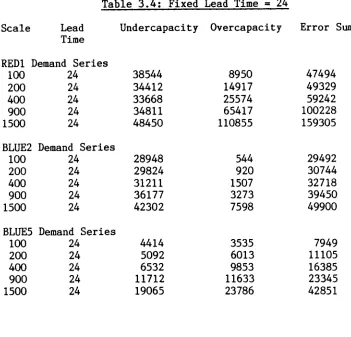
=24
93
3.5 Fixed Lead Time
=
33
94
3.6 Varying Lead Times, Scale Fixed
96
3.7 Standard Runs, Perfect Knowledge
97
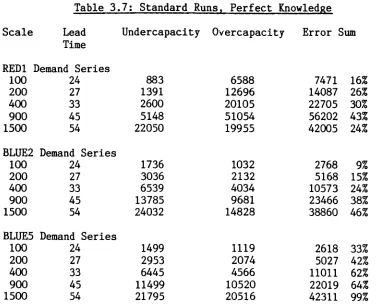
3.8 Improvements with Perfect Knowledge
98
CHAPTER 5: Technological Learning Simulation
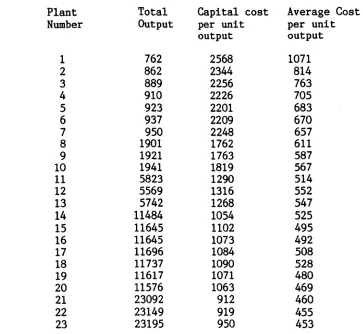
4.1 Results for a Simulated Series of Plants
134
CHAPTER 6: Plural Rationalities: A New Approach to Ideas of Scale
3.2.1 Characteristics of the Four Cultural Biases
155
4.1
Scale Attitudes of the Four Biases
158
CHAPTER 9: Experimental Results with EMIR
2.4.1 Summary of Influence of Starting Configurations on Key
Industry Performance Measures - No Technical Change Runs
(Demand Series A only)
215
2.5.2.1 Summary of Influence of Experimental Variables Upon Key
Industry Performance Measures - Simulations with
Technical Change
219
2.5.2.2 Comparative Total Costs per unit of output for High and
Low Capital Intensity Production Technology
222
3.1.1 Comparison of Market Share Effects With and Without
Technical Change
232
3.1.2 Probabilities of a Firm Being One of the Two Largest in
the Industry in the Ten Periods After Achieving a Given
Market Share (Demand Series A Only)
233
3.2.1 Influences of Experimental Variables Upon Market Share
Effects
234
3.3.1 Chances of Failure and Success in Maintaining a Position
In Top Two for 10 Periods After Achieving Market Share
Thresholds
235
4.1 Results of Competition Between the Wor1dviews
239
5.1 Influences on Firms' Profitability
240
CHAPTER 10: Technological "Lock-In" Through Small Events
3.1 Comparisons
of Production
Costs for Simulated
Technologies A and B at Differing Scale of Production
251
3.2
Results of Technological Competitions
251
3.3
Results of Technological Competitions after a Small
CHAPTER 2:
2.1
3.1.1
4.4.1
LIS
T
0 F
FIG
U RES
The Development of the Theory of Economies of Scale
The U-Shaped Cost Curve
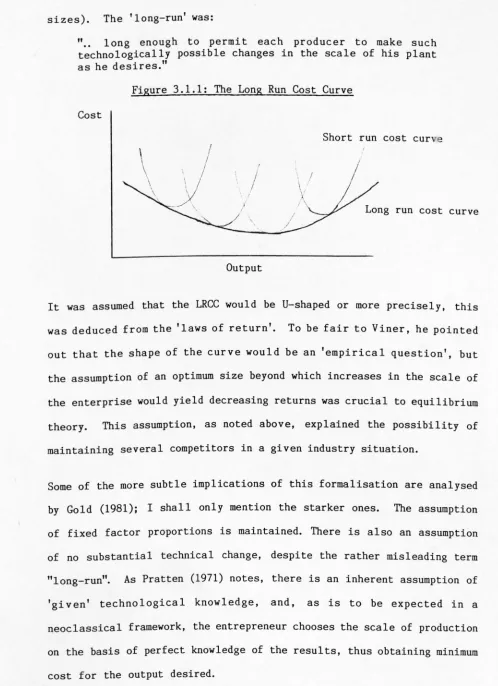
The Long Run Cost Curve
Estimation Errors Through Aggregation
30
34
53
CHAPTER 3: A Simple Simulation of Dynamic Diseconomies of Scale
3.1
Demand Scenarios
88
3.2
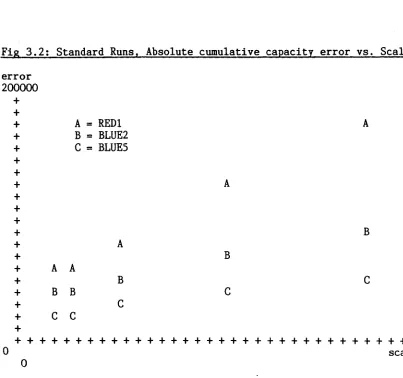
Standard Runs, Absolute Cumulative Capacity Error vs
Scale
91
3.3
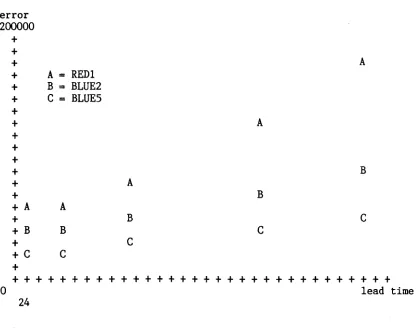
Standard Runs, Absolute Cumulative Capacity Error vs
Lead Time
92
3.4
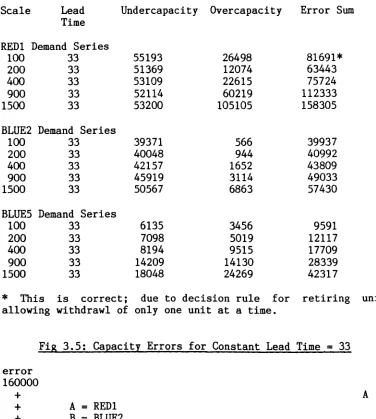
Capacity Errors for Constant Lead Time
=
24
93
3.5
Capacity Errors for Constant Lead Time
=33
94
3.6
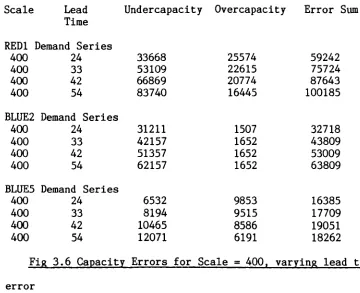
Capacity Errors for Scale
=400, varying Lead Times
96
CHAPTER 4: A Simple Formalisation of Technical Changes
2.1
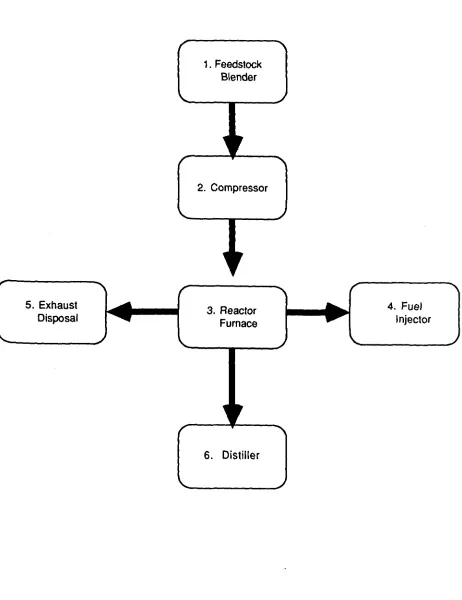
A Stylised Chemical Production Process
107
CHAPTER 5:
2.1
4.1
Technological Learning Simulation
A Stylised Chemical Production Process
Logarithmic Plot of Production Costs from Successive
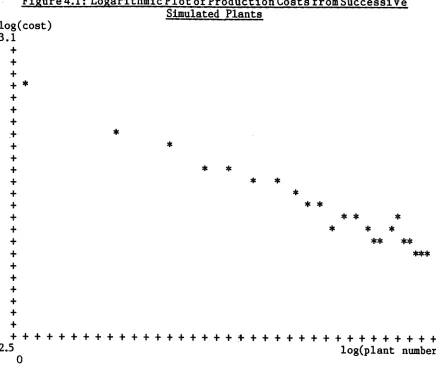
Simulated Plants
128
133
CHAPTER 6: Plural Rationalities: A New Approach to Ideas of Scale
2.4.1 Plural Scale-Cost Curve for Cement Manufacture
146
3.2.1 The Four Cultural Biases
151
3.2.2 The Myths of Stability and the Cultural Biases
154
CHAPTER 7: EMIR - An Evolutionary Model of Increasing Returns
2.1
EMIR Business Cycles
165
2.2
Industry Demand, Capacity and Price for run 16HTC4IV
169
2.3
Total Firm Production Capacities Over Time for run
16HTC4IV
170
2.4
Firm Sizes by Capital Value Over Time for run 16HTC4IV
171
2.5
Firms' Average Production Costs Over Time for run
16HTC4IV
172
2.6
Technological Coefficients
(Kand L) for run 16HTC4IV
173
2.7
Prodn Cost (per unit output) of Successive Plants for
16HTC4IV
175
2.8
2.9
2.10
CHAPTER
8: 1.12.1
2.2
Plant Sizes and Industry Demand over time for run
16HTC4IV
Plant Size and Demand: US Basic Steel
Plant Size and Demand: French Cement
176
177
177
Logical Description of EMIR Structure
Attributes of Firms in the Model
The Innovation Decision Process
Evaluation of Technologies
179
185
189
CHAPTER 9: Experimental Results with EMIR
A C K NOW LED GEM ENT S
My thanks are due to a number of people who read parts of the material
of this thesis and made many useful comments. In particular I would like
to thank Brian Arthur, Peter Beck, John Buzacott, Graham Douglas,
Gerard Fairtlough, Ian Mitroff, Salamah Pope, Maurice Shutler, John
Stringer and Aaron Wildavsky.
Many people were interviewed in the course of the research. Some are
acknowledged directly (Chapter 6); my thanks are due to anonymous others
who have indirectly contributed by increasing my understanding of the
problems of scale by giving of their time and experience.
A particular debt is owed to colleagues on the Aston-Warwick Scale
Project: David Collingridge, Peter James and Michael Thompson. I learnt
much from them, and benefitted considerably from their advice,
encouragement and criticism in differing measures. Mike especially
showed me new ways of looking at the world. The work of this project was
financially supported by the Leverhulme Trust.
I gratefully acknowledge the financial support of the SERC for one year
of full-time study. The University of Warwick waived my fees as a
part-time student whilst I was a member of the University staff.
Above all lowe thanks to my supervisor, Rolfe Tomlinson, who first
interested me in this area. In particular Rolfe has supported me wi th
gentle supervision, amazing tolerance of deviations into unusual
fields, and excellent editorial advice.
Finally, my thanks to my friends and relations for putting up with me
during the sometimes apparently endless months and years of getting all
DEC L A RAT ION
Some parts of the material included herein have been used in other
places:
Chapter 2 has appeared as "The Development of the Theory of Economies of
Scale", Warwick Papers in Management No.2 (1986).
The model described in Chapter 3 is an improved version of a simulation
developed as part of my dissertation for the degree of MSc in Management
Science and Operational Research, School of industrial and Business
Studies, University of Warwick (1983), entitled "A Critical Examination
of Economies of Scale in Production Systems". The original work was
described in ''Determining Appropriate Scale for Production Plants" by R
C Tomlinson and P J Tayler, in vi ted paper to CHEMRAWN-III conference
(1983) .
The material outlined in Chapter 6 is not all my own original work, but
arose from joint work on the Aston-Warwick Scale Project. Part of this
Chapter was presented by me under the title "A New Approach to Problems
of Scale" at EURO-VIII (conference of the European Operational Research
Societies) in Lisbon (September 1986). The general discussion has been
presented in "The Surprise Game: An Exploration of Constrained
Relati vism" (by) M Thompson and P Tayler, Warwick Papers in Management
No. 1 (October 1986), in "Environmental Rationalities" P James, P Tayler
and M Thompson, UK Centre of Economic and Environmental Development
Discussion Paper No. 6 (January 1987), and in "Plural Rationalities" P
James, P Tayler and M Thompson, originally presented to conference on
'Analysisng the Inchoate: Inter-relationships in Complex Systems',
SUM M A R Y
The history of analyses of scale and the conventional reductionist methodology are briefly recounted in the first chapter of the thesis. A detailed examination is then made of the theory of economies of scale and its development since the days of Adam Smith. A comprehensive survey shows that the description provided by conventional economic theory is quite unrealistic, and has been dictated by the demands of Neoclassical ideas of equilibrium. It is shown that the available empirical evidence does not easily allow conclusions to be drawn about the optimal scale of plants or enterprises.
A simple simulation model then demonstrates that static economies of scale alone are insufficient to determine "optimal" scale - dynamic diseconomies depend upon environmental context and uncertainties of forecasting future demand.
The question of technological change is closely bound up with issues of scale. The principle of bounded rationality is applied to deduce some
conditions about the nature of technical change using Heiner's
"Reliability Condition". The existence of "technological heuristics" (such as a bias in favour of scale-augmenting innovations) is predicted. The argument is illustrated with the use of a computer simulation of successive process innovations in a stylised chenical plant.
Conflicting ideas about "optimal" scale in electricity generation, papermaking, brewing and cement manufacture are examined. These views are found to be explicable by borrowing the theory of fourfold cultural bias from the field of social anthropolgy.
An Evolutionary Model of Increasing Returns (EMIR) is developed as a computer simulation. This model demonstrates that the restrictions imposed by conventional economic theory can be overcome in a dynamic economic model; economies of scale and technical change are married with
plural rationalities to provide a range of findings on industry
structure. Market share is found to be a more important determinant of industrial success than economies of scale.
EMIR is used to demonstrate the phenomenon of technological "Lock-In"; important policy choices may be determined by small random events as critical points. Market selection mechanisms cannot be relied upon to optimise, whether in scale decisions or other important policy choices.
Chapter 1: Single Vision or Multiple Perspectives? A Systems Approach to Problems of Scale
1. INTRODUCTION
The original purpose of this research was to provide assistance to
decision-makers faced with "Problems of Scale". That is, it was
initially conceived in terms of developing and improving specific
analytical techniques to help decide how large new elements of
productive capacity should be. This might have been built upon the
textbook "U-shaped" scale-cost curve, possibly identifying the
circumstances under which it would be applicable, and the additional
factors which should be considered in employing it.
However, examination of the theoretical basis of this potential tool for
the decision-maker revealed serious problems. The assumptions
underpinning this approach were found to be wholly inadequate. The
concept of the "optimum" scale of operations was not useful in the face
of considerable technological, economic and perceptual uncertainties. It
has become clear that questions of technical change, of the beliefs or
"culture" of the organisation concerned, and of the sheer
unpredictability of the environment are all significant.
The research has therefore developed away from the original focus on the
immediate problems of the decision maker, to try to develop a new
understanding of the scale problem. The insights gained have been
combined to produce an evolutionary model of the processes invol ved.
This new simulation model shows that theory need not be hide-bound by
the restrictive assumptions employed in the past. It provides a tool for
analysing industry development which has enabled some important
conclusions to be drawn, both for the policy analyst and for the
The thesis also considers, in the final chapter, the methodology used
for studying scale problems, and some general lessons which can be drawn
for other major problems of industrial and social choice.
2. HISTORY
The problem of determining the appropriate scale of a new production
plant has always been with us, but it has reached an increased degree of
prominence and controversy in recent years. This is partly because the
inbuilt belief of many planners and designers that increased size is
necessary for economy and market dominance has received a number of
recent shocks, and partly because of the reaction against giantism
summarised by Schumacher's famous phrase "Small is Beautiful".
The Venice arsenal of the fourteenth century is sometimes ci ted as an
example of an early factory, although in fact it was simply a collection
of craftsmen and artisans working independently under the same roof. The
factory system evolved through the Industrial Revolution as a means of
concentrating workers and specialised machinery for the purposes of
co-operati vel y carrying out complicated, mul ti-stage manufacturing
processes. Perhaps the archetypal factory form was reached with the
giant Ford car plant which in the early 1920's employed over 60,000
people and eventually produced millions of vehicles.
The vertically-integrated Ford works required enormous quantities of raw
materials; it could only come into being in the age of mass
communications- railways for transport of inputs and outputs, and the
telephone for the management of geographically separated but
interdependent functions. The giant "manufactory" had the effect of
concentrating the population and was a force for rapid urbanisation
throughout the nineteenth and early twentieth centuries, posing new
social problems. De-skilled production line workforces had to be
organised in large numbers, and Fordism created the conditions for the
creation of mass trades union movements. The management of the new
industrial armies posed novel problems, as did the need to be responsive
to changes in the huge new national and international markets which
products such as the model-T Ford had themselves created. Bureaucracy,
as old as the Pharaohs, found its apotheosis in the great Soviet GOSPLAN
industrial blueprints. Thus a whole range of new and complex,
interlocking and connected problems are raised by the great increases in
scale which have surged through the last two centuries.
The reasons for the increasing resistance to the idea that "big is
better" during the last two decades are similarly complex. In part, the
rapid expansion in demand in many areas of the economy during the late
1950s and 60s allowed scale mistakes to be swept under the carpet;
plants too large for the market this year would be fully-utilised next,
so why worry. The worldwide economic contractions beginning in the
mid-70s, exacerbated by rising commodity prices and by the oil price shock
of 1974 in particular changed that situation drastically, making
planning errors much more visible- and more expensive. General increases
in the post-war standard of living in the industrialised countries
initially fuelled demand for mass-produced goods, but saturation
stimulated desires for more differentiated products produced at smaller
scale in different ways.
Faith in "Big Science" has been weakened: for example, the optimism of
the early '50s which speculated that nuclear-generated electricity
would be so cheap that it wouldn't be worth metering it, has dwindled to
the point that, in the USA at least, nuclear energy was being seen as
uneconomic in competition with cGnventional sources even before the
near-disaster of Three Mile Island. In Britain new super-ministries such
industries, and all were labelled "bureaucratic", "out of touch" and
"inefficient" in the popular mind by 1980. In the late 1980s the
political agenda of Right and Left talks about reducing the power of the
State, decentralisation, and privatisation. In the Communist world the
reaction against centralised planning, unaccountable bureaucracy and
inefficiency has been even stronger. Finall y, the publ ic image of the
giant mul tinational corporations has not been improved by publ ici ty
surrounding operations in some Third World countries.
The problems of scale are many and complex. Firstly economic
efficiency-is it true that bigger plants are always cheaper to build and run? Even
if they can be built at a lower cost per unit of output, many managers
attest to the reality of the problems mentioned above- problems of
retaining effective control over the giant factories, and of being able
to effect real strategic change in large international organisations.
Secondly there are technical problems in always seeking to build the
biggest plant; technology can be pushed to the limit, or even beyond;
reliability and underperformance have been found to be problems for some
new giant installations.
Thirdly, there are difficulties associated with building production
units which account for a large proportion of their relevant market.
Risks are greater than when a number of smaller plants are operated
because of the "all your eggs in one basket" syndrome, and flexibility
is reduced. Forecasting becomes much more important, particularly when
larger units tend to have longer planning and construction lead times.
Finally, a quantum leap in size often brings into play qualitatively new
factors which were not a problem st the previous scale of production.
Setting up a small workshop to build automobiles is one thing; planning
a Detroit factory is quite another, involving problems of securing raw
materials, arranging dedicated transport facilities, massive
recruitment, buying hundreds of acres of suitable land and and raising
immense amounts of capital. These are qualitatively different from
finding a small site, arranging a loan with the bank and placing an
advertisement in the local paper. Complexity is often bound up with
scale, and neither are respecters of disciplinary boundaries.
3. PREVIOUS
APPROACHES
There is little in the literature to help the planner decide on
appropriate scale in circumstances where there is rapid technological
change and a turbulent economic environment. Part of the difficulty lies
in the fact that most of the research undertaken has been strictly
disciplinary in nature, whereas in reality a broadly inter-disciplinary
approach is needed.
Three main disciplinary approaches have been explored in the past.
Firstl y there has been much discussion of "economies of scale" in the
economics and business studies disciplines. (See Gold (1981), and the
next chapter.) Secondly, sociologists and organisational behaviourists
have been engaged in a rather different study of the relationship
between the size and the structure of organisations (Dewar and Hage
(1978), Dale (1982)). Managers have faced a trend towards giantism in
their organisations, both state-owned and private. Thirdly, engineers
have long been involved with the practical problems arising from the
ever-increasing sizes of buildings, bridges, machinery, vehicles,
factories and other production units. Indeed it seems that the scale of
almost every area of human activity has been growing since history
began. However, the perception that all these special ist areas
confronting the difficulties arising from "scaleup" problems might have
come about very recently.
The first serious interdiscip 1 inary approach to the subject was in a
research project at the International Institute of Applied Systems
Analysis, initiated by Rolfe Tomlinson in 1978. A paper under the title
''Determining Appropriate Scale for Production Plants" was prepared by
Cantley and Glagolev (1978) in the same year, in which they reviewed the
current state of knowledge and made an initial attempt at structuring
the field. This paper was used to help in planning an international
conference held in 1979, which was the first time that representatives
of the different disciplines involved (from many countries) got together
to discuss the issues invol ved. The proceedings of that meeting were
subsequently published (Buzacott, Cantley, Glagolev and Tomlinson 1981).
Subsequently a multidisciplinary research effort was initiated in IMRAD
at the University of Warwick with the aid of a grant from the Leverhulme
Trust under Rolfe Tomlinson and David Collingridge of the University of
Aston. This thesis is largely a result of work carried out on that
project.
4. METHODOLOGY
Approaching such a complex research area as Problems of Scale demands
an appreciation of the past attempts to understand scale, and of the
reasons why they have been at best only partially successful. This in
turn requires that we look at the methods which have been used to tackle
these questions. Some features of the philosophy underlying past
methodology will be discussed in this section, and counterposed with the
emerging "Systems" model of the world. Many themes identified in this
Section will return in later chapters.
It seems to me that the essential. thing past approaches to the scale
problem have in common is that they are essentially reductionist. This
element will be examined first.
The method of reductionism was first articulated in Western thought by
the French philosopher and mathematician Renee Descartes. The
reductionist approach to a complex problem is to divide it up, or reduce
it, into a set of constituent elements. These simpler elements may be
much easier to understand and analyse, and their behaviour as separate
units is likely to be far more comprehensible than that of the original
whole. If not, then the division into smaller and simpler parts must be
continued further until this is possible.
The Age of the Enlightenment made powerful use of this means of
understanding the world, and the reductionist scientific method has
ultimately proved to be one of the most successful cultural innovations
in human history. Perhaps its most impressive achievements were made in
combination with another profound discovery- that mathematics could be
employed to describe and explain events in the natural world. Newton's
invention of the calculus led to a brilliantly simple and elegant model
of the motion of the bodies of the Solar System.
This model can be taken as a symbol of the triumph of the Enlightenment.
The movements of Sun, Moon and planets, sometimes seen in the past as
capricious and signifying the wanton and uncontrollable character of
Nature and God, could now be predicted from a few simple laws from which
there were no deviations. The natural world was like a piece of
clockwork machinery. The stars traced out their orbits against a single
set of coordinates set down by God (and parametrised by Newton). The
former sat, omniscient, needing only rare interventions to ensure the
perfect running of the Uni verse, whilst the latter could predict the
future with mechanical confidence. (Laplace later asserted, under
so complete that no intervention was required.) The Harmony of the
Spheres gave way to a perfect equilibrium system in which history was
redundant- all that was needed was the position and velocities of the
bodies to determine their futures.
The world, then, could be interrogated by the reductionist approach,
described by mathematical and deterministic laws, and could be
predicted, at least in principle. The way was clear for the development
of a vast body of physical science which stood intact at least until the
beginning of this century.
This was not to everyone's liking, we may observe in passing; a few
cranky mystics and madmen have always railed against progress in every
age:
"May God us keep From Single vision and Newton's sleep~"
exclaimed William Blake. To Blake the sterile operation of Reason alone
was insufficient for comprehending the world, and the reductionists and
mathematicians were aspects of Urizen ("your Reason"), a kind of
Devil-figure.
The successes of reductionism, and of rationalist scientific thought
generally, have led to the application in the social sciences of the
same kinds of methods which have succeeded for so long in the physical
sciences. Complex problems in the human world could, it seemed, be tamed
by the grand alliance of reductionism and mathematics. The behaviour of
the economic and social universes could be mapped and measured, and
their futures predicted and optimised by Newton's descendants. The
social sciences enthusiastically embraced the language, philosophy and
methodology of physics.
Here, however, serious problems have arisen, and they apply to Problems
of Scale as much as to anything
else in the human "sciences" area. One
difficulty arises from the subject matter. The social sciences deal very
much with people's perceptions and values- in other words, with things
which cannot be directly
observed.
Indeed, are these "things" in the
usual sense at all?
The reductionist
approach has been tremendously
successful,
but
yet
it carries
within
it the seeds
of its
own
destruction. Reducing a problem
to its constituent
parts is all
very
well,
but what happens
when
the
really
interesting
thing
is the
relationship
between the constituents
rather than their individual
properties?
For
example,
it is quite
possible
to
reduce
a motor
car
to its
components
and gi ve a description
of it in those terms. But that does
not tell us the really important things about the car- for example, what
it was for. Describing a carburettor, a spark plug, a piston, and a fan,
will
only
take us so far if we are not told that they join up in a
particular way to make a motor. In turn, descriptions of motor, chassis,
transmission, steering and tyres are incomplete unless it is known that
they can be joined
to form
part of a transportation
system
(which
includes
roads, facilities
for fuelling,
and so on). Reductionism
is
excellent
for analysis
but
it is not
terribly
good
at assisting
understanding by itself. Furthermore, the scientific foundations
which
seemed to justify the approach
are no longer as secure as they once
seemed.
Just at the moment that social science took on the mindset of Classical
physics, physics itself started to undergo catastrophic
change, with
results
which are still
not very widely
understood. Newton's single
frame of reference had to be abandoned
for Einstein's mul tiplicity
of
quantum
mechanics. The detached
observer
sitting
outside
the
wor1d-machine has gone, and consciousness itself, according to some accounts,
has become an operator
in wave
mechanics.
Indeed,
some of the most
brilliant
physicists now sound more like the mystics and cranks of the
Enlightenment. (See for example Bohm
(1980)and Capra
(1975).)The result is crisis for the philosophies which justify many of the ways
in which we go about seeking knowledge and the ways in which we use that
knowledge. It is a crisis in the Kuhnian sense a1so- the old paradigm is
under threat, and the new has not clearly established itself. There are
some pointers to the way that
things may go,
although in some ways it
is easier at the moment to describe the "New Paradigm" in terms of what
it is not rather
than
what
it is. In what
follows
I shall
try to
identify
what seem to be the most interesting
and important
themes,
particularly with regard to an Applied Systems approach to Problems of
Scale. Jantsch, Prigogine and Allen have been among the most significant
thinkers here, though it is crucial that no single one has a monopoly or
a clear
pre-eminence
in the "invisible
college"
of the New Paradigm.
(See: Jantsch
(1980),Jantsch
and Waddington
(1976),Prigogine
and
Stengers
(1984),and Allen
et a1
(1985).)The first and most important
element
of the new approach is that it is
anti-reductionist. It concerns itself with the emergent properties of a
system; that is, with precisely
those effects which are caused by the
operation of the whole,
and which deal with the relationships between
the parts,
missed by the reductionist approach. Emergent properties are
phenomena
of the whole
which
are qualitatively
different
from the
behaviour
of the parts and could not be predicted
by considering
the
behaviour of the parts alone. An example would be a very simple
sing1e-cell organism. This can be described in terms of its constituent organic
molecules,
but the important
things about it- its limited ability
to
move, to ingest food, to respond
to certain
external
stimuli-
could
not, or at least not in a useful way.
The human social and technical systems we are concerned with in Problems
of Scale are often highly complex and multidimensional.
Indeed, one of
the
most
important
facets
of
scale
problems
in
general
is
the
introduction
of complexity
per se when scale has exceeded some limit.
The problem
with complexity
is that it is hard or even impossible
to
predict all forms of behaviour- cognitive processing ability will always
have some kinds of limits.
The principle of bounded rationality says simply that it is not possible
to know everything about all but the most trivial of systems. There will
always
be suprises, always be aspects of behaviour
which we could not
predict.
Bounded
rationality
is, in one sense,
already
conceded
by
reductionism- for if everything about a system were knowable then there
would
be no need to take it apart to understand
it. The system as an
ordered machine which the omniscient observer
can perfectly comprehend
has to give way to an altogether messier and less satisfying situation,
in the same way that Classical
physics has had to accept an ul timate
bounding
of
its capabilities
by
the
discovery
of
the Heisenberg
Uncertainty
Principle.
Given bounded rationality, one can only have an incomplete picture, or a
partial perspective on a situation. It may be that there exist multiple
_perspecti ves, and therefore
pI ural
rationalities,
just as the single
Newtonian frame of reference has
given way to the (infinitely) mUltiple
frames of the Einsteinian Theory of Relativity.
Newton's "Single Vision"
is no longer adequate, and the commonsense view that there is more than
situation in quite different ways. (Plural rationalities
goes further,
and says that different cognitive structural patterns arise consistently
in particular ways and for particular reasons.) There is
a very wide
literature here; in management and OR mention should be made of Linstone
(1984) and Mitroff (1983). An introduction to the plural
rationalities
program
will
be found
in James,
Tayler
and Thompson
(1987),
and
references therein. Heavyweight philosophical
support
for the general
viewpoint is provided by Goodman (1978).
Anthropologists
have
long
been
familiar
with
structured
partial
representations of reality- they call
them myths. A myth,
in everyday
usage, is something which is not true. On the contrary in this context,
a myth is a story or a symbol
which captures
some essential
partial
truth. Jungian psychologists use a similar concept, that of archetypes.
Applied to systems theory and
management, we see myths and archetypes
as convenient ways of explaining and communicating different aspects of
the very complicated social, economic and technological problems which
we encounter.
A
lot
of "Old
Paradigm"
thinking
is concerned
with
the notion
of
optimality, particularly where numerical and mathematical analyses have
been applied
to complex
systems. One or a few numerical
measures
of
performance or desirability are to be maximised by manipulation of the
system. However, even where this is possible in principle, the problems
of bounded and plural rationalities make optimisation a very difficult
objective
to reach in practice. Firstly,
it is difficult
to optimise
when uncertainty and restrictions on information mean that knowledge is
so bounded
that
prediction
of behaviour
(and understanding
of the
behaviour
of the system
as it occurs)
is problematical.
Secondly,
multiple
perspectives
may
carry
with
them
mUltiple
optimisation
criteria, and it may not be possible to satisfy them all simultaneously.
(Arrow was awarded
the Nobel Prize
in economics
for showing
that, in
general,
it is not.) In many
complex
systems
optimality
may be a
chimera, and its pursuit futile or counterproductive.
Complexity has been mentioned frequently
above,
and it is the attitude
to complexity which lies at the heart of the alternative
approach. The
challenge
is not to reduce
it away,
but to look it in the face, and
accept the restrictions on knowledge
and the ambiguities that it poses.
An exploratory mode of investigation
often has to be undertaken rather
than a rigorously analytical one; archetypal models or "meta-models" are
used to investigate selected aspects of a problem and to throw light on
a particular chosen perspective.
Complex systems have other properties which contradict the single vision
approach.
The relationship
between
chance
and determinism
has been
highlighted
by some. The old view was of the system as a machine,
in
which behaviour
was mechanistically
predictable
in theory (even if
bounded rationality actually prevented
it). Of course there are a great
many things which are predictable
in the wor1d-
we would
not exist
otherwise. However it appears that, contrary to what Einstein believed,
God does play with dice, and just as some sub-atomic behaviour can only
be
described
by a quantum
theory
which
demands
a high
degree
of
indeterminacy, so chance can play an important role in the behaviour of
many systems.
In particular
it is not uncommon
for a system
to reach a bifurcation,
where there is a choice between
two stable
paths of development.
The
choice may depend on very small
events
which are effecti ve1y random;
once it has been taken the system continues deterministically along the
micro-level
events
can affect
macro-structure,
and
the
future
development path depends on the past in a much deeper sense than in the
"timeless" Newtonian celestial mechanics. (An introduction is given by
Eigen
and Winkler
(1975).
A more mathematical
treatment
is gi ven by
Arthur, Ermoliev
and Paniovski
(1986), whilst
bifurcations
in human
systems are Erwin Laszlo's subject (1985).)
Perhaps the most crucial leap in understanding which has to be made is
that away from the "commonsense" idea of equilibrium. Many things around
us which have structure- plants and trees, animals, each other, the very
atmosphere- appear
to be in some sort of equilibrium.
Yet this is an
illusion wrought by the myth of single vision, which insists on seeing
the world
as a machine.
Machines,
our own creations,
often
are in
equilibrium, but natural systems almost never are. The human body is a
far-from-equilibrium system, both thermodynamically
and chemically. It
requires constant change, particularly a steady flow of air, water and
food,
to
maintain
its
extraordinarily
complex
degree
of
self-organisation.
The fact
is that
almost
no interesting
systems
are
equilibrium systems.
(The organic metaphor
has been very popular
with the General
Systems
movement, and does indeed offer a powerful dialectic to the
systems-as-machines
metaphor.
However,
the organic
model
is only
one possible
metaphor- the principle of multiple perspectives must still be applied¢
See Morgan
(1986).)
Moreover, it is self-organisation combined with chance which permits the
emergence of evolution. If the world is a machine we can extrapolate its
behaviour into the future, and so too the lower-order system problems we
are faced with
more immediately.
Machines
do not evolve
and their
qualitative behaviour does not change. Real systems, organic or social,
can evolve
and their behaviour can go through transitions to different
states.
(See especially
Jantsch
(1980). On the phenomenon
of
self-organisation in biochemical systems see Nicolis and Prigogine (1977).)
5. THE
THESIS
The problem facing the industrial planner is ''Howbig should it be?" On
the surface,
this is a question
to be answered
by deploying
various
analytical
tools, and by the judgement of seasoned practitioners. But
analysis
requires
inputs
and
assumptions;
in
the
case
of
scale
decisions,
assumptions
about
economies
of
scale,
about
changing
technology,
about
the effects
on
the
competitive
environment
of
following particular courses of action.
The
pre-analysis
stage
is
less
clear-cut
but
in
some
ways
more
significant:
are there economies of scale? How can we be sure, and how
accurately
are they determined? If there are economt es of scale, does
this not imply that every industry will eventually
be taken over by a
single
giant firm? If there aren't, what is the explanation
for the
historical processes which have led to the explosion in scale discussed
in section 2?
Why are there disagreements about the advantages of large
scale?
The thesis is developed through the following argument:
In Chapter
2 the most important
reductionist
approach
to scale
is
examined:
that of conventional
NeoClassical
micro-economics,
a fine
example of the single-vision approach. Its development from the time of
Adam Smith is traced forward to the work of Alfred Marshall,
in which
the theory of "increasing returns" (which include economies of scale and
technological
change)
was
essentially
dynamic
and organic.
After
Marshall, however, the twin demands of equilibrium analysis and the wish
the complete removal of increasing returns from the scene. The theory.
which assumes perfect information for all actors. has become almost
completely static. and is confined within the straightjacket of the
U-shaped cost curve (another optimality construct).
The evidence supporting the theory is examined. and it is found to fail
satisfactorily to account for the size and growth of firms and
industries. It seems that more behavioural and evolutionary accounts of
economic behaviour are needed- accounts which incorporate bounded
rationality. and which allow for change and disequilibrium to a much
greater degree. The traditional description of economies of scale is
found to be deficient- for example. cost curves can be found which are
not U-shaped at all. It is concluded that it is not easy to determine
the existence of economies of scale in any particular situation. and
still less to be confident of the optimal scale of plant or enterprise.
Furthermore. even if we assume that the existence of economies of scale
is unproblematic. we have to consider the effects of the production
unit's scale on its relationship with its environment- reducing the
problem to the capital costs of the plant is not sufficient. A simple
simulation model of dynamic diseconomies of scale is introduced in
Chapter 3. which shows that the "optimal" scale of operation in a
changing and uncertain world depends upon environmental context. This
model abstracts the most important supply and demand features of a
1 arge-sca 1 e production si t uatLo n , and shows how "common-sense"
optimality notions are easily overturned.
In Chapter 4 the other aspect of increasing returns- technical
change-is tackled. The principle of bounded rationality is applied to deduce
some necessary conditions about the nature of technical change using
Heiner's "Reliability Condition". which deals with how consistent
intelligent behaviour should be in the face of uncertainty. Innovation
is a search procedure with uncertain outcome (contrary to the
NeoClassical assumptions). Search is constrained, and is guided by
heuristics; the attempt to realise economies of large scale operation in
production has been an important technological heuristic in the past.
The idea of technical change as a constrained search procedure is
illustrated by a model in Chapter S. Fictional production plants are
successively built, with the aim of improving the production technology
used and reducing the cost of output. In this model ill ustration the
costs of output fall as more plants are built, in a fashion similar to
the familiar "learning curve" phenomenon.
In Chapter 6 some fundamental disagreements about the optimal scale of
operation in the electricity generation, brewing, papermaking and cement
manufacturing industries are examined. It is argued that views about the
"optimal" scale are often irreconcilable, being based on different
premises and viewing "the facts" in very different ways. The theory of
fourfold cultural bias from social anthropology sheds some very
interesting light on these disputes.
Chapter 7 draws together all the elements of the argument. EMIR, an
Evolutionary Model of Increasing Returns, attempts to overcome the
limitations of the conventional economic approach to scale questions.
EMIR is not a simple model, but represents an attempt to provide a
better description of the behaviour and evolution of industries under
conditions of increasing returns, innovation and incomplete knowledge.
The model is described in detail in Chapter 8. Its findings, given in
Chapter 9, include:
-that increasing returns are the norm and not the exception, and
of investigation;
-predictions of the determinants of industry structure;
-predictions of the influences on the development of large- scale
plants;
-an assessment of the merits and risks of pre-emption as a
competitive strategy;
-that the competitiveness of an industry is not affected by the
availability of technological economies of scale to the degree
expected, but rather by other dynamic factors;
-that under conditions of increasing returns, market mechanisms
cannot be relied upon to select optimal technologies or scale
options.
In Chapter 10 EMIR is used to provide confirmation of Brian Arthur's
thesis that important technological choices may be "locked-in" by the
bifurcations of trivial random events. This application of the model is
particularly interesting because it lies beyond the scope of
conventional economic modelling methodology.
In Chapter 11 the conclusions are presented and the argument summarised.
The implications are particularly drawn of the finding that market
selection mechanisms cannot be relied upon to optimise. This has
considerable consequences for decision-making in an uncertain world with
room for plural views and in which there are increasing returns to
scale.
The new systems approach deals in qualitati vely different features,
findings and modes of description from the classical scientific method.
Very complex problems must needs be approached in an exploratory manner,
and the merits and demerits of the kinds of small models presented in
the thesis are discussed. The exploratory approach is most appropriate
to the pre-analysis stages of scale planning, where assumptions can be
investigated and ''worldview'' scenarios experimented with.
Chapter 2: The Development of the Theory of Economies of Scale
"There has lately been an increasing tendency to believe that the larger an organisation becomes, the greater the efficiency it almost automatically develops. Another view, perhaps slightly less widespread, is that for each industry there is one only optimum size of firm."
Cadbury (1935)
"Popular beliefs are seldom a safe guide in economics, and here they are especially suspect"
Stigler, quoted in Teitel (1975)
"Economies of Scale" are often invoked as an argument in favour of
bigness. The contention of this chapter is that, as a generalisation,
the issue is much more complicated than it is often presented to be. The
theory of economies of scale is traced from Adam Smith and before,
whilst an account is given of the empirical research on the subject to
the present day.
The microeconomic theory of scale has been subjected to a thorough
critique by Gold (1981), and, as far as he goes, I have little to add.
However I will use the subject matter to draw out some of the points of
the preceding chapter, concerning the complexity of scale issues, the
forces encouraging increases in scale, and the qualitatively different
kinds of arguments used by the early theorists.
1. EARLY CONCEPTS- THE DIVISION OF LABOUR
1.1 Adam Smith
Many writers on "economies of scale" begin by referring to Adam Smith
and his famous discussion of the division of labour in pin-making- so
much so that it has almost become a cliche. In point of fact, the idea
of improved efficiency through specialisation of tasks was not original
to Smith; probably the earliest reference comes from Plato's ''Republic'':
'\fuichwould be better- that each should ply several trades,
or that he should confine himself to his own? He should
confine himself to his own. More is done, and done better and more easily when one man does one thing according to his
capacity and at the right moment. We must not be surprised to find that articles are made better in big cities than in
small. In small cities the same workman makes a bed, a
door, a plough, a table, and often he builds a house too .... Now it is impossible that a workman who does so many things should be equally successful in alL"
(George, 1972)
A larger market permits greater specialisation, and thus yields
potential benefits in the production process. Plato's laws stipulate
that no craftsman be permitted to work in both wood and stone at the
same time, because of the presumed loss of excellence this would entail.
As Routh (1975) points out, Adam Smith was not the first economist to set out the principles of division of labour; he was preceded by over a
century by Sir William Petty (1623-87), who indeed originated many
strands of modern economic theory.
" the gain which is made by Manufacturers, will be
greater as the Manufacture itself is greater and better. For in so vast a City Manufacturers will beget one another, and each Manufacture will be divided into as many parts as possi b1e, whereby the Work of each Artisan wi 11 be simple and easie."
(Hull, 1899)
In "The Wealth of Nations" (Smith 1791; Jenkins 1948) Adam Smith was writing of a society being carried along by rapid industrialisation. It
is surely significant that he begins his path-breaking treatise with the
celebrated chapter on the division of labour, and indeed with the words:
"The greatest improvements in the productive process of labour, as well as the skill, dexterity and judgement with which it is applied, seem to have been the effects of the division of 1abour~
The importance of this factor in economic growth is emphasised by the
later remark that division of labour:
"..is generally carried furthest in those countries which enjoy the highest degree of industry and improvement."
decomposed into about eighteen different operations. Whilst one workman
"not educated to this business" would be hard pressed to make even one
pin in a day, a small factory employing ten men could yield a daily
output of about twelve pounds, or 4,800 pins per man. This vast
improvement is due to three factors: the increase in skill and
dexterity in each workman, who can more successfully master his
specialised task; the saving of time previously lost transferring
between operations; and thirdly "the invention of machinery which
replaces hard labour and enables one man to do the work of many".
Thus the di vision of labour yields not only the static ad vantages of
specialisation, but also dynamic advantages through (in modern parlance)
"labour learning" and technological improvements via "learning by
doing". Smith gi ves as an example of the latter the invention of the
automatic regulator in early steam engines (although this story is
probably apocryphal). It would be only a mild exaggeration to say that
Adam Smith used "d I vision" (of labour) as a verb in an acti ve sense,
denoting dynamic progress rather than a passi ve description of
organisational or work structure. Certainly G B Richardson's (1975)
interpretation of Smith suggests that his was an explicitly evolutionary
economic theory.
Leijonhufvud (1986, p 210-12) makes the distinction between horizontal
division of labour, Le. Plato's craftsmen specialising in particular
trades, and vertical di vision, as where Smith's pin-makes di vide the
sequential operations between themselves. The former is a question of
minimum economical scale of operation, and often results in an increase
in the worker's skill. The latter case economises on both capital inputs
(since the same tools will be required as if only one were employed,
with the difference that all will be used simultaneously) and labour
inputs (since no worker needs to be proficient in all stages of the
manufacture any more). Vertical division of labour therefore tends to be
de-skilling and leads to increasing returns to scale of operations.
Smith's insights were further developed by the scientific talents of
Charles Babbage (1832). The Lucasian Professor of Mathematics made
detailed studies of work processes more than half a century before F W
Taylor. He confirmed Smith's reasoning, and adduced a further principle
yielding advantages for manufacture on a large enough scale to permit
division of labour:
".. the master manufacturer, by dividing the work to be executed into different processes, each requiring different
degrees of skill and force, can purchase exactly that
precise quantity of both which is necessary for each
process; whereas, if the whole work were executed by one workman, that person must possess sufficient strength to execute the most laborious of the operations into which the art is di vided."
Specialisation allows more efficient utilisation of resources,
particularly of labour, and Babbage estimated that this factor alone
reduced the cost of manufacture of pins by a factor of three and three
quarters. Babbage went on to consider the "Causes and Consequences of
Large Fac tor a."ee", which include the use of "large capitals", i.e.
machinery, better materials utilisation, and the possibilities of a kind
of vertical integration, eliminating middlemen.
J S Mill (1832) contributed the idea that greater numbers gave possible
advantages through cooperation and combination of labour. 'Simple'
cooperation is demonstrated by the fact that two men can lift a weight
which one cannot; 'complex' cooperation is Smith's division of labour.
Mill considered the relative merits of manufacture on large and small
scales, and noted that in England there was a rapid substitution of
large for small establishments. Besides the technical causes, Mill saw
growth of large scale manufacturing.
Others, for example Jevons and Wicksteed, added to and elaborated these
concepts. However, I will pass over them to the beginning of truly
modern economics, and to the person who could be considered its founder,
the economist described by a later critic (Stigler, 1941) as "almost
incomparably superior to his immediate predecessors and his early
contemporaries": Alfred Marshall.
1.2 Alfred Marshall
Marshall continued the observational tradition of the early economists
and, though a gifted mathematician, eschewed complex analytical
techniques. His "Principles of Economics", first published in 1890, was
clearly inspired by the success of Darwinism in the latter half of the
century and, to quote Stigler again, "almost every subject in the
'Principles' receives its exposition in terms of evolutionary change".
Stigler doubts the "expedience" of this, but on the contrary Marshall,
in a preface to the eighth edition of his conceptually unchanged
masterpiece (1920), says that "the Mecca of the economist lies in
economic biology rather than in economic dynamics", and that, despite
the frequent use of the word 'equilibrium', his work is "concerned
throughout with the forces that cause movement". Despite his
considerable contributions to equilibrium theory in economics, Marshall
most certainly did not regard it as the be-all and end-all.
The evolutionary and dynamic nature of Marshall's thought is nowhere
clearer than in his discussion of Industrial Organisation (Book IV of
''Principles''). Marshall was fascinated by:
"..the continuity in change of the living process in all its
forms and phases and its effects on the structures and
patterns of organisation- a great and badly neglected
unifying thought- by means of evolutionary selection." (Foa, 1982)