Reflections on 3 years of mlearning implementation
(2007-2009)
COCHRANE, Thom and BATEMAN, Roger
<http://orcid.org/0000-0002-3086-6273>
Available from Sheffield Hallam University Research Archive (SHURA) at:
http://shura.shu.ac.uk/4429/
This document is the author deposited version. You are advised to consult the
publisher's version if you wish to cite from it.
Published version
COCHRANE, Thom and BATEMAN, Roger (2010). Reflections on 3 years of
mlearning implementation (2007-2009). In: IADIS International Conference Mobile
Learning 2010, Porto, Portugal, 19-21 March. (Unpublished)
Copyright and re-use policy
See
http://shura.shu.ac.uk/information.html
REFLECTIONS ON 3 YEARS OF MLEARNING
IMPLEMENTATION (2007-2009)
Author Name *
Affiliation *Address *
Author Name *
Affiliation * Address *
ABSTRACT
This paper discusses the implications of 3 years of action research mlearning projects investigating the potential of mobile web 2.0 tools to facilitate social constructivist learning environments across multiple learning contexts. Highlighted are the design framework, identified critical success factors, and implementation strategy developed from the thirteen mlearning projects undertaken between 2007 and 2009. The projects encompassed five different courses, forming five case studies spanning from one to three years of implementation and refinement.
KEYWORDS
Mlearning, web 2.0, social constructivism.
1.
INTRODUCTION
The research has been primarily interested in transforming traditional pedagogy into social constructivist learning paradigms facilitated by mobile web 2.0. What began as an investigation of the affordances of web 2.0 in 2007 developed into three mobile web 2.0 proof of concept projects within the third year of the Bachelor of Product Design in 2008, the Diploma of Contemporary Music, and the Diploma of Landscape Design. These then quickly spread to projects within the first and second year of the Bachelor of Product Design programme in semester2 of 2008. The success of these projects led to the implementation of integrating mobile web 2.0 technologies (based on an explicit social constructivist pedagogy) across all three years of the programme in 2009, and on wider scales into larger courses such as the Bachelor of Performing and Screen Arts, and the second year of the Bachelor of Architecture.
The overall research questions have been:
What are the key factors in integrating Wireless Mobile Devices (WMDs) within tertiary education courses?
What challenges/advantages to established pedagogies do these disruptive technologies present?
To what extent can these WMDs be utilized to support learner interactivity, collaboration, communication, reflection and interest, and thus provide pedagogically rich learning environments that engage and motivate the learner?
To what extent can WMDs be used to harness the potential of current and emerging social constructivist e-learning tools?
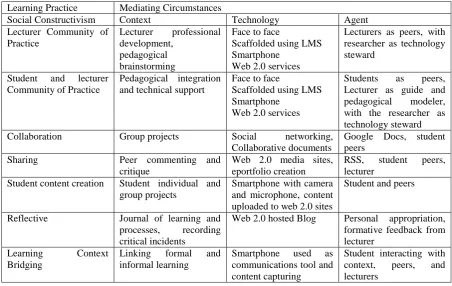
Table1. MLearning project design framework
Learning Practice Mediating Circumstances
Social Constructivism Context Technology Agent Lecturer Community of
Practice
Lecturer professional development,
pedagogical brainstorming
Face to face
Scaffolded using LMS Smartphone
Web 2.0 services
Lecturers as peers, with researcher as technology steward
Student and lecturer Community of Practice
Pedagogical integration and technical support
Face to face
Scaffolded using LMS Smartphone
Web 2.0 services
Students as peers, Lecturer as guide and pedagogical modeler, with the researcher as technology steward Collaboration Group projects Social networking,
Collaborative documents
Google Docs, student peers
Sharing Peer commenting and critique
Web 2.0 media sites, eportfolio creation
RSS, student peers, lecturer
Student content creation Student individual and group projects
Smartphone with camera and microphone, content uploaded to web 2.0 sites
Student and peers
Reflective Journal of learning and processes, recording critical incidents
Web 2.0 hosted Blog Personal appropriation, formative feedback from lecturer
Learning Context Bridging
Linking formal and informal learning
Smartphone used as communications tool and content capturing
Student interacting with context, peers, and lecturers
2.
OVERVIEW OF THE MLEARNING PROJECTS
A wide variety of affordances of the WMDs were investigated throughout the various projects, some with more success than others. Experience and feedback from participants has shown that the focus should be on the affordances of WMDs that are most suitable for the small screens and slower text entry, as well as those affordances that are unique to WMDs (e.g. the built-in geotagging, media recording capabilities, and communications tools). In particular, it is the WMDs potential to bridge multiple learning contexts that faciltates rich interactions between formal and informal social constructivist learning environments. As Laurillard notes: “The intrinsic nature of mobile technologies is to offer digitally-facilitated site-specific learning, which is motivating because of the degree of ownership and control.” (Laurillard, 2007). A generic concept map that has been developed during the research project to graphically illustrate the links between multiple learning contexts, and the web 2.0 technologies that smartphones afford can be viewed at http://homepage.mac.com/thom_cochrane/MobileWeb2/mobileweb2concept2.htm.
[image:3.595.78.531.126.412.2]Space precludes an overview of all of the thirteen projects, thus this paper uses the three 2009 Bachelor of Product Design projects to illustrate the refinement of mobile web 2.0 integration across a three year course.
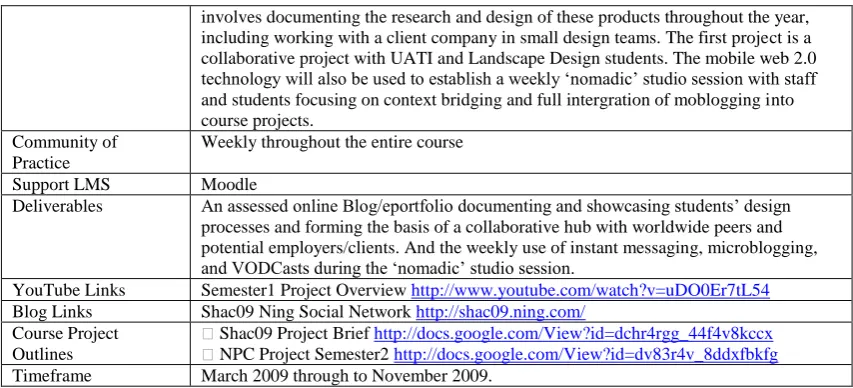
Table 2. Outline of Bachelor of Product Design third year 2009 mobile project
Course: Bachelor of Product Design, third year class, 2009 Participants 24 students
2 Course Lecturers
Technology Steward (Thom Cochrane – CTLI)
Mobile Technology Nokia N95 WiFi smartphone (to be upgraded to N97 in Semester2), Bluetooth folding keyboard, participants responsible for 3G data, voice & txt costs.
Pedagogical Model From Andragogy to Heutagogy
involves documenting the research and design of these products throughout the year, including working with a client company in small design teams. The first project is a collaborative project with UATI and Landscape Design students. The mobile web 2.0 technology will also be used to establish a weekly „nomadic‟ studio session with staff and students focusing on context bridging and full intergration of moblogging into course projects.
Community of Practice
Weekly throughout the entire course
Support LMS Moodle
Deliverables An assessed online Blog/eportfolio documenting and showcasing students‟ design processes and forming the basis of a collaborative hub with worldwide peers and potential employers/clients. And the weekly use of instant messaging, microblogging, and VODCasts during the „nomadic‟ studio session.
YouTube Links Semester1 Project Overview http://www.youtube.com/watch?v=uDO0Er7tL54 Blog Links Shac09 Ning Social Network http://shac09.ning.com/
Course Project Outlines
[image:4.595.79.506.91.285.2]Shac09 Project Brief http://docs.google.com/View?id=dchr4rgg_44f4v8kccx NPC Project Semester2 http://docs.google.com/View?id=dv83r4v_8ddxfbkfg Timeframe March 2009 through to November 2009.
Table 3: Outline of Bachelor of Product Design second year mobile project.
Course: Bachelor of Product Design, second year class, 2009 Participants 15 students
1 Course Lecturer
Technology Steward (Thom Cochrane – CTLI)
Mobile Technology Nokia XpressMusic 5800 WiFi smartphone, participants responsible for 3G data, voice and txt costs.
Pedagogical Model From pedagogy to Andragogy
Pedagogical Focus Building on the students‟ first year mobile web 2.0 experience, integrating moblogging, social networking, and student-generated content into the course, facilitating
collaboration and peer critique. Community of
Practice
Weekly throughout the second semester, during students lunch hour.
Support LMS Moodle
Deliverables An assessed online Blog/eportfolio documenting and showcasing students‟ design processes and forming the basis of collaborative critique and show-casing with worldwide peers and potential employers/clients. Ning is used as a teacher-facilitated collaborative hub for all the projects. Second semester projects focused on sharing and critiquing projects using Google Docs and Vox Group blogs, using the smartphone to capture and share project progress and presentations.
YouTube Links Group Blog video presentations http://pd-mantec-unitec.groups.vox.com/library/videos/ Blog Links Gown Project Ning Social Network http://gowndesign.ning.com/
Course Project Outlines
[image:4.595.77.503.606.726.2]Gown Design Projecthttp://docs.google.com/View?id=dchr4rgg_47cwtgcwcf ManTech Projecthttp://docs.google.com/View?id=dv83r4v_33f89b4fhm Timeframe March 2009 through to November 2009.
Table 4. Outline of Bachelor of Product Design first year mobile project
Course: Bachelor of Product Design, first year class, 2009
Participants 15 students – The average age of the students was 25 (19 to 39), and the gender mix was 4 female student and 11 male students.
1 Course Lecturer
Technology Steward (Thom Cochrane – CTLI)
Mobile Technology Semester1: Dell Mini9 3G netbook. Semester2: Nokia XpressMusic 5800 WiFi smartphone, participants responsible for 3G data, voice and txt costs.
Pedagogical Model Pedagogy
use of social networking for collaboration. Community of
Practice
An assessed online Blog/eportfolio documenting and showcasing students‟ design processes and forming the basis of the beginnings of a collaborative hub with worldwide peers and potential employers/clients.
Support LMS Blackboard
Deliverables An assessed Vox eportfolio and group blog.
YouTube Links Introduction of First Year Project http://www.youtube.com/watch?v=Z6wN36H4TNo Blog Links Example student blog Group http://historicallyfuturisticdesign.groups.vox.com/ Course Project
Outlines
PIC2 Project1http://docs.google.com/View?id=dchr4rgg_55r5gntvf7 PIC2 Project2http://docs.google.com/View?id=dchr4rgg_57c3xj5qg7 Timeframe April 2008 to November 2008
Example Lecturer Reflections (Bachelor of Product Design)
The projects have shown that there are key issues to confront if mobile web 2.0 is to be successfully integrated into courses. The issues include: assessment and staff participation, staff blogging and professional development, and technology choices and support. Projects that do not carry an assessment weighting see a slower and lower uptake. Students want to receive credit for doing something that takes time, focus and commitment. It is vital that staff participate in the blogging process and run their own blogs alongside the student ones. Students want to see that staff are visiting their blogs and commenting on posts as well as offering information that might assist them with their projects. This doesn‟t mean staff are required to comment on all posts but reading the blogs is important. Our projects have allowed students to have the WMDs free of charge. This ensured that participants had the tools they needed to work effectively. A regular technology update is also required and we have found that the most effective way for this to occur is in a community of practice form with participation from a technology steward. Over the last 3 years, the introduction of mobile web 2.0 tools into the Bachelor of Product Design has facilitated significant flexibility for students allowing them to stay connected, share their ideas widely, participate in world wide creative communities and choose to work in virtually any context on and off campus. The increased engagement from students using mobile web 2.0 comes from a sense of connectivity via immediate access to the Internet, photo sharing, IM, emailing and the usual phone and txt messaging the WMDs bring. Students often group together looking at online material, send each other files and photos, URLs and other digital information. Video blogging has become a favourite activity and is an effective way to get out of studio information across in a short space of time. There is also a sense of current technology being embedded into the learning experience. Finally, Students editorial skills have increased due to the constant need to monitor the content of their blogs. A look over almost all of the blogs from start of the project up to today shows how the students have learned about editing content and getting ideas across efficiently.
3.
DISCUSSION
The Impact of Action Research
all the participants, and between the researcher and the course lecturers in particular. The use of an action research methodology has led to the emergence of several key connecting threads between the mlearning projects:
The context bridging affordances of mlearning
The disruptive nature of mlearning technologies
The importance of learning community formation among the participants
The importance of professional development strategies for the course lecturers
Implications of the MLearning Case Studies
The thirteen mlearning projects represented within the five case studies covering 2007 to 2009 provide rich examples of practical pedagogical integration of mlearning within a variety of tertiary education courses. In this section we briefly summarize the main lessons learnt from each project, and how these have informed the implementation of each subsequent mlearning project.
Implications of Case Study1: Diploma of Landscape Design 2007 to 2009
Beginning in 2007, the first mlearning project paved the way for the following projects, highlighting a range of technical and implementation issues that could be improved upon. The project also emphasized the disruptive nature of mlearning, illustrating the process of lecturer pedagogical reconceptualisation of teaching required, and also the process of student reconceptualisation of learning required. Thus the importance of a robust yet flexible technical and pedagogical support strategy was highlighted.
Implications of Case Study2: Bachelor of Product Design 2008 to 2009
The Product Design mlearning projects achieved significant progress in course integration, pedagogical reconceptualisation, and development of a staged and scaffolded learning community facilitated by intentional communitites of practice across each year of the course. The case study illustrated the potential to stage and scaffold mlearning integration across all three years of a Bachelor level course, starting with establishing a learning community culture and facilitation of a progression of pedagogy to heutagogy (Luckin et al., 2008) from first year to third year.
Implications of Case Study3: Diploma of Contemporary Music 2008 to 2009
The Diploma of Contemporary Music mlearning project developed from an initial exploration of the potential of mlearning within the course to an example of successful course integration and student adoption and appropriation of mlearning. During the first iteration of the mlearning project students and lecturers were enthusiastic and engaged by the tools, but skeptical as to the potential impact on the course and leaning outcomes. The second iteration of the mlearning project integrated the mlearning tools into the course assessment leading to adoption and appropriation beyond personal and social use, illustrating the learning context bridging affordances of mobile web 2.0.
Implications of Case Study4: Bachelor of Architecture 2009
The Architecture mlearning project was the widest scoped in terms of student numbers, encompassing the entire second year of the Bachelor of Architecture (115 students and 6 lecturers). However the project was a first implementation within the school, and formed an exploratory initiation into the potential of mlearning for both the lecturers and the students. This illustrates a consistent theme in all of the mlearning projects – the first implementation of an mlearning project breaks new ground, and while not necessarily producing significantly transformed pedagogy due to a lack of course integration, the first iteration creates the groundwork for the ontological shift required by the course lecturers to conceptualise the potential to integrate the technologies into the course in subsequent iterations of the mlearning project. Key lecturers declined to be involved in the establishment of the initial lecturer investigative community of practice, leading to a lack of willingness to integrate the project into the course assessment. This case study therefore highlights the critical importance of lecture professional development and subsequent course integration of the mlearning tools.
The Performing and Screen Arts mlearning project was one of the most ambitious of the mlearning implementations. However, its implementation suffered from the relatively short time the lecturers had for personally appropriating the mlearning tools themselves, and timetabling limitations led to a significant change in the community of practice support model. While not personally modeling the use of the mobile web 2.0 tools to a high level, the course lecturers nevertheless created an atmosphere of high expectations of the students that created an energetic „buzz‟ among them, facilitating experimentation and collaboration around the use of the tools. This case study therefore highlights the importance of the development of a supportive learning community, and the positive impact of high expectations from the lecturers on the participating students.
Critical Success Factors
Based on the experiences gathered from the thirteen mobile learning projects over the last three years the researcher has identified several pedagogical critical success factors. These success factors were identified across the mobile web 2.0 projects by evaluating the following:
The level of student engagement and satisfaction achieved – as evidenced in evaluative surveys and focus group feedback.
The level of moblogging (mobile blogging) achieved by students in the courses.
Lecturer reflective feedback.
Several of these are similar to the „nine critical success factors‟ of authentic learning (Herrington and Herrington, 2007, Herrington and Herrington, 2006), and other similar critical success factors that have been identified by other researchers (Barker et al., 2005, JISC, 2009). Each of the mlearning case studies described earlier in this paper highlight the impact of combinations of these critical success factors.
1. The level of pedagogical integration of the technology into the course criteria and assessment. a. Scoping and planning appropriate course activities and assessments based upon the
chosen pedagogical model (social constructivism). 2. The level of lecturer modeling of the pedagogical use of the tools.
a. Creating a Zone of Proximal Development b. Socialising the everyday use of the technology 3. Creating a learning community
a. The use of regular formative feedback from both lecturers and student peers. b. Establishing and nurturing of an intentional Community Of Practice
c. Supported by social networking and collaboration 4. Appropriate choice of mobile devices and web 2.0 social software.
a. MLearning affordances must be mapped to the chosen pedagogy b. Facilitating context bridging (via ubiquitous connectivity)
c. Socially constructed choices (fostering a sense of personal ownership leading to appropriation and integration of the technology)
5. Technological and pedagogical support.
a. Establishment of a lecturer COP focusing upon investigating the pedagogical use of the tools and developing lecturer competency and personal appropriation of the tools b. Establishment of a combined lecturer and student COP for implementing the
mlearning project
c. The critical role of the „technology steward‟ within the COPs
6. Allowing time for developing an ontological shift, both for the lecturers and the students. a. Stage and scaffold the introduction of disruptive technologies to maximize the
effectiveness of the zone of proximal development.
discussing, but they cannot be left unguided and unsupported. To get the best from the experience the complexity of the learning design must be rich enough to match those rich environments” (Laurillard, 2007, p174).
Lecturers generally require significant time to become comfortable with using the mobile web 2.0 tools, and with the potential for enhancing their course. The integration of mobile web 2.0 into course assessment is a critical step. The point of acceptance into course integration of the mobile web 2.0 tools is typically reached as lecturers realize the flexibility of learning context and feedback that these tools facilitate. Learning activities often begin as translations of more traditional paper based activities into a mobile web 2.0 alternative. As lecturers become more acquainted with the possibilities afforded by mobile web 2.0 tools more creative learning activities are developed and integrated into the courses.
Student feedback from the mlearning projects clearly showed that the choice of smartphone was critically important in the acceptance of its use. This is a function of both the social acceptance (social construction) of a smartphone, and the smartphones ability to enhance the specific requirements of a particular courses focus. In response to this a smartphone evaluation rubric was developed for choosing an appropriate smartphone for each of the 2009 projects. The rubric was used for comparative rating of several current (2009) and soon to be available smartphones according to their match with sixteen chosen affordances for mlearning and mobile web 2.0.
Implementation model
The mobile web 2.0 projects implementation methodologies have so far used a model of providing a common smartphone for the students within a course. The students and staff involved have been encouraged to use the smartphones as if they owned them for the period of the trials. This approach was used to seed the concept and provide proof of concept results. Following the enthusiastic response from the students and lecturers involved in these trials, internal institutional funding was sought, and approved, for extending these small projects to a major large-scale mlearning project in 2009 involving the use of 250 smartphones, and 200 netbooks, followed by 450 smartphones and 400 netbooks in 2010. This larger scale project is informed by the experiences of the previous trials and covers a wider range of courses and learning contexts. However, to create a sustainable model, the goal going forward is to move to a student-owned model, where students purchase a smartphone that meets specifications outlined by the course requirements – much as many institutions require students to purchase a specifically specified laptop computer to ease support requirements. As the cost of appropriate smartphones and 3G data costs drop, the purchase cost may be sustainably subsidized by institutions in lieu of other course related costs that the mobile web 2.0 model replaces.
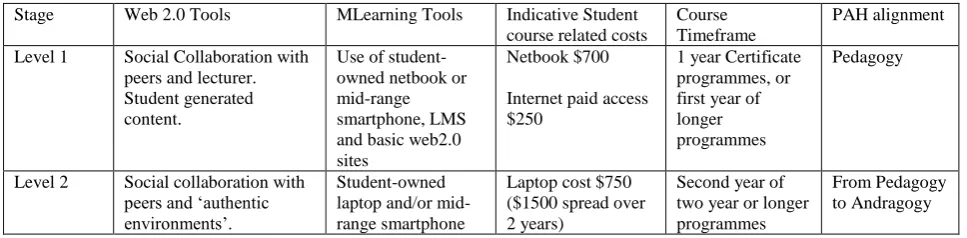
[image:8.595.64.548.602.721.2]Based upon these experiences, in order to achieve an explicit move to a social constructivist learning environment using mobile web 2.0 tools, a staged, and scaffolded approach has been adopted (Table 5). This staged approach allows the bridging of the PAH (Pedagogy, Andragogy, Heutagogy) continuum (Luckin et al., 2008), and the embedding of mobile web 2.0 affordances that support each stage. Additionally, as the life-span of mobile computing is generally shorter than that of desktop computing, a staged roll-out of WMD computing for students involved in three year long courses could be achieved to minimise the redundancy of the student-owned WMDs. Academic staff development is critical in facilitating the pedagogical focus of this roll-out.
Table 5. A staged mobile web 2.0 implementation model
Stage Web 2.0 Tools MLearning Tools Indicative Student course related costs
Course Timeframe
PAH alignment
Level 1 Social Collaboration with peers and lecturer. Student generated content.
Use of student-owned netbook or mid-range smartphone, LMS and basic web2.0 sites
Netbook $700
Internet paid access $250
1 year Certificate programmes, or first year of longer programmes
Pedagogy
Level 2 Social collaboration with peers and „authentic environments‟.
Student-owned laptop and/or mid-range smartphone
Laptop cost $750 ($1500 spread over 2 years)
Second year of two year or longer programmes
Context Aware And/or smartphone $750
Internet paid access $250
Level 3 Context Independent. Student generated contexts.
Student-owned laptop and/or high-end smartphone
Laptop cost $750 ($1500 spread over 2 years)
And/or smartphone $750
Internet paid access $250
Third year of programme
From Andragogy to Heutagogy
Pedagogical and Technical Support Model
The integration of the mobile web 2.0 technologies into lecturers‟ daily workflow and integration into course activities and assessment are critical success factors, as is the establishment of a collaborative learning environment. An intentional Community Of Practice model (Langelier, 2005) has been found to be effective for guiding and supporting the mlearning roll-out to achieve these goals. This comprises weekly “technology sessions” (Community of Practice) with small groups of lecturers facilitated by an appropriate „technology steward‟ (Wenger et al., 2005). The same model is then used with the students and their lecturers in courses.
4.
CONCLUSION
Keys to mlearning sustainability are an institutional cultural and strategy shift as well as a lecturer and student ontological shift in relation to learning and teaching. Achieving this takes time and significant learning design. Establishing collaborative intentional communities of practice is one approach. The frameworks and models presented are beginning to achieve this within the researchers institution, transforming pedagogy and engaging students.
REFERENCES
BARKER, A., KRULL, G. & MALLINSON, B. (2005) A Proposed Theoretical Model for M-Learning Adoption in Developing Countries. mLearn 2005.
HERRINGTON, A. & HERRINGTON, J. (Eds.) (2006) Authentic learning environments in higher education, Hershy, Information Science Publishing.
HERRINGTON, A. & HERRINGTON, J. (2007) Authentic mobile learning in higher education. IN JEFFERY, P. L. (Ed.) AARE 2007 International Educational Research Conference. Fremantle, Australia, Papercode.
JISC (2009) Higher Education in a Web 2.0 World. JISC.
LANGELIER, L. (2005) Work, Learning and Networked: Guide to the implementation and leadership of intentional communities of practice. Quebec City, CEFIRO (Recherche et Études de
cas collection).
LAURILLARD, D. (2007) Pedagogcal forms of mobile learning: framing research questions. IN PACHLER, N. (Ed.)
Mobile Learning: towards a research agenda. London, WLE Centre, Institute of Education.
LUCKIN, R., CLARK, W., GARNETT, F., WHITWORTH, A., AKASS, J., COOK, J., DAY, P., ECCLESFIELD, N., HAMILTON, T. & ROBERTSON, J. (2008) Learner Generated Contexts: a framework to support the effective use of technology to support learning. IN LUCKIN, R. (Ed.). London, The London Knowledge Lab.
MCLOUGHLIN, C. & LEE, M. J. W. (2007) Social software and participatory learning: Pedagogical choices with technology affordances in the Web 2.0 era. ascilite 2007. Singapore.
SHARPLES, M., CROOK, C., JONES, I., KAY, D., CHOWCAT, I., BALMER, K. & STOKES, E. (2009) CAPITAL Year One Final Report. 0.5 ed., University of Nottingham.
WADSWORTH, Y. (1998) What is Participatory Action Research? , Action Research International.
WENGER, E., WHITE, N. & SMITH, J. (2009) Digital Habitats: stewarding technology for communities, Portland, Oregon, CPsquare.