On robustness against JPEG2000: a performance
evaluation of wavelet-based watermarking techniques
BHOWMIK, Deepayan <http://orcid.org/0000-0003-1762-1578> and
ABHAYARATNE, Charith
Available from Sheffield Hallam University Research Archive (SHURA) at:
http://shura.shu.ac.uk/14107/
This document is the author deposited version. You are advised to consult the
publisher's version if you wish to cite from it.
Published version
BHOWMIK, Deepayan and ABHAYARATNE, Charith (2014). On robustness against
JPEG2000: a performance evaluation of wavelet-based watermarking techniques.
Multimedia Systems, 20 (2), 239-252.
Copyright and re-use policy
See
http://shura.shu.ac.uk/information.html
(will be inserted by the editor)
On robustness against JPEG2000: A performance
evaluation of wavelet-based watermarking techniques
Deepayan Bhowmik · Charith Abhayaratne
Received: 01-Sept-2012 / Accepted: date
Abstract With the emergence of new scalable coding standards, such as JPEG2000,
multimedia is stored as scalable coded bit streams that may be adapted to cater network, device and usage preferences in multimedia usage chains providing uni-versal multimedia access. These adaptations include quality, resolution, frame rate and region of interest scalability and achieved by discarding least significant parts of the bit stream according to the scalability criteria. Such content adaptations may also effect the content protection data, such as watermarks, hidden in the original content. Many wavelet-based robust watermarking techniques robust to such JPEG2000 compression attacks are proposed in the literature. In this paper, we have categorized and evaluated the robustness of such wavelet based image watermarking techniques against JPEG2000 compression, in terms of algorithmic choices, wavelet kernel selection, subband selection, or watermark selection using a new modular framework. As most of the algorithms uses a different set of para-metric combination, this analysis is particularly useful to understand the effect of various parameters on the robustness under a common platform and helpful to design any such new algorithm. The analysis also considers the imperceptibility performance of the watermark embedding, as robustness and imperceptibility are two main watermarking properties, complementary to each other.
Keywords Wavelet-based image watermarking · watermarking evaluation ·
robustness·scalable coding·content adaptation·JPEG2000
Department of Electronic and Electrical Engineering, The University of Sheffield. Mappin Street, Sheffield, United Kingdom, S1 3JD
1 Introduction
Recent years have seen the emergence of scalable coding standards for multi-media content coding: JPEG2000 for images [1]; MPEG advanced video coding (AVC)/H.264 scalable video coding (SVC) extension for video [2]; and MPEG-4 scalable profile for audio [3]. The scalable coders produce scalable bit streams representing content in hierarchical layers according to audiovisual quality, spatio-temporal resolutions and regions-of-interests. The bit streams may be accordingly truncated in order to satisfy variable network data rates, display resolutions, dis-play device resources and usage preferences. The new bit streams may be trans-mitted or further adapted or decoded using a universal decoder which is capable of decoding any original or adapted bit streams to display or play adapted versions of the original content in terms of quality or reductions. The multimedia usage framework standard, MPEG-21, standardizes the operation of a content-agnostic content adaptation engine as the part 7 of the standard: Digital Item Adaptation (DIA) [4, 5]. Such bit stream truncation-based content adaptations also affect any content protection data, such as watermarks, embedded in the original content. In this paper, we consider JPEG2000 compression as the scalable coding-based con-tent adaptations for images. Therefore JPEG2000 based attacks are considered here as an important potential attack on the watermarking schemes.
Due to the use of digital wavelet transform (DWT) as the underlying tech-nology of JPEG2000 compression standard, recent years have seen wide use of wavelet-based techniques for image watermarking [6–32] in order to improve the watermarking robustness. However, these algorithms are often different to each other in terms of the wavelet kernel, number of wavelet decomposition levels, wavelet sub band choices for embedding, wavelet coefficient choices for embedding and the coefficient modification method for embedding. Therefore it is extremely difficult to evaluate such algorithms when comparing the performances. Often the algorithms claim improvements compared to the previously proposed ones but of-fer very little information on the reason behind it. Literature suggest that often wavelet kernels [24, 33] or a hosting coefficient selection method [6, 7, 17, 22] may play a key role in watermarking performance while it is very difficult to understand whether the improvements are influenced by any other parametric choices or not. For example, while it is general convention that high-frequency sub-band based watermarking offer high imperceptibility and less robustness to compression. How-ever literature [34] proposed that not all high frequency coefficients are vulnerable to compression while not all low frequency coefficients are robust to compression. In this case the performance evaluation with any other existing method is very difficult unless compared under a common platform. Therefore it is important to study the effect of previously mentioned parametric choices in terms of balanced embedded distortion and robustness to content adaptation attacks performances under a common framework. Such framework is particularly helpful to help the reader to choose various design parameters in proposing a new watermarking algo-rithm. Subsequent sections of this paper discussed in details about such parametric dissection of these algorithms.
The main aim of this paper is to address the evaluation of wavelet-based image watermarking schemes for robustness against scalable coding-based content
adap-tation attacks,e.g., JPEG2000 by proposing a new analysis framework. However,
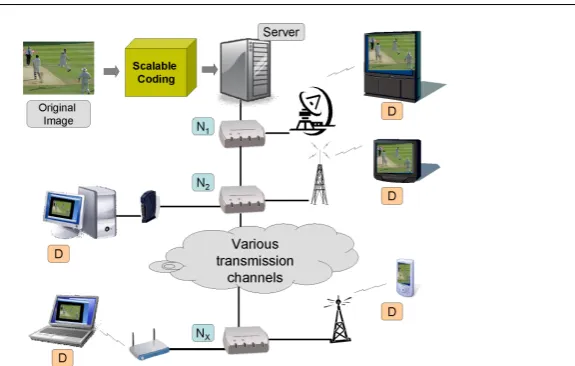
im-Fig. 1 Universal multimedia usage scenarios using scalable coded content.
perceptibility, which is often complementary in nature to robustness. For example, in order to lower the embedding distortion, one may choose low significant frequen-cies or low significant bit plane which often forms the low significant portions of the scalable bit streams which may be discarded during content adaptations. In summary, the main objectives of this paper are:
1. To categorize and dissect wavelet-based image watermarking schemes under one common platform.
2. To design a new framework to analyze the effects of various algorithmic pa-rameters on robustness.
3. To evaluate the robustness of wavelet-based image watermarking techniques against JPEG2000 scalable content adaptations.
The rest of the paper is organized as follows: General overviews of scalable coding-based content adaptation is presented in Sect. 2 followed by the detailed dissection of the wavelet-based watermarking techniques in Sect. 3. The new evalu-ation framework is presented in Sect. 4, whereas the evaluevalu-ation results are discussed in Sect. 5 followed by concluding remarks in Sect. 6.
2 Overview of scalable coding-based content adaptation
[image:4.595.127.415.78.261.2]or via a lower bandwidth network, the bit stream is adapted at different nodes
(N1,N2, ... ,Nx, as shown in Fig. 1) using different scaling parameters to match
those requirements. At each node the adaptation parameters may be different and a new bit stream may be generated. Finally the adapted bit streams are decoded using a universal decoder. The scalable coding-decoding process consists of 3 main modules [35]: encoder, extractor and decoder.
The encoder module is responsible for producing a full resolution, highest
quality compressed bit stream from the original content. The bit stream generation
normally focuses on three main functionalities: quality scalability (Qi), spatial
resolution scalability (Si) and temporal resolution scalability (Ti: for video), where
Qi,SiandTirepresent the scaling parameters for different quality-spatio-temporal
layers with the layer indexi. A bit stream descriptor is also generated along with
the bit stream describing the location of these layers in the scalable bit stream.
The extractor module is part of a cross media engine that adapts the bit
streams following the MPEG 21 part-7 DIA specifications. It truncates the scalable bit stream considering the context and produces the adapted bit-stream, which is also scalable and can be re-adapted at any following network node by using another extractor, and its new description.
The decoder module provides an universal decoder to decode any adapted
bitstream to display the adapted content.
3 Wavelet-based image watermarking
Due to its ability for efficient multi-resolution spatio-frequency representation of signals, the DWT has become the major transform for spread spectrum water-marking. The wavelet domain watermarking algorithms often share a common model. Based on the embedding methodology, wavelet-based image watermarking can be categorized into two main classes: uncompressed domain algorithms and joint compression-watermarking algorithms.
Uncompressed domain watermarking algorithms: Watermark embedding is
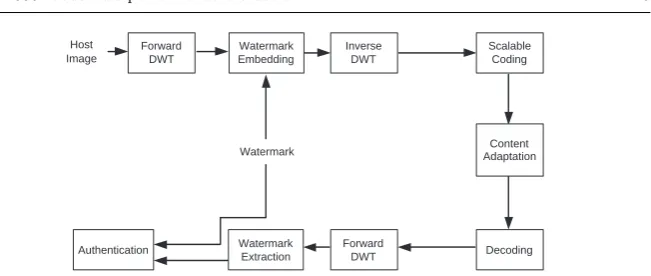
performed independent of and prior to compression. There are many algorithms of this type of watermarking, presented in the literature [6–9, 11–14, 17–20, 22–24]. A system block diagram in the context of scalable coding-based content adapta-tion is shown in Fig. 2. The major steps for embedding include the forward DWT (FDWT) and coefficient modification followed by the inverse DWT (IDWT). Then the content is scalable coded and may be adapted during usage. Watermark au-thentication includes the FDWT and recovery of the watermark as blind or non-blind extraction and comparison with the original watermark.
Joint compression-watermarking algorithms:As scalable image coding is mainly
Forward DWT Host
Image
Watermark Embedding
Scalable Coding
Decoding Watermark
Extraction Authentication
Content Adaptation Watermark
Inverse DWT
Forward DWT
Fig. 2 Uncompressed domain image watermarking and content adaptation attack.
Forward DWT Host
Image Quantisation
Entropy Coding
Bit-stream generator
Watermark Embedding
+
Bit-stream analyser Entropy
Decoding Watermark
Extraction
De-Quantisation Inverse
DWT Decoded
Image
Authentication
Content Adaptation
Fig. 3 Joint compression-watermarking and content adaptation attack.
watermarking algorithm that uses the same DWT kernel for both compression and watermark embedding.
3.1 Dissection of wavelet-based image watermarking algorithms
In both algorithm types, the watermark embedding algorithm considers different options for the choice of wavelet kernels, embedding subbands, for the selection of embedding coefficients and the modification methodology. In this section we dissect the well-known wavelet-based algorithms in terms of these four parameters:
3.1.1 Wavelet kernel
[image:6.595.92.418.74.212.2] [image:6.595.126.364.235.357.2]3.1.2 Subband
Often various watermarking algorithms select different number of wavelet decom-position levels to choose a desired subband or combination of subbands to suit algo-rithmic needs. There have been algorithms using two [6–9,11], three [15,22–24] and four [13, 14, 19] levels of wavelet decompositions. Joint compression-watermarking algorithms used the same number of levels of decompositions used in the compres-sion algorithm. The choice of subbands for watermark embedding is often driven by the imperceptibility and robustness criteria. Algorithms intending to meet low embedding distortion and imperceptibility requirements use high frequency sub-bands for embedding [7–9,11–14,17,28]. On the other hand, algorithms designed to achieve high robustness against compression use low frequency subbands for em-bedding [6, 16, 19, 22]. Finally, algorithms aiming to meet a balance between these two criterions use all subbands resulting in spread spectrum embedding [23–26].
3.1.3 Hosting coefficient
The selection of wavelet coefficients to host the watermark can be classified into three methods: choosing all coefficients in a subband [9, 11–14, 25, 31]; using a threshold based on their magnitude significance [8, 23, 24, 28] or the just noticeable difference(JND) [22]; and based on the median of a 3x1 non-overlapping window, which can be based on the same subband (Intra-band) [6, 26] or spanning three high frequency subbands in the same decomposition level (Inter-band) [7,17]. Some of the all-coefficients-based algorithms use a Human Visual System (HVS)-based mask [12, 13] or a fusion rule-based mask for refining the selection of host coeffi-cients [14, 15] or key-based random sequence for ordering host coefficoeffi-cients [19].
3.1.4 Embedding method
The host wavelet coefficient modification methods used in wavelet-based water-marking algorithms can be generalized as follows:
Cm,n′ =Cm,n+∆m,n, (1)
where Cm,n′ andCm,n are the modified and original coefficients, respectively at
(m, n) position, and∆m,nis the embedding modification. The modification
meth-ods can be categorized into two classes: modification based on magnitude alter-ation [8, 9, 11–15, 22–25, 28, 31]; and re-quantizalter-ation of a coefficient with respect to a group of coefficients within a given window [6, 7, 17, 19, 26].
Further, for magnitude alteration algorithms, the way∆m,nin Eq. (1) is
mod-ified can be mapped into a generalized form consisting of four sub-classes of meth-ods as follows:
∆m,n=a1A1+a2A2+a3A3+a4A4, (2)
where
A1=αCm,nb Wm,n,
A2=vm,nWm,n,
A3=βm,nwm,nand
Fig. 4 Re-quantisation-based modification.
A1corresponds to direct modification of the host coefficientCm,nwith a watermark
valueWm,naccording to the user specified parameters (αandb= 1,2, ...) to vary
the watermark weight and the strength, respectively [9, 22–25]. A2 corresponds
to the HVS driven modification using a weighting parameter (vm,n) which is a
function ofCm,nand the pixel masking process in the HVS model [12, 13, 28].A3
corresponds to fusion-based methods where the host wavelet coefficients are fused
with the watermark wavelet coefficientswm,nusing an HVS-based fusion strength
parameter, βm,n [14, 15]. With A4, we represent all other magnitude alteration
algorithms based on any function,f(Cm,n, Wm,n). It is worth to mention that at
a time only one type of modifications in Eq. (2) is used to represent individual algorithms and also used for experimental evaluation in Sect. 5. Therefore, we use
a binary vector < a1, a2, a3, a4 > to represent specific algorithm by setting the
corresponding vector element to 1 in the evaluation framework. The use of this vector is prominent in the next section.
Similarly we map the re-quantization-based modification into Eq. (1) as follows:
Such algorithms change the median coefficient of a group of coefficients to thekth
quantisation step position by a modification value∆m,n, where|∆m,n| ≤δ, which
is based on the new quantization stepδas shown in Fig. 4. Different functions are
suggested in the literature to find the value ofδ and such functions normally use
the minimum (Cmin) and the maximum (Cmax) coefficient values in the coefficients
group. They can be generalized into the following form:
δ=f(γ, Cmin, Cmax), (3)
whereγ is the user defined weighting factor. As∆m,ndepends on the step sizeδ
and the user definedγ, the modification value∆m,nis typically a function ofCmin
andCmax for each group of coefficients. Details of the embedding procedures can
be found in [6] and [17].
3.2 Different wavelet-based watermarking algorithm realization
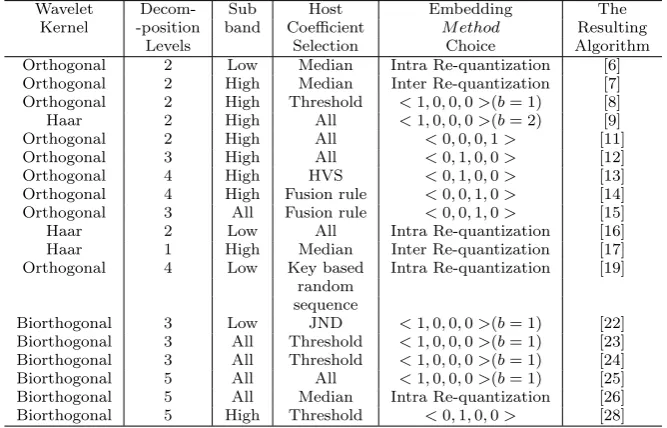
With the above dissection, different wavelet-based watermarking algorithms can be realized under a common framework, based on various parametric options such as, the wavelet kernel, wavelet decomposition, subband choice, host coefficient choice and embedding method, and using a set of user-defined parameters. A examples of realization of major wavelet-based watermarking algorithms are shown in TABLE 1.
[image:8.595.75.419.76.132.2]Table 1 Realization of major wavelet-based watermarking algorithms using parametric dis-section
Wavelet Decom- Sub Host Embedding The Kernel -position band Coefficient M ethod Resulting
Levels Selection Choice Algorithm Orthogonal 2 Low Median Intra Re-quantization [6] Orthogonal 2 High Median Inter Re-quantization [7] Orthogonal 2 High Threshold <1,0,0,0>(b= 1) [8] Haar 2 High All <1,0,0,0>(b= 2) [9] Orthogonal 2 High All <0,0,0,1> [11] Orthogonal 3 High All <0,1,0,0> [12] Orthogonal 4 High HVS <0,1,0,0> [13] Orthogonal 4 High Fusion rule <0,0,1,0> [14] Orthogonal 3 All Fusion rule <0,0,1,0> [15] Haar 2 Low All Intra Re-quantization [16] Haar 1 High Median Inter Re-quantization [17] Orthogonal 4 Low Key based Intra Re-quantization [19]
random sequence
Biorthogonal 3 Low JND <1,0,0,0>(b= 1) [22] Biorthogonal 3 All Threshold <1,0,0,0>(b= 1) [23] Biorthogonal 3 All Threshold <1,0,0,0>(b= 1) [24] Biorthogonal 5 All All <1,0,0,0>(b= 1) [25] Biorthogonal 5 All Median Intra Re-quantization [26] Biorthogonal 5 High Threshold <0,1,0,0> [28]
Analysis framework
Embedding Process Content Adaptation (JPEG2000)
Extraction and Authentication
Embedding Algorithm
Wavelet Kernel
Subband Selection
Coefficient Selection
Quality Scalability
Resolution Scalability
Extraction Algorithm
Authentication
Fig. 5 Framework modules and input/output parameter blocks
4 Analysis framework
[image:9.595.125.367.368.521.2]Watermark embedder
Wavelet Kernel: Forward wavelet transformation
Image storage Image to be watermarked Choice of wavelet kernels
No. of decomposition level
Choice of subband
Choice of
threshold Embedding process Embedding
parameters
Watermark logo storage Watermark
logo
Inverse wavelet transformation
Watermarked image storage Watermarked
image
Watermarked image
Embedding performance evaluation process MSE,
PSNR, SSIM
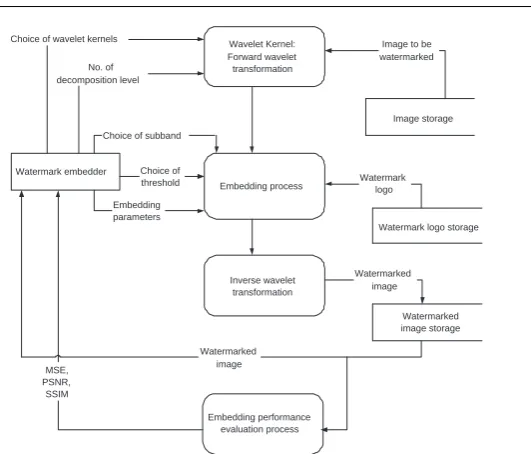
Fig. 6 Flow diagram of the watermark embedding module.
4.1 Watermark embedding module
Following the dissection of wavelet-based watermarking shown in Sect. 3, the wa-termark embedding module facilitates a common framework consisting of a tool repository for implementing those wavelet-based watermarking algorithms. The block diagram of the watermark embedding module consisting all input parame-ters, the sub module functional blocks, embedding performance evaluation, output parameters and their interconnected flow is shown in Fig. 6. The sub modules in-clude the FDWT, watermark embedding, the IDWT, image display and embedding performance evaluation.
The input parameters to this module are three fold: operational; systems-related; and user-defined. Operational inputs are the host image and the water-mark logo. The systems-related input parameters are related to the tools reposi-tory and consist of wavelet kernel choices, number of wavelet decomposition levels, host subband choice, host coefficient selection method and embedding procedure choice. The user-defined input parameters include embedding parameters, such as, thresholds, watermark strengths, and etc. The output parameters include the wa-termarked image and embedding performance evaluation metrics, such as, Mean Square Error (MSE), the Peak Signal to Noise Ratio (PSNR), Structural Similarity Measure (SSIM) and the data hiding capacity.
[image:10.595.120.386.77.304.2]fol-Watermark embeder
Forward DWT initialisation
Image / video store
Image / video to be watermarked
No. of decomposition level Choice of wavelet kernel
Orthogonal wavelet
Embedding Process Lifting-based
Bi-orthogonal wavelet
Non-linear 2D wavelet
Non-linear Quincunx wavelet
Fig. 7 The FDWT submodule with choices wavelet kernels.
lowed by coefficient selection based on the realization of the embedding methods discussed in Sect. 3.
4.2 JPEG2000 content adaptation module
Content adaptation module emulates of a heterogenous communication system, where the content is encoded using the JPEG2000 scalable coders to produce scal-able bit streams. Such content may be adapted to address the varying network bandwidths, quality of services, display resolutions and usage requirements at var-ious nodes of the network. These bit streams are adapted in terms of reducing quality, spatial resolutions and frame rates just by truncating various layers of the bitstream, resulting in low data rates to be streamed. During the robustness eval-uation this module generates test images based on various bit rate of resolution scaling criteria.
4.3 Watermark extraction and authentication module
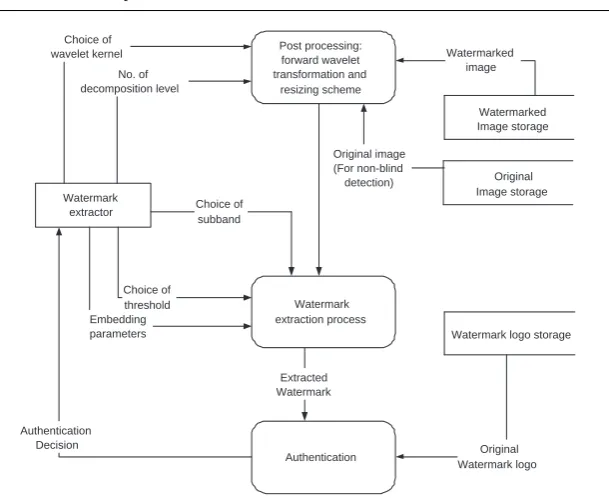
This module, extracts the watermark from the test images and authenticate the extracted watermark to evaluate the robustness. However a preprocessing step has been included to address the resolution scalability issue.
4.3.1 Watermark Extraction
[image:11.595.76.371.72.316.2]Watermark extractor
Post processing: forward wavelet transformation and
resizing scheme
Watermarked Image storage Watermarked
image Choice of
wavelet kernel
No. of decomposition level
Choice of subband
Choice of
threshold Watermark extraction process Embedding
parameters Watermark logo storage
Original Watermark logo Authentication
Extracted Watermark
Original image (For non-blind
detection) Original Image storage
Authentication Decision
Fig. 8 Flow diagram of watermark extraction and authentication module.
In this framework, the schemes associated with magnitude alteration algorithms are non-blind, whereas, re-quantisation-based modifications are blind. In general, watermark extraction (as shown in Fig. 8) includes the FDWT followed by the
finding of∆m,n either asCm,n′ −Cm,nfrom Eq. (1) or asf(γ, Cmin, Cmax) from
Eq. (3) to find the watermark informationWm,n.
Preprocessing:In the case of resolution scalability-based content adaptation, the
resolution of the image of the decoded image is smaller than the original image and the watermarking synchronization is lost. To address such issue, we perform a preprocessing resizing scheme for the scaled test images. The resizing scheme
follows three steps. Firstly, the decoded image is decomposed into (N−M) levels
using the FDWT employed in the compression algorithm, whereN is the number
of wavelet decomposition levels used in the embedding algorithm and M is the
number of levels discarded due to content adaptation. Secondly, the normalization
of all coefficients are adjusted by multiplying with 2M. Finally the dimensions
are extended to those of the original by zero padding the current matrix and the IDWT is applied to obtain the full resolution image.
4.3.2 Watermark Authentication
The authentication process verifies the extracted watermark with the original
wa-termark. Two commonly used authentication metrics are Hamming Distance (H)
[image:12.595.94.399.75.324.2]Hamming Distance is lower than a threshold value or the correlation similarity measure is higher than a given threshold. These metrics are computed as follows:
H(W, W′) = 1
L
L∑−1
i=0
Wi⊕Wi′, (4)
S(W, W′) = W.W
′
√
W′.W′/
W.W
√
W.W ×100,
= √ W.W′
W′.W′√W.W ×100, (5)
where W andW′ are the original and the extracted watermarks, respectively.L
is the length of the sequence and ⊕ represents the XOR operation between the
respective bits.
5 Evaluation results and discussion
In the section we use the proposed framework to evaluate the robustness of the watermarking techniques against the MPEG-21 DIA attacks, such as, JPEG2000-based quality scalable adaptations and JPEG2000-JPEG2000-based resolution scalable adap-tations.
5.1 The experimental setup
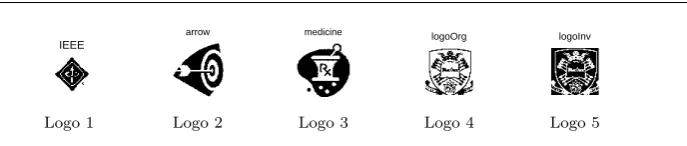
For these experiments, we use the first 100 images from INRIA natural holiday image data set [42] and binary logo as the watermark data. The PSNR is used for setting the host image distortion level to an acceptable level for embedding a given amount of watermarking data for robustness evaluation experiments. The Hamming distance (BER) is used as the authentication measure. The results show the mean value of the Hamming distance for the test image set and the error bars corresponding to 95% confidence level. The robustness against different com-pression ratios for the quality scalability attacks on the full resolution and joint resolution-quality scalability attacks (on half resolution) is evaluated. However, we have also conducted experiments to understand the effect on robustness evalua-tion on choosing different binary logo (varied distribuevalua-tion) as watermark; or how
various embedding performance metric,e.g.,PSNR or SSIM behaves; or how the
authentication metrici.e., Hamming distance can be interpreted.
5.1.1 On the choice of logo
IEEE
arrow medicine logoOrg logoInv
Logo 1 Logo 2 Logo 3 Logo 4 Logo 5
Fig. 9 Test binary logo.
1 2 4 8 10.67 16 24.24 32 44.44 64
0 0.2 0.4
Image 1: Full resolution || Embedded Bit Count = 8192
Compression Ratio
Hamming Distance
Logo 1 Logo 2 Logo 3 Logo 4 Logo 5
1 2 4 8 10.67 16 24.24 32 44.44 64
0 0.2 0.4 0.6
Image 1: Half resolution || Embedded Bit Count = 8192
Hamming Distance
[image:14.595.73.417.79.152.2]Compression Ratio
Fig. 10 An example of comparing the choice of logo with the same bit count (8192) being
embedded using the intra re-quantization-based embedding on robustness to -Row 1: Quality scalability attack on full resolution; andRow 2: Joint resolution-quality scalability attack (half resolution).
5.1.2 On the use of PSNR in evaluations
[image:14.595.107.385.157.422.2]IEEE HD=0.009 HD=0.091 HD=0.153 HD=0.291
[image:15.595.73.411.68.195.2]arrow HD=0.062 HD=0.145 HD=0.254 HD=0.309
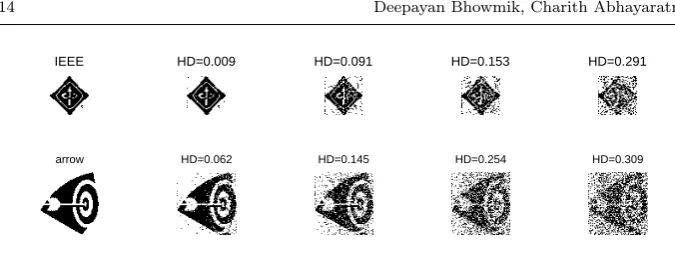
Fig. 11 Original and extracted watermark logo and corresponding to different Hamming
distances (HD).
5.1.3 Hamming distance interpretation
The Hamming distance (BER) is used here as the authentication measure for robustness evaluation. Fig. 11 shows the visual quality corresponding to different Hamming distance values. The Hamming distances, calculated here, have been derived from the extracted watermark at various JPEG2000 compression rate. The logos corresponding to various Hamming distance are the reconstruction of the same extracted watermark bits. It is evident from these figures that after about 0.3 Hamming distance, the visual quality of logos become poor and become difficult to compare with the original logo. Based on the visual significance, one can define a threshold value of the Hamming distance to ensure the extracted watermark is visually comparable with the original logo. Based on our experiments a generalized
hard threshold of 0.20±0.02 and soft threshold up to 0.3 hamming distance can
be set.
5.2 Robustness evaluation
Using the above discussed experimental set up, we considered three different sce-narios to compare and evaluate the robustness against content adaptation. This is carried out by setting all but one parameters setting as common and fixed choices. For a fair robustness evaluation of various experimental set up, we have
dynami-cally tuned the watermark strength parameter,αandγ, to achieve a tight bound
of the PSNR, set to 37±0.5dB for every single test image. The scenarios, we
considered are as follows:
5.2.1 The effect of wavelet kernel choice (Fig. 12 and Fig. 13)
0 10 20 30 40 50 60 70 0 0.05 0.1 0.15 0.2 0.25 0.3 0.35 0.4
Quality scalability attack on full resolution
Compression Ratio
Hamming Distance HR
D−4 5/3 9/7 MH MQ
0 10 20 30 40 50 60 70
0 0.05 0.1 0.15 0.2 0.25 0.3 0.35 0.4
Joint resolution−quality scalability attack (half resolution)
Compression Ratio
Hamming Distance HR
[image:16.595.76.419.74.219.2]D−4 5/3 9/7 MH MQ
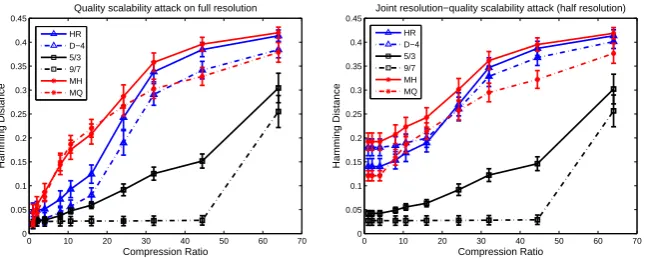
Fig. 12 On evaluating the effect of the wavelet kernel for < 1,0,0,0 > (b = 1) direct
modification-based embedding on robustness to - Column 1: Quality scalability attack on full resolution; andColumn 2: Joint resolution-quality scalability attack (half resolution).
0 10 20 30 40 50 60 70
0 0.05 0.1 0.15 0.2 0.25 0.3 0.35 0.4 0.45
Quality scalability attack on full resolution
Compression Ratio Hamming Distance HR D−4 5/3 9/7 MH MQ
0 10 20 30 40 50 60 70
0 0.05 0.1 0.15 0.2 0.25 0.3 0.35 0.4 0.45
Joint resolution−quality scalability attack (half resolution)
Compression Ratio Hamming Distance HR D−4 5/3 9/7 MH MQ
Fig. 13 On evaluating the effect of the wavelet kernel for intra re-quantization-based
embed-ding on robustness to -Column 1: Quality scalability attack on full resolution; andColumn 2: Joint resolution-quality scalability attack (half resolution).
(5/3 and 9/7) and non-linear (Morphological Haar and MQ) have been used for the comparisons. The results are shown in Fig. 12 (for the non-blind algorithm) and Fig. 13) (for the blind algorithm).
[image:16.595.85.408.292.421.2]0 10 20 30 40 50 60 70 0 0.1 0.2 0.3 0.4 0.5 0.6 0.7
Quality scalability attack on full resolution
Compression Ratio
Hamming Distance
Low frequency High frequency All Frequency
0 10 20 30 40 50 60 70
0 0.1 0.2 0.3 0.4 0.5 0.6 0.7
Joint resolution−quality scalability attack (half resolution)
Compression Ratio
Hamming Distance
[image:17.595.75.411.72.221.2]Low frequency High frequency All Frequency
Fig. 14 On evaluating the effect of the subband choice for < 1,0,0,0 > (b = 1) direct
modification-based embedding on robustness to -Column 1: Quality scalability attack on full resolution; andColumn 2: Joint resolution-quality scalability attack (half resolution).
5.2.2 The effect of subband choice (Fig. 14 and Fig. 15)
We compare the contribution of the choice of subbands for the robustness of a watermarking algorithm by setting all other choices to fixed. In this set of experi-ments, the wavelet kernel and decomposition levels are set to Haar and three, re-spectively. Fig. 14 shows the robustness performance for non-blind extraction that uses threshold-based (<1,0,0,0>(b=1)) embedding method, while Fig. 15 shows the robustness performance for blind extraction that uses intra re-quantisation-based embedding. In plots, low, high and all frequency subband selection refers to the lowest frequency subband, three high frequency subbands in the third de-composition level and all four frequency subband in the third dede-composition level, respectively.
0 10 20 30 40 50 60 70
0 0.1 0.2 0.3 0.4 0.5
Quality scalability attack on full resolution
Compression Ratio
Hamming Distance
Low frequency High frequency All Frequency
0 10 20 30 40 50 60 70
0 0.1 0.2 0.3 0.4 0.5
Joint resolution−quality scalability attack (half resolution)
Compression Ratio
Hamming Distance
Low frequency High frequency All Frequency
Fig. 15 On evaluating the effect of the subband choice for intra re-quantization-based
[image:17.595.81.409.473.607.2]0 5 10 15 20 25 30 35 0
0.1 0.2 0.3 0.4 0.5 0.6 0.7
Quality scalability attack on full resolution
Compression Ratio
Hamming Distance
Magnitude Alteration (non−HVS based) Magnitude Alteration (HVS based) Intra re−quatisation Inter re−quantisation
0 5 10 15 20 25 30 35
0 0.1 0.2 0.3 0.4 0.5 0.6 0.7
Joint resolution−quality scalability attack (half resolution)
Compression Ratio
Hamming Distance
[image:18.595.76.418.77.221.2]Magnitude Alteration (non−HVS based) Magnitude Alteration (HVS based) Intra re−quatisation Inter re−quantisation
Fig. 16 On evaluating the effect of different embedding methods on robustness to -Column 1:
Quality scalability attack on full resolution; andColumn 2: Joint resolution-quality scalability attack (half resolution).
In both cases, embedding in low frequency subbands results in the highest ro-bustness, compared to other two choices. This is mainly due to the high energy concentration in low frequency subband of the host image and the content scala-bility treatments used in JPEG2000 quality scalascala-bility and resolution scalascala-bility.
5.2.3 The effect of the choice of embedding method and host coefficient selection (Fig. 16)
In this experiment set, we have considered two different embedding methods, namely, magnitude alteration and re-quantization. For magnitude alteration, we considered two cases: HVS-based and all coefficient selection. For re-quantization-based methods we considered two cases: inter and intra subband coefficient se-lection. Other parameters, the wavelet kernel, decomposition levels and the em-bedding subband are set to Haar, three and high frequency subbands in the third decomposition level, respectively. It is evident from Fig. 16, for all different content adaptation scenarios, the HVS-based direct modification combination shows the highest robustness. This is mainly due to the efficiency in the coefficient selection method, enabling to choose a higher value for the watermark strength parameter, yet resulting in distortion performance in the specified range. Additionally a choice of coefficients in high frequency subbands can be robust to compression [34, 43] while providing higher imperceptibility. However, at a higher compression ratio, BER values (Hamming distance) of high frequency based watermarking schemes (refer to Fig. 14 and Fig. 16) are observed to be much larger (close to 0.7). This is due to heavy quantization process at higher compression ratios, leading to the loss of coefficient values in high frequency subbands. Therefore a tradeoff must be considered based on the application need.
6 Conclusions
pro-posed in the literature. We have categorized and evaluated the performances of such algorithms under a common framework to achieve three objectives objectives of this paper. Firstly, we dissected different algorithms into common functional submodules, e.g., wavelet kernel, subband, host coefficient and embedding method. A new framework was then designed using these submodules to analyze the ef-fects of various algorithmic parameters. Finally, a robustness evaluation against JPEG2000 content adaptation was performed using various combinations of the new framework. Such an evaluation helps the reader to understand the influence of these parametric choices to design a new optimized algorithm. For example, bi-orthogonal wavelet kernels (9/7 and 5/3 both) offered a better robustness while HVS based magnitude alteration method shows superiority compared other meth-ods. Therefore, this may lead to further investigation into various bi-orthogonal wavelet kernel choice or devising strategy onto algorithmic design similar to HVS method. Further research in filter design for wavelet kernel may help to find highly imperceptible but robust watermarking solutions. The framework will also help to understand other future research directions in this domain, such as, a new em-bedding distortion metric (as PSNR or wPSNR does not necessarily reflect the embedding distortion measure required in watermarking perspective), or a unified robustness measurement metric which includes different parameters.
Acknowledgement
The sponsorship of the UK Engineering and Physical Sciences Research Council (EPSRC) by an EPSRC-BP (British Petroleum) Dorothy Hodgkin Postgraduate Award (DHPA) for this work is acknowledged.
References
1. D. S. Taubman and M. W. Marcellin, JPEG2000 Image Compression Fundamentals,
Standards and Practice. USA: Springer, 2002.
2. H. Schwarz, D. Marpe, and T. Wiegand, “Overview of the scalable video coding extension of the H.264/AVC standard,”IEEE Trans. Circ. and Syst. for Video Tech, vol. 17, no. 9, pp. 1103–1120, Sept. 2007.
3. S. Kandadai and C. D. Creusere, “Scalable audio compression at low bitrates,” IEEE
Trans. Audio, Speech, and Language Processing, vol. 16, no. 5, pp. 969–979, July 2008.
4. I. Burnett, R. V. de Walle, K. Hill, J. Bormans, and F. Pereira, “MPEG-21: goals and achievements,”IEEE Multimedia, vol. 10, no. 4, pp. 60–70, Oct.-Dec. 2003.
5. A. Vetro, “MPEG-21 digital item adaptation: enabling universal multimedia access,”IEEE
Multimedia, vol. 11, no. 1, pp. 84–87, Jan.-March 2004.
6. L. Xie and G. R. Arce, “Joint wavelet compression and authentication watermarking,” in
Proc. IEEE ICIP, vol. 2, 1998, pp. 427–431.
7. F. Huo and X. Gao, “A wavelet based image watermarking scheme,” inProc. IEEE ICIP, 2006, pp. 2573–2576.
8. H. Tao, J. Liu, and J. Tian, “Digital watermarking technique based on integer Harr trans-forms and visual properties,” inProc. SPIE Image Compression and Encryption Tech., vol. 4551-1, 2001, pp. 239–244.
9. X. Xia, C. G. Boncelet, and G. R. Arce, “Wavelet transform based watermark for digital images,”Optic Express, vol. 3, no. 12, pp. 497–511, Dec. 1998.
10. G. Al-Hudhud, “Adaptation of HVS Sensitivity for Perceptual Modelling of Wavelet-Based Image Compression,” inProc. Second Int’l Conf. in Visualisation, 2009, pp. 196–200. 11. X. C. Feng and Y. Yang, “A new watermarking method based on DWT,” inProc. Int’l
Conf. on Computational Intelligence and Security, Lect. Notes in Comp. Sci. (LNCS),
12. Q. Gong and H. Shen, “Toward blind logo watermarking in JPEG-compressed images,” in
Proc. Int’l Conf. on Parallel and Distributed Comp., Appl. and Tech., (PDCAT), 2005,
pp. 1058–1062.
13. M. Barni, F. Bartolini, and A. Piva, “Improved wavelet-based watermarking through pixel-wise masking,”IEEE Trans. Image Processing, vol. 10, no. 5, pp. 783–791, May 2001. 14. D. Kundur and D. Hatzinakos, “Toward robust logo watermarking using multiresolution
image fusion principles,”IEEE Trans. Multimedia, vol. 6, no. 1, pp. 185–198, Feb. 2004. 15. G. Bhatnagar and Q.M. J. Wuand B. Raman, “Robust gray-scale logo watermarking in
wavelet domain,”Computers & Electrical Engineering, 2012.
16. M. R. Soheili, “Blind Wavelet Based Logo Watermarking Resisting to Cropping,” inProc.
20th International Conference on Pattern Recognition, 2010, pp. 1449–1452.
17. D. Kundur and D. Hatzinakos, “Digital watermarking using multiresolution wavelet de-composition,” inProc. IEEE ICASSP, vol. 5, 1998, pp. 2969–2972.
18. P. Campisi, A. Neri, and M. Visconti, “Wavelet-based method for high-frequency subband watermark embedding,” inProc. SPIE Multimedia Sys. and Appl. III, vol. 4209, 2001, pp. 344–353.
19. C. Jin and J. Peng, “A robust wavelet-based blind digital watermarking algorithm,”
In-formation Technology Journal, vol. 5, no. 2, pp. 358–363, 2006.
20. P. Meerwald and A. Uhl, “A survey of wavelet-domain watermarking algorithms,” inProc.
SPIE Security and Watermarking of Multimedia Contents III, vol. 4314, 2001, pp. 505–
516.
21. C.-Y. Yang, W.-Y. Hwang, and Y.-F. Cheng, “IWT-Based Watermarking By Adaptive Bit-Labeling Scheme,” inProc Int’l Conf. on Intelligent Information Hiding and Multimedia
Signal Processing, 2008, pp. 1165–1168.
22. Z. Zhang and Y. L. Mo, “Embedding strategy of image watermarking in wavelet transform domain,” inProc. SPIE Image Compression and Encryption Tech., vol. 4551-1, 2001, pp. 127–131.
23. J. R. Kim and Y. S. Moon, “A robust wavelet-based digital watermarking using level-adaptive thresholding,” inProc. IEEE ICIP, vol. 2, 1999, pp. 226–230.
24. S. Marusic, D. B. H. Tay, G. Deng, and P. Marimuthu, “A study of biorthogonal wavelets in digital watermarking,” inProc. IEEE ICIP, vol. 3, Sept. 2003, pp. II–463–6.
25. T.-S. Chen, J. Chen, and J.-G. Chen, “A simple and efficient watermarking technique based on JPEG2000 codec,” inProc. Int’l Symp. on Multimedia Software Eng., 2003, pp. 80–87.
26. P. Meerwald, “Quantization watermarking in the JPEG2000 coding pipeline,” inProc.
Int’l Working Conf. on Comms. and Multimedia Security, 2001, pp. 69–79.
27. Q. Sun and S. Chang, “A secure and robust digital signature scheme for JPEG2000 image authentication,”IEEE Trans. Multimedia, vol. 7, no. 3, pp. 480–494, June 2005. 28. F. Dufaux, S. J. Wee, J. G. Apostolopoulos, and T. Ebrahimi, “JPSEC for secure imaging
in JPEG2000,” inProc. SPIE Appl. of Digital Image Processing XXVII, vol. 5558-1, 2004, pp. 319–330.
29. L. Chunhua and F. Li, “Adaptive image watermarking algorithm based on biorthogonal wavelet transform,” inProc Int’l Conf. on E-Business and E-Government (ICEE), 2011, pp. 1–4.
30. R. Grosbois, P. Gerbelot, and T. Ebrahimi, “Authentication and access control in the JPEG2000 compressed domain,” inProc. SPIE Appl. of Digital Image Processing XXIV, vol. 4472-1, 2001, pp. 95–104.
31. Y.-S. Seo, M.-S. Kim, H.-J. Park, H.-Y. Jung, H.-Y. Chung, Y. Huh, and J.-D. Lee, “A secure watermarking for JPEG2000,” inProc. IEEE ICIP, vol. 2, 2001, pp. 530–533. 32. M. A. Suhail, M. S. Obaidat, S. S. Ipson, and B. Sadoun, “A comparative study of digital
watermarking in JPEG and JPEG2000 environments,”Information Sciences, vol. 151, pp. 93–105, 2003.
33. D. Bhowmik and C. Abhayaratne, “Morphological wavelet domain image watermarking,”
inProc. European Signal Processing Conference (EUSIPCO), 2007, pp. 2539–2543.
34. C. Abhayaratne and D. Bhowmik, “Scalable watermark extraction for real-time authenti-cation of JPEG2000 images,”Journal of Real-Time Image Processing, vol. 6, no. 4, p. 19 pages, 2011.
35. N. Sprljan, M. Mrak, G. C. K. Abhayaratne, and E. Izquierdo, “A scalable coding frame-work for efficient video adaptation,” inProc. Int’l Workshop on Image Analysis for
36. D. Bhowmik and C. Abhayaratne, “A generalised model for distortion performance anal-ysis of wavelet based watermarking,” inProc. Int’l Workshop on Digital Watermarking
(IWDW ’08), Lect. Notes in Comp. Sci. (LNCS), vol. 5450, 2008, pp. 363–378.
37. ——, “Embedding distortion modeling for non-orthonormal wavelet based watermarking schemes,” inProc. SPIE Wavelet App. in Industrial Processing VI, vol. 7248, 2009, p. 72480K (12 Pages).
38. I. Daubechies and W. Sweldens, “Factoring wavelet transforms into lifting steps,”Journal
of Fourier Anal. Appl., vol. 4, no. 3, pp. 245–267, 1998.
39. G. C. K. Abhayaratne and H. Heijmans, “A novel morphological subband decomposi-tion scheme for 2D+t wavelet video coding,” inProc. Int’l Symp. on Image and Signal
Processing and Analysis, vol. 1, 2003, pp. 239–244.
40. F. J. Hampson and J.-C. Pesquet, “A nonlinear subband decomposition with perfect re-construction,” inProc. IEEE ICASSP, vol. 3, 1996, pp. 1523–1526.
41. H. Heijmans and J. Goutsias, “Nonlinear multiresolution signal decomposition schemes: Part II: Morphological wavelets,”IEEE Trans. Image Processing, vol. 9, no. 11, pp. 1897– 1913, Nov. 2000.
42. H. Jegou, M. Douze, and C. Schmid, “Hamming embedding and weak geometric con-sistency for large scale image search,” inProc. 10th European Conference on Computer
Vision: Part I (ECCV’08). Springer-Verlag, 2008, pp. 304–317.