Effect of the 'Crouch, Bind, Set' engagement routine on
scrum performance in English Premiership Rugby
STEAN, Dale, BARNES, Andrew <http://orcid.org/0000-0001-8262-5132> and CHURCHILL, Sarah M. <http://orcid.org/0000-0001-9542-3812>
Available from Sheffield Hallam University Research Archive (SHURA) at:
http://shura.shu.ac.uk/13481/
This document is the author deposited version. You are advised to consult the publisher's version if you wish to cite from it.
Published version
STEAN, Dale, BARNES, Andrew and CHURCHILL, Sarah M. (2015). Effect of the 'Crouch, Bind, Set' engagement routine on scrum performance in English
Premiership Rugby. International Journal of Performance Analysis in Sport, 15 (3), 1202-1212.
Copyright and re-use policy
See http://shura.shu.ac.uk/information.html
Sheffield Hallam University Research Archive
Effect of the ‘Crouch, Bind, Set’ engagement routine
on scrum performance in English Premiership Rugby
Dale Stean, Andrew Barnes and Sarah M. ChurchillAcademy of Sport and Physical Activity, Sheffield Hallam University, Sheffield, S10 2BP, UK.
Abstract
The effect of the new scrum engagement sequence introduced at the start of the 2013/2014 season on scrum performance has not been evaluated. This study compared scrum performance indicators pre- (2012/2013 season) and post-law change (2013/2014). Several performance indicators at the scrum were identified in 20 games from each season of the English domestic Premiership. These included the number of penalties, free kicks and resets awarded. A Mann Whitney U test showed a significant increase in the number of scrums per game, from 17.50 to 23.85 (p = 0.003, ES = 0.47). This was contributed to by a 112% increase in the number of reset scrums (p <0.0005). Of the resets, there was a significant increase in the number of scrums reset due to collapsing, which is of concern for player welfare. However, resets for collapsing accounted for a similar proportion of the total resets pre and post law change at 52% and 53%, respectively, and may be due to the relative novelty of the technique and stringent law enforcement increasing resets. In contrast, there was a decrease in the number of early engagements from 1.65 to 0.40 per match following the law change which is likely beneficial for player welfare.
Key words: notational analysis, engagement, rugby union, law change
Correspondence Sarah Churchill
Academy of Sport and Physical Activity, Sheffield Hallam University, Room A115, Collegiate Hall, Collegiate Crescent, Sheffield S10 2BP
Effect of the ‘Crouch, Bind, Set’ engagement routine
on scrum performance in English Premiership Rugby
Abstract
The effect of the new scrum engagement sequence introduced at the start of the 2013/2014 season on scrum performance has not been evaluated. This study compared scrum performance indicators pre- (2012/2013 season) and post-law change (2013/2014). Several performance indicators at the scrum were identified in 20 games from each season of the English domestic Premiership. These included the number of penalties, free kicks and resets awarded. A Mann Whitney U test showed a significant increase in the number of scrums per game, from 17.50 to 23.85 (p = 0.003, ES = 0.47). This was contributed to by a 112% increase in the number of reset scrums (p <0.0005). Of the resets, there was a significant increase in the number of scrums reset due to collapsing, which is of concern for player welfare. However, resets for collapsing accounted for a similar proportion of the total resets pre and post law change at 52% and 53%, respectively, and may be due to the relative novelty of the technique and stringent law enforcement increasing resets. In contrast, there was a decrease in the number of early engagements from 1.65 to 0.40 per match following the law change which is likely beneficial for player welfare.
1. Introduction
Scrummaging is a key component of the game of Rugby Union and is a way of restarting play safely and fairly following a stoppage or minor infringement, such as a knock on (World Rugby, 2015). During the scrum eight players from each team bind together to create a tunnel into which the attacking team throws the ball allowing the two teams to compete for possession. The nature of the scrum is such that the front row players experience large forces on engagement (Milburn, 1994; Cazzola et al., 2015), which may result in injury. Furthermore, unstable engagements can result in collapsed scrums which disrupt play and can potentially increase the risk of serious injury.
Injury incidence during scrummaging is relatively rare compared with other aspects of the game. Williams et al. (2013) reported that being tackled and tackling accounted for the first and second highest injury incidences in the game at 29 and 19 incidences per 1000 player hours, respectively. Scrums accounted for 7 injury incidences per 1000 playing hours (Williams et al., 2013). However, Fuller et al. (2007) found that players are 60% more likely to be injured scrummaging than in a tackle. Injuries during scrummaging can be catastrophic, with the potential to cause paralysis and even death. Furthermore, it is believed that the demands of scrummaging may be a factor in chronic degenerative conditions of front row forwards (Quarrie et al., 2002; Hogan et al., 2010). Thus, the potential for injury due to scrummaging has been a cause for concern for the sport's governing body.
In addition to injury concerns, unstable and collapsed scrums disrupt the flow of the game and can reduce spectator enjoyment. Fuller et al. (2007) analysed a total of 1447 scrums within the English Premiership (2003/2004 and 2005/2006 seasons) and found that 17.2% collapsed with 30.1% being reset. In the 2013 Six Nations tournament there was an average of 14 scrums per game (International Rugby Board, 2013a). For every 100 scrums, 59 collapsed, 30 were reset and 41 penalties or free kicks were awarded, indicating that very few scrums were completed without incident (International Rugby Board, 2013a).
obtained by the players scrummaging can prevent repetitive stresses that may lead to degeneration of the spine (Preatoni et al., 2015).
Whilst biomechanical differences between engagement conditions have been studied (Cazzola et al. 2015; Preatoni et al., 2015), the effect of the law changes on game play have not been fully investigated. The trial laws were first piloted in competition in the Southern Hemisphere in the 2013 Rugby Championship. For every 100 scrums there was an increase in collapses, resets and penalties/free kicks awarded in the 2013 competition compared with the 2012 competition under the previous scrum laws. There was a decrease in the number of times the ball came out of the scrum from 69 to 60 per 100 scrums (International Rugby Board 2013b). There was an average of 14 scrums per match with only 80% of possession retained by the side with the throw. This was 10% less than the previous year. One of the new directives for referees was to penalise crooked feeds, thus forcing scrum halves to put the ball in straighter, which may account for the increase in the number of balls won against the head (6 in 172 scrums), an increase from 1.2% to 3.5% in 2013 (International Rugby Board, 2013b). In addition, there was an increase from 31 penalties/free kicks awarded in the 2012 competition to 40 in 2013. It was predicted that the trial laws would result in fewer penalties (Rugby Football Union, 2013a). However, 25% of all penalties and free kicks awarded in the 2013 Rugby Championship were awarded at the scrum (International Rugby Board, 2013b), a figure that is higher than other competitions (International Rugby Board, 2003, 2007, 2011, 2012a, 2012b, 2013a). While the implementation of the new trial laws were suggested to have several benefits to the game such as improved player safety and fewer collapses, penalties and resets (Rugby Football Union, 2013a), the findings from the 2013 pilot may have been the result of a period of adjustment to the new laws, potentially resulting in more mistakes and offences. The pilot of the laws used the Rugby Championship, an international competition made up of southern hemisphere teams. Previous research has shown differences in the playing styles between Northern and Southern Hemisphere teams (Jones et al., 2004b). To our knowledge, no studies of the effect of the change in engagement routine in Northern Hemisphere domestic rugby union have been conducted. Thus, the aim of this study was to investigate the effect of the change in scrum laws from the 2012/2013 to the 2013/2014 seasons on scrum performance indicators in the English Premiership. It was anticipated that this information would aid the evaluation of the trial law change.
2. Methods
2.1 Design and Sample:
various times throughout the season. In total, five matches were taken from each round, providing 20 matches for each of the two seasons. To avoid adverse weather being a potentially confounding variable, the weather conditions were assessed for each match. It was deemed that none of the matches were played in abnormal conditions that could have potentially corrupted the results, thus, all 20 matches were included in the analysis.
2.2 Performance Indicators
Performance Indicators (PI) were decided by viewing game footage and the actions and outcomes that take place during a scrum. World Rugby laws (World Rugby, 2015) and their definitions of indicators within the game were used to support chosen PI’s. The indicators included were: number of scrums awarded, whether the scrum was won cleanly or against the head, Penalties (Collapsing, Standing Up, Bind on the arm, No Bind, Early Release, Offside, Boring In, Wheeled Scrum, Handling, Backing Away, Persistent Offending), Free Kicks (Early Engage, Early Push, Not Straight, Delayed Feed, Foot Up) and Resets (Wheeled Scrum, Collapsing Unstable, Standing Up, Out of the Tunnel). The number of red cards, yellow cards and penalty tries as a result of the scrum were also recorded to provide additional information. Decisions, such as why a penalty or free kick was awarded, were based on the referee’s verbal or gesticulative signals.
2.3 Procedure
The 20 selected games from each season were uploaded into SportsCode software (v9.5.1 Warriewood, NSW, Australia). A Codewindow was created on which all the possible outcomes and performance variables were listed so the footage could be coded. All match analysis was completed by the same experienced analyst. On the occasions when a referee gave more than one reason for a decision, both reasons were recorded. The data was exported to Microsoft Excel 2013 software (Microsoft Corporation, Washington, USA) for further analysis.
2.4 Reliability
Both inter-rater and intra-rater reliability were tested during the study. Intra-rater reliability was assessed by the analyst who retested three of the matches as per Bishop and Barnes (2013). This took place two weeks after the original data analysis.
Inter-rater reliability was tested by a second experienced analyst who independently analysed the three matches. Since there is no clearly defined number of matches or performances to provide an assured answer (O’Donoghue, 2010), three matches were selected to mirror the intra-rater analysis. Altman (1991) recommended that a minimum of 50 observations were required in any trial in order for inter-rater reliability to be agreed upon and within three matches it would be expected that there would be 50 scrums, based on data from the 2011 Rugby World Cup where there was an average of 17 completed scrums per match (International Rugby Board, 2011). Within the three matches analysed there were 47 scrums including resets. Reliability was tested using Kappa coefficient (equation 1)
Where Po, the percentage agreement, is the total number of agreed observations divided by the total number of observations and Pc, the percentage of expected agreement by guessing, is the product of the two observer values for an individual PI, divided by the total number of observations. All the figures for the individual PI were then totalled together and divided by the total number of observations.
Kappa is used to determine the number of cases independent observers agree discounting the proportion they could have agreed upon by chance. For intra-observer reliability the Kappa value was 0.98 and 0.96 for inter-observer, both these were classified as very good (Altman, 1991).
2.5 Data Analysis
Descriptive statistics (mean, standard deviation (SD) and mode) per game were calculated for each PI in each season. Statistical analyses were conducted in SPSS 21.0.0 (IBM Corporation, New York, USA). Whilst the same clubs were used for each season, the players could be different between seasons, thus the samples were considered independent. Analysis showed most PIs to be non-normally distributed, thus a Mann Whitney U test was used to compare the mean values of PIs between seasons. Significance was set at p < 0.05. Effect sizes (ES) were also calculated using equation 2:
r = z-score/√N (2)
Where N is the total number of observations. Cohen's (1992) criteria for effect sizes were used for interpretation where ES ≥ 0.1 <0.3 indicates a small effect, ES ≥ 0.3 <0.5 denotes a medium effect and ES ≥ 0.5 indicates a large effect.
3. Results
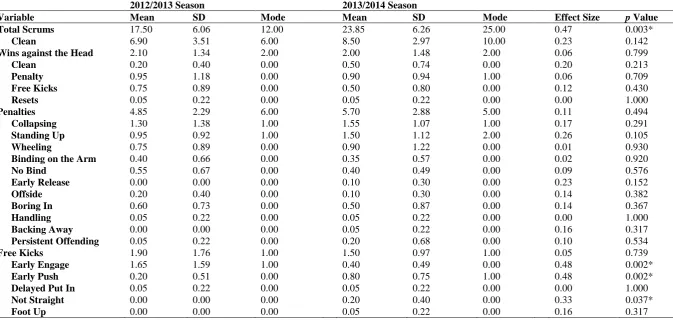
Table 1 presents a comparison of PIs between seasons. There was an increase of 6.35 in the mean number of scrums per match from the 2012/2013 to the 2013/2014 season (p = 0.003, ES = 0.47). There were no significant differences in the number of free kicks awarded from scrums between seasons (p = 0.739, ES = 0.05). However, there were differences in the reasons for their being awarded. There was a reduction of 76% in the number of early engages from 2012/2013 season to 2013/2014 (p = 0.002, ES = 0.48), although pushing early increased four-fold after the trial laws came into play (p = 0.002, ES = 0.48). There was also a significant increase in free kicks being awarded for a crooked feed of the ball (p = 0.037, ES = 0.33), although it is noted that there were no incidents of this in the 2012/2013 season.
Table 1. Differences in performance indicators (per game) before (2012/2013 season) and after (2013/2014 season) the introduction of the trial scrum laws.
2012/2013 Season 2013/2014 Season
Variable Mean SD Mode Mean SD Mode Effect Size p Value
Total Scrums 17.50 6.06 12.00 23.85 6.26 25.00 0.47 0.003*
Clean 6.90 3.51 6.00 8.50 2.97 10.00 0.23 0.142
Wins against the Head 2.10 1.34 2.00 2.00 1.48 2.00 0.06 0.799
Clean 0.20 0.40 0.00 0.50 0.74 0.00 0.20 0.213
Penalty 0.95 1.18 0.00 0.90 0.94 1.00 0.06 0.709
Free Kicks 0.75 0.89 0.00 0.50 0.80 0.00 0.12 0.430
Resets 0.05 0.22 0.00 0.05 0.22 0.00 0.00 1.000
Penalties 4.85 2.29 6.00 5.70 2.88 5.00 0.11 0.494
Collapsing 1.30 1.38 1.00 1.55 1.07 1.00 0.17 0.291
Standing Up 0.95 0.92 1.00 1.50 1.12 2.00 0.26 0.105
Wheeling 0.75 0.89 0.00 0.90 1.22 0.00 0.01 0.930
Binding on the Arm 0.40 0.66 0.00 0.35 0.57 0.00 0.02 0.920
No Bind 0.55 0.67 0.00 0.40 0.49 0.00 0.09 0.576
Early Release 0.00 0.00 0.00 0.10 0.30 0.00 0.23 0.152
Offside 0.20 0.40 0.00 0.10 0.30 0.00 0.14 0.382
Boring In 0.60 0.73 0.00 0.50 0.87 0.00 0.14 0.367
Handling 0.05 0.22 0.00 0.05 0.22 0.00 0.00 1.000
Backing Away 0.00 0.00 0.00 0.05 0.22 0.00 0.16 0.317
Persistent Offending 0.05 0.22 0.00 0.20 0.68 0.00 0.10 0.534
Free Kicks 1.90 1.76 1.00 1.50 0.97 1.00 0.05 0.739
Early Engage 1.65 1.59 1.00 0.40 0.49 0.00 0.48 0.002*
Early Push 0.20 0.51 0.00 0.80 0.75 1.00 0.48 0.002*
Delayed Put In 0.05 0.22 0.00 0.05 0.22 0.00 0.00 1.000
Not Straight 0.00 0.00 0.00 0.20 0.40 0.00 0.33 0.037*
Table 1. (Continued)
2012/2013 Season 2013/2014 Season
Variable Mean SD Mode Mean SD Mode Effect Size p Value
Resets 3.85 2.15 3.00 8.15 2.92 9.00 0.64 <0.0005*
Collapsing 2.00 1.55 3.00 4.45 2.85 3.00 0.45 0.004*
Standing Up 0.65 0.85 0.00 1.15 1.15 1.00 0.22 0.162
Wheeling 0.05 0.22 0.00 0.15 0.36 0.00 0.16 0.298
Unstable 1.15 1.06 0.00 2.05 1.56 2.00 0.30 0.058
Out of the Tunnel 0.00 0.00 0.00 0.35 0.57 0.00 0.41 0.009*
Yellow Card 0.00 0.00 0.00 0.05 0.22 0.00 0.16 0.317
Red Card 0.00 0.00 0.00 0.00 0.00 0.00 0.00 1.000
Penalty Try 0.10 0.30 0.00 0.20 0.51 0.00 0.08 0.604
[image:9.842.75.773.107.239.2]4. Discussion
The purpose of the study was to investigate the effect of the change in scrum laws from the 2012/2013 to the 2013/2014 seasons on scrum performance indicators in the English Premiership. There were significantly more scrums per game and an increase in the number of reset scrums in the 2013/2014 season following the law change. There was no significant difference in the number of free kicks from scrum infringements, but there was a change in the reasons for their award.
The 2013/2014 season saw more scrums per match than there had been in the preceding season (36 % increase), although this was largely due to an increase in the number of reset scrums following the law change. If the number of resets were removed from the results, the number of scrums increased by 15% as a result of the law change. An increase in the number of reset scrums following the law change is in line with the data analysed from the 2013 Rugby Championship (International Rugby Board, 2013b). However, the increase of 112% in the present study was greater than the 16% increase reported from the 2012 to the 2013 Rugby Championship (International Rugby Board, 2013b). It is possible that the relative increase in the number of reset scrums in the present study was due to a greater drive for the strict application of scrum laws following the global roll-out of the trial laws. The number of scrums reset due to collapses increased significantly from 2.00 in the 2012/2013 season to 4.45 per game in the 2013/14 season, although it was noted that these account for similar proportions of the reset scrums at 52% and 53%, respectively. This finding conflicts with those from the 2013 Rugby Championship for which a 5% decrease in the number of reset scrums due to collapsing was reported in comparison to the previous year (International Rugby Board, 2013b). This result suggests that the new laws may not have achieved one of the aims to reduce the number of collapsed scrums (Rugby Football Union, 2013a). However, it is possible that players were still adjusting to the new laws in the 2013/2014 season, and thus the longer term outcomes of the law change cannot yet be concluded.
Whilst overall the results show no significant difference in the number of free kicks awarded at the scrum, there was a notable change in the reasons for their award (Table 1). There was a 76% decrease in free kicks awarded for an early engagement. It is likely that the pre-bind element of the new law prevents teams from trying to gain an advantage by 'winning the hit' on engagement, thus teams may not risk engaging as early as they may have done under the previous laws and instead engage in a more controlled manner. It has been suggested that the tactic of winning the hit risks destabilising the scrum (MacLean and Hutchinson, 2012) and results in greater potential for injury. This coupled with the finding that the more controlled pre-bind engagement reduces impact forces by approximately 20% whilst maintaining a stable scrum (Cazzola et al., 2015), suggests a reduction in the number of early engagements may be indicative of a benefit of the new scrum laws in terms of player welfare.
anticipate the ball feed from the referee's verbal commands. During the period the games were analysed, the trial scrum laws included the "Yes nine" call by the referee to invite the scrum half to put the ball into the scrum. Having heard this command, players may have tried to predict the ball's entry into the scrum, which may have resulted in them pushing early compared with the previous laws when the scrum half did not have to wait for any signal from the referee. Subsequently, the verbal "Yes nine" command has been amended to a non-verbal command from the referee. It is possible that this may have an impact on the number of early push infringements resulting in free kicks. However, further research is warranted to establish this.
Some of the differences observed between seasons may be explained by the remit of referees to strictly enforce the scrum law rules during the 2013/2014 season. For example, the number of free kick offences for a crooked feed increased from 0.00 to an average of 0.20 per game under the new laws. This would suggest that referees had been adhering to the International Rugby Board guidelines not to tolerate any crooked feeds. This may also explain the increase in resets for the ball coming out of the tunnel from 0.00 in the 2012/2013 season to 0.35 per game in the 2013/2014 season.
The findings collected in this study should be considered as relevant to English Premiership rugby in the season immediately following the trial law change. Different playing levels, playing styles, or pitch conditions, for example between international and domestic club sides, or between northern and southern hemisphere teams, may result in differences in the outcome of the laws and may account for some of the variances between the results of this study and the analysis of the 2013 Rugby Championship (International Rugby Board, 2013b). Additionally, as stated above, data analysed for the 2013/2014 season in this study included the “Yes nine” call by the referee to invite the scrum half to throw the ball into the scrum. The subsequent change to non-verbal communication may affect the number of free kicks awarded for pushing early, but further analysis of matches following this minor law amendment would be needed to confirm this. Furthermore, analysis of a greater number of games per season may have given a more complete overview of the changes in the laws. However, using more games from earlier in the 2013/2014 season may have been confounded by the fact that players and referees were still adapting to the changes. Games from later in the season would have been influenced by the change from a verbal to non-verbal command for ball put in. Future studies conducted over, for example, the whole 2014/2015 season, and at different playing levels, would allow assessment of the longer term effects of the changes to the scrum law.
5. Conclusion
player welfare. Even though the proportion of scrums being reset due to collapse remained similar between seasons in percentage terms, the increased number of reset scrums due to collapsing in absolute terms is concerning. On the other hand, a reduction in the number of early engagement infringements may be indicative of a more controlled engagement, and less drive to 'win the hit', which would likely enhance player welfare. Further studies are required to fully evaluate the effectiveness of the new scrum laws. This is particularly true now that players are more familiar with the laws and in light of the fact that a minor amendment has been made to command for the scrum half to put the ball into the tunnel since this analysis was conducted. However, the results of the present study suggest that while engagement may be more controlled under the new laws, this did not result in a reduction in the number of collapsed scrums and the increased number of resets may be detrimental to spectator enjoyment.
6. Acknowledgements
The authors would like to thank Scott Smith for taking time to analyse three matches in order for the inter-rater reliability to be conducted in this study.
7. References
Altman, D.G. (1991), Practical statistics for medical research. London: Chapman and Hall.
Bishop, L. and Barnes, A. (2013), Performance indicators that discriminate winning and losing in the knockout stages of the 2011 Rugby World Cup. International Journal of Performance Analysis in Sport, 13, 149-159.
Cazzola, D., Preatoni, E., Stokes, K.A., England, M.E. and Trewartha, G. (2015), A modified prebind engagement process reduces biomechanical loading on front row players during scrummaging: a cross-sectional study of 11 elite teams. British Journal of Sports Medicine, 49, 541-546.
Cohen, J. (1992), Quantitative methods in psychology: a power primer. Psychological Bulletin, 112, 155-159.
Fuller, C.W., Brooks, J.H.M., Cancea, R.J., Hall, J. and Kemp, S.P.T. (2007), Contact events in rugby union and their propensity to cause injury. British Journal of Sports Medicine, 41, 862-867.
Hogan, B.A., Hogan, N.A., Vos, P.M., Eustace, S.J. and Kenny, P.J. (2010), The cervical spine of professional front-row rugby players: correlation between degenerative changes and symptoms. Irish Journal of Medical Science, 179, 259–263.
International Rugby Board (2003), Rugby World Cup 2003: statistical review and match analysis. Dublin: International Rugby Board.
International Rugby Board (2007), Rugby World Cup 2007: statistical review and match analysis. Dublin: International Rugby Board.
International Rugby Board (2012a), Six Nations 2012: statistical review and match analysis. Dublin: International Rugby Board.
International Rugby Board (2012b), The Rugby Championship 2012: statistical analysis and match review. Dublin: International Rugby Board.
International Rugby Board (2013a), Six Nations 2013: statistical analysis and match review. Dublin: International Rugby Board.
International Rugby Board (2013b), The Rugby Championship 2013: statistical analysis and match review. Dublin: International Rugby Board.
Jones, N., Mellalieu, S., James, N. and Moise J. (2004b). Contact area playing styles of northern and southern hemisphere international rugby union teams. In:
Performance Analysis of Sport VI. O’Donoghue, P.G. and Hughes, M. pp. 114-119.
Maclean, J.G.B. and Hutchinson, J.D. (2012), Serious neck injuries in U19 rugby union players: an audit of admissions to spinal injury units in Great Britain and Ireland. British Journal of Sports Medicine, 46, 591-594.
Milburn, P.D. (1994), Player contributions in a rugby union scrum. Journal of Biomechanics, 27, 677.
O’Donoghue, P. (2010), Research Methods for Sports Performance Analysis. Oxon: Routledge.
Preatoni, E., Stokes, K.A., England, M.E. and Trewartha, G. (2015), Engagement techniques and playing level impact the biomechanical demands on rugby forwards during machine-based scrummaging, British Journal of Sports Medicine, 49, 520-529.
Quarrie, K.L, Cantu, R.C. and Chalmers, D.J. (2002), Rugby union injuries to the cervical spine and spinal cord. Sports Medicine, 32, 633- 653.
Rugby Football Union (2013a). Scrum Engagement Global Trial: Conclusion. [online]. Last accessed 11 August 2015 at: http://www.englandrugby.com/ governance/laws/scrum-engagement-global-trial/conclusion/
Williams S., Trewartha, G., Kemp, S. and Stokes, K. (2013), A Meta-Analysis of Injuries in Senior Men’s Professional Rugby Union. Sports Medicine, 43, 1043-1055.