Operational framework for optimal utilisation of
construction resources during the production process.
FAPOHUNDA, Julius Ayodeji.
Available from Sheffield Hallam University Research Archive (SHURA) at:
http://shura.shu.ac.uk/19639/
This document is the author deposited version. You are advised to consult the publisher's version if you wish to cite from it.
Published version
FAPOHUNDA, Julius Ayodeji. (2009). Operational framework for optimal utilisation of construction resources during the production process. Doctoral, Sheffield Hallam University (United Kingdom)..
Copyright and re-use policy
See http://shura.shu.ac.uk/information.html
ProQuest Number: 10694520
All rights reserved
INFORMATION TO ALL USERS
The qu ality of this repro d u ctio n is d e p e n d e n t upon the q u ality of the copy subm itted.
In the unlikely e v e n t that the a u th o r did not send a c o m p le te m anuscript and there are missing pages, these will be note d . Also, if m aterial had to be rem oved,
a n o te will in d ica te the deletion.
uest
ProQuest 10694520
Published by ProQuest LLC(2017). C op yrig ht of the Dissertation is held by the Author.
All rights reserved.
This work is protected against unauthorized copying under Title 17, United States C o d e M icroform Edition © ProQuest LLC.
ProQuest LLC.
789 East Eisenhower Parkway P.O. Box 1346
Operational Framework for Optimal Utilisation
of Construction Resources during the
Production Process
Julius Ayodeji Fapohunda
A thesis submitted in partial fulfilment o f the requirements of
Sheffield Hallam University
for the degree o f Doctor o f Philosophy
Abstract
The construction industry contributes a significant amount to a nation's Gross Domestic Product and National Income. The industry products are enormously important to other organisational sectors, and provide a considerable amount of employment to the nation’s populace. However, the industry is significantly under-achieving in terms of clients' and stakeholders' satisfaction. In addition, the resources in the industry are currently under-utilised. It is affirmed that resources’ wastes management in the industry is far behind that obtainable in other organisational sectors. Thus, there is a need for re-assessment of the way in which the industry generates its products towards utilising the scarce and costly resources efficiently.
It is noteworthy that a project could be completed, within the estimated cost, time frame and quality expected, and even satisfying the clients' and stakeholders’ implied needs, with lots of resource wastefulness during the construction production process. Despite the lean construction techniques being effective in reducing resources utilisation wastefulness; currently there are difficulties in achieving the approach objectives adequately. Thus, to maximise resources utilisation and avoiding inefficiency, it is paramount to critically evaluate, identify, and establish the several wastage occurrences, occurring either consciously or unconsciously during the project construction process.
This research responded to the need for the construction industry to review the use of resources during production process, and to minimise the "gap" between the construction industry and the other sectors in efficient resources utilisation.
To establish a valid and reliable best practice operational framework, towards utilising construction resources optimally, this research study was triangulated. Both structured and unstructured questionnaires and in-depth interview research surveys were exploited for its data collection. The Statistical Package for the Social Sciences version 13, (SPSS 13), software was used to analyse the data obtained through the questionnaire research survey, while NVivo, (version 8) statistics software was explored to analyse the information collected through the in-depth interview research survey.
This research was grouped into three main studies. The first study evaluated the issues associated with site managers’ efficient performance, and causes of site managers’ inefficiency in performances established were identified. In this respect, the factors that will enhance site managers to optimally utilise resources were established. Secondly, the scenarios of budgeting for resources’ wastes were investigated, and factors that will reduce their effects on optimal resources utilisation were established. Lastly, the causes and modalities of averting resources wastefulness during the production process were investigated and ascertained. The success factor of these studies is the evaluation of the knowledge, attitudes, and perceptions, (KAP), o f construction participants on resources utilisation. Based on these three main research studies and their sub studies, an operational framework for optimal utilisation of construction resources during the production process was developed, validated and established.
Acknowledgement
This research outcome could have not been successful without the Director of Studies,
Professor Paul Stephenson, who consistently guided, motivated, and ensured that the
study mission was successfully achieved. I am very grateful for the immense supports.
I am highly indebted to my research supervisors: Professor Alan Griffith and Dr
Nicholas Chileshe. Their guidance at various stages, greatly tailored the research work
to fruitful outcome.
Special thanks go to the Built Environment Research Administrators for the all the
assistance provided throughout the course of study.
I am grateful to all the Organisations and Site Management's personnel that voluntarily
participated in the research data collection and its framework validation. This research
would not have been possible without the supports o f those who responded positively to
its data collection.
Many thanks go to Professor Ade Wahab for his fatherly assistance, and my fellow
research students for their immeasurable encouragement and supports.
The love from my family strengthened me throughout the research work, I am highly
grateful for their endurance.
The Almighty God should be glorified, for His exceptional and divine favour He always
Heading Page
Title Page i
Abstract ii
Acknowledgements iii
Table of Contents v
List of Appendices vii
List of Tables ix
List of Figures xii
Glossary of Terms and Abbreviations xiv
Chapter One
1.0 Research Introduction 1
1.1 Chapter Introduction 1
1.2 Needs for the Research 3
1.3 Research Aim and Objectives 5
1.4 Research Methodology and the Structure 6
1.5 Significance of the Research Study 7
1.6 Research Statement 8
1.7 Literature Review Outline 10
1.8 Research Question and Sub-questions 11
1.9 Research Scope and Limitation 12
1.10 Chapter One Summary 13
Chapter Two
2.0 Literature Review 14
2.1 Chapter Introduction 15
2.2 Construction Resources’ Wastes Perception 15
2.3 Project Management Overview 16
2.4 Construction Site Management Systems 19
2.5 Site Management Techniques towards Efficient Resources Utilisation 20
2.6 Construction Site Managers' Traits towards Efficient Resources’
Utilisation 32
2.8 States of Construction Industry and Innovations towards Efficient
CRWM in the UK 39
2.9 Construction Resources’ Wastes Management - The Researcher's
Perceptions and Position 53
2.10 Chapter Two Summary 55
Chapter Three
3.0 Research Methodology 57
3.1 Chapter Introduction 58
3.2 Research Strategies 58
3.3 Survey Research and the Approaches 59
3.4 Chapter Three Summary 70
Chapter Four
4.0 Research Methods 72
4.1 Chapter Introduction 73
4.2 Research Variables 73
4.3 Research Theoretical Frameworks 75
4.4 Survey Research Planning Techniques 79
4.5 CRWM Research Questions and the Associated Research Objectives 80
4.6 CRWM Study Research Process and Data Collection 82
4.7 Data Analyses Techniques - The Quantitative and Qualitative Research
Surveys 98
4.8 Validity and Reliability Assurance of the Research Outcome 100
4.9 CRWM Research Pilot Studies 102
4.10 Chapter Four Summary 105
Chapter Five
5.0 Quantitative Data Analyses and Discussion of Findings 106
5.1 Chapter Introduction 107
5.2 Reliability and Validity Tests’ Statistics 108
5.3 Demography of Questionnaires Survey's Respondents 110
5.4 Quantitative Research Study One: Enhancement of Site Managers'
5.5 Quantitative Research Study Two: ‘Budgeting for Resources’ Wastes
Syndromes, (BWS) in the Construction Industry 138
5.6 Quantitative Research Study Three - Avoidance o f Construction
Resources Wastefulness, (ACRW) 156
5.7 Chapter Five: Quantitative Research Survey Summary 176
Chapter Six
6.0 Qualitative Interview Research Data Analyses and Discussion of
Findings 178
6.1 Chapter Introduction 179
6.2 Interview Recording 179
6.3 Interview Data Analyses 179
6.4 Qualitative Interview Research Discussion of Findings 183
6.5 Demography of the Interview Survey Participants 183
6.6 Interview Research Survey Study One - Enhancement of Site Managers'
Efficiency and Performances, (SMEP) on Resources Utilisation 184
6.7 Interview Research Survey Study Two - Budgeting for Resources
Wastes’ Syndromes, (BWS) in the Construction Industry 198
6.8 Interview Research Study Three - Avoidance of Construction
Resources Wastefulness, (ACRW) 204
6.9 Approaches to Minimise or Avoid Construction Resources Wastefulness
during the Production Process 217
6. 10 Chapter Six - Qualitative Interview Research Survey Summary 225
Chapter Seven
7.0 CRWM Operational Framework 226
7.1 Chapter Introduction 227
7.2 Necessity of the CRWM Framework Based on Established Facts from
Scholarly Viewpoints and Literature 229
7.3 Necessity of the CRWM Framework Based on Critical Evaluation
of the Construction Industry Current practice 229
7.4 Establishment of the Causes of Resource Wastefulness during the
Construction Process 230
7.5 CRWM Best Practice Operational Framework 234
7.7 Chapter Seven Summary 347
Chapter Eight
8.0 CRWM Operational Framework Validation Report 249
8.1 Chapter Introduction 250
8.2 Validation Stage One - Verification of the Effectiveness and Relative
Importance of the Solutions and Radical Approaches towards CRWM 250
8.3 Validation Stage Two - Verification of the Applicability and Viability
of the CRWM Operational Framework 256
8.4 Chapter Eight Summary 262
Chapter Nine
9.0 Research Summary, Recommendations and Conclusion 264
9.1 Chapter Introduction 265
9.2 Research Process Summary 265
9.3 Achievement of the Research Objectives 267
9.4 Summary of the main Findings 271
9.5 Summary of the Research 278
9.6 Research Scope and Limitation 280
9.7 Generalisation of the Research Findings and CRWM Operational
Framework 280
9.8 Recommendations for further Studies 281
9.9 Conclusion 282
REFERENCES 283
APPENDIXES 295
Appendix A: Detailed Quantitative Research Survey Results of Avoidance
of Construction Resources Wastefulness, (ACRW) in Percentage
Ranked Order 296
Appendix B: Quantitative Research Survey Questionnaire 299
Appendix C: Interview Survey Letter and Guiding Questions 321
Appendix D: CRWM Operational Framework Validation 332
Appendix E: Sub-Questions that emerged and themes deduced during
Appendix F, (FI to F4): Published Papers in Conference Proceedings 344
Paper One, (FI): Published in BEAR, 2006 Conference Proceedings,
Hong Kong 344
Paper Two, (F2): Published in CIOB Africa, 2006 Conference
Proceedings, South Africa 345
Paper Three, (F3): Published in CITC - IV, 2007 Conference Proceedings,
Gold Coast, Australia 346
Paper Four, (F4): Published in EuroMOT, 2008 Conference Proceedings,
List of Tables Page
Table 3.1: Factors that Enhances the Research Instrument Administration 60
Table 3.2: General Assessments of different Types of Survey Research Methods 68
Table 5.1: Respondents "Site Management Positions"; on, the "Years of
Experience as a Manager" in the Construction Industry 111
Table 5.2: "Numbers of Employees in the Respondents' Organisation" that are
Currently working in U K ; On "Numbers of Regions of which each Respondent
Organisation Operates" in the U K 113
Table 5.3: Attributes that will Enhance Site Managers' Performances in order of
Importance 117
Table 5.4: Essential and Desirable Factors towards Achieving Efficient
Resources Utilisation in order of Importance 118
Table 5.5 Reliability and Validity Tests' Statistics of the Attributes,
(The Variables), that Enhances Site Managers' Performances 120
Table 5.6: Ease of Accomplishment of Site Managers' Propositions in order of
Possibilities 122
Table 5.7: Essential and Desirable Factors towards Accomplishment of Efficient
Resources Utilisation, in order of Importance 125
Table 5.8: Reliability and Validity Tests' Statistics on “Accomplishment of the
Site Managers’ Propositions” 127
Table 5.9: Reliability and Validity Tests’ Statistics of all Variables: Site Managers’
Hindrances 131
Table 5.10: Factors that will Facilitate Optimum Resources Utilisation in order
of Importance 132
Table 5.11: Essential and Desirable Facilitators in order of Importance 134
Table 5.12: Reliability and Validity Tests’ Statistics of all Variables - Facilitators
towards Efficiency 134
Table 5.13 Factors that Contributes to Budgeting for Resources Wastefulness 140
Table 5.14: Reliability and Validity Tests’ Statistics for all Variable Factors that
Contribute to Budgeting for Resources Wastefulness 142
Table 5.15: Budgeting for Wastage in different types o f Resources 145
Table 5.16: Allowance of Wastefulness in deferent Production Information 147
Table 5.17: Beliefs o f the Construction Participants on Resources Wastage. 148
Table 5.18: Site Participants' Attitudes towards Resources Wastage 149
Table 5.20: Possible Motivators and Incentives towards Reduction of Resources
Wastefulness and BWS 152
Table 5.21: Frequency of Occurrence - Wastes due to Materials 157
Table 5.22: Reliability Statistics and Validity Test Statistics of all Variables
- Wastes due to Materials 159
Table 5.23: Frequency of Occurrence - Wastes due to Labour Resource 160
Table 5.24: Reliability Statistics and Validity Tests' Statistics of all Variables
- Wastes due to Labour Utilisation Circumstances 162
Table 5.25: Frequency of Occurrence - Wastes due to Plant and Equipment 162
Table 5.26: Modes of Occurrence - Wastes Due Plant and Equipment 163
Table 5.27: Reliability Statistics and Validity Tests' Statistics of all Variables
- Wastes due to Plant and Equipment Circumstances 165
Table 5.28: Frequency of Occurrence - Wastes due to Production Information 166
Table 5.29: Modes of Occurrence - Wastes due to Production Information 166
Table 5.30: Reliability and Validity Tests' Statistics of all Variables
- Wastes due to Production Information 168
Table 5.31: Frequency of Occurrence - Wastes due to Site Managers’ Inefficiency 169
Table 5.32: Modes of Occurrence - Wastes due to the Site Management 170
Table 5.33: Reliability and Validity Tests’ Statistics of all Variables
- Wastes due to Site Management 171
Table 5.34: Frequency of Occurrence - Wastes due to Design Team 172
Table 5.35: Modes of Occurrence - Wastes due to Design Team 172
Table 5.36: Reliability and Validity Tests’ Statistics of all Variables
- Wastes due to Design Team 174
Table 5.37: Summary o f Occurrence - Resources Wastefulness
(Quantitative Research Study Three) 175
Table 6.1: Demography of Personnel that indicated Interest to be interviewed
and those interviewed 184
Table 7.1: Approaches towards Efficient Resources Utilisation 237
Table 7.2: CRWM Best Practice Approaches 245
Table 8.1: Validation Stage One - Managerial Status of the Respondents;
on Years of Experience as a Manager in the Construction Sector 252
Table 8.2: Number of Full Time Employees Working Presently in the
Respondent’s Organisation in the UK; on the Number of
Table 8.3: Validation Stage One: Respondents order of Agreement to the
Solutions towards Construction Resources’ Wastes Management 253
Table 8.4: Validation Stage One Respondents order of Agreement to the
Radical Approaches towards CRWM 256
List of Figures Page
Figure 1.1: CRWM Research Process 7
Figure 1.2: Research Scope and Limitation Overview 12
Figure 2.1: Project's Delivery Objectives Triangle 18
Figure 2.2: Stakeholders’ Expectations Diamond 18
Figure 2.3: Five Phases of Knowledge Management Life Circle 22
Figure 2.4: Construction Resources Management - Success Factors of a
Proficient Site Manager 31
Figure 4.1: Research Variables 74
Figure 4.2: Construction Resources’ Wastes Generation Envelop and the
Effects 76
Figure 4.3: Resources Utilisation and Wastes Management Conceptual
Framework 77
Figure 4.4: CRWM Theoretical Framework 78
Figure 4.5: CRWM Current Practice Evaluation Sequence towards Best Practice 79
Figure 4.6: Interrelationships between the Research Planning Processes 80
Figure 4.7: Simplified Research Process 85
Figure 4.8: Data Collection Sequence 86
Figure 4.9: Operationalisation of the Research Methodology - Mixed Methods
Survey Research Approach 87
Figure 5.1: Years of Experience of the Respondents as Managers in the
Construction sector 111
Figure 5.2: Respondents Site Management Status 112
Figure 5.3: Respondents that showed Interest in being contacted for further
Enquiries 112
Figure 5.4: Concepts towards Enhancement o f the Site Managers’ Efficiency
and Performances 115
Figure 5.5: Mean Values of the Attributes that Enhances Site Managers’
Efficiency 116
Figure 5.6: Grouped Factors evaluated on Ease of Accomplishment of the Site
Managers' Propositions during Production Process 123
Figure 5.7: Factors that Hinders the Site Managers’ Efficient Performances 130
Figure 5.8: Site Managers’ Potentials, Functions, and Knowledge towards
Figure 5.9: Budgeting for Wastes of different types of Resources
(Summation of strongly agree, and agreed percentages) 145
Figure 5.10: Respondents' agreement on Budgeting for Wastes of different
types of Resources 145
Figures 5.11: Beliefs of the Construction Participants on different Resources
Wastage 165
Figures 5.12: Site Participants' Attitudes towards Resources Wastage 150
Figures 5.13: Behaviour of Site Operatives towards Resources Wastage 152
Figure 5.14: Motivators and Incentives towards Reduction of Resources
Wastefulness and BWS 154
Figure 5.15: Modes of Occurrence - Wastes due to Materials resource 158
Figure 5.16: Avoidance of the Occurrence - Wastes due to Materials Resource 158
Figure 5.17: Modes of Occurrence - Wastes due to Labour Resource 160
Figure 5.18: Avoidance of Occurrence -W astes due to Labour Resource 161
Figure 5.19: Modes o f Occurrence -Wastes due to Plant and Equipment
Resources 163
Figure 5.20: Avoidance of Occurrence - Wastes due to Plant and Equipment 164
Figure 5.21: Modes of Occurrence - Wastes due to Production Information 167
Figure 5.22: Avoidance of Occurrence - Wastes due to Production Information 167
Figures: 5.23: Modes of Occurrence - Wastes due to the Site Management 170
Figures: 5.24: Avoidance of Occurrence - Wastes due to Site Management 170
Figures: 5.25: Modes of Occurrence - Wastes due to the Design Team 172
Figures: 5.26: Avoidance of Occurrence - Wastes due to the Design Team 173
Figure 5.27: Factors towards Construction Resources’ Wastes Management 175
Figure 6.1: Summary o f Themes and Coded Nodes 182
Figure 7.1: Construction Resources Utilisation Innovations’ Re-Assessment
Structure 231
Figure 7.2: Causes of Inefficient Utilisation of Construction Resources
Framework 232
Glossary of Term s and Abbreviations
In relation to this research work, the following notations/definitions hold:
ACRW: Avoidance of Construction Resources Wastefulness.
BWS: Budgeting for Wastes’ Syndromes; conscious Allowance for resources
wastefulness in beliefs that it is normal, (see the definition o f Syndromes).
CITB: Construction Industry Training Board.
Conscious: Noticing or realising something, (Aware).
Construction Resources: These are the integrated inputs, (materials, manpower,
machinery), towards achieving construction product as an output.
CRU: Construction Resources Utilisation.
CRWM: (Construction Resources’ Wastes Management), management of construction
resources' wastes. This phrase is synonymous to ‘Optimal Utilisation o f
Construction Resources’ in this research work, (see the definition of
"Resources' Wastes Management").
CSM: Construction Site Manager. This refers to any management personnel that lead
construction project execution.
CSCS: Construction Skills Certification Scheme.
Efficiency: The quality of doing something well and effectively without wasting time,
money or energy. That is, the ability to get things done correctly.
Effectiveness: Production of result that was wanted or intended. Or, the ability to do the
right things as required.
ERU: Efficient Resources Utilisation.
KAP: Knowledge, Attitudes and Perceptions.
KPIs: The Key Performance Indicators.
(OUR): (Optimal Utilisation of Resources), this phrase is synonymous to ‘Construction
Resources’ Wastes Management’, (CRWM) in this research work.
Resources: In this research work, these are limited to Materials, Manpower, and
Machinery Resources.
Resources’ Wastes M anagement: Is the way and manner of which project
resources/inputs are controlled, monitored and checked for any uneconomical
application. This is synonymous to "Wastes Management" in this research work.
SMEP: Site Management Efficiency and Performances.
SWOT: Strengths, Weakness, Opportunities and Threats.
Unconscious: Unable to see, move or feel in the normal way, (unaware, or not
conscious).
W astes M anagement: (Management of wastes); this is the way and manner o f which
project resources/inputs are controlled, monitored and checked for any
uneconomical application.
W astes M inimisation: reduction of wastes, (materials, manpower and machinery
resources' wastes).
Wastes: (used as a noun - resources' wastes), used to describe the project
inputs/resources that add no value to the final product output of a project. Or, to
use resources more than required. Types of wastes in this research work are
Materials, Manpower and machinery wastes.
Waste: (used as a qualifier - waste resources), used to describe a situation that brings
C H A P T E R O N E
1 .0 R E S E A R C H I N T R O D U C T I O N
1.1 CHAPTER INTRODUCTION
This chapter aims to familiarise the reader with the purpose and the subject area of the
research study, and to provide the structure of the research thesis. The chapter
summarises the phenomena of the research, the overview of the research set up and the
necessity for efficient utilisation of construction resources and resources’ wastes
management framework in the industry.
The problems of resources wastefulness on construction sites have resulted in serious
losses of time and cost. These problems are usually caused by lack o f effective
management, inefficient resources utilisation, bad workmanship, inadequate
supervision, lack of proper planning and poor site organisation. On many occasions,
resources wastage causes: project cost escalation, poor quality o f products, delay in the
handing-over date, or even building failure and project abandonment.
This research investigates to what degree resources wastage occurs through the
inefficient use of labour, materials, plant and equipment. Also, it establishes how these
resources’ wastes can be avoided during the construction production process.
The perceptions of wastes on sites are often attached to solid wastes as in Cheremisinoff
(2003) and the reports of Department for Environment, Food and Rural Affairs, DEFRA
(2007 - 2008), Department of Trade and Industry, DTI (2004) and Strategy Unit (2002).
Moreover, waste is a general term used to describe a situation that brings about
uselessness or inefficient use of resources. The waste arises through lack of proper
planning, inadequate control and monitoring of procedures, (Polat and Ballard, 2003;
and Howell, 1999). The construction resources’ wastes can be conscious or unconscious
in occurrence, avoidable or unavoidable in use, and visible or invisible in sight. It is
these aspects on which the research perception is based.
The management of resources’ wastes is the way and manner in which these resources
approaches could be adopted to achieve this. However, project management is the art of
directing and co-ordinating resources throughout the life of a project, by using several
techniques to achieve the predetermined objectives of scope, cost, time, quality, and
stakeholders' satisfaction, (Fellows et al., 2002; Griffith and Watson, 2004). In respect
of this, project management is a process designed to minimise the risk of failure in
terms o f cost, time, and product fitness for purpose.
In Egan (1998) report, it was identified that the construction industry as a whole is
under achieving, and to achieve its set target, the industry will need to make radical
changes in the process through which it delivers its products. These include the
utilisation of construction resources efficiently and effectively. Thus, the effective
utilisation of materials should be the primary concern of the designers’ and construction
organisations to prevent resources’ wastes, as vast savings would be achieved directly
or indirectly during the operation stage.
Despite the involvements of different professionals before and during construction
production process, (whose make constructive contributions towards achieving better
products), wastage of resources on project sites are still predominant. During the design
stage, cost analysis, value analysis, build-ability assessment and other measures are
carried out; to avoid unnecessary modifications, alterations and variations that could
lead to resources wastage during construction. Egan (1998:15) indicated that ”40-60%
o f labour is effectively utilised, with not less than 10% o f materials being wasted, and
up to 30% o f construction works being reworked or repeated during the construction
production process". Also, Fapohunda et al. (2004) stated that, the cost of both plant
and labour are proportional to the time expected, while it is important to consider the
make up of construction time wastage on site and its effects on productivity and output.
These buttress the needs for adequate integration o f wastes management with project
planning, control and monitoring during construction production process.
In British Standard, BS 6079-1 (2002), Office of Government Commerce, OGC - 02
(2007), and Constructing Excellence (2003a, 2005a), it was emphasised that, the
occurrences o f resources inefficiency are due to one or a combination of the following:
negligence, an incautious attitude, carelessness, indulgence, poor supervision, and
project manager's inefficiency or ineffectiveness; in addition to inefficient utilisation of
Excellence (2003a, 2006a), it was explained that wastes due to motion, transportation,
repetition, overproduction and defects will never add value to construction products.
These issues made the needs, (among other factors), to carry out research on the
occurrences of resources’ wastes in the construction industry, and the evaluation of
wastes’ effects on construction cost, time, quality, and client’s satisfaction. Thus, it will
made possible to ascertain the various causes of resources wastage occurrences due to
construction participants, working patterns, techniques for project monitoring and
schedule control. However, McGeorge and Palmer (2002) did point that effective
project management for construction is more than an academic exercise.
Xiao and Proverbs (2003) state that, construction time, together with cost and quality
are key factors that are target during project construction and are used to measure
contractors’ efficiency. Though, to achieve quality of work and cost effectiveness in a
projected period, there is a need to carry along all the construction participants, and the
participants are required to know the benefits of resources’ wastes minimisation. In
addition, the workers must be made to recognise that the benefits accruing from wastes
minimisation are not for the clients or the contractors alone, but for all the project
executors, (Fapohunda et al., 2006a).
In order for the site management to meet the project objective adequately, the site
management needs to perform several significant functions effectively and efficiently.
As indicated in much literature, these functions include specification of project
objectives and plans, resources utilisation, integration of operations, processes, and
management techniques. In addition, the following are also essential: project integration
and scope management; time, cost and quality management and risk administration,
(Blair, 1993a; Reh, 2005a; Hendrickson, 2009; and in the reports of BS 6079-1, 2002;
Project Management Institute, PMI, 2005; Office of Government Commerce, OGC - 03,
2007).
1.2 NEEDS FOR THE RESEARCH
For a nation to be economically power-driven, its infrastructure, industrial, social
facilities, health, technology, and manpower development need to be adequately
Affairs and Northern Development, DIAND (2001) and Strategy Unit (2002). Also, it
was highlighted in Egan (1998) and DTI (2004) reports that the importance of the
construction sector should be related not only to its size, but also to its roles in
economic development. This implies that national environment and infrastructure
growth are significantly attributed to the construction industry. However, to Xiao and
Proverbs (2002) and Priestley (1994), the expected inputs of the construction industry to
the national endowment are being hindered by many factors, which include inadequate
resources management.
Teo and Loosemore (2001:271) emphasised in their "Theory o f Waste Behaviour in the
Construction Industry ”, that the management of wastes is perceived as a low project
priority; also, there is an absence of the appropriate resources and incentives to support
the management. McGeorge and Palmer (2002), Griffith and Watson (2004), and Fryer
(2004) did point that, for many years the construction industry has been criticised for its
inability to innovate, and slow adoption of new technology and management methods.
These account for a high percentage of resources lost in the industry by design or by
accident. However, these resources are increasing in cost daily and also, becoming
relatively scarce, as reported in Consultative Committee for Construction Industry
Statistics, CCCIS (1998 - 2003) and EC-Harris Pic Economy Survey Research (2003 -
2005). In addition, Griffith and Watson (2004) emphasise that the principal contracting
organisation will only remain a profitable business if it maintains a sustainable
competitive advantage over other contractors in undertaking its projects. All these make
the need for more systematic and integrated project processes, in which wastes in all
forms will be significantly reduced, to achieve an improved quality and efficiency.
The prospective clients and developers need value for the money invested; contractors'
reputations and profits are indispensable, while national development is also imperative;
while these facts rely on the construction management, procurement and use of
construction resources (plant, labour and materials) efficiently. The concerns now are:
what are the contributing factors of construction participants in these negligent wastes,
and how could these resources be efficiently utilised?
In view of all these issues, the researcher upholds the strategic objectives of the Lean
construction principles, among other factors and techniques, (as indicated in the
resources wastage, and to provide a validated operational framework for resources’
wastes minimisation. This framework is to enhance the use of available resources
optimally, towards achieving the set goals and objectives of the clients, contractors, and
nations.
1.3 RESEARCH AIM AND OBJECTIVES
The aim and objectives of this research work are as follows:
1.3.1 Research Aim
This research work is to establish an operational framework for efficient utilisation of
construction resources during the production process.
1.3.2 Research Objectives
In line with the research aim, the objectives of this research are:
a) to evaluate and ascertain site managers’ constraints that enhances construction
resources wastefulness;
b) to identify and ascertain the rationales of budgeting for resources’ wastes in the
construction industry;
c) to investigate and establish various sources of resources wastefulness during the
construction production process;
d) to ascertain how construction resources could be efficiently utilised, to minimise
wastefulness during the production process, based on best practice;
e) to develop and validate an operational framework, that will facilitate optimal
utilisation of construction resources during the production process.
These objectives are buttressed in Sub-section 4.5.2; where the relationships of the
research objectives and questions are drawn.
The next section highlights the methodology and approaches as to how the aim and
1.4 RESEARCH METHODOLOGY AND THE STRUCTURE
To achieve the set aim and objectives of this research study, both qualitative and
quantitative research surveys were conducted. In summary, this research followed this
sequence:
a) Review of literature to obtain existing and current facts in relation to the
research topic. These are presented in Chapter Two.
b) Identification of the research variables to develop appropriate research methods,
as explained in Chapter Three.
c) Evaluation of different research methodologies and establishing the
appropriateness of different research approaches for obtaining viable and
reliable research outcomes. These research methodology approaches are
presented in Chapter Three
d) Evaluation of research design, and identification of the appropriate instruments
to establish the operational framework. The details are presented in Chapter
Four.
e) Collection of quantitative and qualitative data. The questionnaires and interview
surveys data are analysed by exploring appropriate statistical tools. The details
are presented in Chapters Five and Six.
f) Development, establishment and presentation of the research operational
framework. The details are presented in Chapter Seven.
g) Validation of the research operational framework. The reports are presented in
Chapter Eight.
h) Finally, the research conclusion is drawn, and the areas that require further
studies are recommended in Chapter Nine.
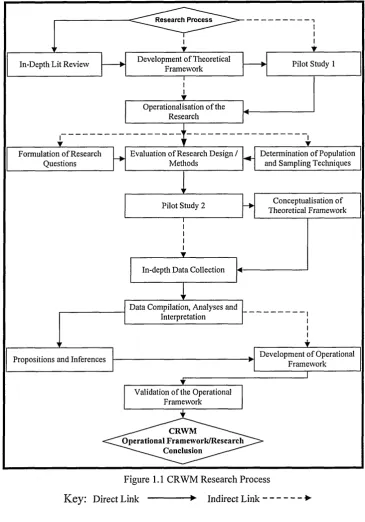
Research Process
CRW M
Operational Fram ework/Research
Conclusion
---In-Depth Lit Review Pilot Study 1
Formulation o f Research Questions
Development o f Operational Framework Propositions and Inferences
Determination o f Population and Sampling Techniques
In-depth Data Collection Operationalisation o f the
Research
Conceptualisation o f Theoretical Framework Pilot Study 2
Development o f Theoretical Framework
Evaluation o f Research Design / Methods
Data Compilation, Analyses and Interpretation
Validation o f the Operational Framework
Figure 1.1 CRWM Research Process
Key: Direct Link --- ► Indirect L in k ---►
1.5 SIGNIFICANCE OF THE RESEARCH STUDY
From much literature, it is evident that the construction industry needs to be re
engineered towards construction resources optimisation that will facilitate cost and time
efficiency. These will not only enhance the image of the industry, but also clients’
satisfaction with the construction products delivered. Egan (1998) affirmed that the
construction production process needs to be re-thought through re-engineering. To
[image:25.616.112.478.9.532.2]Excellence, 2006a); though, the practical applications of these techniques are yet to be
adequately successful. These emphases indicate the need for a robust research into
various construction production processes, resources utilisation and wastefulness that
will reveal the causes of occurrences o f the resources’ inefficiencies during the
production process, and to ascertain the avoidance of the resources’ wastes. Also,
several indications have shown that the construction sector lags behind other industrial
sectors, (the manufacturing and knowledge based service sectors), in resources optimal
utilisation. Thus, to bridge this gap, critical evaluation of its causes and how resources
are really utilised in the construction industry are essential.
The questions at stake are: What are the causes of these predominant resources’ wastes
during the construction stage after due considerations have been made to avert these
wastes during the design stage? When, where, how, and why do resources’ wastes often
occur? Do site participants envisage that resources misuse are inevitable and why? What
are the appropriate resources and incentives to support wastes management on
construction sites? Thus, this research addresses the management of resources’ wastes,
and establishes the causes of the wastes on sites that occur consciously and
unconsciously.
The CRWM operational framework that is to be established will be a benchmark for
wastes avoidance; also, will serve as a significant indicator for averting these wastes’
occurrences during the construction production process. In addition, the outcome of this
research will improve resources utilisation sustainability and the construction lean
production techniques. In consequence, it will enhance organisations' profit,
productivity, and clients’ satisfaction.
1.6 RESEARCH STATEMENT
The economic input of the construction industry to a nation’s Gross Domestic Product
and the provision of employment to a remarkable number of the nation’s populace
cannot be under-estimated. Findings from literature confirmed that resources are wasted
during the construction production process consciously and unconsciously. Though, in
Constructing Excellence (2003a, 2003b and 2006a) reports, there are clear indications
resources wastage. However, there,are difficulties in achieving the set objectives of the
Lean construction consistently, even by many organisations who have tried the
utilisation of the techniques and principles. Thus, many construction professionals,
scholars and researchers are finding modalities on how the Lean construction principles
and techniques could be efficiently and effectively implemented.
In Constructing Excellence (2006a:7), it was emphasised that:
"Lean does work, it reduces cost and time, while it simultaneously improves
client satisfaction But, it’s tough, and more importantly, it's tough to
keep it going! Perhaps, that is why so many organisations have tried, but so
far, few have yet succeeded in making the technique work consistently"
Thus, Ballard, the Co-founder and research director of the Lean Construction Institute
advocated more research on lean construction. Stated that:
"Even though testing o f theory and development o f the production system is
done primarily through field experiments, implementation o f the Lean
Project Delivery System is a research topic in its own right. Various fields o f
study can help us better understand implementation; particularly
organisational development. We are specifically interested in the dynamics
o f organisational change provoked by initiating change in a single element
such as production control".
- Ballard (2000: 7).
In light of these statements, "initiating change in production control" (Ballard, 2000:7),
in addition with "yet succeeded in making Lean Construction techniques work
consistently", (Constructing Excellence, 2006a:7), and other concerns, arise the needs
of this study. The researcher is convinced that, in order to maximise resources
utilisation, the conscious and unconscious occurrences of these wastes during the
construction production process need to be critically examined. Also, the researcher
contends that several wastages termed to be unavoidable, could be avoided, while the
avoidable ones have not be adequately noted by the construction participants and
stakeholders. However, the knowledge, attitudes and perceptions of the construction
This study evaluates several conscious and unconscious wastes’ scenarios, and presents
an operational framework that will be effective for optimal utilisation of construction
resources during the production process.
The key propositions in consideration, (as the success criteria), to achieve the research
objectives are:
a) to re-assess the unconscious and conscious wastefulness of construction
resources; and
b) to ascertain the optimal utilisation of construction resources through avoidance
of resources’ wastes.
1.7 LITERATURE REVIEW OUTLINE
During literature review emphases are placed on resources utilisation. Also, the factors
towards achieving optimal utilisation of construction resources during production
process are highlighted. The facts obtained in the literature reviewed are presented in
Chapter Two. Among the issues evaluated are:
a) construction management principles and practice;
b) the constraints of the site manager in efficient use of construction resources;
c) qualities, skills and attributes required of a site manager for efficient
performance of their obligations;
d) the management techniques towards efficient utilisation of construction
resources;
e) the issues of budgeting for wastes’ syndromes, (BWS) in the construction
industry;
f) the current innovations, principles and practice toward efficient utilisation of
construction resources in the UK.
Base on the findings deduced from the literature reviewed, the researcher’s perception
1.8 RESEARCH QUESTION AND SUB QUESTIONS
Many authors, including Bryman (2004), Sarantakos (2001) and Punch (2003)
emphasised that research methods determine the research questions and methodological
position of the researcher. Also that the research questions are generated to probe the
needs for the research work; this is further argued toward what is achievable within the
framework of the research. Thus, in the designing of these research questions, the
researcher recognises the functions which the questions will perform:
a) to organise the study, and provide a direction to the research methods and
designs to be employed;
b) to indicate and provide directions to the research data to be collected to achieve
the research set objectives;
c) to delimit the research study and show the research boundaries;
d) to keep the research focused during the study;
e) to help in framework development, and establishment.
1.8.1 Research Question
In respect of the research study aim and objectives; and the stated functions of the
research questions, the research into “optimum utilisation of construction resources
during the production process” is guided by this main question:
How could construction resources be efficiently utilised during the production
process?
This question could be explained as:
a) What are the circumstances that surround the conscious and unconscious
wastefulness o f construction resources during the production process?
b) What are the factors that enhance the conscious and unconscious wastefulness
o f construction resources during the production process?
c) Why are construction resources being wasted conscious and unconscious during
the production process?
1.8.2 Research Sub Questions
To address this main research question adequately, the following sub-questions are
a) What are the constraints on site managers that enhance the wastefulness o f
construction resources?
b) What are the factors that need to be constant towards efficient utilisation o f
resources?
c) Why do construction participants budget fo r construction resources
wastefulness?
d) How could construction resources be salvaged toward efficient utilisation?
These research questions are justified and related to the research objectives in Chapter
Four, (the Research Methods, Section 4.5.2).
1.9 RESEARCH SCOPE AND LIMITATION
The research into “Construction Resources’ Wastes Management” focuses on the
utilisation of resources in the UK building industry. The investigations are on resources
management during the construction projects delivery. This research is limited to the
procurement and use of resources, (materials, manpower and machinery); other wastes,
such as energy and social wastes are not investigated.
Figure 1.2 illustrates the scope and limitation of the research, also, the research
variables. This research study is to establish operational framework for optimal
resources utilisation. The research dependent variables are materials, manpower and
machinery wastes, and the extraneous variables are cost of construction, delivery time
expected quality, client’s satisfaction and contractors’ profit. The independent variable
is the construction resources management. The research scope and variables are
explicitly explained in Chapter Four, (the Research Methods, Section 4.2).
Dependent Variables
(Wastesj
• Materials • Manpower • Machinery
CRW M Operational Framework
Research Outcome Independent
Variable
Construction Resources M anagement
Operational Fram ework for Optimal Resources Utilisation
Based on the U .K Construction Industry
• Cost • Time • Quality • Satisfaction
• Profit
Extraneous Variables
1.10 CHAPTER ONE SUMMARY
This chapter introduced this research work and indicated the need for the research study.
The research aim and objectives are stated. The needs to optimise the use of scarce and
costly construction resources are clarified. In the research statement, it was affirmed that
resources in the construction industry are under-utilised and under-achieving the
stakeholders’ satisfaction.
The chapter highlighted the research questions and summarised the methodology
approaches that will be useful for adoption to achieve the research objectives. These
research questions and objectives are further explained in Chapter Four, (the Research
Methods), where their relationships are drawn.
The next chapter, Chapter Two presents the deductions drawn from the literature
reviewed, and the researcher position.
13
C H A P T E R T W O
2.0 LITERATURE REVIEW
2.1 CHAPTER INTRODUCTION
This chapter evaluates and presents statements of facts, views of diverse authors,
scholars, institutes and organisations; taking into consideration the construction
resources utilisation. Management techniques and current innovations in practice
towards the enhancement of construction resources utilisation are evaluated. In addition,
the chapter highlights the scenarios of "Budgeting for Wastes’ Syndromes" and
construction resources sustainability. The chapter presents the research position based
on the divergence views from the literature evaluated, and concludes by presenting the
chapter summary.
2.2 CONSTRUCTION RESOURCES’ WASTES PERCEPTIONS
The perceptions of wastes on construction sites are often attached to solid wastes as
discussed in much literature including DEFRA (2007 - 2008), DTI (2004a) and Strategy
Unit (2002) reports. However, waste is used as a term for a situation that brings forth
uselessness or inefficient utilisation of resources; arising from lack of proper planning,
inadequate control and monitoring of construction procedures, (Polat and Ballard, 2003;
Howell, 1999). In addition, wastes add no value to the construction final product(s).
Management of resources’ wastes revolve around efficient and effective controlling,
monitoring and checking of resources utilisation, (Formoso et al, 1999). The
construction resources’ wastes could be conscious or unconscious in occurrences;
avoidable or unavoidable in use; and visible or invisible in sight.
The scenarios of resources wastefulness are usually developed from the design stage.
Much of the resources’ wastes that occur during the production process are built-up
during design and specifications writing, bill of quantities preparation, cost estimation,
and resources procurement specification; these documents are combined and presented
as the construction production information. The production information conveys the
project objectives, designers’ concepts, and the stakeholders’ requirements o f the
explicit, accurate and properly coordinated, it will be ineffective in use, and will
inevitably lead to resources’ wastes during the project production phase. Thus, quality
production information is fundamental and essential for satisfactory realisation of
construction project objectives.
The requirements of construction resources’ wastes management are to address the
following: the skills, experience, leadership and motivation of workforce; job size and
complexity; job site accessibility; and, materials, machinery and labour availability. In
addition, the management is needed to address procurement system and work schedule
adequately. Other important factors when considering CRWM are: monitoring and
controlling of contractual agreements, local climate and local cultural characteristics.
2.3 PROJECT MANAGEMENT OVERVIEW
Project Management is a carefully planned and organised endeavour to accomplish a
specific one-time effort. The project management includes the development of a project
plan, definition of project goals, objectives, tasks and specifications, and stipulation of
how the project goals will be achieved timely, (PMI, 2005). Therefore, project
management is the implementation of the project plan, to ensure the project stays on its
"critical path" through adequate monitoring and control. That is, to plan and manage the
project according to the pre-determined targets at the inception of the project.
Project management usually follows phases with various titles for each phase:
feasibility study, planning, implementation, evaluation and maintenance. To achieve the
best from a project, the management of projects requires a thorough knowledge of
modern management techniques, (Lane, 2002; McGeorge and Palmer, 2002; Haughey,
2009), as well as an understanding of the current design and construction processes,
(PMI, 2005).
The management of projects has a specific set of objectives with constraints: delivery of
the project within budgeted cost, time frame and quality. While the relevant technology,
institutional arrangements or processes differ, the management of all projects has much
in common; including the management of projects in specialities or technology
project management is distinguished from general management by its mission-oriented
nature. The discipline of project management aims at defining and achieving targets, at
the same time, optimising the use of financial, human, materials and natural resources.
However, project management is generally terminated when the mission is
accomplished.
Management of a project is the responsibility of all the construction project personnel
working within the project province; striving for the successive and successful
achievement of the project objective(s), (Newcombe et al., 2003a, 2003b). Thus, the
Project managers strive to maintain the progress and mutual interaction of various
parties involved in project initiation and execution to ensure that the risk of failure is
reduced.
Project managers can be found in all industries. The numbers of project managers grow
rapidly since all industries and organisations realise the immense importance of project
managers in project success. As project-based organisations have started to emerge;
thus, project management is becoming established as both a professional career path and
a way of controlling business, (Haughey, 2009). The rapid growth arises due to the need
to execute complex works where high technicalities are required for the success and in
the use of scarce resources efficiently.
As highlighted in much literature including Haughey (2009) and APM (2006), the
essential features of project management are:
1. Project management is not an easy task.
2. Project management has a definite beginning and end. It is not a continuous
process.
3. Project management uses various tools to measure accomplishments and track
project tasks. These include Gantt charts, Critical Path Methods, (CPM) and
Program Evaluation and Review Techniques, (PERT) charts.
4. Projects frequently need resources on an ad-hoc basis as opposed to
organisations that have only dedicated full-time positions.
Among the fundamental tasks of a construction project manager indicated in APM
(2006), PMI (2005), and OGC - 2 (2007) reports are:
1. specification o f project objectives and plans including delineation of scope,
budgeting, scheduling, setting performance requirements, and selecting project
participants;
2. maximisation of resources utilisation through efficient procurement o f labour,
materials, and equipment in according to the defined schedule and plan;
3. implementation of various operations through proper co-ordination, monitoring
and controlling, planning, designing, estimating, contracting and constructing of
the entire process;
4. development of effective communications and mechanisms for resolving
conflicts among the various participants.
All construction products require to be delivered (within scope, on time at minimum
cost), to meet the project quality objectives. These factors form the classic time, quality,
cost triangle as illustrated in Figure 2.1. Thus, a project is deemed to be efficient and
effectively implemented when the project is delivered on time, within cost, scope, and
meets the customer quality requirements, (where quality is a constant factor). These four
factors have to satisfy customers’ expectations, (Figure 2.2).
Time Time
Quality
Cost S c o p e
Expectations C ost
S cop e
Figure 2.1 Project's Delivery Objectives Triangle, Figure 2.2 Stakeholders' Expectations D iam ond,
(Haughey, 2009) (Haughey, 2009)
However, there are no two customers' expectations that are the same; but, at the point of
If there is unlimited money and time for a project, management of the project becomes
easier, but several projects have limited time frames and are to be executed within a
budgeted cost. Thus, effective and efficient time and cost management are paramount
for project success. It is therefore pertinent to implement effective construction site
management systems during construction production process.
2.4 CONSTRUCTION SITE MANAGEMENT SYSTEMS
Construction Site Management is the act of carrying out construction processes from
inception to completion on site. The management involves planning, co-ordinating,
controlling, organising and forecasting a viable operational system for project
execution, (Wideman, 1986; Newcombe et al., 1993a). Management of the construction
site also involves the act of motivating the participants and maintaining efficient and
effective communication between the stakeholders. These functions are manned by the
construction site managers, whose responsibility is to execute the project successfully
on behalf of the client and/or the organisation.
In practice, a construction project is rigorous and difficult to manage due to the
characteristics nature of the industry. Fluctuating workloads, complex and non-unique
projects, a mobile workforce, different sub-contractors and suppliers, various regulatory
bodies, and changes in government policy pose hindrances in effective implementation
of site management principles and techniques. However, the historical dividing line
between design practice and the production process is becoming more blurred due to the
increase in the use of different new innovative and contract methods. Such methods are
managing contracting, construction management in risk, turnkey project arrangements,
partnering and the supply chain systems; instead of the old traditional system.
Practically, maximisation of resources utilisation during the construction process is
achievable through effective implementation of various management techniques,
(Hendrickson, 2009). Thus, towards efficient site management, the major areas
requiring site manager's knowledge to Wideman (1986) and Dinsmore (1990), and as
stressed in PMI (2005) and APM (2006) are:
a) integration management: this is to ensure that the various project elements are
b) scope management: this is to ensure that all the work required and only the
required work is included;
c) time management: this is to provide an effective project schedule for project
delivery;
d) cost management: this is paramount in order to identify needed resources and
maintain budget control throughout the construction process;
e) quality management: to ensure functional requirements are met and delineation
o f construction non-conformances;
f) human resources management: to develop effective project personnel, team
work and interactions for construction operation process;
g) communications management: to ensure effective internal and external
communications and feedback from all the stakeholders;
h) risk management: to analyse, mitigate and foresee potential risks and change that
may arise during the construction process;
i) procurement management: to obtain necessary resources from both internal and
external sources as input and convert these resources effectively and efficiently
towards output, that is, the construction products.
Other important management systems of which site managers required are materials,
machinery and knowledge management systems.
These principal knowledge areas form the basis of the Project Management Institute's
certification programmes for any site manager in the construction industry, (PMI, 2005).
2.5 SITE MANAGEMENT TECHNIQUES TOWARDS EFFICIENT
RESOURCES UTILISATION
2.5.1 Introduction
There are several significant management techniques towards achieving efficiency and
effectiveness in construction products delivery. Some of the most important are:
Knowledge Management; Human resources management; Materials management; Plant
and machinery management; and Time management. Also, there are Cost management;
Quality management; Risk management; Communications management, and
relates their importance towards achieving optimal resources utilisation during the
construction production process.
2.5.2 Knowledge Management
This management system describes the processes that enable an organisation to exploit
knowledge and leam from its people. These results in efficiency, an enhanced project
implementation, reduction in wasteful resources and cost, and contribute to greater
innovation and more success in winning new business. To Lin and Tsemg (2003),
knowledge management deals with creating, securing, capturing, coordinating,
combining, retrieving and distributing knowledge. Noteworthy, knowledge sharing
principles between different projects are essential management tools in gaining
competitive advantage over competitors, through avoidance of wastes and
advancements in innovation.
During the project construction, among the necessity of a construction site manager is
the need to harness the experience of others; which helps to prevent mistakes that had
been made in past projects. Re-using experience also avoids problem-solving from
scratch, that is, already solved problems which do not need to be solved over and over
again.
Lin and Tseng (2003) affirmed five major phases in the knowledge management life
cycle; these are: knowledge acquisition, knowledge extraction, knowledge storage,
knowledge sharing, and knowledge updating. Figure 2.3 illustrates the generic of the
phases of the knowledge management life cycle. The Knowledge to be shared has to be
acquired. In construction, most information and knowledge mainly comes from the job
site. Therefore, knowledge collection on a job site plays an important role during
knowledge acquisition. However, the storage is most done in the main office, where all
the information or tacit knowledge sent back from the job site are transferred to explicit
knowledge.
Knowledge sharing is the ultimate goal of knowledge management. After a particular
knowledge has been acquired and stored, only people who need the related-knowledge
for a peculiar project access, select, and reuse the appropriate knowledge. That is, when
required, a specific knowledge is adopted to a new project and put to use in solving
Data
Information Knowledge Sharing
Knowledge Storage Knowledge Acquisition
Knowledge Extraction
Knowledge Updating K now ledge M an ag em en t
Life Cycle
Figure 2.3 Five Phases o f Knowledge M anagement Life Circle, (M odified from Lin Y. C and Tsemg, H. P, 2003)
2.5.3 Human Resources Management
Dinsmore (1990:2) stress that, "at least fifty percent o f the problems that exist in
projects are either totally or partially behavioural in nature, while the percentage could
be as high as seventy five percent in some project set ups". This makes human resources
management, (HRM), to be paramount in project management systems. Human co
ordinates, manages, delegates, performs, processes, decides, approves, solve problems
and carry out all the project activities. Thus, the HRM processes require making
effective use of people that are involved in the project.
The questions on how to blend project elements and human behaviours outlined by
Dinsmore (1990:64) are:
(a) What is the best way to blend the talents of key project personnel?
(b) How can it be done most effectively to meet project needs?
(c) Who should be involved?
(d) Should the programmes be extended to various project levels and include all major
participants and parties?