SELF-EVALUATION OF PHYSICAL EDUCATION TEACHERS IN THE USE OF CONSTRUCTIVE
*
1
PhD candidate, School of Physical Education and
2
Professor of SPESS, School of Physical Education and Sport Science, Democritus University of Thrace, Greece
ARTICLE INFO ABSTRACT
Physical
by solving problems and to be actively involved in the creation of new activities by linking new knowledge to what they already know. The aim of the present study was
of gender and study specialization of the Physical Education teachers (PETs) on the use of CTS. The survey involved 207 PETs from different regions of Greece. The Constructivist Teaching Practices Inventory in Elementary Ph
was used. The results showed that the gender X study specialization interaction was non Statistically significant differences were found between male and female PETs in all fac
in favor of the latter, and between PETs of different study specialization in facilitating student social co-operation in favor of graduates of School of Physical Education and Sport Science (SPESS). In conclusion, the gender of PETs is a fact
specialization affects slightly facilitation of student social co in use of CTS can help PETs in their professional development.
Copyright © 2018, Papamichou and Derri. This is an open use, distribution, and reproduction in any medium, provided
INTRODUCTION
Through education, pupils' socialization (Chen
and their overall development can be achieved and strengthened (Asola, 2014). The educational process is a relationship between teacher and student interaction. Teachers influence the students' cognitive process at 40% (Darling Hammond and McLaughlin, 2009) and should therefore provide learning opportunities to all of them through an appropriate learning environment (Davis and
Physical Education Teachers (PETs) developing their ability to better design and organize their course, pr
maximum opportunities to participate (Emmanouilidou Derri, Vasiliadou and Kioumourtzoglou, 2007). In this frame students should be provided with the opportunity to process and build their learning rather than being passive recipients of information (Cobb, 1994a). Teaching practices are a very important factor in the educational process, influencing the way students learn, understand and interpret the educational content (Schwichow, Zimmerman, Croker and Hartig,2016; Chen, Mason, Hammond-Bennett and Zlamout, 2014).
*Corresponding author: Papamichou, A.
PhD candidate, School of Physical Education and Sport Science, Democritus University of Thrace, Greece
DOI:https://doi.org/10.24941/ijcr.31809.08.2018
ISSN: 0975-833X
Article History:
Received 20th May, 2018
Received in revised form 14th June, 2018
Accepted 25th July, 2018
Published online 30th August, 2018
Citation: Papamichou, A. and Derri, V., 2018. “Self
Journal of Current Research, 10, (08), 72188-72193.
Key Words:
Physical education,
Constructive teaching strategies, Gender, Specialization of studies.
RESEARCH ARTICLE
EVALUATION OF PHYSICAL EDUCATION TEACHERS IN THE USE OF CONSTRUCTIVE
TEACHING STRATEGIES
*1
Papamichou, A. and
2Derri, V.
, School of Physical Education and Sport Science, Democritus University of Thrace, Greece
School of Physical Education and Sport Science, Democritus University of Thrace, Greece
ABSTRACT
Physical Education (PE), Constructive Teaching Strategies (CTS) help pupils to cooperatively learn by solving problems and to be actively involved in the creation of new activities by linking new knowledge to what they already know. The aim of the present study was
of gender and study specialization of the Physical Education teachers (PETs) on the use of CTS. The survey involved 207 PETs from different regions of Greece. The Constructivist Teaching Practices Inventory in Elementary Physical Education (CTPI-EPE) by Chen Burry
was used. The results showed that the gender X study specialization interaction was non Statistically significant differences were found between male and female PETs in all fac
in favor of the latter, and between PETs of different study specialization in facilitating student social operation in favor of graduates of School of Physical Education and Sport Science (SPESS). In conclusion, the gender of PETs is a factor of differentiation in the use of CTS in PE while study specialization affects slightly facilitation of student social co-operation. Specialized training programs in use of CTS can help PETs in their professional development.
open access article distributed under the Creative Commons Attribution provided the original work is properly cited.
Through education, pupils' socialization (Chen and Du, 2013) and their overall development can be achieved and strengthened (Asola, 2014). The educational process is a relationship between teacher and student interaction. Teachers influence the students' cognitive process at 40%
(Darling-ghlin, 2009) and should therefore provide learning opportunities to all of them through an and Sumara, 1997). Physical Education Teachers (PETs) developing their ability to better design and organize their course, provide pupils with maximum opportunities to participate (Emmanouilidou Derri, Kioumourtzoglou, 2007). In this frame students should be provided with the opportunity to process and build their learning rather than being passive recipients of Teaching practices are a very important factor in the educational process, influencing the way students learn, understand and interpret the educational content (Schwichow, Zimmerman, Croker and Hartig,2016; Chen,
Zlamout, 2014).
PhD candidate, School of Physical Education and Sport Science,
.08.2018
They reflect the way the teachers interact with students (Chen
et al, 2014) while their quality significantly contributes to the failure or success of even an educational reform (Loewenberg Ball and Forzani, 2009). In Physical Education (PE) the teaching practices should aim at pupils’ independent thinking based on past experiences, problem solving, interaction, and collaboration (Derri, Emmanouilidou
Traditional teaching practices (TTP) are co
achieving only certain PE objectives (Derri, 2007; Derri, 2011), as they prevent pupils from high order thinking and reacting (Fisher, 1998). In contrast, teaching practices with a student-centered character such as constructi
mutual support and acceptance of each member of the group (Adams, 2006) through cooperative activities (Rovegno Dolly, 2006). In constructively oriented teaching practices, which in the present study will be called Constructive Teaching Strategies (CTS), the teacher establishes a positive learning environment within the classroom (Graham, 2008).
to the theories of constructivism, whose inspirers are Piaget and Vygotsky (RovegnoandDolly,2006) all knowledge is built on a preexisting basis. Children learn better when they are allowed to construct a personal image of reality based on their own perceptions and experiences (Smith, Cowie
Self-evaluation of teaching practices and in this case of the CST by the PETs may influence their views on the quality of
International Journal of Current Research Vol. 10, Issue, 08, pp.72188-72193, August, 2018
Self-evaluation of physical education teachers in the use of constructive teaching strategies
EVALUATION OF PHYSICAL EDUCATION TEACHERS IN THE USE OF CONSTRUCTIVE
Sport Science, Democritus University of Thrace, Greece
School of Physical Education and Sport Science, Democritus University of Thrace, Greece
Education (PE), Constructive Teaching Strategies (CTS) help pupils to cooperatively learn by solving problems and to be actively involved in the creation of new activities by linking new knowledge to what they already know. The aim of the present study was to identify the possible effect of gender and study specialization of the Physical Education teachers (PETs) on the use of CTS. The survey involved 207 PETs from different regions of Greece. The Constructivist Teaching Practices EPE) by Chen Burry-Stock and Rovegno (2000) was used. The results showed that the gender X study specialization interaction was non-significant. Statistically significant differences were found between male and female PETs in all factors of CTS, in favor of the latter, and between PETs of different study specialization in facilitating student social operation in favor of graduates of School of Physical Education and Sport Science (SPESS). In or of differentiation in the use of CTS in PE while study operation. Specialized training programs
ribution License, which permits unrestricted
They reflect the way the teachers interact with students (Chen quality significantly contributes to the failure or success of even an educational reform (Loewenberg In Physical Education (PE) the teaching practices should aim at pupils’ independent thinking based on past experiences, problem solving, interaction, and collaboration (Derri, Emmanouilidou and Vasiliadou, 2011). Traditional teaching practices (TTP) are considered effective in achieving only certain PE objectives (Derri, 2007; Derri, et al., 2011), as they prevent pupils from high order thinking and reacting (Fisher, 1998). In contrast, teaching practices with a centered character such as constructive, enhance the mutual support and acceptance of each member of the group (Adams, 2006) through cooperative activities (Rovegno and Dolly, 2006). In constructively oriented teaching practices, which in the present study will be called Constructive Teaching Strategies (CTS), the teacher establishes a positive learning environment within the classroom (Graham, 2008). According to the theories of constructivism, whose inspirers are Piaget and Dolly,2006) all knowledge is built on a ing basis. Children learn better when they are allowed to construct a personal image of reality based on their own perceptions and experiences (Smith, Cowie and Blades, 2003). evaluation of teaching practices and in this case of the y influence their views on the quality of INTERNATIONAL JOURNAL OF CURRENT RESEARCH
their teaching (Burry-Stock, 1995). Through this, the teacher is provided with feedback to strengthen correct points, make revisions, corrections, and introduce innovative practices that are important for the development of the PE course (Chen et al., 2000).
Theories of constructivism
The constructivist approach to knowledge has been interpreted by Piaget (developmental constructivism), supporting student's investment in prior knowledge and by Vygotsky (social constructivism), illuminating student's social interaction with the environment. The pre-existing knowledge of the individual is called by the developmental constructors (Piaget's followers) schema, which reacts to new knowledge and responds to new information (Lyddonand McLaughlin, 1992). The individuals adapted by modifying the reactions according to the new experiences (Cobb, 1994a). The sociocultural constructors (Vygotcky followers) underline the interaction between the process of active knowledge building and mutual interaction with the social environment (Harris and Graham, 1994).
Constructive teaching strategies
According to Constructive Theory (Cobb, 1994b) learning is realized through three pillars: a. the responsibility of pupils is promoted b. the previous learning situation is taken into account, and steps follow new fields of knowledge c. opportunities for collaborative work are offered to students. Learning occurs when pupils encounter problems, suggest solutions, experiment, and generally are receptive to new things. In the course of development of PE in the USA, the approach of educating the individual as a whole (body, mind, emotions) using student-centered teaching practices was introduced very early (Chen, 2006). Behavioral theory has also influenced PE, framing the so-called traditional teaching practices (Woolley, Benjamin and Woolley, 2004), and supporting automation through repeated iterations of a pattern of behavior (Mergel, 1998). Traditional teaching practices (TTP) approach PE as a "program that suits everyone" hence PETs tend to attribute failures to students instead of taking the responsibility for their own shortcomings (Mc Caughtry and Rovegno, 2003). Azzarito and Ennis (2003) argued that appropriately targeted teaching strategies in PE create a learning environment in which students develop active knowledge and concepts, exchange information, take leadership roles, responsibilities, make decisions, communicate and come closer to their peers.
Self-evaluation of teaching practices
The association between teachers' beliefs and teaching practices is considered to be given (Richardson, 1996). Self-evaluation is a way of recording teachers’ beliefs. It assists teachers to monitor their impact on pupils' success, have information on how far they have achieved their learning goals, influencing satisfaction levels (Ross and Bruce, 2007) and their professional development (Whipp, Taggart and Jackson, 2014).
Gender, specialization of study and CTS
The PE has long been characterized as a direct sex-related lesson from its philosophy to its content and organizational structure through its association with sports (Garrett, 2004). Research (McCaughtry, 2006; Murphy, Dionigi and Litchfield,
2014) focuses on the differentiation of teaching strategies in PE in relation to student gender rather than to teacher gender. Also, in some countries (e.g. Australia), the PE lesson is not taught by PE specialists but by the classroom teachers. Research evidence (Morgan and Hansen, 2007) showed that students who are taught the lesson by an educator with specialized studies in PE present better results in their motor and academic performance, in health indicators (Sallis, McKenzie, Alcaraz, Kolody, Faucette andHovell, 1997), but also in their entertainment (De Corby, Halas, Dixon, Wintrupand Janzen, 2005). Similarly, it is very likely that the specialization of PETs at postgraduate and doctoral level is a factor in improving their teaching practices.
Purpose
The purpose of the present study was to identify the possible effect of gender and specialization studies of PETs οn the use of CTS.
MATERIALS AND METHODS
Sample: Two hundred and seven in-service PETs (113 males
and 94 females) from different regions of Greece with educational experience from 1 to 32 years (M=24 years) voluntarily participated. One hundred and thirty were graduates of Schools of Physical Education and Sports Science (SPESS) and 77 were holders of master or doctoral degree.
Procedure: Teachers completed a specially structured online
questionnaire, which was sent in a link form to their school's e-mail address. They filled it up without mentioning their personal email to maintain their anonymity.
Measuring Tool
The use of CTS was evaluated by the Constructivist Teaching Practices Inventory in Elementary Physical Education (CTPI-EPE) (Chen et al., 2000). It consists of thirty-six (36) questions, and four factors: Factor A: Facilitating Active Construction of Knowledge in Dance/Gymnastics, Factor B: Facilitating Active Construction of Knowledge in Games and Skills, Factor C: Facilitating Personal Relevance, and Factor D: Facilitating Social Cooperation. Responses are given at a 5-point Likert scale (5=almost always, 3= sometimes, 1=never). The construct and factorial validity of the tool has been tested and were found good. However, quoting those results is not the purpose of this research.
Statistical Analysis
Two Way Analysis of Variance (Two Way Anova) was used to investigate the interaction between the two independent variables, gender and study specialization. One Way Anova for each variable was used to investigate their effect on each factor. The internal consistency reliability was examined with Cronbach’s alpha coefficient.
RESULTS
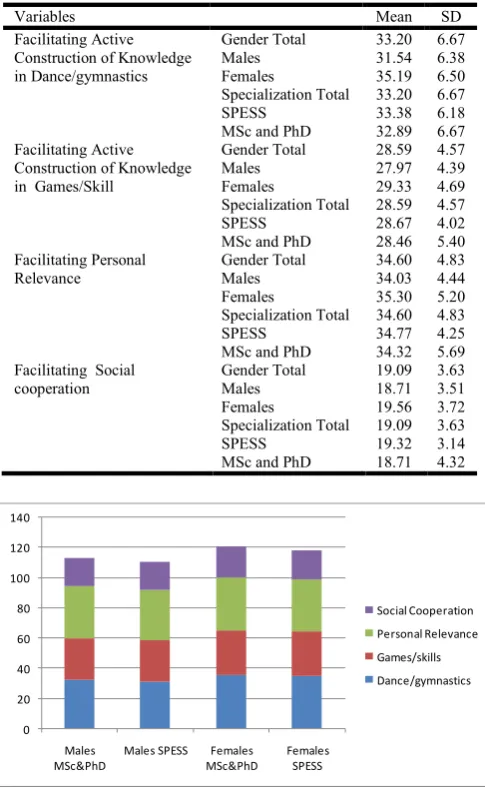
Table 1. Means and standard deviations in all factors by participants’ gender and study specialization
Variables Μean SD
Facilitating Active Construction of Knowledge in Dance/gymnastics
Gender Total Males Females
33.20 31.54 35.19
6.67 6.38 6.50 Specialization Total
SPESS MSc and PhD
33.20 33.38 32.89
6.67 6.18 6.67 Facilitating Active
Construction of Knowledge in Games/Skill
Gender Total Males Females
28.59 27.97 29.33
4.57 4.39 4.69 Specialization Total 28.59 4.57 SPESS
MSc and PhD
28.67 28.46
4.02 5.40 Facilitating Personal
Relevance
Gender Total Males Females
34.60 34.03 35.30
4.83 4.44 5.20 Specialization Total 34.60 4.83 SPESS
MSc and PhD
34.77 34.32
4.25 5.69 Facilitating Social
cooperation
Gender Total Males Females
Specialization Total SPESS
MSc and PhD
19.09 18.71 19.56 19.09 19.32 18.71
[image:3.595.41.289.91.484.2]3.63 3.51 3.72 3.63 3.14 4.32
Figure 1. Gender and studies specialization in all factors
Cronbach’s alpha, means and standard deviations of the total sample on all factors are presented in Table 2. The alpha value for the total scale was .94 while in the four sub-scales ranged from .80 to .88, indicating excellent and good internal consistency-reliability.
Table 2. Alpha indices for the total scale and the subscales
Variable Μ SD Cronbach
’ s alpha
Total 128.44 19.56 .94
Facilitating Active Construction of Knowledge in Dance/gymnastics
35.96 7.38 .88
Facilitating Active Construction of Knowledge in Games/skills
31.69 5.05 .80
Facilitating Personal Relevance 38.35 5.25 .80 Facilitating Social Cooperation 22.40 4.20 .88
Facilitating Active Construction of Knowledge in Dance/Gymnastics F1, 206=16.4, p<0.05, b. in Facilitating Active Construction of Knowledge in Games and Skills F1,206 =4.65, p<0.05 c. in Facilitating Personal Relevance, F1,206 =3.58, p<0.05 and d. in Facilitation in Social Co-operation, F1,206 =3.81, p<0.05. Female PETs seem to use more CTS than males in all factors. With regard to study specialization, the results showed statistically significant differences between graduates of Schools of Physical Education and Sports Science
(SPESS) and holders of master or doctoral degree (MSc andPhD) only in the factor Facilitating social co-operation, F1,206 =3.84, p=0.048, p<0.05, where SPESS excelled.
DISCUSSION
The purpose of the present study was to identify the possible effect of gender and study specialization of PETs οn the use of CTS. Based on the results, the effect of gender was significant on all factors. Female PETs seem to use more CTS than their male colleagues in all studied factors. Specifically, females presented better perceptions on facilitating student active construction of knowledge in dance/gymnastics, games/skills, personal relevance, and social cooperation. In the international bibliography, compared to other lessons, PE is considered far more stereotyped for male and female sports, reaching even the point that girls are a problem in regards to the content of the lesson (Enright and O'Sullivan, 2010). Therefore, influenced by the way they experienced the PE lesson as students and their possible treatment with gender social stereotypes, female PETs may feel that only through the PE approach with new teaching approaches such as the CTS can gender stereotypes be eliminated. These findings are consistent with previous research in other school subject subjects (Wang, 2016) which indicated that female educators prefer student-centered teaching practices to a greater extent than their male colleagues.
Also, in the present research, the study specialization indicated significant differences only in Facilitating social cooperation, where SPESS graduates seem to use slightly more CTS than MSc and PhD holders. Research findings have shown that teacher specialization creates an environment of greater self-confidence (Haney and McArthur, 2002). Therefore, it was expected that MSc and PhD holders would be more self-confident in using student-centered teaching strategies such as CTS because of their expertise. However, this does not seem to apply in the present study, likely because structured teaching to improve social cooperation in PE has been recently included in PETs undergraduate and graduate program studies both in theoretical courses and in PE practicum. Also, according to Pill, Penney, and Swabey (2012), undergraduate students tend to adopt TTP because they are familiar with them since they were students, influencing their teaching profiles (Curtner-Smith, 1999). Similarly, in-service PETs also tend to adopt TTP rather than CTS (Widodo, Duit, and Muller, 2002).
The modernization of teachers' knowledge and skills and the adoption of more effective pedagogical and teaching practices for all pupils are considered necessary (Commission of the European Communities, 2007). As the teacher is one of the key factors influencing student cognitive process, improving the quality of the educational work is important (Jennings, Snowberg, Coccia, and Greenberg, 2011). In this frame, regardless of the level of studies, PETs need targeted training
programs at new teaching approaches such as CTS. The
approach that an identical lesson fits all students does not seem to gain support because of differences in the students' developmental level, in the way they learn, but also in the course objectives (Derri, 2007; Yerg, 1983). As Graham (1995) stated, it would be much easier if students had identical interests, abilities, prior knowledge, which naturally does not apply. Professional development seems to be the key to achieve this goal as it is a key factor in the quality of the educational project (Nye, Konstantopoulos and Hedges, 2004). The study
0 20 40 60 80 100 120 140
Males MSc&PhD
Males SPESS Females
MSc&PhD
Females SPESS
Social Cooperation
Personal Relevance
Games/skills
[image:3.595.41.284.599.689.2]specialization of teachers examined in this study is undoubtedly included in professional development factors. In particular, PETs as lifelong learners through continuous learning and professional development (NASPE, 2007) have the opportunity to be informed about all new teaching approaches, such as CTS (Chen et al., 2000). Anderson and Helms (2001) argue that it is vital to have training programs on CTS that will allow the creation of a different pedagogical framework in PE (Kirk and Macdonald, 1998). Therefore, more training should be provided in the frame of the professional development of PETs. Significant contributor to lifelong professional development could be the cooperation between Universities, school and research centers (Commission of the European Communities, 2007). Since the results of the present study show that regardless of the specialization of studies, PETs need continuous updating of knowledge through training, it would be very interesting, that this training be undertaken by the Universities, with the fields of Teaching/Methodology being leaders in this effort.
The Constructive Theory can additionally provide a theoretical background for redefining the role of PETs introducing new teaching practices (Rovegno, 1998). In this frame, the need to strengthen the role of PETs in terms of using new teaching strategies such as the CTS seems urgent. Self-evaluation of PETs with appropriately structured tools, provides first and foremost information on whether they treat their class as a whole or focus on the needs of each student. With self-evalutation, teachers record their personal beliefs (Burry-Stock, 1995), which are a key factor in deciding which teaching practices to follow (Hsiao and Yang, 2010). Specifically, the views of PETs on their teaching encourage them to use teaching approaches that develop student independent thinking, problem solving, interaction and collaboration (Burry-Stock, 1995; Derri 2007). Moreover, self-evalutation of teaching practices can help teachers’ professional development, which is a lifelong process, as well as the professional learning through which previous knowledge is linked to new learning experiences. Professional development is related to the ability and willingness of the teacher to identify (and thus to evaluate) strengths and weaknesses in order to improve teaching (Avalos, 2011). Facilitation of learning and cooperation are common elements of professional development (European Commission, 2011) and constructive theory (Harris and Graham, 1994).
Specifically, PETs need to receive regular feedback and guidance to improve continuously (Derri, Vasiliadou andKioumourtzoglou, 2015). PETs’ trainings must be properly designed (Sandholtz, 2002) because otherwise they do not affect teaching (Connolly and James, 1998). It is necessary for PETs to be informed through appropriate training programs to renew the design of their course by focusing on the needs of each student. All the above show that PETs’ training programs
should be targeted at new teaching approaches. This is
consistent with relevant research (Johnson, 2006) where students themselves prefer a collaborative and entertaining environment that keeps them active during the course. Therefore, students’ knowledge building based on their interaction with the environment (Schunk, 2008) and their past experiences (Mayer, 2009) provides PETs with high scores on student-centered teaching strategies. Future studies should consider the examination of the effects of targeted training programs on the use of CTS by the PETs and also on student performance should be of great importance.
Conclusion
The gender of PETs is a factor of differentiation in the use of CTS in PE. Specifically, females PETs seem to use more CTS than their male colleagues on facilitating student active construction of knowledge in dance/gymnastics, games/skills, personal relevance, and social cooperation. Study specialization does not seem to be a significant contributor in using CTS in PE. Considering the aforementioned differences, specially structured training programs in CTS can help PETs professional development.
REFΕRENCES
Abrami, P. C., Poulsen, C. and Chambers, B. 2004. Teacher motivation to implement an educational innovation: Factors differentiating users and non-users of cooperative learning.
Educational Psychology, 24(2): 201-216.
Adams, P. 2006. Exploring social constructivism: theories and practicalities. Education 34(3): 243-257.
Anderson, R. D., and Helms, J. V. 2001. The ideal of standards and the reality of schools: Needed research. Journal of Research in Science Teaching, 38(1):3-16.
Asola E. (2014). Integrated Curriculum in Physical Education.
Ghana Physical Education and Sport Journal, 3: 10-22.
Avalos, B. 2011. Teacher professional development
in Teaching and Teacher Education over ten years.
Teaching and Teacher Education, 27: 10-20.
Azzarito, L., and Ennis, C.D. 2003. A sense of connection: Toward social constructivist physical education. Sport, Education, and Society, 8: 179-197.
Burry-Stock, J.A. 1995. Expert science teaching evaluation model (ESTEEM): Theory, development, and research. Kalamazoo, MI: The Evaluation Center, Western Michigan University.
Chen, W. and Du, Y. 2013. A study on the Confirmatory of Primary School PE Teacher training and College PE major reform. 2013 International Symposium -Common Cochran-Smith, M., andLytle, S.L. 1999. Relationships of Knowledge and Practice: Teacher Learning in Communities. Review of Research in Education, 24: 249-305.
Chen, W. 2006. Teachers’ Knowledge about and Views of the National Standards For Physical Education .Journal of Teaching in Physical Education, 25:120-142.
Chen, W., Burry-Stock J.A., Rovengo, I. 2000. Self-Evaluation of Expertise in Teaching Elementary Physical Education from Constructivist Perspectives. Journal of Personnel Evaluation in Education 14(1): 25-45.
Chen, W., Mason, S., Hammond-Bennett A., and Zlamout, S. 2014. Development and Validation of Assessing Quality Teaching Rubrics. Journal of Education and Training Studies, 2(3):52-61.
Cobb, P. 1994a. Constructivism in mathematics and science education. Educational Researcher, 23(7): 4-12.
Commission of the European Communities 2007. Communication from the Cοmmission to the Council and the European Parliament. Improving the Quality of Teacher Education.
Connolly, U., and James, C. 1998. Managing the school improvement journey: the role of continuing professional development. Journal of In-Service Education, 24(2): 271 - 282.
Curtner-Smith, M. D. 1999. The more things change the more they stay the same: Factors influencing teachers' interpretations and delivery of national curriculum physical education. Sport, Education and Society, 4(1): 75-97. Darling –Hammond, L. and Richardson,Ν. 2009. Research
Review / Teacher Learning: What Matters? 66 (5): 46-53. Davis, B., and Sumara, D. J. 1997. Cognition, complexity, and
teacher education. Harvard Educational Review, 67(1): 105-125.
De Corby, K., Halas, J., Dixon, S., Wintrup, L., and Janzen, H. 2005. Classroom teachers and the challenges of delivering quality physical education. The Journal of Educational Research, 98: 208–220.
Derri, V. 2007. Physical Education at the Beginning of the 21st Century. Standards, Goals and Objectives in Elementary Education. Thessaloniki: Christodoulides Publications. Derri, V., Emmanouilidou, K., and Vasiliadou, O. 2011. Digital
school. New Pilot Study Programs. Guide to Physical Education Teacher at Primary School.
Emmanouilidou K., Derri, V., Vasiliadou, O., and Kioumourtzoglou, E. 2007. DSPES, Democritus University of Thrace. The Academic Time of Learning in the Physical Education course in Primary Education. Searches in Physical Education and Sports Volume 5(1): 1 – 9.
Enright, E., and O'Sullivan, M. 2010. “Can I do it in my pyjamas?” Negotiating a physical education curriculum with teenage girls. European Physical Education Review,
16(3):203- 222.
Fisher, R. 1998. Self-designing clinical trials. Statistics in Medicine,17(14): 1551-1562.
Garrett, R. 2004. Negotiating a physical identity: Girls, bodies and physical education. Sport, Education and Society,
9(2):223-237.
Graham, G. 2008. The institution of intellectual values: realism and idealism in higher education. Exeter: Imprint Academic.
Graham, G. 2008.Teaching children Physical Education: Becoming a Master Teacher. Human Kinetics.
Guskey, T. R. 1988. Teacher efficacy, self-concept, and attitudes toward the implementation of instructional innovation. Teaching and Teacher Education, 4(1): 63-69. Haney, J. J., and McArthur, J. 2002. Four case studies of
prospective science teachers’ beliefs concerning constructivist based teaching practices. Science Education,
86(6): 783-802.
Harris, K.R., and Graham, S. 1994. Constructivism: Principles, paradigms, and integration. Journal of Special Education, 28(3): 233-247.
Hsiao, H., and Yang, S. 2010. The study of teaching beliefs reflected on teaching behavior: Focusing on elementary school teachers. The International Journal of Learning,
17(9):299-309.
instruction: Success or failure (pp. 184-200). New York, NY: Routledge.
Jennings, P. A., Snowberg, K. E., Coccia, M. A., and Greenberg, M. T. (2011). Improving classroom learning environments by cultivating awareness and resilience in education (CARE): Results of two pilot studies. Journal of Classroom Interaction, 46(1): 37-48.
Johnson, L. M. 2006. Elementary school students’ learning preferences and the classroom learning environment: Implications for educational practice and policy. Journal of Negro Education, 75(3): 506-518.
Klahr, D. 2009. "To everything there is a season, and a time to every purpose under the heavens": What about direct instruction? In S. Tobias and T. M. Duffy (Eds.),
Loewenberg Ball, D., and Forzani, F. M. 2009. The Work of Teaching and the Challenge for Teacher Education. Journal of Teacher Education, 60: 497-511.
Lyddon, W. J., and McLaughlin, J. T. 1992. Constructivist psychology: A heuristic framework. Journal of Mind and Behavior, 13(1): 89-107.
Mayer, R. E. 2009. Constructivism as a theory of learning versus constructivism as a
Mc Caughtry, N. 2006. Working politically amongst professional knowledge landscapes to implement gender-sensitive physical education reform. Physical Education and Sport Pedagogy, 11(2): 159-179.
McCaughtry, N., and Rovegno, I. 2003. Development of pedagogical content knowledge: Moving from blaming students to predicting skillfulness, recognizing motor development, and understanding emotion. Journal of Teaching in Physical Education, 22: 355-368.
Mergel, B. 1998. Instructional Design and Learning Theory. Learning Theories of Instructional Design.
Morgan, P. and Hansen, V. 2007. Recommendations to Improve Primary School Physical Education: Classroom Teachers’ Perspective. The Journal of Educational Research, 101(2): 99-112.
Murphy, B., Dionigi, R.A., and Litchfield, C. 2014. Physical education and female participation: A case study of teachers’ perspectives and strategies. Issues in Educational Research, 24(3): 241-259.
NASPE. 2007b. Position statement: What constitutes a highly qualified physical education teacher. Reston, VA.
Nye, Β., Konstantopoulos, S., and Hedges, L. 2004. How large are teacher effects? Educational Evaluation and Policy Analysis, 26(3): 237-257.
Pill, S., Penney, D., and Swabey, K. 2012. Rethinking sport teaching in physical education: A case study of research based innovation in teacher education. Australian Journal of Teacher Education, 37: 117–138.
prescription for instruction. In S. Tobias and T. M. Duffy (Eds.), Constructivist
Richardson, V. 1996. The role of attitudes and beliefs in learning to teach. In J. Sikula (Ed). Handbook of research on teacher education (second edition, pp. 102-119). New York: Macmillan.
Ross, J. A., and Bruce, C. 2007. Professional development effects on teacher efficacy; Results of randomized field trial. The Journal of Educational Research, 101(1): 50-66. Routledge.
Rovegno, I. 1998. The development of in-service teachers' knowledge of a constructivist approach to physical education: Teaching beyond activities. Research Quarterly for Exercise and Sport, 69: 147-162.
Rovegno, I. and Dolly, J.P. 2006. Constructivist perspectives on learning. In: Kirk D, O’Sullivan M and Macdonald D (eds), Handbook of Research in Physical Education. Thousand Oaks, CA; London: Sage, pp. 242–261.
Sallis, J. F., McKenzie, T. L., Alcaraz, J. E., Kolody, B., Faucette, N., andHovell, M. F. 1997. The effects of a 2-year physical education program (SPARK) on physical activity and fitness in elementary school students. American Journal of Public Health, 87: 1328–1334.
school/university partnership. Teaching and Teacher Education, 18(7): 815-830.
Schunk, D. H. 2008. Learning theories: An educational perspective (5th ed.). Upper Saddle River, NJ: Pearson Merrill Prentice Hall.
Schwichow, Μ., Zimmerman, C., Croker, S., and Hartig, H. 2016.What students learn from hands on activities.
Journal of research in science teaching 53(7): 980-1002. Smith, P.K., Cowie, H. and Blades, M. 2003. Understanding
children’s development. Oxford: Blackwell Publishing. Wang, P. 2016. Teachers’ Implementation of Constructivist
Teaching: Does Career Motivation Make a Difference?.
Theses and Dissertations (All). Indiana University of Pennsylvania http://knowledge.library.iup.edu/etd/1396 Whipp, P., Taggart, A., and Jackson, B. 2014. Differentiation
in outcome-focused physical education: pedagogical rhetoric and reality. Journal of Physical Education and Sport Pedagogy, 19(4): 370-382.
Widodo, A., Duit, R., and Müller, C. 2002. Constructivist views of teaching and learning in practice: Teachers' views and classroom behavior. In Annual meeting of the national association for research in science teaching, New Orleans, US, 07-10 April 2002 (pp. 1e18). New Orleans: NARST publications.
Woolley, S. L. Benjamin, W.-J. J. and Woolley, A. 2004. Construct validity of a self-report measure of teacher beliefs related to constructivist and traditional approaches to teaching and learning. Educational and Psychological Measurement, 64(2): 319-331.
Yerg, B. 1983. Re-examining the process - product paradigm for research on teaching effectiveness in physical education. In T. Templin and J. Olson (Eds.), Teaching in physical
education. Champaign, IL: Human Kinetics.