doi:10.4236/am.2011.22018 Published Online February 2011 (http://www.SciRP.org/journal/am)
Formulation of the Post-Newtonian Equations of Motion
of the Restricted Three Body Problem
Fawzy A. Abd El-Salam1, Sobhy Abd El-Bar2
1Department of Astronomy
, Faculty of Science, Cairo University, Cairo, Egypt
2Department of Mathematic
s, Faculty of Science, Tanta University, Tanta, Egypt
E-mail: [email protected], [email protected]
Received May 15, 2010; revised November 10, 2010; accepted November 14, 2010
Abstract
In the present work the geodesic equation represents the equations of motion of the particles along the geo-desics is derived. The deviation of the curved space-time metric tensor from that of the Minkowski tensor is considered as a perturbation. The quantities is expanded in powers of c2. The equations of motion of the relativistic three body problem in the PN formalism are obtained.
Keywords: Post Newtonian Approximation, Geodesic Equation, Restricted Three Body Problem
1. Introduction
The Three body problem concerns with the motion of a small particle of negligible mass moving under the
gravi-tational influence of two massive objects m1 and m2.
It’s history began with Euler and Lagrange continues with Jacobi [1], Hill [2], Poincaré [3], and Birkhoff [4]. In 1772, Euler [5] first introduced a synodic (rotating) coordinate system, the use of which led to an integral of the equations of motion, known today as the Jacobian integral. Euler himself did not discover the Jacobia in-tegral which was first given by Jacobi [1] who, as Wint-ner remarks, “rediscovered” the synodic system. The ac-tual situation is somewhat complex since Jacobia pub-lished his integral in a sideral (fixed) system in which its significance is definitely less than in the synodic system.
Many authors hope to investigate the relativistic effe-cts in this problem. But unfortunately, the Einstein field equations are nonlinear, and therefore cannot in general be solved exactly. By imposing the symmetry require-ments of time independence and spatial isotropy we are able to find one useful exact solution, the Schwarzschild metric, but we cannot actually make use of the full con-tent of this solution, because in fact the solar system is not static and isotropic.
Indeed, the Newtonian effects of the planet’s gravita-tional fields are an order of magnitude greater than the first corrections due to general relativity, and completely swamp the higher corrections that are in principle pro-vided by the exact Schwarzschild solution. It is worth
noting to highlight some important articles in this field. Krefetz [6] computed the post-Newtonian deviations of the triangular Lagrangian points from their classical positions in a fixed frame of reference for the first time, but without explicitly stating the equations of motion. Contopoulos [7] treated the relativistic (RTBP) in rotat-ing coordinates. He derived the Lagrangian of the system and the deviations of the triangular points as well. Wein-berg [8] calculated the components of the metric tensor by using the post-Newtonian approximation in order to obtain the (RTBP) problem equations of motion. Soffel
[9] obtained The angular frequency ω of the rotating
frame for the relativistic two-body problem. Brumberg [10,11] studied the problem in more details and collected most of the important results on relativistic celestial me-chanics. He did not obtain only the equations of motion for the general problem of three bodies but also deduced the equations of motion for the restricted problem of three bodies. Bhatnagar and Hallan [12] studied the
exis-tence stability of the triangular points L4,5 in the
relati-vistic (RTBP), they concluded that L4,5 are always
unst-able in the whole range 0 0.5 in contrast to the
previous results of the classical restricted three-body
problem where they are stable for 0 0 where
is the mass ratio and 00.03852. Lucas [13] found
relativity is discussed.
2. Expansion Dimensionless Parameter
In the presence of weak gravitational fields and small ve-locities, the physics of general relativity should become Newtonian. This suggest an expansion of the metric, Christoffel symbols, other tensors and the field equations in powers of small parameter, similar to the perturbation expansions of classical and quantum mechanics.
The nature and value of the expansion parameter is de-termined by the system at hand. But in general we can characterize a self-gravitating system by a characteristic
mass M, characteristic length L and a characteristic time
T. The mass could be the mass of the principal body in
the system. The length could be its physical radius, and the time could be the time it takes an object to traverse the length scale. Each of these quantities set a scale for its particular dimension, and from them we can establish the dimensionless quantities.
In a bound system where motion is periodic, the Virial theorem says (for a nonrelativistic velocities) that
2
1 1
2m v 2V
or, for a Newtonian gravitational potential GmM
r
2 GM
v
r
Dividing both sides by the c2
, where c is the velocity
of light yields
2
2 2
v GM
c c r
This very simple equation enables us to identify the expansion parameter as
2 2
2 2
L GM
c T c L
In the following we will set G = c = L = 1, and have
1 2
T M
As an example, we can compute the parameter for
the Sun, taking its radius as the distance scale.
3
3 8
1.477 10
1.4586 10
6.9598 10
What we need then is not to find more exact solutions, but rather to develop some systematic approximation me-thod that will not rely on any assumed symmetry proper-ties of the system.
There are two such methods that have been
particular-ly useful they are called the Post-Newtonian approxima-tion (PN) and the weak field approximaapproxima-tion. The first is adapted to a system of slowly moving particles bound together by gravitational forces. The second method treats the fields in a lower order of approximation but does not assume that the matter moves
non-relativisti-cally. A test particle in a circular orbit of radius r about a
central mass M will have velocity v given in Newtonian
mechanics by the exact formula v2
GM r
.
The PN approximation may be described as a method for obtaining the motions of the system to one higher
power of the small parameters
GM
r and v2 thangiven by Newtonian mechanics. It is sometimes referred to as an expansion in inverse powers of the speed of light.
We prefer to say that our expansion parameter is c2,
note that geometric units will not be used, so that G1,
and c1. We now proceed to find the equations of
mo-tion of the relativistic three body problem in the PN for-malism, or more precisely the equation of the RTBP.
3. The Geodesic Equation
According to the theory of general relativity a particle moving under the influence of gravity follows a Geodes-ic in a four dimensional space called the space-time ma-nifold. The path that it follows is called a geodesic. Let
the coordinate of this manifold be as follows: x0 ct,
1 , 2
x x x y and x3z. Consider a particle moving
along a geodesic x s
in the space-time manifold,where s is the arc length. A straight line is defined as any path in which its tangent vectors all points in the same
direction. Let the tangent to the curve x(s) be defined
dx s A
ds
(1)
The magnitude of this tangent vector is obtained from the tensor algebra as;
12
A g A A (2)
where g is the metric tensor, which can be obtained
from
2
ds g dx dx (3) substituting into Equation (2) yields
1
A
which means that the tangent vectors all have a constant length, usually called the unit tangent to the curve. This property leads to (when differentiating)
0
dA ds
157
If a unit tangent A is parallel displaced from a point
p to a point pone can easily get
A A dx
(5)
where is the affine connection, to be defined later.
,
A
using the elementary mathematics, can be written
as
p pA
A A A ds
s
(6)
substituting from Equation (5) into Equation (6) yields
0
dA dx
c A
ds ds
(7)
this equation merely represents a division of dA by
ds
and not to be confused with Equation (4). Substituting from Equation (1) into Equation (7) yields directly the geodesic equation. In fact that the geodesic equation represents the equations of motion of the particles along the geodesics
2
2 0
d x dx dx
ds ds ds
(8)
Since the proper time is proportional to the arc-
length these equations can be written as
2
2 0
d x dx dx
d d
d
(9)
where the affine connection is given by
1 2
p p
p
p
g g g
g
x x x
(10)
Now the accelerations can be computed using Equation (9) as
2
2
2 1
2
2
2 2
2
2
2 2
2
2
2 2
2
i i
i i
i i
i i
i d x d dx d
dt d dt dt
d x d dx d dt dt d dt d d
d x d dx dt d dt
dt d d dt d
d
d x dt dx dt d d dt
d d d d dt d
d
d x dt d d
d
3 2 2
2 2
0
i i
i i
x dt d d x
d d dt dt
dx dx dx dx dx dt dt dt dt dt
(11)
where we made use the geodesic Equation (9) for the
inboxed terms.
Remark: We now perform the sums over the dummy
indices, namely , and to separate the time and
space indexed term,
2
0 0 0 2
0 0 0 0
2
2
i j k i
i i i
j k
j j k i
i i
j j k
d x dx dx dx dx
dt dt dt dt dt
dx dx dx dx
dt dt dt dt
In the Newtonian limit we treat all velocities as vani-shingly small, and so have to zeroth Newtonian order
20 0 2
0 0
2
2 2 2
1 1
1
2 2
i i
i i
d x dt
g GM
x x c r
GM O c c r
4. The Metric Tensor
Since a body of a mass mb tends to curve space-time, the
metric of the space-time will deviate from that of the Minkowski tensor which represents the flat space. But assuming, without loss of the accuracy required, that the mass of the body is so small, so that the departure from
the Minkowski tensor will be in powers of c1, or in
other words the effect on the space-time can be
consi-dered as a perturbation to the metric of the flat space, i.e.
is so small
g h h (12)
where , the metric of the flat space-time, is given, in
matrix representation, by
1 0 0 0
0 1 0 0
0 0 1 0
0 0 0 1
(13)
Using the fact that the velocity of a test particle of
mass mp relative to the body is vc, and assuming
0,
p b
m m so that the effects on space-time originating
from the particle are negligible, the metric tensor of the perturbed flat space-time can generally be described by
0 0 0 0
0 0
1 i j i j i j
i i
g h
g h
g h
(14)
sor, induced by the theory of general relativity, that is, to
determine h0 0 to order
6
O c
and h0j to order
5O c
, by solving the Einstein field equations for h0 0
and h0j. Our objective in using the PN approximation
will be to compute
d x2 i dt2 to order c4. Sincethe gi j are expected to include powers of
GM r
, thepartial derivatives of the gi j are significantly smaller
than gi j themselves.
The components of the metric tensor are assumed ex-pandable as
2 4
00 00 00
2 4
3 5
0 0 0
1
ij ij ij ij
i i i
g g g
g g g
g g g
The symbol
N
g denoting the term ing of order
1 cN. Odd powers of c1
c occur in gi0 because gi0
must change sign under the time-reversal
transforma-tiont t.
The inverse of the metric tensor is defined by the equ-ations
0
0 00 0
0 00 0
0 00
0 0
0,
1,
.
i i ij
j i
oi
i i i k
j j jk ij
g g g g g g
g g g g g g
g g g g g g
(15)
We expect that
2 4
00 00 00
2 4
3 5
0 0 0
1
ij ij ij i j
i i i
g g g
g g g
g g g
(16)
Using these expansions into (15) we find
2 2
00 00
2 2
3 3
0 0
,
,
ij ij i
i
g g
g g
g g
(17)
The affine connection may now be obtained from the familiar formula
1 2
p p
p
p
g g g
g
x x x
(18)
Using (15), (16) and (17) we find that 00,
i i
jk
and
0
o i
have the expansions
2 4
(19)
While the components 0
0 , 00
i j
and 0
ij
have the
ex-pansions
3 3
(20) The symbol
N
, denoting the non vanishing terms in
of order 1 cN, are given by
2 2
00 00
4 3 2
4 2
00 0 00
00
2 3
3 3
0 0
0
2 2 2
2
2 3
0 00
00
2 2
0 00
0 1 2
1 1
2 2
1 2
1 2
1 2 1 2 i
i
i i
ij
i j
ij j
i i
j j i
ij jk
i ik
jk k j i
i i
g x
g g g
g t
x x
g g
g t
x x
g g g
x x x
g t g
x
(21)
5. Einstein Field Equations
We are now ready to compute the metric tensor
compo-nents gi j up to the different orders appeared in
Equa-tions (15) and (16). To do that, the Einstein field equa-tions will be used in the following form.
4
8 1
2
G
R T g T
c
(22)
where R is the Ricci tensor and T is the
stress-energy-momentum tensor. Note that Greek indices range from 0 to 3 while roman indices range from 1 to 3.
6. The Ricci Tensor
R
The Ricci tensor is defined by
R
x x
(23)
159 2 4 00 00 00 3 5 0 0 0 2 4 i i i ij ij ij
R R R
R R R
R R R
(24)
where
N ij
R denotes the term in Rij of order 1 cN. The
terms that we can calculate from the known terms in the affine connection are
2 2
00 00
4 3 4
00 0 00
2 2 2 2
0
0 00 00
3 2 3
0 0
2 2 2
0 0 2 i i i i i i
i i j
i ij
j j
i ij j i
k ij j i j ik
k ij k R x R t x R t x R x x x (25)
Using Equation (22), we obtain
2 2
2
0 0 00
2 3
2 2
4 4
0 2
0 0 2 00
2 2 2
2 2
0 0 0 0
2 2 2 2
0 0 0
2 2 3 0 1 2 1 1 2 2 1 1 2 2 1 1 4 4 1 2
i j i
i
i j
i j i j j i
i i i i j
i i i i
i j i
R g
g g
R g
t x t
g g g
g
x x x x
g g g g
x x x x
g R 3 2 2 2 3 0 2 0 2 2 2 2 2 0 0 2 2 2 2 2 2
1 1 1
2 2 2
1 1
2 2
1 1 1
2 2 2
j i j
i
i i j j
k k
i j i j i j
i k k j
i j
k j k i
g g
g
x t x x x t
g g
R
x x x x
g g
g
x x x x
(26)
A tremendous simplification can be achieved at this point by choosing a suitable coordinates system.
It is always possible to define the x so that they obey
the harmonic coordinate conditions, Weinberg [8]
0
g (27)
Using Equations (16), (17), (19) and (21) we find that
the vanishing of the third-order term in g 0
gives
2 2 2
00 0 1 1 0 2 2 i ii i
g g g
t x t
(28)
While the vanishing of the second-order term in
i
g gives
3 2 2 00 1 1 0 2 2 ij jj
i j i
g g
g
x x x
(29)
It follows that
2 2 2
2 2 2
0 00 2 2 2 4 2 2 2 0 2 2 2 2 2 2 2 2 00 1 1 0 2 2 1 0 2 0 ii i i ij ii i
j i j i
ij kj
k j j i
jj
i k i k
g g g
t t x t
g
g g
t x x x x t
g g
x x x x
g g
x x x x
(30)
So the simplified formulas for the Ricci tensor will be in the form
2 2
2
00 00
2 2
4 4 4
2 00 2
00 00 00
2 2 2 2 2 2 00 00 3 3 3 3 2 0 0 2 2 2 2 2 1 2
1 1 1
2 2 2
1 1 2 2 1 2 1 . 2
i j i j
i i
ij ij
R g
g
R g g
t g g g x x R g R g (31)
Substituting into Equation (24), yields
2 4
2 2
00 00 00
2 2 2 2 2 00 00 3 2 0 0 2 2 1 1 2 2 1 1 2 2 1 2 1 2
ij i j
i i
ij ij
R g g
7. The Energy-Momentum Tensor
T
It is assumed that, it is possible to describe the matter of
a system as a perfect fluid, i.e. an isotropic fluid with a
diagonal energy-momentum tensor (no shear stress), in the rest frame of the system. This energy-momentum ten-sor which is required in the field equation can be written as
1 2
3
1
1 n n n
n n
n
dx dx d
T M x x
dt dt dt g
(33)where g is the determinant of the metric tensor and
,
n n
M x and n are the mass, space-time position, and
proper time for the two massive objects. The expression is simplified by calculating the energy-momentum tensor in the rotating frame, in which the velocity of the prima-ries is zero. The nonvanishing components of the energy-momentum tensor are
2
00 3
1 1
1
3
2 2
2
c dt
T M x x
d g
dt
M x x
d
(34)
We expect that T0 0,Ti0 and Ti j will have the
expan-sions
0 2
00 00 00
1 3
0 0 0
2 4
i i i
ij ij ij
T T T
T T T
T T T
(35)
where
N
T denotes the term in T of order 1cN . In
particular
0 00
T is the density of rest-mass, while
2 00 T is the non-relativistic part of the energy density.
What we need now is
1 2
S T g T (36) So that Equation (35) gives
0 2
00 0 0 00
1 3
0 0
0
0 2
i i i
ij ij ij
S S S
S S S
S S S
(37)
where
N
S denotes the term in S of order 1cN In
particular
0 0
00 00
0 2 2 0 2
00 00
00 00
1 1
0 0
0 0
00
1 2 1
2 2
1 2
ij
i i
ij ij
S T
S T g T T
S T
S T
(38)
Using Equations (31) and (37) in the field Equation (22), we find that the field equations in harmonic coordi-nates are indeed consistent with the expansions we have been using, and give
2 0
2 00
00 4
2
2 2
2 2
4
2 00 00
00
2 2 0
00 00
00 4
2 1
2 0
0
2 0
2 00
4
8
8
2
16 8
i j i j i
l i i
ij ij
l G
g T
c
g g
g g
x x x
G
T g T
c
g GT
G
g T
c
(39)
From the first equation in (39) we find as expected
2 00 2
g (40)
where is the Newtonian potential defined by Poisson’s
equation
0
2 00
4
8 GT
c
(41)
Also
2 00
g must vanish at infinity, so the solution is
0 00
3 4
,
, G T x t
x t d x
x x c
(42)From the fourth equation in (39) we find that the
solu-tion for
2 i j
g that vanishes at infinity is
2
2 ij ii
g (43) On the other hand,
3 0
i
g is a new vector potential
3 0 i i
161
1 0
3 4
, 4
,
i
i
T x t
G
x t d x
x x c
(45)Finally, we may simplify the second equation in (39) by using (41), (42) and the identity
2 2 2
1 2
i i
x x
(46)
the result is
4
00 2 2 2
g (47)
where
is a second potential2 2
2 00
2 4
4 GT
t c
(48)
Again,
4 0 0
g must vanish at infinity, so the solution is
2 00
3 4
,
, G T x t
x t d x
x x c
(49)To evaluate these potentials we need the proper time derivatives which can be obtained from the static Schwarzschild line element (in isotropic coordinates) for
an observer at the position of M1 or M2.
2 2
00
n n
d g dt (50)
Using Misner, et al. [14] yields
2 2
00 1 2 2 1 2 2
n n
n
n n
GM GM
g
c r c r
(51)
To the order of the required accuracy we find
2 2 1
2
1 GM
dt
d c R (52)
1 2 2
2
1 GM
dt
d c R (53)
The determinant of the metric tensor is given by
2 4
00 00
1 1 4
g g g (54)
1 1 2
g (55)
Substituting these all into the second potential
yields
2 1 24
1 2
2 1 1
, G M M
x t
r r
c R
(56)
Returning to the metric tensor components yields
2
1 2 1 2
00 2 2 2 2
1 2 1 2
2 1 2 4
1 2
1 2
0
2 2
1 2
2 2 2 2
1
2 1 1
2 2
1 , 0, otherwise
ii i
GM GM GM GM
g
c r c r c r c r
G M M
r r
c R
GM GM
g g
c r c r
(57)
8. The Equations of Motion of Restricted
Three-Body Problem
The standard form of Euler-Lagrange equations read
0
d L L
d x x
(58)
It can be shown that the geodesic equations of motion can be obtained from the Euler-Lagrange equations by
defining the Lagrangian L as follows (see Foster, and
Nightingale, [15])
1
, , 0,1, 2, 3
2
L g x x (59) where the dot denotes the derivatives with respect to
pro-per time , and g are the components of the covariant
metric tensor. Using the components of the metric tensor the Lagrangian, after some lengthy computations, can be constructed. Then evaluating the derivatives in Euler-Lagrange equations results in the equations of motion (61) and (62) in the following section.
9. The Restricted Three-Body Problem
Notations
The well known Restricted Three-Body Problem, e.g. the Earth-Moon system, (from now on, RTBP) models the motion of an infinitesimal particle P under the gravita-tional attraction of two massive bodies, usually called
primaries of masses
M1 1 ,M2
, under thefollowing assumptions:
1) The particle is of infinitesimal mass that it does not affect the motion of the primaries,
2) The primaries are point masses that revolve in cir-cular orbits around their common centre of mass.
It is usual to take a rotating reference frame with the origin at the centre of mass, and such that the two
mas-sive bodies are kept fixed on the axis, the
,
planeis the plane of motion of the primaries, and the axis is
orthogonal to the
,
plane. These coordinates aresometimes called synodical.
In the restricted three-body problem this must be
coordinate system
, ,
by using the transformationcos sin 0
sin cos 0
0 0 1
nt nt
x
nt nt
y z
(60)
where n is the angular frequency of the rotating frame
The primary coordinates on the
x
-axis (−µ, 0), (1− µ,0) are kept fixed and the origin at the center of mass.
Now denoting x, 1, 2, 3 for , , in the Euler-
Lagrangian Equation (58), we obtain
2 2
3 3
1 2
2 3 3
1 2
.
2 2 2
3
1 2 1 2 1 2
1 1
2
1 1
2
1 1
1 1
2
n t n t n t Gt
r r
G
n t
c r r
n t n t n t G t
r r r r r r
3
3 3 3 3
1 2 1 2
2 2 2 2 2 2
1 1 1
1 1
2 2 2
2
r r r r
n t nt
(61)
2 2
3 3
1 2
2 3 3
1 2
2 2 2
3 3
1 2 1 2 1 2
1 2
1 1
2
1
1 1 1
2 1
2
n t n t n t G t
r r
G
n t
c r r
n t n t n t G t
r r r r r r
3 3
1 2
2 2 2 2 2 2
3 3
1 2
1 1
1
2
2 2
r r
n t nt
r r
(62)
where t, the coordinate time and K, the constant of motion are given by
1 2 2
2 2
2 4
1
2
e m
M M
K
t K N G n
r r
c c
(63)
and
2
2
2 2 2 2 2
2 2
1 2 1 2
2 2 2
2 2 2 2 4
2 4 4
1 2 1 2 1 2
2
2 1 2 1
1 1
2 1
2 1 2 1 1 1
1
1 2
2 1
G G
K n
r r r r
c c
G
G G
n c c
r r r r r r
c c c
G c
2 2 2
2 4 4
1 2 1 2 1 2
1 2
2 2
2
1 2
2 1
1 2 1 1 1
1 2
2 1
1
G G
r r r r r r
c c c
G
r r
c
163
The coordinate time can be eliminated from the equa-tions of motion by using Equation (57), the transforma-tion (60) and the general relativistic line element
2 2 2
2 2 2 2
11 c d ds g dx
c dt g dx dy
which leads to
2 2
2
2 2
2
2 2
2 2
dx dy n d d dt d d
n d dt n d dt
Thus the line element in the rotating coordinate system is
2 2 2 2 2 2 2 2
00 00
2 2
2 2
c d c g dt g n d d dt
d d n d dt n d dt
Dividing by d2
allows an expression for
.
t to be
obtained. This can then be used to eliminate
.
tfrom
Eq-uations (61) and (62) and after some algebraic manipula-tion, we get
2
2
U d U
n
dt
U d U
n
dt
(65)
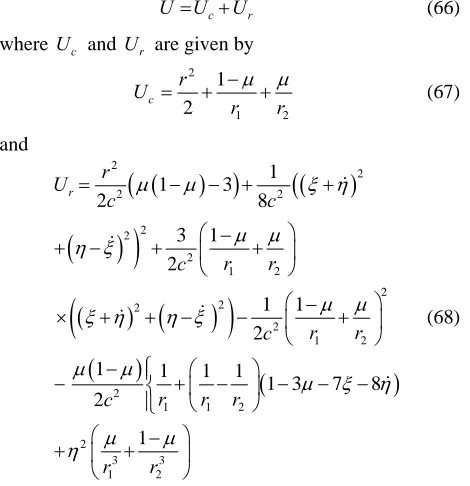
where U is the potential–like function of the relativistic
restricted three-body problem, which can be written as composed of two components, namely the potential of
the classical restricted three-body problem Uc and the
relativistic correction Ur;
c r
U U U (66)
where Uc and Ur are given by
2
1 2
1 2
c r U
r r
(67)
and
2
2
2 2
2 2
2
1 2
2 2
2
2
1 2
2
1 1 2
2
3 3
1 2
1
1 3
2 8
3 1 2
1 1 2
1 1 1 1
1 3 7 8
2 1
r r U
c c
r r
c
r r
c
r r r
c
r r
[image:9.595.313.534.80.236.2](68)
Figure 1. Inertial and rotating frames. The rotating coordi-nate system with coordicoordi-nates and moves counter-clockwise with unit angular velocity relative to the inertial frame with coordinates X and Y.
with
2
2 2
2 2
1
2 2
2
1
1 1 3 ,
2 ,
,
1 .
n
c r
r r
[image:9.595.364.479.321.417.2] [image:9.595.57.292.480.723.2]where the parameters ( ,r r r1, 2) are best illustrated in
Figure 1.
10. Conclusions
An explicit form of the potential-like function of the rela-tivistic restricted three-body problem is derived. Equa-tions (65) to (68) represent the equaEqua-tions of motion of the relativistic three body problem in the PN formalism. These equations will be used in the subsequent works to evaluate the locations of the Lagrangian points, and therefore to investigate their linear stability.
11. References
[1] C. G. Jacobi, “Sur le Movement d’un Point et sur un cas Particulier du Probleme des trios Corps,” Compte Rendus de l’Académie des Sciences, Vol. 3, 1836, p. 59. [2] G. W. Hill, “Researches in the Lunar Theory,” American
Journal of Mathematics, Vol. 1, No. 1, 1878, pp. 5-26. doi:10.2307/2369430
[3] H. Poincaré, “Les Methodes Mouvelles de la Mecanique Celeste,” Vol. 3, Gauthier-Villars, Paris, 1892.
Vol. 39, 1915, pp. 265-334. doi:10.1007/BF03015982 [5] L. Euler, “Theoria Motuum Lumae,” Typis Academiae
Imperialis Scientiarum, Petropoli, 1772.
[6] E. Krefetz, “Restricted Three-Body Problem in the Post-Newtonian Approximation,” Astronomical Journal, Vol. 72, 1967, p. 471. doi:10.1086/110252
[7] G. Contopoulos, “In Memoriam D. Eginitis,” D. Kotsa-kis, Ed., Athens, 1976, p. 159.
[8] S. Weinberg, “Gravitation and Cosmology Principles and Applications of the General Theory of Relativity,” Chap-ter 9, John Wiley & Sons, New York, 1972.
[9] M. H. Soffel, “Relativity in Astrometry, Celestial Me-chanics and Geodesy,” Springer-Verlag, Berlin, 1989, p. 173.
[10] V. A. Brumberg, “Relativistic Celestial Mechanics,” Nauka Press (Science), Moscow, 1972.
[11] V. A. Brumberg, “Essential Relativistic Celestial Me-chanics,” Adam Hilger, Ltd., New York, 1991.
[12] K. B. Bhatnagar and P. P. Hallan, “Existence and Stabili-ty of L4,5 in the Relativistic Restricted Three Body Prob-lem,” Celestial Mechanics, Vol. 69, No. 3, 1998, pp. 271-281.
[13] F. W. Lucas, “Chaotic Amplification in the Relativistic Restricted Three-Body Problem,” Verlag der Zeitschrift für Naturforschung, Tübingen, Vol. 58a, No. 1, 2003, pp. 13-22.
[14] C. W. Misner, K. S. Thorne and J. A. Wheeler, “Gravita-tion,” Freeman and Company, San Francisco, 1973, p. 840.