1
Reproductive interference in insects
12
David M. Shuker*1 and Emily R. Burdfield-Steel2 3
4
1. School of Biology, University of St Andrews, UK. 5
Email: [email protected] 6
2. Centre of Excellence in Biological Interactions, Department of Biological and 7
Environmental Science, University of Jyväskylä, Finland. 8
Email: [email protected] 9
10
*author for correspondence: Dr David M. Shuker, School of Biology, Harold 11
Mitchell Building, University of St Andrews, St Andrews, KY16 9TH, UK. Tel: +44 12
1334 363376. Email: [email protected] 13
14
Running title: Reproductive interference in insects 15
Key words: Behaviour, Competition, Harassment, Inter-specific interactions, 16
Satyr effect, Sexual conflict 17
18
2 Abstract
20
1. Reproductive interference occurs when members of different species engage 21
in reproductive interactions, leading to a fitness cost to one or both actors. 22
2. These interactions can arise through signal interference (“signal-jamming”), 23
disrupted mate searching, heterospecific rivalry, mate choice errors, or 24
misplaced courtship, mating attempts or copulation. 25
3. We present a definition of reproductive interference (RI) and discuss the 26
extent to which a failure of species discrimination is central to a definition of RI. 27
4. We review the possible mechanisms of RI, using a range of insect examples. 28
5. We discuss some of the causes and consequences of RI, focusing in particular 29
on mating systems and mating system evolution. 30
6. We conclude by considering future ways forward, highlighting the 31
opportunities for new theory and for tests of old theory presented by 32
reproductive interference. 33
34
3 Introduction
36
Mating systems are sexual networks of individuals, describing how, where, when 37
and how often animals come together to mate and raise offspring (Emlen & Oring 38
1977; Thornhill & Alcock 1983; Davies 1991). Alongside recent reappraisals of 39
how best to quantify and model key mating system parameters (Kokko et al. 40
2014), there has been growing interest in recent years in – to borrow a popular 41
expression – “when good mating systems go bad”, i.e. when unexpected and 42
seemingly non-adaptive behavioural phenotypes arise during reproductive 43
encounters. For instance, there is an increasing realisation that same-sex sexual 44
behaviour is more widespread than previously thought, challenging our 45
understanding of mate recognition and sexual function (including in insects: 46
Bailey & Zuk 2009). Similarly, it is now clear that mating failure – the failure of 47
individuals, particularly females, to produce offspring – is a more common 48
phenomenon than predicted by our assumptions of strong natural and sexual 49
selection on primary sexual function (Rhainds 2010). Mating failure can arise in 50
a number of ways (Greenway et al. 2015), but with failure to achieve successful 51
insemination despite successful intromission is perhaps being one of the more 52
perplexing examples, but this too can be surprisingly common (e.g. 40-60% in 53
Lygaeus seed bugs; Tadler et al. 1999; Dougherty & Shuker 2014; Greenway &
54
Shuker 2015). Here we will consider another unexpected aspect of mating 55
systems, again apparent in insects, reproductive interference. 56
57
Reproductive interference (RI) arises when individuals of different species 58
4
cost. A ground-breaking review by Gröning and Hochkirch in 2008 revealed that 60
costly heterospecific interactions were widespread in nature (167 bi-species 61
systems, excluding the very many studies on hybridisation). However, the study 62
of RI was perhaps hampered by the various synonyms used (at least 22 different 63
names for the same phenomenon: Gröning & Hochkirch 2008). Their review also 64
showed that heterospecific interactions were often studied by different groups of 65
biologists, asking different kinds of questions. On the one hand, evolutionary 66
biologists interested in speciation have very often studied heterospecific mating 67
interactions and outcomes, given their obvious interest in reproductive isolation 68
and population divergence (Coyne & Orr 2004). On the other, ecologists have 69
been interested in RI in the context of its role in ecological character 70
displacement (Dayan & Simberloff 2005). What perhaps was missing was the 71
middle ground, between ecology and evolution. Here we hope to begin to fill that 72
gap, considering the causes and consequences of reproductive interference in 73
terms of mating system evolution in insects. We will begin by defining RI more 74
completely, outline possible mechanisms by which RI can occur, and then 75
provide empirical examples from insects. We will then consider the causes and 76
consequences of RI, before concluding by outlining a few outstanding questions. 77
78
Defining reproductive interference 79
Reproductive interference occurs when individuals of one species engage in 80
reproductive behaviours with individuals of a different species that result in a 81
loss of fitness for one or both species (Gröning and Hochkirch, 2008; Burdfield-82
5
that this behaviour towards a heterospecific arises due to a failure in species 84
discrimination, which we will consider in further detail below. These authors 85
also clarify the link between RI and ecological competition. As they note, 86
“interference” interactions between individuals have been defined as a form of 87
competition (e.g. Begon et al 2005), but there is an important difference, in that 88
there is no shared resource over which competition can arise when we consider 89
RI. Thus, whilst Gröning and Hochkirch (2008) confirm that RI will often share 90
many of the features of ecological competition, such as density-dependence, it 91
stands apart from competition as a separate ecological process, with its own set 92
of evolutionary consequences. A similar point was made by Ribiero and Spielman 93
(1986), in terms of “reproductive niches” and “trophic niches”. The extent to 94
which the reproductive niches of different species overlapped would give a 95
measure of reproductive interference, whilst overlap of trophic niches would 96
give a measure of traditional resource competition, therefore separating 97
reproductive interference from competition. 98
99
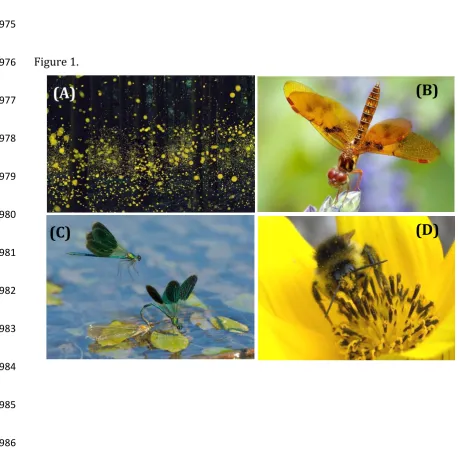
The reproductive behaviours that underlie RI can take many forms (see below; 100
Figure 1). In cases where mating and successful sperm transfer occurs, RI can 101
also lead to hybridisation (although cases of adaptive hybridisation may not 102
constitute RI, see Pfennig and Simovich, 2002). Non-adaptive hybridisation 103
comes with its own fitness consequences (Rhymer and Simberloff, 1996) and has 104
been thoroughly studied in the context of reproduction isolation and speciation. 105
In contrast, there is a greater need for studies focused on interactions where 106
6
These interactions are expected to lead automatically to wasted reproductive 108
effort, although the fitness costs of RI are likely to vary across the type of RI 109
occurring, and the life history and mating system of the species involved. For 110
example, heterospecific mating attempts are likely to carry the highest costs due 111
to gamete wastage, energetic expenditure, and physical damage or death. 112
113
Gröning and Hochkirch (2008) identified a number of key patterns in their 114
review, including the importance of RI for the ecological and evolutionary 115
impacts of invasive species, and that the asymmetry of costs of RI to the two 116
actors appears to be common. This asymmetry is important, as many of the 117
ecological and thus evolutionary consequences of reproductive interference flow 118
from this asymmetry, such as in terms of which species is more likely to be 119
displaced, or be under stronger selection for reproductive character 120
displacement. However, as will we confirm below, RI encompasses a diverse 121
range of phenomena, and generalisations beyond these are so far limited. 122
123
Mechanisms of reproductive interference in insects 124
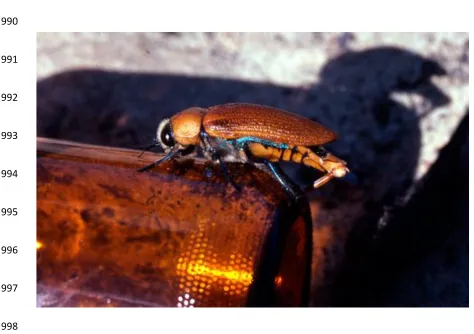
A famous example of a misplaced mating attempt comes from the beetle 125
Julodimorpha bakewelli, with males observed attempting to copulate with a beer
126
bottle (Figure 2; Gwynne & Rentz 1983). This behaviour may arise from the fact 127
that brown, stippled beer bottles provide enough attractive (or even “super-128
normal”) stimuli to generate sexual behaviour (Gwynne & Rentz 1983) but it 129
7
Insects provide numerous examples of RI, which we will review in terms of the 131
different mechanisms of RI, starting with at-a-distance interactions. Our review 132
is far from comprehensive, but hopefully illustrative in terms of the forms of 133
reproductive interference. 134
135
First, RI may arise due to “signal jamming” or signal interference, whereby the 136
signals produced by one species in some way disrupt the sending or receiving of 137
those necessary for successful reproduction in another species. (This is distinct 138
from conspecific "signal-jamming": Tobias and Seddon, 2009). Signal jamming 139
has been widely studied in the Orthoptera, indeed making up a major component 140
of the studies reviewed by Gröning and Hochkirch (2008). Patterns of con- and 141
heterospecific signal discrimination observed in the field may therefore reflect 142
current or indeed previous patterns of interactions or sympatry (Morris and 143
Fullard 1983; Gwynne and Morris 1986), particularly in northern temperate 144
habitats where glaciation cycles have repeatedly constructed and deconstructed 145
communities with the coming and going of the ice sheets. Importantly, signal 146
jamming may arise not just from females being unable to discriminate between 147
different species-specific songs, it may also arise thanks to male responses to 148
heterospecifics. For instance, male Metrioptera brachyptera bush crickets appear 149
to be prevented from calling by the presence of the songs of Metrioptera roeselii 150
(McHugh 1972). 151
8
Signal jamming can also occur in other communication systems and modalities. 153
Insects offer very many examples of chemical communication, and many 154
chemical communication systems are known to be susceptible to environmental 155
disturbance (Fisher et al., 2006), and the presence of heterospecific signals could 156
lower signal efficiency or block them entirely. Pheromonal signal jamming is 157
well-known from Lepidoptera (e.g. Landolt & Heath 1987), but the phenomenon 158
is more widespread. For instance, Ips bark beetles females can be attracted to 159
heterospecific pheromones (Lewis and Cane 1992), whilst males of the mirid bug 160
Phytocoris difficilis are attracted by the aggregation pheromone of the lygaeid
161
Oncopeltus fasciatus (Zhang & Aldrich 2003).
162
163
At-a-distance signalling also presents the opportunity for inter-specific sexual 164
deception, where predators use deceptive sexual signals to lure prey. Mokkonen 165
and Lindstedt (2015) listed several examples of sexual deception, including that 166
of bolas spiders that attract male moths to their lures with pheromones that 167
resemble those of female moths (Stowe et al., 1987, Haynes et al., 2002). A 168
number of orchid species mimic female insects to attract males in order to use 169
males as pollinators (e.g. Gaskett 2011, 2012), being a potential example of 170
reproductive interference across kingdoms, and indeed other plants beyond 171
orchids employ similar sexual deception (e.g. the South African daisy Gorteria 172
diffusa: Ellis and Johnson 2010). Perhaps the classic case though is the sexual
173
deception practised by Photuris fireflies (Figure 1a; Lloyd 1997; Lewis 2016). 174
Female Photuris mimic the signals of the females of Photinus and Pyractomena 175
9
them. However, the complexity does not stop there, as male Photuris also mimic 177
the females of other species, this time presumably to try to attract their own 178
females (Lloyd 1997). 179
180
These cases fall at the blurry edge of RI though. While they do fit the definition of 181
RI from the perspective of the prey species, they are the result of “intentional” 182
deception on the part of the predatory species. As with the “sexual parasitism” 183
described below, the evolutionary dynamics that result from these interactions 184
should differ from more “classic” examples of RI since, although the prey species 185
will undergo selection to avoid these interactions, there will be opposing 186
selection in the predator to enhance them. This differs from most cases of RI 187
where we would expect interspecific interactions to be either costly or 188
selectively neutral for the two actors, not advantageous. 189
190
As well as long-distance attraction, males and females may actively search for 191
mates. During mate searching, individuals may be attracted by the presence of 192
heterospecifics to areas that reduce success, either by an increase in misdirected 193
courtship or mating (see below), or by visiting an area with low numbers of con-194
specifics of the opposite sex. The next form of RI also occurs prior to close-range 195
range interactions, namely heterospecific rivalry for mates. In this case, 196
individuals, often males, mistakenly perceive members of another species as 197
potential rivals for mates and behave aggressively towards them. This is most 198
10
butterflies (Ravenscroft 1994; Dreisig 1995; Jones et al. 1998), and dragonflies 200
(Singer 1990; Schultz & Switzer 2001; see also Ord and Stamps, 2009). Schultz 201
and Switzer (2001) studied the amberwing dragonfly Perithemis tenera (Figure 202
1b) and showed that territorial males chased away butterflies and horse-flies 203
that resembled conspecifics, but actually tended to ignore individuals of five 204
other dragonfly species that look less like conspecifics. Heterospecific rivalry has 205
also been found to drive character displacement in wing spots, a sexually 206
selected trait, in the damselfly Calopteryx splendens (Tynkkynen et al., 2004; 207
Figure 1c). Heterospecific rivalry can also occur in non-territorial species though, 208
as in Tetrix groundhoppers (Hochkirch et al 2008). 209
210
Heterospecific rivalry might be considered non-adaptive when territories are 211
held solely for reproduction, rather than for resources (Ord et al., 2011, Peiman 212
and Robinson, 2010). However, aggression to all-comers, conspecific or not, 213
might be favoured if successful defence against rival males leads to the side effect 214
of occasional attacks on heterospecifics (see below for an analogous argument 215
for mating attempts). As Gröning and Hochkirch (2008) point out though, when 216
males are defending resource-based territories, and when heterospecifics also 217
use those resources, it will often be hard to disentangle inter-specific 218
competition from reproductive interference. 219
220
Once mate searching is completed, RI can then arise from errors in mate choice. 221
11
molecular analysis of hybridisation events looking at inheritance patterns of 223
mitochondrial DNA suggested that unidirectional hybridisation was common 224
(Wirtz 1999; see also Coyne and Orr 2004). Wirtz (1999) suggested that this 225
arose because females are the only sex likely to change mating preferences 226
enough when conspecific mate partners are rare, as males are always likely to be 227
more permissive in their mate choices than females (see also Fowler-Finn & 228
Rodriguez 2011 for an example of plasticity in mate preference as a result of 229
experience in a treehopper). 230
231
Misdirected courtship occurs when an organism directs courtship behaviour 232
towards an individual of a different species and this may then lead to hetero-233
specific mating attempts (Ribiero & Spielman 1986; Cothran et al., 2013), hetero-234
specific mating, and even hybridisation. Our work on lygaeid seed bugs 235
illustrates all these outcomes for Lygaeus equestris (Shuker et al. 2015; 236
Burdfield-Steel et al 2015; Evans et al 2015). Interestingly, there are a number of 237
cases of males preferring heterospecifics over conspecifics, for example in male 238
Anasa andresii squash bugs which prefer larger Anasa tristis females rather than
239
conspecific females (Hamel et al., 2015). A similar pattern is seen in the ground-240
hopper Tetrix ceperoi, where males prefer the larger T. subulata females, even 241
though those females reject them (Hochkirch et al 2007). 242
243
In the absence of hybridisation, heterospecific matings are predicted to carry the 244
greatest fitness costs. In addition to the usual costs of mating (e.g. Shuker et al., 245
2006), heterospecific matings also carry the risk of physical damage from 246
12
Kyogoku and Sota, 2015). This is the case in Hesperocimex bed bugs, which are 248
haematophagous bird parasites and which copulate via traumatic insemination. 249
Females of both H. sonorensis and H. coloradensis die after copulating with males 250
of a third species, H. cochimiensis, in the former case following what appears to 251
be a strong melanisation response (i.e. an immune system response to 252
wounding) leaving blackened abdomens (Ryckman & Ueshima 1964). Similar 253
inter-specific effects of traumatic insemination have been recorded for male 254
Cimex hemipterus bedbugs mating with female Cimex lectularius (Walpole 1988,
255
Newberry 1989). In addition to morphological damage, there is also the threat of 256
attack from the perceived “mate”. Males of the mantid Orthodera 257
novaezealandiae are attracted to the pheromone of females of the invasive
258
species Miomantis caffra, and attempt to copulate with them. As M. caffra females 259
show high levels of sexual cannibalism, such attempts frequently end in the 260
male’s death (Figure 3; Fea et al., 2013). Extreme costs need not only arise from 261
damage or predation though. Heterospecific matings can render females sterile, 262
as in female Aedes aegypti mosquitos when they mate with male Aedes albopictus 263
(Nasci et al 1989; see also Carrasquilla & Lounibos 2015). Similarly, females of 264
the dermestid beetle Trogoderma glabrum often failed to mate with a conspecific 265
after mating with the heterospecific Trogoderma inclusum, effectively sterilising 266
them (Vick 1973). However, sometimes the costs are grave for males as well, for 267
instance if the heterospecific mating involves the transfer of a costly nuptial gift, 268
or indeed if heterospecific matings are similarly fatal for the male (e.g. Heliothis 269
moths: Stadelbacher et al 1983). That said, the swapping of nuptial gifts between 270
heterospecific partners may benefit the recipient (typically the female) provided 271
13
context of interactions between two Orchelimum katydid species, but such 273
benefits are perhaps unlikely to be common. 274
275
Despite these costs, misdirected mating attempts are well known in the insect 276
literature, and we provide just two brief examples. Our own work has shown that 277
five species of lygaeid seed bugs, including three genera and species that either 278
do or do not naturally co-occur, will all attempt mating and achieve successful 279
intromission with each other, in something like 10% of mating trials (Shuker et 280
al 2015). Moreover, Lygaeus equestris females suffer similar costs of inter-281
specific harassment when kept with male Spilostethus pandurus as they do when 282
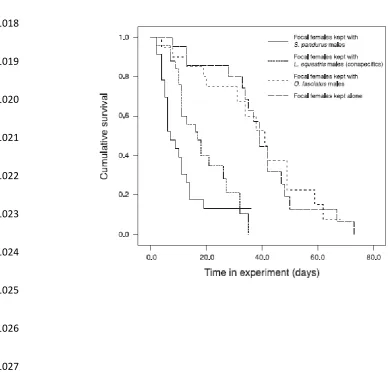
kept with conspecific males (Figure 4; Shuker et al 2015; Burdfield-Steel et al 283
2015). Related Heteroptera also provide some of the neatest examples of the 284
ecological consequences of RI by mating attempts. Mating harassment by male 285
Neacoryphus bicrucis displace five other species (beetles, bugs and a bushcricket)
286
from their Senecio smallii food-plants (McLain & Shure 1987), whilst female N. 287
bicrucis are in turn harrassed by a different bug (a coreid), Margus obscurator,
288
and themselves are displaced from food-plants (McLain & Pratt 1999). 289
290
A rather particular form of RI occurs in gynogenetic species. Gynogenesis (or 291
“pseudogamy”) is a form of parthenogenesis that requires sperm to trigger 292
embryonic development. Despite this dependence on sperm, embryos produced 293
in this manner contain only maternal chromosomes. Thus, gynogenetic species 294
are almost exclusively female and require matings with males of closely-related 295
species in order to reproduce. There are a few known examples in insects (in 296
14
easily missed without careful study. As the males that mate with these females 298
pass no genes to the offspring produced, gynogenetic species can be thought of 299
as “sexual parasites”. A similar form of sexual parasitism is hybridogenesis, as 300
found in the Bacillus rossius stick insects (Mantovani & Scali 1992). In 301
hybridogenesis, sperm from a closely-related sexual species is used to fertilise 302
eggs, but all the offspring develop as females, and when they produce their own 303
haploid gametes, they only use their mother’s chromosomes, so that the males 304
never produce grand-offspring (reviewed by Lehtonen et al. 2013; Normark 305
2014). Gynogenetic and hybridogenetic species are perhaps a special case 306
however as, typically, there are no mating interactions between truly 307
parthenogenetic species and so no reproductive interference (as defined above). 308
With the exception of gynogenetic species, parthenogenetic species will only 309
influence RI when they become a target for misdirected mating interactions (for 310
instance, if there are closely related sexual and asexual species, which is of 311
course the case in a variety of insects: Normark 2014). 312
313
Post-mating, pre-zygotic reproductive interference can also occur via inter-314
specific sperm competition. Data from a range of insects suggest that con-specific 315
sperm are favoured over heterospecific sperm (e.g. Howard et al 1998; Howard 316
1999; Simmons 2001), a phenomenon known as homogamy. For instance, Price 317
(1997) showed that three sibling species of Drosophila exhibited conspecific 318
sperm precedence, a phenomenon seemingly associated with seminal fluid 319
products. Nonetheless, heterospecific sperm can disrupt sperm uptake, storage 320
and usage. 321
15
In conclusion, reproductive interference takes a very wide range of forms in 323
insects. Moreover, multiple forms of RI can often occur simultaneously, for 324
instance, when both signal jamming and erroneous mate preferences result in 325
heterospecific mating attempts (Andrews et al., 1982). In the next section, we 326
will consider some of the causes and consequences of reproductive interference. 327
328
Causes and consequences of reproductive interference 329
What causes reproductive interference? The ecological factors influencing RI 330
have already been thoroughly reviewed, as have some of the ecological 331
consequences of RI, such as species coexistence, sexual exclusion, and ecological 332
character displacement (Kuno 1992; Gröning & Hochkirch 2008; recent 333
examples include Kyogoku, 2015; Noriyuki & Osawa 2016; Ruokolainen & 334
Hanski 2016). Given space constraints though, we will focus on the evolution of 335
mating systems, including the evolutionary causes and consequences of 336
polyandry, sexual selection, and sexual conflict on RI. However, ecological and 337
evolutionary processes will be intimately linked, and we do not wish to stress the 338
importance of one over the other. 339
340
In terms of causation, it is important to separate proximate and ultimate causes. 341
For instance, a failure to discriminate stimuli at the proximate level begs the 342
question as to why better discrimination has not evolved, or why a permissive 343
discrimination system, that allows failure under some circumstances, has 344
16
reproductive behaviour (for a discussion of how we use words in studies of 346
sexual behaviour, see for instance Dougherty et al. 2013). If we assume that 347
natural selection, first and foremost, favours con-specific reproductive 348
interactions (apart from sexual deception say), then perhaps we can tentatively 349
identify true “errors”. Here RI has no ultimate cause, and is involved either with 350
an underlying pathology of one or both of the actors (damaged sensory 351
structures for instance), or is truly a stochastic misplaced behaviour. On the 352
other hand, there may be “adaptive errors”, whereby some plasticity in 353
behaviour or permissiveness in response to signals is adaptive, even though RI 354
may sometimes result occur as a side effect. 355
356
Proximate causes of RI can be broken down into those that are based on a failure 357
of species recognition and those that occur independently of species recognition. 358
Gröning and Hochkirch (2008) defined reproductive interference as “any kind of 359
interspecific interaction during the process of mate acquisition that adversely 360
affects the fitness of at least one of the species involved and that is caused by 361
incomplete species recognition”. Presumably, many of the examples given in the 362
previous section do involve a failure of species recognition. However, this is not 363
always explicitly tested. Moreover, whilst a failure of species discrimination may 364
often be the observed outcome of RI, it need not necessarily be its cause. A clear 365
example of this comes from signal jamming. “Contaminating” signals from 366
hetero-specifics may mask variation among conspecific signals, making mate 367
choice difficult or effectively random (Pfennig, 2000). This may be costly, and it 368
17
discrimination decision here, as there may only be conspecific mating options, or 370
a garbled set of signals that are indecipherable. More generally, signal jamming 371
may reduce choosiness within a species, compromising mate choice in a way that 372
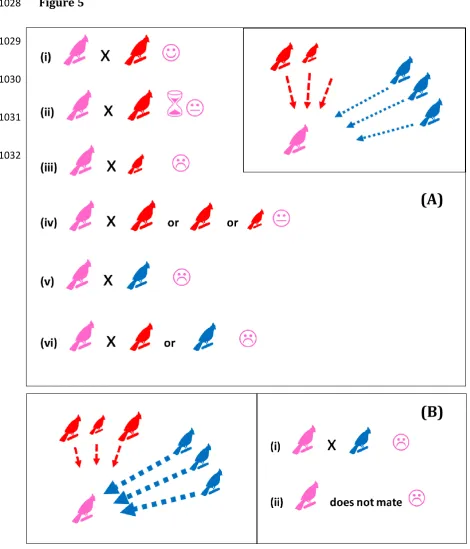
is costly to the chooser, without leading to a failure of species discrimination (we 373
extend this point in Figure 5). As such, while we can generally assume that 374
failures in species discrimination play some role in RI – and we certainly do not 375
wish to underplay its role – they may not be the driving force shaping the 376
behavioural outcomes, and we recommend a definition of RI that is not 377
predicated on a failure of species discrimination. 378
379
In terms of ultimate causes of RI, when might RI be a side effect of an adaptive 380
strategy? In a species that mates only once, such a mistake would be disastrous 381
and reduce the fitness of the affected individual to zero. Under such conditions, 382
we would expect very strong selection for species discrimination or reproductive 383
character displacement that reduced the likelihood of hetero-specific encounters. 384
The parasitoid wasps Nasonia vitripennis and N. giraulti overlap in Eastern North 385
America, and have been found parasitising blow-fly pupae hosts in the same bird 386
nests (Grillenberger et al. 2009). As with many parasitoids, the two species are 387
mostly monandrous, with females typically mating once before dispersing to find 388
new hosts (Boulton et al 2015). The two species are reproductively isolated by 389
endosymbiont-based incompatibilities, with the two species hosting different 390
and bi-directionally incompatible strains of the bacteria Wolbachia (Breeuwer & 391
Werren 1990; Bordenstein & Werren 1998). Whilst there are also mate 392
18
Crucially though, the two species have very different patterns of mating, with N. 394
vitripennis typically mating outside of the host puparium after adult eclosion,
395
whilst N. giraulti mates within the puparium; this difference in mating behaviour 396
is suggested to have evolved to limit inter-specifics mating (Drapeau & Werren 397
1999). More generally, we should expect species with a limited degree of 398
multiple mating to exhibit extremely low reproductive interference. In contrast, 399
in species that mate multiply, interspecific matings, while they may waste both 400
time and mating effort, are expected to extract a lesser cost in terms of lifetime 401
fitness, and these species may therefore be more tolerant to RI. We know of no 402
formal test of that prediction yet. 403
404
Turning to mating systems theory more explicitly, some of the classic ways to 405
view mating systems is through measures such as the operational sex ratio (OSR; 406
Emlen & Oring 1977; Thornhill & Alcock 1983) and the Bateman gradient 407
(Bateman, 1948; Kokko et al. 2014). Indeed, the operational sex ratio should 408
influence the extent of RI in multiple ways. For instance, high skew in OSR (with 409
one sex being rare for whatever reason) may make heterospecific interactions, 410
and hence RI, more likely, as the common sex searches for possible mates. If 411
mates are rare, then overly restrictive mate searching or mate choice thresholds 412
maybe costly due to the possibility of missing out on mating entirely. Thus mate 413
encounter rate should shape how permissive individuals are in terms of their 414
species discrimination, and to what extent the need to mate leaves reproductive 415
interference as a possible side-effect (for classic mate-searching and mate choice 416
19
been used to suggest that polyandry should be considered the null situation for 418
females, given the risks to females of going unmated: Kokko and Mappes 2013). 419
We suspect that many occurrences of RI will be explained this way. The OSR may 420
also influence the severity of the fitness costs, as it will influence an individual’s 421
chances of re-mating or not, or increase the intensity of courtship, or other forms 422
of RI. 423
424
The Bateman gradient may also shape the nature and extent of RI. If Bateman 425
gradients are steep (i.e. fitness increases sharply with increased numbers of 426
matings, being typically steeper for males than females: Janicke et al 2016), then 427
selection for less selective mating behaviour may lead to higher RI. However, 428
increased RI may then feed back into the system, as high RI may eventually 429
reduce the slope of the Bateman gradient (as selection favours individuals that 430
mate less, but more selectively). Therefore, reproductive interference may be 431
both a consequence of the mating system and also a cause of mating system 432
structure. As yet, a formal theoretical consideration of OSR and Bateman 433
gradients in the context of the ecological and evolutionary consequences of 434
reproductive interference is lacking, and experimental tests of these ideas would 435
be very welcome. 436
437
Turning to what other factors may influence RI we will first consider courtship. 438
Courtship plays a number of roles (Alexander et al. 1997). Not the least of which 439
20
in species discrimination (Ritchie et al., 1999). At first glance then, it seems likely 441
that courtship will reduce the chances of an individual mating with other species, 442
even if it may make them vulnerable to other forms of RI, such as misplaced 443
courtship or signal jamming. However, evidence that species with pre-copulatory 444
courtship are less susceptible to RI is not as abundant as might be expected 445
(Gray, 2005). Moreover, it remains an open question for those interested in the 446
interaction between sexual selection and speciation whether inter-specific mate 447
choice maps to intra-specific mate choice in terms of preferred signals and the 448
underlying genetics. 449
450
One factor identified as having close ties to both courtship and RI is sexual 451
conflict. Sexual conflict occurs when the evolutionary interests of the sexes differ 452
(Parker 1979; Lessells, 1999; Chapman et al., 2003; Arnqvist & Rowe 2005). 453
Despite much of the discussion about within- and among-population sexual 454
conflict taking place in the context of reproductive isolation and speciation (e.g. 455
Parker and Partridge, 1998, Gavrilets, 2000), much of the theory developed can 456
also be applied to RI. Here we will focus on conflict over mating frequency 457
(Parker, 1979). 458
459
Sexual conflict over mating usually involves males coercing females to mate at a 460
rate above (or in some cases below) the female optima (e.g. seaweed flies: 461
Shuker and Day, 2001, 2002; seedbugs: Shuker et al., 2006). Conflict over mating 462
21
Chapman et al., 1995, Wigby et al., 2009, Perry et al., 2013). The co-evolution of 464
male coercion and female resistance can result in males having greater mating 465
success with females from different populations, as these will lack the co-evolved 466
resistance present in females of their own population. Furthermore, if, as has 467
been suggested (Parker, 1979, Parker and Partridge, 1998), females are likely to 468
show robust species discrimination, processes that manipulate or circumvent 469
female choice may increase the likelihood of RI. It should be noted, however, that 470
these models assume that hybridisation is possible between the populations, and 471
so only include true reproductive interference at the limits of their parameter 472
space. McPeek and Gavrilets (2006), on the other hand, explored the role of 473
encounters with heterospecific males on female mate preferences when they are 474
post-reproductively isolated and not able to form hybrids. Whilst focusing on 475
speciation, they showed that the presence of heterospecifics increased selection 476
for mate preferences, which meant that in a population divergence context, 477
heterospecifics would increase the likelihood of speciation (and of course reduce 478
the extent of RI). 479
480
A rather different aspect of behaviour may influence the outcome of RI, namely 481
learning. Learning has the potential to reduce or increase the incidence of RI 482
depending on the circumstances in which it occurs. Learned mate preferences 483
have now been displayed in multiple species (e.g. in Drosophila: Dukas 2004, 484
Dukas et al 2006; in damselflies: Svensson et al., 2010, Verzijden & Svensson 485
2016; in psyllids: Stockton et al. 2017). While acquiring a mate preference based 486
22
where individuals may actually acquire preferences for the “wrong” mate, for 488
instance if the focal species is locally rare, or simply outnumbered by the 489
“interfering” species. However, an example from the butterfly Bicyclus anynana 490
provides a potential solution to this problem. In this species, males have varying 491
numbers of eye-spots on their wings, which are thought to play a role in mate-492
choice. A recent study found that naïve females have an innate preference for 493
males with two eyespots (the most common phenotype found in nature). When 494
exposed to males with increased ornamentation (i.e. four eyespots) shortly after 495
emergence, the females developed a preference for this phenotype, however they 496
did not show any change in preference if exposed to males with no eyespots. This 497
suggests that mate-preference learning is biased in this species. While the exact 498
cause of this bias is still under investigation, the presence of closely related 499
species in sympatry with B. anynana that possess fewer eyespots does raise the 500
possibility that this bias has arisen in order to prevent females from acquiring 501
preferences for hetero-specific males (Westerman et al., 2012). 502
503
To finish this section, given the range of possible factors influencing RI, it is clear 504
that predicting when RI will occur will not be a straightforward task. RI can 505
happen in many different ways, and indeed we can find examples of it from 506
almost every kind mating system and ecology (Gröning & Hochkirch 2008). The 507
species-specific nature of RI may also explain why the fitness costs it inflicts 508
often appear to be asymmetric (i.e. one species suffers more than another; 509
Gröning et al., 2007). There has been an attempt to generate and test predictions 510
23
hybridisation rather than RI per se (Ord et al 2011). The authors constructed 512
predictions associated with social context (including the cost of mate searching), 513
sex differences in discrimination, familiarity (e.g. sympatric versus para- or 514
allopatric species; again mate-search costs are important here), and the 515
reliability of species-specific cues. Testing these predictions in the context of 516
hybridisation using meta-analysis, Ord and colleagues (2011) failed to find 517
consistent effects of any of these factors on the response of individuals to hetero-518
specifics. Instead, they concluded that the benefits of species discrimination 519
appear to be highly species specific. Aspects of species biology that were 520
implicated included the spacing patterns of conspecifics, the intensity of sexual 521
selection, and predation pressure (Ord et al., 2011). Thus, if we extend this 522
finding from hybridisation to reproductive interference, current evidence 523
suggests that multiple aspects of species biology and ecology will influence not 524
just the likelihood of RI occurring, but also its consequences. Given then that RI is 525
often the outcome of several different factors working together, its causes may 526
be difficult to generalise. 527
528
Concluding remarks 529
There has been a renewed interest in reproductive interference in recent years 530
(e.g. Burdfield-Steel & Shuker 2011; Kyogoku 2015 and associated papers; Otte 531
et al. 2016; Yassin and David 2016). The ecological consequences of RI still 532
remain to the forefront – if we exclude work in relation to speciation – but 533
broader questions are being addressed too, and here we have focused on mating 534
24 536
First, as argued above, since RI can arise without a failure of species 537
discrimination as a proximate cause, we suggest a more inclusive definition of RI 538
that does not require this failure (see Figure 5). Second, there have been calls for 539
more studies of RI in the field (Gröning & Hochkirch 2008; Kyogoku 2015), not 540
least as field and laboratory studies may yield different results (Gröning et al 541
2007). Whilst we agree that field conditions may vary considerably from the 542
laboratory, in terms of population density, encounter rate, habitat complexity 543
and so forth, the laboratory still has much to offer in terms of facilitating 544
experimental studies of the causes and consequences of RI. These include both 545
manipulating ecological factors and allowing long-term experimental evolution 546
studies. We therefore suggest that both field and lab studies be combined, with 547
the aim not just to ascertain the occurrence of RI under field-realistic conditions, 548
but also to experimentally test hypotheses about why RI happens and how it 549
influences ecological and evolutionary dynamics. Moreover, given the lack of 550
generalities about reproductive interference at present, laboratory studies will 551
continue to provide important data for synthetic and hypothesis-testing meta-552
analyses, as we are unlikely to be able to collect field-data as quickly as we can 553
lab-data. 554
555
Our final point is that RI provides us with opportunities to generate new theory 556
and also to test existing theory. Here we consider mating systems and sexual 557
selection theory, but the same will no doubt be true in other sub-disciplines. 558
25
parameters remain to be formulated, even though existing models (such as those 560
of Parker & Partridge 1998) speak to some of the questions we might wish to 561
ask. Ideally, we would like to map out the landscape of RI in terms of aspects of 562
the mating system, such as operational sex ratio, encounter rate, mate searching, 563
costs and benefits of mating (including Bateman gradients), levels of polyandry, 564
and pre- and post-copulatory sexual selection. As some of the discussion above 565
has suggested, we are able to generate plausible verbal hypotheses that could 566
link Bateman gradients with both higher and lower RI. A more systematic body 567
of theory might help us unpick this tangled bank of effects, but more importantly 568
perhaps, it will also throw new light on our existing body of theory and stimulate 569
tests of that theory using heterospecifics, either as “controls” or to provide a 570
greater range of possibilities (e.g. extreme outbreeding: Burdfield-Steel et al 571
2015). This will put our theory really through its paces. Finally, mating systems 572
biology is only beginning to appreciate the value of network-based analyses (e.g. 573
Muniz et al 2015; Fisher et al 2016), but in the light of this symposium, modelling 574
and interpreting reproductive interference in terms of the socio-sexual network 575
of con- and heterospecifics may provide a useful tool to draw out and test 576
predictions about this puzzling yet beguiling behaviour [NOTE TO EDITORS: we 577
are happy to include references to other symposium papers if appropriate]. 578
579
Acknowledgments 580
We are grateful to Gordon Port, James Gilbert and Darren Evans for the invitation 581
to contribute to this symposium. We are grateful to Nina Wedell and Carl Smith 582
26
also helped shape our thinking about reproductive interference. We are also 584
grateful to two anonymous reviewers for their thoughts and encouragement. 585
Author contributions 586
DMS and ERB-S conceived of and wrote the manuscript. 587
Conflict of interest 588
DMS and ERB-S declare no conflicts of interest 589
27 References
591
Alexander, R.D., Marshall, D.C. and Cooley, J.R. (1997) Evolutionary perspectives 592
on insect mating. In Choe, J.C. and Crespi, B.J. (eds). The evolution of mating 593
systems in insects and arachnids, pp.4-31. Cambridge University Press,
594
Cambridge. 595
Andrews, R.H., Petney, T.N. and Bull, C.M. (1982) Reproductive Interference 596
between 3 parapatric species of Reptile Tick. Oecologia, 52: 281-286. 597
Arnqvist, G. and Rowe, L. (2005) Sexual conflict. Princeton University Press, 598
Princeton. 599
Bailey, N.W. and Zuk, M. (2009) Same-sex sexual behavior and evolution. Trends 600
in Ecology & Evolution, 24: 439-446.
601
Bateman, A. (1948) Intra-sexual selection in Drosophila. Heredity, 2: 349–368. 602
Bath, E., Tatarnic, N. and Bonduriansky, R. (2012) Asymmetric reproductive 603
isolation and interference in neriid flies: the roles of genital morphology and 604
behaviour. Animal Behaviour, 84: 1331-1339. 605
Begon, M., Townsend, C.R. and Harper, J.L. (2005) Ecology: From individuals to 606
ecosystems. Blackwell, Oxford.
607
Bonduriansky, R. (2001) The evolution of male mate choice in insects: a 608
synthesis of ideas and evidence. Biological Reviews, 76: 305-339. 609
Bordenstein, S.R. and Werren, J.H. (1998) Effects of A and B Wolbachia and host 610
genotype on interspecies cytoplasmic incompatibility in Nasonia. Genetics, 148: 611
28
Boulton, R.A., Collins, L.A. and Shuker, D.M. (2015) Beyond sex allocation: the 613
role of mating systems in sexual selection in parasitoid wasps. Biological Reviews, 614
90: 599-627. 615
Breeuwer, J.A. and Werren, J.H. (1990) Microorganisms associated with 616
chromosome destruction and reproductive isolation between two insect species. 617
Nature, 346: 558.
618
Burdfield-Steel, E. R., Auty, S. and Shuker, D. M. (2015) Do the benefits of 619
polyandry scale with outbreeding? Behavioral Ecology, 26: 1423-1431. 620
Burdfield-Steel, E. R. and Shuker, D. M. (2011) Reproductive interference. Current 621
Biology, 21: R450-R451.
622
Chapman, T., Arnqvist, G., Bangham, J. and Rowe, L. (2003) Sexual conflict. Trends 623
in Ecology & Evolution, 18: 41-47.
624
Chapman, T., Liddle, L. F., Kalb, J. M., Wolfner, M. F. and Partridge, L. (1995) Cost 625
of mating in Drosophila melanogaster females is mediated by male accessory 626
gland products. Nature, 373: 241-244. 627
Cothran, R. D., Stiff, A. R., Chapman, K., Wellborn, G. A. and Relyea, R. A. (2013) 628
Reproductive interference via interspecific pairing in an amphipod species 629
complex. Behavioral Ecology and Sociobiology, 67: 1357-1367. 630
Coyne, J. A. and Orr, H. A. (2004) Speciation. Sinauer Associates Sunderland, MA. 631
Davies, N.B. (1991) Mating systems. In Krebs, J.R. and Davies, N.B. (eds) 632
Behavioural ecology: an evolutionary approach, 3rd edition, pp.263-94. Blackwell, 633
29
Dayan, T. and Simberloff, D. (2005) Ecological and community-wide character 635
displacement: the next generation. Ecology Letters, 8: 875-894. 636
den Hollander, M. and Gwynne, D. T. (2009) Female fitness consequences of male 637
harassment and copulation in seed beetles, Callosobruchus maculatus. Animal 638
Behaviour, 78: 1061-1070.
639
Doherty, J. A. and Howard, D. J. (1996) Lack of preference for conspecific calling 640
songs in female crickets. Animal Behaviour, 51: 981-989. 641
Dougherty, L.R., Burdfield-Steel, E.R. & Shuker, D.M. (2013) Sexual stereotypes: 642
the case of sexual cannibalism. Animal Behaviour, 85: 313-322. 643
Dougherty, L.R. & Shuker, D.M. (2014) Pre-copulatory sexual selection in the 644
seed bug Lygaeus equestris: a comparison of choice and no-choice paradigms. 645
Animal Behaviour, 89: 207-214.
646
Dreisig, H. (1995) Thermoregulation and flight activity in territorial male 647
graylings, Hipparchia semele (Satyridae), and large skippers, Ochlodes venata 648
(Hesperiidae). Oecologia, 101: 169-176. 649
Dukas, R. (2004) Male fruit flies learn to avoid interspecific courtship. Behavioral 650
Ecology, 15: 695-698.
651
Dukas, R., Clark, C.W. and Abbott, K. (2006) Courtship strategies of male insects: 652
when is learning advantageous? Animal Behaviour, 72: 1395-1404. 653
Edward, D. A. and Chapman, T. (2011) The evolution and significance of male 654
30
Ellis, A.G. and S.D. Johnson (2010) Floral mimicry enhances pollen export: the 656
evolution of pollination by sexual deceit outside of the Orchidaceae. American 657
Naturalist, 176: E143-E151.
658
Emlen, S.T. and Oring, L.W. (1977) Ecology, sexual selection, and the evolution of 659
mating systems. Science, 197: 215-223. 660
Evans, G.M.V., Nowlan, T. & Shuker, D.M. (2015) Patterns of reproductive 661
isolation within- and between- species characterised by a sexual conflict over 662
mating. Biological Journal of the Linnaean Society, 116: 890–901. 663
Fea, M. P., Stanley, M. C. and Holwell, G. I. (2013) Fatal attraction: sexually 664
cannibalistic invaders attract naive native mantids. Biology Letters, 9(6). 665
Fisher, D.N., Rodríguez-Muñoz, R. and Tregenza, T. (2016) Comparing pre-and 666
post-copulatory mate competition using social network analysis in wild crickets. 667
Behavioral Ecology, 27: 912-919.
668
Fisher, H. S., Wong, B. B. M. and Rosenthal, G. G. (2006) Alteration of the chemical 669
environment disrupts communication in a freshwater fish. Proceedings of the 670
Royal Society B-Biological Sciences, 273: 1187-1193.
671
Fowler-Finn, K.D. and Rodríguez, R.L. (2012) Experience-mediated plasticity in 672
mate preferences: mating assurance in a variable environment. Evolution, 66: 673
459-468. 674
Gaskett, A.C. (2011) Orchid pollination by sexual deception: pollinator 675
31
Gaskett, A.C. (2012) Floral shape mimicry and variation in sexually deceptive 677
orchids with a shared pollinator. Biological Journal of the Linnaean Society, 106: 678
469-481. 679
Gavrilets, S. (2000) Rapid evolution of reproductive barriers driven by sexual 680
conflict. Nature, 403: 886-889. 681
Gray, D. A. (2005) Does courtship behavior contribute to species-level 682
reproductive isolation in field crickets? Behavioral Ecology, 16: 201-206. 683
Greenway, E.V., Dougherty, L.R. & Shuker, D.M. (2015) Mating failure. Current 684
Biology, 25: R534-R536.
685
Greenway, E.V. & Shuker, D.M. (2015) The repeatability of mating failure in a 686
polyandrous insect. Journal of Evolutionary Biology, 28: 1578-1582. 687
Grillenberger, B.K., Van De Zande, L., Bijlsma, R., Gadau, J. and Beukeboom, L.W. 688
(2009) Reproductive strategies under multiparasitism in natural populations of 689
the parasitoid wasp Nasonia (Hymenoptera). Journal of Evolutionary Biology, 22: 690
60-470. 691
Gröning, J. and Hochkirch, A. (2008) Reproductive interference between animal 692
species. Quarterly Review of Biology, 83: 257-282. 693
Gröning, J., Lucke, N., Finger, A. and Hochkirch, A. (2007) Reproductive 694
interference in two ground-hopper species: testing hypotheses of coexistence in 695
the field. Oikos, 116: 1449-1460. 696
Gwynne, D.T., and Morris, G.K. (1986). Heterospecific recognition and behavioral 697
32
Gwynne, D.T. and Rentz, D.C.F. (1983) Beetles on the bottle: male buprestids 699
mistake stubbies for females (Coleoptera). Austral Entomology, 22: 79-80. 700
Hamel, J. A., Nease, S. A. and Miller, C. W. (2015) Male mate choice and female 701
receptivity lead to reproductive interference. Behavioral Ecology and 702
Sociobiology, 69: 951-956.
703
Haynes, K. F., Gemeno, C., Yeargan, K. V., Millar, J. G. and Johnson, K. M. (2002) 704
Aggressive chemical mimicry of moth pheromones by a bolas spider: how does 705
this specialist predator attract more than one species of prey? Chemoecology, 12: 706
99-105. 707
Herberstein, M., Schneider, J. and Elgar, M. (2002) Costs of courtship and mating 708
in a sexually cannibalistic orb-web spider: female mating strategies and their 709
consequences for males. Behavioral Ecology and Sociobiology, 51: 440-446. 710
Hochkirch, A., Gröning, J. and Bucker, A. (2007) Sympatry with the devil: 711
reproductive interference could hamper species coexistence. Journal of Animal 712
Ecology, 76: 633-42.
713
Hochkirch, A., Bücker, A. and Gröning, J. (2008) Reproductive interference 714
between the common hopper Tetrix undulata and the slender ground-715
hopper Tetrix subulata (Orthoptera, Tetrigidae). Bulletin of Entomological 716
Research, 98: 605-612.
717
Howard, D.J., Gregory, P.G., Chu, J. and Cain, M.L. (1998) Conspecific sperm 718
precedence is an effective barrier to hybridization between closely related 719
33
Howard, D.J. (1999) Conspecific sperm and pollen precedence and speciation. 721
Annual Review of Ecology and Systematics, 30: 109-132.
722
Janicke, T., Häderer, I.K., Lajeunesse, M.J. and Anthes, N. (2016) Darwinian sex 723
roles confirmed across the animal kingdom. Science advances, 2: 1500983. 724
Jones, M.J., Lace, L.A., Harrison, E.C. and Stevens-Wood, B. (1998) Territorial 725
behavior in the speckled wood butterflies Pararge xiphia and P. aegeria of 726
Madeira: a mechanism for interspecific competition. Ecography, 21: 297-305. 727
Kokko, H., Klug, H. and Jennions, M.D (2014) Mating systems. In Shuker, D.M. and 728
Simmons, L.W. (eds) The evolution of insect mating systems, pp. 42-58. Oxford 729
University Press, Oxford. 730
Kokko, H. and Mappes, J. (2013) Multiple mating by females is a natural outcome 731
of a null model of mate encounters. Entomologia Experimentalis Et Applicata, 732
146: 26-37. 733
Kuno, E. (1992) Competitive exclusion through reproductive interference. 734
Researches on Population Ecology, 34: 275-284.
735
Kyogoku, D. (2015) Reproductive interference: ecological and evolutionary 736
consequences of interspecific promiscuity. Population Ecology, 57: 253-260. 737
Kyogoku, D. and Nishida, T. (2013) The mechanism of the fecundity reduction in 738
Callosobruchus maculatus caused by Callosobruchus chinensis males. Population
739
Ecology, 55: 87-93.
34
Kyogoku, D. and Sota, T. (2015) Exaggerated male genitalia intensify interspecific 741
reproductive interference by damaging heterospecific female genitalia. Journal of 742
Evolutionary Biology, 28: 1283-1289.
743
Landolt, P.J. and Heath, R.R. (1987) Role of female-produced sex pheromone in 744
behavioral reproductive isolation between Trichoplusia ni (Hübner) and 745
Pseudoplusia includens (Walker)(Lepidoptera: Noctuidae, Plusiinae). Journal of
746
Chemical Ecology, 13: 1005-1018.
747
Lehtonen, J., Schmidt, D.J., Heubel, K. and Kokko, H. (2013) Evolutionary and 748
ecological implications of sexual parasitism. Trends in Ecology & Evolution, 28: 749
297-306. 750
Lewis, S. (2016) Silent Sparks: The Wondrous World of Fireflies. Princeton 751
University Press, Princeton. 752
Lewis, E.E. and Cane, J.H., (1992) Inefficacy of courtship stridulation as a 753
premating ethological barrier for Ips bark beetles (Coleoptera: Scolytidae). 754
Annals of the Entomological Society of America, 85: 517-524.
755
Lloyd, J.E. (1997) Firefly mating ecology, selection and evolution. In Choe, J.C. and 756
Crespi, B.J. (eds) The evolution of mating systems in insects and arachnids, pp.184-757
192. Cambridge University Press, Cambridge. 758
Lessells, C.M. (1999) Sexual conflict in animals. In Keller, L. (ed) Levels of 759
Selection in Evolution, pp.73-99. Princeton University Press, Princeton.
35
Mantovani, B. and Scali, V. (1992) Hybridogenesis and androgenesis in the stick-761
insect Bacillus rossius-grandii benazzii (Insecta, Phasmatodea). Evolution, 46: 762
783-796. 763
McHugh R. (1972) Aspects of acoustic interaction in the bushcricket genus 764
Metrioptera (Orth., Tettigoniidae). Unpublished Ph.D., University of London.
765
McLain D. K., Pratt A. E. (1999) The cost of sexual coercion and heterospecific 766
sexual harassment on the fecundity of a host-specific, seed-eating insect 767
(Neacoryphus bicrucis). Behavioral Ecology and Sociobiology, 46: 164 –170. 768
McLain D. K., Shure D. J. (1987) Pseudocompetition: interspecific displacement of 769
insect species through misdirected courtship. Oikos 49:291–296. 770
McPeek, M.A. and Gavrilets, S. (2006) The evolution of female mating 771
preferences: differentiation from species with promiscuous males can promote 772
speciation. Evolution, 60: 1967-1980. 773
Mokkonen, M. and Lindstedt, C. (2016) The evolutionary ecology of deception. 774
Biological Reviews, 4: 1020-1035.
775
Morris, G.K., and Fullard, J.H. (1983).Random noise and congeneric 776
discrimination in Conocephalus (Orthoptera: Tettigoniidae). In D.T. Gwynne and 777
G.K. Morris (eds) Orthopteran Mating Systems: Sexual Competition in a Diverse 778
Group of Insects, pp. 73-96. Westview Press, Boulder, Colorado.
779
Muniz, D.G., Guimarães, P.R., Buzatto, B.A. and Machado, G. (2015) A sexual 780
network approach to sperm competition in a species with alternative mating 781
36
Nasci R. S., Hare S. G., Willis F. S. (1989) Interspecific mating between Louisiana 783
strains of Aedes albopictus and Aedes aegypti in the field and laboratory. Journal 784
of the American Mosquito Control Association, 5(3):416–421.
785
Normark, B.B., 2014. Modes of reproduction. In Shuker, D.M. and Simmons, L.W. 786
(eds) The evolution of insect mating systems, pp. 1-19. Oxford University Press, 787
Oxford. 788
Noriyuki, S. and Osawa, N. (2016) Reproductive Interference and Niche 789
Partitioning in Aphidophagous Insects. Psyche: A Journal of Entomology, 2016: 790
4751280. 791
792
Ord, T. J., King, L. and Young, A. R. (2011) Contrasting theory with the empirical 793
data of species recognition. Evolution, 65: 2572-91. 794
Ord, T. J. and Stamps, J. A. (2009) Species identity cues in animal communication. 795
American Naturalist, 174: 585-93.
796
Otte, T., Hilker, M. and Geiselhardt, S. (2016) Phenotypic plasticity of mate 797
recognition systems prevents sexual interference between two sympatric leaf 798
beetle species. Evolution, 70: 1819–1828. 799
Parker, G. A. (1979) Sexual selection and sexual conflict. In Blum, M.S. & Blum, 800
B.N. (eds.) Sexual selection and reproductive competition in insects, pp. 123-166. 801
37
Parker, G. A. and Partridge, L. (1998) Sexual conflict and speciation. Philosophical 803
Transactions of the Royal Society of London. Series B: Biological Sciences, 353:
804
261-274. 805
Peiman, K. S. and Robinson, B. W. (2010) Ecology and evolution of resource-806
related heterospecific aggression. Quarterly Review of Biology, 85: 133-58. 807
Perry, J. C., Sirot, L. and Wigby, S. (2013) The seminal symphony: how to 808
compose an ejaculate. Trends in Ecology & Evolution, 28: 414-422. 809
Pfennig, K. S. (2000) Female spadefoot toads compromise on mate quality to 810
ensure conspecific matings. Behavioral Ecology, 11: 220-227. 811
Pfennig, K. S. and Simovich, M. A. (2002) Differential selection to avoid 812
hybridization in two toad species. Evolution, 56: 1840-8. 813
Price, C.S. (1997) Conspecific sperm precedence in Drosophila. Nature, 388: 663-814
666. 815
Rantala, M. J. and Kortet, R. (2003) Courtship song and immune function in the 816
field cricket Gryllus bimaculatus. Biological Journal of the Linnean Society, 79: 817
503-510. 818
Ravenscroft, N. O. M. (1994) Environmental influences on mate location in male 819
chequered skipper butterflies, Carterocephalus palaemon (Lepidoptera: 820
Hesperiidae). Animal Behaviour 47:1179 –1187. 821
Rhainds, M. (2010) Female mating failures in insects. Entomologia Experimentalis 822
et Applicata, 136: 211–226.
38
Rhymer, J. M. and Simberloff, D. (1996) Extinction by Hybridization and 824
Introgression. Annual Review of Ecology and Systematics, 27: 83-109. 825
Ribeiro, J. M. C. and Spielman, A. (1986) The satyr effect: a model predicting 826
parapatry and species extinction. American Naturalist 128:513–528. 827
Ritchie, M. G., Halsey, E. J. and Gleason, J. M. (1999) Drosophila song as a species-828
specific mating signal and the behavioural importance of Kyriacou & Hall cycles 829
in D. melanogaster song. Animal Behaviour, 58: 649-657. 830
Rogers, D. W. and Greig, D. (2009) Experimental evolution of a sexually selected 831
display in yeast. Proceedings of the Royal Society B: Biological Sciences, 276: 543-832
549. 833
Rosenthal, G. G. (2013) Individual mating decisions and hybridization. Journal of 834
Evolutionary Biology, 26: 252-255.
835
Rönn, J., Katvala, M. and Arnqvist, G. (2007) Coevolution between harmful male 836
genitalia and female resistance in seed beetles. Proceedings of the National 837
Academy of Sciences, 104: 10921-10925.
838
Ruokolainen, L. and Hanski, I. (2016) Stable coexistence of ecologically identical 839
species: conspecific aggregation via reproductive interference. Journal of Animal 840
Ecology 85: 638-47.
841
Ryckman, R. E. and Ueshima, N. (1964) Biosystematics of the Hesperocimex 842
complex (Hemiptera: Cimicidae) and avian hosts (Piciformes: Picidae; 843
Passeriformes: Hirundinidae). Annals of the Entomological Society of America 57: 844
39
Schultz, J. K. and Switzer P. V. (2001) Pursuit of heterospecific targets by 846
territorial amberwing dragonflies (Perithemis tenera Say): a case of mistaken 847
identity. Journal of Insect Behavior 14:607– 620. 848
Severinghaus, L. L., Kurtak, B.H. and Eickwort G. C. (1981) The reproductive 849
behavior of Anthidium manicatum (Hymenoptera: Megachilidae) and the 850
significance of size for territorial males. Behavioral Ecology and Sociobiology, 9: 851
51–58. 852
Shapiro, L.H. (1999). Reproductive costs to heterospecific mating between two 853
hybridizing katydids (Orthoptera: Tettigoniidae). Annals of the Entomological 854
Society of America, 93: 440-446.
855
Shuker, D. M., Ballantyne, G. A. and Wedell, N. (2006) Variation in the cost to 856
females of the sexual conflict over mating in the seed bug, Lygaeus equestris. 857
Animal Behaviour, 72: 313-321.
858
Shuker, D. M., Currie, N., Hoole, T. and Burdfield-Steel, E. R. (2015) The extent 859
and costs of reproductive interference among four species of true bug. 860
Population Ecology, 57: 321-331.
861
Shuker, D. M. and Day, T. H. (2001) The repeatability of a sexual conflict over 862
mating. Animal Behaviour, 61:755-762. 863
Shuker, D. M. and Day, T. H. (2002) Mate sampling and the sexual conflict over 864
40
Sillen-Tullberg, B., Gamberale-Stille, G. and Solbreck, C. (2000) Effects of food 866
plant and group size on predator defence: differences between two co-occurring 867
aposematic Lygaeinae bugs. Ecological Entomology, 25: 220-225. 868
Simmons, L. W. (2001) Sperm competition and its evolutionary consequences in 869
the insects. Princeton University Press, Princeton.
870
Singer, F. (1990). Reproductive costs arising from incomplete habitat segregation 871
among three species of Leucorrhinia dragonflies. Behaviour 115: 188 –201. 872
Stadelbacher, E. A., Barry, M. W., Raina, A. K. and Plimmer, J. R. (1983) Fatal 873
interspecific mating of two Heliothis species induced by synthetic sex 874
pheromone. Cellular and Molecular Life Sciences 39(10): 1174–1176. 875
Stockton, D.G., Martini, X. and Stelinski, L.L. (2017) Male Psyllids Differentially 876
Learn in the Context of Copulation. Insects, 8: 16. 877
Stowe, M. K., Tumlinson, J. H. and Heath, R. R. (1987) Chemical Mimicry - Bolas 878
spiders emit components of moth prey species sex-pheromones. Science, 236: 879
964-967. 880
Svensson, E. I., Eroukhmanoff, F., Karlsson, K., Runemark, A. and Brodin, A. 881
(2010) A role for learning in population divergence of mate preferences. 882
Evolution, 64: 3101-3113.
883
Tadler, A., Nemeschkal, H.L. and Pass, G. (1999) Selection of male traits during 884
and after copulation in the seedbug Lygaeus simulans (Heteroptera, Lygaeidae). 885
Biological journal of the Linnean Society, 68: 471-483.
41
Thornhill, R. and Alcock, J. (1983) The evolution of insect mating systems. Harvard 887
University Press, Cambridge. 888
Tobias, J. A. and Seddon, N. (2009) Signal Jamming Mediates Sexual Conflict in a 889
Duetting Bird. Current Biology, 19: 577-582. 890
Tregenza, T. and Wedell, N. (1998) Benefits of multiple mates in the cricket 891
Gryllus bimaculatus. Evolution, 52: 1726-1730.
892
Tregenza, T. and Wedell, N. (2002) Polyandrous females avoid costs of 893
inbreeding. Nature, 415: 71-3. 894
Tynkkynen, K., Rantala, M. J. and Suhonen, J. (2004) Interspecific aggression and 895
character displacement in the damselfly Calopteryx splendens. Journal of 896
Evolutionary Biology, 17: 759-767.
897
Verzijden, M.N. and Svensson, E.I. (2016) Interspecific interactions and learning 898
variability jointly drive geographic differences in mate preferences. Evolution, 899
70: 1896-1903. 900
Vick, K.W. (1973) Effects of interspecific matings on Trogoderma glabrum and T. 901
inclusum on oviposition and remating. Annals of the Entomological Society of
902
America, 66: 237–239.
903
Walpole, D.E. (1988) Cross-mating studies between two species of bedbugs 904
(Hemiptera: Cimicidae) with a description of a marker on inter-specific mating. 905
South African Journal of Science, 84: 215-216.
42
Westerman, E. L., Hodgins-Davis, A., Dinwiddie, A. and Monteiro, A. (2012) 907
Biased learning affects mate choice in a butterfly. Proceedings of the National 908
Academy of Sciences, 109: 10948-10953.
909
Wigby, S., Sirot, L. K., Linklater, J. R., Buehner, N., Calboli, F. C. F., Bretman, A., 910
Wolfner, M. F. and Chapman, T. (2009) Seminal Fluid Protein Allocation and Male 911
Reproductive Success. Current Biology, 19: 751-757. 912
Wirtz, P. (1999) Mother species–father species: unidirectional hybridization in 913
animals with female choice. Animal Behaviour, 58: 1-12. 914
Zhang, QH. & Aldrich, J.R. (2003) Pheromones of milkweed bugs (Heteroptera: 915
Lygaeidae) attract wayward plant bugs: Phytocoris Mirid sex pheromone. Journal 916
of Chemical Ecology, 29: 1835-1851.
917
918