doi:10.4236/ijcns.2011.44028 Published Online April 2011 (http://www.SciRP.org/journal/ijcns)
Empirical Modeling and Simulation of Temporal Based
Adaptive Mobility Model for MANET
Gurusamy Prema1,3, Chandrabose Aravindan2, Kirthivasan Kannan1, Rathinam Maheswaran3 1
SASTRA University, Thanjavur, India
2
SSN College of Engineering, Chennai, India
3
Mepco Schlenk Engineering College, Sivakasi, India
E-mail: {gprema, rmahes}@mepcoeng.ac.in, [email protected], [email protected] Received December 14, 2010; revised February 20, 2011; accepted February 28, 2011
Abstract
Mobile Ad Hoc network (MANET) is a collection of wireless mobile nodes forming a temporary network without the aid of any established infrastructure. To conduct meaningful performance analysis of MANETs, it is essential that the simulation of mobility model should reflect the realistic mobility pattern of mobile nodes i.e. placement of mobile nodes at different intervals of time. The formation of spontaneous network depends heavily on the movement of different nodes in a particular practical scenario. This research focuses on the modeling and simulation of a temporal Adaptive Mobility Model which can be adapted to any dy-namic practical scenario. The mobility in the realistic environment is simulated based on a Probability Tran-sition Matrix named as Personal Behavior Model (PBM) and validated for a practical Health Care Environ-ment. The formation of MANET is assumed to be based on the movement of the patient i.e. mobile nodes in the health care environment. Patients waiting in front of each service point for different time intervals are taken as results and compared with the actual data.
Keywords:MANET, Mobility Model, Probability Transition Matrix, System Dynamics
1. Introduction
A Mobile Ad Hoc Network (MANET) is a spontaneous, self-organizing network of mobile computing devices, having no fixed infrastructure or administrative support, where each mobile node also acts as a router of network packets. The primary function of the MANET is to fa-cilitate communication between its constituent nodes. So, each node on the network may be either sender or re-ceiver of packets, and all nodes works as router as dis-cussed in [1]. MANET’s performance is validated by simulation with the help of mobility models that describe and dictate the mobility pattern of the mobile nodes that take part in forming MANET. Mobility model mimic the movement of mobile nodes in MANET simulation and is a representation of a certain real or abstract world that contains moving entities. The mobility model describes the movement pattern of mobile user and how their loca-tion, change over time. The movement pattern of mobile nodes plays an important role in the performance analy-sis of wireless networks [2,3]. The mobility of the nodes
affects the number of average connected paths, which in turn affect the performance of the routing algorithm [4]. In [5], S.Ray discussed some of the mobility models are realistic and they reflect as close as possible those real world scenarios.
stead of randomly choosing the destination. An adaptive mobility model is developed in this work can be used to simulate various practical environments [10,11]. The dynamic MANET formulation in any environment [12] with its realistic movement of nodes at different time intervals can also be simulated by using the developed adaptive model.
The developed model is validated for a Health Care Environment having five Service Points/ Attraction Points and working from 9 am to 10 pm with a maximum average of 106 patients per day by conducting a survey and observing the patients movement [13,14].
The paper is organized as follows: Development of Temporal Adaptive Mobility Model is discussed in Sec-tion 2 and Health care environment for which the model is developed is described in Section 3. Numerical exam-ple showing the simulation setup is given in Section 4. Simulation results are explained in Section 5. Finally Conclusion is given in Section 6.
2. Development of Temporal Adaptive
Mobility Model
The proposed Temporal Adaptive Mobility Model is de-veloped based on the following assumptions:
1) Nodes which are entering into the environment are assumed to carry a mobile device capable of form- ing MANET [9].
2) Each node has its own RF transmission range of coverage as per IEEE 802.11b standards [15]. 3) A node may visit an attraction point only once to
complete all the services performed at that attraction point.
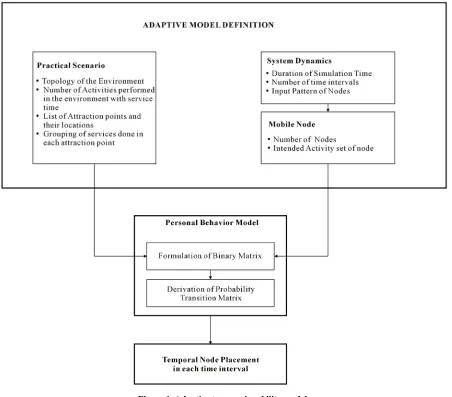
[image:2.595.74.526.318.715.2]When a mobile node enters into the region where other nodes transmission range overlaps with its own trans- mission range, the connectivity is established between the nodes and the MANET structure is formed [16]. The block diagram of the proposed temporal adaptive mobility model is given as shown in Figure 1.
The temporal adaptive mobility model is defined by the various inputs viz. 1) System dynamics based inputs, 2) Practical scenario based inputs and 3) Mobile node based inputs and they are used to formulate a Personal Behav-ior Model (PBM) which is a probability transition matrix and temporal node placement in different time interval to form spontaneous dynamic MANET within the envi-ronment.
2.1. Temporal Adaptive Model Definition
The temporal adaptive model suitable for any practical environment is defined by the following three inputs.
1) System dynamics based inputs. 2) Practical scenario based inputs. 3) Mobile node based inputs. 2.1.1. System Dynamics Based Input
The system dynamics of the adaptive mobility model is governed by two dynamic inputs namely 1) Duration of Simulation which is the time for which the environment is simulated and 2) Number of time intervals. The input pattern of nodes may follow a Probability Distribution Function over the simulation time. The total simulation period is the total period of observation in which the en-vironment is simulated and duration of time interval can be calculated according to the number of time interval. At the start of each time interval the personal behavior model is updated.
2.1.2. Practical Scenario Based Inputs
The practical scenario based inputs [17] are environment specific inputs that specify the simulation environment according to the practical scenario. This consists of to-pology of the scenario which indicates the dimensions of the environment; various activities performed in the en-vironment are listed out with their service time and given as total number of activities. Services are grouped and performed in particular service points. Various service points are listed out and given as inputs to the model with their locations.
2.1.3. Mobile Node Based Inputs
Any entity needing services from the practical scenario can be taken as nodes. These entities will enter into the practical scenario with an intended set of activities named as activity set and fulfilling their activities by the ser-vices performed at different service points and leave the system. So, any entity entering into the system has to move within the dimensions of environment and create individual mobility pattern within the environment dur-ing the simulation time. These will be given as mobile node based inputs. It is assumed that each entity is
hav-ing a mobile device to formulate MANET at different time instances.
2.2. Personal Behavior Model (PBM)
Personal behavior model represents the intended real movement pattern of individual nodes in the environment based on the activities to be performed in the different attraction points. PBM is formulated by means of a bi-nary matrix formed based upon the practical scenario and node based inputs at a particular time interval.
2.2.1. Formulation of Binary Matrix
Binary matrix is represented as a M × N matrix where M is the number of nodes entering at a particular time interval and N is the number of activities performed in the environment as shown in Table 1.
The Binary matrix is formulated as follows: Elements Cij in the matrix represent whether ith Node performs jth
activity or not. Cij is assigned as ‘one’; if the ith node
performs jthactivity. Else Cij is assigned as ‘zero’; i.e.,
the ith node does not perform jth activity.
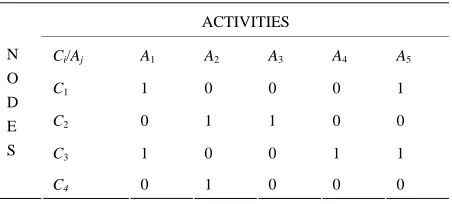
For example, four nodes, C1, C2, C3 and C4 are
enter-ing into the environment with four different activity sets AS1, AS2, AS3 and AS4respectively at a particular time
interval. C1 is entering with an activity set consists of
activities A1& A5; C2 is entering with an activity set
con-sists of activities A2 & A3; C3 is entering with an activity
set consists of activities A1, A4 & A5 and C4 is entering
with an activity set consists of activity A2. The
corre-sponding entries in binary matrix are shown in the Table 2. The binary matrix given in Table 2 will be the input for the derivation of PBM.
2.2.2. Derivation of Personal Behavior Model
[image:3.595.312.538.622.724.2]Personal behavior model is a Probability Transition Matrix,
Table 1. Binary matrix.
ACTIVITIES
Ci/Aj A1 A2 A3 A4 A5 … AN N
O D E
S C1 Cij
Table 2. Formulation of binary matrix.
ACTIVITIES
Ci/Aj A1 A2 A3 A4 A5
C1 1 0 0 0 1
C2 0 1 1 0 0
C3 1 0 0 1 1
N O D E S
which indicates the probable movement of the nodes to fulfill the intended activities towards various service points in the environment. The matrix is having dynamic rows based upon the nodes available in the system other than waiting in front of the attraction points and number of attraction points as columns and updated at the start-ing of each time interval. This behavior model is used to denote the Probability of the nodes moving towards each attraction point. The Personal behavior model is derived as follows: Let Ti be the total number of activities in the
intended activity set of the ith node and Tik be the number
of activities serviced in kth attraction point for ith node. Probability P(Ci, APk) represents the probability of ith
node in the system intended to move to the kth attraction point and given by the Equation (1).
,
iki k
i
T P C AP
T
(1)
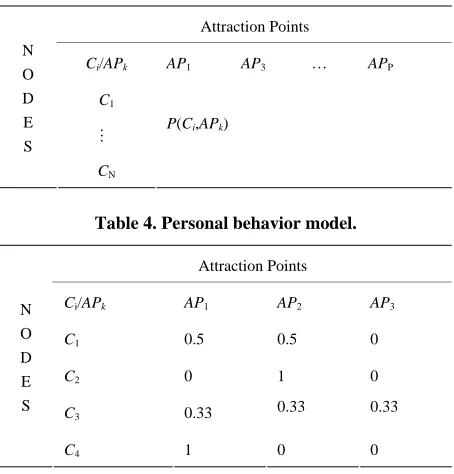
For a particular time interval, having the binary matrix as shown in Table 2, the PBM is derived as shown in Table 3.
Consider a practical environment, where there are three attraction points located and activities A1 and A2 are
performed in AP1, activities A3 and A5 are performed in
AP2 and activity A4 is performed in AP3. For the binary
matrix shown in Table 3, the entries in the PBM are as shown in Table 4.
After completion of all the activities, a node will move to next attraction point if it is having activity to do and after completing all the intended activities a node will leave the system.
Table 3. Formulation of personal behavior model.
Attraction Points
Ci/APk AP1 AP3 … APP
C1
…
N O D E S
CN
[image:4.595.59.286.486.723.2]P(Ci,APk)
Table 4. Personal behavior model.
Attraction Points
Ci/APk AP1 AP2 AP3
C1 0.5 0.5 0
C2 0 1 0
C3 0.33 0.33 0.33
N O D E S
C4 1 0 0
2.3. Temporal Node Placement
For a given simulation time, different nodes are entering into the system and move according to their intended activity set. For any discrete time interval of the simula-tion, the nodes will be distributed over the entire dimen-sions of the environment. This distribution is purely based upon purpose of entering the system and leaving the system after the services are completed. So, the con-nectivity of the nodes will be spontaneous and it will form a self organizing network i.e. MANET. So, the node placement during the entire simulation time is taken as the mobility pattern of the system to formulate the MANET structure.
3. Health Care Environment
The Temporal adaptive mobility model developed is tes- ted for a practical health care environment, where 31 different activities are performed at 5 different service points namely, Doctor’s Room, Injection/Dressing Room, Pharmacy, Laboratory and Physiotherapy centre and is working from 9 a.m to 10 p.m. After making a pilot sur-vey for a period of one month, it is observed that a maximum average of 106 patients is entering into the system to avail different services.
[image:4.595.319.528.546.695.2]Health care environment is defined by having the sys-tem dynamic based inputs, the total simulation period 780 minutes is divided into 26 numbers of equal intervals, each of 30 minutes duration. First interval is from 9.00 am to 9.30 am, second interval is from 9.30 am to 10.00 am, etc. up to 26th interval is from 9.30 pm to 10 pm. It is assumed that Personal Behavior Matrix is updated at the start of each time interval. For the first time interval it is updated at 9.00 am, second time at 9.30 am etc. The Ar-rival pattern of the nodes into the system may follow a probability distribution and observed during the different time intervals is plotted as shown in Figure 2.
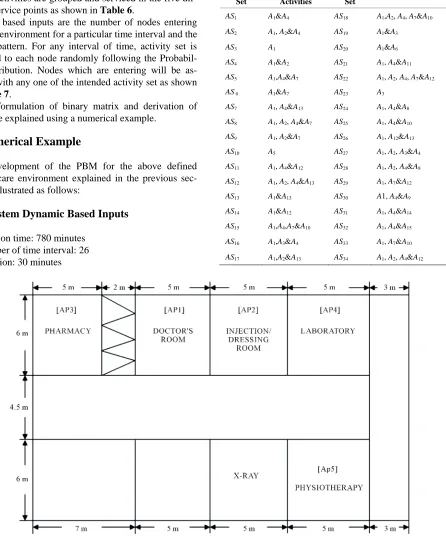
4.2. Practical Scenario Based Inputs Practical scenario based inputs showing area of the
environment having the dimension 25 m (Length) and 16.5 m (width) and locations of service points are given in Figure 3.
Area of the environment: 25 m* 16.5 m Number of Activities performed: 15 15 different significant activities are selected by
[image:5.595.90.538.160.710.2]neglect-ing the rarely occurrneglect-ing activities performed in the envi-ronment with their service time are listed in Table 5.
Table 5. The list of activities and their service time.
Activity Set
List of Activities
Activity
Set List of activities
AS1 A1&A4 AS18 A1,A2, A4, A7&A10
AS2 A1, A2&A4 AS19 A1&A3
AS3 A1 AS20 A1&A6
AS4 A1&A2 AS21 A1, A4&A11
AS5 A1,A4&A7 AS22 A1, A2, A4, A7&A12
AS 6 A1&A7 AS23 A3
AS7 A1, A4&A13 AS24 A1, A4&A8
AS8 A1, A2, A4&A7 AS25 A1, A4&A10
AS9 A1, A2&A7 AS26 A1, A12&A13
AS10 A5 AS27 A1, A2, A3&A4
AS11 A1, A4&A12 AS28 A1, A2, A4&A8
AS12 A1, A2, A4&A13 AS29 A1, A7&A12
AS13 A1&A13 AS30 A1, A4&A9
AS14 A1&A12 AS31 A1, A4&A14
AS15 A1,A4,A7&A10 AS32 A1, A4&A15
AS16 A1,A3&A4 AS33 A1, A7&A10
AS17 A1,A2&A13 AS34 A1, A2, A4&A12
The activities are grouped and serviced in the five dif-ferent service points as shown in Table 6.
Node based inputs are the number of nodes entering into the environment for a particular time interval and the arrival pattern. For any interval of time, activity set is assigned to each node randomly following the Probabil-ity Distribution. Nodes which are entering will be as-signed with any one of the intended activity set as shown in Table 7.
The formulation of binary matrix and derivation of PBM are explained using a numerical example.
4. Numerical Example
The development of the PBM for the above defined Health care environment explained in the previous sec-tion is illustrated as follows:
4.1. System Dynamic Based Inputs
Simulation time: 780 minutes Number of time interval: 26 Duration: 30 minutes
[image:5.595.90.536.171.708.2]Table 6. Attraction point and activities performed in them.
Attraction
Point Name Activities
AP1 Doctor’s Room A1
AP2
Injection/Dressing
Room A2 & A3
AP3 Pharmacy A4 & A5
AP4 Laboratory
A6, A7, A8, A9, A10, A11, A12 & A13
AP5
Physiotherapy
centre A14 & A15
Table 7. Activity set.
Activity Set
List of Activities
Activity
Set List of Activities
AS1 A1&A4 AS18 A1, A2, A4, A7&A10
AS2 A1, A2&A4 AS19 A1&A3
AS3 A1 AS20 A1&A6
AS4 A1&A2 AS21 A1, A4&A11
AS5 A1, A4&A7 AS22 A1, A2, A4, A7&A12
AS6 A1&A7 AS23 A3
AS7 A1, A4&A13 AS24 A1, A4&A8
AS8 A1, A2, A4&A7 AS25 A1, A4&A10
AS9 A1, A2&A7 AS26 A1, A12&A13
AS10 A5 AS27 A1, A2, A3&A4
AS11 A1, A4&A12 AS28 A1, A2, A4&A8
AS12 A1, A2, A4&A13 AS29 A1, A7&A12
AS13 A1&A13 AS30 A1, A4&A9
AS14 A1&A12 AS31 A1, A4&A14
AS15 A1, A4, A7&A10 AS32 A1, A4&A15
AS16 A1, A3&A4 AS33 A1, A7&A10
AS17 A1, A2&A13 AS34 A1, A2, A4&A12
Number of Attraction points: 5
No. of Activities performed in AP1: 1
No. of Activities performed in AP2: 2
No. of Activities performed in AP3: 2
No. of Activities performed in AP4: 8
No. of Activities performed in AP5: 2 4.3. Node Based Inputs at the First Time
Interval t1 From 9.00 Am to 9.30 Am
The number of nodes entering in first time interval from 9.00 am to 9.30 am is one and the intended activity set assigned to this node among 34 activity set is AS1, which
consists of two activities A1 and A4. Binary matrix
for-mulated at the start of first time interval is as shown in Table 8.
The node has to visit two attraction points namely, AP1 to fulfill the activity A1 and AP3 to fulfill the activity
A4. The probability of visit to different attraction points
are calculated by using equation (1). Therefore, P(C1,AP1)
= 0.5, P(C1, AP2) = 0, P(C1, AP3) = 0.5, P(C1, AP4) = 0
and P(C1, AP5) = 0. Personal behavior matrix derived for
the first time interval is given in Table 9.
This PBM will be updated according to the entry of nodes in time interval 2, time interval 3 etc. For a middle interval, i.e. at the start of seventh time interval t7, from
12 pm to 12.30 pm, the number of nodes arrived during this interval are 7 (from C35 to C41). Up to the 6th interval,
34 nodes entered into the environment. 8 Nodes fulfilled the services and left the system and at the start of 6th in-terval, 26 nodes are present in the system at the start of the interval. At the end of 6th interval, one node left the system. The corresponding Binary matrix formulated at the start of seventh time interval is shown in Table 10.
Personal behavior matrix derived for this time interval is given in Table 11.
Table 8. Binary matrix formulated at first time interval.
Ci/Aj A1 A2 A3 A4 A5 A6 A7 A8 A9 A10 A11 A12 A13 A14 A15
C1 1 0 0 1 0 0 0 0 0 0 0 0 0 0 0
Table 9. Personal behavior matrix derived atfirst time in-terval.
Ci/APk AP1 AP2 AP3 AP4 AP5
C1 0.5 0 0.5 0 0
Table 10. Binary matrix formulated at seventh time interval.
Ci/Aj A1 A2 A3 A4 A5 A6 A7 A8 A9 A10 A11 A12 A13 A14 A15
C35 1 0 0 0 0 0 0 0 0 0 0 0 0 0 0
C36 1 1 0 1 0 0 0 0 0 0 0 0 0 0 0
C37 1 0 0 1 0 0 0 0 0 0 0 0 0 0 0
C38 1 0 0 1 0 0 0 0 0 0 0 0 0 0 0
C39 1 0 0 1 0 0 0 0 0 0 0 0 0 0 0
C40 1 0 0 1 0 0 0 0 0 0 0 0 0 0 0
C41 1 0 0 1 0 0 0 0 0 0 0 0 0 0 0
Table 11. Personal behavior matrix at time interval t7.
Ci/APk AP1 AP2 AP3 AP4 AP5
C35 1 0 0 0 0
C36 0.333 0.333 0.333 0 0
C37 0.5 0 0.5 0 0
C38 0.5 0 0.5 0 0
C39 0.5 0 0.5 0 0
C40 0.5 0 0.5 0 0
For each time interval, if there is any entity waiting for service at attraction points, node has to join in the queue for their service. This placement of different nodes in the environment will create a dynamic MANET topology and connectivity among the nodes for the entire simula-tion period.
5. Simulation Results
The temporal adaptive model is defined and simulated with VC++ in a Pentium IV computer with 1 GB RAM
working in Windows XP Professional O.S platform ver-sion 2. The arrival of nodes into the health care environ-ment, their movement patterns i.e. the placement of nodes at different time interval is simulated. The results of simulation viz. mobile nodes placement in different attraction points for each time interval, number of nodes arrived, total number of nodes present in the system at the start of the interval, number of nodes which are waiting in front of APs at the start of the interval and the number of nodes left the system at the end of the interval are tabulated and shown in Table 12.
Table 12. Mobile nodes details in front of all APs in each time interval.
No. of nodes in APs at the start of the interval
Time Interval No. of nodes
arrived
Total no. of nodes in the
system AP1 AP2 AP3 AP4 AP5
No. of nodes left the system at the end of
the interval
1 1 1 1 - - - - 1
2 4 4 2 - 2 - - 1
3 6 9 3 2 4 - - 2
4 7 14 5 3 6 - - 1
5 8 21 8 4 9 - - 3
6 8 26 10 5 11 - - 1
7 7 32 11 6 15 - - 3
8 7 36 13 5 17 1 - 3
9 7 40 14 7 19 - - 4
10 6 42 15 7 20 - - 1
11 5 46 15 8 23 - - 1
12 3 48 15 6 27 - - 3
13 1 46 10 6 30 - - 4
14 0 42 5 4 33 - - 2
15 0 40 - 5 35 - - 2
16 0 38 1 3 34 - - 2
17 0 36 - 3 33 - - 2
18 2 36 2 1 33 - - 2
19 5 39 4 1 34 - - 2
20 7 44 5 2 36 1 - 3
21 7 48 8 1 39 - - 3
22 6 51 11 2 38 - - 2
23 5 54 9 2 43 - - 3
24 4 55 9 1 45 - - 3
25 1 53 4 3 46 - - 3
26 1 51 1 1 49 - - 2
It is observed from the results that more number of mobile nodes is waiting for service at AP1 & AP2 than
AP3, AP4 & AP5 since in most of the activity sets,
activi-ties to be done at AP3, AP4 & AP5 are rarely occurring
when compared to other activities done in this particular simulated Health care environment. Therefore, nodes get services in these attraction points without waiting in the queue. It is also observed that size of the queue in front of AP1, i.e. at Doctor’s Room is having a peak from 12
pm to 3 pm and around 7 pm. Number of nodes in AP3,
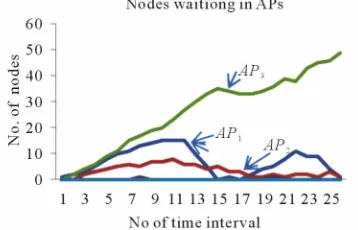
i.e. at Pharmacy is increasing up to last time interval since most of the patients has to visit Pharmacy in the health care environment. The number of nodes waiting in front of the various service points is shown in Figure 4.
From the Figure 4, it is observed that the nodes wait-ing in front of Laboratory and Physiotherapy centre are minimum. Maximum numbers of nodes are waiting in front of Doctors room and Pharmacy. It is also verified from the observed data that always Pharmacy is over-crowded. The number of nodes present in the system for various time intervals is given in Figure 5.
The simulation results showing nodes leaving pattern is shown in Figure 6.
[image:8.595.309.537.83.165.2]In the simulation it is assumed that all the nodes will the system only after fulfilling the intended activities. Therefore the nodes present in the system have to wait in the queue for long time as the number of nodes entered as per the arrival pattern. But the real time data observed
Figure 4. Nodes in attraction points at different time inter-vals.
[image:8.595.83.262.431.546.2]Figure 5. Nodes present in the system at different time in-tervals.
Figure 6. Nodes left the system at different time intervals.
in the environment during survey is having the leaving pattern of the nodes that some of the nodes left the sys-tem after consultation without getting medicine from the pharmacy.
6. Conclusions
A temporal adaptive mobility model is developed which can be used to simulate any practical scenario by giving the appropriate inputs. The model is simulated for a health care environment by assuming patients as nodes which moves towards various service points like Doc-tor’s Room, Injection/Dressing Room, Pharmacy etc. and the mobility patterns are analyzed. The output of the si-mulated model reflects exactly the dynamic movement pattern of the mobile entities as observed in the envi-ronment. The simulated results are similar to the practi-cal environment but the number of nodes queue in front of pharmacy is not correlated because of dejected leaving patients from the system.
7. Acknowledgements
The authors are thankful to the Management, Principal and Head of the Electronics and Communication Engi-neering Department, Mepco Schlenk EngiEngi-neering Col-lege, Sivakasi, Tamilnadu, India, for giving the support to carry out this research work.
8. References
[1] M. Kim, D. Kotz and S. Kim, “Extracting a Mobility Model from Real User Traces,” Proceedings of the 25th Annual Joint Conference of the IEEE Computer and Communications Societies,Barcelona, 23-29 April 2006, pp. 1-13.
[2] M. McNett and G. M. Voelker, “Access and Mobility of Wireless PDA Users,” Mobile Computing Communica-tions Review, Vol. 9, No. 2, 2005, pp. 40-55.
doi:10.1145/1072989.1072995
[3] B. Divecha, A. Abraham, C. Grosan and S. Sanyal, “Im-pact of Node Mobility on MANET Routing Protocols Models,” Journal of Digital Information Management, Vol. 5, No. 1, 2007, pp. 19-24.
[image:8.595.61.284.585.697.2]MA-NET,” Proceedings of Innovation North Research &
Practice Conference, Leeds, 9-11 July 2007, pp. 1-15. [5] S. Ray, “Realistic Mobility for MANET Simulation,”
Master’s Thesis, The University of British Columbia, Vancouver, 2003.
[6] A. Jardosh, E. M. Belding-Royer, K. C. Almeroth and S. Suri, “Real World Environment Models for Mobile Ad- Hoc Networks Evaluation,” IEEE Journal on Selected Areas in Communications, Special Issue on Wireless Ad Hoc Networks, Vol. 23, No. 3, 2005, pp. 622-632. [7] S. Gowrishankar, T. G. Basavaraju and S. Sarkar, “Effect
of Random Mobility Models Pattern in Mobile Ad Hoc Networks,” International Journal of Computer Science and Network Security, Vol. 7, No. 6, 2007, pp. 160-164. [8] P. Venkateswaran, R. Ghosh, A. Das, S. K. Sanyal and R.
Nandi, “An Obstacle Based Realistic Ad-Hoc Mobility Model for Social Networks,” Journal of Networks, Vol. 1, No. 2, 2006, pp. 37-44.
[9] T. Camp, J. Boleng and V. Davies, “A Survey of Mobil-ity Models for Ad Hoc Network Research,” Wireless Communication and Mobile Computing: Special Issue on Mobile Ad Hoc Networking: Research, Trends and Appli-cations, Vol. 2, No. 5 , 2002, pp. 483-502.
[10] A. J. Pullin and C. Pattinson, “A Realistic Battlefield Model for the Evaluation of MANET,” Proceedings of
5th Annual Conference on Wireless on Demand Network Systems and Services, Garmisch Partenkirchen, 23-25 January 2008, Vol. 23, pp. 81-84.
doi:10.1109/WONS.2008.4459359
[11] T. M. L. Flower, G. Prema, C. Aravindan, K. Kannan and
R. Maheswaran, “A Realistic Mobility Pattern for Adap-tive MANET Simulation Environment,” Proceedings of National Conference on Networks, Image & Security, Kumarakoil, 14-15 March 2008, pp. 70-75.
[12] G. Lu, G. Manson and D. Belis, “Mobility Modeling in Mobile Ad Hoc Networks with Environment-Aware,”
Journal of Networks, Vol. 1, No. 1, 2006, pp. 54-63. [13] D. Bhattacharjee, A. C. R. Shah, M. Shah and A. Helmy,
“Empirical Modeling of Campus-Wide Pedestrian Mobil-ity: Observations on the USC Campus,” Proceedings of IEEE Vehicular Technology Conference, Los Angeles, 26- 29 September 2004 Vol. 4, pp. 2887-2891.
[14] J. Kim and S. Bohacek, “A Survey-Based Mobility Mod-el of People for Simulation of Urban Mesh Networks,”
Proceedings of Mesh Nets, Budapest, July 2005, pp. 1-11. [15] D. Huang, “Unlinkability Measure for IEEE 802.11 Based MANETs,” IEEE Transactions on Wireless Communica-tions, Vol. 7, No. 2, 2008, pp. 1025-1034.
doi:10.1109/TWC.2008.060777
[16] M. A. Rajan, M. G. Chandra, L. C. Reddy and P. S. Hi-remath, “Topological and Energy Analysis of K-Con- nected MANETs: A Semi-Analytical Approach,” Inter-national Journal of Computer Science and Network Se-curity, Vol. 8, No. 2, 2008, pp. 199-207.