Scott Richard Taylor
A Thesis Submitted for the Degree of PhD
at the
University of St Andrews
2019
Full metadata for this item is available in
St Andrews Research Repository
at:
http://research-repository.st-andrews.ac.uk/
Please use this identifier to cite or link to this item:
http://hdl.handle.net/10023/17867
Non-equilibrium processes and ergodicity-breaking in
isolated quantum systems
Scott Richard Taylor
This thesis is submitted in partial fulfilment for the degree of
Doctor of Philosophy (PhD)
at the University of St Andrews
is approximately 20,700 words in length, has been written by me, and that it is the record of work carried out by me, or principally by myself in collaboration with others as acknowledged, and that it has not been submitted in any previous application for any degree.
I was admitted as a research student at the University of St Andrews in August 2014.
I received funding from an organisation or institution and have acknowledged the funder(s) in the full text of my thesis.
Date Signature of candidate
Supervisor's declaration
I hereby certify that the candidate has fulfilled the conditions of the Resolution and Regulations appropriate for the degree of PhD in the University of St Andrews and that the candidate is qualified to submit this thesis in application for that degree.
Date Signature of supervisor
Permission for publication
In submitting this thesis to the University of St Andrews we understand that we are giving permission for it to be made available for use in accordance with the regulations of the University Library for the time being in force, subject to any copyright vested in the work not being affected thereby. We also understand, unless exempt by an award of an embargo as requested below, that the title and the abstract will be published, and that a copy of the work may be made and supplied to any bona fide library or research worker, that this thesis will be electronically accessible for personal or research use and that the library has the right to migrate this thesis into new electronic forms as required to ensure continued access to the thesis.
I, Scott Richard Taylor, confirm that my thesis does not contain any third-party material that requires copyright clearance.
The following is an agreed request by candidate and supervisor regarding the publication of this thesis:
Electronic copy
No embargo on electronic copy.
Date Signature of candidate
Date Signature of supervisor
I, Scott Richard Taylor, understand that by declaring that I have original research data or digital outputs, I should make every effort in meeting the University's and research funders'
requirements on the deposit and sharing of research data or research digital outputs.
Date Signature of candidate
Permission for publication of underpinning research data or digital outputs
We understand that for any original research data or digital outputs which are deposited, we are giving permission for them to be made available for use in accordance with the requirements of the University and research funders, for the time being in force.
We also understand that the title and the description will be published, and that the underpinning research data or digital outputs will be electronically accessible for use in accordance with the license specified at the point of deposit, unless exempt by award of an embargo as requested below.
The following is an agreed request by candidate and supervisor regarding the publication of underpinning research data or digital outputs:
No embargo on underpinning research data or digital outputs.
Date Signature of candidate
ergodicity-breaking in isolated
quantum systems
Author:
Scott R. Taylor
Supervisor: Dr Chris A. Hooley
This thesis is submitted in partial fulfilment of the requirements
for the degree of Doctor of Philosophy in Theoretical Physics
at the
University of St Andrews
In this thesis we consider isolated quantum systems influenced by disorder and external driving, and explore aspects of localisation and
ergodicity-breaking in three different models.
We first consider the XYZ spin chain in a disordered magnetic field; this
system breaks the U(1) symmetry of the XXZ model and therefore violates
the conservation of thezcomponent of the total magnetisation. We identify
a quantum phase transition between an ergodic phase and a many-body localised phase at a finite disorder strength that is strongly dependent on the
size of the U(1) symmetry-breaking term. We also investigate the breakdown
of thermalisation by studying the matrix elements of local operators in the
basis of the system’s eigenstates, and we find suggestive evidence of sub-diffusive energy transport at disorder strengths preceding the localisation
transition.
We then consider a two-level time-dependent quantum system that is
influ-enced by a fluctuating classical noise term. We show that the noise does not
fully randomise the quantum state if the fluctuations of every noise
param-eter coupled to the system are perfectly correlated; the state of the system instead becomes distributed over a finite subset of the full state space.
Lastly we consider a one-dimensional Anderson-localised system that is affected by randomly fluctuating onsite potentials. We explore how the
spatiotemporal correlations between these onsite potentials affect the
Acknowledgements
I would first like to thank my supervisor, Chris Hooley, both for giving me this opportunity and for his support, patience, and guidance throughout my
studies. He has a remarkable enthusiasm for all physics, an optimism that no
pessimist can extinguish, and a great sense of fun. The experience of a PhD
hinges on the relationship a student has with their supervisor, and I am glad to consider mine a good friend.
I would like to thank Antonello Scardicchio for being a great source of
guid-ance and insight, and I look forward to working with him more in the near future. I must also thank Andrey Shytov, who properly introduced me to
theoretical physics and inspired me to pursue it beyond my undergraduate
degree.
I owe a great deal of gratitude to Maxi Schulz, a fellow student, friend, and
collaborator. He has been involved in many of the most enjoyable moments
of my PhD, both scientific and social, and I am so glad that we will continue working together over the next year.
There are many other people who I must thank for making my time in St Andrews so enjoyable: Aidan, Artem, Chris C., Connor, Conor, Dave, Deep,
Elliott, Federico, Francisco, Ian, Igor, Jack, Jon, J-P, Justyna, Kyle, Laura,
Lewis, Maja, Maria Laura, Matt N., Matt T., Nat, Oliver, Pippa, Rebecca,
Rhea, Sam, Steph, Veronika, and Vish. The pies, pints, cups of tea and coffee, games of badminton, aimless walks around town, and everything else we
did together made for a fantastic four years.
Life extends far beyond the town of St Andrews, and I owe a lot to friends that I made before my PhD. From my time in Exeter I must thank Alex, Jack,
and Sam, who taught me that physics is best done with friends. I am also
us living so far apart. Thank you Ben, George, Jack, Jim, Josh, and Toby, who
have no connection to physics, but always ask about what I’m working on.
I will forever be grateful to Fiona for her support and companionship over
the past years, and for her ability to make me smile even on the worst days.
She is my best friend, and there is truly nobody I would rather spend my time with.
Finally, I could not neglect to thank my family, whose literally unwavering
support and constant encouragement has gotten me to where I am today. Thank you so much for everything; I could never have done this without you.
This work was supported by the CM-CDT under the EPSRC (UK) grant
Contents
Abstract
Acknowledgements i
Introduction 1
1 Many-body localisation 3
1.1 Disorder-induced localisation . . . 3
1.1.1 Anderson localisation . . . 3
1.1.2 Localisation in interacting models . . . 7
1.1.3 Experimental observations of localisation . . . 8
1.2 Thermalisation in quantum systems . . . 10
1.2.1 Thermalisation . . . 10
1.2.2 Emergent integrability in many-body localised systems 11 1.2.3 The eigenstate thermalisation hypothesis . . . 12
1.3 Many-body localisation in spin chains . . . 14
1.4 Signatures of many-body localisation . . . 17
1.4.1 Spectral statistics . . . 17
1.4.2 Entanglement . . . 20
1.4.3 Eigenvector measures . . . 22
1.4.4 Breakdown of the eigenstate thermalisation hypothesis 23 2 Systems with time-dependent parameters 26 2.1 Time-evolution in quantum systems . . . 26
2.1.1 Systems with time-independent Hamiltonians . . . 27
2.1.2 Systems with time-dependent Hamiltonians . . . 28
2.1.3 The adiabatic theorem . . . 30
2.2 Systems with time-dependent noise . . . 33
2.2.1 ‘White’ noise . . . 34
2.2.2 ‘Real’ noise . . . 36
3 The disordered XYZ spin chain 39 3.1 The XYZ spin chain . . . 39
3.2 The disorder-free XYZ spin chain . . . 41
3.3 Many-body localisation in the XYZ spin chain . . . 42
3.3.1 Signatures in the eigenenergy spectrum . . . 43
3.3.2 Signatures in the entanglement . . . 48
3.3.3 Signatures in the Shannon entropy . . . 49
3.3.4 The many-body mobility edge . . . 51
3.3.5 The effect of breaking the U(1) symmetry . . . 53
3.4 Thermalisation in the XYZ spin chain . . . 55
3.4.1 Diagonal elements . . . 55
3.4.2 Off-diagonal elements . . . 59
3.5 Summary and outlook . . . 60
4 Correlated noise in few-level quantum systems 61 4.1 The model . . . 61
4.2 The fidelity plateau . . . 63
4.3 Requirements for the fidelity plateau . . . 66
4.3.1 Negligible transitions due to[H0,Hn]6= 0 . . . 67
4.3.2 Negligible non-adiabatic transitions . . . 68
4.3.3 Completely dephased components of the wavefunction 69 4.4 Numerical demonstration . . . 70
4.5 Imperfectly correlated noise . . . 77
4.6 Summary and outlook . . . 79
5 Time-dependent disorder in Anderson-localised systems 80 5.1 The model . . . 80
5.2 Some simple limits . . . 82
5.4 Power-law noise . . . 88
5.5 Diffusive noise . . . 89
5.6 Summary and outlook . . . 91
Summary 92
List of Figures
1.1 Phase diagram of the disordered XXZ model . . . 16
1.2 Histograms of the off-diagonal matrix elements ofsz
nin the
eigenbasis of the disordered XXZ model . . . 25
2.1 Transition probabilities in the Landau-Zener problem . . . 33
3.1 Spectral statistics in the disorder-free XYZ model . . . 41
3.2 Location of the MBL transition in the disordered XYZ model . 44
3.3 Spectral statistics in the disordered XYZ model . . . 45
3.4 Finite-size scaling analysis of spectral statistics in the disor-dered XYZ model . . . 46
3.5 Values of the finite-size scaling exponentνfrom the analysis
of the disordered XYZ model . . . 47
3.6 Fluctuations of entanglement entropy in the disordered XYZ model . . . 48
3.7 Finite-size scaling analysis of fluctuations of entanglement
entropy in the disordered XYZ model . . . 49 3.8 Fluctuations of Shannon entropy in the disordered XYZ model 50
3.9 Finite-size scaling analysis of fluctuations of Shannon entropy
in the disordered XYZ model . . . 50
3.10 Energy-resolved phase diagrams of the disordered XYZ model 52 3.11 Schematic of double-hopping processes in the XYZ model . . 53
3.12 Violation of the eigenstate thermalisation hypothesis in the
di-agonal elements of the bond energy operator in the disordered XYZ model . . . 56
3.13 Scaling of the diagonal elements of the bond energy operator
3.14 Scaling exponent of the diagonal elements of the bond energy
operator in the disordered XYZ model . . . 58
3.15 Distributions of the off-diagonal elements of the bond energy operator in the disordered XYZ model . . . 59
4.1 Distribution of the final state on the Bloch spheres of the noise
HamiltonianHn(T)and the clean HamiltonianH0(T)in the
strong-noise limit . . . 66
4.2 Schematic of the plateau in a plot of the disorder-averaged
fidelity as a function of exposure timeT . . . 70
4.3 Disorder-averaged fidelity as a function of exposure timeT . . 72
4.4 Disorder-averaged fidelity as a function of noise strength . . 73
4.5 Absolute deviation of the disorder-averaged fidelity from the
plateau value as a function of noise strengthand exposure
timeT . . . 74
4.6 Histogram of the fidelity as a function of time showing the
plateau behaviour . . . 75
4.7 Histograms of the fidelity as a function of time not showing the plateau behaviour . . . 76
4.8 Decay of the population imbalance in a system with
imper-fectly correlated noise . . . 79
5.1 Expansion of a particle in a disorder-free tight-binding model 82
5.2 Expansion of a particle in a time-independent Anderson
insu-lator . . . 83
5.3 Expansion of a particle due to noise with Gaussian temporal correlations . . . 85
5.4 Expansion of a particle due to noise with Gaussian
spatiotem-poral correlations . . . 86
5.5 Comparison of Gaussian and power-law correlation functions 87 5.6 Expansion of a particle due to noise with power-law temporal
Introduction
When writing a mathematical model to describe a physical system, the first
step is often an idealised simplification, such as a perfectly harmonic oscilla-tor or a completely translationally invariant tight-binding model. However,
reality is rarely so perfect, and will always feature some amount of disorder
and randomness, which we must necessarily understand to fully describe nature. However, the study of disordered systems is not merely a pragmatic
attempt to more accurately describe the physical realisations of a particular
model. Since the latter half of the 20thcentury, the study of localisation in
dis-ordered quantum systems has revealed physics that cannot be found in their non-disordered counterparts, and violations of the laws of thermodynamics.
This has once again highlighted fundamental questions about the emergence
of thermodynamics and thermalisation in isolated quantum systems.
All of the work included in this thesis concerns quantum systems that are
disordered in some sense, and some of the systems considered are also
de-scribed by a time-dependent Hamiltonian. Therefore, Chapter 1 will be an introductory chapter exploring the effects of time-independent disorder on
quantum systems, specifically localisation in both single-particle and
inter-acting models. Chapter 2 will be an introductory chapter that addresses time evolution in quantum systems, and also with variables that fluctuate in time
in a non-deterministic manner, i.e. noise.
Chapter 3, the first chapter of original research, will explore the effects of disorder on the XYZ spin chain. The XXZ spin chain has become a popular
model for the study of many-body localisation, and the XYZ spin chain is
particles when rewritten in the fermionic language. We demonstrate that
there is a many-body localisation transition in this model, which occurs at
a disorder strength that is strongly dependent on the strength of the non-number-conserving term.
Chapter 4 considers a few-level quantum system with a Hamiltonian that has both a smoothly time-dependent component and a noisy component that
fluctuates rapidly and randomly in time. We show that, when the noise in
every parameter of the Hamiltonian is perfectly correlated, the fluctuations
are unable to cause the complete randomisation of the quantum state of the system. We make analytical predictions of the strength of the noise required
to observe this behaviour, and test them numerically.
In Chapter 5 we consider the effects of smoothly fluctuating disorder on an Anderson-localised system. We expose the Anderson insulator to additional
time-dependent onsite potentials that fluctuate randomly with certain
corre-lations in both space and time. We explore the effects of these spatiotemporal correlations, showing that temporal correlations can lead to an intermediate
period of subdiffusive transport, and that long-ranged spatial correlations
can inhibit transport at later times. We then discuss the idea of using this as
Chapter 1
Many-body localisation
Many-body localisation (MBL) is currently the subject of intense research,
for both practical reasons (such as possible applications in quantum com-puting), and also in the context of fundamental questions in physics (such
as the thermalisation of quantum systems). In this chapter we will discuss
localisation due to disorder, and its relevance to thermalisation. We will then briefly outline the results of recent research into MBL in the context of spin
chains, before discussing aspects of the phenomenology of MBL systems.
1.1
Disorder-induced localisation
1.1.1 Anderson localisation
The study of disordered quantum systems began sixty years ago, with
P. W. Anderson’s work on the localisation of a single particle on a disordered lattice [1]. This phenomenon is now known as ‘Anderson localisation’, and
has been the subject of significant scientific interest in the decades since its
discovery [2, 3]. The Hamiltonian for a particle hopping on ad-dimensional
lattice with random on-site potential energies is
H=−JX
hi,ji
|iihj|+|jihi|+X
i
i|iihi|, (1.1)
wherehi,jidenotes pairs of nearest-neighbour sites,|iiis the quantum state
corresponding to the particle existing on sitei= (i1, i2, ..., id),Jis the
which are uncorrelated numbers drawn from a uniform distribution.
One might ask, what is the probability of finding a particle, initially located at
the origin, still there at a timet, i.e. what isp(t) =|h0|ψ(t)i|2if|ψ(0)i=|0i?
This is a simple problem in two extreme limits:
The disorder-free model(W = 0)
In the absence of disorder, (1.1) is the standard translationally invariant
tight-binding model, which has Bloch-wave eigenstates. On a hypercubic lattice
with periodic boundary conditions inddimensions, these eigenstates|φki
and their associated eigenenergiesEkhave the form
|φki=L−d/2 X
j
e−ik·j
|ji, Ek=−2J
d
X
n=1
coskn (1.2)
for a lattice with L sites in every direction, where the quasimomentum
components obey the conditionknL= 2πmnwithmn∈ {0,1, ..., L−1}. The
initial state|0imust be constructed using a phase-coherent superposition of
every eigenstate, which are plane waves that propagate ballistically with a
velocityvk =∇kEk (setting~= 1, which we will assume throughout this
thesis). The time-dependent wavefunction is given by
jψ(t)= 1
Ld
X
k
eik·j+i2J tPdn=1cos(kn), (1.3)
and taking the thermodynamic limitL→ ∞, this becomes [4]
jψ(t)=
Z 2π
0
ddk (2π)de
ik·j+i2J tPdn=1cos(kn)=id
d
Y
n=1
Jjn(2Jt), (1.4)
where Jα(x) is the αth order Bessel function of the first kind [5]. Bessel
functions asymptotically decay asx−1/2, and so we findp(t) =|h0|ψ(t)i|2 ∼
t−d. As one would expect for ballistic expansion, the width of the density
grows linearly in time [4]:
We can intuitively understand the forms ofp(t)andσ(t): the width of the
density grows linearly in time in each direction, so the height of the density
must decay with a power oftfor each direction in order to remain normalised.
The infinite-disorder limit(J/W →0)
In this limit the position basis is the eigenbasis of the system
|φni=|ni, En=n, (1.6)
and the Hamiltonian generates no dynamics:|ψ(t)i=e−i0t|0i. As a result,
the wavepacket does not spread,σ(t) =σ(0) = 0, and the return probability
is constant in timep(t) =p(0) = 1.
This then leaves the question of what happens at intermediate disorder
strengths, which is of course the interesting case. In a picture where a particle propagates ballistically between scattering events at ‘impurities’ (which are
the disorder), the outcome is diffusive motion:
hx2i(t) = 2Dt, (1.7)
whereDis the diffusion constant, the bar denotes an average over disorder
realisations, andtmust be much larger than the scattering timeτ. A
perturba-tive calculation using the golden rule can estimate the scattering rate,Γ =τ−1,
from the disorder potential. By considering the plane-wave solutions of the
clean problem, |ki, and treating the disorder potential,V = Pnn|nihn|,
as the perturbation, the scattering rate depends on the disorder strength as
Γ∼W2(withk-dependent prefactors). This gives the scaling of the diffusion
constant [4]:
D=v2
gτ ∼ 1 Γ ∼
1
W2, (1.8)
wherevgis thek-dependent group velocity. Anderson predicted that,
con-trary to the expression above (which is always finite forW >0), all transport
does not decay to zero). This lack of transport is a defining characteristic of a
localised phase. It is also the case that the eigenstates,|φmi, become localised
in space, decaying exponentially at large distances from their centre,j0m, with
a localisation lengthξ[2]:
jφm∼e−|j0m−j|/ξ. (1.9)
This exponential localisation of a quantum particle is a result of destructive interference between the multiple reflected components of the wavefunction
from the potential barriers due to the disorder on each site [2, 6].
The dimensionality of the system is a significant factor in localisation. In
d = 1it has been proven that every eigenstate of the Anderson model is
localised, even in the presence of vanishingly small disorder [7], where the
localisation length diverges as ξ ∼ W−2 [2]. Similarly, ind = 2, scaling
arguments indicate that there is also no localisation transition as a function
disorder strength, and all states are localised [8]. Ind≥3it is known that
the system will undergo a transition to a localised phase above a critical
disorder strengthWc[4]. In this case the entire spectrum does not localise
simultaneously: for weak disorder, only the energy states in the highest and
lowest regions of the spectrum are localised, and the states in the middle of
the spectrum are extended. The energy separating the localised and extended
states is known as the mobility edge. As we increase the disorder strength,
the delocalised part of the spectrum shrinks, and atW =Wcall states become
localised [2].
Localisation is a purely wave-mechanical effect with no counterpart for
classical particles, which can be seen by considering the classical equivalent
of a particle moving in a disordered landscape. If the potential energy of
the particleV(x)has a maximum value ofVmax, and the total energy of the
particleE < Vmax, then the particle will be ‘localised’ between two of the
can travel throughout the system, with a velocityvthat changes with position
as v(x) = p2(E−V(x))/m, where mis its mass. This is in clear contrast
to the quantum system which is localised at all energies for any disorder
strength ind ≤ 2. For disorder with a long-tailed distribution, such as a
Gaussian distribution which has no finiteVmax, the results are qualitatively
the same, although the critical disorder strengthWcdecreases [9].
1.1.2 Localisation in interacting models
The existence of localisation in the presence of interactions between the par-ticles was debated for several decades, with some studies suggesting that
localisation may persist in the presence of short-ranged interactions and
others suggesting that interactions would destroy the Anderson insulator
[10–13]. More recently, D. M. Basko, I. L. Aleiner, and B. L. Altshuler studied a disordered model of interacting fermions with localised single-particle
eigenstates; they showed that for small but finite temperatures, a many-body
mobility edge exists even in the presence of weak interactions, and the system can undergo a transition to a localised phase with exactly zero conductivity
[14]. This interacting version of Anderson localisation is known as
many-body localisation (MBL).
Localisation in an interacting system is not characterised by such a simple
quantity as the localisation length in the single-particle problem, and instead
we must consider whether excitations can propagate through the system, or whether the system relaxes to a state with memory of its initial
condi-tions. However, we can think about this problem in an analogous way to
the single-particle system, by considering it as localisation in state space
rather than in real space. In this picture the Hamiltonian describes the state of the system ‘hopping’ on a complicated graph where the nodes represent
states in the system’s many-body Fock space [14–16]. The MBL transition
then corresponds to a change in the structure of the eigenstates from being extended to localised in Fock space [17]. It is worth noting that this is not as
lattice with an interesting geometry; the different many-body states can be
connected by several paths, and these paths are not statistically independent
[14, 17].
The transition between the delocalised and localised phases is unusual in
that it has no signatures in thermodynamic variables, but is evident in the individual many-body eigenstates of the Hamiltonian [18], as we will discuss
later in this chapter. A great deal of interest has been generated by the fact
that the transition cannot be described in the framework of equilibrium
statistical mechanics [19].
1.1.3 Experimental observations of localisation
The enduring interest in localisation has undoubtedly been stimulated by suc-cessful experimental observations. Localisation and the Anderson transition
have been observed in transport measurements on solid-state systems, which
have been well summarised by B. Kramer and A. MacKinnon [2]. These studies have found evidence for localisation in many observables, including:
the dielectric susceptibility, the magnetoresistance, and the fluctuations and
dependences on temperature and doping of the conductance in disordered
samples. Anderson localisation has also been explored in light in disordered media [20], however, this is a difficult system to study experimentally [21],
and light’s vector character means that the extrapolation from particles to
photons is non-trivial [22].
More recently, advances in the manipulation of cold-atom systems have
re-sulted in access to quantum systems that can be engineered and controlled to
an unprecedented degree of precision [23, 24]. In cold-atom setups the cloud of atoms can be imaged directly, offering the opportunity to truly observe
the density profile, and more details of the wavefunction itself are available
through interference experiments. These measurements can be performed by determining the shape of the atom cloud from the absorption of light
momentum distributions, or by observing the occupation of individual sites
in lattice systems [24]. Lattice models can be constructed by exposing the
atoms to laser standing waves, known as ‘optical lattices’, which mimic the periodic potential of a crystal. These optical lattices naturally contain no
impurities or imperfections, they do not contain phonons, and they can be
created in a range of geometries and dimensionalities by employing sophis-ticated setups with several lasers [25, 26]. A quasiperiodic potential of the
formhn=Wcos(βπn), whereβis an irrational number, can be generated by
adding an additional weak lattice with a periodicity that is incommensurate
with the original lattice. This is known as the Aubry-André model [27], and
the predicted localisation transition at finiteW has been observed in
non-interacting particles in an optical lattice [28]. True disorder can be realised
in cold-atom systems by exposing the atoms to a laser speckle pattern, and
Anderson localisation has also been observed in these systems [29]. Addi-tionally, the interaction strength is easily tuned in these experiments [23],
allowing experimentalists to study the many-body localisation transition.
The localisation transition in cold-atom setups has been observed in a
num-ber of ways in both fermionic and bosonic systems. In one-dimensional
non-interacting Bose-Einstein condensates, localisation has been observed
through direct measurements of the localisation length from the exponential decay of the density profile [28, 29]. This localisation was also tested by
confirming that the density did not expand in space when the confining
potential was switched off. Many-body localisation has been observed by measuring the relaxation of initially ordered states. An initially staggered
density of interacting fermions in a one-dimensional quasiperiodic lattice
was found not to relax to a uniform density above a critical disorder strength
[30], and similar behaviour was found for a domain wall configuration in a two-dimensional system of bosons [31]. Interacting fermions in a
three-dimensional disordered lattice have also been found to localise, even at finite
temperature, above a critical disorder strength [32]. A magnetic field was
removed and the momentum distribution measured to determine the velocity
of the centre of mass; this velocity dropped to zero when the disorder was
increased above a critical value.
1.2
Thermalisation in quantum systems
1.2.1 Thermalisation
The thermalisation of quantum systems is a fundamental question in physics,
and it has received a great deal of attention [18, 33–37]. In a classical system,
this relaxation to a thermal state is understood to be a result of particle
collisions redistributing energy between the different degrees of freedom of the system. This appears in the form of non-linearity in the system’s
equations of motion, which makes it ‘chaotic’ (meaning that its dynamics are
exponentially sensitive to even infinitesimal changes to the initial conditions), and it is not possible to predict the behaviour of the system over long periods
of time [37]. As a result, the time evolution causes the system to ‘forget’
its initial conditions, and it tends to a state which is well described by a
few average thermodynamic quantities. This relies on the system obeying Boltzmann’s ergodic hypothesis, that given an infinite amount of time, the
system will explore its entire state space in an unbiased way (i.e. that a
long-time average is equivalent to an ensemble average). However, the Schrödinger equation describes unitary time evolution,
|ψ(0)i=X α
cα|αi → |ψ(t)i=X α
cαe−iEαt|αi, (1.10)
where|αiare eigenstates of the system with eigenenergiesEα, which clearly
retains knowledge of the initial state in the amplitudescα, and can never
sample its entire state space in this way.
An isolated quantum system has no contact with a thermal reservoir by
definition, but we may consider a small subsystem, and ask whether the rest
state of the subsystem can be described by the laws of statistical mechanics,
and the subsystem thermalises, even though the system as a whole
remem-bers its initial conditions. For a localised system this is not the case; the system retains a local memory of its initial state, and so a generic subsystem
will fail to reach thermal equilibrium [18].
1.2.2 Emergent integrability in many-body localised systems
Localised systems are not the only examples of systems that fail to thermalise: this is a well-known feature of integrable systems. Integrable systems
pos-sess an extensive number of non-trivial conserved quantities, and they are
often exactly solvable by Bethe Ansatz methods [38]. The large number of
conserved quantities restricts the dynamics, making it impossible for the system to reach a thermal state, and the long-time steady state will instead
be described by an appropriately constructed ‘generalised Gibbs ensemble’
[39]. However, these systems are fragile and even weak perturbations are known to break the integrability. In MBL systems, on the other hand, the
non-thermalising behaviour is robust to arbitrary small local perturbations
to the Hamiltonian [18].
The related phenomenology of MBL and integrable systems is not a
coinci-dence: a certain type of integrability emerges deep in the MBL phase. This
integrability appears in the form of an extensive set of independent
mutually-commuting quasilocal operators{Iα}that commute with the Hamiltonian,
which are known as local integrals of motion (LIOMs) [40–44]. These
opera-tors are quasilocal in the sense that they have a finite spatial extent, which
suppresses transport and thermalisation as the system retains a local memory
of its initial conditions. If we construct a LIOM centred atRαfrom a
superpo-sition of local operators, then the contribution of each local operator decays
exponentially with its distance from Rα [42, 43]. The LIOMs can be
con-structed by a quasilocal unitary operationΩon the Pauli basis:Iα = Ω†sz
αΩ
Pauli operators: Iα will have a significant overlap with the original Pauli
operator, and the overlap with the other Pauli operators will decay
exponen-tially in real space [18]. An MBL Hamiltonian can be written in diagonal form as a non-linear combination of the LIOMs:
H=E0+
X
α
hαIα+X α,β
JαβIαIβ+
∞ X
n=1
X
α,β,{γ}
Kαn{γ}βIαIγ1...IγnIβ, (1.11)
and the eigenstates ofHare the simultaneous eigenstates of{Iα}, which can
be uniquely labelled by their eigenvalues. The quasilocal structure of the
LIOMs implies that the interaction strengthsJαβandKn
α{γ}βdecay
exponen-tially with distance [18, 40]. The phenomenology of many-body localised
systems, which we will discuss later in this chapter, can be successfully
described in terms of LIOMs [18, 40].
1.2.3 The eigenstate thermalisation hypothesis
The eigenstate thermalisation hypothesis (ETH) provides a mathematical route through which the expectation values of certain operators can become
thermal, and is usually applied to operators that act only on a few particles
[37, 46–49]. The underlying idea is that the eigenstates of the system are already thermal, and that this property is revealed by the dephasing of the
phase-coherent initial state due to unitary time evolution [46]. The long-time
average of the expectation value of an operatorA in the state|ψ(t)i from
(1.10) is given by:
hhAiiT = lim T→∞
1 T
Z T
0
dthψ(t)|A|ψ(t)i
= lim T→∞
1 T
Z T
0
dtX α,β
c?αcβe−i(Eβ−Eα)thα|A|βi
=X α
|cα|2hα|A|αi
(1.12)
where we have assumed that the energiesEα are non-degenerate, so the
off-diagonal terms cancel in the average over time. This expression contains
arbitrary states and operators there is no reason why this should correspond
to a thermal value.
Additionally, the fluctuations of hAi are controlled by the size of its
off-diagonal elements:
hAi − hhAiiT
2
T =
X
α6=β
c?αcβe−i(Eβ−Eα)thα|A|βi2
T
= X α6=β
|cα|2|cβ|2 |hα|A|βi|2
,
(1.13)
where the restriction ofα 6= βresults from subtracting theα =β terms in
(1.12), and the simplification in the last line is a result of the phases averaging
to zero in all other terms. In order for the time average (1.12) to be mean-ingful (i.e. that the value stays close to its average), we require that these
fluctuations must be small in the thermodynamic limit.
The ETH ansatz is that the matrix elements ofAhave the same statistical
properties as:
hα|A|βi=A(E)δα,β+e−s(E)V /2f(E, ω)Rα,β, (1.14)
whereE = (Eα+Eβ)/2,ω =Eβ−Eα,s(E)is the microcanonical entropy
density, V is the system volume, A(E) andf(E, ω)are smooth functions,
andRα,β is a random variable with zero mean and unit variance [33]. The
distribution ofRα,βis often taken to be Gaussian, based on the conjecture by
Berry that the components of the eigenstates in a thermalising system follow
a Gaussian distribution [34]. Importantly,A(E)is equal to the microcanonical
expectation value of the observableAat energyE.
We can see the consequences of this ansatz by constructing a quantum state
windowδEaroundE0. We then find that the average value (1.12) becomes:
hhψE0|A|ψE0iiT =
X
α
|cα|2A(Eα)≈A(E 0)
X
α |cα|2
=A(E0),
(1.15)
so the quantum and the thermodynamic expectation values are equivalent. Furthermore, the average size of the off-diagonal elements in (1.14) decays
exponentially with the system size, which is consistent with the fluctuations
of the average (1.13) vanishing in the thermodynamic limit [37].
1.3
Many-body localisation in spin chains
Recently, MBL has been studied mostly in spin chain systems, which exhibit
the relevant physics in a simple setting. The one-dimensional spin-1/2 XXZ
chain is an extensively studied model, which has the Hamiltonian:
HXXZ =
L
X
n=1
h
sxnsxn+1+synsyn+1+ ∆sznszn+1+hnszni, (1.16)
wheresµn=σµn/2is the operator for theµcomponent of the spin on siten,∆
is the Ising anisotropy,hnis a random on-site field drawn from a uniform
distributionhn∈[−W, W], andLis the length of the chain. This expression
corresponds to periodic boundary conditions, with siteL+1being equivalent
to site1. (Note that this is by no means the only spin system in which MBL
has been studied [41, 45, 49–53].) This model can be mapped to a system
of spinless fermions on a one-dimensional lattice using the Jordan-Wigner
transformation [54]:
szn ←→ c†ncn−1 2; s+
n ←→ c†neiπ
Pn−1
j=1c†jcj; (1.17)
sn− ←→ e−iπPnj=1−1c†jcjc
n,
wherec†nandcnare the creation and annihilation operators for a fermion on
(up to irrelevant constants):
HXXZ=
L
X
n=1
"
1 2
c†ncn+1+c†n+1cn+ ∆c†ncnc†n+1cn+1+hnc†ncn
#
. (1.18)
In this language it is clear that∆corresponds to the strength of a
nearest-neighbour interaction. We will only discuss the physics of one-dimensional models, as these are the most thoroughly investigated and well understood
systems, and they are the focus of the work in the following chapters.
Numerical studies of this system indicate that in the isotropic ‘Heisenberg’
limit (∆ = 1) the MBL transition occurs atWc '3.7, and suggest the
exis-tence of a mobility edge at weaker disorder [55–57]. Fig. 1.1 [55] shows the
phase diagram of this model, as determined by a finite-size scaling analysis of
the energy spectrum and eigenstate properties on system sizes up toL= 22.
In this study, the transition was determined by analysing the structure of
the energy spectrum, the half-chain entanglement entropy and the size of its
fluctuations, the Shannon entropy, and fluctuations in the half-chain mag-netisation. We will discuss some of these measures in the next section. These
types of study, despite pushing the boundaries of what is achievable by exact
numerical methods, are still far from the thermodynamic limit. The extracted critical exponents violate bounds derived under quite general assumptions
(i.e. that the MBL transition separates a localised phase from a phase that
satisfies the ETH) [58], suggesting that the scaling regime has not yet been
reached, and the possibility of the existence of a many-body mobility edge has been questioned [59].
Recently, attention has turned to the delocalised region withW < Wc, where
a variety of interesting physics may be studied [17]. Several numerical
studies have observed anomalous subdiffusive spin transport in the XXZ
model [60–62], most effectively by studying the scaling of the spin current
with system length j ∼ L−γ (γ = 1 corresponds to diffusive transport,
FIGURE 1.1: The phase diagram of the XXZ model (1.16)
as a function of disorder strength hand energy density ,
showing the two phases and the mobility edge. The critical disorder strength was determined from an exact
diagonali-sation study of system sizes up toL = 22. The location of
the MBL transition is determined from the spectral statis-tics (turquoise upwards-pointing triangles), entanglement entropy (red squares), fluctuations of the entanglement en-tropy (green circles), the decay of a long-wavelength spin density (blue downwards-pointing triangles), and the fluctu-ations of the half-chain magnetisation (yellow left-pointing triangles). The colour scheme indicates the scaling of the
Shannon entropy with system size (D1in the notation used
transition). The transport is subdiffusive for all disorder strengths in the
strongly interacting regime (∆ > 1), while a transition between diffusive
and subdiffusive transport exists at finiteW in weakly interacting systems
(∆ <1) [62]. This anomalous transport has been linked to long-tailed (i.e.
non-Gaussian) distributions for the off-diagonal matrix elements of local spin
operators in the ergodic phase [63]. It was found that these systems satisfy a modified version of the ETH in the subdiffusive regime, in which the scaling
of the variance of the off-diagonal matrix elements with system size requires
power-law corrections to the exponential in (1.14) [63]. Furthermore, it has
been shown that energy transport is diffusive when the disorder is weak, and the system undergoes a transition to subdiffusive transport at a finite disorder
strength (which depends on the strength of the interactions) before the MBL
transition [64–66]. Subdiffusive spin transport has also been observed in a
periodically driven Floquet version of the model, with associated long-tailed distributions of the matrix elements of local spin operators in the eigenstates
of the Floquet unitary [67]. It is interesting to note that in this system, which
does not conserve energy, the MBL phase is still present [68–72].
1.4
Signatures of many-body localisation
1.4.1 Spectral statistics
The statistical properties of a model’s eigenenergy spectrum have become
one of the key diagnostics of the MBL transition [49–52, 55, 60, 61, 66, 73–
75]. This approach to studying the properties of a system has its roots in
nuclear physics [37], and more recently has become associated with inte-grable quantum systems, where it can be used as a diagnostic of integrability
[38]. The quantities of interest are the gaps between adjacent energy levels
δn=En−En−1, whereEnare the ordered eigenenergies of the Hamiltonian,
More recently, the gap-ratio parameter
rn= min
δn δn+1
,δn+1 δn
(1.19)
was introduced [73], which is an attractive quantity as it does not depend on the density of states (the ‘unfolding’ procedure to remove this dependence
fromδnis non-trivial [75–77]). These quantities are clearly a measure of the
level-repulsion between eigenstates. In an integrable model the extensive number of conserved quantities suppresses the level repulsion, as they split
the state space into a extensive number of independent sectors. The
eigen-states in each sector are not influenced by those in other sectors, so their
eigenenergies will not be correlated, and the distribution of level spacings can have significant weight near zero. On the other hand, in non-integrable
and non-localised models there are fewer conserved quantities to suppress
matrix elements, and the resulting level repulsion causes the distribution of level spacings to vanish at zero.
In the context of MBL we would therefore expect to find level-repulsion in
the ergodic phase and no level-repulsion in the localised phase; the transition is often located by determining the disorder strength at which this behaviour
changes. We may gain a cartoon understanding of this difference by
con-sidering a single particle on a disordered lattice. In a localised state, the
wavefunction decays exponentially in space, and therefore it has negligible
overlap with another localised state at a distance∆x ξ. The
hybridisa-tion between these states is then exponentially small, and a significant level
repulsion (i.e. repulsion on the scale of the typical level spacing) requires consecutive eigenstates to be located nearby in space, which is vanishingly
unlikely in the thermodynamic limit. We will therefore not observe the
power-law suppression of the level-gap distribution that we would see in
ergodic systems. In contrast, two extended states will necessarily have signif-icant weight on the same parts of the lattice, and the Hamiltonian may couple
MBL phase, this argument becomes that two consecutive eigenstates will
generically differ by an extensive number of eigenvalues of the LIOMs, so
the Hamiltonian cannot hybridise them to produce level repulsion on the scale of the typical level spacing [40].
To put this on a more quantitative footing, in the localised phase the eigen-energies are effectively independent random numbers, and are thus described
by a Poisson distribution:
PP(δ) = 1 αexp
−δ α
→ PP(r) = 2
(1 +r)2 (1.20)
whereαis the average level spacing. The form ofPP(r)can be derived by
showing that the ratio of two uncorrelated Poisson-distributed variables,˜r,
has the distributionPP(˜r) = (1 + ˜r)−2, and the factor of two is a result of the
contribution fromr >˜ 1, asPP(˜r−1) = ˜r2PP(˜r).
In the thermalising phase, the level statistics have been found to follow the
statistics of a random-matrix ensemble; for models with real Hamiltonians
(such as the XXZ model in (1.16)) this is the Gaussian orthogonal ensemble
(GOE). The distribution of δ in this case is well described by ‘Wigner’s
surmise’ [78, 79]:
PGOE(δ) =βδexp(−γδ2), (1.21)
whereβandγare appropriately chosen constants. An appropriate
‘Wigner-like surmise’ has been derived forr[79]:
PGOE(r) =
27 4
r+r2
(1 +r+r2)5/2, (1.22)
and the residual discrepancy is well captured by the correction term:
δP(r) = C (1 +r)2
r 1 +r2 −
c1r2
(1 +r2)2
, (1.23)
c1 = 24π−−π4 to satisfy normalisation conditions. The averages and second
mo-ments of these distributions are shown in Table 1.1, which can be compared
to the numerical data to determine whether or not the system is localised. In Fig. 1.1 turquoise upwards triangles show the position of the MBL transition
as determined byhri.
Distribution hri hr2i
PP(r) ln 4−1 3−ln 16 ≈0.386294 ≈0.227411
PGOE(r) 2(2−
√
3) ≈0.351522 ≈0.535898
PGOE(r) +δP(r) ≈0.530745 ≈0.346437
TABLE1.1: Moments of the gap-ratio parameterrcalculated
from the distributions corresponding to localised and ergodic systems.
1.4.2 Entanglement
A key observation is that the entanglement across a cut in the system behaves differently in the ergodic and localised phases. The entanglement between
two parts of a system,Aand its complementB, can be quantified by the von
Neumann entanglement entropy
SvN(ρA) =−TrρAlnρA, (1.24)
whereρAis the reduced density matrix of subsystemA, found by tracing
over the degrees of freedom in subsystemBin the full-system density matrix.
The ergodic phase is characterised by long-range entanglement, so the von Neumann entanglement entropy across a cut grows with the volume of the
subsystem (i.e.∼ldfor a subsystem of linear sizel), whereas in the localised
phase the entanglement is short-ranged, so the entanglement entropy follows
an area law (i.e. ∼ ld−1) [18]. It is straightforward to show that the von
density matrix,ρ∼exp (−βH):
SvN(ρth) =−Trρthlnρth
=−TrX α
1 Ze
−βEαln
1 Ze
−βEα
|αihα|
=βX α
1 Ze
−βEαEα+ lnZX
α 1 Ze
−βEα
=βE+ lnZ =βE−βF =βT Sth
=Sth,
(1.25)
whereZis the partition function and we have setkB = 1. AsSthis extensive
in system size by definition, the area-law scaling in the localised phase clearly
signifies a failure to thermalise.
It was observed that the fluctuations in the entanglement entropy of the eigenstates have a maximum at the MBL transition, and this has become a
common diagnostic of the critical disorder strength [50, 55]. This peak can be
understood in a simple way: in the vicinity of the MBL transition, a small difference in disorder strength (or energy density, in the presence of a
mobil-ity edge) can cause the entanglement properties to change, so the variance
of entanglement entropy will diverge with system size over a window that
contains the MBL transition as it includes both extended and localised states [50]. The red squares and green circles in Fig. 1.1 show the position of the
MBL transition as determined by the scaling properties and fluctuations of
the entanglement entropy respectively.
The time-dependence of the entanglement entropy also has distinctive
fea-tures in the MBL phase. If we initialise a system in a non-entangled state
(which is not an eigenstate), and observe how the entanglement entropy across a cut depends on time, we find an unbounded logarithmic growth
with time,S∼ln(V t), whereV is the interaction strength [80–82].
behaviour [18]. This is also distinct from the non-interacting Anderson
insula-tor, which shows no spreading of entanglement after an initial fast relaxation
[18, 81].
1.4.3 Eigenvector measures
The behaviour of the wavefunction is perhaps the most obvious indicator of
localisation, as it directly indicates the populations of individual basis states
within the eigenstates of the model. A common method in non-interacting
systems is to measure the moments of eigenstates|ψαiin the position basis
{|xi}[17]:
Iqα =X x
|hx|ψαi|2q. (1.26)
A fully extended state will scale with the system sizeV ashx|ψαi ∼V−1/2,
andIα
q ∼V1−q, while a localised state decays exponentially with distance, so
Iα
q ∼constant as long as the system extends beyond the localisation length.
The inverse participation ratio (IPR), defined asIα
2, quantifies the inverse
number of sites occupied by|ψαiin real space. In an ergodic state the IPR will
decay asV−1, but ifIα
2 ∼V−D2 where0< D2<1, the state is sub-extensive
in real space, and is described as delocalised but non-ergodic. We may
gen-eralise this to other moments of|ψαiasIα
q ∼VDq(1−q); if these generalised
dimensionsDqdepend onq, as is the case at the Anderson transition [3], the
eigenstate is called multifractal.
An analogous approach is taken in many-body systems, applying the idea of
localisation in state space. For an eigenstate|αithe moments are defined as
[17, 83]:
Iqα=X n
|hn|αi|2q∼ NDq(1−q) (1.27)
where|niis a basis with dimensionN (in a chain ofd-level systems with
lengthL, for example,N =dL). For a thermalising state, we expect to see a
result similar to that for a fully random matrix in the GOE:Iα
2 ≈3/N [83].
These quantities clearly depend on the basis chosen for|ni, and while the
is less obvious in an interacting system. To study localisation in real space
one might study the IPR of an eigenstate in the Pauli basis [83], while the
IPR of an arbitrary state with respect to the energy eigenstates is related to its survival probability [84].
Another quantity related toDqis the Renyi entropy:
Sq(R),α= 1 1−q ln I
α q
∼DqlnN, (1.28)
and the Shannon entropy corresponds to theq→1limit:
Sα
Sh= limq→1S(qR),α=−
X
n
|hn|αi|2ln|hn|αi|2, (1.29)
which allows us to calculateD1 (asI1α ≡1). The colour scheme in Fig. 1.1
corresponds toD1, showing the difference in the scaling ofSShwith system
size between the ergodic and localised phases. It has been noted thatSShand
SvNexhibit very similar behaviour, but the Shannon entropy is less expensive
to calculate numerically [83].
1.4.4 Breakdown of the eigenstate thermalisation hypothesis
In a phase that fails to thermalise we can expect that operators will not be
well described by the ETH ansatz, which we can thus use to test for the MBL
phase. A key assumption of the ETH is that the expectation values of local observables taken with respect to the eigenstates of the Hamiltonian, known
as eigenstate expectation values (EEVs), are smooth functions of their
eigen-energies. Therefore examining the statistical distribution of the difference
between the EEVs of consecutive eigenstates,δhOni=hOi(En+1)− hOi(En),
offers a simple method for determining whether or not a system is localised
[48, 49, 85]. In the thermalising phase this should be peaked at zero with
a width that decreases with increasing system size [48, 86], whereas this
will not be the case in the localised phase. Considering the operatorsz
nas
an example, deep in the localised phase one would expect the eigenstates
specific disorder realisation. In this limit, the expectation values ofsz
nwill be
those of a spin either aligned or anti-aligned with the field (i.e.±1/2), with
no correlation between the values in neighbouring eigenstates. As a result,
the distribution ofδhsz
niwill be sharply peaked around the values 0 and±1,
which correspond to neighbouring eigenstates with the same or different
expectation values respectively.
The off-diagonal elements can also be used as a diagnostic of interesting
behaviour. While the diagonal elements of an operator describe the
aver-age values of quantities, the off-diagonal elements are associated with the relaxation to these averages. As such, the behaviour of off-diagonal elements
in the ergodic phase preceding the MBL transition has received recent
in-terest. It has been found in numerical studies that the onset of anomalous
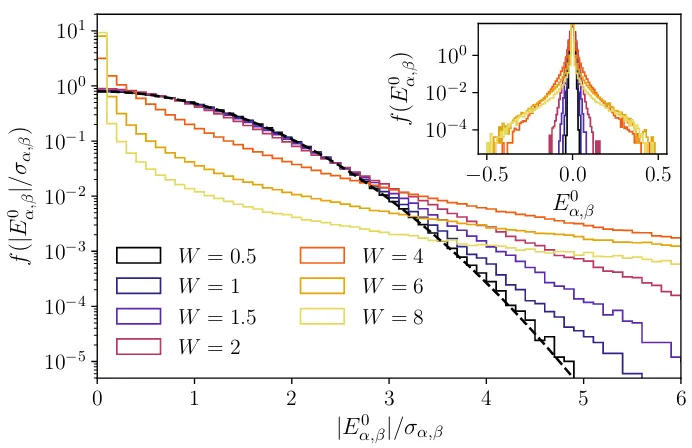
subdiffusive transport is accompanied by a change in the distributions of off-diagonal matrix elements, which develop long tails, violating Berry’s
conjecture that the fluctuations should be Gaussian [63, 67]. This behaviour is
demonstrated in Fig. 1.2 [63], where the distributions are consistently Gaus-sian for all system sizes with weak disorder, but develop long tails when
the disorder is stronger. The matrix elements of spin operators in the
one-dimensional disordered XXZ model were also shown to satisfy a modified
version of the ETH, which includes a power-law correction to the exponential decay of the off-diagonal elements with system size,
hα|A|βi ∝e−s(E)L/2Lγ/2Rα,β, |Eα−Eβ|< L−γ−1, (1.30)
where the additional power-law comes from the behaviour off(E, ω)in (1.14)
[37, 63]. This power-law is related to the subdiffusive transport through the
−0.2 0.0 0.2
10−7
10−5
10−3
10−1
101 p ( h α | S
z i|
β
i
)
W =0.4 L=12
L=14
L=16
L=18
L=20
−8 −4 0 4 8
10−8 10−6 10−4 10−2 100 p ( h α | S
z i|
β
i
/σ
)
W =0.4
−0.5 0.0 0.5
hα|Siz|βi
10−5
10−3
10−1
101 p ( h α | S
z i|
β
i
)
W =2.0 L=12
L=14
L=16
L=18
L=20
L=22
−20 −10 0 10 20
hα|Szi|βi/σ
10−8
10−6
10−4
10−2
100 p ( h α | S
z i|
β
i
/σ
)
W =2.0
FIGURE1.2: The distributions of off-diagonal elements of
sz
nin the eigenbasis of the disordered XXZ model for weak
disorder (upper panels) and stronger disorder (lower panels). The panels on the right have been rescaled horizontally by the standard deviation of the data, and the successful collapse of all system sizes onto the same curve shows that the results are indicative of the true behaviour in the thermodynamic
Chapter 2
Systems with time-dependent
parameters
When a system is affected by time-dependent parameters (i.e. when it exists
in a time-dependent environment) it adds another layer of complexity to its equations of motion. In this chapter we will discuss the effects of this
time-dependence on quantum systems, namely non-adiabatic effects caused
by a time-dependent Hamiltonian. These effects have become increasingly
prominent with the development of sophisticated cold-atom experiments in which the timescales of the dynamics can be on the order of milliseconds; this
is slow enough that it is experimentally viable to change the Hamiltonian
much faster than the system can react, and to properly probe non-equilibrium quantum effects. We will then move on to consider systems which are affected
by classical noise, both ‘white’ noise and noise with more structure in its
temporal correlations, and we will discuss the practicalities of determining
the time-evolution of such systems.
2.1
Time-evolution in quantum systems
The dynamics of a quantum system are governed by the Schrödinger
equa-tion, which describes the time-dependence of a quantum state|ψ(t)idue to a
HamiltonianH(t):
If we define the unitary operator which evolves a state from an initial timet0
to a final timet,|ψ(t)i=U(t, t0)|ψ(t0)i, it follows that the unitary obeys the
same equation:
i∂tU(t) =H(t)U(t), (2.2)
whereU(t) :=U(t,0).
A generic expression forU(t)(known as a Dyson series) can be derived by
integrating (2.2) and repeatedly inserting the resulting equation into itself:
U(t) = 1−i
Z t
0
dt0H(t0)U(t0)
= 1−i
Z t
0
dt0H(t0)
"
1−i
Z t0
0
dt00H(t00)U(t00)
#
= 1−i
Z t
0
dt0H(t0)−
Z t
0
dt0
Z t0
0
dt00H(t0)H(t00)
+i
Z t
0
dt0
Z t0
0
dt00
Z t00
0
dt000H(t0)H(t00)H(t000) +...
=T
∞ X
n=0
(−i)n n!
Z t
0
dt0H(t0)
n
=T exp
−i
Z t
0
dt0H(t0)
(2.3)
whereT is the time-ordering operator which dictates that the following
op-erators must act in order of increasing time, as enforced by the limits of the
integrals in the third line. The factor of1/n!in the penultimate line appears as
a result of extending the upper limits of each integration tot, which includes
then!possible orderings of thenoperators in the integrand.
2.1.1 Systems with time-independent Hamiltonians
The form ofU in (2.3) immediately suggests that for systems in whichH(t) =
H, the logical choice of basis is the eigenbasis of the Hamiltonian {|ni}.
the unitary and quantum state at all times can be written simply as:
U(t) =X n
e−iEntnn
ψ(t)=X
n
nψ(0)e−iEntn
(2.4)
whereEnis the energy eigenvalue of the eigenstate|ni.
2.1.2 Systems with time-dependent Hamiltonians
The problem is more complicated if we consider a system in which the
Hamil-tonianH(t)changes in time, as the eigenbasis of the Hamiltonian becomes
time-dependent and transitions between these instantaneous eigenstates are
possible. IfH(t)changes smoothly from H(0) = H(i)toH(T) = H(f), we
can gain some insight by writing the state in the instantaneous eigenbasis of
H(t),{|n(t)i}:
ψ(t)=X
n
cn(t)n(t). (2.5)
The Schrödinger equation then gives the equations of motion for the
ampli-tudescn(t):
i∂tcn(t) =En(t)cn(t)−i
X
m
n(t)∂t
m(t)cm(t), (2.6)
whereEn(t) is the instantaneous eigenenergy of |n(t)i. Importantly this
has off-diagonal terms of the formhn(t)|∂t|m(t)i, which generate transitions
between the instantaneous eigenstates ofH(t). A more intuitive form of (2.6)
in terms of the time-derivative of the Hamiltonian is:
i∂tcn(t) =En(t)−in(t)∂tn(t)cn(t)
−iX m6=n
n(t)∂tH(t)
m(t)
This can be shown by taking the inner product of the time-derivative of
H(t)|m(t)iand|n(t)iwithm6=n:
n(t)∂thH(t)m(t)i=n(t)∂thEm(t)m(t)i
n(t)h∂tH(t)m(t)+H(t)∂tm(t)i=Em(t)n(t)∂tm(t)
n(t)h∂tH(t)m(t)+En(t)∂tm(t)i=Em(t)n(t)∂tm(t)
n(t)∂tH(t)m(t)= (Em(t)−En(t))n(t)∂tm(t)
(2.8)
where the∂tEm(t)hn(t)|m(t)i term that would appear on the second line
vanishes due to orthogonality.
There are two simple limits where the evolution can generically be described
exactly.
The sudden limit (T →0)
If a system is prepared in a state |ψ(0)i, and att = 0 the Hamiltonian is
instantaneously changed fromH(i)toH(f), the system has no time to react.
As a result, the evolution of the system can be trivially evaluated in{|nfi},
the eigenbasis ofH(f):
ψ(0)=X
n
niψ(0) ni=X n
nfψ(0) nf
ψ(t)=X
n
nfψ(0)e−iE(f)n tnf,
(2.9)
whereEn(f) is the eigenenergy of the state|nfi. Despite the apparent
sim-plicity of this limit, the study of sudden changes to the parameters of a
many-body Hamiltonian (known as a ‘quantum quench’) is an active area of
theoretical research with a rich phenomenology [87].
The adiabatic limit (T → ∞)
The opposite limit, in which the Hamiltonian changes infinitely slowly with
a time-derivative, so must decrease in magnitude as T−1. Thus, as T →
∞ the transitions between the instantaneous eigenstates of H(t) vanish,
and the system will adiabatically follow this basis. In other words, the
populations of the instantaneous eigenstates ofH(t)are constant in time, and
they accumulate a relative phase:
ψ(t)=X
n
n(0)ψ(0)e−iRt
0dt0En(t0)+iφn(t)n(t). (2.10)
The first contribution to the phase, known as dynamical phase, is a
sim-ple generalisation of the linear phase accumulation in (2.4). The second
contribution is known as geometric phase, which has the form:
φn(t) =i
Z t
0
dτhn(τ)|∂τ|n(τ)i (2.11)
and results from the changing eigenbasis of the Hamiltonian. Note thatφn(t)
is a real number, so this is purely a contribution to the phase and has no effect
on the populations of levels.
2.1.3 The adiabatic theorem
The adiabatic theorem states that a quantum system in an instantaneous eigenstate will remain in that eigenstate if a perturbation acts on it
suffi-ciently slowly and if there is a gap separating the eigenenergy from the rest
of the spectrum [88]. This corresponds to theT → ∞limit discussed above,
and we shall now consider this more quantitatively to understand when the
state|ψ(t)ican be accurately approximated by (2.10). A derivation of these
results can be found in [89].
To the next order beyond the adiabatic approximation, the probability for a
non-adiabatic transition to occur between the statesmandnis given by:
Pm→n=
Z T
0
dteiRt
0dt0(En(t0)−Em(t0))hn(t)|∂tH(t)|m(t)i
En(t)−Em(t)
2
. (2.12)
that∆En,m(t) =En(t)−Em(t)andDn,m(t) =hn(t)|∂tH(t)|m(t)iare constant
in time:
Pm→n≈
∆EDn,m2
n,m 2
2 [1−cos(∆En,mT)]
∼ Dn,m ∆E2 n,m 2 , (2.13)
where we have discarded the details in the second line, noting only that
2(1−cosx)is a number of order 1 for a typical (i.e. non-fine-tuned) time
T. Assuming that∆En,m(t)andDn,m(t)are smooth functions of time, the
transition probability between these two states will generally be smaller than
Pm→n.Max
Dn,m(t) ∆En,m(t)2
2 , (2.14)
where the maximum is taken overt. The condition thatPm→n1gives us a
criterion for the validity of the adiabatic approximation. It is worth noting
that the criterion of the right-hand side of (2.14) being much smaller than one
is overly restrictive in practice, but has been used to good effect in protocols designed to minimise non-adiabatic transitions [90].
2.1.4 The Landau-Zener problem
Non-adiabatic effects are well illustrated in the Landau-Zener problem, a
time-dependent quantum system solved simultaneously by L. D. Landau
[91], C. Zener [92], E. Majorana [93], and E. C. G. Stueckelberg [94] in 1932. They considered a two-level system in which two states with an energy
difference that depends linearly on time with a ‘speed’vare coupled by a
constant parameter∆:
HLZ(t) =
vt 2σ
z+∆ 2σ
x, (2.15)
whereσµare Pauli matrices in the{|↑i,|↓i}basis. The system is initialised