doi:10.4236/ojm.2011.11002 Published Online May 2011 (http://www.SciRP.org/journal/ojm)
Octonionic Gravity Formation, Its Connections to
Micro Physics
Andrew Beckwith
Department of Physics, Chongqing University, Chongqing, China E-mail: [email protected]
Received March 14, 2011; revised May 1, 2011; accepted May 11, 2011
Abstract
We ask if Octonionic quantum gravity is a relevant consideration near the Planck scale. Furthermore, we examine whether gravitational waves would be generated during the initial phase,
0, of the universe when triggered by changes in spacetime geometry; i.e. what role would an increase in degrees of freedom have in setting the conditions during
0, so that the result of these conditions can be observed and analyzed by a gravitational detector. The micro physics interaction is due to the formation of a pre Planckian to Planckian space time transition in spatial dimensions at and near the Planck dimensional values, i.e. 10–33 centimeters inspatial dimensions. This transition would be abrupt and arising in micro physics regimes of space time.
Keywords:High-Frequency Gravitational Waves (HFGW), Symmetry, Causal Discontinuity
1. Introduction
The Planck epoch has remained mysterious, and may be invisible to all other kinds of detectors, but the universe’s gravity wave background radiation likely contains the imprint of even the very earliest events. Changes in the geometry of space-time near the Planck scale could be revealed or studied in this manner. We discuss how to obtain insights into 0, initially, while looking at the geometric considerations determining space and time development which would create relevant space-time geometry phase changes during the early universe. The formation of Planckian space time is in what is called Octonionic quantum gravity [1] Each such phase change leading to Octonionic Quantum gravity should produce gravitational waves. The geometry change alluded to is effectively initially on an infinitesimal scale, which is why Micro physics is referred to at all. (‘quantum me-chanics’) and de facto quantum gravity, at the start of Planckian space time. This Planckian space time would mark the beginning of inflation. We give conditions for detection of [2,3] 0 if, for example, one can isolate an appropriate first-order perturbative electromagnetic power
flux, [2-4] in scenarios where the graviton has a (1)
uv
T
vanishingly small – but non-zero – rest mass [2]. Now for how to get non zero graviton rest mass. This is where the micro physics regime becomes so important.
The Micro Physics Problem. How to Solve the Corre-spondence Problem, I. E. (Gravitons in 4D with Slight Mass (5 Degrees of Freedom) Versus Gravitons in 4 D with NO Mass (2 Degrees of Freedom).
This formation of a graviton, must be done before the formation of QM, in space time.
The correspondence problem, is that a Graviton with slight rest mass in 4 D will have five degrees of freedom wheras a Graviton in 4 D, with no mass has two degrees of freedom. I.e. there is no way about this, and that if gravitons as brought up by Beckwith [2] have a small rest mass, which contributes to DE speed up of accelera-tion of the universe a billion years ago, gravitons cannot be synthesized during the time when QM becomes dominant. This document gives a regime of space time before QM, which embeds quantum mechanics. If a 4D graviton with rest mass not equal to zero is formed, it will be in the template of space time before to up to 10–44 seconds. I.e. as stated , so as to have GW/Gravitons with rest mass not equal to zero forming [2], The document mentions a phase alteration, which we claim is due to this alteration from classical embedding of quantum me-chanics, to its full expression in the Planckian space time regime. This micro physics leads to [2-4] 0
What we propose is the following evolution in the mi-cro physics regime, up to 10–44 seconds
in-crease in temperature, during a transition to a Rindler Geometry flat space regime of space time. As given in Equation (16), with increasing temperature, more degrees of freedom unfold from a topological transi-tion. Degrees of freedom likely approach a maxima as temperature does, but this is a subject needing ex-perimental exploration and verification.
2) That for low but non zero initial temperature, the so called cold universe model, in pre space time in the pre Planckian regime, one has initially a huge degree of generated entropy. At the same time, we have about 2 degrees of freedom, with complex geometry in each geometrical slot, geoinfometric instantiation, or “infometron” of space time, which large quantities of stored entropy enveloped in the ‘crevices’ between infometrons, or lattice points.
3) Low degrees of freedom for low temperature corre-sponds to a complex geometry storing large amounts of total entropy in a complex geometric structure, and that later the entropy is released, with a break down of this complex geometric structure, i.e. equivalent to having many lattices, highly ordered, with low de-grees of freedom per ‘lattice’, to many dede-grees of freedom (DOF) as space time ‘lattices’ are broken, releasing entropy. The analogy is not perfect, but ap-proximates what would happen as one goes from complex curved space geometry with many ‘crevices’ for storage of entropy, which are released, “appar-ently” leading to a lot of entropy,.
Further elaboration of what is being brought up is tied in with mutually unbiased basis (MUB), [5] .The values of 0 are set by the difference between Renyi entropy [6], and a particle count version of entropy, i.e. S n . Are predictions also possible regarding signal strength of evolutionary artifacts of early universe HFGW? Again, yes. What we are talking about is the break down, due to thermal heat flux of an initial mutually unbiased basis set for a very complex initial geometry, and a reconstitution of space time geometry in flat Euclidian space time re-gime. The topological transition is due to a change in basis / geometry from the regime of Renyi entropy [6]to entropy in a particle count version of entropy, i.e. S n . The choice of a Gaussian mapping, with two variable inputs, as given by Equation (16) below is done as a simplest case model. We will model inputs into the ini-tial value of as high energy fluctuations, and see if they contribute to examination of the formation of non commutative geometry in the beginning/just before the inflationary era.
1.1. First, Thermal Input into the New Universe. In Terms of Vacuum Energy
We will briefly allude to temperature drivers which may say something about how thermal energy will be intro-duced into the onset of a universe. This will be the ‘thermal driver’ for the increase in degrees of freedom. Begin first with looking at different value of the cosmo-logical vacuum energy parameters, in four and five di-mensions [7]
5 dim c1 1T
(1)
in contrast with the more traditional four-dimensional version of the same, minus the minus sign of the brane world theory version. as given by Park [8]
4 dim c T2
(2) Right after the gravitons are released, one still sees a drop-off of temperature contributions to the cosmological constant .Then for time values 1
P
t t , and
integer n [7]
1
0 1
4 dim 5 dim
1 1
n
(3)
In terms of its import the following has been suggested in the initial phases of the big bang, with large vacuum energy and a t
0, 0a t
1, the following relation, which violates (signal) causality, is obtained for small fluctuation a t
lP If we examine 5 dim c T2
We assume in this that we have, a discontinuity in the pre Planckian regime, for scale factors [7].
1 ( ) 1a t t
value a t
(4)
Furthermore, in the transition for 0 t tP the fol-lowing increase in degrees of freedom is driven by ther-mal energy from a prior universe starting with [9]
0
1 2
thermal B temperature
E k T T (5)
The assumption is that there is an initial fixed entropy arising, with N as a nucleated structure in short time
interval as temperature
ar-rives.
19
0 ,10
temperature
T GeV
If the inputs into the inflaton , as given by a random influx of thermal energy from temperature, we will see the particle count on the right hand side of Equation (13)
2 2 22 2
1 6 12 1 6 1
2
4π 4π 4π
Planck
S T k M
above a random creation of nParticle Count
e degrees of
. The way to
introduce the expansion of th freedom from
3 is to defi
nearly zero to having N(T) ~ 10 ne the classical and quantum regimes of gravity as to minimize the point of the bifurcation diagram affected by quantum processes [9]. Dynamical systems modeling is employed right ‘af-ter’ evolution through the ‘quantum dot’ regime. The diagram, would look like an application of the Gauss mapping of [9].
2
exp
xi1 xi (7) The inputs of change of iterated st
hand side of Equation (14) may indeed s de
eps on the right how increase in grees of freedom. Change of temperature, as given, over a short distance, is [5,6]
5 B temp 2
N k T
dist di
net electric field
qE st
change in degree of freedom
(8)
We would regard this as being the regime in which we see a thermal increase in temperature, up to the Planckian ph
Temperatures as Given in Table 1 Leads to n
To d [1] as to how to look at the way we
may have , if temperatures increase, as stated in Table 1
ysics regime. If so, then we can next look at what is the feeding in mechanism from the end of a universe, or universes, and inputs into Equation (7), Equation (8).
1.2. Formal Proof that Increase in Thermal
Approaching Quantum Mechanics, As a End Run about the Correspondence Problem.
o this we look at
above, from a low point to a higher one, for there to be a flattening of space time and the end of non communative geometry. This non communative geometry due to rising temperatures signifies conditions for the emergence of Equation (23) to become [1]
, ,
j i Te
x p mp i i j
(9)
In order to get conditions for Equation lowing can be referred to about non comm om
smological in 5 and 4 dimensions [7], with
phasis upon the Mic hysics initial regime.
[image:3.595.319.539.599.698.2](24) the fol-utative ge-etry [1]
Table 1. Co
ro p
em 0 t tP
(PLANCK TIME ~10–44S CONDS). Time0
E
P
t t
Time 0 t tP Time t t P
5
undefined, TT1032
almost
, 0
j i ji Temp
x x i
(10)
The essentials step is to i metric r l
tensor is proportional to the square of 1 over the Parks representation of the “Planck const nt”, which has a temperature dependence built in it [1].
say the ant sym ea
a
22 2
4
~ ~ 1 0
ji NC Dim T T
(11)
When Equation (26) goes to zero, leading to Equation (10) going to zero, we submit that then Equation (10) is recovering quantum/Octonian gravity. The Equation (24) is linkable to initial violations of Lorentz invaria
submit that the entire argument of Equation (22) to Eq
f Emergent Structure Cosmology
We
and wave
gene given
by L ed in Chong-
quing the following representation of amplitude, i.e. as nce. We
uation (25), as given by Equation (11) with rising temperature is a way to understand the removal of non Euclidian space to approach Euclidian flat space. We shall next examine how this increasing temperature may lead to an explosion of the degrees of freedom present.
1.3. Understanding how Phase Shift in
Gravitational Waves may be Affected by the Transition to and from a Causal
Discontinuity, and Different Models o
will outline research initiated by . Beckwith and Li, Yang Nang, gives us details of gravitational ration by early universe conditions. In [3] as i, and Yang, 2009, Beckwith [2] outlin
by reading [3] the following case for amplitude
AAA
(12) Furthermore, the first order perturbative (E and M) terms of an E&M field may have its components written as [3]
(1)
0 2 0
(1) 1
F iF (13) Secondly, there is a way to represent the” number” of transverse first order perturbative photon flux density as given by (in an earth bound high frequency GW detector). [3]
(1) 0
Re 2
r
e
c n
(14)
(1)* 0 1exp x y
e
i i i F
y x
(15)
Here the quantity x y
e
i
y x
K
4 dim
5
, extrem y large
4 dim
el
32 12
10 K T 10 K
5 4
dim, T much smaller than T1012K
represents the
z component of the magnetic field of a Gaussian b be used in an EM cavity to detect GW. We introduce the
qu y factor of the dete to
antity Q, the qualit ctor cavity set up
observe GW, and A, the experimental GW amplitude.
In the simplest case, ˆ(0) y
B is a static magnetic field.
Then the (1) (1)
0 2 0 1
F iF will lead to [2,3]
(1) (0)
0 1 0
π
ˆ
2 y s n exp g
n z
F i AB Q i t
b
i
rmula
(16)
The fo a 1k TB temperature
2 therm l
E is a feed
into g provided that we pick time Planc and set Equation (16) with
t k time,
g g
by setting up the
1 2
thermal B tempT erature
E k [9]. In other words, for relic
ra ran
GW/g viton production, a topological t sformation and interrelationship between and
1 2
thermal B temperature
E k T for increases in (topologi-
cal) degrees of freedom, as a change in geometry, i.e. before quantum gravity. Passing gravitons through to a new universe is not the same thing though as a pre Planckian geometry, f or Octonian gravity conditions arise in early Planckian space time. This is a different perspective than what is normally used in analyzing what happens in a transition between initial Planck time ~
44
10 seconds, and cosmological evolution up to 1030 seconds We will specify how to locate massive gravitons, via an experimental set up which may enable obtaining data for supporting a value [2,3] for 0. The next dis-cussion is on research done by Dr. F. Li, et al., 2003, [4],
2. Re Casting the Problem of GW/Graviton
in a Detector for “Massive” Gravitons
We now turn to the problem of detection. The following /
-sea time
gy
discussion is based upon with the work of Dr. Li, Dr Beckwith, and other Institute of theoretical physics re
rchers in Chongquing University [2-4]. It is now to consider what happens if one is looking for traces of gravitons which may have a small rest mass in four di-mensions. What Li et al. have shown in 2003 [2-4] which Beckwith commented upon and made an extension in [2] is to obtain a way to present what is called here in the literature [3,4]a first order perturbative electromagnetic power flux, i.e. what was called
(1)
uv
T in terms of a non zero four dimensional graviton rest mass, in a detector , in the presence of uniform magnetic field, when exam-ining the following situation, i.e. [2-4] what if we have curved space time with say an ener momentum tensor of the electro magnetic fields in GW fields as given by
0
1 1
4
uv v v
T F F g F F
(17)
Li et al. [3,4] state that (0) (1)
v v v
F F F , with
(1) (0)
v v
F F will lead to
(0) (1)
uv uv uv uv
T T T T
(2)
The 1st term to the right hand side of Equation (18) is
th f the back groun
tro magnetic 2 term to the right hand side
of Equation (18) is the first order perturbation of an elec-tro magnetic field due to the presen
w
(18)
e energy – momentum tensor o d
elec-field, and the nd
ce of gravitational aves. The above Equation (17) and Equation (18) will eventually lead to a curved space version of the Maxwell equations as [3]
01 v
v g g g F J
x g
(19)
as well as
v, 0
F (20) Eventually, with GW affecting the above
ve a way to isolate If one looks at if a sional graviton with a very small rest mass included [2-4] we can write[2] an
[3,4]
two equa-
tions, we ha four dimen
(1)
uv
T .
extension of Li et al.
.
0 effectivev g g g F J J
x
g
1 v
(21)
where for 0 but very small [3,4]
v,
F (22) The claim which A. Beckwith made [2] is that
4
effective count D Gravition
J n m (23)
As stated by Beckwith, in [2],
grams, while
Be
ten ut an appropriate
as ass, and u
of
65 4 D Gravition 10
m
of count
n is the number
gravitons which may be in the detector sample. What ckwith, Li, and Chonquing university researchers in-
d to do is to try to isolate o suming a non zero graviton res
(1)
uv T
t m sing
Equa-tion (21), EquaEqua-tion (22) and EquaEqua-tion (23). From there,
the energy density order contributions of,
(1)
uv T i.e.
(1) 00
T
can be isolated, and reviewed in order to obtain traces
, which can be used to interpret Equation (14). I.e. use
F
and make a linkage of sorts with
(1) 00
T . The term
(1) 00
T isolated out from
(1)
uv
T present day data. The point
va
be to co sen
of diffe
Working with a unified The value picked for
here that the detected GW would help constrain and lidate Equation (14). If this is done, the next step will me up with a protocol as far as making se out rent GW measurement protocols.
2
0 GW
m
2.1. Wavelength, Sensitivity a
] treatment of both wavelength, early
serve,
such le of
early ation of GW at the
general easurements was
2 6
0 GW ~ 10
h (24)
Next, after we tabulate results with this measurement standard, we will commence to note the difference and
the variances from using 2 6
0 GW ~ 10
h as a unified
measurement which will be in the different models dis-cussed right afterwards
nd other such Constructions from Maggiore, with our Adaptations and Comments
We will next give several of our basic considerations as to early universe geometry which we think are appropri-ate as to Maggiore’s [10
strain, and GW among other things. As far as universe geometry and what we may be able to ob considerations are make or break as to the ro
universe geometry and the gener
start of the universe. To begin with, we will look at Maggiore’s [10] GW formulation, his ideas of strain. The idea will be to look at how the ten to the tenth stretch out of generated wave length may tie in with early universe models. We will from there proceed to look at, and speculate how the presented conclusions factor in with information exchange between different universes.
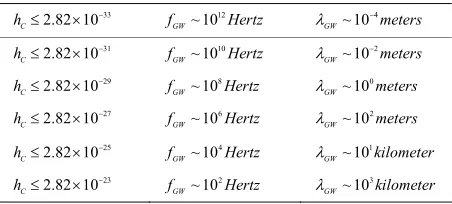
We begin with the following tables, Table 1 and Ta-ble 2. The idea will be to, if one has h00.51 0.14 , as a degree of measurement uncertainty begin as to under-stand what may be affecting an expansion of the wave lengths of pre Planckian GW/gravitons which are then increased up to ten orders of magnitude. What we have stated below in Table 2 will have major consequences as far as not only information flow from a prior to present universe, but also fine tuning the degree of GW variance What we are expecting, as given to us by L. Crowell, is that initial waves, synthesized in the initial part of the Planckian regime would have about ~ 1014
GW meters
for ~ 1022
GW
f Hertz which would turn into
1
~ 10
GW meters
, for ~ 109
GW
[image:5.595.59.285.620.722.2]f Hertz, and sensitivity
Table 2. Managing GW generation from pre planckian physics and its immediate aftermath.
33
2.82 10
C
h ~ 1012
GW
f Hertz ~ 104
GW meters
31
2.82 10
C
h ~ 1010
GW
f Hertz ~ 102
GW meters 29 2.82 10 C
h ~ 108
GW
f Hertz ~ 100
GW meters
27
2.82 10
C
h ~ 106
GW
f Hertz ~ 102
GW meters
25
2.82 10
C
h ~ 104
GW
f Hertz ~ 101
GW kilometer
23 2
2.82 10
C
h ~ 10
GW
f Hertz ~ 103
GW kilometer
30
2.82 0 C
h . This is assuming that 2
0
h
of 1
6 GW
~ 10 , using Magg
. It is por discuss the differen
iorie’s [10] analy
tant to note t models th
2
0 GW
h
i all of this, th at the
tical at when
2 ~ 6
GW
ex-pression im n
we h0 10
is drastically al-n (26
eality, on
, the fi ) should
ly the pe being
seri-ons of rst col-is th tered be 2nd
e first me surem . hC which is m also noted t be
and 3rd columns in ly off and very vita
n
a ent metr
entioned i an upper b
Table 1
ic which Equatio ound. In r
above esca
quark n o
ous different., since the interacti
gra tional waves/gravitons with – gluon
plas-mas and even neutrinos would serve to deform by at least an order of magnitude hC. So for Table 1
umn is meant to be an upper bound which, even if using Equatio (40.c) may be off by an order of magnitude. More seriously, the number of gravitons per unit volume of phase space as estimated, is heavily dependent upon
2 6
0 GW ~ 10
h .
The particle per phase state count will be given as, if
2 6
0 GW ~ 10
h [10]
4 37 2 0 10 1000 ~ 3.6 f GW Hz n h f
(25)
Secondly we have that a detector strain for device physics is given by [10]
2.82 10 21
1 CHz h
f
(26)
These values of strain, the numerical count, and also of nf
ssibl
give a bit count and entropy which
po e limits as to how much information is trans
fe
will lead to
rred. Note that the beginning of relic inflation GW
1 6
~ 10metersnf 10 graviton unit phase/
9
space for fGW ~ 10 Hertz
in pre inflationary physics of
This is to have, say a starting point
22
10 ~ GW
f Hertzwhen
14
~ 10 ,
GW meters i.e. a change of ders of
magnitude in about 1025
13
~ 10 or
seconds, or less.
3. 1
stPart of Conclusion. Can We Justify/
Isolate out an Appropriate
if one ha
on Zero Gra
It is difficult. It tandi
struc at the
mathe-matical self organized criticality structure is akin to a
fla-Wh itting
(1)
uv
T
s
N
viton Rest Mass?
depends upon unders ng what is
meant by emergent ture, we assert th
definition as to how Dp branes arise at the start of in tion. at is the emergent structure perm
,
i k i k
p dx
to hold? [1] What isticality structure leading to forming an
the self organized
cri appropriate
(1)
uv
finding
(1)
uv
T in a GW detector, its full analytical link- age to in Equation (16). The following construction is used to elucid
GW detector. This construction below is to be used to inve
/gra
ity c
space tim rresponds, as brought up in the
sy
chni-cal assistance to the author as to understanding the phase
s due to early universe cos-gnificant encouragement to
[2] A. W. Beckwith, “Identifying a Kaluza- Klein treatment permitting a de-celeration parameter Q(Z) e to standard DE “,Journal of Cosmology,
104008
018-1026, 2008
n Brane
Use the Cosmological
ate how a EM Gaussian sense beam can
(1)
perhaps be used to eventually help in isolating Tuv in a
stigate ‘massive gravitons’/and also the initial struc-ture of self organized criticality, in the aftermath of graviton vitational wave generation.
3.1. 2nd Part of Conclusion: In Terms of the
Planckian Evolution and a Pre Planckian Space Time
We wish to summarize what we have presented in an orderly fashion. Doing so is a way of stating that Analog, (Pre Ocononian) reality is the driving force behind the evolution of inflationary physics
1) Pre Octonian gravity physics (analog regime of ity) features a break down of the Octonian grav
ommutation relationships when one has curve e. This co
real-Volume 13, 2011,
http://journalofcosmology/BeckwithGraviton.pdf [3] F. Li, and N. Yang, “Phase and Polarization State of High
d Fr
Jacobi iterated mapping for the evolution of degrees of freedom to a build up of temperature for an in-crease in degrees of freedom from 2 to over 1000. Per unit volume of space time. The peak regime of where the degrees of freedom maximize is where the Octo-nian regime holds.
2) Analog physics, prior to the build up of temperature can be represented by Equation (7) and Equation (8). The first of these mappings is an ergotic mapping, a perfect mixing regime from many universes into our own present universe. This mapping requires a de-terministic quantum limit as similar to what t’Hooft included in his embedding of Quantum physics in a larger, non linear theory [11].
This will help to localize the regime of space time build up potentially giving experimental details to the formation of Equation (14) and Equation (15) above. The claim is that the physical evolution described by Equa-tion (7) and EquaEqua-tion (8) would arise, as a dynamic evo-lutionary process in the Micro physics regime leading to an embedding of quantum physics, in a larger, non linear theory, which would lead to massive gravitons being
nthesized whole scale. This whole scale synthesis of gravitons with a small rest mass occurs in initial micro physics background as indicated above, a result we hope to confirm via accurate measurements of the phase.
4.
Acknowledgements
This work is supported in part by National Nature Sci-ence Foundation of China grant No. 11075224 Dr Fan-gyu Li of Chongquing University gave extensive te
change in gravitational wave mology. Stuart Allen gave si
the author as to finalizing this document for publication.
5. References
[1] L. Crowell, Quantum Fluctuations of Space-time, in World Scientific Series in Contemporary Chemical Phys-ics, Volume 25, Singapore, Republic of Singapore, 2005.
of a Graviton as an alternativ
equency Gravitational waves”, Chin Phys. Lett. Vol
236, No 5(2009),050402, pp 1-4
[4] F. Li,. M.,Tang, D. Shi, “Electromagnetic response of a Gaussian beam to high frequency relic gravitational waves in quintessential inflationary models”, PRD 67, (2003), pp1-17
[5] S. Chaturvedi, “Mutually Unbiased Bases”, Pramana Journal of Physics, Vol. 52, No. 2, pp 345-350
[6] John C. Baez, “Renyi Entropy and Free Energy”, http://arxiv.org/abs/1102.2098
[7] A. W. Beckwith, arXiv:0804.0196 [physics.gen-ph], AIP Conf.Proc. 969:1
[8] D. K., Park, H. Kim, H., and S. Tamarayan, “Nonvanish-ing Cosmological Constant of Flat Universe i world Senarios,” Phys. Lett. B535,5-10 (2002). [9] A. W. Beckwith,” How to
Schwinger Principle for Energy Entropy, and “atoms of Space-Time” to Create a Thermodynamic Space-Time and Multiverse”; accepted for the DICE 2010 proceed-ings; http://vixra.org/abs/1101.0024, 2010
[10] M. Maggiorie,. “Gravitational Wave Experiments and Early Universe Cosmology”, Physics Reports 331 (2000) pp. 283-367
![Table 1. Coin 5 and 4 dimensions [7], with emsmological phasis upon the Mic ro physics initial regime](https://thumb-us.123doks.com/thumbv2/123dok_us/9050544.401298/3.595.319.539.599.698/table-coin-dimensions-emsmological-phasis-physics-initial-regime.webp)