INFORMATION SHARING:-THE IMPACT OF THE INTELLIGENCE REFORM AND
PREVENTION ACT OF 2004 ON U.S. NATIONAL SECURITY
*
Ositadinma Chukwuemeka Alozie
ARTICLE INFO ABSTRACT
The United States establi
2004 with the fundamental concept of improving information sharing within the Intelligence Community to boost its counterterrorism efforts in Homeland Security. The IRTPA of 2004 was established to enhance the communication channels among intelligence agencies, facilitate data exchange and analytic tradecraft etc. to reduce intelligence failures t
terrorist attacks like the September 9, 2001 terrorist attacks. Unfortunately, more than a decade after the establishment of the Act, there are doubts on the level of National Security threats after 2004 coupled with argume
Therefore, this research paper evaluates the impact of IRTPA of 2004 on homeland security focusing on the degree of terrorist activities from 1990
between 1990 hypotheses that
Copyright © 2019, Ositadinma Chukwuemeka Alozie. unrestricted use, distribution, and reproduction in any medium,
INTRODUCTION
The Intelligence Community comprises of many agencies that share overlying duties, but individual agencies have their own exclusive and definite purposes. That is, they have differing various level departments that make them to accommodate varying leadership structures and policy guidelines (Reeves 2013). Usually, the Intelligence Community is an organization synonymous with covert operations, a culture that hinders adequate intelligence information sharing among the relevant U.S. intelligence agencies responsible for national security. Undoubtedly, information sharing within the United States Intelligence Community is certainly a critical aspect of the federal government’s war against major national threats especially terrorism (Thompson 2003). Indeed, a
September 11, 2001 attacks that astonished the United States, investigators later concluded that both technical and bureaucratic obstacles were the major factors that limited sharing of intelligence gathered by different agencies that, if viewed together might have yielded useful insight into the unfolding plot (Best Jr. 2011). Therefore, in line with the 9/11 Commission’s recommendations Congress established the Intelligence Reform and Terrorism Prevention Act in December 7, 2004 (IRTPA).
*Corresponding author: Ositadinma Chukwuemeka Alozie
American Military University, USA.
ISSN: 0975-833X
Article History:
Received 05th November, 2018
Received in revised form
24th December, 2018
Accepted 29th January, 2019
Published online 28th February, 2019
Citation: Ositadinma Chukwuemeka Alozie. 2019. “
national security”, International Journal of Current Research
Key Words:
IRTPA, Terrorism, Security, Criminology, Criminal Justice, Act .
RESEARCH ARTICLE
THE IMPACT OF THE INTELLIGENCE REFORM AND
PREVENTION ACT OF 2004 ON U.S. NATIONAL SECURITY
Ositadinma Chukwuemeka Alozie
American Military University, USA
ABSTRACT
The United States established the Intelligence Reform and Terrorism Prevention Act (IRTPA) of 2004 with the fundamental concept of improving information sharing within the Intelligence mmunity to boost its counterterrorism efforts in Homeland Security. The IRTPA of 2004 was established to enhance the communication channels among intelligence agencies, facilitate data exchange and analytic tradecraft etc. to reduce intelligence failures t
terrorist attacks like the September 9, 2001 terrorist attacks. Unfortunately, more than a decade after the establishment of the Act, there are doubts on the level of National Security threats after 2004 coupled with arguments on the effectiveness of the IRTPA of 2004 on U.S. counterterrorism efforts. Therefore, this research paper evaluates the impact of IRTPA of 2004 on homeland security focusing on the degree of terrorist activities from 1990 – 2018. Comparing the level o
between 1990 – 2004 (before the Act) and 2005 – 2018 respectively, to accept or reject the null hypotheses that the IRTPA of 2004 decreases threats to National Security.
This is an open access article distributed under the Creative Commons medium, provided the original work is properly cited.
The Intelligence Community comprises of many agencies that share overlying duties, but individual agencies have their own exclusive and definite purposes. That is, they have differing various level departments that make them to accommodate rship structures and policy guidelines (Reeves 2013). Usually, the Intelligence Community is an organization synonymous with covert operations, a culture that hinders adequate intelligence information sharing among the relevant esponsible for national security. Undoubtedly, information sharing within the United States Intelligence Community is certainly a critical aspect of the federal government’s war against major national threats especially terrorism (Thompson 2003). Indeed, after the September 11, 2001 attacks that astonished the United States, investigators later concluded that both technical and bureaucratic obstacles were the major factors that limited sharing of intelligence gathered by different agencies that, if ogether might have yielded useful insight into the Therefore, in line with the 9/11 Commission’s recommendations Congress established the Intelligence Reform and Terrorism Prevention Act in
Ositadinma Chukwuemeka Alozie,
Thus, the IRTPA of 2004 (P.L.108
organizational structure of the Intelligence Community and the intelligence agencies (Reeves 2013) with a view to
repeat of the intelligence failure that led to the 9/11 attacks etc. The Intelligence Reform and Terrorism Prevention Act of 2004 was enacted on the assumptions that; enhancing the channels of communication among intelligence agencies would lead considerable improvements that will enable better and faster exchange of information, thereby encouraging greater cooperation, especially when directed to the investigation of terrorist activities (Jackson 2007). Further, data exchange will enable intelligence officials to put together pieces of intelligence information, facilitate detection of threats against the U.S., and reduces the chances of appalling intelligence failures (Sales 2010). Accordingly, enhancing analytic tradecraft will lead to reduced
2014). In addition, information sharing enables analysts’ ability to examine the broadest possible range of information, including data gathered by other agencies, with resultant system of inexpensive analysis in which several
consult a common pool of information to tackle the same intelligence question (Sales 2010). Besides, information sharing allows intelligence analysts to cross
innocent facts against other signs of
approaching the reasonable certainty of predictable threat assessments. However, to ensure closer coordination among the intelligence agencies and improve information sharing, the
International Journal of Current Research
Vol. 11, Issue, 02, pp.1417-1425, February, 2019
DOI: https://doi.org/10.24941/ijcr.33912.02.2019
“Information sharing:-the impact of the intelligence reform and terrorism prevention act of 2004 on U.S.
International Journal of Current Research, 11, (02), 1417-1425.
THE IMPACT OF THE INTELLIGENCE REFORM AND TERRORISM
PREVENTION ACT OF 2004 ON U.S. NATIONAL SECURITY
shed the Intelligence Reform and Terrorism Prevention Act (IRTPA) of 2004 with the fundamental concept of improving information sharing within the Intelligence mmunity to boost its counterterrorism efforts in Homeland Security. The IRTPA of 2004 was established to enhance the communication channels among intelligence agencies, facilitate data exchange and analytic tradecraft etc. to reduce intelligence failures that could result to catastrophic terrorist attacks like the September 9, 2001 terrorist attacks. Unfortunately, more than a decade after the establishment of the Act, there are doubts on the level of National Security threats after 2004 nts on the effectiveness of the IRTPA of 2004 on U.S. counterterrorism efforts. Therefore, this research paper evaluates the impact of IRTPA of 2004 on homeland security focusing 2018. Comparing the level of terrorist incidents 2018 respectively, to accept or reject the null the IRTPA of 2004 decreases threats to National Security.
Commons Attribution License, which permits
Thus, the IRTPA of 2004 (P.L.108-458) changed the organizational structure of the Intelligence Community and the intelligence agencies (Reeves 2013) with a view to prevent a repeat of the intelligence failure that led to the 9/11 attacks etc. The Intelligence Reform and Terrorism Prevention Act of 2004 was enacted on the assumptions that; enhancing the channels of communication among intelligence agencies would lead to considerable improvements that will enable better and faster exchange of information, thereby encouraging greater cooperation, especially when directed to the investigation of terrorist activities (Jackson 2007). Further, data exchange will ligence officials to put together pieces of intelligence information, facilitate detection of threats against the U.S., and reduces the chances of appalling intelligence failures (Sales 2010). Accordingly, enhancing analytic tradecraft will lead to reduced intelligence failures (Borek In addition, information sharing enables analysts’ ability to examine the broadest possible range of information, including data gathered by other agencies, with resultant system of inexpensive analysis in which several agencies consult a common pool of information to tackle the same intelligence question (Sales 2010). Besides, information sharing allows intelligence analysts to cross-check apparently innocent facts against other signs of potential danger, thereby ching the reasonable certainty of predictable threat However, to ensure closer coordination among the intelligence agencies and improve information sharing, the
INTERNATIONAL JOURNAL OF CURRENT RESEARCH
IRPTA of 2004 established the position of the Director of National Intelligence (DNI) as the head of the Intelligence Community, and assigned it with the responsibility of coordinating the United States intelligence efforts – monitors and directs the application of the National Intelligence Program (NIP) (Best Jr. 2010). Specifically, the regulation has it that it is the principal authority of the DNI to ensure maximum availability of and access to intelligence information within the Intelligence Community in line with the national security requirements (Best Jr. 2011). In addition, the National Counterterrorism Center (NCTC) and Information Sharing Environment (ISE) were established within the Office of the Director of National Intelligence (ODNI) (Best Jr. 2011) with the responsibilities of evaluating information regarding terrorist threats and preparing government-wide counterterrorism planning (Best Jr. 2010), and the supply of the procedures, policies, technologies and standards for the sharing of terrorism related information among federal, state, and local authorities etc. (Best Jr. 2011).
Indeed, more than a decade after the establishment of IRPTA of 2004, some intelligence analyst, some scholars, and some public observers are optimistic that the information sharing has led to drastic reduction in the number of terrorist activities taken place within the United States of America in particular, and that the Act has obviously improved national security due to the fact that the Intelligence Community has significantly suppressed key terrorist organizations that were formerly running the U.S., an issue that has resulted to enormous reduction in terrorist activities, unlike before the enactment of the Act. Those with opposing views reasoned that despite the establishment of IRTPA of 2004, there has been no substantial progress made that should elicit applause for the Intelligence Community, because terrorist activities within the U.S. continues to increase dramatically at an unprecedented rate with resultant increases in national security problems. The Act has done little in reducing the numerous terrorist activities in particular and home grown violent extremism within the United States (Sullivan 2018).However, to better understand the effect of the IRTPA of 2004 on national security, this paper evaluates the impact of IRTPA of 2004 on national security to determine whether information sharing improves national security by taken into consideration the terrorist incidents (both successful and unsuccessful) that occurred between 1990 -2018 within the United States, with the view of rejecting the null hypothesis
that IRTPA of 2004 decreases threats to national security.
LITERATURE REVIEW
Before the enactment of the IRTPA of 2004, the Intelligence Community was an organization that had structural problems due to the culture of secrecy normal to the intelligence agencies, a situation that prevented freer communication and information sharing across the Intelligence Community. The Intelligence Community was a stovepipe organization, however, this organizational structure almost restricted in its entirety the smooth upward and downward flow of intelligence information across through the lines of control, thus constraining cross organizational control, a situation that created intelligence gaps, leading to some of the intelligence failures that resulted to catastrophic incidents before the Act of 2004. The Intelligence Reform and Terrorism Prevention Act of 2004 seem the most significant legislation impacting the United States Intelligence Community after the National Security Act of 1947 (Best Jr. 2011), because the stovepipe
structure of the Intelligence Community has undergone significant restructuring, creating room for more vertical communication and information sharing across the intelligence agencies. There is more integration of the Intelligence Community due to the efforts of the Director of National Intelligence (DNI) in ensuring that the Intelligence Community is a community that delivers the most insightful intelligence possible and that the Intelligence Community operated effectively as one team (Office of the DNI, 2016). The Intelligence Community has made considerable achievements in breaking down the information-sharing, technical, and cultural obstacles across the Intelligence Community to enhance information sharing, promote strategic, unified direction, and ensure integration across the United States Intelligence Community (Best Jr. 2010). Tamanaha (2009) found that the Intelligence Community has made remarkable progresses in addressing the underlying deficiencies exposed in the 9/11 attacks which has eventually resulted to improved national security leading to a drastic decline particularly in major terrorist attacks.
Improved information sharing as the result of IRTPA of 2004 was responsible for the successful operations against Osama bin Laden in May 2, 2011 (Best Jr. 2011). Due to the Act a tangible number of initiatives has been undertaken by the Office of the Director of National Intelligence (ODNI) to increase information sharing and incorporation within the Intelligence Community (Best Jr. 2010) to ensure effective performance of the intelligence agencies in the areas of national security in particular. However, the Intelligence Community has established collaborative tools such as Intellipedia, A-Space and Library of National Intelligence – a separate data retrieval system used for artificial intelligence information (Best Jr. 2011), with the aim of enhancing counterterrorism efforts and improving national security. However, these improvements within the Intelligence Community in information sharing made possible by the IRTPA of 2004 led to the confirmation of the existence and purpose of Iran’s uranium enrichment facility at Qum (Best Jr. 2010). Sales (2010) found that information sharing allows intelligence agencies to specialize in the collection of different kinds of data, thereby producing efficiency gains, and enables officials to piece together the intelligence mosaic, which is an especially essential task in conflicts with nontraditional enemies such as terrorist organizations.
Borek noted that the IRTPA of 2004 has made some major changes in the National Infrastructure of the US as efforts such as precision-guided attack and expeditionary warfare depends essentially on the provision of information from national level systems (Borek 2014). Indeed, information sharing was responsible for the arrest of Najibulah Nazi before he could successful detonate explosives in the New York City subway in 2009, as well as other plots planned to take place in the U.S and against U.S interest abroad (Best Jr. 2011). Moreover, Arzt discovered that information sharing between the Intelligence Community and other countries bordering the United States improves border security and assist in thwarting the entrance of some terrorists or other violent criminal elements that could threaten national security (Arzt 2006). Similarly, Tortorella (2014) found that some Americans believe that the IRTPA of 2004 has generated many improvements, creating enabling environment that allows the Intelligence Community proactive response to national security threats, and the provision of better and timelier analytic support. Despite the successes so far recorded by the Intelligence Community as the result of the establishment of the Intelligence Reform and Terrorism Prevention Act of 2004, some analyst, some scholars and a section of the public are pessimistic of the capability of the Intelligence Community in ensuring national security. They are cynical of the inability of the Intelligence Community to thwart some of the successful terrorist attacks in the United States within the past decade. According to Neary (the director of strategy in the ODNI), the IRTPA of 2004 is simply a lukewarm version of intelligence reform that has ran its course, and the Intelligence Community remains fundamentally unreformed and intelligence reform remains unreformed (Best Jr. 2010). Besides, the National Intelligence Center (NIC-C) established in 2007 as part of Office of National Intelligence (ODNI) has no comprehensive collection dashboard display, no 24-hour operation capability, and no immediate mechanism to issue directive changes (Best Jr. 2010).
There are concerns that the Reform of 2004 has not done effectively and enough in safeguarding national security, considering that the United States is gradually strolling back to the labyrinth of accumulating dangerous terrorist(s) attacks especially within the U.S. Accordingly, scholars indicate that one of the most significant intelligence lapses after the IRTPA of 2004 was the inability of the Intelligence Community to track and contain the Nigerian born Umar Farouk Abdulmutallab (the underwear bomber) in 2009, who attempted to donate an explosive on an airline approaching Detroit, but was restrained by passengers and crews (Best Jr. 2011). However, a report by Senate Intelligence Committee (SIC) concluded that there were various failures to intelligence
information sharing. The Committee pointed out
inconsistencies in the distribution of key intelligence reports, a situation that could have contributed to the failure of the Intelligence Community to categorize Abdulmutallab as potential terrorists (Best Jr. 2011). Makey asserts that after years of the enactment of IRPTA of 2004, the effort to integrate the Intelligence Community has fallen far short of expectations (Makey 2009). Scholars assert that the inability of the Intelligence Community to stop the Fort Hood Shooting in November 5, 2009 is an indication of the unpreparedness of the Intelligence Community to deal with national security issues. Thus, in November 5, 2009 Army Major Nidal Hassan shot and killed 13 and wounded 44 people at the Solder Readiness Center at Fort Hood, Texas. However, an investigation by the Senate Homeland Security and Government Affairs Committee
concluded lack of appropriate information sharing about Nidal’s contact with foreign terrorists, thus, the report indicated that the Federal Bureau of Investigation (FBI) and Department of Defense (DOD) failed to recognize and to link the information they possessed despite the fact they had advantages with respect to Nidal as compared to other lone wolves (Jackson 2007). The research by Habeck & Stimson (2016) pointed out that there is significant resistance within the Intelligence Community to consolidated centers due to unique
agency cultures and hieratical views coupled with
disagreements regarding the proper size and role of the ODNI as it regards to the production of analytical products and coordination of the community’s efforts. The Intelligence Community sometimes struggles with national security issues that require consistent timely dispatch and information sharing, a situation that mostly lead to successful terror attacks. Sullivan (2018) posits that there are gaps and vulnerabilities within the Intelligence Community to the advantage of terrorist. Indeed, the failure of the Intelligence Community to put Omar Mateen on the terrorist watch list led to the June 12, 2016 mass shooting spree at a gay nightclub in Orlando during which 50 people were killed and 53 others wounded (Johnston 2018). Thus, following Mateen’s connection to a Florida native Moner Mohammed Abusalha who killed himself in a suicide attack in Syria in 2013 by driving a full explosives inside a restaurant, Mateen was interviewed by the FBI in 2013 and 2014, and was later placed in the Terrorist Screening Database (TSDB) but was remove from the database after the FBI concluded its investigation.
Nevertheless, Mateen watched extremist videos, had empathy for the jihadist cause and verbally displayed his support for terrorist organizations, and ran searches on the social media (Facebook) about past terrorist attacks (Sullivan 2018).
Furthermore, the 1st October 2017 Las Vegas shooting by
Stephen Paddock, a 64 year old wealthy retired accountant, has also been cited by some scholars as evidence that the Intelligence Community has information dissemination problem within the Intelligence Community resulting to certain levels of intelligence failures. Accordingly, there are insinuations that law enforcement officers were alerted six minutes earlier before Paddock (a self-styled terrorist) sprayed bullets from his 32nd –floor suite at the Mandalay Bay Resort and Casino, a shooting that killed 59 people and injured 527 (Johnston 2017), however, the police failed to search and get hold of him until 23 minutes later – after the shooting (Subramanian 2018), when he had killed himself.
New York. Furthermore, the 8 November, 2018 deadly shooting by 28-year old Ian David Long a former U.S. Marine at a bar in Thousand Oaks California Borderline Bar and Grill, that saw 12 people dead (Arango et al, 2018), has been cited by critics as one of the reasons of undisputable intelligence awkwardness by the Intelligence Community. Observers believe that the Intelligence Community is becoming too lax in its innate responsibilities of protecting American citizens at home. Police records indicate that Mr. Long had irrationality that could be mentally related, and that he might suffer post-traumatic stress disorder due to his military background, but never restrained him from having access to guns. Considering the past terrorists red flags and/or mode of lives, style of attacks, and nature of bombings, the IC should not be looking
up skies from underneath “iyi ala” (muddy water) when
terrorists are ruling cities in the United States. Evaluating the assertions of the optimistic scholars etc. There are credible reasons to believe that the Intelligence Reform and Terrorism Prevention Act of 2004 has contributed to a good level of improvements in information sharing unlike previously, thus resulting to considerable degree of achievement by the Intelligence Community in counterterrorism thereby improving national security. Unfortunately, most of the intelligence counterterrorism victories occurred outside the domain of the United States of America, however, counterterrorism victories abroad involving other foreign intelligence agencies cannot be wholly credited to the U.S. Intelligence Community, whose level of contribution to the defeat of such terrorists or terrorist activities may be minimal, because that will mislead the Intelligence Community by making them to relax back thinking that all is well. Besides, basing only on the pessimistic scholars etc. there are likewise concrete evidence to believe that the Intelligence Community has not been doing well after the enactment of the IRPTA of 2004 drawn from a series of successful terrorist activities that had taken place mostly within the domain of the United States, an issue of serious concern. Nevertheless, only negative reports against the Intelligence Community has the potential to demoralize them and sometimes make them to adopt a gloomy attitude and allow Americans to face their fate at home. This study will apply the mosaic theory of intelligence collection in collaboration with the National Information sharing strategies to evaluate how the IRTPA of 2004 has impacted national security through information sharing.
MATERIALS AND METHODS
This research paper will examine the terrorist activities that had taken place from 1990 – 2018 to determine the nature of the relationship between national security and the IRTPA of 2004 based wholly on the level of terrorist activities that has occurred. This is important to determine whether there is an increase or decrease in terrorist activities within the United States after the establishment of the IRPTA of 2004, to accept or reject the null hypothesis. Understanding, whether there is a linear or nonlinear relationship between terrorism activities and the IRTPA of 2004 will enable the Intelligence Community and policy makers to ascertain the level of national security risk involved and where to concentrate more counterterrorism efforts. This research will focus on the level of terrorist activities that took place 1990 – 2004 (December 31) thus before the establishment of the Act to understand the level of terrorist activities within the U.S and on the extent of terrorist activities that occurred between 2005 – 2018 with the view of
understanding the degree of terrorist incidents that took place and the level of Intelligence Community counterterrorism efforts to combating such terrorist activities. Comparing whether there is a linear or nonlinear relationships in the two sub periods to terrorist activities (1990 – 2004 and 2005 – 2018) will help to determine the impact of the IRTPA of 2004 on national security. Understanding the pattern of the relationship is necessary due the possibility of information bias, wrong classification, and negative psychological effects on the available data that could result to erroneous conclusion of an outcome. In this study numerical variables of one (1) and zero (0) are first assigned to successfully terrorist attacks and thwarted terrorist attacks from 1990 – 2004 and from 2005 – 2018 respectively, and the values obtained summed up and divided by the Total Terrorist Incidents between 1990 (base year) to 2018 to get the percentage of successful and thwarted terrorist activities within the sub periods. In addition, the percentages obtained graphed to display the charts depicting the level of successful and thwarted terrorist activities within the homeland. However, the methodology used here is important for understating the movement of terrorist activities within the U.S. after the Act of 2004 to establish a relationship between Information sharing and National Security. Thus, to determine whether information sharing brings about true all-source analysis, deliverance of timely, and objective intelligence (McConnel & Meyerrose 2008) that improves homeland security.
RESULTS
Examining figure 4 to understand the level of successful and thwarted terrorist incidents that took place per year in the U.S. from 1990 – 2004 (before the Act) shows that the largest number of terrorist activities took place in the year 2012 with a total terrorist incidents of fourteen (14) – 12 successfully carried out while only two (2) were thwarted, thus in this year terrorist succeeded in carrying out terrorist attacks 85.71% of the time while the Intelligence Community only thwarted them 14.29% of the time. Nevertheless, in 1992, 1995 and 1996, the IC made considerable efforts in its counterterrorism efforts, as it thwarted them correspondingly. The U.S. witnessed relative peace in the year 2000 as there was no recorded terror incident. However, from 1990 to 2001 excluding ’92, ’95, ’96, and 2000 the Intelligence Community performed abysmally as terrorists outsmarted them which led to more terrorist activities, with 1990 and 1991 recording all terror without anyone thwarted. More so, from 2003 to 2004 the IC performed optimally as all attempted terrorist activities were botched by the Intelligence Community. However, excerpt the disaster of 9/11, before the passage into law of IRTPA of 2004, the Intelligence Community performed significantly in their counterterrorism efforts to improve national security.
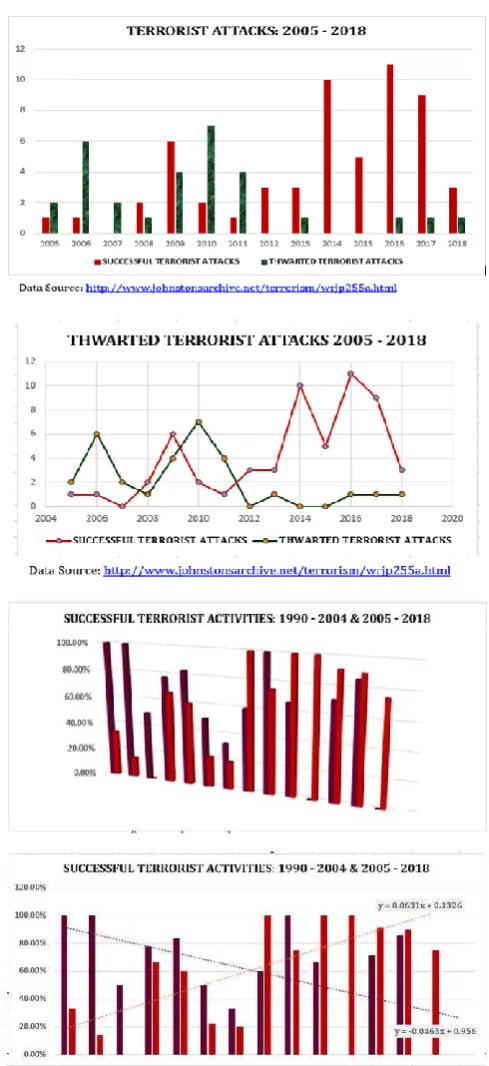
From some observers perspective, it might be difficult to figure out the degree of successful and thwarted terrorist activities within the U.S. domain from 1990 – 2004, therefore, figure 5 indicates the scatter graph of successful terrorist attacks and thwarted terror attacks from 1990 – 2004. You can see that the Intelligence Community made significant efforts most of the periods under consideration here, to thwart terrorist activities and secure national security, although the curve reached an unlikeable peak but later fattened out to compensate for the weakness caused by the peak value. Examining figure 6 to comprehend the extent of successful and thwarted terrorist occurrences that took place per year in the U.S. from 2005– 2018. (After establishing the Act) shows that the largest number of terrorist activities took place in the year 2016 with a total terrorist incidents of twelve (12), with eleven (11) of them successfully carried out while only one (1) was thwarted, so, in this year alone terrorist throve in carrying out terrorist attacks 91.67% of the time while the Intelligence Community only thwarted 8.33%. However, in the years, 2006, 2007, 2010 and 2011, the IC met public expectation as they made substantial counterterrorism efforts resulting to prevention of terrorist activities, making most remarkable efforts in 2007 as it thwarted all the terrorist attempts. Nonetheless, from 2005 to 2018 excluding ’06, ’07, ’10, and 2011 the Intelligence Community performed appallingly as terrorists outmaneuvered them which led to more successful terrorist activities, with 2012, 2014 and 2015 recording all successful terrorist activities without a single one thwarted. Further, from 2012 to 2018 the IC performed far below public expectation, this range indicated consistently higher than acceptable level of successful terrorist activities with lean IC counterterrorism efforts. An indication of increasing insecurity and threats to National Security. Again Figure 7 indicates the scatter graph of successful terrorist attacks and thwarted terror attacks from 2005 – 2018. Inspecting the chart shows that the Intelligence Community made satisfactory counterterrorism efforts in dealing with terrorist activities within the U.S. However, unfortunately, the IC counterterrorism efforts started declining 2012, and gradually worsened to 2018. Figure 7 successful terrorist activities curve depicts several peak value points as observable from the superimposition of both curves, an indication of lack of effectiveness in proactively combating terrorism.
Figure 8 is a comparison of the successful terrorist activities from 1990 - 2004 and from 2005 – 2018 using a 3-D Clustered Column bar chart. Groping this chart indicates how successful terrorist activities compare within the relevant years. The plum bars represent successful terrorist activities from 1990 – 2004 (before the Act) while the red bars represents successful terrorist activities from 2005 – 2018. Figure 9 is used to understand how successful terrorist activities reacts with increasing number of years (1990 -2004) and (2005 – 2018) respectively.
The SLOPE function was used to determine the nature of the slope of the curve in relation to years for the two sub periods: 1990 – 2004 and 2005 – 2018. Figure 9 shows that the slope of the trend line equation for successful terrorist activities (1990 –
2004) has a negative (m < 0) value of - 0.0463 implying that
[image:6.595.311.556.171.705.2]activities (2005 – 2018) has a positive value (m > 0) of 0.0631, implying that successful terrorist activities increases with increase in the number of years, moving from left to right. The slope of the two independent curves suggest the IC became less effective after the enactment of the Intelligence Reform and Terrorism Act of 2004. Obviously, evaluating terrorist activities from 2005 – 2018, there is evidence of steady upward movements in successful terrorist activities within the United States that tends to increase with increase in the number of years. There are also indications of diffused efforts by the IC to thwart terrorist attacks during which all attempted terrorist attacks were successfully carried out. Besides, the above selected figures examined for the sub period of 2005 – 2018 shows tangible proof of unpreparedness within the Intelligence Community as evidenced by its consistent declining victory against terrorist in its homeland counterterrorism efforts. However, there is increase in the number of successful terrorist activities within the homeland, after the Act of 2004. This is an indication of intelligence gaps that cast aspersion on the effectiveness of information sharing within the Intelligence Community and among the intelligence agencies. Thus, there is an indirect relationship between national security and information sharing, implying that national security decrease with increase in information sharing. In addition, putting figure 3 and other figures groped for thwarted terrorism attacks under consideration tends to disprove what might be inferred from the pattern of terrorist activities from 2005 - 2018.
The slope of the curve of thwarted terrorist activities is positive, thus, suggesting that terrorisms prevention increases with increase in information sharing. Figure 3 implies that information sharing results to more prevention of terrorist activities, implying a positive linear relationship between information sharing and national security, unlike before the establishment of the Act which has a result lagging by 17.64%. There is no doubt that despite the influence of the IRTPA of 2004 the national security threats continues to increase at an alarming rate. The pattern of figure 2 suggest that the Act might have forced some terrorists and terrorist organizations to device decisive means of maneuvering the Intelligence Community, and to indulge in the use of sophisticated methods and technology, looking for gaps to exploit the Intelligence Community, thereby taken U. S. unawares. In addition, it also suggests lack of the creation of an effective up-to-date counterterrorism network which requires that information flows more freely through the Intelligence Community and the breakdown of institutional boundaries (Field 2009), couple with other structural problems etc. That hinders more prevention of terrorist activities before they are successfully carried out.
Conclusion
The changes instituted by the Intelligence Reform and Terrorism Prevention Act of 2004 in the Intelligence Community has reshaped the community’s former procedures on national security, resulting to more recorded successes in terrorism prevention, but unfortunately, the Intelligence Community still faces a great upheaval in its counterterrorism efforts on the homeland. Terrorists seem to strategize, re-train and reequip faster, and have better access to complex technologies than the Intelligence Community. Besides, the Intelligence Community sometimes overlook the importance of homeland security and instead focus most of their attentions on combating terrorist activities in foreign countries, thereby given
terrorists operating in the U.S. the opportunity to successfully hit their targets. So, this foreign concentration often result to slow response by counterterrorism agencies who needed to take action against much broader range of terrorist targets within the United States and intervene far earlier in the process of radicalization, recruitment and attack planning (Field 2009). There are indications that the fear of failure remains palpable in the Intelligence Community, thus, Intelligence Community members do not want to be later queried for certain actions they may have taken during counterterrorism efforts. According to Habeck and Stimson (2016) there is a development of a well-founded fear of failure within the Intelligence Community, of being blamed by the public and policymakers, a situation that can lead to risk aversion, creating opportunities for more successful terrorist attacks. Many agencies are still observant of their principle, as they continue to adhere to their modus of operation before the Act of 2004. Some intelligence agencies are still mindful of their own practices in terms of procedures, thus, the mindsets and cultures of different intelligence agencies continue to obstruct the kind of moderately overt and collaborative platforms made accessible by the changes the IRTPA of 2004 introduced (Office of the DNI, 2016). Legal barriers is another problem that continues to reduce the effectiveness of the Intelligence Community in its counterterrorism efforts especially within the U.S. Obviously, in law enforcement, a case is carefully built based on admissible evidence which is handled in a prescribed manner, and a definite set of procedure is precisely followed to ensure the successful prosecution of the case in the court of law (Jackson 2007).
activities from 2005 –2018, because of the presence of
accusations of number manipulations and perhaps
misclassification to appease interested parties, policyholders, appear clean etc. According to Habeck and Stimson (2016) “the ongoing investigation into allegations of intelligence-analysis manipulation at Central Command’s intelligence shop, for instance, has exposed the problem of a preferred narrative that analyst are presume to maintain”. There is alteration of finish products by managers, and analysts are even threatened if the analyst does not obey (Habeck & Stimson 2016). Therefore,
the null hypothesis that IRTPA of 2004 decreases threats to
national security is rejected. When well harnessed information sharing is an important aspect of counterterrorism efforts etc. However, the current dynamically changing terrorist threats demands that information is shared expeditiously and dynamically to all participants, therefore, analysts and collectors need to be able to piece together fragments of information from all intelligence sources (McConnel & Meyerrose 2008) to be able to connect the dots.
There is need to foster in a culture of diversity of views and analytical conclusions within the Intelligence Community, this is necessary given the dangers of groupthink suggested by the investigation at Central Command, as well as the IC’s failure to foresee the Arab Spring, the reappearance of al-Qaeda, and other national security challenges (Best Jr. 2010). Moreover, IRTPA should be amended to remove obstacles that might prevent information sharing within the Intelligence Community because risk averse bureaucrats facing legal commands of unclear meaning could withhold action to avoid litigation (Sales 2010). While information sharing seem to be important for the counterterrorism mission, and other Intelligence Community efforts in protecting national security, there is vital need for secrecy, because sharing all intelligence information may result to would be clandestine information getting to the wrong hands. Accordingly, the concept of secrecy is the main characteristics of intelligence. In the concept of secrecy Abram Shulsky emphasizes the need for secrecy in intelligence activities and organizations, thus, referring to secrecy as a constitutive element of intelligence work (Gustavo 2005). Obviously, secrecy is the power behind enemy defeat, because sometimes within the agencies, the enemy might have plants instructing and guiding him on, when, where and how to carry out nefarious acts. Indeed, without some level of secrecy, valuable intelligence and its method might be jeopardized. Although, open discussion of intelligence questions is now accepted as normal part of the public debate concerning government activities generally, however, the sources of information and the methods by which the information is gathered must remain unknown to the targets of intelligence (Gustavo 2010). The Intelligence Community must not relegate lone wolf attacks to the background because lone wolf might be a messenger from a pack of wolves, trained and guided to test the vulnerability of the United States homeland security outfit, pending major terrorist attacks. The Intelligence Community should abandon the notion that lone wolf terrorist attacks are difficult to handle, and instead re-assure the public of concerted efforts to improve homeland security, because majority of terrorist threats and/or national security threats facing the U.S. resides mostly within which majority of them presently occurs as lone wolf attacks.
REFERENCES
Arzt, Sigrid. 2006. “U.S. –Mexico Security Collaboration: Information sharing and Law Enforcement Cooperation”.
Rowman and Littlefield Publishers, 357. Lanham,
Maryland. Accessed 26, 2018. ABI/Inform Global database. Best Jr., A. Richard. 2010. “Intelligence Reform after Five Years: The Role of the Director of National Intelligence
(DNI)”. Congressional Research Service, 2-14. Accessed
November 25, 2018. https://fas.org/sgp/crs/intel/R41295.pdf Best Jr, A. Richard. 2011. “Intelligence Information:
Need-to-know vs. Need-to- Share.” Congressional Research Service
2-5. https://fas.org/sgp/crs/intel/R41848.pdf
Borek, J. John. (2014). “Developing an Understanding of Analytic Tradecraft in the Intelligence Community”.
Davebucklin Bulletins, 2-15. Accessed December 17, 2018.
https://davebucklin.com/icfiles/SSRN-id2453641.pdf Field, Anthony. (2009). “Tracking Terrorist Networks
Problems of Information sharing within the UK Intelligence
Community”. Review of International Studies. Accessed
December 8, 2018. ABI/Inform Global database.
Habeck Mary and Stimson Charles. 2016. “Reforming Intelligence: A Proposal for Reorganizing the Intelligence Community and Improving Analysis”.
Backgrounder. Accessed December 08, 2018.
https://www.heritage.org/defense/report/reforming-intelligence-
proposal-reorganizing-the-intelligence-community-and
Jackson, T. 2007. “The Need to Share: The U.S. Intelligence
Community and Law Enforcement.” Armed Forces
Communications and Electronics Association AFCEA
https://www.afcea.org/mission/intel/documents/SpringIntel07w hitepape r_000.pdf
Johnston, W. Robert. (2017). “Terrorist Attacks and Related Incidents in the United States. Accessed December 21, 2018.
http://www.johnstonsarchive.net/terrorism/wrjp255a.html Matey, Gustavo D. 2009. “Learning to Live with Intelligence”.
Intelligence and National Security 18(4). Accessed
November 12, 2018. https://www.ucm.es/
data/cont/media/www/pag-72533-09/Gustavo2.pdf
McConnel, J. M and Meyerrose Dale. 2008. “Information
Sharing Strategy.” Office of the Director of National
Intelligence 2-13. Accessed November 13, 2018.
https://fas.org/irp/dni/iss.pdf
Office of the DNI (ODNI). 2016. “15 Years Later: 9/11 and the Evolution of the American Intelligence Community”.
ODNI. Accessed December 21, 2018. ABI/Inform Global
database.
Reeves, A. Brennan. (2013). “The Implications of the Intelligence Reform and Terrorism Prevention Act for U.
Bureaucracies”. University of Alabama, 3-9. Accessed
November 24, 2018. http://www.mhsl.uab.edu/
dt/2013/Reeves_uab_0005M_11231.pdf
Sales, N. Alexander. 2010. “Mending Walls: Information
Sharing After USA PATRIOT ACT”. Texas Law Review,
88(7), 1799 – 1812. Accessed December 06, 2018.
ABI/Inform Global database.
Subramanian, Courtney. (2017). “Las Vegas Shooting: What
was Stephen Paddock’s Motive?” BBC News. Accessed
December 25, 2018. https://www.bbc.com/news/world Sullivan, M. Elizabeth. (2018). “Beware the Terror Gap:
Closing the Loophole between the U.S. Terrorist Watch list
System and the Right to Bear Arms”. Cornell Law Review,
103(205), 206 – 209. Accessed November 30, 2018.
http://www.cornelllawreview.org/files/2017/11/5.Sullivann otefinal.pdf
Yale Law & Policy Review, 28(2), 419-425. Accessed
December 03, 2018. https://digitalcommons.law.
yale.edu/cgi/view content.cgi? referer=https:// www.
google.com/&htt psredir=1&article =1597 &context=ylpr Thompson, Larry. D. 2003. “Intelligence Collection and
Information Sharing within the United States.” Brookings.
Accessed November 16, 2018. https://www
.brookings.edu/testimonies/intelligence-collection-and- information-sharing-within-the-united-states/
Tortorella, Francesca. 2014. “Under Pressure: U.S. Intelligence
Analysis in the Wake of 9/11 and Iraq”. II Mondo
Intelligence, 2-12. Accessed November 02, 2018.
https://www. sicurezzanazionale.gov.it/sisr.nsf/wp- content/ uploads/2014/11/US-Intelligence-Analysis-After-9-11-Francesca- Tortorella.pdf
The author of this article can be reached by phone at
2349032665271 or via email at osvconsultancy
@gmail.com; [email protected]