Analysis of Mobile Phone Reliability Based on
Active Disassembly Using Smart Materials
*
Zhifeng Liu, Liuxian Zhao, Jun Zhong, Xinyu Li, Huanbo Cheng
School of Mechanical and Auto Engineering, Hefei University of Technology, Hefei, China. Email: [email protected]
Received March 14th, 2011; revised April 30th, 2011; accepted May 8th, 2011.
ABSTRACT
When using shape memory materials into active disassembly of actual electronic products, because the elastic modulus of shape memory materials is affected by the temperature is relatively large, therefore, the main difference of environ-mental reliability between active disassembly products and common products is the impact of collision and vibration under different temperature. Establishing three-dimensional analysis model, comparing the impact of collision and vi-bration of mobile phone shells which are made up of PVC materials after casting & radiation and PC/ABS materials under different temperature. Analyzing the reliability of mobile phone under different temperature and optimizing its structure according to data of testing.
Keywords: Active Disassembly, Mobile Phone, Environmental Reliability, Analysis of Collision, Analysis of Vibration
1. Introduction
With the rapid development of electronic technology, it is growing demand for electronic products and the pace of elimination of these products is accelerating which result in the serious pollution of environment. Therefore, Design for Disassembly (DfD) of products is getting more and more attention in order to meet the require-ments of environment protection [1,2]. However, the current disassembly process of products is only one to one; that is to say, worker can only disassemble one product at one time. It is very difficult to achieve the automation and assembly line of disassembly process of products. What is more, the disassembly process can pose threat to human health. So, it is a growing concern of people about how efficiently to recycle and reuse these obsolete electronic products [3-5].
In recent years, with the deep research and extensive application of smart materials, the method of Active Disassembly using Smart Materials (ADSM) is getting more and more concerns [6-10]. The technology of ADSM was put forward by Dr. Chiodo in Brunel Uni-versity at 1997. Active disassembly using smart material (ADSM) is a method using shape memory material to replace fastener, when it is heated to the stimulated tem-perature, the product can be disassembled actively. The
R&D center of Nokia, Helsinki University of Technolo-gy and Helsinki University of Art and Design started to research the active disassembly of mobile phone in co-operation at 2000-2001, which aimed to develop a ther-mal stimulated mechanical structure for simplifying the recycling process of mobile phone. By testing, the aver-age disassembly time of mobile phone using ADSM is 2s, which is only 1/50 of the average disassembly time using artificial. Therefore, the method of ADSM can improve the efficiency of disassembly and achieve the economic and efficient recycling of mobile phone. The active disassembly tests of mobile phone and radio are shown in Figure 1 [11].
Any brand of mobile phone needs to go through ri-gorous testing to verify whether the mobile phone can meet the required reliability norms before sales in the market. Environment is one of the most important factors which affect the reliability of mobile. According to some materials, it is about 52% accidents of electronic prod-ucts are caused by environment. Including 40% are caused by temperature, 27% are caused by vibration, 19% are caused by humidity and the remaining accidents are caused by dust, smoke etc [12].
The main difference between active disassembly mo-bile phone and common momo-bile phone is that active dis-assembly mobile phone is made up of smart drives or active disassembly fasteners using shape memory alloy
Figure 1. The active disassembly tests of mobile phone and radio [11].
(SMA) or shape memory polymer (SMP). And put the drives and fasteners into the product when design and assembly. Because properties of SMA and SMP are easy to be affected by temperature, so, the main difference of reliability between active disassembly mobile phone and common mobile phone is caused by collision and vibra-tion under different temperature.
2. Constructing the CAD Model of Active
Disassembly Mobile Phone
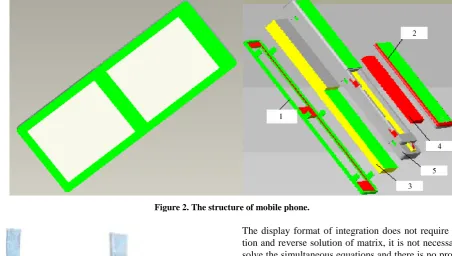
Constructing active disassembly mobile phone model used three-dimensional modeling software according to the structure of bar phone. As shown in Figure 2.
In order to be simple and can explain the problem, this phone model consists five parts. Number the parts ac-cording to the order from the outside to the inside, 1 - front cover, 2 - battery compartment cover, 3 - LCD screen and the circuit board, 4 - battery, 5 - back cover. The active disassembly fasteners of front cover and back cover are made up of PVC material which receives ir-radiation after casting, the dose of ir-radiation is 4kGy (SMP for short). There are two L shaped slot in the area of back cover in order to place Ni-Ti memory alloy films which act as drive of disassembling the battery, the drive can be changed by changing the size of memory alloy films, shown in Figure 3.
Here select the stimulation temperature of Ni-Ti memory alloy films as 75˚C. The size of phone model is 105 mm × 45 mm × 8 mm, the screen is 2 inch on stan-dard, and the thickness of shell is 1 mm. The shell of common mobile phone is made up of PC/ABS. The properties of the shell of active disassembly mobile phone and common phone are shown in Table 1.
Table 1. The properties of SMP and PC/ABS.
Name Density
kg/m3
Elastic modulus GPa
Tensile strength MPa
Poisson’s ratio
SMP 1000 3.7 70 0.4
PC/ABS 1140 2.5 80 0.3
3. Analysis of Collision of Active
Disassembly Mobile Phone
Simulating the free falling body of mobile phone using computer simulation in order to observe the response of mobile during the process of free falling body.
3.1. Establishing the Equation of Collision
Establishing the equation of collision before analyzing the collision of mobile phone using Abaqus. The equa-tion of collision can be described as below under the overall coordinate system.
ex
Ma+Cv+Kd=F , (1)
in which M means the mass matrix of the structure, C
means the damping matrix of the structure, K means the stiffness matrix of the structure, a means the vector of the acceleration, v means the vector of the velocity, d means the vector of the displacement, Fex means he vector of the external forces including the force of collision.
If order Fin =Cv+Kd and suppose
re ex in
F =F −F , then equation of collision can be de-scribed as below.
re
Ma=F , (2)
[image:2.595.310.537.331.391.2]freedom is independent. That is,
Figure 2. The structure of mobile phone.
Figure 3. The Ni-Ti memory alloy films before and after deformation.
(
)
, 1, 2, ,
re
i i i
M a =F i= (3)
Solving the equation of collision using display me-thod, firstly obtain the following equation by Equation (3).
re
i i i
a =F M , (4)
Then obtaining the velocity (vi) by integration of time, obtaining the displacement (di) by integration of time once again. Here, the integration of time using dis-play format of central difference. The disdis-play format of central difference is described as below.
(
)
(
)
1/ 2 1/ 2 1 2 1 2
1 1/ 2 1 2
1/ 2 1 2
2 2
n n n n n
n n n n
n n n
v v a t t
d d v t
t t t
+ − + − + + + + + = + ∆ + ∆ = + ⋅ ∆ ∆ = ∆ + ∆ (5)
Therefore, obtaining the displacement, velocity and acceleration of each discrete point of time in the overall domain of the time used the above recurrence formula.
The display format of integration does not require solu-tion and reverse solusolu-tion of matrix, it is not necessary to solve the simultaneous equations and there is no problem of convergence. Therefore, the speed of computation is much fast; the criteria of stability can automatically con-trol the step of time and ensure the speed of integration [13].
3.2. The Model of Finite Element Analysis
The experimental condition of the example is shown in Figure 3. The shell of mobile phone collides with the rigid plane from a height of 2 mm by free falling body. The element type of mobile phone shell is C3D8R, eight-node, reduced integration, linear, solid element, and the rigid plane uses discrete rigid body for simula-tion. Selecting the type of parts as discrete rigid body when constructing the model, therefore, it is not neces-sary to define the properties of materials. Selecting Ex-plicit solver in Abaqus [14]. The properties of materials of mobile phone shell are shown in Table 1.
3.3. Analysis of the Result of Collision
Simulation
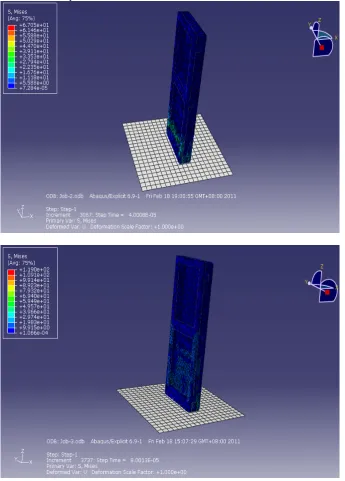
Simulating the mobile phone collides with the rigid plane by Abaqus finite element method. As shown in Figure 4.
up of PC/ABS can be destroyed falling on the rigid plane from a height of 2 m at room temperature. Thus, the
[image:4.595.127.473.108.590.2]re-liability of mobile phone made up of SMP is higher than
Figure 4. The collision experiment of mobile phone using SMP and PC/ABS.
the reliability of mobile phone made up of PC/ABS. The maximum stress of collision of active disassembly mobile phone and the common mobile phone under dif-ferent temperature are shown in Table 2 and Table 3.
4. Analysis of Vibration of Active
Disassembly Mobile Phone
4.1. The Analysis Model of Mobile Phone
4.2. Analysis of the Result of Vibration
Simulation
The mobile phone can only move alternatively along the Table 2. The maximum stress of collision of active disas-sembly mobile phone under different temperature.
Temperature ˚C The maximum
temperature MPa
Tensile strength MPa
20 - 60 67.1 70
70 36.5 12.9
Table 3. The maximum stress of collision of common mobile phone under different temperature.
Temperature ˚C The maximum
temperature MPa
Tensile strength MPa
[image:5.595.57.473.252.528.2]20 - 40 119 80
Table 4. The parameters of motor.
Rated voltage V (DC)
Rated Current (mA)
Rated Speed R/M
Hammer
length mm Mass g
3.0 80 20000 5 2
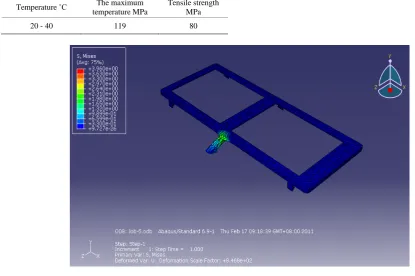
Z direction using finite element method of Abaqus. Therefore, it is necessary to define the constraints of X, Y directions and three rotation directions. The mobile phone suffers a sinusoidal alternating load, the amplitude is 2 mm, the result is shown in Figure 5.
Figure 5. The collision experiment of mobile phone using SMP.
ment is 1.54 × 10⁻² mm, while the length of connection between front cover and back cover is 0.8 mm, therefore, the fasteners between front cover and back cover do not detach and it ensures the reliability of vibration of mobile phone. The maximum stress of vibration of active disas-sembly mobile phone under different temperature is shown in Table 5.
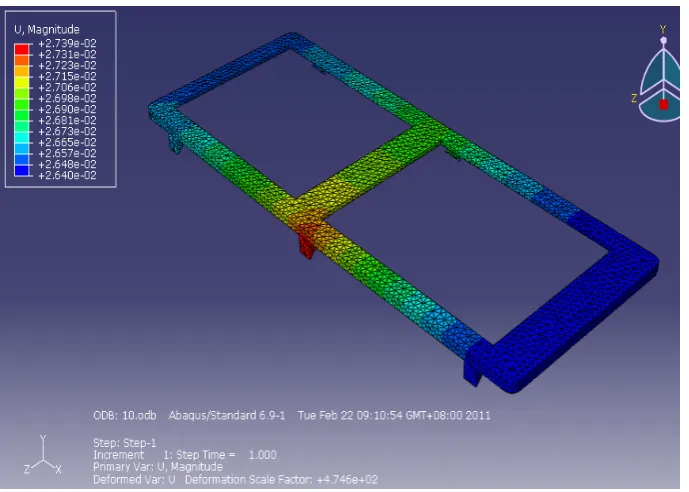
[image:6.595.128.470.452.687.2]For easy comparison, conducting the same analysis of mobile phone made up of PC/ABS, the result is shown in Figure 6.
It can be seen from Figure 6 that the maximum stress of front cover made up of PC/ABS is 0.12 MP, and the maximum displacement is 2.74 × 10−-2 mm, while the length of connection between front cover and back cover is 0.8 mm, therefore, the fasteners between front cover and back cover do not detach and it ensures the reliability of vibration of mobile phone. The maximum stress of vibration of mobile phone made up of PC/ABS under different temperature is shown in Table 6.
Figure 6. The collision experiment of mobile phone using PC/ABS. Table 5. The maximum stress of vibration of active
disas-sembly mobile phone under different temperature.
Temperature ˚C Maximum
displacement mm
The length of connection of fasteners mm
20 - 60 1.54 × 10⁻²
0.8
70 7.15 × 10⁻²
0.8
80 3.32 × 10⁻²
0.8
[image:7.595.127.472.83.329.2]90 1.54 0.8
Table 6. The maximum stress of vibration of mobile phone made up of PC/ABS under different temperature.
Temperature ˚C Maximum
displacement mm
The length of connection of fasteners mm
20-40 2.74x 10⁻² 0.8
90 1.18 x 10⁻² 0.8
PC/ABS is higher than the vibration reliability of mobile phone made up of SMP by comparison.
4.3. Optimizing the Structure of Mobile Phone
In order to expand the stress of collision and vibration quickly to other locations around the shell and obtain better mechanical performance, it is necessary to replace the material of fillet of mobile phone into magnesium alloy material, as shown in Figure 7 [15]. Currently, the price of magnesium alloy shell is about the double of
plastic shell. However, the mass of magnesium alloy is light, the density is low, the resistance to stress is rela-tively strong, the hardness is several times more than traditional plastic, but its weight is only 1/3 of ordinary plastic. Therefore, it can improve the reliability of mobile phone using magnesium alloy shell. What is more, it can make the product more attractive by treating the surface of magnesium alloy. Therefore, magnesium alloy shell can be used in high-end mobile phones [15].
5. Conclusions
1) The mobile phone made up of SMP is not destroyed falling from a height of 2 m under the room temperature, while the mobile phone made up of PC/ABS is destroyed under the same conditions. Therefore, the collision relia-bility of mobile phone shell made up of PVC material which receives irradiation after casting is higher than the collision reliability of mobile phone shell made up of PC/ABS. And it can improve the collision reliability us-ing magnesium alloy shell of mobile phone.
[image:7.595.58.284.372.471.2] [image:7.595.59.284.510.578.2]Figure 7. Magnesium alloy shell of mobile phone.
of vibration under room temperature. Because the prop-erty of SMP is easily affected by the temperature, the elastic modulus of SMP declines sharply under high- temperature condition which results in the reliability of mobile phone made up of SMP is relatively low. While the elastic modulus of PC/ABS affected by the tempera-ture is not so large, therefore, the mobile phone made up of PC/ABS can ensure the reliability of vibration under the temperature of 90˚C.
3) Mobile phone is used under the room temperature because the electronic components of mobile phone are easily destroyed under high temperature. The mobile phone made up of SMP can ensure the reliability of col-lision and vibration under room temperature, therefore, the mobile phone made up of SMP meets the environ-mental reliability.
6. Outlook
It is necessary to analyze the reliability of multi-step ac-tive disassembly products, such as the impact of collision and vibration on multi-step active disassembly mobile phone. What is more, it is necessary to research the im-pact of active disassembly on the economy and environ-ment of products.
7. Acknowledgements
Thanks to the support of NSFC item: 50775064.
REFERENCES
[1] W. Xu and J. H. Tao, “Research of Recycling Oriented Disassembly Technology,” Machine Tool & Hydraulics, Vol. 37, No. 2, 2009, pp. 24-28.
[2] K. Lee and R Gadh, “Computer Aided Design for Disas-sembly: A Destructive Approach,” Proceedings of the
1996 IEEE International Symposium on Electronics & the Environment, New Jersey, 1999, pp. 173-178.
[3] R. C. Li, J. J. Tang, X. Hong and K. G. Wu, “Harmful Influence to Environment and Recycling of Discarded Household Appliance,” Environmental Pollution and Control, Vol. 25, No. 4, 2003, pp. 109-110.
[4] F. H. Lian, Q. P. Su, M. H. Wang, Y. Zhang and G. H. Tang, “Recycling and Disposal of the Old and Waste Household Appliances,” Environmental Pollution and Control, Vol. 26, No. 1, 2004, pp. 67-69.
[5] J. Z. Li, P. Shrivastava and Z. Gao, “Printed Circuit Board Recycling: A State-of-the-Art Survey,” Proceeding of the 2002 IEEE International Symposium on Electronics and the Environment, Vol. 27, 2004, pp. 234-241. [6] K. Lee and R. Gadh, “Computer Aided Design for
Disas-sembly: A Destructive Approach” Proceedings of the
1996 IEEE International Symposium on Electronics & the Environment, New Jersey, 1999, pp. 173-178.
[7] J. D. Chiodo, E. H. Billett and D. J. Harrison, “Prelimi-nary Investigations of Active Disassembly Using Shape Memory Polymers,” Proceedings First International Symposium on Environmentally Conscious Design and Inverse Manufacturing, Tokyo, 1999, pp. 590-595. [8] S. Seelecke, “Shape Memory Alloy Actuators in Smart
Structures: Modeling and simulation,” American Society of Mechanical Engineers, Vol. 57, No. 1, 2004, pp. 23-46.
[9] Z. F. Liu, X. Y. Li and H. C. Zhang, “Research on Design Methods of Products Based on ADSM,” Chinese Journal of Mechanical Engineering, 2009, Vol. 45, No. 10, pp.
192-197
[10] Z. F. Liu, L. X. Zhao, X. Y. Li, H. C. Zhang and H. B. Cheng, “Research on Multi-Step Active Disassembly Method of products Based on ADSM,” Conference of Manufacturing Engineering and Automation, Vol. 139- 141, Guangzhou, 2010, pp. 1428-1432.
[11] J. D. Chiodo and C. Boks, “Assessment of End-of-Life Strategies with Active Disassembly Using Smart Mate-rials,” The Journal of Sustainable Product Design, Vol. 2, No. 1-2, 2002, pp. 69-82.
[12] J. Peng, “Humid and Hot Environment and Electronic Product Reliability,” Electronic Product Reliability and Environmental Testing, Vol. 5, 2003, pp. 57-60.
[13] J. P. Zu and C. Q. Xu, “The Simulation and Investigation for Free - Drop of Mobile Phone,” Manufacture Informa-tion Engineering of China, Vol. 35, No. 11, 2006, pp. 68-70.
[14] J. Ding, G. Li, C. Q. Xue and L. Yu, “A Study on An-ti-impact Property of the Bottom Shape of Plastic Mobile Phone Case,” Electro-Mechanical Engineering, Vol. 25, No. 1, 2009, pp. 42-48.
![Figure 1. The active disassembly tests of mobile phone and radio [11].](https://thumb-us.123doks.com/thumbv2/123dok_us/9070120.403447/2.595.310.537.331.391/figure-active-disassembly-tests-mobile-phone-radio.webp)