doi:10.4236/am.2011.23037 Published Online March 2011 (http://www.scirp.org/journal/am)
On the Global Convergence of the PERRY-SHANNO
Method for Nonconvex Unconstrained
Optimization Problems*
Linghua Huang1, Qingjun Wu2, Gonglin Yuan3 1
Department of Mathematics and Statistics, Guangxi University of Finance and Economics, Nanning, China
2
Department of Mathematics and Computer Science, Yulin Normal University, Yulin,China
3
Department of Mathematics and Information Science, Guangxi University, Nanning, China E-mail: linghuahuang@163.com, wqj600@yahoo.com.cn, [email protected] Received November 15, 2010; revised January 12, 2011; accepted January 16, 2011
Abstract
In this paper, we prove the global convergence of the Perry-Shanno’s memoryless quasi-Newton (PSMQN) method with a new inexact line search when applied to nonconvex unconstrained minimization problems. Preliminary numerical results show that the PSMQN with the particularly line search conditions are very promising.
Keywords: Unconstrained Optimization, Nonconvex Optimization, Global Convergence
1. Introduction
We consider the unconstrained optimization problem:
min f x xRn , (1.1) where f R: n Ris continuously differentiable. Perry and Shanno’s memoryless quasi-Newton method is often
used to solve the problem (1.1) when
n
is large. ThePSMQN method was originated from the works of Perry (1977 [1]) and Shanno (1978 [2]), and subsequently de-veloped and analyzed by many authors. Perry and Shan-no’s memoryless method is an iterative algorithm of the form
1
k k k k
x x d , (1.2) where k is a steplength, anddkis a search direction
which given by the following formula:
1 1
d g , (1.3)
1 1
1 2 1 2
1 2
2
, 1
T T T
k k k k k k
k k T k
k k
k k
T k k
k k
y s y g s g
d g s
y s
y y
s g
y k y
(1.4)
wheresk xk1x yk, k gk1gkand gj denotes the
gradient of f at xj. If we denote
2 2
1 2
T
k k k k T
k T T T k k
k k k k k k k
y y y y
B I s s
y s y s s y s
(1.5)
and
1
1 1
k k
H B ,
then
1 2 2
1 2
T T
T T
k k k k
k T k k k k
k k
k k
y s s s
H I s y y s
y s
y y
. (1.6)
By (1.4) and (1.5), we can rewrite dk1 as
1 1 1
k k k
d H g .
In practical testing, it is shown that the memoryless method is much more superior to the conjugate gradient methods, and in theoretic analysis, Perry and Shanno had proved that this method will be convergent for uniform convex function with Armijor or Wolfe line search. Shanno pointed out that this method will be convergent for convex function if the Wolfe line search is used. De-spite of many efforts has been put to its convergence behavior, the global convergence of the PSMQN method is still open for the case of f is not a convex function. Recently, Han, Liu and Yin [3] proved the global con-vergence of the PSMQN method for nonconvex function under the following condition
lim k 0
k s .
The purpose of this paper is to study the global con-vergence behavior of PSMQN method by introducing a new line search conditions. The line search strategy used in this paper is as follows: find tk satisfying
2 41
min ,
T
k k k k k k k k k k
f x t d f x t g d g t d
(1.7) and
T Tk k k k k k
g x t d d g d , (1.8) where1
0,1 s a small scalar and
1,
is alarge scalar. It is clear that (1.7) and (1.8) are a modifica-tion of the weak Wolfe-Powell (MWWP) line search conditions.
This paper is organized as follows. In Section 2, we present the PSMQN with the new line search MWWP. In Section 3, we establish the global convergence of the proposed method. The preliminary numerical results are contained in Section 4.
2. Algorithm
By combining the PSMQN and the MWWP, we can ob-tain a modified Perry-Shanno’s memoryless quasi-Newton method as follows:
Algorithm 1 (A Modified PSMQN method: MPS- MQN)
Step 0: Given 1
n
x R , set d1 g k1, 1. If g10,
then stop.
Step 1: Find a tk 0 satisfying MWWP.
Step 2: Let xk1xkt dk k and gk1g x
k1
. If1 0
k
g , then stop.
Step 3: Generate dk1 by the PSMQN formula (1.4).
Step 4: Set k: k 1, go to Step 1.
3. Global Convergence
In order to prove the global convergence of Algorithm 1, we will impose the following two assumptions, which have been used often in the literature to analyze the glo- bal convergence of conjugate gradient and quasi-Newton methods with inexact line searches.
Assumption A. The level set
1
n
x R f x f x
is bounded.
Assumption B. There exists a constant
L
such that for anyx y, ,
g x g y L xy . (3.1)
Since
f x
k
is a decreasing sequence, it is clear thatthe sequence
xk generated by Algorithm 1 is containedin, and there exists a constant f, such that
lim k
k f x f
. (3.2)
Lemma 3.1 Suppose that Assumption A holds and there exists a positive constant such that
k
g . (3.3) then,
2
lim k k 0
kt d (3.4)
and
2
lim k k 0
kt d . (3.5)
Proof. From (3.2), we have
1 1
1 1
1 1
1
lim
lim
.
N
k k k k
N
k k
k N
f x f x f x f x
f x f x f x f
thus
1
1
,
k k
k
f x f x
which combining with
2 41
min ,
T
k k k k k k k k k k
f x t d f x t g d g t d and (3.3), yields
4 2
1 k k k
t d
, (3.6)and
1 T k k k k
t g d
. (3.7)therefore, (3.4) and (3.5) hold.
The property (3.4) is very important for proving the global convergence of Algorithm 1, and it is not known yet for us whether (3.4) holds for other types line search (for example, the weak Wolfe-Powell conditions or the strong Wolfe-Powell conditions).
By using (3.4) and the result given in [3], we can de-duce that Algorithm 1 is convergent globally. In the fol-lowing, we give a direct proof for the global convergence of Algorithm 1.
Lemma 3.2 Assume thatBkis a positive definite
ma-trix. Then
2
k
r k T
k k k g
T B
g H g . (3.8)
Proof. Omitted.
Lemma 3.3 Supposed that Assumption A and B hold, and xk is generated by Algorithm 1.Then there exists a
1 k k i t ck
. (3.9)Proof. By (1.5) and (1.6), we have
1
2k
r k T
k k y
T B n
y s
, (3.10)
and
1
2
2 2 2T
k k k
r k T
k k k
y s s
T H n
y s y
. (3.11)
From
y sTk k
2 sk 2 yk 2, we obtain
1
2
2 2 2T
k k k
r k T
k k k
y s s
T H n
y s y
. (3.12)
Using (1.8) and (3.12), we have
1
21
k k k
r k T
k k k t H g n
T H
g H g
. (3.13)
By using the positive definiteness of Hk, we have
2
k k
r k T
k k k H g
T H
g H g , (3.14)
from which we can deduce that
1
11
1
k
k
r k r k
i n
T H T H t
. (3.15)By the Assumption B, (3.10) and (1.8), we get
2 1 2 2 2 2 2 1 1 1 1 , kr k T
k k k T k k k k k T
k k k
k k k T
k k k
k r k y
T B n
y s s nL g s H g nL t
g H g
H g c t
g H g
c t T H , where 2 1 1 nL c
. Combining with (3.15) yields
1
1 1
11
1
k k
r k k r k
i n
T B c t T H t
.Adding above inequality to (3.15), we obtain
1
1 1 1
1
1
1 .
1
k
r k r k k r k
i
c n
T B T H T H t
n
Now, if we denote the eigenvalues of Bk by
1, 2, ,
k k kn
h h h , then the eigenvalues of
H
k are1 2
1 1 1
, , ,
k k kn
h h h , so we have
1
1
1
1 2
n
r k r k ki
i ki
T B T H h n
h
.Thus we have
1 1 1 2 1 1 1 k k k i r n t c n T H n
.Hence there exists a positive constant
c
such that1 k k k i t c
. Therefore 1 k k i t ck
.Theorem 3.1 Supposed that Assumption A and B hold, and
x
k is generated by Algorithm 1.Thenlim inf k 0
k g . (3.16) Proof. Suppose that the conclusion doesn’t hold, i.e., there exists a positive constant
such thatk
g .
From (3.3), (3.10) and Lemma 3.3, we have
2 1 2 2 2 2 2 2 2 2 2 2 2 2 2 1 2 1 1 2 2 1 1 1 1 1 1 1 , kr k T
k k
k T
k k k k
k k T
k k k k k
k k
T k k k k
k
r k k
k
k k
r i i
i i
k k
r i i
i y
T B n
y s y n
t g H g
y g
n
t g g H g
nL s g
t g H g nL s
T B t
nL
T B s t
c T B t d
where
2 2 2 1 nL c there exists a positive constant
k
0 such that2 2
1
i i t d
c
for all ik0.
Therefore
0
0 0
0
0 0
2 2
1 2 2 1
1 1
2
2 1 3
1
3
1 3
1
1
.
k k
k k k
r k r i i i i
i i k
k k
r i i
i
k i i
T B c c T B t d t d
c T B t d c
c k
c t c
Hence from the above inequality and Lemma 3.2 and Lemma 3.3, we have
3
1 1
1 3
2 1 3
2 1
.
k k
k
i i k i r k
T k k k k
i k
T k k k k i
t c t
c T B
t
c t g H g
c g
c
t g H g c
Therefore
1 k i
t
,which contradicts to Lemma 3.3. Thus (3.16) holds.
Remark: In this remark, we give a cautious update of Perry-Shanoo’s Memoryless quasi-Newton method (CP- SMQN), we do not discuss the global convergence here. We let it to be a topic of further research.
Algorithm 2: (CPSMQN method)
Step 0: Given 1
n
x R , set d1 g k1, 1. If g10,
then stop.
Step 1: Find a tk 0satisfying WWP.
Step 2: Let xk1xkt dk k and gk1g x
k1
. If1 0
k
g , then stop.
Step 3: Choose Bk1 by the following equation and
Generate dk1,
2 2
2 2
1
if ,
else
T T
k k k k T k k
k k
T T T
k k k k k k k k k
k
y y y y g s
I s s m
B y s y s s y s s
B
(3.17) where m is a positive constant.
4. Numerical Experiments
In this section, we report the numerical results for
PSM-QN, MPSMQN and CPSMQN method. The problems that we tested are from [4]. For each test problem, the termination condition is
5
10
)
(
x
k
g
.We will test the following three methods:
•PSMQN: the Perry-Shanno’s Memoryless quasi-
Newton method with the WWP, where 0.1 and
0.9
;
•MPSMQN: Algorithm 1 with 0.1, 0.9,
16 1 10
and 10;
• CPSMQN: Algorithm 2 with 0.1, 0.9 and
18
10
m .
In order to rank the iterative numerical methods, one can compute the total number of function and gradient evaluations by the formula
,
total
N NF m NG (4.1)
where NF NG, denote the number of function
evalua-tions and gradient evaluaevalua-tions, respectively, and m is some integer. According to the results on automatic dif-ferentiation ([5] and [6]), the value of m can be set to
5
m . That is to say, one gradient evaluation is equiva-lent to m number of function evaluations if automatic differentiation is used.
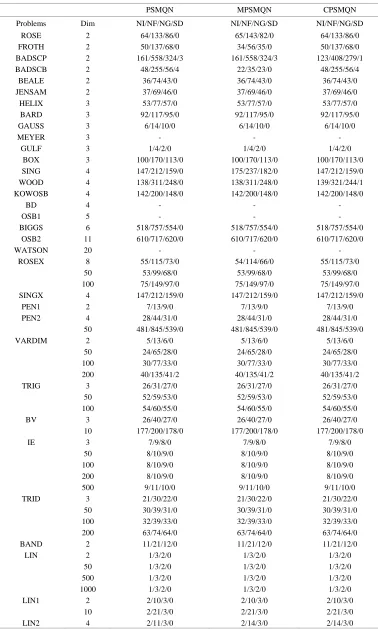
Tables 1 shows the computation results, where the co- lumns have the following meanings:
Problem: the name of the test problem in MATLAB; Dim: the dimension of the problem;
NI: the number of iterations;
NF: the number of function evaluations; NG: the number of gradient evaluations;
SD: the number of iterations for which the steepest descent direction used;
In this part, we compare the PSMQN, MPSMQN and
CPSMQN method as follows: for each testing examplei,
compute the total numbers of function evaluations and gradient evaluations required by the evaluated method
j EM j and the PSMQN method by the formula (4.1), and denote them by Ntotal i EM j, andNtotal i PSMQN, ;
then calculate the ratio
,
, total i EM j i
total i PSMQN
N r EM j
N
. (4.2)
If EM j
0 does not work for examplei
0, we replacethe
0 0
,
total i EM j
N by a positive constant
which defineas follows
, 1
max Ntotal i EM j : ,i j S
,
where
1 , :
Table 1. Test results for PSMQN/MPSMQN/CPSMQN.
PSMQN MPSMQN CPSMQN
Problems Dim NI/NF/NG/SD NI/NF/NG/SD NI/NF/NG/SD ROSE
FROTH BADSCP BADSCB BEALE JENSAM
HELIX BARD GAUSS MEYER GULF
BOX SING WOOD KOWOSB
BD OSB1 BIGGS
OSB2 WATSON
ROSEX
SINGX PEN1 PEN2
VARDIM
TRIG
BV
IE
TRID
BAND LIN
LIN1
LIN2
2 2 2 2 2 2 3 3 3 3 3 3 4 4 4 4 5 6 11 20 8 50 100
4 2 4 50
2 50 100 200 3 50 100
3 10
3 50 100 200 500 3 50 100 200 2 2 50 500 1000
2 10
4
64/133/86/0 50/137/68/0 161/558/324/3
48/255/56/4 36/74/43/0 37/69/46/0 53/77/57/0 92/117/95/0
6/14/10/0 - 1/4/2/0 100/170/113/0 147/212/159/0 138/311/248/0 142/200/148/0
- - 518/757/554/0 610/717/620/0
- 55/115/73/0
53/99/68/0 75/149/97/0 147/212/159/0
7/13/9/0 28/44/31/0 481/845/539/0
5/13/6/0 24/65/28/0 30/77/33/0 40/135/41/2
26/31/27/0 52/59/53/0 54/60/55/0 26/40/27/0 177/200/178/0
7/9/8/0 8/10/9/0 8/10/9/0 8/10/9/0 9/11/10/0 21/30/22/0 30/39/31/0 32/39/33/0 63/74/64/0 11/21/12/0 1/3/2/0 1/3/2/0 1/3/2/0 1/3/2/0 2/10/3/0 2/21/3/0 2/11/3/0
65/143/82/0 34/56/35/0 161/558/324/3
22/35/23/0 36/74/43/0 37/69/46/0 53/77/57/0 92/117/95/0
6/14/10/0 - 1/4/2/0 100/170/113/0 175/237/182/0 138/311/248/0 142/200/148/0
- - 518/757/554/0 610/717/620/0
- 54/114/66/0
53/99/68/0 75/149/97/0 147/212/159/0
7/13/9/0 28/44/31/0 481/845/539/0
5/13/6/0 24/65/28/0 30/77/33/0 40/135/41/2
26/31/27/0 52/59/53/0 54/60/55/0 26/40/27/0 177/200/178/0
7/9/8/0 8/10/9/0 8/10/9/0 8/10/9/0 9/11/10/0 21/30/22/0 30/39/31/0 32/39/33/0 63/74/64/0 11/21/12/0 1/3/2/0 1/3/2/0 1/3/2/0 1/3/2/0 2/10/3/0 2/21/3/0 2/14/3/0
64/133/86/0 50/137/68/0 123/408/279/1
48/255/56/4 36/74/43/0 37/69/46/0 53/77/57/0 92/117/95/0
6/14/10/0 - 1/4/2/0 100/170/113/0 147/212/159/0 139/321/244/1 142/200/148/0
- - 518/757/554/0 610/717/620/0
- 55/115/73/0
53/99/68/0 75/149/97/0 147/212/159/0
7/13/9/0 28/44/31/0 481/845/539/0
5/13/6/0 24/65/28/0 30/77/33/0 40/135/41/2
26/31/27/0 52/59/53/0 54/60/55/0 26/40/27/0 177/200/178/0
Table 2. Relative efficiency of PSMQN, MPSMQN and CPSMQN.
PSMQN MPSMQN CPSMQN
1 0.9752 0.9963
The geometric mean of these ratios for method EM( j)
over all the test problems is defined by
i
1Si S
r EM j r EM j
, (4.3)where S denotes the set of the test problems and S
the number of elements in S . One advantage of the abo- ve rule is that, the comparison is relative and hence does not be dominated by a few problems for which the me-thod requires a great deal of function evaluations and gradient functions.
From Table 2, we observe that the average
perfor-mances of the Algorithm 1 are the best among the three methods, and the average performances of the Algorithm 2 are little better than the PSMQN method. Therefore, the Algorithm 1 is the best method among the three me-thods given in this paper from both theory and the com-putational point of view.
5. References
[1] J. M. Perry, “A Class of Conjugate Algorithms with a Two Step Variable Metric Memory,” Discussion paper 269, Northwestern University, 1977.
[2] D. F. Shanno, “On the Convergence of a New Conjugate Gradient Algorithm,” SIAM Journal on Numerical Anal-ysis, Vol. 15, No. 6, 1978, pp. 1247-1257.
doi:10.1137/0715085
[3] J. Y. Han, G. H. Liu and H. X. Yin, “Convergence of Perry and Shanno’s Memoryless Quasi-Newton Method of Nonconvex Optimization Problems,” On Transactions, Vol. 1, No. 3, 1997, pp. 22-28.
[4] J. J. More, B. S. Garbow and K. E. Hillstrome, “Testing Unconstrained Optimization Software,” ACM Transac-tions on Mathematical Software, Vol. 7, No. 1, 1981, pp. 17-41. doi:10.1145/355934.355936
[5] A. Griewank, “On Automatic Differentiation,” Kluwer Academic Publishers,Norwell, 1989.
[6] Y. Dai and Q. Ni, “Testing Different Conjugate Gradient Methods for Large-Scale Unconstrained Optimization,”