A Design Method of Noncoherent Unitary
Space-Time Codes
Li Peng,Qiuping Peng, Lingling Yang
Department of Electronics and Information Engineering, Huazhong University of Science and Technology,
Wuhan National Laboratory for Optoelectronics, Wuhan, China E-mail: [email protected]
Received May 13, 2011; revised June 18, 2011; accepted June 24, 2011
Abstract
We generalized an constructing method of noncoherent unitary space time codes (N-USTC) over Rayleigh flat fading channels. A family of N-USTCs with T symbol peroids, M transmit and N receive antennas was constructed by the exponential mapping method based on the tangent subspace of the Grassmann manifold. This exponential mapping method can transform the coherent space time codes (C-STC) into the N-USTC on the Grassmann manifold. We infered an universal framework of constructing a C-STC that is designed by using the algebraic number theory and has full rate and full diversity (FRFD) for t symbol periods and same antennas, where M, N, T, t are general positive integer. We discussed the constraint condition that the expo-nential mappinghas only one solution, from which we presented an approach of searching the optimum ad-justive factor αopt that can generate an optimum noncoherent codeword. For different code parameters M, N,
T, t and the optimum adjustive factor αopt, we gave the simulation results of the several N-USTCs.1
Keywords: Noncoherent Uintary Space-Time Codes (N-USTC), Coherent Space-Time Codes (C-STC), Grassmann Manifold, Degree of Freedom, Exponenatial Map, Full Rate and Full Diversity (FRFD)
1. Introduction
The noncoherent unitary space-time code (N-USTC) in [1-4] provided a potential solution for the multiple an-tennas communication in fading channel that neither transmitter nor receiver knows the channel state imfor-mation (CSI). This paper generalized an constructing method for a family of the N-USTCs based on the Grassmann manifold. The system models on noncoherent and cohenent channel are comparatively built. Starting from the basic theory of the Grassmann manifold [4], a basic thought of designing the Grassmannian unitary space-time matrix was described. That is the exponent mapping method [5,6] from the M t C-STC to the T M N-USTC for the MIMO system with M trans- mit and N receive antennas, where t and T are co- herent and noncoherent symbol periods, respectively, and M N T t, , , are general positive integer, T t M and T M t .
In order to map the M t C-STC into the T M
N-USTC, firstly, one must consider how to construct the M t C-STC. Many literatures [7-11] discussed multi-farious methods of constructing the C-STCs. Enlightened by [7-11] and other literatures (omitted in reference as the limitation of length), we discussed a method of con-structing the M t universal C-STCs with FDFR based on the algebraic number theory. Therefore, we created four kinds of matrices: uncoded symbol matrix S, lin-ear combinatorial matrix L, rotated matrix R and lin- ear combinatorial symbol matrix Z that is Z LSR=
formed by the linear combinatorial technique of the symbols of constellations, such as q-PSK or q-QAM, and then we get the the coded matrix of a C-STC by trans-forming matrix Z.
In the mapping process from the M t C-STC into the T M N-USTC, we discussed the constraint condi-tion of the only one solucondi-tion of the the exponent map, from which we discover that the optimum codeword of the Grassmannian N-USTC can be obtained by searching the optimum adjustive factor opt. Simulation tests show
that for BPSK constellation symbols, when T is un-changed and antenna number M N= increases, the
1This work is supported by National Natural Science Foundation of
spectral efficiency increases and the performance of the bit error rate (BER) also advances, or when M N= is unchanged and T increases, so do the spectral effi-ciency and the BER performance; for QPSK constella-tion symbols, when M N= 2 and T 5, the spectral efficiency achieves 2.4 bits/Hz/s but at the cost of sacri-ficing the BER performance.
2. System Model and Background
Knowledge
2.1. System Model
We focus on the block fading channel model on which the fading coefficients are assumed to be constant during T periods of one codeword and to change independ-ently from one codeword to the next. Under the assump-tion of no inter-symbol interference, the noncoherent channel model with codeword periods T M is
TN T TM MN TN
Y X H W (1) For the convenience of comparison and application later on, we simultaneously give the coherent channel model with codeword periods t M :
Nt NM Mt Nt
Y H B W (2) where Y is T N received signal matrix for nonco-herent model or N t matrix for coherent model, H is M N or N M fading coefficients matrix and W is T N or N t additive noise matrix. Elements of H and W are assumed to be the independent and identically distributed complex Gaussian random vari-ables respectively from distribution CN
0,1 and
0, 2
CN . XTM and BMt are noncoherent and
co-herent transmit signal matrices, respectively.
2.2. Grassmann Manifolds and Its Tangential Space
Manifold is a topologic space which is locally homeo-morphic to the Euclidian space. More formally, Every point on n-dimensional manifold has a neighborhood homeomorphic to n-dimensional Euclidian space Rn.
We consider a set of all M -dimension linear sub-spaces in T-dimension complex space. This set has the structure of manifold, called Grassmann manifold and denoted by GT MC, , and its definition [12] is:
†
,
C
T M M
G Φ Φ Φ I (3)
where “†” denotes transpose for real number or conju-gate transpose for complex number; Φ denotes the subspace spanned by M column vectors in an T M
unitary matrix Φ. C, T M
G can also be represented by the
quotient space of the unitary group U
n [12], i.e.
,
C
T M T M T M
G U U U (4) As the real dimension of the unitary group U
n is
2dimRU n n , one can obtain the real dimension of
,
C T M
G : 2 2
2
,
dim C 2
RGT M T M T M M T M
[13] according to (4). So the complex dimension of ,
C T M
G is dim ,
C
CGT M M T M which means that
the N-USTCs on ,
C T M
G have M T M
degrees of freedom, and the maximal symbol rate is M
1
M T
[3].
Literature [5,6] introduces that the tangential space of any a point on ,
C T M
G forms a set of matrices as follows:
† 0
0
TM
Δ Q B
B (5) where B C M T M and the point Q can be chosen arbitrarily, i.e., for simplified calculation, one can choose
TM M M T MM
, - †
B I I 0 as a reference subspace on ,
C T M
G . The dimension of the tangential space defined by (5) is also M T M
. According to the theory of Lie- group, i.e., the point of the tangential space on GT MC, can be projected into the point of GT MC, by exponent map, the point X of GT MC, can be denoted by the ex-ponent form of the tangential space:† 0 exp
0
TM TM
B
X I
B (6) (6) shows a complicated computing task, but it can be simplified by the technique of the singular value decom-pose (SVD) of matrix. B is disposed by the SVD as follows:
†
M M M T M T M T M
Λ
B U V (7) where U and V are unitary matrices, and the form of
Λ is:
1 0 0 0 0
0 0
0 0 M 0 0
Λ
(8)
where 1, , M are the singular values of matrix B. Putting (7) into (6), one can obtain the simplified
TM
X :
† †
TM
T M
UCU X
VSU (9)
where
1
cos 0
0 cos
M M
M
† 1 sin 0 0 0 sin
T M M
M S .
3.
Coherent Space-Time Codes
Most methods of constructing the C-STCs with FRFD are to efficaciously combine all information symbols si
(i1, 2, , tM) to form the coding matrix BMt, where
all si belong to one of constellations, such as q-PSK or
q-QAM, etc. If we adopt the technique of linear combi-nation to design BMt, then the rank and determinant
properties of BMt
si is equivalent to them of
Mt si Mt sj
B B , where i j,
1,Mt
and i j. Let r be the minimal rank available of any codeword matrix
Mt si
B . According to the design criterion of determi-nate in [10], under the linear combination of all si of
forming BMt, we can obtain a FRFD matrix and its rank
rM , so the maximum coding gain
1 1 1 1 r M r M j j j j
can be guaranteed. Being enligh-tened by using the algebraic number theory to construct the C-STCs in [8,10,11], we investigate how to design the universal coherent matrix BMt with FRFD for
, ,
M N t being general positive integer. The applied de-sign step is shown as follows.
a) We first create three kinds of matrices: uncoded symbol matrix S, linear combinatorial matrix L (also named left-multiplied matrix) and rotated matrix R (also named right-multiplied matrix), they have next ge-
neral forms:
1 1 1 1
2 2 1 2
2
2 1
2 2 1 1
1 2 2 1
1 , 1 1 , 1
1 0 0
0 0
0 0
M t M
M t M
M M Mt
M
M M
M M M
t
s s s
s s s
s s s
j j j
j j j
S L R
where s s1, , ,2 stM take from the constelltions; let
t
; choosing j makes the determinate of matrix L be unequal to zero. Let ei which is an alge-braic number [10], here i 1 and is a parameter of needing the optimization design so that is searched in
0,π 2
to maximize the coding gain.b) For S left-multiplied by L and right-multiplied by R, one can get the linear combinatorial symbol matrix
M t
Z like (10) as follows:
c) In the linear combinatorial symbol matrix ZM t , circulant-right-shifting the second row one time, the third row two times,…, the final row (i.e., the Mth row)
1
M times, respectively, one can get the coded matrix like (11) as follows:
2 1
1 1 1 ( 1)
2 2 1 1
2 2 2 ( 1)
1
1 2 2 1
2
1 1
1 2 1 2 2
1 0 0
1 0 0 1 0 0 1 ... M
M M t
M M
M M t
M t
t
M M M
M M Mt
M M
M M M M
s s s
s s s
j j j
s s s
j j j
s s s s s s
Z LSR
11 1 2 1
1
1
1 1 2 1
1 1 1 1
1 2 1 2 2
1 1
1 1
1 1 2 1
1 2 1 1 2 1
1 2 1 2 2
...
...
t
M t M t
M Mt t
M t M t
M M t t
M M M M
M M
Mt
t M
M t M t
M M M M M M
M M M M
s s
s
s j s
s j s j s s j s j s
j s
s j s
s j s j s s j s j s
11 1 2 1
1 1
1 2 1 2 2 1
2 1
1 2 2 2
1 1 ) 2 1 1 1
1 2
1 1 1 1
1
1 1
1 1 2 1
t
M t M t
M M
M M M M M
Mt
t t
M t M t
M t M t M M
M
M M M M
Mt Mt
M t
t M
M t M t
M
s s
s s s s s s
s
s j s
s j s
s j s j s
j s j s
s j s
j B
1 1 21 2 1
1 2 2 1
2 1
2
M
M M
M M M
M M
M
M Mt
s j s
s j s j s
j s s (11)
Several examples of the C-STCs are presented as fol-lows. Let M t 2, according to (10), we have:
1 3 2 2
2 4 1 2 3 4 1 2 3 4
1 1 0
1 0
s s
s s
j
s s s s
s j s s j s
Z LSR
If j1, then Z2 2 0 which means the linear
combinatorial form of information symbols is lost. If
1
j , the linear combinatorial operation is retained. For 2 ei π4 , we can get the 2 2 C-STC matrix which is same as those in [5,6]
1 2
3 42 2
3 4 1 2
s s s s
s s s s
B
Again let M 3, t4, we have
2
1 4 7 10
2 2
3 4 2 5 8 11 2
2 2
3 6 9 12 3
1 0 0 0
1
0 0 0
1
0 0 0
1
0 0 0
s s s s
j j s s s s
j j s s s s
Z LSR
when 4 eiπ6, jei23π,
3 4
Z is full rank. Thus we can get the 3 4 C-STC matrix like (12) as follows:
2 2 2 2 3 2
1 2 3 4 5 6 7 8 9 10 11 12
3 2 2 2 2 2 2 2 2 2
3 4 10 11 12 1 2 3 4 5 6 7 8 9
2 2 2 3 2 2 2 2 2 2
7 8 9 10 11 12 1 2 3 4 5 6
s s s s s s s s s s s s
s j s j s s j s j s s j s j s s j s j s
s j s j s s j s j s s j s j s s j s j s
B (12)
Similarly, we can get B2 3 , B2 4 , B2 5 and B3 3 which and all above will be applied to simulation testing later on.
4.
Noncoherent Space-Time Codes
Literatures [5,6] introduce the design criterion of the Grassmann N-USTC. Let i and j denote the
sub-spaces spanned by the column vectors of Xi and Xj,
respectively. Let
1, , ,2 M
denote the principal angles between i and j, then the chordal productdistance between two points Xi and Xj on ,
C T M
G is:
2 ,
1
sin
M
i j m
m
(13)The design criterion of the Grassmann N-USTC C is
to make the minimal chordal product distance achieve the maximum, i.e. max min ,
i j i j
X X C
C . It is known from the expression (6) that the product Θi,0 of the chordal dis-tances between the subspace i and the reference
sub-space 0 is equal to the product of all singular values in matrix Bi whose M column vectors span the sub-space i. The design criterion of a C-STC is to
maxi-mize its coding gain, which is equal to maximizing the minimum product of singular values of codeword matrix. Therefore we can use the matrix BMt of (11) to design the matrix B in (6).
The exponential map from BMt to XTM must be the
condition of m is:
max m Mt π/ 2, 0,1, , 1
m B m M (14)
where m
BMt is the mth singular value of any codeword BMt which is equal to the mth principal angle between any and 0. Therefore, a conceiv-able skill is that taking a scale , called the adjustive factor which multiplies the codeword matrix BMt, can guarantee the map to be monotone and reversible. Thus (6) can be rewritten as follows:
† 0 exp0
TM TM
B
X I
B (15) Obviously, only affects the singular value of the matrix BMt. Let
0,max
denote a range of values,the method of optimum searching is described as follows.
Let X Xi, jGT MC, be two distinct N-USTC code-words, the SVD of the matrix †
j i
X X is † †
j i Σ
X X U V , where Σ is a diagonal matrix formed by the singular values 1, , M. The M principal angles between the
subspaces i and j spanned respectively by Xi
and Xj are m cos1m, 0,1, ,m M1,
substi-tuting cos 1
m m
for the expression (13), we can
get:
2
, 1
1
M
i j m
m
(16) Under the condition of making i j, maximize, by searching in
0,max
, we can get the optimumopt
.
Now we design XTM by mapping exponentially Mt
B to GT MC, . The design step is:
(a) For M transmit antennas and t coherent peri-ods, according to (10) and (11), design the C-STC matrix
Mt
B from the information symbol s s1, , ,2 stM. (b) Substitute BMt for B in (15), search the
opti-mum adjustive factor , and construct the exponential mapping matrix
†0
0
Mt Mt
B E
B .
(c) According to (7) and the above E matrix, apply-ing the SVD to
optBMt
, we get the noncoherentcodeword XTM like (9), and T M t . □
5. Examples and Numerical Simulation
Results
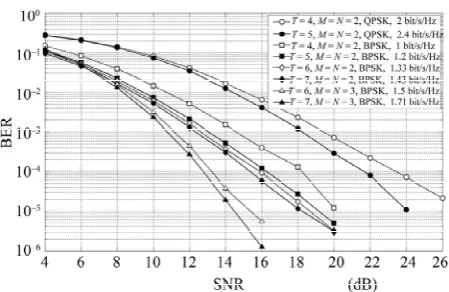
According to the above presented method, this section gives several examples of the N-USTCs whose numeri-cal simulation curves are shown as Figure 1. Let
D M T M denote the degree of freedom. Suppose
modulation is q-PSK with symbol number p. So the spectral efficiency of the N-USTC is
log2
T M p D T
bits/Hz/s.
Example 1: Compare two curves of solid line with black dot and dash line with circle in Figure 1. For sys-tem M N2 and QPSK modulation with p4, let
2
t , we construct the C-STC B2 2 ,where π4
2 ei
, j 1. When t3, we get B2 3 , where 3 ei π4 , j 1. As T M t , having
4
T for t2 and T 5 for t3, corresponding to D4 and D6, we compute 4 2 2 bits/Hz/s and 5 2 2.4 bits/Hz/s, respectively. We map the
C-STC B2 2 into the N-USTC X4 2 on 4,2
C
G and 2 3
B into X5 2 on G5,2C which correspond to the op-timum adjustive factor 4 2
, 0.29
opt Q
and 5 2 , 0.25
opt Q
,
respectively. At 105 bit error rate (BER), 5 2 X out-perform X4 2 about 3 dB. Obviously, under all para- meter being same except T increasing, the N-USTC BER performance and the spectral efficiency are im-proved.
Example 2: Compare four curves of solid line with black square, dash line with white square, solid line with black diamond and dash line with white diamond in Fig-ure 1. For system M N2 and BPSK modulation with p2 , let t2,3, 4,5 , get T 4,5,6,7 and
4,6,8,10
D , so 4 2 1, 5 2 1.2, 6 2 1.33 and 7 2 1.43
bits/Hz/s, respectively. We map B2 2 , 2 3
B , B2 4 and B2 6 into X4 2 , X5 2 , X6 2 and 7 2
X whose factors are 4 2 , 0.41
opt B
, 5 2
, 0.36
opt B
,
6 2 , 0.32
opt B
and 7 2 , 0.29
opt B
. At 105 BER, the performance of the N-USTC improve about 0.5 - 1.0 dB and the spectral efficiency increases along with T in-creasing.
Example 3: Compare two curves with solid line with black triangle and dash line with white triangle in Figure 1. For system M N3 and BPSK modulation with
2
p , let t3, 4, get T6, 7 and D9,12, so 6 3 1.5
and 7 3 1.71 bits/Hz/s, respectively. We
[image:5.595.311.536.559.705.2]map B3 3 and B3 4 into X6 3 and X7 3 whose fac-
tors are 6 3 , 0.24
opt B
and 7 3 , 0.22
opt B
. At 105 BER, the performance of the N-USTC improve about 0.8 dB from T 6 to T 7, and the spectral efficiency also increases 0.2 bits/Hz/s.
6. Conclusions
A specific step that maps the coherent space-time matrix into the noncoherent space-time matrix by means of the exponent form of the tangential space of Grassmann manifold was summed up for designing the N-USTCs. Especially, our work makes the structural parameters
, , ,
M N T t with regard to both the N-USTC based on the Grassmann manifold and the C-STC based on the alge-braic number theory be able to be designed more flexibly. We also discovered that in the discussed family of Grassmannian N-USTC, the optimum codeword can be obtained by searching the optimum adjustive factor opt. It is noticed that the design of the parameter j in left- multiplied matrix L is open problem, we will track this problem in the future.
7. References
[1] T. L. Marzetta and B. M. Hochwald, “Capacity of a Mo-bile Multiple-Antenna Communication Link in Rayleigh flat Fading,” IEEE Transactions on Information Theory, Vol. 45, No. 1, January 1999, pp. 139-157.
doi:10.1109/18.746779
[2] B. M. Hochwald and T. L. Marzetta, “Unitary Space- Time Modulation for Multiple-Antenna Communication in Rayleigh Flat Fading,” IEEE Transactions on Informa-tion Theory, Vol. 46, No. 2, March 2000, pp. 543-564. doi:10.1109/18.825818
[3] L. Zheng and D. N. C. Tse, “Communication on the Grassmann Manifold: A Geometric Approach to the Non-coherent Multiple-Antenna Channel,” IEEE Transactions on Information Theory, Vol. 48, No. 2, February 2002, pp. 359-383.doi:10.1109/18.978730
[4] R. H. Gohary and T. N. Davidson, “Noncoherent MIMO Communication: Grassmannian Constellations and
Effi-cient Detection,” IEEE Transactions on Information The-ory, Vol. 55, No. 3, March 2009, pp. 1176-1205. doi:10.1109/TIT.2008.2011512
[5] I. Kammoun and J. C. Belfiore, “A New Family of Grassmannian Space-Time Codes for Noncoherent MIMO Systems,” IEEE Communication Letters, Vol. 7, No. 11, November 2003, pp. 528-530.
doi:10.1109/LCOMM.2003.820081
[6] I. Kammoun, A. M. Cipriano and J. C. Belfiore, “Nonco-herent Codes over the Grassmannian,” IEEE Transactions on Wireless Communications, Vol. 6, No. 10, October 2007, pp. 3657-3667.doi:10.1109/TWC.2007.06059 [7] S. M. Alamouti, “A Simple Transmit Diversity
Tech-nique for Wireless Communications,” IEEE Journal on Selected Areas in Communications, Vol. 16, No. 8, Oc-tober 1998, pp. 1451-1458.doi:10.1109/49.730453 [8] M. O. Damen, A. Tewfik and J. C. Belfiore, “A
Con-struction of a Space-Time Code Based on the Theory of Numbers,” IEEE Transactions on Information Theory, Vol. 48, No. 3, March 2002, pp. 753-760.
doi:10.1109/18.986032
[9] J. C. Belfiore, G. Rekaya and E. Viterbo, “The Golden Code: A 2*2 Full-Rate Space—Time Code with Nonvan-ishing Determinants,” IEEE Transactions on Information Theory, Vol. 51, No. 4, April 2005, pp. 1432-1436. doi:10.1109/TIT.2005.844069
[10] H. E. Gamal and M. O. Damen, “Universal Space-Time Coding,” IEEE Transactions on Information Theory, Vol. 49, No. 5, May 2003, pp. 1097-1119.
doi:10.1109/TIT.2003.810644
[11] F. Oggier, G. Rekaya, J. C. Belfiore and E. Viterbo, “Per-fect Space-Time Block Codes,” IEEE Transactions on Information Theory, Vol. 52, No. 9, September 2006, pp. 3885-3902.doi:10.1109/TIT.2006.880010
[12] J. H. Conway, R. H. Hardin and N. J. A. Sloane, “Packing Lines, Planes, etc.: Packings in Grassmannian Spaces,” Experimental Mathematics, Vol. 5, No. 2, 1996, pp. 139- 159.