ISSN Print: 2152-7180
DOI: 10.4236/psych.2019.1015135 Dec. 27, 2019 2091 Psychology
To Deaf or not to deaf: That is the Question
Kimberly K. Pudans-Smith
1, Katrina R. Cue
2, Ju-Lee A. Wolsey
3, M. Diane Clark
21Department of ASL and Deaf Studies, Gallaudet University, Washington DC, USA 2Department of Deaf Studies and Deaf Education, Lamar University, Beaumont, TX, USA 3Deaf Studies, Interdisciplinary Programs, Towson University, Towson, MD, USA
Abstract
Names are both personal and political, as they relate to identity. Woodward’s 1975 etic article first mentioned a naming convention for D/deaf and promi-nent scholars have debated the issue since. To evaluate current preferences, the research team used an online questionnaire to gather emic insights and opinions from the community, as well as a more etic perspective from hear-ing individuals for work with these issues. Data from these three self-identified groups of participants, Deaf, deaf, and hearing, were analyzed. Results found high variability among responses related to the terms, D/deaf, and whether or not certain terms should remain in the lexicon. Results are discussed and presented both to contribute and to further research in the field. It is recommended that the usage of existing term(s) be adhered to and that an individual’s preferred naming conventions be respected and utilized whenever possible.
Keywords
Deaf, D/deaf, Deaf emic perspective, Deaf identity, Deaf terminology usage, Deaf naming conventions, Deaf community, Deaf culture
1. Introduction
When doing research, writing, and publishing within the field of Deaf Studies or Deaf education, researchers and scholars are inevitably faced with decision(s) regarding the appropriate terms and capitalization to use when describing a person’s hearing status. Given the research team’s personal experiences of strug-gling with those decisions, which can detract from overall research goals, it was decided to research this issue further. The team asked themselves the question, “Can we find a consensus regarding which labels are preferred by deaf people themselves regarding Woodward’s (1975) naming convention?” The idea was to
How to cite this paper: Pudans-Smith, K. K., Cue, K. R., Wolsey, J. A., & Clark, M. D. (2019). To Deaf or not to deaf: That is the Question. Psychology, 10, 2091-2114. https://doi.org/10.4236/psych.2019.1015135
Received: November 7, 2019 Accepted: December 24, 2019 Published: December 27, 2019
Copyright © 2019 by author(s) and Scientific Research Publishing Inc. This work is licensed under the Creative Commons Attribution International License (CC BY 4.0).
DOI: 10.4236/psych.2019.1015135 2092 Psychology
help researchers save time when conducting research, analyzing results, creating reports, as well as writing for publications. In pursuing this study, the research-ers grappled with quite a few issues related to identity, authority to decide, privi-leges, agency, and community representation.
Originally, this issue focused on when to use deaf versus Deaf in academic writing. For instance, the word deaf has traditionally been capitalized to denote those individuals who are culturally Deaf1. Whereas, the medical or audiological
condition of being deaf is often written in lowercase. Then, there are other indi-viduals who feel that all deaf people should be under the same cultural umbrella regardless of their hearing, language, or community affiliation and should be re-ferred to as Deaf. Yet, other individuals feel that they are not part of the Deaf world and prefer to use the term deaf or hard of hearing, as they are able to function in the hearing world and pass for hearing (Harmon, 2013).
The distinction of Deaf versus deaf has its roots in an article written by James Woodward (1975), who was a hearing man. Although the Deaf community later adopted and expanded upon the Woodward capitalization distinction, the fact that Woodward was hearing is worth noting due to the fact that the nomencla-ture originated from an etic, or outsider, perspective. To understand why an emic, or insider, perspective is important, consider this saying prominent in the disability rights movement: “Nothing about us without us” (Charlton, 1998). If there was any Deaf community input in Woodward’s creation of the capitaliza-tion convencapitaliza-tions, they were not named nor acknowledged. It would seem that
Woodward (1975) developed his nomenclature in isolation. However, after 44 years of using this term, it has recently been suggested that Woodward’s nomen-clature has historically been misunderstood and mis-cited (Woodward & Ho-rejes, 2016).
The story of how Woodward (1975) first conceptualized the distinction of
Deaf and deaf came about when he observed a Deaf individual utilizing Ameri-can Sign Language (ASL), as a primary mode of communication. To outsiders, this individual was labeled as hard of hearing; while within the Deaf community, this individual was considered to be Deaf. Woodward (1975) approached the Deaf individual to find out how he identified himself; his response was, “I am Deaf, but I can hear and speak through a phone.” Woodward (1975) realized that there were different perspectives of a person’s hearing status that quite pos-sibly had nothing to do with their actual hearing status. Woodward’s purpose for distinguishing between Deaf and deaf was first presented in a March 1975 sym-posium on majority and minority languages at the annual meeting of the Society of Applied Anthropology in Amsterdam. Woodward (1975) stated that he used the convention of capitalizing “D” in the word Deaf to refer to Deaf people claiming membership within a community of like-minded Deaf individuals.
1Although this paper is specifically addressing D/deaf naming conventions, we still must identify our
DOI: 10.4236/psych.2019.1015135 2093 Psychology
Whereas an uncapitalized “d” in deaf was used to refer to individuals who are unrelated to the Deaf community while still highlighting their hearing status
(Woodward, 1975). In 1978, Woodward and his colleague, Markowicz, officially coined the terms Deaf versus deaf in an article classifying deaf people based on their hearing status and identity within their Deaf community (Markowicz & Woodward, 1978).
In 1990, Padden and Humphries published a book discussing American Deaf Culture. The authors quote the nomenclature by Woodward as:
Following a convention proposed by James Woodward (1972) [sic], we use the lowercase deaf when referring to the audiological condition of not hearing, and the uppercase Deaf when referring to a particular group of deaf people who share a language—American Sign Language (ASL)—and a culture (Padden & Humphries, 1990: p. 2).
Padden and Humphries (1990) expanded the usage by including those indi-viduals “who share a language—American Sign Language (ASL)—and a culture” (p. 2). This definition did not include the discussion of who qualifies to be in-cluded in the term deaf or Deaf. However, the citation has been used in numer-ous articles, books, and publications with additional clarification being added, as needed, such as “social groupings and cultural identifications arising from inte-ractions among people with hearing losses” (Erting, Johnson, Smith, & Snider, 1994: p. xxiii).
Later, Smith and Bienvenu (2007), simplified the definition of these labels in a concise explanation stating: “When this word is spelled with a capital ‘D’ it de-scribes a cultural identity, when it is spelled with a lower case [sic] ‘d’ it dede-scribes the audiological experience of not being able to hear sound” (p. 47). Moreover, the authors quoted Saul (2003) in showing the importance of capitalizing a word to show the strength of diversity within any group. Capitalizing the word need not necessarily be exclusive to classifying a certain group of people with specific characters or skills; rather, it is done to give a level of respect for the entire pop-ulation, as a marginalized group.
Glickman (1993) also emphasized the difference between those two terms fo-cusing on the idea of disability versus difference, stating: “Rather than under-standing deafness as a disability, Deafness is understood as a cultural difference” (p. 2). In addition, Glickman (1993) emphasized that “... deaf people vary in their degree of awareness of Deaf culture and the extent to which they identify with the Deaf community” (p. 12). In the glossary of his book, Understanding
Deaf Culture: In Search of Deafhood, Ladd (2003) provided a detailed
descrip-tion:
re-DOI: 10.4236/psych.2019.1015135 2094 Psychology
fers to those born Deaf or deafened in early (sometimes late) childhood, for whom the sign languages, communities and cultures of the Deaf collective represents their primary experience and allegiance, many of whom perceive their experience as essentially akin to other language minorities (p. xvii).
Ladd (2003) included this description to illustrate the fact that there is diver-sity within the Deaf community. Rather than categorize all members of the Deaf community as Deaf regardless of their hearing status, he focused on the concept of identity through membership in the community and their choice of language.
Holcomb (2010) has additionally argued that the term deaf could be used for many different purposes nonetheless, he still specifically defines the term to pro-vide clarification and for specific usage in publication or situations.
Scholarly literature is not clear between the two uses of the capitalization when it defines deaf versus Deaf in describing those individuals who are cultu-rally Deaf versus those persons who do not identify with this culture preferring the use of the lowercase as in deaf(Lane, 2005). Lane (2005) provided an exam-ple: “For example, some hard-of-hearing people are active in the American Deaf-World; others are not. Oral deaf adults and late-deafened adults usually consider that they have a hearing impairment and do not self-identify as mem-bers of the Deaf-World” (p. 291). In her article, Burch (1997) felt it necessary to add emphasis when she defined the usage of deaf versus Deaf, “for the sake of ef-ficiency and clarity…” (p. 1). Additionally, Stapleton (2015) added a footnote in her article defining d/Deaf to make it consistent with all of the arguments and perspectives mentioned above. She emphasized, “In this study, d/Deaf is used because the differences are not always clearly identified in the literature or among the participants” (2015, p. 570). Holcomb’s (2012) book on American Deaf Culture uses the term deaf to focus on the audiological and physiological condition of an individual’s hearing regardless of whether or not they chose to identify with the Deaf community. Furthermore, Holcomb (2012) continued to use the general definition of Deaf to portray a group of people who are members of the Deaf community, embrace Deaf culture, and use sign language as their primary mode of communication. Notably, Holcomb (2012) emphasized that the use of Deaf reflected a sense of pride, which included the, “rich experiences, heritages, outlook, and values of Deaf people” (p. 46).
DOI: 10.4236/psych.2019.1015135 2095 Psychology
In contrast, Hauser, O’Hearn, McKee, Steider, and Thew’s (2010) article on Deaf epistemology established a distinction between Deaf and deaf. Hauser et al. (2010) referred to those “individuals who have been deaf or hard of hearing all or most of their lives, and for whom auditory channels are not sufficient for meaningful, accessible communication” (p. 491) as “Deaf.” Additionally, Hauser et al. (2010) claimed that Deaf individuals are visually oriented rather than au-ditorily limited. This assertion by Hauser et al. (2010) highlights the notion that the idea of being Deaf has to do with a differently oriented way of life (e.g. vi-sion) rather than one’s hearing status. Again, this distinction illustrates the is-sues of who decides, especially when the community consensus is often murky, and scholars still grapple with clarifying the issue at hand.
The Hauser et al. (2010) finding is consistent with the Deaf epistemology ar-ticle published by Cue, Pudans-Smith, Wolsey, Wright, and Clark (2019). The authors investigated epistemology among D/deaf individuals by asking the ques-tion, “What does it mean to be D/deaf?” Based on their data, two overall themes emerged: journey and belonging. The two themes culminated in an overall theme of situated homecoming. The data revealed the often complex and differ-ing journey of D/deaf individuals that related to identity, experiences, and their place within the Deaf community. While the data did not yield any answers re-lated to how to write the term, deaf, it did further serve to highlight and assert the multi-layered and often ever-changing complexities of Deaf identity.
In looking at community perspectives outside of the scholarly and research worlds, it could perhaps be argued that stronger stances have been adopted. For instance, Marvin Miller, a founding Board member of the Deafhood Foundation, gave a presentation at Gallaudet University during Faculty Development week in January 2018. His PowerPoint presentation stated:
We should use the capitalized “D”eaf for all of Deaf people instead of using both lowercase d and capitalized D in order to differentiate between those who are culturally Deaf and those who are not. No. The capitalization of Deaf brings the true recognition that all Deaf and hard of hearing children have a natural birthright to ASL, Deaf culture, healthy identity, and being a part of the Deaf community. This also includes those who become Deaf lat-er in life!
The Deafhood Foundation (2017) sends a similar message in using Deaf as an
inclusive term in that it welcomes and encompasses people from all backgrounds and experiences, rather than excluding certain type(s) of Deaf individuals. In addition, the Foundation mentioned that historically, the term Deaf usually re-flected a group of people who carried a certain type of “elite” identity and lan-guage. The Foundation is attempting to shift this perspective by embracing eve-ryone regardless of ethnicities, socioeconomic status, school backgrounds, and languages; thus, they also do not use the term hard of hearing. In addition, the Foundation does not support the earlier labeling conventions that used D/deaf
Foun-DOI: 10.4236/psych.2019.1015135 2096 Psychology dation (2017) felt that this nomenclature caused Deaf people to be divided and segregated rather than present a unified front for all Deaf people.
The National Deaf Center (NDC) on Postsecondary Outcomes (2018) sup-ported Miller’s (2018) naming conventions in terms of adopting an all-inclusive approach, regarding whether the word D/deaf is capitalized or not. However, the National Deaf Center on Postsecondary Outcomes did not agree with Miller (2018) that the term should be capitalized, choosing the lowercase spelling as the default:
The National Deaf Center is using the term deaf in an all-inclusive manner, to include people who may identify as deaf, deafblind, deafdisabled hard of hearing, late-deafened, and hearing impaired. NDC recognizes that for many individuals, identity is fluid and can change over time or with setting. NDC has chosen to use one term, deaf, with the goal of recognizing expe-riences that are shared by all members of our diverse communities while also honoring all of our differences (National Deaf Center on Postsecon-dary Outcomes, 2018).
Now the Deafhood Foundation (2017) and the National Deaf Center on Post-secondary Outcomes (2018) are in agreement about being all-inclusive. Howev-er, they are not yet in agreement regarding capitalization; leaving the ques-tion—to capitalize or not to capitalize? As can be seen, clarity was not achieved between 1975 and 2015, as individuals continue to need to define these terms. Therefore, the research team decided to complete a review of the extant litera-ture, as well as ask the Deaf community their perspectives in an attempt to:
1) Understand the nomenclature currently used by scholars;
2) Determine if we could arrive at a consensus regarding what nomenclature should be used (e.g., what is the “agreed” upon usage);
3) Develop a set of “Lamar University Naming Conventions” of the above-mentioned terms to provide researchers/academics a source to refer to in their work when they must define the terms they use and why; and
4) Provide a central place where the above questions are grappled with and investigated empirically, rather than relying on an inconsistent and scattered collection of footnotes.
This review leads to the three research questions listed below.
2. Research Questions
1) How do individuals determine their definitions for D/deaf across groups? 2) How do individuals write the various definitions for D/deaf across various sources?
3) Is there an “agreement” regarding this usage?
3. Research Process
3.1. Recruitment and Sampling Strategy
DOI: 10.4236/psych.2019.1015135 2097 Psychology
(Expedited FY 18-214, Approved April 27, 2018), participants were recruited through purposeful and snowball sampling. Through purposeful sampling, the research team recruited individuals who identified as Deaf, deaf, hard of hearing, late-deafened, DeafBlind, and DeafDisabled, as well as hearing. The research team especially sought the perspectives of those individuals who worked as a re-searcher or an academic within the fields of Deaf Studies, Deaf education, or ASL to participate in the research project. In addition, participant recruitment included individuals who could be considered insiders or allies as well as those who were potentially outsiders. Recruitment was done over a two-week period via face-to-face interactions, electronic mail (email), social media sites such as Facebook, listservs, organizations, and schools. A post on the Lamar University Deaf Studies and Deaf Education Department Facebook page had over 6.7 thou-sand views as well as 88 shares to other Facebook accounts or pages. In addition, snowball recruitment was done via word-of-mouth, where participants con-tacted other participants who had similar backgrounds and were willing to par-ticipate. The research team attempted to recruit a diverse sample that was repre-sentative of the deaf population as possible.
3.2. Participants
There was a total of 239 respondents from diverse backgrounds based on how they identified themselves. Only 198 respondents provided their hearing identi-fication including; 133 Deaf, 33 hearing, 14 deaf, five hard of hearing, three DeafBlind, one deaf-blind, and one late deafened. There were no respondents who identified as DeafDisabled, although one participant in their “other” com-ment com-mentioned that they had an additional disability, but felt it was “a less prominent factor.” Eight respondents used the “other” option to list their hear-ing identification; visually impaired (hearhear-ing), CODA (Children of Deaf Adults; 2 respondents), TBI [Traumatic Brain Injury] survivor, Sumain2, hard of hearing
and Deaf, DeafBlind disabled, not sure yet, and maybe deaf. Given the low numbers of hard of hearing, DeafBlind, and lack of self-identified DeafDisabled individuals, only those respondents who identified as Deaf, deaf, or hearing were included in the data analysis. Therefore, the final sample consisted of 180 par-ticipants even though six parpar-ticipants reported using either Tactile ASL or Pro-Tactile.
Of the 180 participants, the majority of participants were women (65.6%), while 30% were men, and 4.45% were self-described or not specified. The par-ticipants’ ethnicities varied; the majority identified as being Caucasian (86.1%). Although there were a few participants from other ethnicities, there were no respondents who identified as American Indian, Alaskan Native, Native
Ha-2Sumain is an emic proposed alternative to the word deaf as proposed by Ryan Commerson (2019).
DOI: 10.4236/psych.2019.1015135 2098 Psychology
waiian, Pacific Islander, Black, or African American. Participants’ ages ranged from 18 to 76, with one participant selecting the 75 or older age range option. Despite the largest number of participants being in the 36 - 50 age group, this age group consisted of less than half (37.2%) of the total respondents. Partici-pants’ hearing status varied as to how they identified themselves. The majority of participants identified as being Deaf (73.89%) while 7.78% used lowercase “d” for deaf, and 18.33% identified as hearing. In regard to participants’ current primary modality of communication, it also varied by hearing status. While thirteen options were provided, participants could choose more than one option that they felt applied to them. The majority of participants cited using ASL or some sort of sign language system (e.g. Signed English, Manually Coded English, Signed Exact English, Pidgin Signed English, Conceptually Accurate Signed Eng-lish, and finger spelling (n = 173; 96.1%) while 30.5% (n = 55) selected spoken English. A subset of the participants (n = 27; 15%) used a mixture of sign and speech (e.g., SimCom3, Total Communication4, Spoken English with Sign
Sup-port). Lastly, six participants or 3.3% of the total respondents, reported using Tactile ASL5 or ProTactile6.
The highest level of education completed by the participants also varied. The majority of participants either had a bachelor’s degree (19.55%), master’s degree (31.28%), or doctorate degree (14.53%). In terms of employment, the majority of the participants were employed full-time (64.44%), while 11.67% were students, and 8.33% were employed part-time. Finally, participants re-ported being in diverse roles or employment positions that ranged from being in academia, research, or administration to being a community member, in-terpreter, and parent. While seven options were provided, participants were allowed to choose all option(s) that applied to them. Therefore, some partici-pants chose more than one option. Roles with the highest percentages were professor/lecturer/instructor/teacher (27.89%), member of Deaf or DeafBlind or
3SimCom or Simultaneous Communication is a communication approach and philosophy often
used in Deaf education. It occurs when a person attempts to both speak verbally and sign at the same time. The idea is that it provides the listener with access to both speech and sign “simultaneously.” However, attempting to sign and talk at the same time tends to cause one mode of communication to “drop” or become less prioritized than the other (typically sign) (Marschark, 2017;Tevenal & Vil-lanueva, 2009). SimCom is usually only seen with signed and spoken languages being used in con-junction because it is physically impossible to speak two languages simultaneously due to anatomical limitations of the mouth.
4Total Communication (TC) is an educational philosophy and approach that became popular in
Deaf education in the late 1970s (Hawkins & Brawner, 1997). It combined multiple modalities of communication such as signing, listening, and speaking. With the TC approach, one would often see “SimCom” utilized even though this approach is a misapplication of the TC philosophy.
5Tactile ASL is a communication system where the person (receiver) puts their hand(s) on top of the
other person’s hands (signer) while signing ASL to feel the different linguistic features such as handshape, palm orientation, movement, or location of the signs (American Association of the DeafBlind, 2009;Petronio & Dively, 2006).
6ProTactile is a socio-cultural philosophy that includes its own philosophy, method, and attitude that
DOI: 10.4236/psych.2019.1015135 2099 Psychology
DeafDisabled community (24.30%), and academic/researcher/scholar (19.52%). Participants who chose “other” (16.73%) put in a specific response such as in-terpreter, parent, audiologist, medical professional, and/or advocate.
3.3. Materials and Data Collection
The idea of this research project was born from a prior paper on epistemology (see Cue et al., 2019) where researchers had to pause and dedicate a significant amount of time to grapple with the D/deaf nomenclature while writing the pa-per. This project was presented as a possible spring semester project in the La-mar University Cognition in Context doctoral research lab. Once there was agreement on the research questions, the survey was designed via Qualtrics and submitted to the project team for feedback and revisions. Prior to finalizing de-velopment and distributing the D/deaf Naming Conventions Questionnaire, it was reviewed and discussed with colleagues and doctoral peers who provided feedback with wording and questions to ensure clarity. A February 2018 research lab meeting was particularly rife with debate regarding how to present the ques-tions without introducing possible bias (e.g., “How would you write the follow-ing term _______” rather than “How would you write the term ‘Deaf’”). Qual-trics was used as an online web-based survey platform to create the question-naire due to Lamar University’s IRB requirements, as well as its ease of use, sim-plicity, and the ability to track and analyze results. The questionnaire was first distributed to a small batch of participants to ensure it was error-free and then distributed via multiple sources by the research team to recruit a diverse number of participants.
3.4. Procedures
Recruitment. As previously mentioned, participants were recruited via email and social media (e.g., Facebook). The study advertisement included a link to a vlog in ASL by one of the researchers explaining the research study, as well as another link to the online survey. A video description and transcript of the ASL vlog was also provided to make content accessible to all individuals. Further-more, a Word document of the survey (as well as a Word Document version of the Informed Consent form) was shared via an email listserv with DeafBlind in-dividuals to ensure accessibility.
Informed consent and confidentiality. Participants were assured that the survey was anonymous, confidential, and that all data would be de-identified. The online survey link included the description and purpose of the study, as well as the informed consent. Participants clicked on a consent e-button to acknowl-edge or decline participation in the study. There were no participants who elected to submit a paper-based informed consent survey. Final survey results did not show any identifying information, as Qualtrics masked the IP address and location of all responses.
res-DOI: 10.4236/psych.2019.1015135 2100 Psychology
ponses were received, which was approximately two weeks. The online ano-nymous survey included nine demographic questions that asked about partici-pants’ background, 20 close-ended research questions with the option to select “other” and type in additional comments on the majority of the questions, and one open-ended question to share any other information or comments not asked in the survey. Research questions asked participants their opinions and insights regarding specific terms such as Deaf, deaf, hearing impaired, and how these terms should be written from their perspectives.
3.5. Data Analytic Plan
A survey research design was used to conduct this study. While data from the demographic questions provided background information about participants, research questions were analyzed using descriptive statistics via Qualtrics and a statistical analysis software namely Statistics Package for the Social Sciences (SPSS). Close-ended survey questions were analyzed for each group of partici-pants identifying as Deaf, deaf, and hearing; therefore, all survey responses were split into three groups to determine percentages. A power analysis using G * Power determined that the sample size should be 134, which is smaller than the 198 used here. Some tables reflect missing data when respondents skipped a question. One open-ended question that listed participants’ opinions was coded to find common threads and shared ideas to further contribute to the discussion, implications, and future research possibilities. While all of the research questions provided options of visualization display via Qualtrics, the research team elected to manually create tables combining some of the responses to the questions in a grouped summary format for ease of analysis and reporting.
4. Results
Results from the questionnaire provided a variety of opinions related to what terms to keep or eliminate, and how to write the terms that participants felt should remain in our lexicon. The majority of the questions had an “other” op-tion where participants could type in their own answers. These “other” res-ponses were analyzed and coded together along with Question number 33 in or-der to probe responses in context of the existing question choices and/or the discussion/implications/future research choices section. Relevant questions and summary responses are discussed next.
DOI: 10.4236/psych.2019.1015135 2101 Psychology
that the results can lead to further research that may result in the clarity that we were unable to find.
Survey Responses
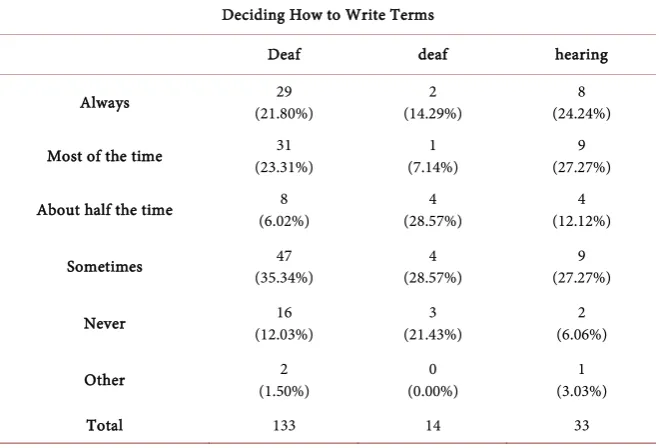
The first research question (Q14) asked, “Do you find yourself encountering sit-uations where you must decide how to write the terms of Deaf, deaf, hard of hearing, DeafBlind, or Deaf Disabled with regards to whether or not to use up-percase or lowercase?” Respondents chose from one of six options; “always,” “most of the time,” “about half the time,” “sometimes,” “never,” and “other.” The majority at least sometimes experienced those situations. The data is sum-marized in Table 1.
[image:11.595.210.540.494.718.2]The second research question (Q15) asked participants, “Are you consistent with using uppercase (capitalizing) or using lowercase for the following terms: deaf, hard of hearing, deaf blind, deaf disabled, and so forth?” Respondents were also provided with the same six options to this statement; “always,” “most of the time,” “about half the time, “sometimes,” “never,” and “other.” Deaf participants felt that they were “always” (36.84%) or “mostly” (36.09%) consistent with up-percase versus lowercase use regarding the above terms. The hearing partici-pants responded “always” (21.21%), “most of the time” (48.48%), “about half the time” (12.12%) or “sometimes” (15.15%). The deaf participants were more va-ried, with 28.57% choosing “most of the time,” 14.29% selecting “about half the time,” 35.71% saying “sometimes,” and 14.29% responding that they were “nev-er” consistent in capitalization of the word deaf. Interestingly, the deaf partici-pants had the highest percentage responding “sometimes” (35.71%), but the “always” option was not selected by the deaf participants.
Table 1. Frequency of participants encountering situations requiring decisions on how to write the terms.
Deciding How to Write Terms
Deaf deaf hearing
Always (21.80%) 29 (14.29%) 2 (24.24%) 8
Most of the time (23.31%) 31 (7.14%) 1 (27.27%) 9
About half the time (6.02%) 8 (28.57%) 4 (12.12%) 4
Sometimes (35.34%) 47 (28.57%) 4 (27.27%) 9
Never (12.03%) 16 (21.43%) 3 (6.06%) 2
Other (1.50%) 2 (0.00%) 0 (3.03%) 1
DOI: 10.4236/psych.2019.1015135 2102 Psychology
The third research question (Q16) provided six options to the question, “Do you feel a system of naming conventions that you could readily refer to would be beneficial to you in your field?” Respondents chose from one of six options; “definitely yes,” “probably yes,” “maybe,” “probably not,” “definitely not,” and “other.” The majority of participants who identified as Deaf and hearing were more favorable (e.g., “definitely yes,” “probably yes,” “maybe”) that a system would benefit them in their field; 94.57% Deaf and 93.93% hearing. However, deaf participants did report that it would be beneficial, but endorsed this ques-tion at lower levels that the other two groups (64.28%).
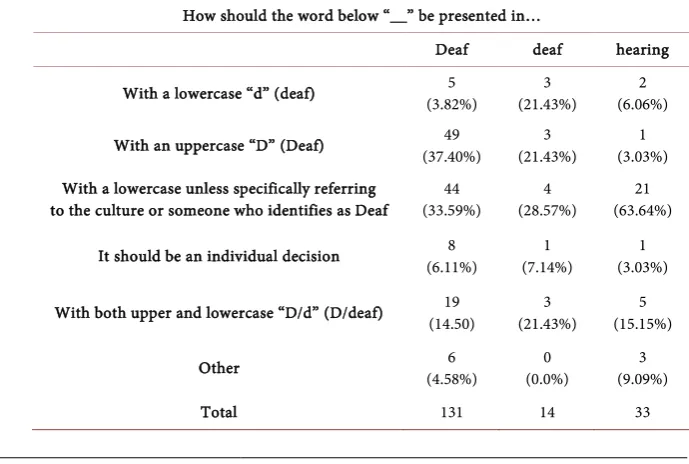
The fourth research question (Q17) asked participants their opinion about the terms, Deaf/deaf in a question that was worded as follows: “How should the word ‘______’ be presented in publications, papers, articles, research, presenta-tions?” Respondents were provided with six options (shown in Table 2) and asked to choose one response. More Deaf participants supported the use of an uppercase “D” followed closely by the Woodward convention of using the “D” for culturally Deaf individuals. In contrast, deaf participants were more varied with responses split almost evenly among the top three options. Hearing partic-ipants strongly supported the Woodward convention. See Table 2 for a sum-mary.
[image:12.595.193.538.509.741.2]The seventh research question (Q20) asked participants, “Should the acronym DHH (deaf and hard of hearing) be adopted as a standardized naming conven-tion and acronym?” Respondents chose from one of six opconven-tions: “yes,” “no,” “maybe,” “unsure,” “it should be an individual decision,” and “other.” As far as whether or not the DHH acronym should be adopted and applied, 37.88% Deaf participants replied “yes,” 24.24% replied “no,” with 24.24% being “maybe” and “unsure.” The deaf participants were more supportive of this acronym with 57.14% responding “yes.” Less than 10% of all of the participants in the two
Table 2. How participants use the term, Deaf, in writing.
How should the word below “__” be presented in…
Deaf deaf hearing
With a lowercase “d” (deaf) (3.82%) 5 (21.43%) 3 (6.06%) 2
With an uppercase “D” (Deaf) (37.40%) 49 (21.43%) 3 (3.03%) 1
With a lowercase unless specifically referring
to the culture or someone who identifies as Deaf (33.59%) 44 (28.57%) 4 (63.64%) 21
It should be an individual decision (6.11%) 8 (7.14%) 1 (3.03%) 1
With both upper and lowercase “D/d” (D/deaf) (14.50) 19 (21.43%) 3 (15.15%) 5
Other (4.58%) 6 (0.0%) 0 (9.09%) 3
DOI: 10.4236/psych.2019.1015135 2103 Psychology
groups felt “it should be an individual decision.” Hearing participants were sim-ilar to the Deaf participants, with 48.48% supporting the DHH abbreviation. Few participants rejected this acronym, with 7.14% of deaf and 12.12% of hearing participants choosing “no.”
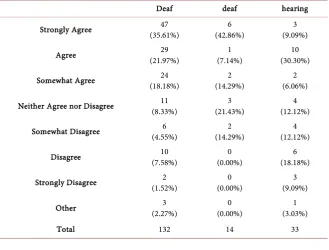
The tenth research question (Q23), “Should the term ‘deaf’ be exclusively used to define anyone with a hearing loss (no matter the degree or severity)?” Re-sponse choices included “strongly agree,” “agree,” “somewhat agree,” “neither agree nor disagree,” “somewhat disagree,” “disagree,” “strongly disagree,” or “other.” Deaf participants were largely in agreement, with deaf participants fol-lowing suit, while hearing participants were not as confident that there should be an umbrella term. Table 3 provides a summary of data.
[image:13.595.210.540.483.733.2]The eleventh research question (Q24), “If you agree to the term ‘deaf’ being exclusively used to define anyone with a hearing loss (no matter the degree or severity), how should the term be written?” There were five possible options to choose from: 1) “with an uppercase ‘D’ (Deaf)”; 2) “with a lowercase ‘d’ (deaf);” 3) “unsure;” 4) “it should be an individual decision;” and 4) “other.” The major-ity of participants had mixed responses, but the highest percentages were with writing the term “with a lowercase ‘d’” that included 32.26% of Deaf, 53.85% of deaf, and 50% of hearing participants. Writing “with the uppercase ‘D’” also had various responses in favor; 30.65% Deaf, 7.69% deaf and 19.23% hearing partic-ipants. While Deaf participants felt that “it should be an individual decision” (22.58%); deaf and hearing participants had lower response rates, 7.69% and 3.85% respectively. Few Deaf participants (8.87%) were “unsure” about how the term should be written. In contrast, a large number of deaf participants were “unsure” (30.77%). Hearing participants were between these two groups, with
Table 3. How participants responded if the term “deaf” should be used to define anyone with a hearing loss regardless of the degree or severity of hearing loss.
Deaf deaf hearing
Strongly Agree (35.61%) 47 (42.86%) 6 (9.09%) 3
Agree (21.97%) 29 (7.14%) 1 (30.30%) 10
Somewhat Agree (18.18%) 24 (14.29%) 2 (6.06%) 2
Neither Agree nor Disagree (8.33%) 11 (21.43%) 3 (12.12%) 4
Somewhat Disagree (4.55%) 6 (14.29%) 2 (12.12%) 4
Disagree (7.58%) 10 (0.00%) 0 (18.18%) 6
Strongly Disagree (1.52%) 2 (0.00%) 0 (9.09%) 3
Other (2.27%) 3 (0.00%) 0 (3.03%) 1
DOI: 10.4236/psych.2019.1015135 2104 Psychology
15.38% reporting that they were unsure what term should be exclusively used to define anyone with a hearing loss.
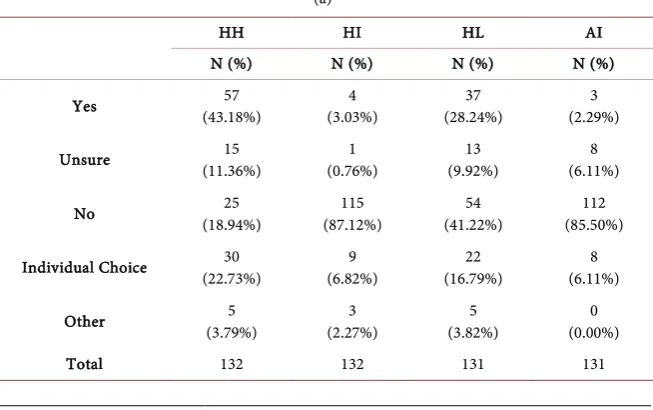
The next seven research questions (Q25 to Q31), asked participants their opi-nions regarding the terminology that should be used regarding different sub-groups within the population. Terminology including hard of hearing, hearing impaired, hearing loss, and auditory impaired were presented to participants. Questions were in the format of, “Should the term ‘_____________’ remain in our lexicon or be eradicated from our lexicon (collective vocabulary)?” Each question had five possible response choices as can be seen in Table 4 which has three sub Tables 4(a)-(c) reflecting the specific answers broken down indivi-dually among the groups of Deaf, deaf, and hearing. Complete foils were; “Yes, it should remain in our lexicon (keep the term)”; “unsure”; “no, it should be era-dicated from our lexicon (remove the term)”; “it should be an individual choice”; and “other.” Here the data is presented in these three sub-tables across the seven questions. A key is shown after the table identifying the seven abbrevi-ations used in the table. Raw scores and percentages are presented for each ques-tion and for each of the opques-tions within these seven quesques-tions.
For Deaf participants (see Table 4(a)), while the majority of these participants supported the terms, “hard of hearing,” they opposed “hearing loss.” With re-gards to the terms, “hearing impaired” or “auditory impaired,” there was strong opposition.
Participants who are deaf (see Table 4(b)) endorsed using the terms, “hard of hearing” and “hearing loss” but over half did not support other terms such as “hearing impaired,” or “auditory impaired.”
[image:14.595.211.538.535.740.2]With hearing participants (see Table 4(c)), the majority supported the terms, “hard of hearing,” or “hearing loss.” In contrast, the terms, “hearing impaired,” and “auditory impaired,” were emphatically not supported by this group. See
Table 4 for a summary of data with these three subgroups.
Table 4. Three sub-tables show Deaf, deaf, and hearing participants’ responses regarding four terminologies. (a) Deaf; (b) deaf; (c) Hearing.
(a)
HH HI HL AI
N (%) N (%) N (%) N (%)
Yes (43.18%) 57 (3.03%) 4 (28.24%) 37 (2.29%) 3
Unsure (11.36%) 15 (0.76%) 1 (9.92%) 13 (6.11%) 8
No (18.94%) 25 (87.12%) 115 (41.22%) 54 (85.50%) 112
Individual Choice (22.73%) 30 (6.82%) 9 (16.79%) 22 (6.11%) 8
Other (3.79%) 5 (2.27%) 3 (3.82%) 5 (0.00%) 0
DOI: 10.4236/psych.2019.1015135 2105 Psychology (b)
HH HI HL AI
N (%) N (%) N (%) N (%)
Yes (50.0%) 7 (28.57%) 4 (42.86%) 6 (14.29%) 2
Unsure (21.43%) 3 (14.29%) 2 (21.43%) 3 (21.43%) 3
No (0.00%) 0 (50.00%) 7 (7.14%) 1 (57.14%) 8
Individual Choice (28.57%) 4 (7.14%) 1 (28.57%) 4 (7.14%) 1
Other (0.00%) 0 (0.00%) 0 (0.00%) 0 (0.00%) 0
Total 14 14 14 14
(c)
HH HI HL AI
N (%) N (%) N (%) N (%)
Yes (54.55%) 18 (6.06%) 2 (51.52%) 17 (6.25%) 2
Unsure (21.21%) 7 (3.03%) 1 (0.00%) 0 (9.38%) 3
No (12.12%) 4 (81.82%) 27 (15.15%) 5 (78.13%) 25
Individual Choice (12.12%) 4 (9.09%) 3 (18.18%) 6 (3.13%) 1
Other (0.00%) 0 (0.00%) 0 (15.15%) 5 (3.13%) 1
Total 33 33 33 32
Key
HH Hard of hearing HL Hearing Loss
HI Hearing Impaired AI Auditory Impaired
In summary, Deaf, deaf, and hearing participants provided a variety of differ-ent responses and opinions to individual statemdiffer-ents and questions regarding the different terminologies. Some survey questions were eliminated from analysis, as there was not enough representation from hard of hearing, DeafBlind or Deaf-Disabled individuals. Next, we move into a discussion related to these results, consider how it relates to past research, suggest future research, and highlight the study’s limitations.
5. Discussion
DOI: 10.4236/psych.2019.1015135 2106 Psychology
people would be beneficial. However, there is not yet agreement regarding what that usage should be among the three groups of Deaf, deaf, and hearing partici-pants. More deaf and a majority of hearing participants supported the traditional
Woodward (1975) usage of deaf for all members except for those participants who identify as a member of the Deaf culture. In contrast, Deaf participants were split between this traditional usage and always using an uppercase “D.” When this Woodward (1975) option was not part of another question, phrased as “if you agree to the term ‘deaf’ being exclusively used to define anyone with a hear-ing loss (no matter the degree or severity), how should the term be written, the highest levels of support were given to the use of a lowercase ‘d’.” These res-ponses show that the community is focused on this idea but has not yet come to a consensus.
Interestingly, this study included both an emic perspective from Deaf and deaf participants, as well as an etic perspective from hearing individuals. Although this paper focuses on an emic perspective, the research team felt it was impor-tant to include the hearing or etic perspective due to the often “dual” roles they occupy as both outsiders and “insiders” when it comes to navigating the Deaf world. Therefore, hearing participants were also highly involved with the ongo-ing discussions regardongo-ing how to characterize members of the community. It is important to note that almost half of the participants were academicians; both deaf and hearing. In many cases, Deaf and hearing participants selected similar options for naming.
DOI: 10.4236/psych.2019.1015135 2107 Psychology
In between lies the question of, “To capitalize Deaf or not?” Research results showed variability among the responses from the two groups of participants used in the data analysis, which included both an emic perspective from Deaf and deaf participants, as well as an etic perspective from hearing participants. Further complicating matters is the issue of colonization as raised by Ladd’s (2003) Deafhood research. The Deaf community has developed within and in spite of the oppressions faced from the hearing world. Even after an infamous Deaf education convention in Milan in 1880 that recommended the banning of sign language and encouraging the proliferation of oralism, an event that should have sounded a death knell for a community identifying strongly with ASL; the Deaf community persisted (Ladd, 2003). At the same time, the Deaf community developed its own identity in refusing to identify with the disability world and valuing their own cultural beliefs and language identity. The debates regarding nomenclature could be argued to be ultimately an etic one; it was a hearing man who suggested the bifurcation of the community. The word “deaf” itself is a dis-ability related label. In fact, Commerson (2019) has proposed rejecting the word
deaf altogether and replacing it with “Sumain,” which is certainly an emic pers-pective being that Commerson is deaf himself.
The different factions of the Deaf community have long discussed a host of opinions and insights regarding the different terminologies presented. The orig-inal terminology for the Deaf community may have been penned by Woodward (1975) and his observation of how deaf individuals identified themselves; yet, his seemingly innocuous observation has resulted in the creation of a terminology that has seen over four decades of use. The Woodward terminology persists de-spite its controversies. Even decades later, our participants still echo the differing opinions that have arisen in the debate about whether or not to continue to dis-tinguish among the D/deaf community based on their ability to hear and/or sign. However, a participant questioned if a “hearing loss” should be the deciding factor used to both create and define distinctive groups. This questioning of whether or not “hearing loss” or one’s hearing status is the best factor to use to label the community is consistent with the Holcomb (2012) discussion from above. Our participants largely agreed on the importance of recognizing “all kinds of deaf people;” as yet another participant wrote, “doesn’t matter—deaf is deaf.”
On the other hand, a hearing participant expressed their concern that using an uppercase D and lowercase d causes a division within a community; the partici-pant felt that this division should not happen. Rather, she expressed the idea that all individuals should fall under one broad category. Meanwhile, the same par-ticipant felt the separate labels caused discrimination within their own [Deaf] community, which is consistent with the philosophy of both the Deafhood Foundation (2017) and the National Deaf Center (2018). The majority of the participants in this survey also agreed that the community should not be di-vided.
DOI: 10.4236/psych.2019.1015135 2108 Psychology
that the term Deaf is unilateral in application and substance. Wright (2017) went on to explain that even though he learned English as his native language, has the ability to speak English, and is fluent in ASL, he considers himself a capital “D”eaf individual (p. 233). In other words, he made a decision, as an individual, to identify with the Deaf community and utilize a capital D, as is his right. The community has not yet resolved many of these issues but seems willing to pond-er them, as was found in this study. The research team grappled with which tpond-erm to choose, as initially, we assumed that the capitalization of Deaf would be con-sistently endorsed; however, the survey results did not support this usage. Even those respondents who identified as Deaf in the surveys were mixed about the usage of the term D/deaf.
As Cue et al. (2019) showed, there is a journey and a sense of belonging inhe-rent in membership within the Deaf culture and Deaf community at large, and we do not have that information about our participants. Our survey only identi-fied participants’ current opinions. It did not show their past opinions, current status on their journey, and/or whether or not they feel they belong within Deaf culture. Several additional precautions should be included here. First, the major-ity of the participants within this study were white and tended to be highly edu-cated; a position not highly representative of the complete Deaf community. Second, the number of participants identifying as deaf was relatively low com-pared to other participants who identified as “Deaf.”
Given the limitations noted above, we do not feel comfortable at this time in proposing recommendations for academicians. However, we caution that indi-vidual decisions and preferences should always be followed, community deci-sions should always be honored, and that using any given set of naming conven-tions is entirely voluntary. Given the static nature of manuscripts and publica-tions, there may come a point when the current nomenclature becomes out-dated. However, the fluid nature of a community’s evolution is such that this manuscript merely marks a point in time within the evolution of this specific nomenclature. The Woodward Naming Conventions was published in 1975 and it is still cited today for convenience’s sake and a lack of another reference. The
Woodward (1975) article did not set out to determine naming conventions; it was just a blurb in an otherwise unrelated topic. Regardless, it has stood for over 44 years, since 1975.
DOI: 10.4236/psych.2019.1015135 2109 Psychology
Deaf-centric organizations use the terms of “hearing/auditory impaired.” The only appearance of the terms today is in school systems or organizations that have been slow to evolve and/or in archaic publications. Furthermore, the states of New Hampshire, New York, and Utah have passed laws to remove the “hear-ing impaired” term from all legislation (Arnold, 2018). On May 25, 2019, Texas passed Senate bill 281 to do the same by replacing the terms, “hearing impaired,” hearing loss,” and “auditory/speech impaired” with “deaf” or “hard of hearing”
(LegiScan, 2019). Given the changes in legalese, as well as the near unanimous rejection from our participants, we recommend avoiding these terms that in-clude the word “impaired.”
Originally, we planned to propose a set of Lamar University Naming Conven-tions only to provide an inclusive set of convenConven-tions for a multi-fractioned community as a whole, for the sake of clarity and brevity in academic writing. We envisioned the use of these suggested terms to be entirely voluntary, with in-dividual preferences being adhered to when referring to a specific member within this group. Although the proposed Lamar University Naming Conven-tions did not come to fruition, we are pleased to present the data and discussion above for consideration and use in future research. Also, we encourage future research to adopt a similar approach in the use of emic input(s).
6. Limitations
Like any other study, there are limitations to this study. One is that the sample, even though relatively large for a research project, is not representative of the population which includes Deaf, deaf, hard of hearing, DeafBlind, DeafDisabled, as well as others. Therefore, findings cannot be generalized to the larger popula-tion. The research team used social media to attempt to recruit as large a sample as possible and even though there were 6657 views on our Facebook Page, only 239 individuals accessed the survey. Thus, the results did not include all possible groupings of deaf individuals and/or all possible members of the Deaf community. For instance, there were known swaths of the deaf populations that did not con-tribute to the study such as deaf individuals of color, including (but not limited to) Asians, Black/African Americans, Mexican/Mexican-American/Chicano/Puerto- Rican/Cuban/Cuban-American/Hispanic/Hispanic-American, or American In-dian/Alaskan Native. In addition, an extremely low number of DeafBlind, Deaf-Disabled, and hard of hearing participants completed the survey. Although, it is possible we did have a higher number of hard of hearing, DeafBlind, or DeafDi-sabled responses, but they self-reported as “Deaf/deaf” and thereby were not counted under the less-reported categories. Nonetheless, more effort is needed to reach out to these groups to obtain their valuable input. It must also be ac-knowledged that the study results largely arise from a hegemonic input of pre-dominantly white, academic, and privileged populations.
DOI: 10.4236/psych.2019.1015135 2110 Psychology
comment was provided on the survey asking for an ASL version to ensure that participants received an accurate interpretation of each question via their com-munication modality. One participant made the comment that, “many members of [the] deaf community who are not in the field of deaf studies would not know many of these modes [of communication]. [I] Had to look up SimCom on the internet for definition. But the terminology can be interpreted in different ways.” Not only did the survey need to be made accessible in multiple ways, some of the survey questions and options were not as clear as they could have been. With all of the above being said and knowing that the study’s purpose was to develop a set of naming conventions for academic writing, the results cannot be genera-lized to the larger deaf population in the United States.
7. Future Research
Even though the research team had a large number of individuals viewing the ASL and English announcement on social media, more effort is needed to recruit more DeafBlind, hard of hearing, and DeafDisabled participants, as well as reaching out to different ethnic groups. While the research team assumed that clear cut answers would be provided to the preferred terminologies especially from deaf participants, the findings quickly morphed into a deeper discussion to find reasons for the surprising results. Through this discussion, the team pon-dered if the terminologies reflected participants’ colonization and a reflection of where they are in their current journey rather than an eventual identity end-point. This finding is consistent with Cue et al. (2019) who investigated Deaf epistemology and how deaf people may be colonized by the system that deter-mines labels.
In addition, doing a follow-up mixed method study that includes interviewing participants along with administering the survey would provide a richer tapestry from which to further explore and expand upon these issues that confounded researchers in the current study. The research team understands that deaf people reject any derogatory terminologies or any terminology that were assigned to us by the system; yet, the community is not sure how to create a consensus at this moment.
8. Conclusion
DOI: 10.4236/psych.2019.1015135 2111 Psychology
Acknowledgements
During the 2018 spring semester, members of the Lamar University Cognition in Context (C’nC) Research Team and Professor/Chair, Dr. M. Diane Clark, de-cided to further explore and discuss how to use, define, and write the terms D/deaf in various manuscripts. It was decided that we needed to investigate and come up with standard naming conventions from an emic perspective regarding the Deaf community’s views of how to define ourselves in academic writing. The two primary authors, Kimberly K. Pudans-Smith and Katrina R. Cue led the project and data collection. The authors wish to thank the C’nC Team of doctor-al students for their contribution to the project, especidoctor-ally, Ashley N. Greene-Woods, Oscar L. Ocuto, and Sarah J. Morrison. Additionally, gratitude is extended to the participants for contributing their time and data for analysis.
This manuscript would not have been possible if it were not for the myriad of members within the Deaf community at large who have examined these issues for many years. Philosophical discussions such as these often begin with its foundations in the community. It is often the collective work of the community that informs and shapes academic discussions and research. The work can often be unrecognized and thankless. Therefore, we wish to recognize and thank those individuals in the community who helped us to escape the “Ivory Tower” for a bit to better understand the diverse opinions and issues within the community.
Declaration of Interest Statement
The authors certify that they have no affiliations with or involvement in any or-ganization or entity with any financial or non-financial interests regarding the subject matter or materials discussed in this manuscript.
Conflicts of Interest
The authors declare no conflicts of interest regarding the publication of this pa-per.
References
American Association of the DeafBlind (2009). How Do Deaf-Blind People Communi-cate? http://www.aadb.org/factsheets/db_communications.html
Arnold, C. (2018). New Law Ensures “Hearing Impaired” Struck from New York’s books.
Democrat & Chronicle.
https://www.democratandchronicle.com/story/news/politics/albany/2018/08/31/hearin g-impaired-struck-new-yorks-books/1131655002/
Bennett, J. L. (1967). What’s in a Name? Negro vs. Afro-American vs. Black. Ebony Mag-azine, 23, 399-412. https://www.jstor.org/stable/42574587?seq=1
Breivik, J. K., Haualand, H., & Solvang, P. (2002). Rome—A Temporary Deaf City!: Deaf-lympics2001 (pp. 28-29). Working Paper No. 2-2003. Bergen, Norway: Stein Rokken Center for Deaf Studies, University of Bergen.
DOI: 10.4236/psych.2019.1015135 2112 Psychology
Charlton, J. I. (1998). Nothing about Us without Us: Disability Oppression and Empo-werment. Oakland, CA: University of California Press.
Commerson, R. (2019). A Proposal: Replacing Deaf with Sumain. [Video File] https://www.youtube.com/watch?v=q4kxp7ZW84g
Cue, K. R., Pudans-Smith, K. K., Wolsey, J. A., Wright, S. J., & Clark, M. D. (2019). The Odyssey of Deaf Epistemology: A Search for Meaning-Making. American Annals of the Deaf, 164, 395-422. https://doi.org/10.1353/aad.2019.0017
De Clerck, G. A. (2010). Deaf Epistemologies as a Critique and Alternative to the Practice of Science: An Anthropological Perspective. American Annals of the Deaf, 154,
435-446. https://doi.org/10.1353/aad.0.0121
Deafhood Foundation (2017). To D or Not to D: Deafhood Foundation’s Position Paper on Naming Deaf People. http://deafhood.org/news/to-d-or-not-to-d/
Erting, C. J., Johnson, R. C., Smith, D. L., & Snider, B. D. (1994). The Deaf Way: Perspec-tives from the International Conference on Deaf Culture. Washington DC: Gallaudet University Press.
Facundo Element (n.d.). Purpose. http://www.facundoelement.com/purpose/
Fjord, L. L. (1996). Images of Difference: Deaf and Hearing in the United States. Anthro-pology and Humanism, 21, 55-69. https://doi.org/10.1525/ahu.1996.21.1.55
Gimenez, M. E. (1989). Latino/“Hispanic”—Who Needs a Name? The Case against a Standardized Terminology. The International Journal of Health Services, 1, 557-571. https://doi.org/10.2190/HN6N-P1TH-8CHL-KW5X
Glickman, N. S. (1993). Deaf Identity Development: Construction and Validation of Theoretical Model. Unpublished Doctoral Dissertation, Amherst, MA: University of Massachusetts.https://doi.org/10.1037/t15703-000
Harmon, K. (2013). Growing up to Become Hearing: Dreams of “Passing” in Oral Deaf Education. In J. Brune, & D. Wilson (Eds.), Disability and Passing: Blurring the Lines of Identity (pp. 167-198). Philadelphia, PA: Temple University Press.
Hauser, P. C., O’Hearn, A., McKee, M., Steider, A., & Thew, D. (2010). Deaf Epistemolo-gy: Deafhood and Deafness. American Annals of the Deaf, 154, 486-492.
https://doi.org/10.1353/aad.0.0120
Hawkins, L., & Brawner, J. (1997). Educating Children Who Are Deaf or Hard of Hear-ing: Total Communication. ERIC Digests, #559.
https://files.eric.ed.gov/fulltext/ED414677.pdf
Hildner, V. (2014). Decoding Ethnic Labels: Are You Chicano, Latino or Hispan-ic? Boulder, CO: University of Colorado.
https://connections.cu.edu/stories/decoding-ethnic-labels-are-you-chicano-latino-or-h ispanic
Hinchcliffe, K. (2008). Ask Anything: 10 Questions with NAACP President Rev. William Barber. Raleigh, NC: Capitol Broadcasting Company.
https://www.wral.com/ask-anything-10-questions-with-naacp-president-rev-william-b arber/4142989/
Holcomb, T. K. (2010). Deaf Epistemology: The Deaf Way of Knowing. American Annals of the Deaf, 154, 471-478. https://doi.org/10.1353/aad.0.0116
Holcomb, T. K. (2012). Introduction to American Deaf Culture. New York: Oxford Uni-versity Press.
DOI: 10.4236/psych.2019.1015135 2113 Psychology
Lane, H. (2005). Ethnicity, Ethics, and the Deaf-World. Journal of Deaf Studies and Deaf Education, 10, 291-310. https://doi.org/10.1093/deafed/eni030
LegiScan (2019). TX SB 281: An Act Relating to the Use of Certain Language Regarding a Person Who Is Deaf or Hard of Hearing in Statutes or Resolutions.
https://legiscan.com/TX/text/SB281/id/2017516
Marin, G., & Marin, B. V. (1991). Research with Hispanic Populations. Thousand Oaks, CA: Sage Publications, Inc.https://doi.org/10.4135/9781412985734
Markowicz, H., & Woodward, J. (1978). Language and the Maintenance of Ethnic Boun-daries in the Deaf Community. Communication and Cognition Ghent, 11, 29-37. http://www.cslds.org/v3/publications.php?author=Woodward-J&page=5
Marschark, M. (2017). Is SimCom Evil? Raising and Educating Deaf Children: Founda-tions for Policy, Practice and Outcomes.
http://www.raisingandeducatingdeafchildren.org/2017/01/05/is-simcom-evil/ Miller, M. (2018). Deafhood 101. Paper Presented at the Faculty Development Week,
Washington DC: Gallaudet University.
National Deaf Center on Postsecondary Outcomes (2018). Defining Deaf. https://www.nationaldeafcenter.org/defining-deaf
Nuccio, J., & granda, a. j. (2013). Pro-Tactile Vlog #1. Pro-Tactile: The DeafBlind Way.
[Video File] http://www.protactile.org/2016/03/pro-tactile-vlog-1.html
Padden, C. A., & Humphries, T. (1990). Deaf in America: Voices from a Culture. Cam-bridge, MA: Harvard University Press.
https://doi.org/10.1097/00003446-198904000-00022
Petronio, K., & Dively, V. (2006). Yes, #No, Visibility, and Variation in ASL and Tactile ASL. Sign Language Studies, 7, 57-98. https://doi.org/10.1353/sls.2006.0032
Saul, J. M. (2003). Feminism: Issues & Arguments. New York: Oxford University Press. Smith, K. L., & Bienvenu, M. J. (2007). “Deaf Theory”: What Can We Learn from
Femin-ist Theory? Multicultural Education, 20, 43-48.
https://www.thefreelibrary.com/%22Deaf+theory%22%3A+what+can+we+learn+from +feminist+theory%3F-a0411196908
Stapleton, L. (2015). When Being Deaf Is Centered: D/Deaf Women of Color’s Expe-riences with Racial/Ethnic and d/Deaf Identities in College. Journal of College Student Development, 56, 570-586. https://doi.org/10.1353/csd.2015.0061
Taylor, P., Lopez, M. H., Martínez, J. H., & Valasco, G. (2012). When Labels Don’t Fit: Hispanics and Their Views of Identity. Washington DC: Pew Research Center. https://www.pewresearch.org/hispanic/2012/04/04/when-labels-dont-fit-hispanics-and -their-views-of-identity/
Tevenal, S., & Villanueva, M. (2009). Are You Getting the Message? The Effects of Sim-Com on the Message Received by Deaf, Hard of Hearing, and Hearing Students. Sign Language Studies, 9, 266-286. https://doi.org/10.1353/sls.0.0015
Warner, M. (1991). Introduction: Fear of a Queer Planet. Social Text, 29, 3-17. https://www.jstor.org/stable/466295
Woodward, J. & Horejes, T. (2016). d/Deaf: Origins and Usage. In G. Gertz, & P. Bou-dreault (Eds.), The SAGE Deaf Studies Encyclopedia (Vol. 1, pp. 284-287). Thousand Oaks, CA: Sage Publications.
DOI: 10.4236/psych.2019.1015135 2114 Psychology